

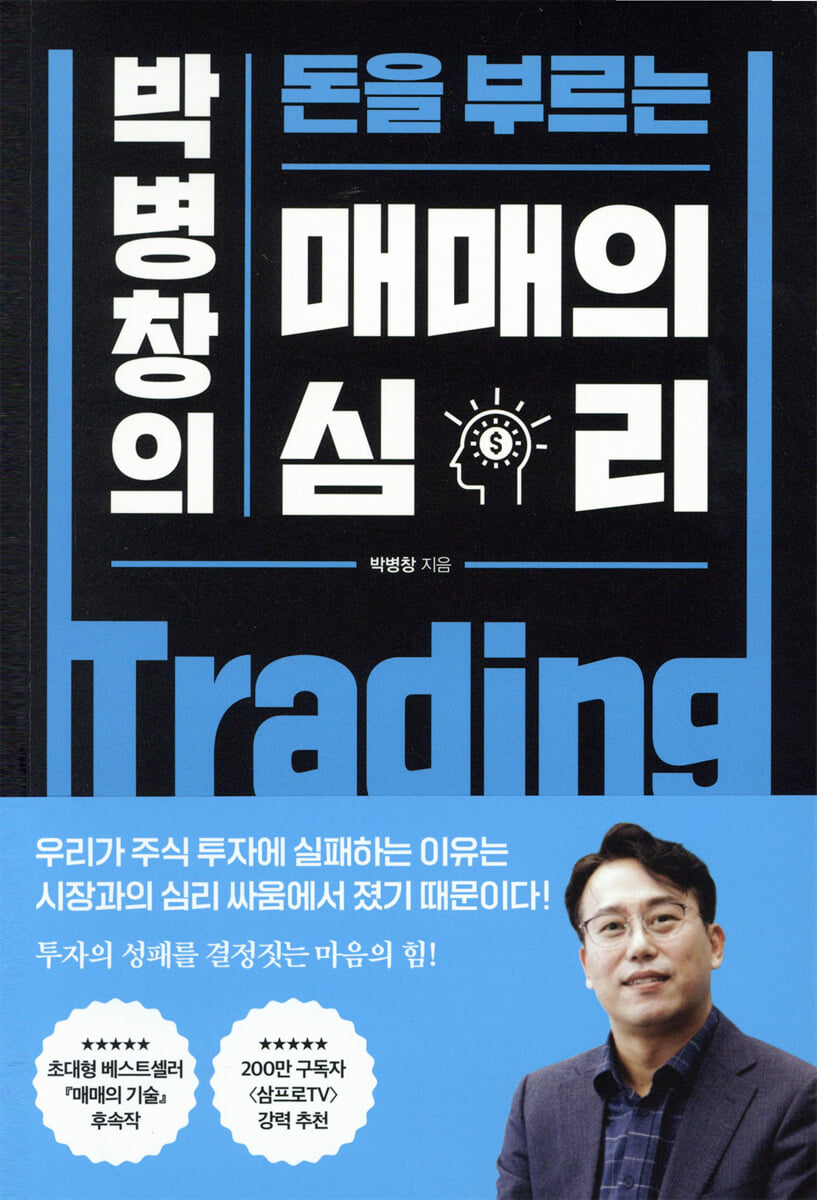
Psychology of trading
 |
Description
Book Introduction
- A word from MD
-
Determines the success or failure of a tradeThis is a new book by Park Byeong-chang, the best trader in Yeouido who shared his practical trading know-how with the bestseller, “The Art of Trading.”
This book covers the investment psychology that determines the success or failure of trading in the countless moments of choice encountered while investing, and discusses 62 investment psychology strategies that will help you perfect your trading skills.
September 13, 2022. Economics and Management PD Kim Sang-geun
“The reason we fail at stock investing is
“Because I lost the psychological battle with the market.”
Learn from the best traders in Yeouido
Practical investment psychology strategies that create a 99% win rate
*** The sequel to the mega-bestseller, The Art of Trading
*** 2 million subscribers [Sampro TV] Highly recommended
In the spring of 2021, the South Korean stock market, which had plummeted due to the COVID-19 pandemic, hit bottom and more than doubled in value, thrilling investors.
But that was short-lived. Within a few months, the market began to decline, and most investors were left holding onto their losing assets and watching the market with pity.
Despite repeated warnings about the irrational surge in stock prices, why haven't investors made rational choices? It's not because they lack understanding of stock investment theory or because their investment strategies are flawed.
The problem was the 'mind' with which one approached the stock market.
When the crowd is moving in one direction as a group, the conservative mentality of not being able to break away from the group, greed and fear when buying, and loss aversion and denial of reality when selling make investing difficult.
Park Byeong-chang, a manager at Kyobo Securities who has been praised by investors as "God Byeong-chang" for his accurate market analysis and sharp insights on [Sampyo TV] and [Korea Economic TV], has realized one thing more important than any technical strategy while working as a trader in Yeouido for over 20 years.
In actual investment, contrary to theory, investors' psychology plays a decisive role in profitability.
Stock investment is an act in which people gather together and buy or sell stocks according to their own judgment.
Therefore, investor sentiment will create the flow of money and move prices.
Even if you look at market conditions, analyze financial statements, and study supply and demand and charts, in real-world investing, it is ultimately the investor's psychology that determines the success or failure of a trade.
This book is the sequel to the mega-bestseller "The Art of Trading," which thrilled investors by reaching number one on the overall rankings in 2021. It discusses 62 investment psychology strategies for perfecting the art of trading.
Each strategy is imbued with the experience, insight, and wisdom gleaned from over 20 years of experience as one of South Korea's top traders.
If you're an investor who's ever wondered why your stocks are falling, when exactly should you buy and sell, or whether you're truly suited to investing in stocks, this book will be a great guide not only for stock investing but also for achieving financial freedom in life.
“Because I lost the psychological battle with the market.”
Learn from the best traders in Yeouido
Practical investment psychology strategies that create a 99% win rate
*** The sequel to the mega-bestseller, The Art of Trading
*** 2 million subscribers [Sampro TV] Highly recommended
In the spring of 2021, the South Korean stock market, which had plummeted due to the COVID-19 pandemic, hit bottom and more than doubled in value, thrilling investors.
But that was short-lived. Within a few months, the market began to decline, and most investors were left holding onto their losing assets and watching the market with pity.
Despite repeated warnings about the irrational surge in stock prices, why haven't investors made rational choices? It's not because they lack understanding of stock investment theory or because their investment strategies are flawed.
The problem was the 'mind' with which one approached the stock market.
When the crowd is moving in one direction as a group, the conservative mentality of not being able to break away from the group, greed and fear when buying, and loss aversion and denial of reality when selling make investing difficult.
Park Byeong-chang, a manager at Kyobo Securities who has been praised by investors as "God Byeong-chang" for his accurate market analysis and sharp insights on [Sampyo TV] and [Korea Economic TV], has realized one thing more important than any technical strategy while working as a trader in Yeouido for over 20 years.
In actual investment, contrary to theory, investors' psychology plays a decisive role in profitability.
Stock investment is an act in which people gather together and buy or sell stocks according to their own judgment.
Therefore, investor sentiment will create the flow of money and move prices.
Even if you look at market conditions, analyze financial statements, and study supply and demand and charts, in real-world investing, it is ultimately the investor's psychology that determines the success or failure of a trade.
This book is the sequel to the mega-bestseller "The Art of Trading," which thrilled investors by reaching number one on the overall rankings in 2021. It discusses 62 investment psychology strategies for perfecting the art of trading.
Each strategy is imbued with the experience, insight, and wisdom gleaned from over 20 years of experience as one of South Korea's top traders.
If you're an investor who's ever wondered why your stocks are falling, when exactly should you buy and sell, or whether you're truly suited to investing in stocks, this book will be a great guide not only for stock investing but also for achieving financial freedom in life.
- You can preview some of the book's contents.
Preview
index
Prologue: Change Your Mind to See Money
Chapter 1: The Mindset of Starting an Investment
A society that encourages investment
The inevitable FOMO syndrome
Things in the world must be urgent to succeed, stocks must be leisurely to succeed.
The Life Changes of Stock Investment
Tendency and investment style
Aversion to change
Stock investing is a fair game that requires no qualifications.
Self-avoidance using famous experts
Finding the Right Investment Method for You Based on MBTI
Chapter 2: The Mind of Money Management
Difficult and demanding full-time investment
Accounting ledger of the mind
Will diversification protect my assets?
Principal guarantee psychology
The Red Dress Story
Turkey Story
The difference between cutting losses and taking profits
The ultimate winner is the one who successfully manages his money.
Chapter 3: The Mind of Judging the Market
Predicting the future is a scenario
Simplicity is key
Thinking cannot be outsourced
Keep common sense
Why Stock Markets Rise During Recessions
Empathetic investment and reverse thinking
The top is made by greed, the bottom by fear.
Investors who want to become experts
The emptiness that comes from thinking, "This time will be different."
A Conversation with Mr. Market
Escape from the familiar
Things you only look back on after a crash
Chapter 4: The Mind of Value Analysis
The judgment that 'the stock price is cheap or expensive' is the result of crowd psychology.
Luxury bags, luxury shoes, and luxury stocks
The psychology of corporate analysts
Reports that come out on time
The Inconvenient Truth About Value Analysis Metrics
Investors who do not believe the research center's report
Earnings surprise, earnings shock
Fall after earnings surprise, rise after earnings shock
Why stock prices rise and fall
Changes in the world and stock prices
Chapter 5: The Heart of Chart Analysis
Let's look at the chart intuitively
Past charts are almost perfect
The best time to buy is when the psychology reverses.
The heart that catches a falling blade
Not all children are the same.
Running horse, resting horse, old horse
blazing flames
Suitability Terrain Theory
Trading timing is about reading investors' psychology.
The psychology of aiming for a jackpot
Zebras that don't get stomach ulcers
Intuition and rational thinking
The surge in trading volume driven by greed and fear
Chapter 6: The Mind of the Market
Is stock investing a gamble, a stroke of luck, or a bust?
Should I invest or speculate?
Why Women Have Better Returns
Choosing an Investment Strategy
The Tale of the Four Animals of the Stock Market
Information is more important than truth
Polarization of investment sentiment
Are experts good at investing in stocks?
Cherry-picking investments
Saving with growth stocks
Chapter 1: The Mindset of Starting an Investment
A society that encourages investment
The inevitable FOMO syndrome
Things in the world must be urgent to succeed, stocks must be leisurely to succeed.
The Life Changes of Stock Investment
Tendency and investment style
Aversion to change
Stock investing is a fair game that requires no qualifications.
Self-avoidance using famous experts
Finding the Right Investment Method for You Based on MBTI
Chapter 2: The Mind of Money Management
Difficult and demanding full-time investment
Accounting ledger of the mind
Will diversification protect my assets?
Principal guarantee psychology
The Red Dress Story
Turkey Story
The difference between cutting losses and taking profits
The ultimate winner is the one who successfully manages his money.
Chapter 3: The Mind of Judging the Market
Predicting the future is a scenario
Simplicity is key
Thinking cannot be outsourced
Keep common sense
Why Stock Markets Rise During Recessions
Empathetic investment and reverse thinking
The top is made by greed, the bottom by fear.
Investors who want to become experts
The emptiness that comes from thinking, "This time will be different."
A Conversation with Mr. Market
Escape from the familiar
Things you only look back on after a crash
Chapter 4: The Mind of Value Analysis
The judgment that 'the stock price is cheap or expensive' is the result of crowd psychology.
Luxury bags, luxury shoes, and luxury stocks
The psychology of corporate analysts
Reports that come out on time
The Inconvenient Truth About Value Analysis Metrics
Investors who do not believe the research center's report
Earnings surprise, earnings shock
Fall after earnings surprise, rise after earnings shock
Why stock prices rise and fall
Changes in the world and stock prices
Chapter 5: The Heart of Chart Analysis
Let's look at the chart intuitively
Past charts are almost perfect
The best time to buy is when the psychology reverses.
The heart that catches a falling blade
Not all children are the same.
Running horse, resting horse, old horse
blazing flames
Suitability Terrain Theory
Trading timing is about reading investors' psychology.
The psychology of aiming for a jackpot
Zebras that don't get stomach ulcers
Intuition and rational thinking
The surge in trading volume driven by greed and fear
Chapter 6: The Mind of the Market
Is stock investing a gamble, a stroke of luck, or a bust?
Should I invest or speculate?
Why Women Have Better Returns
Choosing an Investment Strategy
The Tale of the Four Animals of the Stock Market
Information is more important than truth
Polarization of investment sentiment
Are experts good at investing in stocks?
Cherry-picking investments
Saving with growth stocks
Detailed image

Into the book
"Why did we act in a way that defies common sense?", "Why doesn't stock investing always work out the way I want?" In fact, it's not because we "don't know the theory of stock investing."
It's not because you can't analyze companies, can't analyze charts, or have a wrong investment strategy.
It's a matter of the 'heart'.
When the crowd is moving in one direction as a group, the conservative mentality of not being able to break away from the group, greed and fear when buying, and loss aversion and denial of reality when selling lead to poor investments.
--- p.5
I've seen a lot of professional investors.
I've seen many people who have thrown themselves into the world of investing with dreams of hitting the jackpot.
As a result, investors desperate for short-term profits were more likely to fail.
Rather, those who observed the market leisurely were successful.
Desperate people look to soaring stocks.
Relaxed people watch for stocks that will soar.
Desperate investors need the stock price to go up today, but relaxed investors can expect it to go up tomorrow or the day after.
These little things make a huge difference.
--- p.31
In real investment, it is better to sell stocks that are falling rather than stocks that are rising.
Because rising stocks tend to rise further and falling stocks tend to fall further.
When a rising stock falls, it is thought to be a correction and buying begins, but when a falling stock falls further, the psychology of 'I can't stand it anymore' and 'This stock is not good after all' leads to selling.
Almost all investors say that selling is difficult.
They say that if you sell, it goes up, and if you buy, it goes down.
It sounds like a complaint, but if you repeat it, you will make mistakes due to psychological errors.
Not everyone can succeed all the time.
We are just trying to increase our chances of success.
Babe Ruth is the all-time home run king, but he also has the most strikeouts.
In stock investing, what matters is not the 'frequency' of success in all investments, but the 'size' of the return when success occurs.
--- p.88
Your own thoughts on predicting future stock prices by observing stock price trends, your own thoughts on reading the flow of change by observing indicators—those kinds of insights are not taught by experts.
Tools can be shared, but ideas cannot.
In the end, you have to make your own judgment, and the outcome is also determined by your own judgment.
When it comes to investing, the final decision on investment decisions cannot be outsourced.
It is entirely up to us, and we go through trial and error to make that judgment, but we constantly study investment to reduce that error.
--- p.115
Investing in stocks is about predicting a company's future performance and investing in its growth potential.
Because it is difficult to accurately predict a company's future growth (performance), stock prices fluctuate in a trend of rising and falling.
No matter how well you analyze a company, there are many cases where you can be in trouble if you misjudge macro variables such as the global economy.
Trying to understand stock prices solely by relying on current corporate performance is no different from judging them by looking at the rain falling down from a well.
When stock prices don't track earnings, you should question why.
When a stock price moves in a way that is inexplicable based on current performance, the answer must be sought in the 'price movement' itself.
If the stock price does not rise after good news, there is a selling pressure.
If you are holding on to a stock while waiting for good news and the stock price does not respond to the good news, it means that the stock price has either fully reflected the good news or there is bad news that I am not aware of.
If the stock price does not fall after bad news, it is because there is buying in the supply and demand.
Buying on bad news means that the bad news has been fully reflected or that there is new good news.
The answer lies in the stock price.
You shouldn't force yourself to hold a stock against its stock price movements.
The crowd is foolish and I am not wise.
--- p.214~215
Even flowers you don't like will start to like you if you keep looking at them.
This is the case in most cases where large losses are incurred while investing in stocks.
Even though it has already withered and become an ugly flower, if you hold on to it with the thought that it will become a pretty flower, you will suffer a great loss.
In the stock market, pretty flowers (stocks) are flowers (stocks) that give me profit.
In the stock market, the ugly flower (stock) is the flower (stock) that causes me loss.
That's it.
You should not create artificial meaning in the stocks you own.
There may be a particular style of flower (stock) that you like differently from others.
But usually, the flower that the crowd likes ends up blooming into a pretty flower.
--- p.233
A rise in stock prices reflects the sentiment of investors wanting to buy, while a fall reflects the sentiment of investors wanting to sell.
Psychology drives supply and demand, and supply and demand move stock prices.
In a market where investors have a strong desire to buy immediately, buying should be done quickly and selling should be done slowly. However, in a situation where investor sentiment is not good, selling should be done quickly and buying should be done slowly.
It should be emphasized that if you miss the timing of buying, you miss the opportunity to make a profit, but if you miss the timing of selling, it leads to a decrease in your deposit assets.
--- p.280~281
Sheep have a habit of moving in flocks.
The sheep watch the fight between the bull and the bear, and if they think the bull will win, they flock to the bull, and if they think the bear will win, they flock to the bear.
The sheep watch the fight between the bull and the bear, not their own fight, to see who will win.
If you go to the bull because you think the bull will win, but the bear ends up winning, the sheep will be devastated.
When the judgment of who will win is in turmoil, countless sheep are badly hurt.
In a situation where the bull clearly wins, most of the sheep also make money.
If a small number of sheep go in the opposite direction, it can result in a big loss.
While most investors who followed the bulls in 2020 were able to easily make profits, some investors suffered huge losses by investing in inverse index funds.
It's not because you can't analyze companies, can't analyze charts, or have a wrong investment strategy.
It's a matter of the 'heart'.
When the crowd is moving in one direction as a group, the conservative mentality of not being able to break away from the group, greed and fear when buying, and loss aversion and denial of reality when selling lead to poor investments.
--- p.5
I've seen a lot of professional investors.
I've seen many people who have thrown themselves into the world of investing with dreams of hitting the jackpot.
As a result, investors desperate for short-term profits were more likely to fail.
Rather, those who observed the market leisurely were successful.
Desperate people look to soaring stocks.
Relaxed people watch for stocks that will soar.
Desperate investors need the stock price to go up today, but relaxed investors can expect it to go up tomorrow or the day after.
These little things make a huge difference.
--- p.31
In real investment, it is better to sell stocks that are falling rather than stocks that are rising.
Because rising stocks tend to rise further and falling stocks tend to fall further.
When a rising stock falls, it is thought to be a correction and buying begins, but when a falling stock falls further, the psychology of 'I can't stand it anymore' and 'This stock is not good after all' leads to selling.
Almost all investors say that selling is difficult.
They say that if you sell, it goes up, and if you buy, it goes down.
It sounds like a complaint, but if you repeat it, you will make mistakes due to psychological errors.
Not everyone can succeed all the time.
We are just trying to increase our chances of success.
Babe Ruth is the all-time home run king, but he also has the most strikeouts.
In stock investing, what matters is not the 'frequency' of success in all investments, but the 'size' of the return when success occurs.
--- p.88
Your own thoughts on predicting future stock prices by observing stock price trends, your own thoughts on reading the flow of change by observing indicators—those kinds of insights are not taught by experts.
Tools can be shared, but ideas cannot.
In the end, you have to make your own judgment, and the outcome is also determined by your own judgment.
When it comes to investing, the final decision on investment decisions cannot be outsourced.
It is entirely up to us, and we go through trial and error to make that judgment, but we constantly study investment to reduce that error.
--- p.115
Investing in stocks is about predicting a company's future performance and investing in its growth potential.
Because it is difficult to accurately predict a company's future growth (performance), stock prices fluctuate in a trend of rising and falling.
No matter how well you analyze a company, there are many cases where you can be in trouble if you misjudge macro variables such as the global economy.
Trying to understand stock prices solely by relying on current corporate performance is no different from judging them by looking at the rain falling down from a well.
When stock prices don't track earnings, you should question why.
When a stock price moves in a way that is inexplicable based on current performance, the answer must be sought in the 'price movement' itself.
If the stock price does not rise after good news, there is a selling pressure.
If you are holding on to a stock while waiting for good news and the stock price does not respond to the good news, it means that the stock price has either fully reflected the good news or there is bad news that I am not aware of.
If the stock price does not fall after bad news, it is because there is buying in the supply and demand.
Buying on bad news means that the bad news has been fully reflected or that there is new good news.
The answer lies in the stock price.
You shouldn't force yourself to hold a stock against its stock price movements.
The crowd is foolish and I am not wise.
--- p.214~215
Even flowers you don't like will start to like you if you keep looking at them.
This is the case in most cases where large losses are incurred while investing in stocks.
Even though it has already withered and become an ugly flower, if you hold on to it with the thought that it will become a pretty flower, you will suffer a great loss.
In the stock market, pretty flowers (stocks) are flowers (stocks) that give me profit.
In the stock market, the ugly flower (stock) is the flower (stock) that causes me loss.
That's it.
You should not create artificial meaning in the stocks you own.
There may be a particular style of flower (stock) that you like differently from others.
But usually, the flower that the crowd likes ends up blooming into a pretty flower.
--- p.233
A rise in stock prices reflects the sentiment of investors wanting to buy, while a fall reflects the sentiment of investors wanting to sell.
Psychology drives supply and demand, and supply and demand move stock prices.
In a market where investors have a strong desire to buy immediately, buying should be done quickly and selling should be done slowly. However, in a situation where investor sentiment is not good, selling should be done quickly and buying should be done slowly.
It should be emphasized that if you miss the timing of buying, you miss the opportunity to make a profit, but if you miss the timing of selling, it leads to a decrease in your deposit assets.
--- p.280~281
Sheep have a habit of moving in flocks.
The sheep watch the fight between the bull and the bear, and if they think the bull will win, they flock to the bull, and if they think the bear will win, they flock to the bear.
The sheep watch the fight between the bull and the bear, not their own fight, to see who will win.
If you go to the bull because you think the bull will win, but the bear ends up winning, the sheep will be devastated.
When the judgment of who will win is in turmoil, countless sheep are badly hurt.
In a situation where the bull clearly wins, most of the sheep also make money.
If a small number of sheep go in the opposite direction, it can result in a big loss.
While most investors who followed the bulls in 2020 were able to easily make profits, some investors suffered huge losses by investing in inverse index funds.
--- p.332
Publisher's Review
Success in stock investment
It is determined by the 'size' of the return, not the 'frequency'.
Things You Must Give Up for Successful Stock Investing
Many people find selling more difficult than buying when investing in stocks.
Rising stocks are sold after making only a small profit, while falling stocks are held and remain at a large loss, or are bought to increase losses.
There is even a self-deprecating joke that says, “If I keep doing this, I’ll become a major shareholder,” as they keep buying stocks while the stock price falls.
The biggest reason investors fail to cut losses on declining stocks is the psychology of 'loss aversion.'
This is blocking accurate investment decisions that require you to confirm your losses after selling.
In fact, the criteria for deciding whether to sell are simple.
Assuming you have cash now and want to buy stocks, if you think you should buy the stocks you currently own, hold them; if you think you should not buy them, sell them.
It doesn't matter whether you're currently making a profit or a loss.
If the stock has gone up a lot but you still want to buy it, you should hold on to it. If the stock has gone down a lot but you still don't want to buy it, you should sell it.
In investing, it's not how many times you lose money that matters, but how much profit you make.
In other words, the success of an investment is determined by the ‘size’ of the return, not the ‘frequency’.
“People hesitate to come down from a tree once they have climbed it.
Because it's shameful to admit your mistakes, and it's a hassle to start over.
So, even though they know that continuing in this way is disadvantageous to them, they find it difficult to turn back.” This is a phrase often used in behavioral economics.
This statement also holds true in the stock market.
Remember that if you don't take action in everyday life, you're just lazy, but in stock investing, if you don't take action, you could end up broke.
“More important than any investment strategy is
“It’s about knowing exactly how you feel about the market!”
62 Investment Psychology Strategies to Complete "The Art of Trading"
The stock market is often referred to as a battleground between bulls and bears.
This means that you can make a profit by observing the market movements, figuring out who the bulls and bears are, and quickly jumping on the bandwagon to figure out which side is winning.
But there is one important thing here.
Because it is the human mind, or psychology, that creates bulls and bears in the stock market.
Stock investment is an act in which people gather together and buy or sell stocks according to their own judgment.
Naturally, investor sentiment will create the flow of money and move prices.
This is where the utility of this book lies.
The ability to identify who is a bull and who is a bear is directly related to understanding psychology, so psychology is an important factor that must be addressed in stock investment.
The author, who created a buzz by revealing 16 situational trading timings and practical know-how in his previous work, "Park Byeong-chang's Money-Current Trading Techniques," now delves into the 62 psychological factors that influence value investing and technical trading timing in this book, "The Psychology of Trading."
Beginning with the mindset for stock investment, this book delves into the psychology of investors, encompassing fund management, market judgment, value analysis, and chart analysis, as well as the impact of market characteristics on us. By doing so, it generously imparts wisdom that will serve as the foundation for ultimate investment success.
“What kind of investor are you?”
The power of the mind that determines the success or failure of investment
Let's say you own a small clothing store that sells yellow, green, and red dresses.
The red dresses sold out as soon as they were put on display, half of the green ones sold, and none of the yellow ones sold.
So what would you do if you said, "All the red dresses are sold out.
If you were to suggest to a customer, "This yellow dress is also a pretty good deal. Why don't you buy this?", you would never be in business.
A seasoned businessperson who has been in business for a long time would make this decision.
“We need to sell off the yellow dress quickly, even if it means giving it a discount, and buy more red dresses to sell.”
The same goes for stock investing.
People often think that they should sell stocks that are profitable and wait for stocks that are losing to rise again, but when your investment judgment is wrong, you should quickly cut your losses and focus on the stocks where your judgment was correct.
Human decisions cannot always be right.
But stock investing is all about making big profits from a few right decisions.
The desire to avoid losses and the attachment to the stocks we hold can actually lead to large losses that cost us money.
It is determined by the 'size' of the return, not the 'frequency'.
Things You Must Give Up for Successful Stock Investing
Many people find selling more difficult than buying when investing in stocks.
Rising stocks are sold after making only a small profit, while falling stocks are held and remain at a large loss, or are bought to increase losses.
There is even a self-deprecating joke that says, “If I keep doing this, I’ll become a major shareholder,” as they keep buying stocks while the stock price falls.
The biggest reason investors fail to cut losses on declining stocks is the psychology of 'loss aversion.'
This is blocking accurate investment decisions that require you to confirm your losses after selling.
In fact, the criteria for deciding whether to sell are simple.
Assuming you have cash now and want to buy stocks, if you think you should buy the stocks you currently own, hold them; if you think you should not buy them, sell them.
It doesn't matter whether you're currently making a profit or a loss.
If the stock has gone up a lot but you still want to buy it, you should hold on to it. If the stock has gone down a lot but you still don't want to buy it, you should sell it.
In investing, it's not how many times you lose money that matters, but how much profit you make.
In other words, the success of an investment is determined by the ‘size’ of the return, not the ‘frequency’.
“People hesitate to come down from a tree once they have climbed it.
Because it's shameful to admit your mistakes, and it's a hassle to start over.
So, even though they know that continuing in this way is disadvantageous to them, they find it difficult to turn back.” This is a phrase often used in behavioral economics.
This statement also holds true in the stock market.
Remember that if you don't take action in everyday life, you're just lazy, but in stock investing, if you don't take action, you could end up broke.
“More important than any investment strategy is
“It’s about knowing exactly how you feel about the market!”
62 Investment Psychology Strategies to Complete "The Art of Trading"
The stock market is often referred to as a battleground between bulls and bears.
This means that you can make a profit by observing the market movements, figuring out who the bulls and bears are, and quickly jumping on the bandwagon to figure out which side is winning.
But there is one important thing here.
Because it is the human mind, or psychology, that creates bulls and bears in the stock market.
Stock investment is an act in which people gather together and buy or sell stocks according to their own judgment.
Naturally, investor sentiment will create the flow of money and move prices.
This is where the utility of this book lies.
The ability to identify who is a bull and who is a bear is directly related to understanding psychology, so psychology is an important factor that must be addressed in stock investment.
The author, who created a buzz by revealing 16 situational trading timings and practical know-how in his previous work, "Park Byeong-chang's Money-Current Trading Techniques," now delves into the 62 psychological factors that influence value investing and technical trading timing in this book, "The Psychology of Trading."
Beginning with the mindset for stock investment, this book delves into the psychology of investors, encompassing fund management, market judgment, value analysis, and chart analysis, as well as the impact of market characteristics on us. By doing so, it generously imparts wisdom that will serve as the foundation for ultimate investment success.
“What kind of investor are you?”
The power of the mind that determines the success or failure of investment
Let's say you own a small clothing store that sells yellow, green, and red dresses.
The red dresses sold out as soon as they were put on display, half of the green ones sold, and none of the yellow ones sold.
So what would you do if you said, "All the red dresses are sold out.
If you were to suggest to a customer, "This yellow dress is also a pretty good deal. Why don't you buy this?", you would never be in business.
A seasoned businessperson who has been in business for a long time would make this decision.
“We need to sell off the yellow dress quickly, even if it means giving it a discount, and buy more red dresses to sell.”
The same goes for stock investing.
People often think that they should sell stocks that are profitable and wait for stocks that are losing to rise again, but when your investment judgment is wrong, you should quickly cut your losses and focus on the stocks where your judgment was correct.
Human decisions cannot always be right.
But stock investing is all about making big profits from a few right decisions.
The desire to avoid losses and the attachment to the stocks we hold can actually lead to large losses that cost us money.
GOODS SPECIFICS
- Date of issue: August 31, 2022
- Page count, weight, size: 364 pages | 652g | 152*225*24mm
- ISBN13: 9791192625010
- ISBN10: 1192625013
You may also like
카테고리
korean


korean

![GQ KOREA Mark (Monthly): December [2025]](http://librairie.coreenne.fr/cdn/shop/files/8ef265dbbfbf186523ed75ba7319009d.jpg?v=1765340328&width=3840)


