

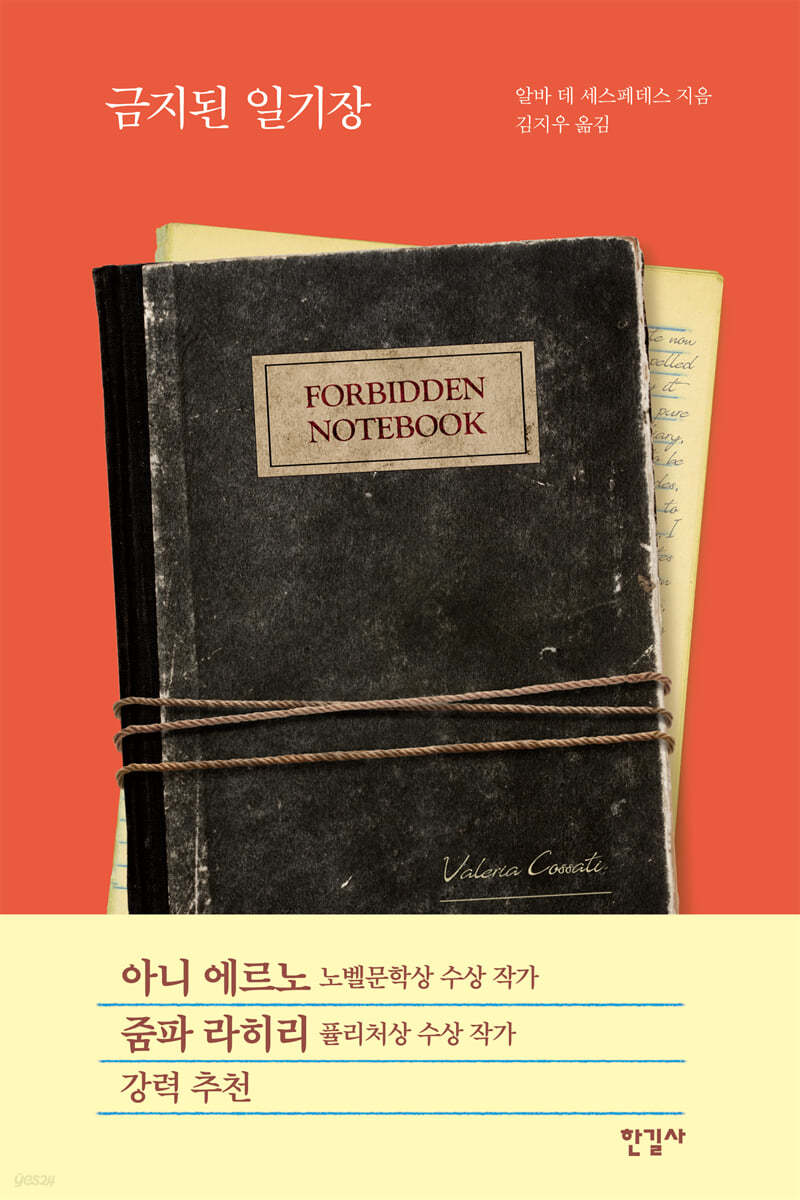
Forbidden Diary
 |
Description
Book Introduction
- A word from MD
-
The path to understanding the most secret meaning of lifeA masterpiece by Cespedes, a representative of 20th-century Italian literature.
A woman who has lived as a good wife and mother begins to keep a diary by chance.
Through his diary, he expressed his desire to regain his dreams and desires that had been crushed by his family and the times.
It is also the work that inspired Elena Ferrante's "My Brilliant Friend."
January 14, 2025. Novel/Poetry PD Kim Yu-ri
“I always thought my life was trivial.
I thought there was nothing special about it except marriage and having children.
But after I started writing a diary by chance,
The little things like tone of voice and choice of words are as important as the things we have considered until now.
No, I realized that sometimes it's even more important than that."
Alba de Céspedes, a representative female writer of 20th-century Italy, is introduced to Korean readers for the first time through ‘The Forbidden Diary.’
His novels are considered pioneering works that have inspired many feminist writers.
After Elena Ferrante described Céspedes's work as "a work that gives me courage," a craze for "rereading Céspedes" began to blow across Europe and the English-speaking world.
Pulitzer Prize-winning author Jhumpa Lahiri wrote the foreword to the English edition of The Forbidden Diary, and Nobel Prize-winning author Annie Ernaux praised Céspedes, saying, “Reading Céspedes is like entering an unknown world for me.”
The main setting of "The Forbidden Diary" is an ordinary family home in Rome, Italy, after the end of World War II, where the 43-year-old protagonist, Valeria, lives with her husband and two children.
Valeria, who has lived as a good daughter, a good wife, and a good mother, buys a black notebook by a very random impulse.
He decides to record his secret thoughts and feelings in this notebook.
Valeria struggles to keep her family from finding out that she keeps a diary in a social climate that does not allow women to think.
As Valeria writes her diary, she rediscovers herself as more than just a wife and mother, and is forced to confront long-held self-discontent and desires.
This leaves Valeria with great confusion and guilt between what society demands of her and what she wants to be.
Rather than choosing the traditional female role of a good wife and mother to support her family, Valeria chose to be a dual-income earner, a somewhat unusual choice for her generation.
But at the same time, she struggles to live as a 'good wife and a good mother'.
In his diary, he feels that the oppression placed on him is unfair, but he also refuses help from his family and criticizes his daughter for pioneering her own life.
As pity for her son, jealousy for her daughter, resentment toward her husband, and an affair with her boss Guido become intertwined, Valeria opens her eyes to his ego and desires.
"The Forbidden Diary" is a classic feminist work that most honestly reveals the complex inner life of a very ordinary woman.
I thought there was nothing special about it except marriage and having children.
But after I started writing a diary by chance,
The little things like tone of voice and choice of words are as important as the things we have considered until now.
No, I realized that sometimes it's even more important than that."
Alba de Céspedes, a representative female writer of 20th-century Italy, is introduced to Korean readers for the first time through ‘The Forbidden Diary.’
His novels are considered pioneering works that have inspired many feminist writers.
After Elena Ferrante described Céspedes's work as "a work that gives me courage," a craze for "rereading Céspedes" began to blow across Europe and the English-speaking world.
Pulitzer Prize-winning author Jhumpa Lahiri wrote the foreword to the English edition of The Forbidden Diary, and Nobel Prize-winning author Annie Ernaux praised Céspedes, saying, “Reading Céspedes is like entering an unknown world for me.”
The main setting of "The Forbidden Diary" is an ordinary family home in Rome, Italy, after the end of World War II, where the 43-year-old protagonist, Valeria, lives with her husband and two children.
Valeria, who has lived as a good daughter, a good wife, and a good mother, buys a black notebook by a very random impulse.
He decides to record his secret thoughts and feelings in this notebook.
Valeria struggles to keep her family from finding out that she keeps a diary in a social climate that does not allow women to think.
As Valeria writes her diary, she rediscovers herself as more than just a wife and mother, and is forced to confront long-held self-discontent and desires.
This leaves Valeria with great confusion and guilt between what society demands of her and what she wants to be.
Rather than choosing the traditional female role of a good wife and mother to support her family, Valeria chose to be a dual-income earner, a somewhat unusual choice for her generation.
But at the same time, she struggles to live as a 'good wife and a good mother'.
In his diary, he feels that the oppression placed on him is unfair, but he also refuses help from his family and criticizes his daughter for pioneering her own life.
As pity for her son, jealousy for her daughter, resentment toward her husband, and an affair with her boss Guido become intertwined, Valeria opens her eyes to his ego and desires.
"The Forbidden Diary" is a classic feminist work that most honestly reveals the complex inner life of a very ordinary woman.
- You can preview some of the book's contents.
Preview
index
November 26, 1950 · 9
May 27, 1951 · 422
Confessing Secret Desires in a Forbidden Diary (translated by Kim Ji-woo) · 431
May 27, 1951 · 422
Confessing Secret Desires in a Forbidden Diary (translated by Kim Ji-woo) · 431
Detailed image

Into the book
I always thought my life was trivial.
I thought there was nothing special about it except marriage and having children.
But since I started keeping a diary by chance, I've realized that small details like tone and word choice are just as important, if not more so, than the things I've always considered important.
---p.51
If we do not forget, it will be revealed that all humans are beings full of blemishes.
The gap between what you promised to do and what you actually did, between who you wanted to be and who you actually are in compromise with reality, will be revealed to be a huge mass of contradictions.
---p.71
The fact that I'm writing this late means that for the first time in 23 years of marriage, I'm starting to take time for myself.
---p.96
I know it won't be easy to save Mirella.
Maybe even he can't save himself.
With a bitter heart, I asked myself if I was truly trying to save him, or if I was punishing him by destroying his chances of a better life and forcing him to follow my example and go his own way.
---p.98
If you can't be honest with your loved ones, who can you be honest with?
How can we discover our true self?
The only time I can truly be myself is…
---p.130
Family is a group of people who love each other very much, but also defend themselves from each other as if they were enemies.
---p.183
“I think my mom thinks it’s a sin for a woman to feel any sense of accomplishment outside of housework or cooking.
They say that a woman's only duty is to take care of her family.
But I don't want to live like that.
“I don’t want to do that.”
---p.191
I wanted to destroy myself.
I felt like I was tired of wearing heavy disguises, and I wanted to shed my shell and feel relief mixed with anger.
---p.199
That was the first time I could understand what other mothers felt but I didn't.
It was a desire to project one's own life and hopes onto one's children.
Mothers wanted to project their lives and hopes onto lives different from their own.
---p.250
The thought that I had sacrificed my life for her began to eat away at my heart and turn into malice.
---p.276
The letters we exchanged early in our relationship seemed to have been written by someone different from the couple we are now, or when he was in Africa.
We don't write letters to each other anymore.
We've become so accustomed to feeling ashamed of our love for one another that it's almost like a sin, and before we know it, it's become real.
---p.282
“If it continues like that, there will never be any change.
Even if generations change, the past will be passed down without any development.
If that's the case, you'd still be selling slaves in the square. You're twenty, so you can rebel.
At the age of forty, you won't be able to make any changes.
“Because everyone wants to live a comfortable life.”
I thought there was nothing special about it except marriage and having children.
But since I started keeping a diary by chance, I've realized that small details like tone and word choice are just as important, if not more so, than the things I've always considered important.
---p.51
If we do not forget, it will be revealed that all humans are beings full of blemishes.
The gap between what you promised to do and what you actually did, between who you wanted to be and who you actually are in compromise with reality, will be revealed to be a huge mass of contradictions.
---p.71
The fact that I'm writing this late means that for the first time in 23 years of marriage, I'm starting to take time for myself.
---p.96
I know it won't be easy to save Mirella.
Maybe even he can't save himself.
With a bitter heart, I asked myself if I was truly trying to save him, or if I was punishing him by destroying his chances of a better life and forcing him to follow my example and go his own way.
---p.98
If you can't be honest with your loved ones, who can you be honest with?
How can we discover our true self?
The only time I can truly be myself is…
---p.130
Family is a group of people who love each other very much, but also defend themselves from each other as if they were enemies.
---p.183
“I think my mom thinks it’s a sin for a woman to feel any sense of accomplishment outside of housework or cooking.
They say that a woman's only duty is to take care of her family.
But I don't want to live like that.
“I don’t want to do that.”
---p.191
I wanted to destroy myself.
I felt like I was tired of wearing heavy disguises, and I wanted to shed my shell and feel relief mixed with anger.
---p.199
That was the first time I could understand what other mothers felt but I didn't.
It was a desire to project one's own life and hopes onto one's children.
Mothers wanted to project their lives and hopes onto lives different from their own.
---p.250
The thought that I had sacrificed my life for her began to eat away at my heart and turn into malice.
---p.276
The letters we exchanged early in our relationship seemed to have been written by someone different from the couple we are now, or when he was in Africa.
We don't write letters to each other anymore.
We've become so accustomed to feeling ashamed of our love for one another that it's almost like a sin, and before we know it, it's become real.
---p.282
“If it continues like that, there will never be any change.
Even if generations change, the past will be passed down without any development.
If that's the case, you'd still be selling slaves in the square. You're twenty, so you can rebel.
At the age of forty, you won't be able to make any changes.
“Because everyone wants to live a comfortable life.”
---p.297
Publisher's Review
The most intimate truths hidden behind the ordinary unfold.
A forbidden diary that honestly reveals a woman's innermost thoughts.
When you first read The Forbidden Diary, you'll be surprised to learn that it was first published in 1952.
This story, about a housewife oppressed under a patriarchal system who begins to record her daily life in a diary and discovers herself as a subject of desire, resonates deeply with readers living in 2025.
"The Forbidden Diary," which deals with universal themes, has the power to keep you reading even without dramatic events.
The protagonist, Valeria Cosati, is not a perfect victim of patriarchy.
He is in a position where he cannot even find time for himself, yet he finds help from his family uncomfortable.
The son who treats his girlfriend authoritarianly treats her like a child left out on the water's edge, but the daughter's enterprising attitude towards making her own life is disappointing.
At first glance, this appearance appears dualistic.
However, these devices are meant to show the colorful aspects of an individual.
Even though "The Forbidden Diary" was written over 70 years ago, it portrays women in a three-dimensional way, rather than in a flat structure of either an obedient or an enterprising woman.
This is why we cannot help but accept the assessment that it is a classic work of feminism.
"The Forbidden Diary" is a work that ingeniously combines the formats of a diary and a novel.
The diary is written entirely from the narrator's point of view.
All the characters' lines and actions are conveyed to the reader only through the perspective of the protagonist, Valeria.
So, as the reader reads his diary, he experiences the world through Valeria's eyes.
This allows Valeria and the reader to see the world through the same eyes, and the reader is able to glimpse into the most intimate thoughts he confesses.
"The Forbidden Diary" is a diary, but at the same time it is also a confessional work.
Alba de Céspedes, an anti-fascist revolutionary
Breaking the socially defined stereotypes of femininity
Alba de Céspedes was imprisoned twice for anti-fascist activities, in 1935 and 1943.
After that, his debut works, 『No One Returns』 and 『Escape』, were banned and forgotten for a long time.
After Elena Ferrante referred to Céspedes's work as "a work that gives me courage" in her essay "Frantumaglia," a craze for "rereading Céspedes" began to blow across Europe and the English-speaking world.
His novels are so sophisticated that it's hard to believe they were written over 70 years ago, and they starkly expose the oppression of women and advocate for their liberation.
Cespedes, who was a revolutionary, also spoke of a women's revolution through her writings.
“I was struck by how modern it felt when I first read it,” said Anne Goldstein, who translated “The Forbidden Diary.” “The reason the fascists suppressed Céspedes’s book was because the way he portrayed women in his novels was not the kind of woman they wanted.”
But female readers were enthusiastic about the book.
Although Cespedes's works became bestsellers whenever they were published, the Italian literary world did not appreciate him, saying that he was merely "writing by women for women."
This image of Italy in the 1950s is similar to Korean society today in many ways.
"The Forbidden Diary" is surprisingly similar not only to the content but also to the phenomena surrounding the work in 2025.
The reason why renowned authors such as Elena Ferrante, Nobel Prize-winning author Annie Erno, and Pulitzer Prize-winning author Jhumpa Lahiri praise The Forbidden Diary is because the story of a woman who does not fit the image of womanhood presented by society is still relevant.
Even today, there are many things that are forbidden to women.
Legal equality has been achieved, but social equality is still a long way off.
In the hearts of all women living in such a world, there is a ‘forbidden diary.’
I hope that through 『Forbidden Diary』, readers will find their own forbidden diary.
A forbidden diary that honestly reveals a woman's innermost thoughts.
When you first read The Forbidden Diary, you'll be surprised to learn that it was first published in 1952.
This story, about a housewife oppressed under a patriarchal system who begins to record her daily life in a diary and discovers herself as a subject of desire, resonates deeply with readers living in 2025.
"The Forbidden Diary," which deals with universal themes, has the power to keep you reading even without dramatic events.
The protagonist, Valeria Cosati, is not a perfect victim of patriarchy.
He is in a position where he cannot even find time for himself, yet he finds help from his family uncomfortable.
The son who treats his girlfriend authoritarianly treats her like a child left out on the water's edge, but the daughter's enterprising attitude towards making her own life is disappointing.
At first glance, this appearance appears dualistic.
However, these devices are meant to show the colorful aspects of an individual.
Even though "The Forbidden Diary" was written over 70 years ago, it portrays women in a three-dimensional way, rather than in a flat structure of either an obedient or an enterprising woman.
This is why we cannot help but accept the assessment that it is a classic work of feminism.
"The Forbidden Diary" is a work that ingeniously combines the formats of a diary and a novel.
The diary is written entirely from the narrator's point of view.
All the characters' lines and actions are conveyed to the reader only through the perspective of the protagonist, Valeria.
So, as the reader reads his diary, he experiences the world through Valeria's eyes.
This allows Valeria and the reader to see the world through the same eyes, and the reader is able to glimpse into the most intimate thoughts he confesses.
"The Forbidden Diary" is a diary, but at the same time it is also a confessional work.
Alba de Céspedes, an anti-fascist revolutionary
Breaking the socially defined stereotypes of femininity
Alba de Céspedes was imprisoned twice for anti-fascist activities, in 1935 and 1943.
After that, his debut works, 『No One Returns』 and 『Escape』, were banned and forgotten for a long time.
After Elena Ferrante referred to Céspedes's work as "a work that gives me courage" in her essay "Frantumaglia," a craze for "rereading Céspedes" began to blow across Europe and the English-speaking world.
His novels are so sophisticated that it's hard to believe they were written over 70 years ago, and they starkly expose the oppression of women and advocate for their liberation.
Cespedes, who was a revolutionary, also spoke of a women's revolution through her writings.
“I was struck by how modern it felt when I first read it,” said Anne Goldstein, who translated “The Forbidden Diary.” “The reason the fascists suppressed Céspedes’s book was because the way he portrayed women in his novels was not the kind of woman they wanted.”
But female readers were enthusiastic about the book.
Although Cespedes's works became bestsellers whenever they were published, the Italian literary world did not appreciate him, saying that he was merely "writing by women for women."
This image of Italy in the 1950s is similar to Korean society today in many ways.
"The Forbidden Diary" is surprisingly similar not only to the content but also to the phenomena surrounding the work in 2025.
The reason why renowned authors such as Elena Ferrante, Nobel Prize-winning author Annie Erno, and Pulitzer Prize-winning author Jhumpa Lahiri praise The Forbidden Diary is because the story of a woman who does not fit the image of womanhood presented by society is still relevant.
Even today, there are many things that are forbidden to women.
Legal equality has been achieved, but social equality is still a long way off.
In the hearts of all women living in such a world, there is a ‘forbidden diary.’
I hope that through 『Forbidden Diary』, readers will find their own forbidden diary.
GOODS SPECIFICS
- Date of issue: January 6, 2025
- Page count, weight, size: 440 pages | 660g | 140*210*28mm
- ISBN13: 9788935678907
You may also like
카테고리
korean


korean

![GQ KOREA Mark (Monthly): December [2025]](http://librairie.coreenne.fr/cdn/shop/files/8ef265dbbfbf186523ed75ba7319009d.jpg?v=1765340328&width=3840)


