

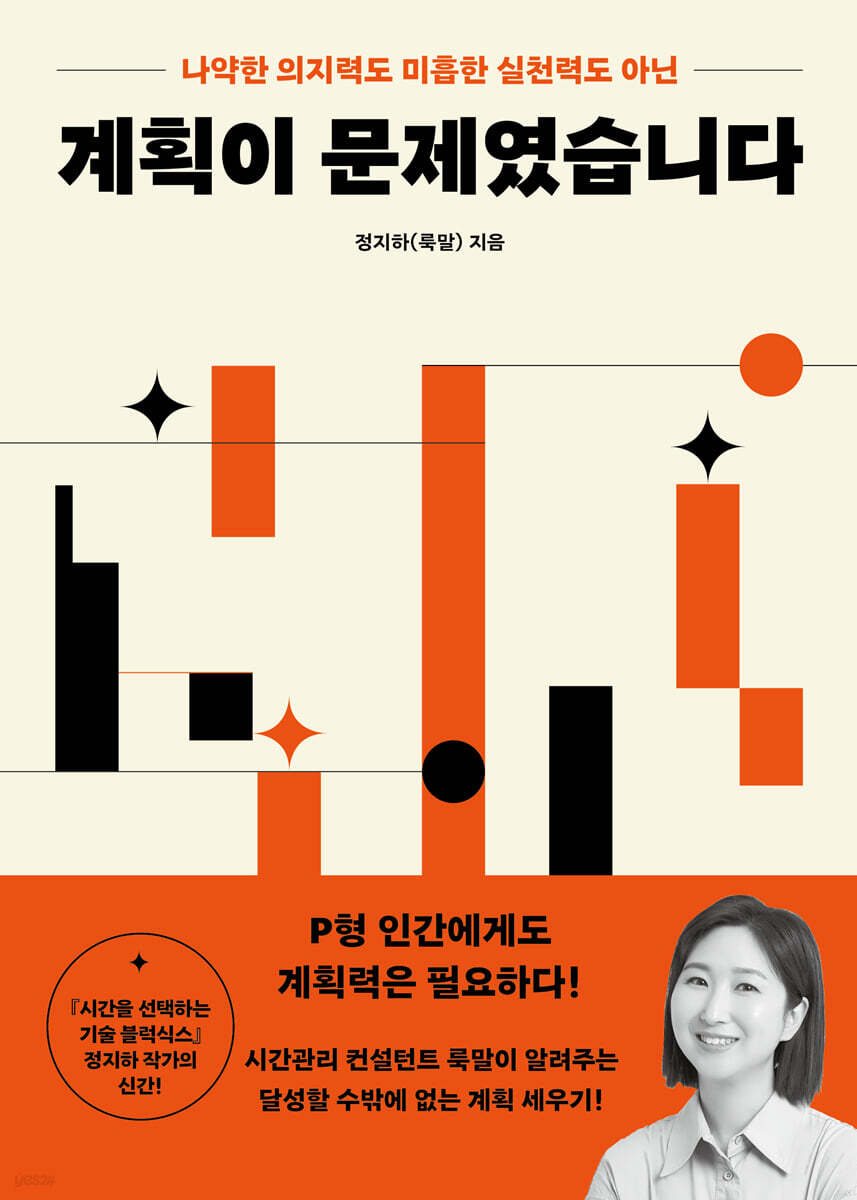
The plan was the problem
 |
Description
Book Introduction
The ENFP improvisational third-shift nurse who became a time management expert
Well-developed 'planning skills' can change your life!
Author of "Block Six: The Art of Choosing Time"
Lookmal reveals the secret to making a plan you can't help but stick to!
Nowadays, there is no one in the world who plays only one role.
We are each given multiple roles at home, at work, and in society, and we must complete the given tasks within a limited amount of time.
For example, you have to attend a parent-teacher conference next Monday, have an important project presentation the day after, and then plan a family trip in between.
But time is so limited.
Excluding the time we spend eating, sleeping, and working at the office, the amount of time we have at our disposal is limited to a few hours a day.
How to organize and plan a complex schedule.
It's a topic we always find difficult.
Author Ji-ha Jeong (Lookmal), who met readers four years ago with the book 『The Art of Choosing Time, Block Six』, introduces to us, in this new book 『The Plan Was the Problem』, how to develop our 'planning skills'.
If you are someone who thinks, 'I always fail at making plans' or 'I have so much to do that I don't know where to start', this book can provide an answer.
Well-developed 'planning skills' can change your life!
Author of "Block Six: The Art of Choosing Time"
Lookmal reveals the secret to making a plan you can't help but stick to!
Nowadays, there is no one in the world who plays only one role.
We are each given multiple roles at home, at work, and in society, and we must complete the given tasks within a limited amount of time.
For example, you have to attend a parent-teacher conference next Monday, have an important project presentation the day after, and then plan a family trip in between.
But time is so limited.
Excluding the time we spend eating, sleeping, and working at the office, the amount of time we have at our disposal is limited to a few hours a day.
How to organize and plan a complex schedule.
It's a topic we always find difficult.
Author Ji-ha Jeong (Lookmal), who met readers four years ago with the book 『The Art of Choosing Time, Block Six』, introduces to us, in this new book 『The Plan Was the Problem』, how to develop our 'planning skills'.
If you are someone who thinks, 'I always fail at making plans' or 'I have so much to do that I don't know where to start', this book can provide an answer.
- You can preview some of the book's contents.
Preview
index
prolog
Chapter 1.
Type P, a third-shift nurse, becomes a time management expert.
1-1.
Losing Time: What Shift Work Takes Away
1-2.
Buried in Time: The Myth of Full-Time Work
1-3.
Choose Your Time: Taking Control of Your Time
Chapter 2.
Why is your plan problematic?
2-1.
Awakening the sense of being able to do it
2-2.
The basic formula for a plan that can change today
2-3.
Plan at least!
2-4.
3 seconds! Take advantage of the moment before the location changes.
2-5.
A plan is a strategy, not a promise.
2-6.
Two things that helped me grow even when things were dark
Chapter 3.
Developing planning skills
3-1.
Step 3 of the plan
3-2.
Step 1: Pour out
3-3.
Step 2: Select
3-4.
Step 3: Adjust
3-5.
Five Ways to Make Your Plans a Reality
3-6.
There are separate sustainable goals.
3-7.
Subtract and add for focus
3-8.
Retrospection is a time to find possible ways
3-9.
Three Ways to Make the Most of Your Evenings
Chapter 4.
The plan of a person who is good at work
4-1.
Three Questions About Work
4-2.
Are you a leader who saves your team members' time?
4-3.
Even if you speak like a dog, I understand you perfectly
4-4.
Why I Procrastinate
4-5.
Let's set an immersion deadline, not a deadline.
4-6.
Planning as a set, from preparation to finishing
4-7.
Eliciting cooperation is also a skill.
4-8.
3 Stages of Immersion
Chapter 5.
My planning ability to take care of my whole life
5-1.
A stimulating environment is important.
5-2.
3 Steps to Turning Today's Sincerity into Results
5-3.
We all have '100 days of freedom'
5-4.
The me of 5 years from now is the me of today
5-5.
I hope you don't just live hard without a dream.
Epilogue
Chapter 1.
Type P, a third-shift nurse, becomes a time management expert.
1-1.
Losing Time: What Shift Work Takes Away
1-2.
Buried in Time: The Myth of Full-Time Work
1-3.
Choose Your Time: Taking Control of Your Time
Chapter 2.
Why is your plan problematic?
2-1.
Awakening the sense of being able to do it
2-2.
The basic formula for a plan that can change today
2-3.
Plan at least!
2-4.
3 seconds! Take advantage of the moment before the location changes.
2-5.
A plan is a strategy, not a promise.
2-6.
Two things that helped me grow even when things were dark
Chapter 3.
Developing planning skills
3-1.
Step 3 of the plan
3-2.
Step 1: Pour out
3-3.
Step 2: Select
3-4.
Step 3: Adjust
3-5.
Five Ways to Make Your Plans a Reality
3-6.
There are separate sustainable goals.
3-7.
Subtract and add for focus
3-8.
Retrospection is a time to find possible ways
3-9.
Three Ways to Make the Most of Your Evenings
Chapter 4.
The plan of a person who is good at work
4-1.
Three Questions About Work
4-2.
Are you a leader who saves your team members' time?
4-3.
Even if you speak like a dog, I understand you perfectly
4-4.
Why I Procrastinate
4-5.
Let's set an immersion deadline, not a deadline.
4-6.
Planning as a set, from preparation to finishing
4-7.
Eliciting cooperation is also a skill.
4-8.
3 Stages of Immersion
Chapter 5.
My planning ability to take care of my whole life
5-1.
A stimulating environment is important.
5-2.
3 Steps to Turning Today's Sincerity into Results
5-3.
We all have '100 days of freedom'
5-4.
The me of 5 years from now is the me of today
5-5.
I hope you don't just live hard without a dream.
Epilogue
Detailed image

Into the book
The meaning of self-care here is very comprehensive.
Thinking about the direction of life and work, exercising, calming the mind, managing annoyances, taking the time to be considerate of others, taking a break before getting tired, and figuring out what to do today.
This isn't something you have to manage separately, but rather, by looking at how you spend your time and developing metacognition, you'll connect the dots and grow together.
--- p.32, 「1-3.
From “Choose Your Time: Taking Control of Your Time”
You must change the mode before opening the door.
Put your hand on the doorknob and stop for exactly 3 seconds.
Then, when you open the door, you think about what to do and quickly change modes.
'If you open this door and go in, you will go straight to the bathroom and take a shower first.'
Even if you were in a hazy state of mind in the elevator, you can still get back on track.
These 3 seconds determine the quality of the next 3 hours after entering the house.
--- p.60, 「2-4.
3 seconds! Take advantage of the moment before the location changes.
Plus, if you clearly define what you won't do today, you'll naturally find time to do it.
It could be tomorrow or next week, but the important thing is that there is a specific box somewhere on your calendar for that task.
If you continue this habit of rearranging for just a week or two, you will create a system that prevents you from overloading yourself with work.
--- p.104, 「3-3.
Step 2: Select from
The more difficult the task, the more important it is to create a structure rather than a will.
In that sense, ‘one place, one purpose’ is an important factor in utilizing evening time.
Everyone wants to rest when they get home, and just want to lie down when they see a bed.
This is not a question of mental strength.
In psychology, there is a concept called 'context-dependent memory'.
This means that our brain does not remember a place simply as a background, but rather turns the space itself into a signal. According to this theory, since a bed is already remembered as a 'place to rest', when we see a bed, our brain automatically tries to select 'rest mode'.
So it's natural that we want to lie down just by looking at the bed.
--- p.153, 「3-9.
From "Three Ways to Make the Most of Your Evening"
"I know what you're saying, but now's not the time to rest…" Are you still thinking this way? If so, you need to shift your thinking and see rest as a part of your job.
If you can't concentrate and keep putting it off, let's stop for a moment.
This is a realization I've gained from experiencing several burnout-prevention breaks.
--- p.195-196, 「4-4.
From “Why I Procrastinate”
It's a shame that you can't fully utilize your abilities because you can't manage your time well.
You may have ideas and skills, but wouldn't it be frustrating if opportunities were lost due to poor planning, or if you only focus on the last minute and repeatedly produce disappointing results? The 80:20 rule isn't just a strategy for getting things done quickly.
It is a choice to bring forward the timing of my immersion and use the energy and time I have in a way that is beneficial to me.
--- p.219, 「4-5.
Let's set an immersion deadline, not a deadline.
Are there any skills or habits you'd like to internalize? While you can develop skills and develop habits through short-term focus, if you want them to stick with you for longer, you need to surround yourself with stimuli.
The easiest way is to surround yourself with people who are living the life you want.
If you want to incorporate running into your life, join a running crew. If you want to read books consistently, subscribe to several YouTube channels that introduce books to keep them appearing in your YouTube algorithm.
If you want to increase your assets, you should go to a group that studies economics.
Thinking about the direction of life and work, exercising, calming the mind, managing annoyances, taking the time to be considerate of others, taking a break before getting tired, and figuring out what to do today.
This isn't something you have to manage separately, but rather, by looking at how you spend your time and developing metacognition, you'll connect the dots and grow together.
--- p.32, 「1-3.
From “Choose Your Time: Taking Control of Your Time”
You must change the mode before opening the door.
Put your hand on the doorknob and stop for exactly 3 seconds.
Then, when you open the door, you think about what to do and quickly change modes.
'If you open this door and go in, you will go straight to the bathroom and take a shower first.'
Even if you were in a hazy state of mind in the elevator, you can still get back on track.
These 3 seconds determine the quality of the next 3 hours after entering the house.
--- p.60, 「2-4.
3 seconds! Take advantage of the moment before the location changes.
Plus, if you clearly define what you won't do today, you'll naturally find time to do it.
It could be tomorrow or next week, but the important thing is that there is a specific box somewhere on your calendar for that task.
If you continue this habit of rearranging for just a week or two, you will create a system that prevents you from overloading yourself with work.
--- p.104, 「3-3.
Step 2: Select from
The more difficult the task, the more important it is to create a structure rather than a will.
In that sense, ‘one place, one purpose’ is an important factor in utilizing evening time.
Everyone wants to rest when they get home, and just want to lie down when they see a bed.
This is not a question of mental strength.
In psychology, there is a concept called 'context-dependent memory'.
This means that our brain does not remember a place simply as a background, but rather turns the space itself into a signal. According to this theory, since a bed is already remembered as a 'place to rest', when we see a bed, our brain automatically tries to select 'rest mode'.
So it's natural that we want to lie down just by looking at the bed.
--- p.153, 「3-9.
From "Three Ways to Make the Most of Your Evening"
"I know what you're saying, but now's not the time to rest…" Are you still thinking this way? If so, you need to shift your thinking and see rest as a part of your job.
If you can't concentrate and keep putting it off, let's stop for a moment.
This is a realization I've gained from experiencing several burnout-prevention breaks.
--- p.195-196, 「4-4.
From “Why I Procrastinate”
It's a shame that you can't fully utilize your abilities because you can't manage your time well.
You may have ideas and skills, but wouldn't it be frustrating if opportunities were lost due to poor planning, or if you only focus on the last minute and repeatedly produce disappointing results? The 80:20 rule isn't just a strategy for getting things done quickly.
It is a choice to bring forward the timing of my immersion and use the energy and time I have in a way that is beneficial to me.
--- p.219, 「4-5.
Let's set an immersion deadline, not a deadline.
Are there any skills or habits you'd like to internalize? While you can develop skills and develop habits through short-term focus, if you want them to stick with you for longer, you need to surround yourself with stimuli.
The easiest way is to surround yourself with people who are living the life you want.
If you want to incorporate running into your life, join a running crew. If you want to read books consistently, subscribe to several YouTube channels that introduce books to keep them appearing in your YouTube algorithm.
If you want to increase your assets, you should go to a group that studies economics.
--- p.259, 「5-1.
“An environment where one can be stimulated is important”
“An environment where one can be stimulated is important”
Publisher's Review
The sustainable planning ability of successful people
Simple and straightforward, but clear is the key!
Professor Heo Jun-i, winner of the Fields Medal, known as the Nobel Prize of mathematics.
He, like us, is a person who must simultaneously fulfill multiple roles, such as professor, researcher, and father.
While preparing for school classes, he must also handle administrative tasks and conduct personal research, while also not neglecting his role as a husband and father.
How did he manage to balance this and succeed? It was thanks to his meticulously planned daily schedule.
He believes he can concentrate better in the morning, so he devotes three or four hours in the morning to studying.
After lunch, he takes a short nap, then in the afternoon, he focuses on his duties as a member of the school, such as preparing classes and completing administrative tasks, and then after work, he focuses on spending time with his family in the evening.
World-renowned novelist Haruki Murakami is also famous for his daily routine, which he plans according to clear standards between work, self-management, and hobbies, such as the amount of writing to do each day and the distance to run.
Successful people like this have one thing in common: they have a simple, yet clear, and sustainable "planning ability" that allows them to distinguish between what they need to focus on now and what they can put off until later, among the many tasks they have to do.
From daily planning to work and life
Fix your problematic plans and live the life you want!
If you've developed a plan and started to change your daily life, you can apply it to your work and future plans.
By accurately identifying the reasons why we procrastinate and setting a "deadline" for our work at the beginning rather than focusing solely on deadlines, or by planning a specific event or meeting, from preparing for it to actually carrying out the event and finishing it, we can significantly improve our work performance.
Planning is important when developing yourself for the future, whether it's a few months or a few years down the road.
The final chapter of this book talks about planning, how to find and secure your own limited time each day and what to do with it.
By surrounding yourself with inspiring people who share your goals and consistently reviewing your plan to spend two or three hours each evening wisely, readers, like the author and crew featured in this book, will surely achieve at least one dream they hold dear.
Simple and straightforward, but clear is the key!
Professor Heo Jun-i, winner of the Fields Medal, known as the Nobel Prize of mathematics.
He, like us, is a person who must simultaneously fulfill multiple roles, such as professor, researcher, and father.
While preparing for school classes, he must also handle administrative tasks and conduct personal research, while also not neglecting his role as a husband and father.
How did he manage to balance this and succeed? It was thanks to his meticulously planned daily schedule.
He believes he can concentrate better in the morning, so he devotes three or four hours in the morning to studying.
After lunch, he takes a short nap, then in the afternoon, he focuses on his duties as a member of the school, such as preparing classes and completing administrative tasks, and then after work, he focuses on spending time with his family in the evening.
World-renowned novelist Haruki Murakami is also famous for his daily routine, which he plans according to clear standards between work, self-management, and hobbies, such as the amount of writing to do each day and the distance to run.
Successful people like this have one thing in common: they have a simple, yet clear, and sustainable "planning ability" that allows them to distinguish between what they need to focus on now and what they can put off until later, among the many tasks they have to do.
From daily planning to work and life
Fix your problematic plans and live the life you want!
If you've developed a plan and started to change your daily life, you can apply it to your work and future plans.
By accurately identifying the reasons why we procrastinate and setting a "deadline" for our work at the beginning rather than focusing solely on deadlines, or by planning a specific event or meeting, from preparing for it to actually carrying out the event and finishing it, we can significantly improve our work performance.
Planning is important when developing yourself for the future, whether it's a few months or a few years down the road.
The final chapter of this book talks about planning, how to find and secure your own limited time each day and what to do with it.
By surrounding yourself with inspiring people who share your goals and consistently reviewing your plan to spend two or three hours each evening wisely, readers, like the author and crew featured in this book, will surely achieve at least one dream they hold dear.
GOODS SPECIFICS
- Date of issue: September 18, 2025
- Page count, weight, size: 300 pages | 510g | 150*210*20mm
- ISBN13: 9791194777441
- ISBN10: 1194777449
You may also like
카테고리
korean


korean

![ELLE 엘르 스페셜 에디션 A형 : 12월 [2025]](http://librairie.coreenne.fr/cdn/shop/files/b8e27a3de6c9538896439686c6b0e8fb.jpg?v=1766436872&width=3840)


