

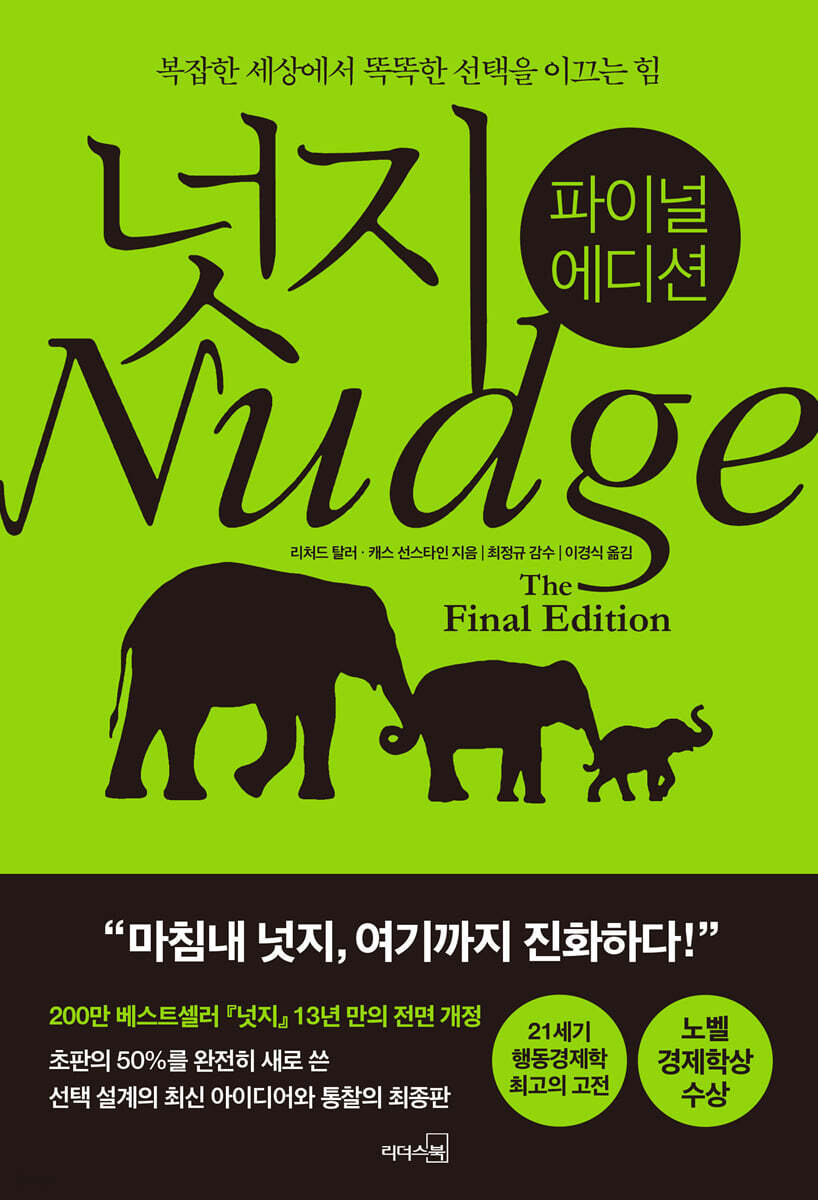
Nudge: Final Edition
 |
Description
Book Introduction
From overcoming climate change and COVID-19 to sludge and pension plan design,
The final edition of the global bestseller "Nudge," which completely changed the 21st century.
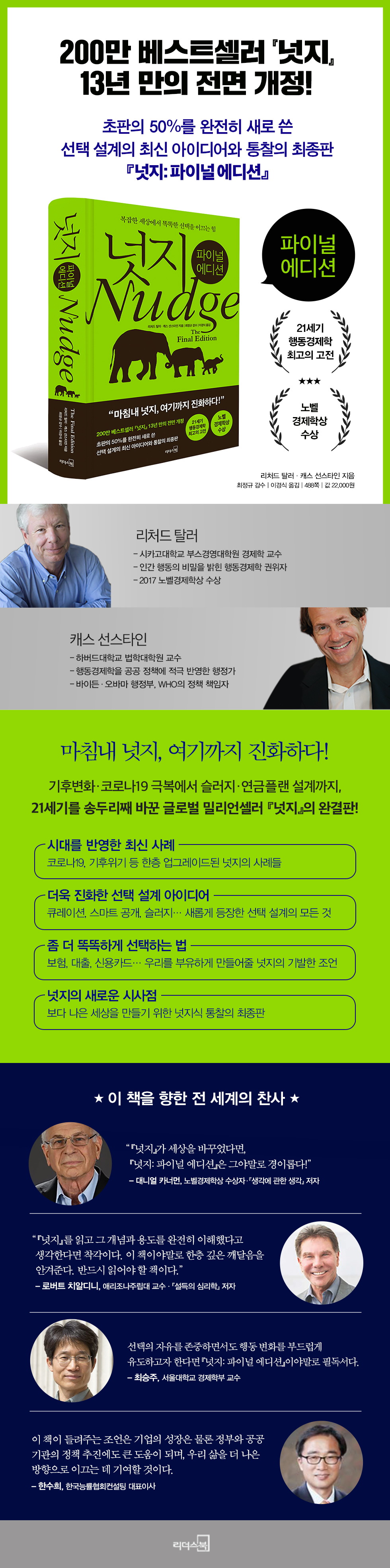
The global bestseller "Nudge," which sparked a worldwide craze for "nudge," has been reborn as an even more powerful final edition, "Nudge: The Final Edition," 13 years after its publication.
First published in the United States in 2008, Nudge, the century's greatest economics classic that completely overturned perspectives on human behavior and choice, has been recognized by 2 million readers and won the Nobel Prize in Economics. Now, armed with even more powerful choice design ideas and up-to-date examples, it's back.
As the preface states, “We threw out the old and filled in the new,” authors Richard Thaler and Cass Sunstein have completely rewritten about half of the content to reflect the world that has changed significantly over the past 13 years.
This final edition guides readers into a more expansive world of nudge, exploring cutting-edge cases that reflect our times, including the COVID-19 pandemic, which vividly demonstrated social nudges, and climate change, which has become an urgent global issue.
It also introduces emerging choice design ideas such as sludge, curation, smart disclosure, and personalized default settings, and delves deeper into topics closely related to individual decision-making in real life, such as savings, insurance, and loans.
In addition, we look back at the nudges applied and their effects in designing public policies such as retirement pensions, health insurance, and organ donation, and consider future nudges.
Daniel Kahneman, a Nobel Prize winner in economics, praised this final edition, which has been out for 13 years, saying, “If ‘Nudge’ changed the world, ‘Nudge: The Final Edition’ is truly amazing!”
Evolving into a fresh and modern version to keep pace with the changing times, "Nudge: The Final Edition" will once again completely change our perspective on humanity and the world.
The final edition of the global bestseller "Nudge," which completely changed the 21st century.
The global bestseller "Nudge," which sparked a worldwide craze for "nudge," has been reborn as an even more powerful final edition, "Nudge: The Final Edition," 13 years after its publication.
First published in the United States in 2008, Nudge, the century's greatest economics classic that completely overturned perspectives on human behavior and choice, has been recognized by 2 million readers and won the Nobel Prize in Economics. Now, armed with even more powerful choice design ideas and up-to-date examples, it's back.
As the preface states, “We threw out the old and filled in the new,” authors Richard Thaler and Cass Sunstein have completely rewritten about half of the content to reflect the world that has changed significantly over the past 13 years.
This final edition guides readers into a more expansive world of nudge, exploring cutting-edge cases that reflect our times, including the COVID-19 pandemic, which vividly demonstrated social nudges, and climate change, which has become an urgent global issue.
It also introduces emerging choice design ideas such as sludge, curation, smart disclosure, and personalized default settings, and delves deeper into topics closely related to individual decision-making in real life, such as savings, insurance, and loans.
In addition, we look back at the nudges applied and their effects in designing public policies such as retirement pensions, health insurance, and organ donation, and consider future nudges.
Daniel Kahneman, a Nobel Prize winner in economics, praised this final edition, which has been out for 13 years, saying, “If ‘Nudge’ changed the world, ‘Nudge: The Final Edition’ is truly amazing!”
Evolving into a fresh and modern version to keep pace with the changing times, "Nudge: The Final Edition" will once again completely change our perspective on humanity and the world.
- You can preview some of the book's contents.
Preview
index
Preface to the Final Edition_ To Nudge: The Final Edition
First Edition Intro_Nudges Determine Your Every Action
Part 1 | Humans and Icons: We Are Geniuses and Fools at the Same Time
Chapter 1.
Bias and mistakes
Heuristics: Useful but systematically biased
Optimism and Overconfidence: How Humans Become Unrealistically Optimistic
Gains and Losses: A Strong Will to Hold on to What You Hold
Status Quo Bias: Oh, so what!
Framing: How Frames Shape Judgments
How we think: automatic and deliberative systems
Well, then how?
Chapter 2.
Resisting temptation
Self-Control Strategies: Planning Self vs. Doing Self
Psychological Accounting: Mobilizing Your "Inner Control System"
Chapter 3.
Humans move in groups
Do what others do
Cultural and political change, and unpredictability
What people want you to do
Pluralistic Ignorance: Tradition, Practice, and Nudge
New social norms that act as powerful nudges
Chapter 4.
A moment when a nudge is needed
How to design the best choice
Can markets solve the problem of choice?
Chapter 5.
The World of Choice Architecture
Default settings and the path of least resistance
Expect errors
Give feedback
Understanding Mapping: From Choice to Well-Being
Structuring complex choices
Choice Design Systems and Incentives
When you need to take a break
Chapter 6.
Wait, there's more
Curation: Designing Choices That Reach the Needs of the Underserved
Make it fun
Part 2 | Tools of the Choice Architect: What Leads to Optimal Choices
Chapter 7.
Smart Public
Standardized units and smart choices
Smart publicity utilizing the latest technology
Machine readable
Make the most of each person's information
Chapter 8.
#sludge
Things that make us uncomfortable
Hidden Attributes
We have too many useless procedures.
The sludge of the college admissions process
Sludge created or destroyed by the government
Sludge at the airport
The sludge of the online world
Taxes, taxes, taxes
Reducing Sludge One Step at a Time
Chapter 9.
Nudges to Increase Savings
Are we saving enough money?
How to nudge people to sign up for a pension
Designing for 'More Savings for the Future'
Default settings for investment options
Best Practice: Nest Pension in the UK
Part 3 | Money: Nudges Make Us Rich
Chapter 10.
Will nudges last forever?
The default fund and the Swedish people's choice
Will active choosers make good choices?
Is it a sweet dream or a terrible nightmare?
How long will the nudge effect last?
What the Swedish Case Tells Us
Chapter 11.
Borrow More Money Today: Secured Loans and Credit Cards
Overly complicated home mortgage loans
Credit Cards: How You Use Them Is Important
Chapter 12.
Don't risk your life on trivial matters: Insurance
Create 'My Own Account'
How to Choose the Best Insurance Plan
Avoiding Deductibles and Optimal Health Insurance
Part 4 | Society: How to Create a Better World
Chapter 13.
Organ Donation: The Illusion of a Default Solution
The Reality Surrounding Organ Donation
Conventional Eviction: All rights belong to the government.
Presumed Consent: Can It Be a True Choice?
Explicit Consent: Between Passion and True Intentions
Guided Choice: Alternatives to Nudges to Increase Organ Donation Rates
Forced Choice: When Commands Meet Nudges
Israel's incentive policy
Presumed consent saves lives?
To achieve your true goals
Chapter 14.
Saving the Earth from Climate Change
Perfect Storm
Encourage cooperation
Better incentives
The paradox of energy
Feedback and Information
Disclosure of greenhouse gas emissions
Automatic eco-friendly
Norms and Transparency
Part 5 | Grievance Handling: Criticisms and Rebuttals of Nudge
Chapter 15.
Various comments about nudges
slippery slope
Freedom and active choice
Teach, don't nudge?
Is nudge a trick?
The principle of setting limits and disclosure
Between commands, prohibitions, and nudges
For a world where the phrase "good nudge" comes true
Acknowledgements
References
Search
First Edition Intro_Nudges Determine Your Every Action
Part 1 | Humans and Icons: We Are Geniuses and Fools at the Same Time
Chapter 1.
Bias and mistakes
Heuristics: Useful but systematically biased
Optimism and Overconfidence: How Humans Become Unrealistically Optimistic
Gains and Losses: A Strong Will to Hold on to What You Hold
Status Quo Bias: Oh, so what!
Framing: How Frames Shape Judgments
How we think: automatic and deliberative systems
Well, then how?
Chapter 2.
Resisting temptation
Self-Control Strategies: Planning Self vs. Doing Self
Psychological Accounting: Mobilizing Your "Inner Control System"
Chapter 3.
Humans move in groups
Do what others do
Cultural and political change, and unpredictability
What people want you to do
Pluralistic Ignorance: Tradition, Practice, and Nudge
New social norms that act as powerful nudges
Chapter 4.
A moment when a nudge is needed
How to design the best choice
Can markets solve the problem of choice?
Chapter 5.
The World of Choice Architecture
Default settings and the path of least resistance
Expect errors
Give feedback
Understanding Mapping: From Choice to Well-Being
Structuring complex choices
Choice Design Systems and Incentives
When you need to take a break
Chapter 6.
Wait, there's more
Curation: Designing Choices That Reach the Needs of the Underserved
Make it fun
Part 2 | Tools of the Choice Architect: What Leads to Optimal Choices
Chapter 7.
Smart Public
Standardized units and smart choices
Smart publicity utilizing the latest technology
Machine readable
Make the most of each person's information
Chapter 8.
#sludge
Things that make us uncomfortable
Hidden Attributes
We have too many useless procedures.
The sludge of the college admissions process
Sludge created or destroyed by the government
Sludge at the airport
The sludge of the online world
Taxes, taxes, taxes
Reducing Sludge One Step at a Time
Chapter 9.
Nudges to Increase Savings
Are we saving enough money?
How to nudge people to sign up for a pension
Designing for 'More Savings for the Future'
Default settings for investment options
Best Practice: Nest Pension in the UK
Part 3 | Money: Nudges Make Us Rich
Chapter 10.
Will nudges last forever?
The default fund and the Swedish people's choice
Will active choosers make good choices?
Is it a sweet dream or a terrible nightmare?
How long will the nudge effect last?
What the Swedish Case Tells Us
Chapter 11.
Borrow More Money Today: Secured Loans and Credit Cards
Overly complicated home mortgage loans
Credit Cards: How You Use Them Is Important
Chapter 12.
Don't risk your life on trivial matters: Insurance
Create 'My Own Account'
How to Choose the Best Insurance Plan
Avoiding Deductibles and Optimal Health Insurance
Part 4 | Society: How to Create a Better World
Chapter 13.
Organ Donation: The Illusion of a Default Solution
The Reality Surrounding Organ Donation
Conventional Eviction: All rights belong to the government.
Presumed Consent: Can It Be a True Choice?
Explicit Consent: Between Passion and True Intentions
Guided Choice: Alternatives to Nudges to Increase Organ Donation Rates
Forced Choice: When Commands Meet Nudges
Israel's incentive policy
Presumed consent saves lives?
To achieve your true goals
Chapter 14.
Saving the Earth from Climate Change
Perfect Storm
Encourage cooperation
Better incentives
The paradox of energy
Feedback and Information
Disclosure of greenhouse gas emissions
Automatic eco-friendly
Norms and Transparency
Part 5 | Grievance Handling: Criticisms and Rebuttals of Nudge
Chapter 15.
Various comments about nudges
slippery slope
Freedom and active choice
Teach, don't nudge?
Is nudge a trick?
The principle of setting limits and disclosure
Between commands, prohibitions, and nudges
For a world where the phrase "good nudge" comes true
Acknowledgements
References
Search
Detailed image
Into the book
But we were already looking through old manuscripts, and the COVID-19 pandemic was just around the corner.
Chapter 1 of "Nudge" deals with the iPod, which was incredibly sophisticated at the time but is now completely outdated... Oh my, looking back at that manuscript, it seems like such a long time ago.
But the overall content finds a solution that is still excellent even today, making marriage possible for same-sex couples.
Since then, many countries have solved that very problem in ways we never imagined were politically possible.
The problem was solved by enacting a law legalizing same-sex marriage.
Looking at these various points, we thought that there might be a need to organize some parts of Nudge.
…in military terms, this is called ‘mission creep.’
Eventually we decided to publish a revised edition.
And I planned to finish the revised manuscript in one summer.
But, strangely enough, the completed manuscript was not delivered to the publisher until the end of November of the same year.
---From "'Preface to the Final Edition of Nudge: The Final Edition'"
A famous passage from Mark Twain's novel The Adventures of Tom Sawyer illustrates this point well.
Tom, a mischievous boy, is punished by his Aunt Polly for his bad behavior.
The punishment is to paint the board fence that runs along the sidewalk in front of the house white.
Tom wants to play with his friends, but he can't and hates doing that boring work.
Besides, I'm sure my friends will pass by and tease me if they see me getting punished, and I don't want to be teased like that.
As Tom is painting, worrying about this, his friend Ben Rogers walks in.
Ben is holding a delicious apple in his hand.
Tom, seeing this, comes up with a plan to trick Ben.
Tom put all his heart into painting, as if he was having a lot of fun, and Ben, seeing this, thought that it must be very exciting and enjoyable.
Ben suggests that he try it too, but Tom refuses.
I can't give up something fun.
Eventually, Ben apologizes to Tom and begs him to give him the paintbrush and begin painting.
So by evening Aunt Polly's fence had been painted three times.
---「Chapter 6.
From "Wait, there's more"
Our two authors have friends in the Behavioral Insights team in London who tell us that PayPal's terms and conditions contain a whopping 36,275 words.
This is a little over a third of the book's length.
For that reason, we believe that no one, including PayPal employees, has read these terms from beginning to end.
The question is whether this can be called 'disclosure' in the sense that it allows consumers to read and know the necessary information in advance.
It can only be seen as an intentional obfuscation to prevent people from understanding the content.
To be clear, our authors did not intentionally use PayPal as an example.
I just gave an example from my friends on the Behavioral Insights team.
What's interesting about this disclosure is that while it's accessible online, it's ultimately just a massive pile of information.
It is difficult to read this content easily on a computer.
The goal of smart disclosure is to solve precisely this problem.
Taking travel products as an example, we can see how this problem can be improved.
---「Chapter 7.
From "Smart Public"
We use sludge to mean 'any aspect of a choice architecture that makes it difficult for people to achieve the desired outcome they want.'
If you can't get financial aid without filling out a 20-page form, you're in for a rude awakening.
If you can't get a student visa without going through four interviews, you're in for a real treat.
If you're having to navigate a complex website, fill out countless online forms and documents, and drive to a remote clinic for two hours to get tested for COVID-19 or get a vaccine, you're definitely being slogged through.
---「Chapter 8.
#Sludge"
These results demonstrate the power of choice architecture.
Let's compare the behavior of this company's employees, divided into three groups.
The first group is those who did not receive counseling.
This group was saving about 6 percent of their income when the "Save More for the Future" pension began, and their contribution rate remained the same for the next three years.
The second group is those who accepted the recommendation to raise the contribution rate by 5 percentage points.
Their contribution rate, which was 4 percent immediately after the first wage increase, jumped to 9 percent.
However, this contribution rate remained roughly the same for a long time thereafter.
The third group is those who have signed up for a 'saving more for the future' pension.
This group's original contribution rate was the lowest of the three groups, at 3 to 5 percent, but it steadily increased after joining the program, and after three years and six months, when their wages had increased four times, it had nearly quadrupled to 13.6 percent.
This figure is significantly higher than the 9 percent increase in contributions made by those who followed the recommendation to raise their contribution rates by 5 percentage points.
---「Chapter 9.
From "Nudges to Increase Savings"
A question we haven't yet explored is how long the effects of nudges last.
One possibility is that people initially exhibit default behaviors due to reasons such as status quo bias, laziness, or procrastination, but over time they refine their behavior and try to shift their initial choices toward more rational ones.
In such situations, the specific design provided by the choice architect ends up having only a temporary effect.
But if the nudge effect is to persist, choice architecture may play a crucial role, and the effect could last for decades.
The Swedish experience with the pension system can shed some light on the sustainability of nudge effects, as it provides data that can track what happened from its inception through the end of 2016.
---「Chapter 10.
From "Will Nudge Last Forever?"
A group of economists studied card users' answers to this question using British data, and later replicated the results using American data.
Before we actually hear what people did, let's ask Dan what he should do.
Anyway, Dan has to pay the minimum payment amount.
If you don't do that, you'll have to pay a lot of late fees.
After paying the minimum payments of $40 and $20, Dan's best strategy is to use the remaining money to pay off his high-interest credit card debt.
This is a simple and quite understandable rule.
Pay the minimum balance required by each credit card, and use the remaining money to pay off any debt on high-interest cards.
However, researchers found that only about 10 percent of the total sample followed this rule.
---「Chapter 11.
Borrow More Money Today: Secured Loans and Credit Cards
Bad choices have something in common.
This means choosing the one with the lower deductible.
In many cases, plans with higher deductibles are superior to plans with lower deductibles.
For example, one insurance plan had an annual deductible of $1,000 and an annual premium of $930.
This insurance plan is superior to a plan with a $500 deductible and a $1,568 premium, all other conditions being the same.
This is a problem that can be solved with simple math.
On the other hand, if you choose the latter insurance plan, you will have to pay $638 per year to reduce your deductible by $500.
This would cost you at least $138 more, and would also wipe out the $638 you could have saved if you never had to file a claim.
Employees who followed our easy rule of thumb to choose the one with the highest deduction would have avoided this trap.
---「Chapter 12.
Don't risk your life on trivial matters: Insurance"
Belgium, and particularly Flanders, has been a pioneer in this type of organ donor recruitment.
The 2018 television program Make Belgium Great Again dedicated an episode to the importance of organ donation, combining an emotional appeal with a call to action for viewers.
The program also worked in collaboration with 240 municipalities across Flanders, which opened their offices the following Sunday to accept applications for organ donation.
As a result, more than 26,000 people registered as organ donors, a remarkable achievement considering that the region had previously registered between 7,000 and 8,000 organ donors annually.
…Belgium also allowed citizens to register as organ donors during local elections.
The Belgian government introduced a program called the "Federal Truck," which, from 2015 to 2019, involved touring the country with trucks to educate students about organ transplants and encourage families to talk about organ donation at home.
As a result of these efforts, the number of people registered as organ donors in Belgium has more than tripled since 2009, while the number of people opting out has remained stagnant.
Chapter 1 of "Nudge" deals with the iPod, which was incredibly sophisticated at the time but is now completely outdated... Oh my, looking back at that manuscript, it seems like such a long time ago.
But the overall content finds a solution that is still excellent even today, making marriage possible for same-sex couples.
Since then, many countries have solved that very problem in ways we never imagined were politically possible.
The problem was solved by enacting a law legalizing same-sex marriage.
Looking at these various points, we thought that there might be a need to organize some parts of Nudge.
…in military terms, this is called ‘mission creep.’
Eventually we decided to publish a revised edition.
And I planned to finish the revised manuscript in one summer.
But, strangely enough, the completed manuscript was not delivered to the publisher until the end of November of the same year.
---From "'Preface to the Final Edition of Nudge: The Final Edition'"
A famous passage from Mark Twain's novel The Adventures of Tom Sawyer illustrates this point well.
Tom, a mischievous boy, is punished by his Aunt Polly for his bad behavior.
The punishment is to paint the board fence that runs along the sidewalk in front of the house white.
Tom wants to play with his friends, but he can't and hates doing that boring work.
Besides, I'm sure my friends will pass by and tease me if they see me getting punished, and I don't want to be teased like that.
As Tom is painting, worrying about this, his friend Ben Rogers walks in.
Ben is holding a delicious apple in his hand.
Tom, seeing this, comes up with a plan to trick Ben.
Tom put all his heart into painting, as if he was having a lot of fun, and Ben, seeing this, thought that it must be very exciting and enjoyable.
Ben suggests that he try it too, but Tom refuses.
I can't give up something fun.
Eventually, Ben apologizes to Tom and begs him to give him the paintbrush and begin painting.
So by evening Aunt Polly's fence had been painted three times.
---「Chapter 6.
From "Wait, there's more"
Our two authors have friends in the Behavioral Insights team in London who tell us that PayPal's terms and conditions contain a whopping 36,275 words.
This is a little over a third of the book's length.
For that reason, we believe that no one, including PayPal employees, has read these terms from beginning to end.
The question is whether this can be called 'disclosure' in the sense that it allows consumers to read and know the necessary information in advance.
It can only be seen as an intentional obfuscation to prevent people from understanding the content.
To be clear, our authors did not intentionally use PayPal as an example.
I just gave an example from my friends on the Behavioral Insights team.
What's interesting about this disclosure is that while it's accessible online, it's ultimately just a massive pile of information.
It is difficult to read this content easily on a computer.
The goal of smart disclosure is to solve precisely this problem.
Taking travel products as an example, we can see how this problem can be improved.
---「Chapter 7.
From "Smart Public"
We use sludge to mean 'any aspect of a choice architecture that makes it difficult for people to achieve the desired outcome they want.'
If you can't get financial aid without filling out a 20-page form, you're in for a rude awakening.
If you can't get a student visa without going through four interviews, you're in for a real treat.
If you're having to navigate a complex website, fill out countless online forms and documents, and drive to a remote clinic for two hours to get tested for COVID-19 or get a vaccine, you're definitely being slogged through.
---「Chapter 8.
#Sludge"
These results demonstrate the power of choice architecture.
Let's compare the behavior of this company's employees, divided into three groups.
The first group is those who did not receive counseling.
This group was saving about 6 percent of their income when the "Save More for the Future" pension began, and their contribution rate remained the same for the next three years.
The second group is those who accepted the recommendation to raise the contribution rate by 5 percentage points.
Their contribution rate, which was 4 percent immediately after the first wage increase, jumped to 9 percent.
However, this contribution rate remained roughly the same for a long time thereafter.
The third group is those who have signed up for a 'saving more for the future' pension.
This group's original contribution rate was the lowest of the three groups, at 3 to 5 percent, but it steadily increased after joining the program, and after three years and six months, when their wages had increased four times, it had nearly quadrupled to 13.6 percent.
This figure is significantly higher than the 9 percent increase in contributions made by those who followed the recommendation to raise their contribution rates by 5 percentage points.
---「Chapter 9.
From "Nudges to Increase Savings"
A question we haven't yet explored is how long the effects of nudges last.
One possibility is that people initially exhibit default behaviors due to reasons such as status quo bias, laziness, or procrastination, but over time they refine their behavior and try to shift their initial choices toward more rational ones.
In such situations, the specific design provided by the choice architect ends up having only a temporary effect.
But if the nudge effect is to persist, choice architecture may play a crucial role, and the effect could last for decades.
The Swedish experience with the pension system can shed some light on the sustainability of nudge effects, as it provides data that can track what happened from its inception through the end of 2016.
---「Chapter 10.
From "Will Nudge Last Forever?"
A group of economists studied card users' answers to this question using British data, and later replicated the results using American data.
Before we actually hear what people did, let's ask Dan what he should do.
Anyway, Dan has to pay the minimum payment amount.
If you don't do that, you'll have to pay a lot of late fees.
After paying the minimum payments of $40 and $20, Dan's best strategy is to use the remaining money to pay off his high-interest credit card debt.
This is a simple and quite understandable rule.
Pay the minimum balance required by each credit card, and use the remaining money to pay off any debt on high-interest cards.
However, researchers found that only about 10 percent of the total sample followed this rule.
---「Chapter 11.
Borrow More Money Today: Secured Loans and Credit Cards
Bad choices have something in common.
This means choosing the one with the lower deductible.
In many cases, plans with higher deductibles are superior to plans with lower deductibles.
For example, one insurance plan had an annual deductible of $1,000 and an annual premium of $930.
This insurance plan is superior to a plan with a $500 deductible and a $1,568 premium, all other conditions being the same.
This is a problem that can be solved with simple math.
On the other hand, if you choose the latter insurance plan, you will have to pay $638 per year to reduce your deductible by $500.
This would cost you at least $138 more, and would also wipe out the $638 you could have saved if you never had to file a claim.
Employees who followed our easy rule of thumb to choose the one with the highest deduction would have avoided this trap.
---「Chapter 12.
Don't risk your life on trivial matters: Insurance"
Belgium, and particularly Flanders, has been a pioneer in this type of organ donor recruitment.
The 2018 television program Make Belgium Great Again dedicated an episode to the importance of organ donation, combining an emotional appeal with a call to action for viewers.
The program also worked in collaboration with 240 municipalities across Flanders, which opened their offices the following Sunday to accept applications for organ donation.
As a result, more than 26,000 people registered as organ donors, a remarkable achievement considering that the region had previously registered between 7,000 and 8,000 organ donors annually.
…Belgium also allowed citizens to register as organ donors during local elections.
The Belgian government introduced a program called the "Federal Truck," which, from 2015 to 2019, involved touring the country with trucks to educate students about organ transplants and encourage families to talk about organ donation at home.
As a result of these efforts, the number of people registered as organ donors in Belgium has more than tripled since 2009, while the number of people opting out has remained stagnant.
---「Chapter 13.
From "Organ Donation: The Illusion of a Default Solution"
From "Organ Donation: The Illusion of a Default Solution"
Publisher's Review
Over the past decade, individuals, organizations, businesses and governments around the world have
Why are we so enthusiastic about 'nudge'?
It completely turns our perspective on human behavior and choices upside down.
The power of choice design, proven by 2 million readers and a Nobel Prize in economics.
First published in the United States in 2008, Nudge is considered one of the greatest economic classics of the 21st century, fundamentally changing the perspective on human behavior.
The title of the book, 'Nudge', which means 'to gently nudge with the elbow', has excited the world by introducing the concept of 'choice architecture', which states that desirable choices can be brought about with just a little gentle intervention, without the need for coercive regulations or orders, and without incurring large costs.
Individuals, governments, and businesses alike have begun to pay attention to nudges because the outcomes of their choices can change drastically depending on how they are influenced, and the Obama administration in the United States and the Conservative Party in the United Kingdom have established dedicated administrative organizations to actively incorporate nudges into their policy design.
Since then, applying nudges to government policies and corporate management has become a routine process, like cost-benefit analysis or business plan writing, in countries around the world.
Here, the global financial crisis that suddenly brought a great shock to the world economy in the fall of 2008 raised questions about the effectiveness of market fundamentalism and incentives, which had been strongly supported until then, and gave rise to nudge as an alternative.
In this way, since its first publication 13 years ago, Nudge has not only completely changed the way we think, choose, and act, but has also contributed to making the world a better place to live.
And in 2017, when one of the authors, Richard Thaler, won the Nobel Prize in Economics for his work uncovering the secrets of irrational human behavior, Nudge became a true social science classic of the 21st century and a steady seller.
“Throw away the old and fill it with new things!”
The final edition, 13 years after the first edition was published, is a completely new version with 50% of the entire book rewritten.
Nudge: The Final Edition is out now!
In the summer of 2020, amid the COVID-19 pandemic, authors Richard Thaler and Cass Sunstein decided to make a major revision to their manuscript, 13 years after its first publication.
As time passed, many of the situations mentioned in the book changed, and I realized that the material that was considered quite sophisticated when the first edition was published was now a story from a very long time ago.
The revision work, which was supposed to be done in one summer, turned out to be a much larger project than expected, and I was only able to finish the manuscript in November of that year.
The authors state that they have "thrown out all the old stuff and filled it with new stuff" regarding this final version, which they have named "Nudge: The Final Edition" with the intention of never touching it again.
In fact, it is no exaggeration to say that this final edition, which has revised 50% of the content of the first edition, is a completely new book.
The 16 chapters in the first edition were changed to 15 through reorganization and ordering, and systems and cases that have now become naturally established through changes in social awareness, such as same-sex marriage, were all omitted.
Instead, it guides readers into a broader world of nudges, moving through cutting-edge examples such as explaining social nudges and the COVID-19 pandemic through the human tendency to flock together, and discussing ways to solve the climate crisis, which has been stalled for years due to national egoism.
Wait, there's more!
Curation, smart disclosure, sludge, personalized preferences…
Evolved into a modern style to keep pace with the changing times
The complete edition of the latest ideas and insights in choice architecture.
Let's recall the now-famous example of the men's restroom at Amsterdam's Schiphol Airport, which was introduced in the first edition of Nudge.
There is a small fly-shaped sticker stuck right in the center of the urinal.
Nowhere does it say to aim for flies when urinating, but users naturally aim for flies, and as a result, they were able to reduce the amount of urine leaking out by up to 80%.
Choice architecture is a way of encouraging people to take specific actions, such as putting a fly-shaped sticker on a urinal.
Just as the shape of a building is determined by its blueprint, the results and impact of a choice greatly differ depending on the content of the design choice.
Therefore, choice architecture can be said to be a kind of 'device' that realizes nudge and determines its success or failure.
This final edition presents new design ideas that emerged over time and were not introduced in the first edition.
How did small bookstores in Chicago survive against the retail giant Amazon? What's the simplest way to ensure people pay their bills, credit card bills, and rent on time? What are some ways to ensure employees use company-funded expenses most efficiently? The book presents cutting-edge choice architecture ideas, including "curation," a key concept for those in the market who are particularly vulnerable; "smart disclosure," which addresses the 21st-century challenge of information disclosure; "make it fun," which leverages entertainment as a nudge in a world where entertainment is highly valued; and "reducing the sludge," the antithesis of nudge. These ideas are presented with diverse, real-world examples.
From designing insurance plans and home mortgages to increasing organ donation rates,
For a richer life and a better world
New Implications of Nudge
The world has become much more complex than it was when the first edition was published.
With this in mind, the authors offer novel insights into how people can make better choices with their money, even in systems that increasingly insidiously encourage flawed decision-making.
Is it wiser to choose an insurance plan with lower monthly premiums but higher deductibles, or one with higher monthly premiums but lower deductibles? Should you pay off $2,000 in credit card debt at 18 percent interest or $1,000 at 23 percent? This book offers insightful advice on how to choose the right insurance plan or home equity loan for you, how to exercise self-discipline to save more, and how to use credit cards wisely. It also offers insightful advice on how to nurture your wealth in everyday life.
Finally, we cannot leave out topics that deal with public policy, such as retirement pensions, health insurance, organ donation, and voting.
This final edition examines the outcomes of various policies implemented around the world, including pension systems in the UK and Sweden, and organ donation programs in several countries.
Readers who have been curious about the effectiveness and sustainability of nudges will be able to resolve their questions and consider new implications for creating a better world.
Are nudges a trick? Do nudges take away our freedom of choice?
Criticisms of Nudge and the Authors' Rebuttals, Revealed 13 Years Later
Although nudges have been used in various fields and have proven to be effective, there are still people who oppose nudges.
Even with good intentions, opponents' main arguments are that nudges take away people's freedom of choice, that education should be strengthened instead of nudges, or that nudges are nothing more than a manipulation trick.
Richard Thaler and Cass Sunstein redefine the "libertarian paternalism" that forms the basis of nudge theory and refute these criticisms point by point.
According to this concept, nudges never force people to make a particular choice or prevent them from making a particular choice.
It simply aims to help people live longer, healthier, and better lives.
Can humans, who know they can't properly divide without a calculator and will never use it, still buy it again just because they're given the freedom to choose? Will teaching students about fixed and variable rates today help them skillfully choose the most advantageous mortgage product ten years from now? And if we consider intentional choice planning to be deceptive or manipulative, shouldn't we eliminate the countless advertisements that appear on television?
The authors do not believe that nudges can easily solve all the world's serious problems.
However, I believe that nudge can contribute to creating a better life for humans without falling into the swamp of various errors and inertia, and therefore I hope that it will be utilized more in the way individual lives are governed as well as in the way various systems and laws are regulated.
The authors call this wish a "nudge for good" and invite readers to consider it as well.
In this way, 『Nudge: Final Edition』, newly released after 13 years, provides an opportunity to think about the future of nudge and invites you to a provocative discussion.
Why are we so enthusiastic about 'nudge'?
It completely turns our perspective on human behavior and choices upside down.
The power of choice design, proven by 2 million readers and a Nobel Prize in economics.
First published in the United States in 2008, Nudge is considered one of the greatest economic classics of the 21st century, fundamentally changing the perspective on human behavior.
The title of the book, 'Nudge', which means 'to gently nudge with the elbow', has excited the world by introducing the concept of 'choice architecture', which states that desirable choices can be brought about with just a little gentle intervention, without the need for coercive regulations or orders, and without incurring large costs.
Individuals, governments, and businesses alike have begun to pay attention to nudges because the outcomes of their choices can change drastically depending on how they are influenced, and the Obama administration in the United States and the Conservative Party in the United Kingdom have established dedicated administrative organizations to actively incorporate nudges into their policy design.
Since then, applying nudges to government policies and corporate management has become a routine process, like cost-benefit analysis or business plan writing, in countries around the world.
Here, the global financial crisis that suddenly brought a great shock to the world economy in the fall of 2008 raised questions about the effectiveness of market fundamentalism and incentives, which had been strongly supported until then, and gave rise to nudge as an alternative.
In this way, since its first publication 13 years ago, Nudge has not only completely changed the way we think, choose, and act, but has also contributed to making the world a better place to live.
And in 2017, when one of the authors, Richard Thaler, won the Nobel Prize in Economics for his work uncovering the secrets of irrational human behavior, Nudge became a true social science classic of the 21st century and a steady seller.
“Throw away the old and fill it with new things!”
The final edition, 13 years after the first edition was published, is a completely new version with 50% of the entire book rewritten.
Nudge: The Final Edition is out now!
In the summer of 2020, amid the COVID-19 pandemic, authors Richard Thaler and Cass Sunstein decided to make a major revision to their manuscript, 13 years after its first publication.
As time passed, many of the situations mentioned in the book changed, and I realized that the material that was considered quite sophisticated when the first edition was published was now a story from a very long time ago.
The revision work, which was supposed to be done in one summer, turned out to be a much larger project than expected, and I was only able to finish the manuscript in November of that year.
The authors state that they have "thrown out all the old stuff and filled it with new stuff" regarding this final version, which they have named "Nudge: The Final Edition" with the intention of never touching it again.
In fact, it is no exaggeration to say that this final edition, which has revised 50% of the content of the first edition, is a completely new book.
The 16 chapters in the first edition were changed to 15 through reorganization and ordering, and systems and cases that have now become naturally established through changes in social awareness, such as same-sex marriage, were all omitted.
Instead, it guides readers into a broader world of nudges, moving through cutting-edge examples such as explaining social nudges and the COVID-19 pandemic through the human tendency to flock together, and discussing ways to solve the climate crisis, which has been stalled for years due to national egoism.
Wait, there's more!
Curation, smart disclosure, sludge, personalized preferences…
Evolved into a modern style to keep pace with the changing times
The complete edition of the latest ideas and insights in choice architecture.
Let's recall the now-famous example of the men's restroom at Amsterdam's Schiphol Airport, which was introduced in the first edition of Nudge.
There is a small fly-shaped sticker stuck right in the center of the urinal.
Nowhere does it say to aim for flies when urinating, but users naturally aim for flies, and as a result, they were able to reduce the amount of urine leaking out by up to 80%.
Choice architecture is a way of encouraging people to take specific actions, such as putting a fly-shaped sticker on a urinal.
Just as the shape of a building is determined by its blueprint, the results and impact of a choice greatly differ depending on the content of the design choice.
Therefore, choice architecture can be said to be a kind of 'device' that realizes nudge and determines its success or failure.
This final edition presents new design ideas that emerged over time and were not introduced in the first edition.
How did small bookstores in Chicago survive against the retail giant Amazon? What's the simplest way to ensure people pay their bills, credit card bills, and rent on time? What are some ways to ensure employees use company-funded expenses most efficiently? The book presents cutting-edge choice architecture ideas, including "curation," a key concept for those in the market who are particularly vulnerable; "smart disclosure," which addresses the 21st-century challenge of information disclosure; "make it fun," which leverages entertainment as a nudge in a world where entertainment is highly valued; and "reducing the sludge," the antithesis of nudge. These ideas are presented with diverse, real-world examples.
From designing insurance plans and home mortgages to increasing organ donation rates,
For a richer life and a better world
New Implications of Nudge
The world has become much more complex than it was when the first edition was published.
With this in mind, the authors offer novel insights into how people can make better choices with their money, even in systems that increasingly insidiously encourage flawed decision-making.
Is it wiser to choose an insurance plan with lower monthly premiums but higher deductibles, or one with higher monthly premiums but lower deductibles? Should you pay off $2,000 in credit card debt at 18 percent interest or $1,000 at 23 percent? This book offers insightful advice on how to choose the right insurance plan or home equity loan for you, how to exercise self-discipline to save more, and how to use credit cards wisely. It also offers insightful advice on how to nurture your wealth in everyday life.
Finally, we cannot leave out topics that deal with public policy, such as retirement pensions, health insurance, organ donation, and voting.
This final edition examines the outcomes of various policies implemented around the world, including pension systems in the UK and Sweden, and organ donation programs in several countries.
Readers who have been curious about the effectiveness and sustainability of nudges will be able to resolve their questions and consider new implications for creating a better world.
Are nudges a trick? Do nudges take away our freedom of choice?
Criticisms of Nudge and the Authors' Rebuttals, Revealed 13 Years Later
Although nudges have been used in various fields and have proven to be effective, there are still people who oppose nudges.
Even with good intentions, opponents' main arguments are that nudges take away people's freedom of choice, that education should be strengthened instead of nudges, or that nudges are nothing more than a manipulation trick.
Richard Thaler and Cass Sunstein redefine the "libertarian paternalism" that forms the basis of nudge theory and refute these criticisms point by point.
According to this concept, nudges never force people to make a particular choice or prevent them from making a particular choice.
It simply aims to help people live longer, healthier, and better lives.
Can humans, who know they can't properly divide without a calculator and will never use it, still buy it again just because they're given the freedom to choose? Will teaching students about fixed and variable rates today help them skillfully choose the most advantageous mortgage product ten years from now? And if we consider intentional choice planning to be deceptive or manipulative, shouldn't we eliminate the countless advertisements that appear on television?
The authors do not believe that nudges can easily solve all the world's serious problems.
However, I believe that nudge can contribute to creating a better life for humans without falling into the swamp of various errors and inertia, and therefore I hope that it will be utilized more in the way individual lives are governed as well as in the way various systems and laws are regulated.
The authors call this wish a "nudge for good" and invite readers to consider it as well.
In this way, 『Nudge: Final Edition』, newly released after 13 years, provides an opportunity to think about the future of nudge and invites you to a provocative discussion.
GOODS SPECIFICS
- Publication date: June 20, 2022
- Format: Hardcover book binding method guide
- Page count, weight, size: 488 pages | 760g | 145*212mm
- ISBN13: 9788901260679
- ISBN10: 8901260670
You may also like
카테고리
korean


korean

![ELLE 엘르 스페셜 에디션 A형 : 12월 [2025]](http://librairie.coreenne.fr/cdn/shop/files/b8e27a3de6c9538896439686c6b0e8fb.jpg?v=1766436872&width=3840)


