

Spring 1991
 |
Description
Book Introduction
Memories of the spring of 1991,
Records for a Better Society
"1991, Spring" is a book that records the stories of young people who threw themselves into resistance against state violence in the spring of 1991 and those who were unable to return home for the next 30 years.
Director Kwon Kyung-won, who directed and produced the documentary [1991, Spring], which deals with the May 1991 incident centered around the forged will incident, revisits the events between 1987 and 1991 and writes about and interviews with those who risked their lives to expose injustice after 1991 for several years.
Jeong Jun-hee and Song Sang-kyo added text, and author Lee Kang-hoon included illustrations of 21 people, from Kang Kyung-dae and Kim Gwi-jeong to Byun Hee-soo and Kim Yong-gyun.
The June Struggle of 1987, which achieved direct presidential elections through the power of the entire nation.
The Roh Tae-woo administration came to power in the year-end presidential election, but the democratization movement spread throughout all sectors of society.
However, it is not well known that the number of victims of state violence in the four years starting in 1987 was greater than the number of victims from 1959 to 1987 (excluding the April 19 Revolution and the May 18 Uprising).
Eight young people threw themselves into the water on April 26, 1991, and Park Chang-soo died mysteriously, until Kim Gwi-jeong died from police violence on May 26.
The author carefully examines how their anger and sacrifice were denigrated and erased.
While the police were at the forefront of blocking the mourning procession with violence, the media was inciting hatred every day, calling it a "death ritual" and a "power behind the scenes." The prosecution mobilized nine prosecutors to frame one individual for writing the will.
Professor Jeong Jun-hee analyzes that the press, which gained freedom through the people's struggle for democracy, abused that freedom and established itself as a bloc of power.
Attorney Song Sang-kyo, who is handling the forged will case, calmly explains that the judicial reality of 1991, from investigation to trial, has remained virtually unchanged for 30 years.
The reality that powerless and nameless deaths continue even now is the reason why 『1991, Spring』 recorded the stories of people who threw themselves into resistance against an unjust reality for 30 years.
The story of Moon Song-myeon, who died of mercury poisoning at the age of 17, brings to mind Kim Yong-gyun, and the story of Yuk Woo-dang, who hanged himself in the office of the Solidarity for LGBT Human Rights, brings to mind Byun Hee-soo and Kim Ki-hong.
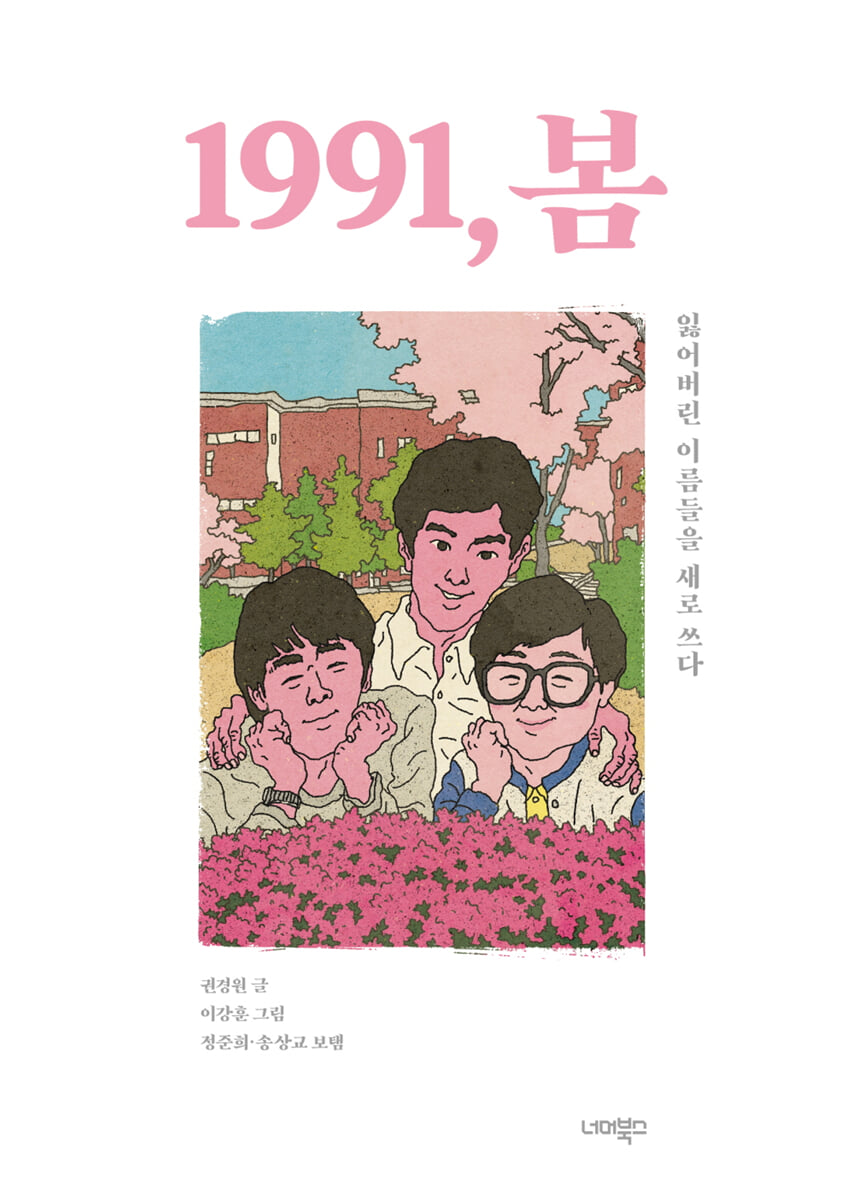
Artist Lee Kang-hoon imagined them as if they had lived in a spring day with flowers in full bloom, and drew them with faint smiles against the backdrop of a schoolyard lined with azaleas, a cherry blossom road, and Boseong green tea fields.
The book is filled with warmth as it features paintings and documentaries that evoke a sense of longing, and stories from across the country and abroad that bring these individuals to life.
The author asks us to reflect on whether we only talk about the memories of victory or whether we have a weak historical awareness that their sacrifices cannot be compared to those of Park Jong-cheol or Lee Han-yeol because they were demands for school autonomy or the sectoral movement.
How we remember them will determine the future of our society.
30 years have passed since 1991.
Now is the time to recall, mourn, reflect, and record those deaths and the names that were erased, one by one.
Records for a Better Society
"1991, Spring" is a book that records the stories of young people who threw themselves into resistance against state violence in the spring of 1991 and those who were unable to return home for the next 30 years.
Director Kwon Kyung-won, who directed and produced the documentary [1991, Spring], which deals with the May 1991 incident centered around the forged will incident, revisits the events between 1987 and 1991 and writes about and interviews with those who risked their lives to expose injustice after 1991 for several years.
Jeong Jun-hee and Song Sang-kyo added text, and author Lee Kang-hoon included illustrations of 21 people, from Kang Kyung-dae and Kim Gwi-jeong to Byun Hee-soo and Kim Yong-gyun.
The June Struggle of 1987, which achieved direct presidential elections through the power of the entire nation.
The Roh Tae-woo administration came to power in the year-end presidential election, but the democratization movement spread throughout all sectors of society.
However, it is not well known that the number of victims of state violence in the four years starting in 1987 was greater than the number of victims from 1959 to 1987 (excluding the April 19 Revolution and the May 18 Uprising).
Eight young people threw themselves into the water on April 26, 1991, and Park Chang-soo died mysteriously, until Kim Gwi-jeong died from police violence on May 26.
The author carefully examines how their anger and sacrifice were denigrated and erased.
While the police were at the forefront of blocking the mourning procession with violence, the media was inciting hatred every day, calling it a "death ritual" and a "power behind the scenes." The prosecution mobilized nine prosecutors to frame one individual for writing the will.
Professor Jeong Jun-hee analyzes that the press, which gained freedom through the people's struggle for democracy, abused that freedom and established itself as a bloc of power.
Attorney Song Sang-kyo, who is handling the forged will case, calmly explains that the judicial reality of 1991, from investigation to trial, has remained virtually unchanged for 30 years.
The reality that powerless and nameless deaths continue even now is the reason why 『1991, Spring』 recorded the stories of people who threw themselves into resistance against an unjust reality for 30 years.
The story of Moon Song-myeon, who died of mercury poisoning at the age of 17, brings to mind Kim Yong-gyun, and the story of Yuk Woo-dang, who hanged himself in the office of the Solidarity for LGBT Human Rights, brings to mind Byun Hee-soo and Kim Ki-hong.
Artist Lee Kang-hoon imagined them as if they had lived in a spring day with flowers in full bloom, and drew them with faint smiles against the backdrop of a schoolyard lined with azaleas, a cherry blossom road, and Boseong green tea fields.
The book is filled with warmth as it features paintings and documentaries that evoke a sense of longing, and stories from across the country and abroad that bring these individuals to life.
The author asks us to reflect on whether we only talk about the memories of victory or whether we have a weak historical awareness that their sacrifices cannot be compared to those of Park Jong-cheol or Lee Han-yeol because they were demands for school autonomy or the sectoral movement.
How we remember them will determine the future of our society.
30 years have passed since 1991.
Now is the time to recall, mourn, reflect, and record those deaths and the names that were erased, one by one.
- You can preview some of the book's contents.
Preview
index
Preface: Remembering 1991 5
0.
Between 1987 and 1991 15
Inside and Outside Korean Society in the Late 1980s 17
Image Politics of 1991: The Birth of Media Power 28
01 1991 Prelude to a Nightmare 39
Kang Kyung-dae, 41, a college freshman who never returned
45 years of time without Kang Kyung-dae
We've been enduring it for too long 49
The regime's counterattack: a three-party merger and a "police state"? 51
Prelude to a Nightmare, 1987–1991 54
Protesters will be tracked down and arrested until the end. 56
02 Resistance, Aversion, Silence 59
Successive resistance 61
Forbidden Mourning 63
65 Powers Behind the Scenes That Create Power Behind the Scenes
To forget or not to forget 70
03 Young Names Who Couldn't Return 75
April 29, 1991, Park Seung-hee, 77
May 1, 1991, Kim Young-gyun, 84
May 3, 1991, Cheon Se-yong, 88
May 8, 1991, Kim Ki-seol, 94
May 9, 1991, Park Chang-soo, 97
May 10, 1991, Yoon Yong-ha 105
May 18, 1991, Lee Jeong-sun 110
Kim Cheol-su, May 18, 1991, 115
May 22, 1991, Jeong Sang-sun 120
May 25, 1991, Kim Gwi-jeong 125
The nameless and powerless sacrifices never ceased. 131
1991, The Names 135
04 A Story Stranger Than a Novel: Reconstructing the Ghostwriting Case 139
“It felt like I was hit in the back of the head by a stranger on the street.” 141
“A million cowards, hypocrites, and sycophants are born every year.” 144
The Difficulty the Deceased Did Not Intentionally Cause 151
154 People Who Are Doing Better Now
Was it the same embarrassment as Gregor? 159
Stranger Kang Ki-hoon 162
“Take the role of the victim” 165
Some Wish 168
Lies, Hypocrisy, and the Survivors 171
Judicial Reality of 1991 174
The trial never ended, a seven-year retrial 186
No one ever apologized 191
The Reality of Damages Claims 196
05 People who haven't returned for a long time since then 201
September 17, 1985, Song Gwang-yeong 203
July 1988, Munsong-myeon 210
June 5, 1990, Kim Soo-kyung 216
March 1991, Dongwoo College Story 221
November 7, 1991, Yang Yong-chan 227
September 26, 1993, Gil Ok-hwa 231
Choi Jeong-hwan, March 8, 1995, 237
April 26, 2003, Yukwoodang 243
October 11, 2007, Lee Geun-jae 250
April 2013, Choi Jong-beom 255
Erased Time, Those Names 260
6.
People Who Remember 267
Conclusion: Trapped or Scattered? 295
0.
Between 1987 and 1991 15
Inside and Outside Korean Society in the Late 1980s 17
Image Politics of 1991: The Birth of Media Power 28
01 1991 Prelude to a Nightmare 39
Kang Kyung-dae, 41, a college freshman who never returned
45 years of time without Kang Kyung-dae
We've been enduring it for too long 49
The regime's counterattack: a three-party merger and a "police state"? 51
Prelude to a Nightmare, 1987–1991 54
Protesters will be tracked down and arrested until the end. 56
02 Resistance, Aversion, Silence 59
Successive resistance 61
Forbidden Mourning 63
65 Powers Behind the Scenes That Create Power Behind the Scenes
To forget or not to forget 70
03 Young Names Who Couldn't Return 75
April 29, 1991, Park Seung-hee, 77
May 1, 1991, Kim Young-gyun, 84
May 3, 1991, Cheon Se-yong, 88
May 8, 1991, Kim Ki-seol, 94
May 9, 1991, Park Chang-soo, 97
May 10, 1991, Yoon Yong-ha 105
May 18, 1991, Lee Jeong-sun 110
Kim Cheol-su, May 18, 1991, 115
May 22, 1991, Jeong Sang-sun 120
May 25, 1991, Kim Gwi-jeong 125
The nameless and powerless sacrifices never ceased. 131
1991, The Names 135
04 A Story Stranger Than a Novel: Reconstructing the Ghostwriting Case 139
“It felt like I was hit in the back of the head by a stranger on the street.” 141
“A million cowards, hypocrites, and sycophants are born every year.” 144
The Difficulty the Deceased Did Not Intentionally Cause 151
154 People Who Are Doing Better Now
Was it the same embarrassment as Gregor? 159
Stranger Kang Ki-hoon 162
“Take the role of the victim” 165
Some Wish 168
Lies, Hypocrisy, and the Survivors 171
Judicial Reality of 1991 174
The trial never ended, a seven-year retrial 186
No one ever apologized 191
The Reality of Damages Claims 196
05 People who haven't returned for a long time since then 201
September 17, 1985, Song Gwang-yeong 203
July 1988, Munsong-myeon 210
June 5, 1990, Kim Soo-kyung 216
March 1991, Dongwoo College Story 221
November 7, 1991, Yang Yong-chan 227
September 26, 1993, Gil Ok-hwa 231
Choi Jeong-hwan, March 8, 1995, 237
April 26, 2003, Yukwoodang 243
October 11, 2007, Lee Geun-jae 250
April 2013, Choi Jong-beom 255
Erased Time, Those Names 260
6.
People Who Remember 267
Conclusion: Trapped or Scattered? 295
Into the book
The names of Kim Ju-yeol, a 17-year-old who surfaced in the Masan sea in 1960, Jeon Tae-il, who died in flames at the Pyeonghwa Market while holding a copy of the Labor Standards Act, and Yun Sang-won, who defended the Gwangju Provincial Office to the end despite the airborne troops' gunfire, are etched in Korea's modern history. However, from the May 16 coup to the new military regime's seizure of power, cunning and absurd anti-historical times were also repeated blatantly.
It was only after more than 20 years that I was able to revisit the time between 1987 and 1991 while making the film “1991, Spring.”
The difficult stories I've written in this article will soon be organized into much neater sentences and become stories that can be found in textbooks.
However, as I went back through the materials from that time and went out to film, I would like to reveal that there were several moments between 1987 and just before 1991 that I was unaware of or had ignored before filming the film.
---p.23
On April 19, 1991, Gyeongnam University student Jeong Jin-tae and Wonkwang University student Yu Cheol-geun were seriously injured and required brain surgery after being hit by tear gas fired directly by the police.
The next day, an accident occurs where Chonnam National University student Choi Kang-il is hit by a KP tear gas canister and loses sight in his left eye.
While young people were exposed to a 'predestined disaster' that they did not intend, the unwavering, one-sided, ultra-hardline state violence did not hesitate even once, until it reached Kang Kyung-dae, who died during a protest sparked by a tuition issue, Park Chang-soo, the union leader who died mysteriously during the National Intelligence Service's operation to obstruct the establishment of the Korean Council of Trade Unions (hereafter, the National Council of Trade Unions), and Kim Gwi-jeong of Sungkyunkwan University, who died in a rabbit-like suppression during a protest.
As we now know, it ultimately succeeds in tearing apart the solidarity of the weak who have barely joined hands in the dream of a better society.
---p.57
What broke me was his voice vaguely calling out to someone to hear his voice.
“Everyone, everyone.”
It felt like Cheolsu, who passed away 30 years ago, was repeatedly calling me in the second person.
I listened to Kim Cheol-su's voice over and over again to convey it without making a single mistake.
we
I think you all know what I want to say to you.
From now on, everyone!
I would appreciate it if you could think about what a true life is from one to ten.
I hope that we can become a society where justice overflows in everything we do.
(omitted)
---pp.118,119
Those who belittle the events of the spring of 1991 are not only conservatives.
The argument that 'Kang Kyung-dae died in the midst of a struggle for academic autonomy (which was incomparable to that of 1987) and therefore cannot be remembered as much as Park Jong-cheol or Lee Han-yeol' also relies on a poor sense of history that has existed to the point where the distinction between camps is meaningless.
Kang Kyung-dae was also a vanguard who stood on the front line where Lee Han-yeol stood.
Everything that happened in 1991, from the struggle for school autonomy and labor disputes that took place throughout society to the comfort women issue first raised by grandmother Kim Hak-sun, was a frontline fight as desperate as the "abolition of the Constitution and overthrow of the dictatorship" of 1987.
It is time to face the struggles of countless nameless people who tried to deeply embed democracy, which was only in words during the Sixth Republic, into their own lives.
---pp.133,134
The second keyword is the ‘principle of unity of inspection.’
When the Prosecutor General issued an order to investigate the 'mastermind behind the altercation' and the Seoul District Prosecutors' Office formed a large-scale investigation team, each and every prosecutor had to follow the order.
Why would that be?
At that time, Article 7, Paragraph 1 of the Public Prosecutors' Office Act, under the title of "Principle of Unity of Prosecutors," stipulated in Paragraph 1 that "prosecutors shall obey the orders of their superiors with regard to prosecution affairs."
In political cases, this principle has become a basis for more blatantly manipulating investigations.
The 'self-immolation theory' raised by the government and prosecution soon became a firm guideline for the investigation.
---p.178
The real name of Yuk Woo-dang, a sexual minority rights activist, is Yoon Hyun-seok.
Yuk Woo-dang's real name, which he had left in his will saying, "After I die, you will be able to call my name proudly," could not be made public even after 10 years since his death.
Even after his death, the reality remains that young LGBTQ+ youth are still being advised to seek "treatment" for their identity, even from youth phone counselors.
There is no life that can be pushed back to later.
The rainbow flag that Attorney Jang held in front of the presidential candidates continued to flutter in the sky over Gwanghwamun Candlelight Square throughout the winter, and on May 24, 2019, Taiwan became the first country in Asia to recognize same-sex marriage.
It was only after more than 20 years that I was able to revisit the time between 1987 and 1991 while making the film “1991, Spring.”
The difficult stories I've written in this article will soon be organized into much neater sentences and become stories that can be found in textbooks.
However, as I went back through the materials from that time and went out to film, I would like to reveal that there were several moments between 1987 and just before 1991 that I was unaware of or had ignored before filming the film.
---p.23
On April 19, 1991, Gyeongnam University student Jeong Jin-tae and Wonkwang University student Yu Cheol-geun were seriously injured and required brain surgery after being hit by tear gas fired directly by the police.
The next day, an accident occurs where Chonnam National University student Choi Kang-il is hit by a KP tear gas canister and loses sight in his left eye.
While young people were exposed to a 'predestined disaster' that they did not intend, the unwavering, one-sided, ultra-hardline state violence did not hesitate even once, until it reached Kang Kyung-dae, who died during a protest sparked by a tuition issue, Park Chang-soo, the union leader who died mysteriously during the National Intelligence Service's operation to obstruct the establishment of the Korean Council of Trade Unions (hereafter, the National Council of Trade Unions), and Kim Gwi-jeong of Sungkyunkwan University, who died in a rabbit-like suppression during a protest.
As we now know, it ultimately succeeds in tearing apart the solidarity of the weak who have barely joined hands in the dream of a better society.
---p.57
What broke me was his voice vaguely calling out to someone to hear his voice.
“Everyone, everyone.”
It felt like Cheolsu, who passed away 30 years ago, was repeatedly calling me in the second person.
I listened to Kim Cheol-su's voice over and over again to convey it without making a single mistake.
we
I think you all know what I want to say to you.
From now on, everyone!
I would appreciate it if you could think about what a true life is from one to ten.
I hope that we can become a society where justice overflows in everything we do.
(omitted)
---pp.118,119
Those who belittle the events of the spring of 1991 are not only conservatives.
The argument that 'Kang Kyung-dae died in the midst of a struggle for academic autonomy (which was incomparable to that of 1987) and therefore cannot be remembered as much as Park Jong-cheol or Lee Han-yeol' also relies on a poor sense of history that has existed to the point where the distinction between camps is meaningless.
Kang Kyung-dae was also a vanguard who stood on the front line where Lee Han-yeol stood.
Everything that happened in 1991, from the struggle for school autonomy and labor disputes that took place throughout society to the comfort women issue first raised by grandmother Kim Hak-sun, was a frontline fight as desperate as the "abolition of the Constitution and overthrow of the dictatorship" of 1987.
It is time to face the struggles of countless nameless people who tried to deeply embed democracy, which was only in words during the Sixth Republic, into their own lives.
---pp.133,134
The second keyword is the ‘principle of unity of inspection.’
When the Prosecutor General issued an order to investigate the 'mastermind behind the altercation' and the Seoul District Prosecutors' Office formed a large-scale investigation team, each and every prosecutor had to follow the order.
Why would that be?
At that time, Article 7, Paragraph 1 of the Public Prosecutors' Office Act, under the title of "Principle of Unity of Prosecutors," stipulated in Paragraph 1 that "prosecutors shall obey the orders of their superiors with regard to prosecution affairs."
In political cases, this principle has become a basis for more blatantly manipulating investigations.
The 'self-immolation theory' raised by the government and prosecution soon became a firm guideline for the investigation.
---p.178
The real name of Yuk Woo-dang, a sexual minority rights activist, is Yoon Hyun-seok.
Yuk Woo-dang's real name, which he had left in his will saying, "After I die, you will be able to call my name proudly," could not be made public even after 10 years since his death.
Even after his death, the reality remains that young LGBTQ+ youth are still being advised to seek "treatment" for their identity, even from youth phone counselors.
There is no life that can be pushed back to later.
The rainbow flag that Attorney Jang held in front of the presidential candidates continued to flutter in the sky over Gwanghwamun Candlelight Square throughout the winter, and on May 24, 2019, Taiwan became the first country in Asia to recognize same-sex marriage.
---p.249
Publisher's Review
Between 1987 and 1991, and in May 1991
The book revisits the period between 1987 and 1991 before bringing the spring of 1991 into the present.
The author believes that the seeds of the tragedy of 1991 were sown at this time.
The democratization fever of 1987 was soon frozen by the government's counterattack, represented by the three-party merger and the public security situation.
The declaration of war on crime in October 1990 led to a strong public security regime that "tracks down and arrests protesters to the end."
Director Kwon Kyung-won wrote in this book that when Korean society was turned upside down, it was, in a word, 'the prelude to a nightmare.'
On April 26, 1991, Kang Kyung-dae, a student at Myongji University, was beaten to death with an iron pipe by members of the Baekgoldan.
And young people in their prime risked their lives to protest against the tyranny of the regime.
On April 29, Chonnam National University student Park Seung-hee set herself on fire during a rally to condemn the death of Kang Kyung-dae.
On May 1st, Andong National University student Kim Young-gyun, on May 3rd, Kyungwon University student Cheon Se-yong, on May 8th, Jeonminryun Social Affairs Department Director Kim Ki-seol, on May 12th, Workplace Democratization Youth Alliance member Yoon Yong-ha, on May 18th, worker Lee Jeong-sun, on May 19th, Jeonnam Boseong High School student Kim Cheol-su, and on May 22nd, worker Jeong Sang-sun threw themselves into the fight.
On May 6, Park Chang-soo, the chairman of the Hanjin Heavy Industries union, died under suspicious circumstances, and on May 25, Kim Gwi-jeong of Sungkyunkwan University died during a protest.
They were all in their 20s and 30s.
In response, the state power created the worst case of forged will, claiming that "there is someone behind the death."
Those who mobilized nine prosecutors to 'find out the power behind the scenes' acted as one body and succeeded in changing the flow of the political situation that had been demanding the restoration of democratic order into punishment for the unfilial group.
『1991, Spring』 contained an analysis by Jeong Jun-hee, an adjunct professor of information and media sociology at Hanyang University, who argued that ‘media power’ was born during this process.
Starting with the Chosun Ilbo, which published Kim Ji-ha's column, they competed to report on the suspicion of ghostwriting and ran a special article on a photo of Acting Prime Minister Jeong Won-sik covered in flour, successfully manipulating the image of him as an 'unfilial son', and finally became a true 'media power' in name and reality.
As the instability and unpredictability of the power re-creation structure rapidly increased, vacuums frequently emerged, and the importance of discursive competition to coordinate the interests of the power elite while securing external legitimacy grew.
It was the mainstream media in Korea that exploited this very gap.
_Jeong Jun-hee
Death, which resisted unjust public power, was denigrated and became an object of hatred in this process.
The cry to live together was rapidly losing strength.
It only left scars.
Young names who sacrificed themselves to save others
What were the lives of these people, barely in their 20s or 30s, like? What were their thoughts like? Stories from years of research into their lives unfold with a calming tone.
Kang Kyung-dae, a freshman at Myongji University, leaves a loving note to his parents saying he will go to school, study hard, and return soon, and has ambitions to become a businessman who donates 99% of his earnings.
He was a high school student who visited Myeongdong Cathedral to meet with teachers who had been fired after joining the Korean Teachers and Education Workers Union.
Park Seung-hee, Kim Yong-gyun, and Cheon Se-yong were all students of the class of 1990. They had experienced the dismissal of their teacher when they were high school students and had participated in the high school student movement by distributing protest leaflets.
Kim Cheol-su, a second-year high school student at Boseong High School, also set himself on fire, saying, "Let's get a proper education."
In the will he left behind while battling illness, the words “everyone, everyone” appear repeatedly, which breaks his heart.
The resistance of Yoon Yong-ha, Lee Jeong-sun, and Jeong Sang-sun, who could not just watch these sudden deaths, was met with a cold gaze as if they were sudden, unknown deaths.
However, they were people who were born in difficult times and worked hard to build their own lives, and they boldly revealed the reason for throwing themselves into it, like Jeong Sang-sun's will, "Why do young students have to go? We, the young generation of the established generation, are ashamed. I am choked up."
Kim Gwi-jeong, who was sacrificed in the suppression of the rabbit hunt in Chungmuro, was actively involved in club activities and student council activities even though he had to work part-time to pay for his tuition due to financial difficulties.
The documentary "Wangsimni Kim Jong-bun," which tells the story of Kim Gwi-jeong's mother, Kim Jong-bun, who promised to buy her delicious food when she earned money later, is scheduled to be released on May 25th.
The masterminds of the forged will case, for which no one has ever apologized.
The forged will incident that caused the May 1991 Struggle to shift from a situation of neglect and silence.
Mostly alone, sometimes with a few colleagues, Kang Ki-hoon remains trapped in a prison of misunderstanding and prejudice, even after 1,151 days of unacceptable imprisonment.
The author says we don't really know much about the forged will case.
This is the first case in which the prosecution, rather than the police headquarters or intelligence agencies, initiated the investigation and created the case from the beginning.
The fact that immediately after the 'Security Relations Countermeasures Meeting' on the morning of May 8th, the day Kim Ki-seol committed suicide, a team of prosecutors from the Seoul District Prosecutors' Office's Violent Crimes Division was formed under the Prosecutor General's order to 'investigate the mastermind', and that they conducted coercive investigations and separate investigations without even the most basic human rights, collected evidence that appeared to be Kim Ki-seol's handwriting, and then destroyed all of it, and even after doing so, issued an indictment that could not even specify the place or time.
The facts of the case were made into a 'fact' by announcing them to the media every day, and the trial's conclusion was already decided.
(1990-1991) If I were to summarize in a few points how the judicial reality was structured and operated at the time, I would be surprised once again by the fact that not much has changed even after 30 years.
_Song Sang-kyo
Even though the Supreme Court ruled him not guilty in a retrial in 2014, legally, Kim Ki-seol's will is still considered to have been written by someone other than Kim Ki-seol.
None of the prosecutors or judges in charge have ever apologized.
Almost all of them have gone on to achieve great success, and in 2021, they still serve as lawyers, members of the National Assembly, and heads of private foundations.
This is why I had no choice but to file a civil suit even though I was going through trauma.
I would like to say a word to the prosecution, which continues to repeat its past claims even in the retrial court.
True courage is confessing your mistakes.
The prosecution, which should be a source of pride for the people, is now a laughing stock. The prosecution itself is responsible for this.
- 2014.
1. From the final statement of Kang Ki-hoon at the retrial on the 16th
The book contains heartwarming anecdotes that make us feel the humanity of Ki-Hoon Kang, who has been trapped in this case for 30 years but has handled it with composure and composure, and the people around him.
Our society's future lies in remembering the powerless and nameless sacrifices.
Since 1991, the meaning of sacrifice and death has been denigrated.
And the meaning has left wounds on many, and the reality remains that the deaths of the weak are still not respected.
In 1985, Song Gwang-yeong of Kyungwon University was the first university student to self-immolate in protest against Chun Doo-hwan's oppression, and there have been many Kyungwon University students who have self-immolated since the 1990s.
The violence committed by the academy in an attempt to remove his memorial from the school grounds is no different from the sacrifices that occurred during the fight to resolve corruption at academies such as Dongwoo College and Dong-eui University.
16-year-old Moon Song-myeon gets a job at a thermometer factory to earn money and study.
His death from mercury poisoning after only a few months of working in a squalid workplace was far from the national movement for democratic labor unions.
Like the tragic death of Kim Yong-gyun at the Taean Thermal Power Plant in 2018.
The sacrifice of Choi Jong-beom, the father of Byul, who wanted to expose the so-called first-class company Samsung and the despicable acts it did to prevent the formation of a union, clearly laid the foundation for breaking Samsung's no-union policy a few years later.
The incident in which numerous teachers were fired for joining the Korean Teachers and Education Workers Union, which advocated for humanized education and freedom from standardized and oppressive education, led to the sacrifices of Kim Su-kyung, who threw herself at Kyunghwa Girls' High School in Daegu on June 5, 1990, and Gil Ok-hwa, who passed away on September 26, 2003, unable to bear the humiliation of being told to write a resignation letter.
Last year, the Korean Teachers and Education Workers Union was finally legalized.
However, there are still sharp words attacking the Seoul Metropolitan Office of Education for selecting teachers with a history of educational democratization movement through legal procedures.
April 26, 2003 is the day when 19-year-old homosexual Yuk Woo-dang hanged himself at the office of the Solidarity for LGBT Human Rights (hereafter referred to as the Solidarity).
Nearly 20 years have passed since they resisted with their lives the radical church and all kinds of malicious comments that tried to erase their existence, but Sergeant Byun Hee-soo and Teacher Kim Ki-hong had no choice but to leave their paths of life.
The stories of Yang Yong-chan, who resisted the transformation of his hometown into a tourist attraction, Choi Jeong-hwan, who called for the abolition of discrimination against the disabled, and Lee Geun-jae, who fought for his right to live in the face of the slogan of urban beautification, must be remembered and recorded in light of the truth that no life can be postponed.
At the end of the book, there are stories of people who remember.
The story of the documentary “1991, Spring” being invited to be screened in foreign countries such as Prague, Czech Republic, Yokohama, and Udine, Italy, and the story of meeting people in Jeongeup, Busan, Gwangju, Andong, etc., show the way to a minimum level of empathy and solidarity.
The book revisits the period between 1987 and 1991 before bringing the spring of 1991 into the present.
The author believes that the seeds of the tragedy of 1991 were sown at this time.
The democratization fever of 1987 was soon frozen by the government's counterattack, represented by the three-party merger and the public security situation.
The declaration of war on crime in October 1990 led to a strong public security regime that "tracks down and arrests protesters to the end."
Director Kwon Kyung-won wrote in this book that when Korean society was turned upside down, it was, in a word, 'the prelude to a nightmare.'
On April 26, 1991, Kang Kyung-dae, a student at Myongji University, was beaten to death with an iron pipe by members of the Baekgoldan.
And young people in their prime risked their lives to protest against the tyranny of the regime.
On April 29, Chonnam National University student Park Seung-hee set herself on fire during a rally to condemn the death of Kang Kyung-dae.
On May 1st, Andong National University student Kim Young-gyun, on May 3rd, Kyungwon University student Cheon Se-yong, on May 8th, Jeonminryun Social Affairs Department Director Kim Ki-seol, on May 12th, Workplace Democratization Youth Alliance member Yoon Yong-ha, on May 18th, worker Lee Jeong-sun, on May 19th, Jeonnam Boseong High School student Kim Cheol-su, and on May 22nd, worker Jeong Sang-sun threw themselves into the fight.
On May 6, Park Chang-soo, the chairman of the Hanjin Heavy Industries union, died under suspicious circumstances, and on May 25, Kim Gwi-jeong of Sungkyunkwan University died during a protest.
They were all in their 20s and 30s.
In response, the state power created the worst case of forged will, claiming that "there is someone behind the death."
Those who mobilized nine prosecutors to 'find out the power behind the scenes' acted as one body and succeeded in changing the flow of the political situation that had been demanding the restoration of democratic order into punishment for the unfilial group.
『1991, Spring』 contained an analysis by Jeong Jun-hee, an adjunct professor of information and media sociology at Hanyang University, who argued that ‘media power’ was born during this process.
Starting with the Chosun Ilbo, which published Kim Ji-ha's column, they competed to report on the suspicion of ghostwriting and ran a special article on a photo of Acting Prime Minister Jeong Won-sik covered in flour, successfully manipulating the image of him as an 'unfilial son', and finally became a true 'media power' in name and reality.
As the instability and unpredictability of the power re-creation structure rapidly increased, vacuums frequently emerged, and the importance of discursive competition to coordinate the interests of the power elite while securing external legitimacy grew.
It was the mainstream media in Korea that exploited this very gap.
_Jeong Jun-hee
Death, which resisted unjust public power, was denigrated and became an object of hatred in this process.
The cry to live together was rapidly losing strength.
It only left scars.
Young names who sacrificed themselves to save others
What were the lives of these people, barely in their 20s or 30s, like? What were their thoughts like? Stories from years of research into their lives unfold with a calming tone.
Kang Kyung-dae, a freshman at Myongji University, leaves a loving note to his parents saying he will go to school, study hard, and return soon, and has ambitions to become a businessman who donates 99% of his earnings.
He was a high school student who visited Myeongdong Cathedral to meet with teachers who had been fired after joining the Korean Teachers and Education Workers Union.
Park Seung-hee, Kim Yong-gyun, and Cheon Se-yong were all students of the class of 1990. They had experienced the dismissal of their teacher when they were high school students and had participated in the high school student movement by distributing protest leaflets.
Kim Cheol-su, a second-year high school student at Boseong High School, also set himself on fire, saying, "Let's get a proper education."
In the will he left behind while battling illness, the words “everyone, everyone” appear repeatedly, which breaks his heart.
The resistance of Yoon Yong-ha, Lee Jeong-sun, and Jeong Sang-sun, who could not just watch these sudden deaths, was met with a cold gaze as if they were sudden, unknown deaths.
However, they were people who were born in difficult times and worked hard to build their own lives, and they boldly revealed the reason for throwing themselves into it, like Jeong Sang-sun's will, "Why do young students have to go? We, the young generation of the established generation, are ashamed. I am choked up."
Kim Gwi-jeong, who was sacrificed in the suppression of the rabbit hunt in Chungmuro, was actively involved in club activities and student council activities even though he had to work part-time to pay for his tuition due to financial difficulties.
The documentary "Wangsimni Kim Jong-bun," which tells the story of Kim Gwi-jeong's mother, Kim Jong-bun, who promised to buy her delicious food when she earned money later, is scheduled to be released on May 25th.
The masterminds of the forged will case, for which no one has ever apologized.
The forged will incident that caused the May 1991 Struggle to shift from a situation of neglect and silence.
Mostly alone, sometimes with a few colleagues, Kang Ki-hoon remains trapped in a prison of misunderstanding and prejudice, even after 1,151 days of unacceptable imprisonment.
The author says we don't really know much about the forged will case.
This is the first case in which the prosecution, rather than the police headquarters or intelligence agencies, initiated the investigation and created the case from the beginning.
The fact that immediately after the 'Security Relations Countermeasures Meeting' on the morning of May 8th, the day Kim Ki-seol committed suicide, a team of prosecutors from the Seoul District Prosecutors' Office's Violent Crimes Division was formed under the Prosecutor General's order to 'investigate the mastermind', and that they conducted coercive investigations and separate investigations without even the most basic human rights, collected evidence that appeared to be Kim Ki-seol's handwriting, and then destroyed all of it, and even after doing so, issued an indictment that could not even specify the place or time.
The facts of the case were made into a 'fact' by announcing them to the media every day, and the trial's conclusion was already decided.
(1990-1991) If I were to summarize in a few points how the judicial reality was structured and operated at the time, I would be surprised once again by the fact that not much has changed even after 30 years.
_Song Sang-kyo
Even though the Supreme Court ruled him not guilty in a retrial in 2014, legally, Kim Ki-seol's will is still considered to have been written by someone other than Kim Ki-seol.
None of the prosecutors or judges in charge have ever apologized.
Almost all of them have gone on to achieve great success, and in 2021, they still serve as lawyers, members of the National Assembly, and heads of private foundations.
This is why I had no choice but to file a civil suit even though I was going through trauma.
I would like to say a word to the prosecution, which continues to repeat its past claims even in the retrial court.
True courage is confessing your mistakes.
The prosecution, which should be a source of pride for the people, is now a laughing stock. The prosecution itself is responsible for this.
- 2014.
1. From the final statement of Kang Ki-hoon at the retrial on the 16th
The book contains heartwarming anecdotes that make us feel the humanity of Ki-Hoon Kang, who has been trapped in this case for 30 years but has handled it with composure and composure, and the people around him.
Our society's future lies in remembering the powerless and nameless sacrifices.
Since 1991, the meaning of sacrifice and death has been denigrated.
And the meaning has left wounds on many, and the reality remains that the deaths of the weak are still not respected.
In 1985, Song Gwang-yeong of Kyungwon University was the first university student to self-immolate in protest against Chun Doo-hwan's oppression, and there have been many Kyungwon University students who have self-immolated since the 1990s.
The violence committed by the academy in an attempt to remove his memorial from the school grounds is no different from the sacrifices that occurred during the fight to resolve corruption at academies such as Dongwoo College and Dong-eui University.
16-year-old Moon Song-myeon gets a job at a thermometer factory to earn money and study.
His death from mercury poisoning after only a few months of working in a squalid workplace was far from the national movement for democratic labor unions.
Like the tragic death of Kim Yong-gyun at the Taean Thermal Power Plant in 2018.
The sacrifice of Choi Jong-beom, the father of Byul, who wanted to expose the so-called first-class company Samsung and the despicable acts it did to prevent the formation of a union, clearly laid the foundation for breaking Samsung's no-union policy a few years later.
The incident in which numerous teachers were fired for joining the Korean Teachers and Education Workers Union, which advocated for humanized education and freedom from standardized and oppressive education, led to the sacrifices of Kim Su-kyung, who threw herself at Kyunghwa Girls' High School in Daegu on June 5, 1990, and Gil Ok-hwa, who passed away on September 26, 2003, unable to bear the humiliation of being told to write a resignation letter.
Last year, the Korean Teachers and Education Workers Union was finally legalized.
However, there are still sharp words attacking the Seoul Metropolitan Office of Education for selecting teachers with a history of educational democratization movement through legal procedures.
April 26, 2003 is the day when 19-year-old homosexual Yuk Woo-dang hanged himself at the office of the Solidarity for LGBT Human Rights (hereafter referred to as the Solidarity).
Nearly 20 years have passed since they resisted with their lives the radical church and all kinds of malicious comments that tried to erase their existence, but Sergeant Byun Hee-soo and Teacher Kim Ki-hong had no choice but to leave their paths of life.
The stories of Yang Yong-chan, who resisted the transformation of his hometown into a tourist attraction, Choi Jeong-hwan, who called for the abolition of discrimination against the disabled, and Lee Geun-jae, who fought for his right to live in the face of the slogan of urban beautification, must be remembered and recorded in light of the truth that no life can be postponed.
At the end of the book, there are stories of people who remember.
The story of the documentary “1991, Spring” being invited to be screened in foreign countries such as Prague, Czech Republic, Yokohama, and Udine, Italy, and the story of meeting people in Jeongeup, Busan, Gwangju, Andong, etc., show the way to a minimum level of empathy and solidarity.
GOODS SPECIFICS
- Date of issue: May 7, 2021
- Page count, weight, size: 302 pages | 418g | 150*210*30mm
- ISBN13: 9788994606651
- ISBN10: 8994606653
You may also like
카테고리
korean


korean

![GQ KOREA Mark (Monthly): December [2025]](http://librairie.coreenne.fr/cdn/shop/files/8ef265dbbfbf186523ed75ba7319009d.jpg?v=1765340328&width=3840)


