

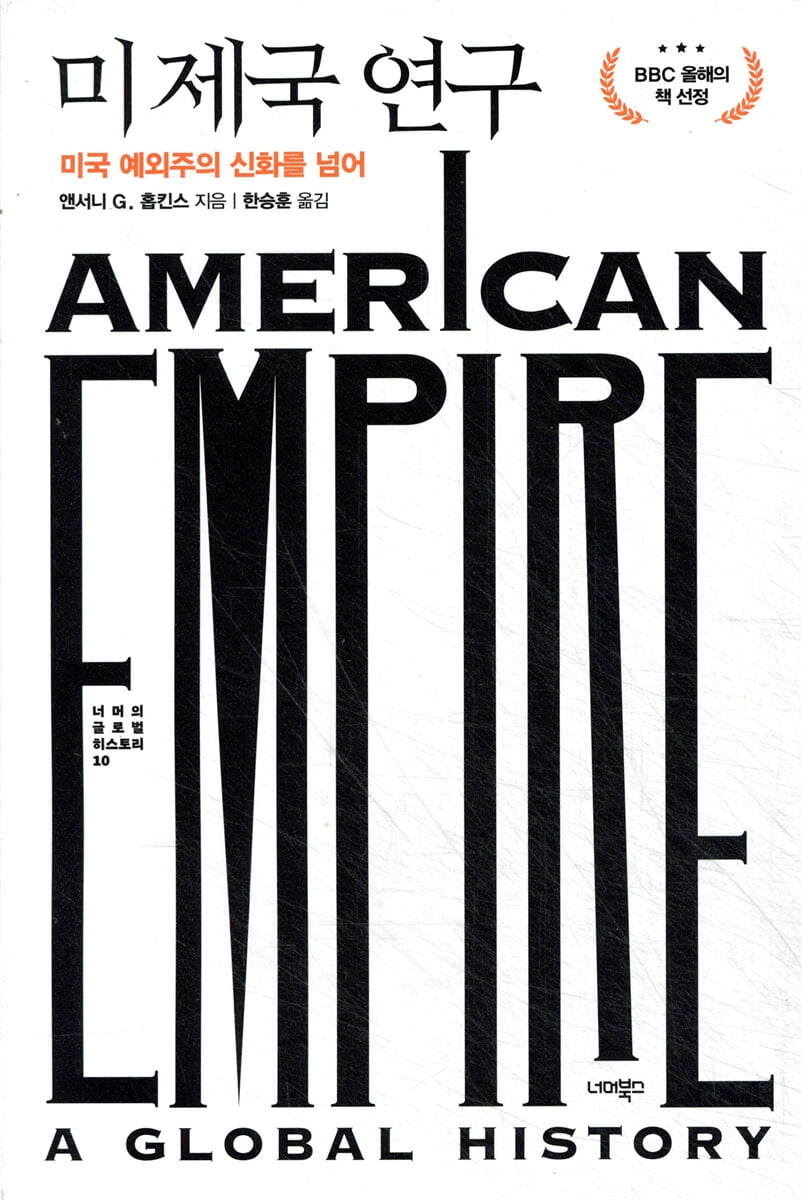
American Empire Studies
 |
Description
Book Introduction
BBC (History Magazine) Book of the Year,
What will happen to America?
The master's magnum opus, AMERICAN EMPIRE: A Global History, systematically dismantles the myth of "American exceptionalism" through 1,450 pages of extensive research and dazzling insights.
A key approach is to situate America's national narrative within a global, and specifically imperial, context.
Thus, this book combines American history with the history of Western empires, extending beyond the Atlantic to the Pacific.
Anthony G.
Hopkins (Professor Emeritus, University of Cambridge) identifies ‘empire’ as the core driving force of globalization.
“During the three centuries covered in this study (18th to 20th centuries), globalization and empire were closely linked.
“Empires were active innovators and agents of globalization,” he defines, and identifies three major phases of globalization—early globalization (late 18th century), modern globalization (late 19th century), and postcolonial globalization (mid-20th century)—and analyzes the dialectical interactions that led to these changes.
Anthony Hopkins opens this book with the British invasion of Iraq in 1915 and concludes it with the American occupation of Iraq in 2003, in order to convey the message of Iraq's Kut, which had enormous consequences for the international community due to its failure to recognize the new phase of globalization and the fundamental shift in power.
Unfortunately, the author points out that the United States has a tradition of preferring confrontation over compromise, and in the preface to the Korean edition, he says that the radical challenge to international trade triggered by Trump's election in 2025 "can be seen as an example of aggressive economic imperialism, different from building a territorial empire," and that this does not mean that China can be treated like Cuba.
We are currently at the beginning of a long winter, marked by protracted trade wars and rising international tensions.
In this way, 『Studies in American Empire』 presents a way to understand what America will become, both now and in the near future.
What will happen to America?
The master's magnum opus, AMERICAN EMPIRE: A Global History, systematically dismantles the myth of "American exceptionalism" through 1,450 pages of extensive research and dazzling insights.
A key approach is to situate America's national narrative within a global, and specifically imperial, context.
Thus, this book combines American history with the history of Western empires, extending beyond the Atlantic to the Pacific.
Anthony G.
Hopkins (Professor Emeritus, University of Cambridge) identifies ‘empire’ as the core driving force of globalization.
“During the three centuries covered in this study (18th to 20th centuries), globalization and empire were closely linked.
“Empires were active innovators and agents of globalization,” he defines, and identifies three major phases of globalization—early globalization (late 18th century), modern globalization (late 19th century), and postcolonial globalization (mid-20th century)—and analyzes the dialectical interactions that led to these changes.
Anthony Hopkins opens this book with the British invasion of Iraq in 1915 and concludes it with the American occupation of Iraq in 2003, in order to convey the message of Iraq's Kut, which had enormous consequences for the international community due to its failure to recognize the new phase of globalization and the fundamental shift in power.
Unfortunately, the author points out that the United States has a tradition of preferring confrontation over compromise, and in the preface to the Korean edition, he says that the radical challenge to international trade triggered by Trump's election in 2025 "can be seen as an example of aggressive economic imperialism, different from building a territorial empire," and that this does not mean that China can be treated like Cuba.
We are currently at the beginning of a long winter, marked by protracted trade wars and rising international tensions.
In this way, 『Studies in American Empire』 presents a way to understand what America will become, both now and in the near future.
index
Preface to the Korean edition
introduction
Prologue: Lessons of Liberation: Iraq, 1915–1921
Chapter 1: Three Crises and Their Consequences
Choosing among alternatives
Beyond the national ideology of American exceptionalism
Empire: 'A Rose by Any Other Name…?'
Globalization and Empires
Time and change
The growing toil of a longer journey
Part 1 | Decolonization and Subordination 1759–1865
Chapter 2: The Development and Decline of the Military-Financial State
Human relationships and chronology
A huge convergence?
The Glorious Revolution and the Exceptional Military-Financial State
The development of the British military-financial state
New World Order
War, Reconstruction, and Reform
UK: 'A Combination of Permanence and Change'
The vast empire on which the sun never sets
'Images of the past projected into the fog of the unknown'
Chapter 3: From Revolution to Constitution
Harry Washington and the Emerging World Order
Towards a 'New Colonial System'
John Company's activities
A revolution with dashed expectations
'A union of states, indivisible, under one federal government'
A magnificent scene of turmoil and conflict
Planning for an Empire, Not an Empire
Chapter 4: The Struggle for Independence
Midnight's Children
The Rhetoric and Reality of Revolution
The dilemma of dependent development
Cultural continuity
Transforming the wilderness into a haven for the ideal of freedom.
Chapter 5: The Merger War
'Great nation of the future'
The brilliant idea of property, the concept of exclusive rights.
1812: A Second War of Independence?
America knows how to expand and how to trample.
'An uncontrollable conflict between opposing forces'
"Please, I beg you, let's avoid getting involved in this, if possible."
Rethinking War and Peace
Part 2 | Modernity and Imperialism 1865–1914
Chapter 6: Uneven Development and Imperial Expansion
A Turbulent Earth, Facing a New Era
The Road to Money: A Journey to Modern Globalization
“Oh, brothers, love your country.”
massive deflation
Globalization and 'New' Imperialism
Lions, Jackals, and the Struggle for Empire
A New Era, an Era of Social Progress
Chapter 7: Achieving Substantial Independence
In the whirlpool of confusion and pain
'I lost everything but my position and that hope.'
"Beautiful credit! The cornerstone of modern society."
global nationalist culture
From 'Federation' to 'United States'
Chapter 8: Mastering the Ordinary Empire
'The world's opportunity, the world's duty, the world's glory'
Controversy surrounding the war of 1898
Don Quixote's Last Journey
Mobilization of means of destruction
The unstoppable expansion seems to be back in action.
'We have come not as tyrants, but as angels of salvation.'
Fate, Divinity, and the Dollar
Chapter 9: The Islands' Perspective on the Invading World
The unstoppable wheel of modern politics
sugar-coated pills
Cuba: 'Depraved people with no sense of honor or gratitude'
Puerto Rico: A Journey Through History
Philippines: "The Land I Worship, the Sorrow of My Sorrow"
Hawaii: 'A rapidly disappearing people'
Chosen War
Intermission: Modernity Through Tarzan
Part 3 | Empire and International Disorder, 1914–1959
Chapter 10: The Modern Imperial System: From Conquest to Collapse
'Is this the American Century?'
Isolation or integration?
World War I and the Return to Normalcy
One of the greatest economic disasters in modern history
The war that destroyed and reorganized the empire
Second colonial occupation
colonial-style liberation
Empire and Colony: The End of the Story
Chapter 11: The Rule of a Forgotten Empire
belated regret
A Greater Britain, A Nobler Mission
Modernization mission
The Empire's Possessions: Parliament and the Constitution
Lobby and Freedom
A course taught under the guidance of a strong leader.
'There wasn't even a ripple of failure on the wave of success.'
view
Chapter 12: Carnival of the Caribbean
Islands of Pleasure
Puerto Rico: 'A Model of Island Governance'
Cuba: 'That damn little republic'
“We are no longer shaken.”
Chapter 13: Paradise in the Pacific
Where the Blue Sky Calls Me
Hawaii: Island of Peace, Happy World
Philippines: 'Just and Moderate Governance Instead of Arbitrary Rule'
“We will not rest until our flag flies.”
Memoirs of an Island Empire
Chapter 14: The Twilight of Colonialism
Delegate authority and assume responsibility
global context
Don't let go of the empire
Defense in the Pacific
Coercion and Collaboration in the Caribbean
Moving on to the next phase
Progress in the Pacific?
Caribbean Contrasts
Conclusion: A shining example of the American way for the entire planet.
Part 4 | Outcome: Decolonizing Globalization
Chapter 15: Dominance and Decline in the Postcolonial Era
Our only duty to history is to rewrite it.
Globalization and Empire
Postcolonial globalization
The United States: A country striving for hegemony
Captain America: Will it continue?
Epilogue: Lessons of Freedom: Iraq, 2003–2011
Americas
Translator's Note
Search
introduction
Prologue: Lessons of Liberation: Iraq, 1915–1921
Chapter 1: Three Crises and Their Consequences
Choosing among alternatives
Beyond the national ideology of American exceptionalism
Empire: 'A Rose by Any Other Name…?'
Globalization and Empires
Time and change
The growing toil of a longer journey
Part 1 | Decolonization and Subordination 1759–1865
Chapter 2: The Development and Decline of the Military-Financial State
Human relationships and chronology
A huge convergence?
The Glorious Revolution and the Exceptional Military-Financial State
The development of the British military-financial state
New World Order
War, Reconstruction, and Reform
UK: 'A Combination of Permanence and Change'
The vast empire on which the sun never sets
'Images of the past projected into the fog of the unknown'
Chapter 3: From Revolution to Constitution
Harry Washington and the Emerging World Order
Towards a 'New Colonial System'
John Company's activities
A revolution with dashed expectations
'A union of states, indivisible, under one federal government'
A magnificent scene of turmoil and conflict
Planning for an Empire, Not an Empire
Chapter 4: The Struggle for Independence
Midnight's Children
The Rhetoric and Reality of Revolution
The dilemma of dependent development
Cultural continuity
Transforming the wilderness into a haven for the ideal of freedom.
Chapter 5: The Merger War
'Great nation of the future'
The brilliant idea of property, the concept of exclusive rights.
1812: A Second War of Independence?
America knows how to expand and how to trample.
'An uncontrollable conflict between opposing forces'
"Please, I beg you, let's avoid getting involved in this, if possible."
Rethinking War and Peace
Part 2 | Modernity and Imperialism 1865–1914
Chapter 6: Uneven Development and Imperial Expansion
A Turbulent Earth, Facing a New Era
The Road to Money: A Journey to Modern Globalization
“Oh, brothers, love your country.”
massive deflation
Globalization and 'New' Imperialism
Lions, Jackals, and the Struggle for Empire
A New Era, an Era of Social Progress
Chapter 7: Achieving Substantial Independence
In the whirlpool of confusion and pain
'I lost everything but my position and that hope.'
"Beautiful credit! The cornerstone of modern society."
global nationalist culture
From 'Federation' to 'United States'
Chapter 8: Mastering the Ordinary Empire
'The world's opportunity, the world's duty, the world's glory'
Controversy surrounding the war of 1898
Don Quixote's Last Journey
Mobilization of means of destruction
The unstoppable expansion seems to be back in action.
'We have come not as tyrants, but as angels of salvation.'
Fate, Divinity, and the Dollar
Chapter 9: The Islands' Perspective on the Invading World
The unstoppable wheel of modern politics
sugar-coated pills
Cuba: 'Depraved people with no sense of honor or gratitude'
Puerto Rico: A Journey Through History
Philippines: "The Land I Worship, the Sorrow of My Sorrow"
Hawaii: 'A rapidly disappearing people'
Chosen War
Intermission: Modernity Through Tarzan
Part 3 | Empire and International Disorder, 1914–1959
Chapter 10: The Modern Imperial System: From Conquest to Collapse
'Is this the American Century?'
Isolation or integration?
World War I and the Return to Normalcy
One of the greatest economic disasters in modern history
The war that destroyed and reorganized the empire
Second colonial occupation
colonial-style liberation
Empire and Colony: The End of the Story
Chapter 11: The Rule of a Forgotten Empire
belated regret
A Greater Britain, A Nobler Mission
Modernization mission
The Empire's Possessions: Parliament and the Constitution
Lobby and Freedom
A course taught under the guidance of a strong leader.
'There wasn't even a ripple of failure on the wave of success.'
view
Chapter 12: Carnival of the Caribbean
Islands of Pleasure
Puerto Rico: 'A Model of Island Governance'
Cuba: 'That damn little republic'
“We are no longer shaken.”
Chapter 13: Paradise in the Pacific
Where the Blue Sky Calls Me
Hawaii: Island of Peace, Happy World
Philippines: 'Just and Moderate Governance Instead of Arbitrary Rule'
“We will not rest until our flag flies.”
Memoirs of an Island Empire
Chapter 14: The Twilight of Colonialism
Delegate authority and assume responsibility
global context
Don't let go of the empire
Defense in the Pacific
Coercion and Collaboration in the Caribbean
Moving on to the next phase
Progress in the Pacific?
Caribbean Contrasts
Conclusion: A shining example of the American way for the entire planet.
Part 4 | Outcome: Decolonizing Globalization
Chapter 15: Dominance and Decline in the Postcolonial Era
Our only duty to history is to rewrite it.
Globalization and Empire
Postcolonial globalization
The United States: A country striving for hegemony
Captain America: Will it continue?
Epilogue: Lessons of Freedom: Iraq, 2003–2011
Americas
Translator's Note
Search
Into the book
The military-financial states of 18th-century Europe undoubtedly showed marked differences.
Lacking adequate means of borrowing, Sweden relied on French and British subsidies, hired mercenaries when its finances were plentiful, and provided them to other nations when circumstances permitted.
The French military-financial state had no central, unified budget, and even in the so-called 'absolute monarchy' the monarchs were not given complete control over the state finances.
The Crown had to resort to various expedients, some of them desperate, the government's credibility was constantly in doubt, and lack of funds hampered the French army's ability at crucial moments.
Spain's official records shatter all stereotypes.
Spain was neither an absolutist nor a declining country in the 18th century.
The size of the army was limited, the government distrusted national debt, and local authorities and colonial elites controlled a significant portion of total tax revenue.
Despite these characteristics, or perhaps precisely because of them, Spain ruled a wealthy and dynamic empire.
--- pp.114-115
Harry Washington was one of George Washington's slaves.
He was born in Gambia around 1740, transported across the Atlantic in the early 1760s, and purchased by George Washington in 1763 to work for the shady Dismal Swamp Company.
George managed the company until 1768, when he handed over control to his brother John.
Harry attempted to escape in 1771 but was captured and later worked as a servant in the house of John Washington.
Harry had a second chance at freedom in 1775 when Virginia Governor Lord Dunmore issued a proclamation granting freedom to slaves who joined the British army.
--- p.184
The Confederacy's defeat not only dashed their imperial ambitions, but also shattered the neocolonial bond that bound Britain to the South.
In 1865, the partisan pundit Henry Carey made the connection clearly, though perhaps hyperbolically, when he wrote, “The present Civil War owes its debt to British free trade.”
Until 1865, Britain was an 'indispensable power' to the United States.
Britain, which once ruled the United States as a colony, was the United States' main source of foreign funds, its largest overseas market, and its last bastion in times of crisis.
Britain's massive demand for cotton underpinned the economic prosperity and political dominance of the American South, a structure that began to unravel as Britain moved toward abolition.
The American Civil War, which Victor Hugo called "the plague of progress, that is, civil war," provided the impetus for the two countries to fundamentally re-establish their long-standing partnership since 1865.
--- p.423
1898 was one of the high points of the new imperialism, when enthusiastic American imperialists seized the last remaining territories of the Spanish Empire.
Britain took control of Sudan, came close to war with France over the little-known central African town of Fashoda, and, in alliance with France, Russia, and Germany, extracted territorial concessions from China.
The year before, in 1897, Britain had occupied Benin, Germany had taken Rwanda, and France had annexed Madagascar.
The very next year, 1899, Britain was deeply embroiled in the Boer War, France was consolidating its rule over Laos, and the Boxer Rebellion broke out in China.
By 1914, the world Adam Smith described as the "golden dream" had become a reality.
Western powers brought most of the world under their rule.
By 1880, Britain had already reached a level of dominance 'perhaps unprecedented in history', controlling 90 percent of the colonial territories and populations of Western nations.
Despite the intensifying competition for colonies and the continued challenges from other powers, the Union Jack was still flying over two-thirds of the total colonial territory and three-quarters of the colonial population in 1913.
This was hardly an achievement for an empire that was often considered to be in decline.
In contrast, in 1913 the United States held only 0.6 percent of the territory occupied by the colonial powers, with a population of 1.8 percent.
Nevertheless, the United States joined the ranks of imperialist nations and soon secured a significant stake in maintaining the imperialist system.
--- pp.498-499
Football gained popularity, especially in the South, where it appealed to the region's martial values and spirited sports culture, creating an opportunity to revive the South's distinctively ceremonial and extravagant festivities.
Victory in the game restored Southern pride in much the same way that defeating the 'mother country' boosted the morale of nations within the British Empire.
Sports also extended social order to areas of society where high culture had not yet reached.
For example, baseball was the quintessential sport of American democracy.
Because of its open terrain and minimal equipment required, baseball was a favorite game of both armies during the Civil War.
--- p.567
In 1950, two old buildings in central London, built after Britain emerged as a world power in 1815, were demolished to make room for a new, spacious building for the Colonial Department.
This was an additional facility needed as the number of people increased and the work expanded.
Even after the Indian sun had set, the London authorities were confident that a new dawn would brighten the imperial sky.
But in the 1950s, this optimism gave way to disappointment.
The building's foundation was laid, but construction was halted in 1952.
After 1960, there was little left for the Colonial Department to manage, and in 1966 it was merged with the Commonwealth Relations Office to form the Commonwealth Office.
The history of the Colonial Office building, which was never completed, symbolizes the unexpected and rapid end of the British colonial empire in the late 1950s, which had been revived, reformed, and reunited after 1945.
Within ten years of being given funds and objectives, the Empire was in a state of irreparable ruin.
No new Rome was built, and no new Romans were needed.
--- pp.806-807
Standard accounts of Cuban history from 1898 to 1959 reflect familiar stereotypes of modern colonial historiography.
But the Cuban case has special properties.
Because the 1959 revolution has had a profound impact on the historical narrative of the past half-century, and at times has seemed to be obsessed with it.
The official American orthodoxy portrays Cuba as a pawn of a terrifying entity known as the "Evil Empire," distorting Cuban history to fit a predetermined, diabolical script.
From Washington's perspective, American policy was benevolent and progressive, but Cuba's response was disrespectful and ungrateful.
The island, which committed the unforgivable sin of rejecting American values, was portrayed as having a stubborn history of self-imposed authoritarianism and backwardness.
Unrepented sins had to be punished, and in Cuba, these punishments were actually meted out.
--- p.910
This was a kind of punitive independence.
The Philippines was not only thrown into a sea of hardship, but also caught in the path of the storm.
The country was virtually defenseless against Japan's militaristic expansionism.
Export economies were forced to adapt to the imminent threat of being cut off from their major markets without adequate preparation.
In 1934, Filipinos were reclassified as aliens in the United States, and were excluded from various opportunities in the country.
At home, they had to endure the pain of rising unemployment, and abroad, they had to endure the humiliation of racial prejudice.
A prominent American commentator lamented, concluding, "The law that forced independence on the Philippines showed little political foresight and no generosity whatsoever."
The mission of civilization had not even properly established its foundation.
Self-sufficiency, as measured by financial soundness, was barely achieved through questionable accounting manipulation.
--- p.1016
Iraq's quagmire reveals a reality that is easy to fall into but difficult to escape, reaffirming Ibn Khaldun's insight that history should be "a practical discipline necessary for achieving excellence in governance."
While the "lessons of history" are controversial, it is still important to discuss their validity and limitations, at least to ensure that policies are based on objective facts and not on evidence.
Today's historians no longer have to take risks directly for their own governments.
This is because, unlike the time when Ibn Khaldun was active, they are now further removed from the center of power.
But given the reality that inaccurate knowledge can lead to flawed policies, historians must still be prepared to lower their representatives from the walls when the moment calls for it, and to make their voices heard within the confines of those in power.
--- p.1186
The author argues that we must move beyond the "national ideology of American exceptionalism," and points out that many great powers have their own myths of exceptionalism, such as France's "la grande nation," Russia's "sacred mission," and Germany's "Sonderweg."
This shows that American exceptionalism is not something special, but rather one of the characteristics that great powers generally exhibit.
Lacking adequate means of borrowing, Sweden relied on French and British subsidies, hired mercenaries when its finances were plentiful, and provided them to other nations when circumstances permitted.
The French military-financial state had no central, unified budget, and even in the so-called 'absolute monarchy' the monarchs were not given complete control over the state finances.
The Crown had to resort to various expedients, some of them desperate, the government's credibility was constantly in doubt, and lack of funds hampered the French army's ability at crucial moments.
Spain's official records shatter all stereotypes.
Spain was neither an absolutist nor a declining country in the 18th century.
The size of the army was limited, the government distrusted national debt, and local authorities and colonial elites controlled a significant portion of total tax revenue.
Despite these characteristics, or perhaps precisely because of them, Spain ruled a wealthy and dynamic empire.
--- pp.114-115
Harry Washington was one of George Washington's slaves.
He was born in Gambia around 1740, transported across the Atlantic in the early 1760s, and purchased by George Washington in 1763 to work for the shady Dismal Swamp Company.
George managed the company until 1768, when he handed over control to his brother John.
Harry attempted to escape in 1771 but was captured and later worked as a servant in the house of John Washington.
Harry had a second chance at freedom in 1775 when Virginia Governor Lord Dunmore issued a proclamation granting freedom to slaves who joined the British army.
--- p.184
The Confederacy's defeat not only dashed their imperial ambitions, but also shattered the neocolonial bond that bound Britain to the South.
In 1865, the partisan pundit Henry Carey made the connection clearly, though perhaps hyperbolically, when he wrote, “The present Civil War owes its debt to British free trade.”
Until 1865, Britain was an 'indispensable power' to the United States.
Britain, which once ruled the United States as a colony, was the United States' main source of foreign funds, its largest overseas market, and its last bastion in times of crisis.
Britain's massive demand for cotton underpinned the economic prosperity and political dominance of the American South, a structure that began to unravel as Britain moved toward abolition.
The American Civil War, which Victor Hugo called "the plague of progress, that is, civil war," provided the impetus for the two countries to fundamentally re-establish their long-standing partnership since 1865.
--- p.423
1898 was one of the high points of the new imperialism, when enthusiastic American imperialists seized the last remaining territories of the Spanish Empire.
Britain took control of Sudan, came close to war with France over the little-known central African town of Fashoda, and, in alliance with France, Russia, and Germany, extracted territorial concessions from China.
The year before, in 1897, Britain had occupied Benin, Germany had taken Rwanda, and France had annexed Madagascar.
The very next year, 1899, Britain was deeply embroiled in the Boer War, France was consolidating its rule over Laos, and the Boxer Rebellion broke out in China.
By 1914, the world Adam Smith described as the "golden dream" had become a reality.
Western powers brought most of the world under their rule.
By 1880, Britain had already reached a level of dominance 'perhaps unprecedented in history', controlling 90 percent of the colonial territories and populations of Western nations.
Despite the intensifying competition for colonies and the continued challenges from other powers, the Union Jack was still flying over two-thirds of the total colonial territory and three-quarters of the colonial population in 1913.
This was hardly an achievement for an empire that was often considered to be in decline.
In contrast, in 1913 the United States held only 0.6 percent of the territory occupied by the colonial powers, with a population of 1.8 percent.
Nevertheless, the United States joined the ranks of imperialist nations and soon secured a significant stake in maintaining the imperialist system.
--- pp.498-499
Football gained popularity, especially in the South, where it appealed to the region's martial values and spirited sports culture, creating an opportunity to revive the South's distinctively ceremonial and extravagant festivities.
Victory in the game restored Southern pride in much the same way that defeating the 'mother country' boosted the morale of nations within the British Empire.
Sports also extended social order to areas of society where high culture had not yet reached.
For example, baseball was the quintessential sport of American democracy.
Because of its open terrain and minimal equipment required, baseball was a favorite game of both armies during the Civil War.
--- p.567
In 1950, two old buildings in central London, built after Britain emerged as a world power in 1815, were demolished to make room for a new, spacious building for the Colonial Department.
This was an additional facility needed as the number of people increased and the work expanded.
Even after the Indian sun had set, the London authorities were confident that a new dawn would brighten the imperial sky.
But in the 1950s, this optimism gave way to disappointment.
The building's foundation was laid, but construction was halted in 1952.
After 1960, there was little left for the Colonial Department to manage, and in 1966 it was merged with the Commonwealth Relations Office to form the Commonwealth Office.
The history of the Colonial Office building, which was never completed, symbolizes the unexpected and rapid end of the British colonial empire in the late 1950s, which had been revived, reformed, and reunited after 1945.
Within ten years of being given funds and objectives, the Empire was in a state of irreparable ruin.
No new Rome was built, and no new Romans were needed.
--- pp.806-807
Standard accounts of Cuban history from 1898 to 1959 reflect familiar stereotypes of modern colonial historiography.
But the Cuban case has special properties.
Because the 1959 revolution has had a profound impact on the historical narrative of the past half-century, and at times has seemed to be obsessed with it.
The official American orthodoxy portrays Cuba as a pawn of a terrifying entity known as the "Evil Empire," distorting Cuban history to fit a predetermined, diabolical script.
From Washington's perspective, American policy was benevolent and progressive, but Cuba's response was disrespectful and ungrateful.
The island, which committed the unforgivable sin of rejecting American values, was portrayed as having a stubborn history of self-imposed authoritarianism and backwardness.
Unrepented sins had to be punished, and in Cuba, these punishments were actually meted out.
--- p.910
This was a kind of punitive independence.
The Philippines was not only thrown into a sea of hardship, but also caught in the path of the storm.
The country was virtually defenseless against Japan's militaristic expansionism.
Export economies were forced to adapt to the imminent threat of being cut off from their major markets without adequate preparation.
In 1934, Filipinos were reclassified as aliens in the United States, and were excluded from various opportunities in the country.
At home, they had to endure the pain of rising unemployment, and abroad, they had to endure the humiliation of racial prejudice.
A prominent American commentator lamented, concluding, "The law that forced independence on the Philippines showed little political foresight and no generosity whatsoever."
The mission of civilization had not even properly established its foundation.
Self-sufficiency, as measured by financial soundness, was barely achieved through questionable accounting manipulation.
--- p.1016
Iraq's quagmire reveals a reality that is easy to fall into but difficult to escape, reaffirming Ibn Khaldun's insight that history should be "a practical discipline necessary for achieving excellence in governance."
While the "lessons of history" are controversial, it is still important to discuss their validity and limitations, at least to ensure that policies are based on objective facts and not on evidence.
Today's historians no longer have to take risks directly for their own governments.
This is because, unlike the time when Ibn Khaldun was active, they are now further removed from the center of power.
But given the reality that inaccurate knowledge can lead to flawed policies, historians must still be prepared to lower their representatives from the walls when the moment calls for it, and to make their voices heard within the confines of those in power.
--- p.1186
The author argues that we must move beyond the "national ideology of American exceptionalism," and points out that many great powers have their own myths of exceptionalism, such as France's "la grande nation," Russia's "sacred mission," and Germany's "Sonderweg."
This shows that American exceptionalism is not something special, but rather one of the characteristics that great powers generally exhibit.
--- p.1431
Publisher's Review
American decolonization and informal dependence
『American Empire Studies』 views American history in a broader global context.
The table of contents of the book clearly shows this structure.
Part 1 deals with the crisis of early globalization (American independence), Part 2 with modern globalization (American nation-building and imperialization), Part 3 with the crisis of empire, and Part 4 with postcolonial globalization, leading to the conclusion.
Each stage had a profound impact on the empire's destiny and course, transforming its political and economic structure and altering the geographical scope of its rule.
The history of the United States corresponds to the author's three phases of globalization, as it has transformed from a postcolonial dependency to an industrial nation, then to a territorial empire, and finally to a post-imperial hegemon.
The first stage of globalization, early globalization, reached its peak in the late 18th century, when wars between the major European military-financial powers spread across the globe, resulting in large-scale mutual destruction.
The crisis was essentially financial.
As fiscal pressures intensified due to the arms race and the resulting public goods spending, European countries actively sought to create new sources of revenue and increase taxes.
As is well known, the American Revolution of 1776 was a protest against the increasing demand for tax revenue and unwelcome regulations that restricted the expansion of inland settlements.
In other words, it was an event in which the crisis that had befallen the military-financial states of Europe in the late 18th century extended to the colonial periphery.
Anthony Hopkins's research shines in this way by linking American independence to a European and global context.
This is because the study breaks away from the so-called 'American exceptionalism' tradition, which has been strongly formed since the independence period, when the study of the United States became a specialized field of national history.
The period after 1783 was not so much a history of the rise of 'liberty and democracy' as a series of conflicts between the South and the North over the nature of the new nation after the Revolution, and a struggle between conservatives and reformers, which reflected the confrontation between progressive and conservative forces that had unfolded in Europe since 1815.
Northern interest groups championed a range of developmental ideas, from tariff protection to ambitions for cultural independence.
However, as Southern interest groups gained political dominance, the free trade system dependent on Britain and the cultural affinity that accompanied it were strengthened.
Westward expansion relieved the land demands that Britain had sought to limit, but it also intensified competition between northern and southern interests.
The Civil War broke out as these tensions reached a peak, foreshadowing similar separatist movements that would appear in the history of many other newly independent nations in the 20th century.
The war also bore similarities to the conflicts within Europe triggered by the revolutions of 1848 and the military campaigns that unified Germany and Italy in the 1860s.
If the South, which had sought to establish a slave empire, had won, it would have established itself as a true empire at that point.
From the longest perspective, the American Civil War was the final resolution of the crisis that had struck the military-financial states of Europe in the late 18th century, and it was an event that led to the establishment of the nation-state by dismantling the existing state.
Beyond the national ideology of American exceptionalism
The belief that America has a providential mission has shaped the character of American nationalism and the course of American history.
By emphasizing freedom and democracy over the monarchies, estates, and imperialism of Europe, the independence and new republic of the United States were distinguished from the Old World.
The standard narrative of American history, which is not even called an empire like Britain or France, is based on American exceptionalism, which leads to success in two world wars in the 20th century and culminates in ultimate victory over the Soviet Union during the Cold War.
『Studies in American Empire』 is fundamentally different.
"American Empire Studies" argues that the histories of the United States and Western Europe have not followed divergent paths, but rather have followed very similar trajectories over a long period of time.
American independence in 1783 was not a complete break with Britain, but rather an opportunity to strengthen political, economic, and cultural ties.
Going beyond conventional wisdom, it reveals that the United States was unable to escape its economic dependence on its former colonial power, Britain, until around the time of the American Civil War, and that it only achieved "real" independence in the late 19th century, based on the painful experiences of industrialization and the American Civil War.
From this perspective, the United States is redefined as 'the first major postcolonial power in the modern era' and presented as a classic example of a country that took a long time to move from formal to substantive independence.
The author shows that American independence can be understood in a context similar to the challenges faced by many countries in Latin America, Asia, and Africa in their quest for true self-reliance after independence.
The Crisis of Modern Globalization and the Imperialization of the United States
In the late 19th century, the second major crisis of globalization arose from what this book calls "modern globalization."
Modern globalization was the product of two well-known processes: industrialization and the emergence of the nation-state.
"American Empire Studies" traces the uneven development that preceded the expansion of the American empire among the British and European empires.
Because it is essential to understanding American history and because it tells a story that is quite different from the narrative of the rise of the republic.
The competition between conservatives and reformers, which intensified after the French Revolution, continued throughout the 19th century.
World War I was essentially a conflict between land-based powers and city-based powers.
While Britain pioneered industrialization and developed an unrivaled financial and service sector, continental European countries such as Italy and Spain remained largely rural.
The transition to modern globalization, as its name suggests, involved increased global integration driven by technological advances that reduced the costs of production, distribution, and coercion.
Free trade elevated the British Empire's influence far beyond its formal empire.
The transition of European military-fiscal states to liberal constitutional systems and modern economies entailed great pressures and plunged European states into a major crisis in the late 19th century.
The nation-building of the United States proceeded simultaneously with the unification of France, Germany, and Italy, the reorganization of Austria and Japan, and the expansion of suffrage and the feasibility of creating an imperial federation in Britain.
"American Empire Studies" reconstructs the series of events from the American Civil War to the Spanish-American War: nation-building, industrialization, achieving de facto independence, and building an overseas empire.
The rapid economic growth of the United States that began in the 1870s was aggravated by a sudden recession and deflation, which not only created conflict between capital and labor and led to unprecedented urban unemployment, but also triggered violent anarchism.
At the same time, the loss of overseas markets and the suffering of rural people due to deflation spurred a large-scale populist movement that challenged the political base and policy direction of the then-dominant Republican Party.
The Spanish-American War of 1898, led by the Republican Party, was the first dramatic demonstration of American unity and opened a new chapter in the history of the American Empire.
Cuba, Puerto Rico, the Philippines, and Hawaii were acquired as colonies or overseas territories, and at this very moment the United States joined the ranks of imperialists and emerged as a great power.
In America, imperialism was part of nation-building.
Imperialism once again consolidated the threatened unity of the republic, and in the process celebrated the achievement of de facto independence.
Internal tensions have calmed, and capitalism has emerged from its self-created state of excess.
The United States was never an isolated observer, but an enthusiastic participant.
"American Empire Studies" delves deeply into a topic that has been largely neglected and understudied: the question of America's overseas territorial governance in the 20th century.
In American national narratives, the war with Spain has often been seen as a "great aberration" that temporarily interrupted the steady growth of republican ideals.
Generations of historians have also tended to marginalize or obscure the true nature of America's island empire.
As will be noted later, it was not until after World War II that a new type of American 'empire' was discussed.
But when imperialism reached its peak in the late 19th century, the United States was by no means an isolated observer but an enthusiastic participant.
The history of American colonial rule was not 'exceptional' but conformed to the colonial model established by other Western powers.
The American island empires, though smaller in scale, represented all the types of colonies found in the British and French empires.
Colonial administrators adopted both direct and indirect methods of rule and attempted policies of assimilation and confederation.
It also shows that they have the same racial bias.
Traditional policies of expanding export crops such as sugar and relying on cheap labor remained in place.
It has some unique characteristics that set it apart from other established empires like Britain and France: first, the lack of bipartisanship, which led to conflicting policies championed by the Democratic and Republican parties; second, tariff policy still functioned as a tool for competition among the various lobbying groups representing domestic interests in Washington; and third, the island empire's marginal role in the American economy.
However, the trajectory of the American empire unfolded very similarly to that of the European empires.
Anthony Hopkins refutes the claim that the period before and after World War I was already the 'American Century'.
Britain and, to a lesser extent, France, were still the major imperialist powers.
The author emphasizes understanding the continuity of the situation rather than the contrast between the pre- and post-World War I periods.
Because the foundations of colonial development—traditional manufacturing and the exchange of raw materials—continued, racial prejudice remained the guiding principle of colonial policy, and the possibility of transferring colonial territories among the great powers as needed was considered a diplomatic act, as had been the case in the 18th and 19th centuries.
Nevertheless, signs of the changes that would lead to the third stage, 'decolonial globalization', were already evident in the interwar period.
During and immediately after World War I, nationalist protests were intense.
A more significant challenge arose in the 1930s.
“America is shooting itself in the foot.
“Exactly on both sides.”
The Great Depression sparked mass protests across the Western world and gave rise to new political movements against colonial rule.
The colonists transformed the liberal propaganda of the civilizing mission into a demand for political progress.
World War II brought further chaos, but in the short term it only delayed decolonization until the late 1950s.
Decolonization in the mid-20th century combined with the changing nature of globalization, which has created a transnational, multiethnic world beyond the nation-state.
According to the author, this new situation was incompatible with the formation or maintenance of a territorial empire.
By the 1950s, the old colonial trade patterns of exchanging manufactured goods for raw materials began to break down.
Trade between developed countries has become more important than trade between developed core and developing periphery.
In former Asian colonies such as China and India, manufacturing clusters emerged as major sources of manufactured goods and capital.
As the white supremacist beliefs that justified imperialism and facilitated colonial rule began to fade, the ideas of racial equality and national self-determination spread.
Nationalist leaders in the colonies turned this trend into a practical political movement.
These advances not only reduced the need to acquire new colonies, but also made it difficult, and even impossible.
In the new era of decolonial globalization, empires had to recalibrate their strategies to fit the new structures.
Existing studies argue that the United States played no significant role in this dramatic transition, aside from waging the Cold War and contributing to the decolonization of Western powers.
But at the very moment when the European powers were losing their imperial legitimacy and dismantling their colonial ties, the United States decolonized its island empires.
The author points out that “the irony of world history is that the United States began to be called an empire only after it decolonized its island territories.”
By the mid-1950s, the empire had lost its legitimacy.
The United States had to recalibrate its strategy to fit the new structure.
America's motivations were strategic rather than economic, so it aimed to establish military bases rather than occupy vast territories, and exercised "soft power," including financial pressure.
Anthony Hopkins disagrees with the argument that even if the United States ceased to be an empire in terms of the changing structure of the world and its objectives after 1945, its influence was sufficient to exercise a level of control similar to that of past Western empires.
Since the 1960s, most of the intervention policies pursued by the United States in Asia, Africa, and Latin America have ended in failure.
The Vietnam War, which took place at the height of American power, was a disaster that drained the United States of its vast resources and resulted in defeat. The 2003 invasion of Iraq, which was ushering in a unipolar era following the collapse of the Soviet Union in the 1990s, cost countless lives and sank countless individuals, plunging the region into chaos that persists to this day.
American power has been short-lived compared to the much longer histories of European empires, and its control over other societies has been limited.
In the post-colonial world, citizens of other nations will not tolerate their own country being invaded, no matter how small, no matter what incentives are offered.
This is how we got to the present.
The Trump administration's aggressive tariff policies are upending the postwar order based on international division of labor and free trade.
Anthony Hopkins says, “It may not be a consequence of the economic crisis, but rather a cause of it.
America has shot itself in the foot.
“This is true for both sides,” he said, pointing out that compromise and cooperation are the only path to peaceful coexistence.
This will be a slow and difficult process.
Author's Note
The current weather forecast leaves little room for sunshine in international relations.
Predictions are dangerous.
One possibility is that we are at the beginning of a long winter, marked by protracted trade wars and rising international tensions.
On the other hand, there may be a ray of sunshine between the clouds as Trump wins some concessions and faces growing opposition from domestic corporate interests.
In this case, he will have to scale back his ambitions, but he will still claim victory.
But we must remember that historians are hired to understand the past.
Others who claim predictive power may also improve on past performance to provide better guidance for the future.
Translator's Note
The intellectual authority of this book comes not simply from adding a global perspective to American history, but from its fundamental reframing of the United States as a nation itself.
That is, it places the United States within the general category of '19th-century Western imperialist powers' rather than as a unique and unique case.
This reclassification brings about a powerful intellectual shift, tearing down the entrenched walls of American exceptionalism and making the tools used to analyze European imperialism applicable to American history.
This provides a very important insight into the concept of a title that highlights the revisionist nature of the book.
『American Empire Studies』 views American history in a broader global context.
The table of contents of the book clearly shows this structure.
Part 1 deals with the crisis of early globalization (American independence), Part 2 with modern globalization (American nation-building and imperialization), Part 3 with the crisis of empire, and Part 4 with postcolonial globalization, leading to the conclusion.
Each stage had a profound impact on the empire's destiny and course, transforming its political and economic structure and altering the geographical scope of its rule.
The history of the United States corresponds to the author's three phases of globalization, as it has transformed from a postcolonial dependency to an industrial nation, then to a territorial empire, and finally to a post-imperial hegemon.
The first stage of globalization, early globalization, reached its peak in the late 18th century, when wars between the major European military-financial powers spread across the globe, resulting in large-scale mutual destruction.
The crisis was essentially financial.
As fiscal pressures intensified due to the arms race and the resulting public goods spending, European countries actively sought to create new sources of revenue and increase taxes.
As is well known, the American Revolution of 1776 was a protest against the increasing demand for tax revenue and unwelcome regulations that restricted the expansion of inland settlements.
In other words, it was an event in which the crisis that had befallen the military-financial states of Europe in the late 18th century extended to the colonial periphery.
Anthony Hopkins's research shines in this way by linking American independence to a European and global context.
This is because the study breaks away from the so-called 'American exceptionalism' tradition, which has been strongly formed since the independence period, when the study of the United States became a specialized field of national history.
The period after 1783 was not so much a history of the rise of 'liberty and democracy' as a series of conflicts between the South and the North over the nature of the new nation after the Revolution, and a struggle between conservatives and reformers, which reflected the confrontation between progressive and conservative forces that had unfolded in Europe since 1815.
Northern interest groups championed a range of developmental ideas, from tariff protection to ambitions for cultural independence.
However, as Southern interest groups gained political dominance, the free trade system dependent on Britain and the cultural affinity that accompanied it were strengthened.
Westward expansion relieved the land demands that Britain had sought to limit, but it also intensified competition between northern and southern interests.
The Civil War broke out as these tensions reached a peak, foreshadowing similar separatist movements that would appear in the history of many other newly independent nations in the 20th century.
The war also bore similarities to the conflicts within Europe triggered by the revolutions of 1848 and the military campaigns that unified Germany and Italy in the 1860s.
If the South, which had sought to establish a slave empire, had won, it would have established itself as a true empire at that point.
From the longest perspective, the American Civil War was the final resolution of the crisis that had struck the military-financial states of Europe in the late 18th century, and it was an event that led to the establishment of the nation-state by dismantling the existing state.
Beyond the national ideology of American exceptionalism
The belief that America has a providential mission has shaped the character of American nationalism and the course of American history.
By emphasizing freedom and democracy over the monarchies, estates, and imperialism of Europe, the independence and new republic of the United States were distinguished from the Old World.
The standard narrative of American history, which is not even called an empire like Britain or France, is based on American exceptionalism, which leads to success in two world wars in the 20th century and culminates in ultimate victory over the Soviet Union during the Cold War.
『Studies in American Empire』 is fundamentally different.
"American Empire Studies" argues that the histories of the United States and Western Europe have not followed divergent paths, but rather have followed very similar trajectories over a long period of time.
American independence in 1783 was not a complete break with Britain, but rather an opportunity to strengthen political, economic, and cultural ties.
Going beyond conventional wisdom, it reveals that the United States was unable to escape its economic dependence on its former colonial power, Britain, until around the time of the American Civil War, and that it only achieved "real" independence in the late 19th century, based on the painful experiences of industrialization and the American Civil War.
From this perspective, the United States is redefined as 'the first major postcolonial power in the modern era' and presented as a classic example of a country that took a long time to move from formal to substantive independence.
The author shows that American independence can be understood in a context similar to the challenges faced by many countries in Latin America, Asia, and Africa in their quest for true self-reliance after independence.
The Crisis of Modern Globalization and the Imperialization of the United States
In the late 19th century, the second major crisis of globalization arose from what this book calls "modern globalization."
Modern globalization was the product of two well-known processes: industrialization and the emergence of the nation-state.
"American Empire Studies" traces the uneven development that preceded the expansion of the American empire among the British and European empires.
Because it is essential to understanding American history and because it tells a story that is quite different from the narrative of the rise of the republic.
The competition between conservatives and reformers, which intensified after the French Revolution, continued throughout the 19th century.
World War I was essentially a conflict between land-based powers and city-based powers.
While Britain pioneered industrialization and developed an unrivaled financial and service sector, continental European countries such as Italy and Spain remained largely rural.
The transition to modern globalization, as its name suggests, involved increased global integration driven by technological advances that reduced the costs of production, distribution, and coercion.
Free trade elevated the British Empire's influence far beyond its formal empire.
The transition of European military-fiscal states to liberal constitutional systems and modern economies entailed great pressures and plunged European states into a major crisis in the late 19th century.
The nation-building of the United States proceeded simultaneously with the unification of France, Germany, and Italy, the reorganization of Austria and Japan, and the expansion of suffrage and the feasibility of creating an imperial federation in Britain.
"American Empire Studies" reconstructs the series of events from the American Civil War to the Spanish-American War: nation-building, industrialization, achieving de facto independence, and building an overseas empire.
The rapid economic growth of the United States that began in the 1870s was aggravated by a sudden recession and deflation, which not only created conflict between capital and labor and led to unprecedented urban unemployment, but also triggered violent anarchism.
At the same time, the loss of overseas markets and the suffering of rural people due to deflation spurred a large-scale populist movement that challenged the political base and policy direction of the then-dominant Republican Party.
The Spanish-American War of 1898, led by the Republican Party, was the first dramatic demonstration of American unity and opened a new chapter in the history of the American Empire.
Cuba, Puerto Rico, the Philippines, and Hawaii were acquired as colonies or overseas territories, and at this very moment the United States joined the ranks of imperialists and emerged as a great power.
In America, imperialism was part of nation-building.
Imperialism once again consolidated the threatened unity of the republic, and in the process celebrated the achievement of de facto independence.
Internal tensions have calmed, and capitalism has emerged from its self-created state of excess.
The United States was never an isolated observer, but an enthusiastic participant.
"American Empire Studies" delves deeply into a topic that has been largely neglected and understudied: the question of America's overseas territorial governance in the 20th century.
In American national narratives, the war with Spain has often been seen as a "great aberration" that temporarily interrupted the steady growth of republican ideals.
Generations of historians have also tended to marginalize or obscure the true nature of America's island empire.
As will be noted later, it was not until after World War II that a new type of American 'empire' was discussed.
But when imperialism reached its peak in the late 19th century, the United States was by no means an isolated observer but an enthusiastic participant.
The history of American colonial rule was not 'exceptional' but conformed to the colonial model established by other Western powers.
The American island empires, though smaller in scale, represented all the types of colonies found in the British and French empires.
Colonial administrators adopted both direct and indirect methods of rule and attempted policies of assimilation and confederation.
It also shows that they have the same racial bias.
Traditional policies of expanding export crops such as sugar and relying on cheap labor remained in place.
It has some unique characteristics that set it apart from other established empires like Britain and France: first, the lack of bipartisanship, which led to conflicting policies championed by the Democratic and Republican parties; second, tariff policy still functioned as a tool for competition among the various lobbying groups representing domestic interests in Washington; and third, the island empire's marginal role in the American economy.
However, the trajectory of the American empire unfolded very similarly to that of the European empires.
Anthony Hopkins refutes the claim that the period before and after World War I was already the 'American Century'.
Britain and, to a lesser extent, France, were still the major imperialist powers.
The author emphasizes understanding the continuity of the situation rather than the contrast between the pre- and post-World War I periods.
Because the foundations of colonial development—traditional manufacturing and the exchange of raw materials—continued, racial prejudice remained the guiding principle of colonial policy, and the possibility of transferring colonial territories among the great powers as needed was considered a diplomatic act, as had been the case in the 18th and 19th centuries.
Nevertheless, signs of the changes that would lead to the third stage, 'decolonial globalization', were already evident in the interwar period.
During and immediately after World War I, nationalist protests were intense.
A more significant challenge arose in the 1930s.
“America is shooting itself in the foot.
“Exactly on both sides.”
The Great Depression sparked mass protests across the Western world and gave rise to new political movements against colonial rule.
The colonists transformed the liberal propaganda of the civilizing mission into a demand for political progress.
World War II brought further chaos, but in the short term it only delayed decolonization until the late 1950s.
Decolonization in the mid-20th century combined with the changing nature of globalization, which has created a transnational, multiethnic world beyond the nation-state.
According to the author, this new situation was incompatible with the formation or maintenance of a territorial empire.
By the 1950s, the old colonial trade patterns of exchanging manufactured goods for raw materials began to break down.
Trade between developed countries has become more important than trade between developed core and developing periphery.
In former Asian colonies such as China and India, manufacturing clusters emerged as major sources of manufactured goods and capital.
As the white supremacist beliefs that justified imperialism and facilitated colonial rule began to fade, the ideas of racial equality and national self-determination spread.
Nationalist leaders in the colonies turned this trend into a practical political movement.
These advances not only reduced the need to acquire new colonies, but also made it difficult, and even impossible.
In the new era of decolonial globalization, empires had to recalibrate their strategies to fit the new structures.
Existing studies argue that the United States played no significant role in this dramatic transition, aside from waging the Cold War and contributing to the decolonization of Western powers.
But at the very moment when the European powers were losing their imperial legitimacy and dismantling their colonial ties, the United States decolonized its island empires.
The author points out that “the irony of world history is that the United States began to be called an empire only after it decolonized its island territories.”
By the mid-1950s, the empire had lost its legitimacy.
The United States had to recalibrate its strategy to fit the new structure.
America's motivations were strategic rather than economic, so it aimed to establish military bases rather than occupy vast territories, and exercised "soft power," including financial pressure.
Anthony Hopkins disagrees with the argument that even if the United States ceased to be an empire in terms of the changing structure of the world and its objectives after 1945, its influence was sufficient to exercise a level of control similar to that of past Western empires.
Since the 1960s, most of the intervention policies pursued by the United States in Asia, Africa, and Latin America have ended in failure.
The Vietnam War, which took place at the height of American power, was a disaster that drained the United States of its vast resources and resulted in defeat. The 2003 invasion of Iraq, which was ushering in a unipolar era following the collapse of the Soviet Union in the 1990s, cost countless lives and sank countless individuals, plunging the region into chaos that persists to this day.
American power has been short-lived compared to the much longer histories of European empires, and its control over other societies has been limited.
In the post-colonial world, citizens of other nations will not tolerate their own country being invaded, no matter how small, no matter what incentives are offered.
This is how we got to the present.
The Trump administration's aggressive tariff policies are upending the postwar order based on international division of labor and free trade.
Anthony Hopkins says, “It may not be a consequence of the economic crisis, but rather a cause of it.
America has shot itself in the foot.
“This is true for both sides,” he said, pointing out that compromise and cooperation are the only path to peaceful coexistence.
This will be a slow and difficult process.
Author's Note
The current weather forecast leaves little room for sunshine in international relations.
Predictions are dangerous.
One possibility is that we are at the beginning of a long winter, marked by protracted trade wars and rising international tensions.
On the other hand, there may be a ray of sunshine between the clouds as Trump wins some concessions and faces growing opposition from domestic corporate interests.
In this case, he will have to scale back his ambitions, but he will still claim victory.
But we must remember that historians are hired to understand the past.
Others who claim predictive power may also improve on past performance to provide better guidance for the future.
Translator's Note
The intellectual authority of this book comes not simply from adding a global perspective to American history, but from its fundamental reframing of the United States as a nation itself.
That is, it places the United States within the general category of '19th-century Western imperialist powers' rather than as a unique and unique case.
This reclassification brings about a powerful intellectual shift, tearing down the entrenched walls of American exceptionalism and making the tools used to analyze European imperialism applicable to American history.
This provides a very important insight into the concept of a title that highlights the revisionist nature of the book.
GOODS SPECIFICS
- Date of issue: October 10, 2025
- Format: Hardcover book binding method guide
- Page count, weight, size: 1,456 pages | 152*225*80mm
- ISBN13: 9788994606989
- ISBN10: 899460698X
You may also like
카테고리
korean


korean

![ELLE 엘르 스페셜 에디션 A형 : 12월 [2025]](http://librairie.coreenne.fr/cdn/shop/files/b8e27a3de6c9538896439686c6b0e8fb.jpg?v=1766436872&width=3840)


