

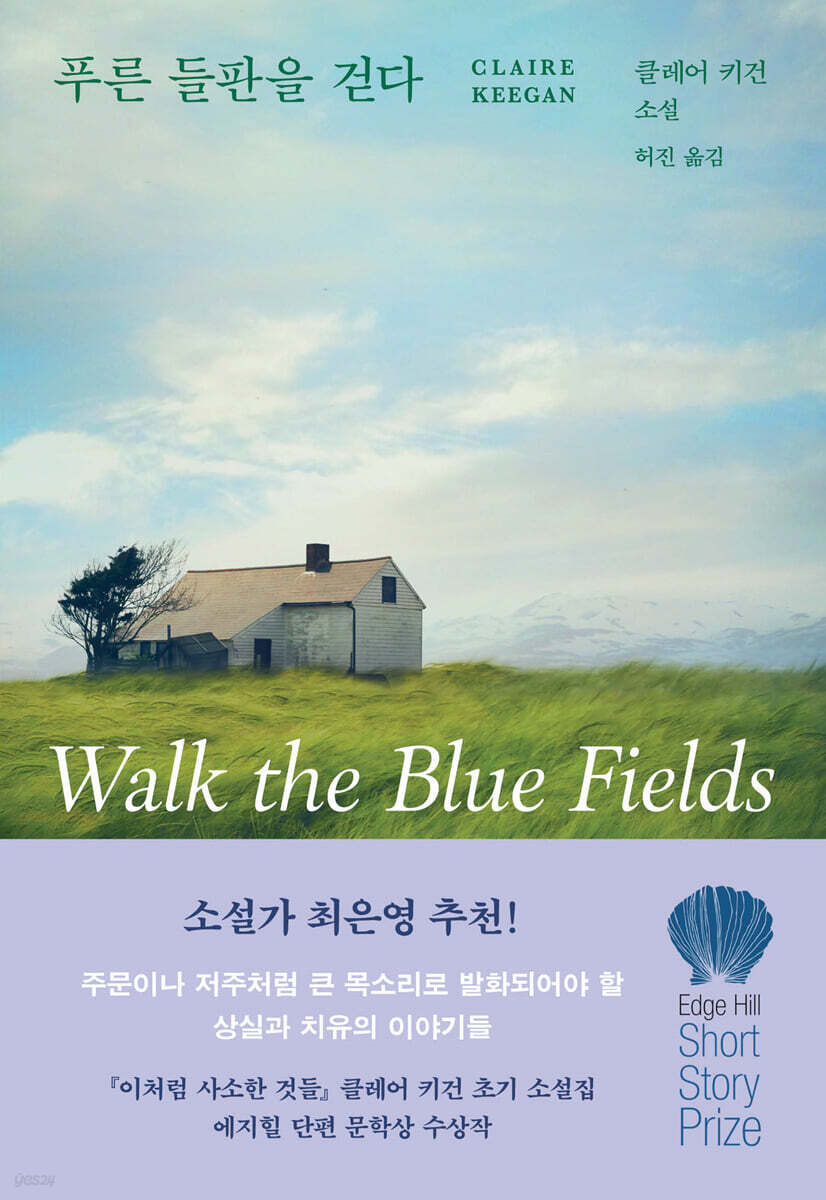
Walking through the green fields
 |
Description
Book Introduction
Claire Keegan's new book, "These Little Things," is out now!
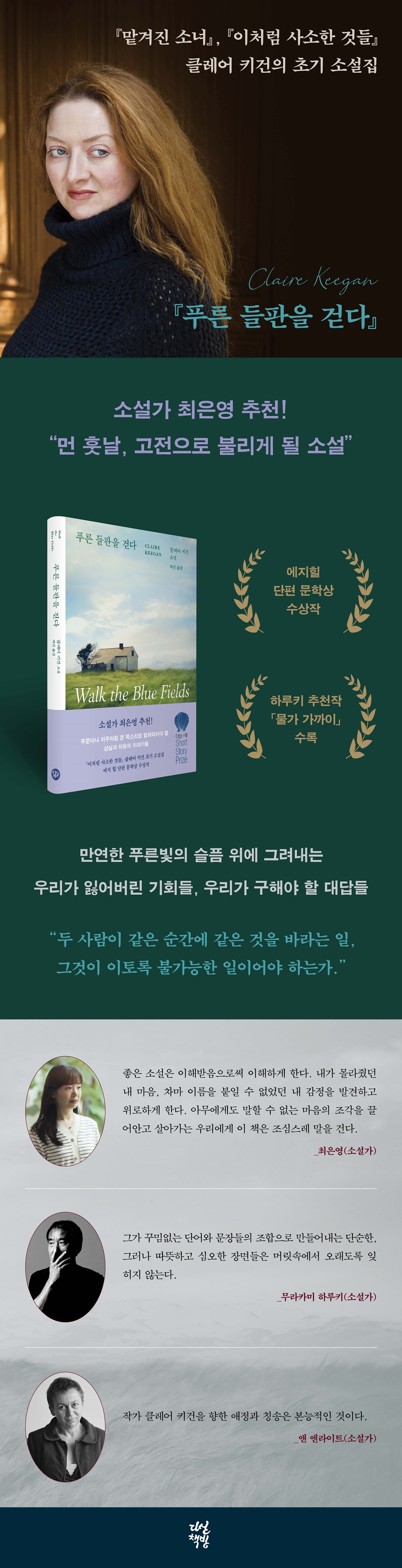
* Highly recommended by novelist Choi Eun-young * Winner of the Edgehill Short Story Literature Award
* Includes Haruki Murakami's recommended work, "Close to the Water"
Irish novelist Claire Keegan, who received enthusiastic love from readers for her debut novel, "The Girl Entrusted" and her representative work, "Such Trivial Things," has published a new book by Dasan Books.
"Walking in the Blue Fields" is the author's third work to be introduced in Korea, and his first collection of short stories.
Claire Keegan, who made a splendid debut in 1999 with her debut work 『Antarctica』, was the biggest topic of conversation among international critics at the time about what kind of follow-up work she would produce.
Eight years later, after a long silence, this book was finally revealed to the world, clearly revealing Keegan's world of work and captivating readers from all over the world, beyond the critics, and bringing her continental fame along with the title of 'Queen of Short Stories'.
Winner of the Edgehill Short Story Award for the most distinguished collection of short stories published in the British Isles, this book contains seven stories that have been praised as “breathtakingly accurate,” including “Close to the Water,” which was highly praised by Haruki Murakami, who had been paying attention to Keegan for 20 years.
* Highly recommended by novelist Choi Eun-young * Winner of the Edgehill Short Story Literature Award
* Includes Haruki Murakami's recommended work, "Close to the Water"
Irish novelist Claire Keegan, who received enthusiastic love from readers for her debut novel, "The Girl Entrusted" and her representative work, "Such Trivial Things," has published a new book by Dasan Books.
"Walking in the Blue Fields" is the author's third work to be introduced in Korea, and his first collection of short stories.
Claire Keegan, who made a splendid debut in 1999 with her debut work 『Antarctica』, was the biggest topic of conversation among international critics at the time about what kind of follow-up work she would produce.
Eight years later, after a long silence, this book was finally revealed to the world, clearly revealing Keegan's world of work and captivating readers from all over the world, beyond the critics, and bringing her continental fame along with the title of 'Queen of Short Stories'.
Winner of the Edgehill Short Story Award for the most distinguished collection of short stories published in the British Isles, this book contains seven stories that have been praised as “breathtakingly accurate,” including “Close to the Water,” which was highly praised by Haruki Murakami, who had been paying attention to Keegan for 20 years.
- You can preview some of the book's contents.
Preview
index
farewell gift
Walking through the green fields
black horse
The Forester's Daughter
near the water
surrender
Night in the Quicken Tree Forest
Acknowledgements
Translator's Note
Walking through the green fields
black horse
The Forester's Daughter
near the water
surrender
Night in the Quicken Tree Forest
Acknowledgements
Translator's Note
Detailed image
Into the book
Now you stand on the landing and try to remember happiness, good days, pleasant evenings, kind words.
I feel like I should be looking for happy memories that would make it difficult to say goodbye, but I can't think of any.
Instead, I remember when the setter I was raising had several puppies.
It was around the time your mother started letting you into his room.
In the barn, my mother bent over a halved barrel and lowered the sack into the water, and eventually the squeaking stopped and the sack became quiet.
The day you drowned your puppies, your mother turned her head and smiled at you.
--- pp.17~18
The bride stands with both hands outstretched.
As he places the pearl in his bride's hand, she looks into his eyes.
Tears well up in her eyes, but she has strong pride, so she doesn't blink them away.
If she blinks, the priest will take her hand and run away from here.
At least that's what the priest himself thought.
That's exactly what she once wished for, but it's rare in this world for two people to wish for the same thing at the same time.
Sometimes that's the hardest part about being human.
--- p.52
It's been three years since I last touched another person, and the hand of a stranger feels surprisingly soft.
Why does tenderness make a person more helpless than wounds?
--- p.60
The fragmented memories of the time I spent with Roller's daughter flash through my mind.
How much fun it was getting to know her inside out.
She said that self-awareness exists beyond words.
In a way, the purpose of conversation is to figure out what you already know.
She believed that there was an invisible vessel in every conversation.
Storytelling is the art of putting good words into a bowl and taking out other words.
When we have loving conversations, we discover ourselves in a warmer way, and eventually the vessel becomes empty again.
She said that humans cannot know themselves alone.
I believed that there was true knowledge beyond the act of sharing love.
He was sometimes angry at her thoughts, but he could never prove her wrong.
--- pp.61~62
It was very rare, but when a neighbor came over, Martha would tell them a story.
In fact, she was the best storyteller.
On those rare nights, the neighbors would watch her suddenly snap her mind to something, as if she were grabbing it from thin air, and then break it open before their eyes.
When they returned home, what they remembered was not the old, impressive house, nor the worried-looking man who owned it, nor the quirky teenagers, but the woman whose dark brown hair grew increasingly tangled as the night wore on, and her pale hands tugging at the improbable stories.
The stories she told by the fireside gradually ripened like green plums.
--- p.91
When Margaret was young, her mother went on a pilgrimage to the Holy Land and returned with candy canes and an umbrella.
Margaret waited for a windy day, then thought she could fly, so she opened her umbrella and jumped off the boiler room wall, but fell onto the road and broke her ankle.
I wish that even as an adult, my baseless thoughts were proven wrong so quickly.
Growing up was largely about being in the dark.
--- p.190
That night the power went out, and he drank five glasses of hot whiskey and thought about the past.
Nothing could compare to the past.
His mother laughed as she watched him use his left hand.
My father taught me how to shave.
A summer when the whole family got sunburned in the peatlands and took turns applying calamine lotion.
How strange it was to hear my father sing, and how my mother would blush when she heard it.
But my mother and father passed away.
He staggered slightly toward Margaret's house, thinking about death and how he would die.
He thought he would die alone, that his body would be found only after someone recognized Josephine on the street, having eaten away the door.
But at least I was sure of death.
Everyone had to be sure of something.
That way I could understand the day.
--- pp.204~205
Yeah, it's like being crazy or being completely sane.
Margaret thought.
Sometimes everyone was right.
People, mad or sane, have mostly stumbled in the dark, reaching out for something they didn't even know they wanted.
I feel like I should be looking for happy memories that would make it difficult to say goodbye, but I can't think of any.
Instead, I remember when the setter I was raising had several puppies.
It was around the time your mother started letting you into his room.
In the barn, my mother bent over a halved barrel and lowered the sack into the water, and eventually the squeaking stopped and the sack became quiet.
The day you drowned your puppies, your mother turned her head and smiled at you.
--- pp.17~18
The bride stands with both hands outstretched.
As he places the pearl in his bride's hand, she looks into his eyes.
Tears well up in her eyes, but she has strong pride, so she doesn't blink them away.
If she blinks, the priest will take her hand and run away from here.
At least that's what the priest himself thought.
That's exactly what she once wished for, but it's rare in this world for two people to wish for the same thing at the same time.
Sometimes that's the hardest part about being human.
--- p.52
It's been three years since I last touched another person, and the hand of a stranger feels surprisingly soft.
Why does tenderness make a person more helpless than wounds?
--- p.60
The fragmented memories of the time I spent with Roller's daughter flash through my mind.
How much fun it was getting to know her inside out.
She said that self-awareness exists beyond words.
In a way, the purpose of conversation is to figure out what you already know.
She believed that there was an invisible vessel in every conversation.
Storytelling is the art of putting good words into a bowl and taking out other words.
When we have loving conversations, we discover ourselves in a warmer way, and eventually the vessel becomes empty again.
She said that humans cannot know themselves alone.
I believed that there was true knowledge beyond the act of sharing love.
He was sometimes angry at her thoughts, but he could never prove her wrong.
--- pp.61~62
It was very rare, but when a neighbor came over, Martha would tell them a story.
In fact, she was the best storyteller.
On those rare nights, the neighbors would watch her suddenly snap her mind to something, as if she were grabbing it from thin air, and then break it open before their eyes.
When they returned home, what they remembered was not the old, impressive house, nor the worried-looking man who owned it, nor the quirky teenagers, but the woman whose dark brown hair grew increasingly tangled as the night wore on, and her pale hands tugging at the improbable stories.
The stories she told by the fireside gradually ripened like green plums.
--- p.91
When Margaret was young, her mother went on a pilgrimage to the Holy Land and returned with candy canes and an umbrella.
Margaret waited for a windy day, then thought she could fly, so she opened her umbrella and jumped off the boiler room wall, but fell onto the road and broke her ankle.
I wish that even as an adult, my baseless thoughts were proven wrong so quickly.
Growing up was largely about being in the dark.
--- p.190
That night the power went out, and he drank five glasses of hot whiskey and thought about the past.
Nothing could compare to the past.
His mother laughed as she watched him use his left hand.
My father taught me how to shave.
A summer when the whole family got sunburned in the peatlands and took turns applying calamine lotion.
How strange it was to hear my father sing, and how my mother would blush when she heard it.
But my mother and father passed away.
He staggered slightly toward Margaret's house, thinking about death and how he would die.
He thought he would die alone, that his body would be found only after someone recognized Josephine on the street, having eaten away the door.
But at least I was sure of death.
Everyone had to be sure of something.
That way I could understand the day.
--- pp.204~205
Yeah, it's like being crazy or being completely sane.
Margaret thought.
Sometimes everyone was right.
People, mad or sane, have mostly stumbled in the dark, reaching out for something they didn't even know they wanted.
--- pp.233~234
Publisher's Review
The hottest author in bookstores right now
Claire Keegan's early novels
Irish novelist Claire Keegan, who has established her name among readers and writers with her unique presence just one year after her introduction in Korea, has published her new book, "Walking Through the Blue Fields," by Dasan Books.
With her first translated work, “The Girl Entrusted”, and her representative work, “Such Trivial Things,” each taking the top spot on the novel and comprehensive bestseller lists, she established herself as the most popular novelist and the most sought-after novelist in the first half of 2024 (No. 1 in YES24/Aladdin novels, No. 2 in Kyobo Bookstore novels).
It was selected as the book of the year just ten days after its publication, and was also selected as the novel of the year by 50 novelists, which is an extremely unusual achievement for an author who was just becoming known in Korea.
Readers not only sought out Keegan's novels but also showed their affection for the author in various ways, such as transcribing the entire book, or obtaining the original book and translating it themselves.
This 'Claire Keegan craze' has captured the attention of not only bibliophiles but also readers who have distanced themselves from literature.
The new book, "Walking in the Blue Fields," is the author's third work to be introduced in Korea and the first collection of short stories to be presented.
In 1999, Keegan made a splash with his debut work, Antarctica, and was met with praise from international readers and critics alike, while also keeping a close eye on what kind of work he would produce next.
Eight years later, in 2007, this book was published after a long silence, and it proudly proved that the critical acclaim he received was not in vain.
By vividly revealing the world of author Claire Keegan's work, she captivated the world and earned her continental fame along with the title of 'Queen of the Short Story.'
By exceeding the high expectations of readers who had been waiting for a long time, he was able to turn the high expectations and interest, which could have easily become poison, into applause for himself.
“A novel that will one day be called a classic.”
Recommended by novelists Choi Eun-young, Haruki Murakami, and Richard Ford!
Winner of the Edgehill Prize for Short Stories, awarded to the most distinguished collection of short stories published in the British Isles, this collection contains seven stories of exceptional vitality and breathtaking suspense.
Among them is "Close to the Water," a work highly praised by Haruki Murakami, who has already paid special tribute to Keegan for 20 years.
In 2004, Haruki Murakami published an anthology of short stories by foreign writers called “Birthday Stories,” and included Keegan’s work in the revised edition, praising it, saying, “The simple, yet warm and profound scenes he creates with unadorned combinations of words and sentences linger in the mind for a long time.”
Pulitzer Prize-winning American novelist Richard Ford also selected this collection of short stories as his "Book of the Year" and expressed his special affection by leaving a recommendation saying, "Keegan is one of those rare authors I always want to read."
Meanwhile, the work that has received the most attention from critics is Keegan's short story "Surrender," which was inspired by Irish novelist John McGahern.
John McGahern is known as Claire Keegan's greatest literary influence, and this work is based on an anecdote about her father in McGahern's Memoir.
When McGahern's father is forced to marry a woman he has been engaged to for years, he buys about 20 oranges, sits on a park bench, and eats them all on the spot.
In "Surrender," the protagonist eats an orange, symbolizing the last indulgence he allows himself before submitting to the heavy responsibility of marriage. This work stands out for its unique literary borrowing, showing the psychology of an extreme man with an all-or-nothing mindset.
Critics have praised his work as “breathtakingly precise” and “a genius of allusion,” praising it for its charm comparable to that of short story masters such as Raymond Carver and Anton Chekhov.
Few writers in contemporary literature have achieved international renown by focusing solely on the short story, yet Keegan, with only two collections published at the time, had already established himself as one of the world's greatest short story writers.
In an interview, Keegan confessed why he writes short stories:
“Most novels in the world are too long.
I'm interested in portraying life's important moments with a certain intensity.
But this intensity easily disappears in a full-length novel.” Keegan’s style is characterized by stripping away the surroundings until only the essential remains, thereby making the important moments of life more vivid.
This early work, which highlights his identity as a writer, also boasts meticulously carved allusions and metaphorical expressions, and is a masterpiece that allows us to glimpse his outstanding ability to refine the meaning of a novel into poetry, and in which he displayed his magic more brilliantly than anyone else.
“Where can one small step lead?”
A story of loss, healing, and slowly groping in the darkness
While Claire Keegan's previously introduced works in Korea had a calm, melancholic, yet warm atmosphere, "Walking in the Green Fields" sharply depicts the reality of Ireland with an angry gaze, while also presenting a mysterious atmosphere with a tale-like story.
In a rural world populated by taciturn men and wild women, most of them end up in unhappy marriages and have children who don't quite understand their circumstances.
Characters such as a father and daughter, a farmer and a lover, a priest and a bride, each trapped in their own world of loneliness, appear, and through the depiction of their daily conflicts and emotions, the fragile inner selves of each individual are gradually revealed.
The main characters in the work each experience different tragedies and losses. They are a girl who was sexually abused by her father ("Farewell Gift"), a priest who loses his lover because he is torn between the loneliness of his role as a priest and the heat of worldly life ("Walking in the Green Fields"), and a man who loses the woman he loves due to emotional ignorance and whose misery can only be consoled by alcohol and dreams ("Black Horse").
She is also a wife who continues her marriage with a husband who lacks love ("The Forester's Daughter"), and a woman who has lost both the man she loved and her baby ("Night in the Quicken Tree Forest").
The characters in the story each bear the scars and deprivations of their own unique losses, and Keegan carefully salvages them with delicate and concise language.
But they are never bound to a dark past.
The girl in "Farewell Gift" sells her father's horse to buy a plane ticket and escapes her hometown; the priest in "Walking in the Green Fields" seeks out a Chinese healer and recovers by confronting the wounds of the past; and Margaret, the protagonist of "Night in the Quicken Tree Forest," escapes her own story by boarding the boat of a fisherman she doesn't know, all attempting to walk out of the trajectory of failure.
Whether it is a fateful choice or an act against fate, their “one step can lead to” (p. 202) leaves readers with a faint hope and expectation.
“A good novel makes you understand by being understood.
It helps me discover and comfort my feelings that I didn't know I had, and the feelings that I couldn't even name.
This book cautiously speaks to us, who live with fragments of our hearts that we cannot tell anyone.
”_Choi Eun-young
As Claire Keegan said, a novel is “a slow groping in the dark,” and this novel will also beautifully stand as a story of healing, slowly groping through a harsh and sad life.
Claire Keegan's early novels
Irish novelist Claire Keegan, who has established her name among readers and writers with her unique presence just one year after her introduction in Korea, has published her new book, "Walking Through the Blue Fields," by Dasan Books.
With her first translated work, “The Girl Entrusted”, and her representative work, “Such Trivial Things,” each taking the top spot on the novel and comprehensive bestseller lists, she established herself as the most popular novelist and the most sought-after novelist in the first half of 2024 (No. 1 in YES24/Aladdin novels, No. 2 in Kyobo Bookstore novels).
It was selected as the book of the year just ten days after its publication, and was also selected as the novel of the year by 50 novelists, which is an extremely unusual achievement for an author who was just becoming known in Korea.
Readers not only sought out Keegan's novels but also showed their affection for the author in various ways, such as transcribing the entire book, or obtaining the original book and translating it themselves.
This 'Claire Keegan craze' has captured the attention of not only bibliophiles but also readers who have distanced themselves from literature.
The new book, "Walking in the Blue Fields," is the author's third work to be introduced in Korea and the first collection of short stories to be presented.
In 1999, Keegan made a splash with his debut work, Antarctica, and was met with praise from international readers and critics alike, while also keeping a close eye on what kind of work he would produce next.
Eight years later, in 2007, this book was published after a long silence, and it proudly proved that the critical acclaim he received was not in vain.
By vividly revealing the world of author Claire Keegan's work, she captivated the world and earned her continental fame along with the title of 'Queen of the Short Story.'
By exceeding the high expectations of readers who had been waiting for a long time, he was able to turn the high expectations and interest, which could have easily become poison, into applause for himself.
“A novel that will one day be called a classic.”
Recommended by novelists Choi Eun-young, Haruki Murakami, and Richard Ford!
Winner of the Edgehill Prize for Short Stories, awarded to the most distinguished collection of short stories published in the British Isles, this collection contains seven stories of exceptional vitality and breathtaking suspense.
Among them is "Close to the Water," a work highly praised by Haruki Murakami, who has already paid special tribute to Keegan for 20 years.
In 2004, Haruki Murakami published an anthology of short stories by foreign writers called “Birthday Stories,” and included Keegan’s work in the revised edition, praising it, saying, “The simple, yet warm and profound scenes he creates with unadorned combinations of words and sentences linger in the mind for a long time.”
Pulitzer Prize-winning American novelist Richard Ford also selected this collection of short stories as his "Book of the Year" and expressed his special affection by leaving a recommendation saying, "Keegan is one of those rare authors I always want to read."
Meanwhile, the work that has received the most attention from critics is Keegan's short story "Surrender," which was inspired by Irish novelist John McGahern.
John McGahern is known as Claire Keegan's greatest literary influence, and this work is based on an anecdote about her father in McGahern's Memoir.
When McGahern's father is forced to marry a woman he has been engaged to for years, he buys about 20 oranges, sits on a park bench, and eats them all on the spot.
In "Surrender," the protagonist eats an orange, symbolizing the last indulgence he allows himself before submitting to the heavy responsibility of marriage. This work stands out for its unique literary borrowing, showing the psychology of an extreme man with an all-or-nothing mindset.
Critics have praised his work as “breathtakingly precise” and “a genius of allusion,” praising it for its charm comparable to that of short story masters such as Raymond Carver and Anton Chekhov.
Few writers in contemporary literature have achieved international renown by focusing solely on the short story, yet Keegan, with only two collections published at the time, had already established himself as one of the world's greatest short story writers.
In an interview, Keegan confessed why he writes short stories:
“Most novels in the world are too long.
I'm interested in portraying life's important moments with a certain intensity.
But this intensity easily disappears in a full-length novel.” Keegan’s style is characterized by stripping away the surroundings until only the essential remains, thereby making the important moments of life more vivid.
This early work, which highlights his identity as a writer, also boasts meticulously carved allusions and metaphorical expressions, and is a masterpiece that allows us to glimpse his outstanding ability to refine the meaning of a novel into poetry, and in which he displayed his magic more brilliantly than anyone else.
“Where can one small step lead?”
A story of loss, healing, and slowly groping in the darkness
While Claire Keegan's previously introduced works in Korea had a calm, melancholic, yet warm atmosphere, "Walking in the Green Fields" sharply depicts the reality of Ireland with an angry gaze, while also presenting a mysterious atmosphere with a tale-like story.
In a rural world populated by taciturn men and wild women, most of them end up in unhappy marriages and have children who don't quite understand their circumstances.
Characters such as a father and daughter, a farmer and a lover, a priest and a bride, each trapped in their own world of loneliness, appear, and through the depiction of their daily conflicts and emotions, the fragile inner selves of each individual are gradually revealed.
The main characters in the work each experience different tragedies and losses. They are a girl who was sexually abused by her father ("Farewell Gift"), a priest who loses his lover because he is torn between the loneliness of his role as a priest and the heat of worldly life ("Walking in the Green Fields"), and a man who loses the woman he loves due to emotional ignorance and whose misery can only be consoled by alcohol and dreams ("Black Horse").
She is also a wife who continues her marriage with a husband who lacks love ("The Forester's Daughter"), and a woman who has lost both the man she loved and her baby ("Night in the Quicken Tree Forest").
The characters in the story each bear the scars and deprivations of their own unique losses, and Keegan carefully salvages them with delicate and concise language.
But they are never bound to a dark past.
The girl in "Farewell Gift" sells her father's horse to buy a plane ticket and escapes her hometown; the priest in "Walking in the Green Fields" seeks out a Chinese healer and recovers by confronting the wounds of the past; and Margaret, the protagonist of "Night in the Quicken Tree Forest," escapes her own story by boarding the boat of a fisherman she doesn't know, all attempting to walk out of the trajectory of failure.
Whether it is a fateful choice or an act against fate, their “one step can lead to” (p. 202) leaves readers with a faint hope and expectation.
“A good novel makes you understand by being understood.
It helps me discover and comfort my feelings that I didn't know I had, and the feelings that I couldn't even name.
This book cautiously speaks to us, who live with fragments of our hearts that we cannot tell anyone.
”_Choi Eun-young
As Claire Keegan said, a novel is “a slow groping in the dark,” and this novel will also beautifully stand as a story of healing, slowly groping through a harsh and sad life.
GOODS SPECIFICS
- Date of issue: August 20, 2024
- Page count, weight, size: 252 pages | 374g | 132*192*16mm
- ISBN13: 9791130654621
- ISBN10: 1130654621
You may also like
카테고리
korean


korean

![GQ KOREA Mark (Monthly): December [2025]](http://librairie.coreenne.fr/cdn/shop/files/8ef265dbbfbf186523ed75ba7319009d.jpg?v=1765340328&width=3840)


