

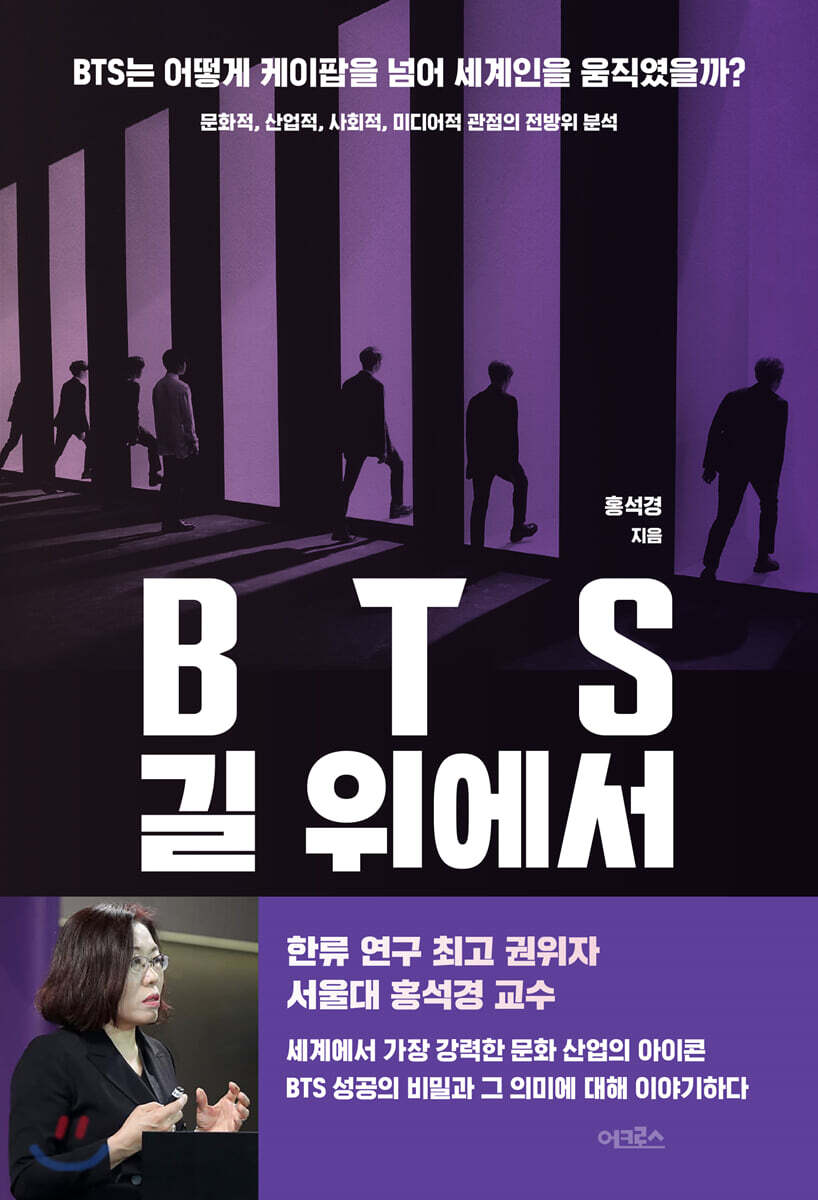
BTS on the road
 |
Description
Book Introduction
“How did BTS move people around the world beyond K-pop?” From the periphery of the K-pop industry to the center of global pop culture BTS, who are constantly creating new paths and legends Discuss the generational, cultural, racial, and gender implications of the phenomenon. A comprehensive analysis of BTS's success from cultural, industrial, social, and media perspectives by Professor Hong Seok-kyung of Seoul National University, a leading authority on Hallyu research. Unusually for a Korean book, leading publishers in Japan and China have already inquired about copyrights before publication! Big Hit Entertainment is conducting research on "overseas fandoms," and KBS's "Myungkyun Manri" episode, "BTS and K-pop," is being consulted. - What are the similarities and differences between BTS and K-pop? - What is transmedia, the key word for understanding BTS? - In the era of neoliberalism, why are young people around the world crazy about BTS? - What does it mean to be an ARMY, to live as an ARMY? - How did BTS turn Asians into objects of fascination? BTS, a model of alternative masculinity, and their gender sensitivity BTS, a new type of cultural producer and artist born on the fringes of global pop culture and constantly growing on the road, writing their own narrative. Professor Hong Seok-kyung of the Department of Journalism and Communication at Seoul National University, a leading Korean Wave researcher in Korea, discusses the secrets and meaning of its success. This book, which is unusual for a Korean book and has already received inquiries from leading publishers around the world, including those in Japan and China, for copyright even before its publication, creatively overcomes the limitations of the Korean Wave and K-pop, and comprehensively analyzes BTS, which has emerged as the world's most powerful cultural product, from cultural industry, social, and media perspectives. |
- You can preview some of the book's contents.
Preview
index
Entering _005
prolog
Into the world with BTS
Seeing the World Through BTS _019
BTS in the Age of Globalization and Digital Culture _021
On the road BTS walks _026
Taking a journey no one has ever taken before _029
Chapter 1: BTS, Beyond K-Pop
: From the fringes of the K-pop industry to the center of global pop culture
A New Order in Global Cultural Distribution _038
Korean and Japanese idol systems and BTS _042
BTS and K-Pop: What's the Same and What's Different? _048
How BTS Shows Hybridity _063
Beyond K-Pop, Into the World _070
Chapter 2 BTS Transmedia
: The most important keyword to understand BTS's narrative
What is Transmedia _083
BTS's Transmedia Strategy _087
BTS Transmedia in Three Layers _093
Second Layer: BTS and its Members' Narratives _099
The Third Layer: BTS Members' Natural Narratives _103
Rabbit Hole: A Knot Connecting Different Layers of Narrative _106
Jin's "Epiphany" _111
V's "Singularity" _115
BTS Transmedia Completed with Fan Participation _121
Chapter 3: Reading the BTS Phenomenon Through Generational and Class Theories
: Why are young people around the world crazy about BTS?
Singing about the living conditions of the younger generation _133
You can't live like your parents anymore, what are you going to do? _136
Resist, Growth Over Success _142
Icons of the Young Generation: The Beatles, David Bowie, and BTS _154
Chapter 4: Becoming an Army, Living as an Army
: They are behind every phenomenon
Meet the Army on the Scene _164
Being an ARMY, Living as an ARMY _167
Encounter: Falling into the World of BTS _168
Favorite: When I was having a hard time, BTS saved me _171
The Power of Community: Amira _174
Communication of Comfort and Salvation _176
Stories from Middle-Aged Fans _178
Learning Korean, the Language of BTS _181
ARMY's Taste, ARMY as Taste _187
A Community of Media, Tastes, and Values _191
ARMY and Fan Activism _199
Chapter 5: BTS and the New Racial Imagination
: How BTS Turned Asians into Objects of Fascination
From Local to Global, BTS Leads K-Pop _209
Global Pop Music in Korean _213
Cultural Citation Strategies in a Multicultural World _220
The Shift in White-Centric Racial Imagination _222
Racial Sensitivity in K-Pop Fandom _226
Finding an Alternative Between Stereotype and Mythology _231
Chapter 6: BTS and Alternative Masculinity
: How did they influence the gender sensitivity of the younger generation?
Images of men that provide visual pleasure _240
Soft Masculinity _246
Harmless Masculinity _250
Beyond Alternative Masculinity to Gender Issues _256
BTS's Body _262
Epilogue
BTS, Imagination of a New Era _265
prolog
Into the world with BTS
Seeing the World Through BTS _019
BTS in the Age of Globalization and Digital Culture _021
On the road BTS walks _026
Taking a journey no one has ever taken before _029
Chapter 1: BTS, Beyond K-Pop
: From the fringes of the K-pop industry to the center of global pop culture
A New Order in Global Cultural Distribution _038
Korean and Japanese idol systems and BTS _042
BTS and K-Pop: What's the Same and What's Different? _048
How BTS Shows Hybridity _063
Beyond K-Pop, Into the World _070
Chapter 2 BTS Transmedia
: The most important keyword to understand BTS's narrative
What is Transmedia _083
BTS's Transmedia Strategy _087
BTS Transmedia in Three Layers _093
Second Layer: BTS and its Members' Narratives _099
The Third Layer: BTS Members' Natural Narratives _103
Rabbit Hole: A Knot Connecting Different Layers of Narrative _106
Jin's "Epiphany" _111
V's "Singularity" _115
BTS Transmedia Completed with Fan Participation _121
Chapter 3: Reading the BTS Phenomenon Through Generational and Class Theories
: Why are young people around the world crazy about BTS?
Singing about the living conditions of the younger generation _133
You can't live like your parents anymore, what are you going to do? _136
Resist, Growth Over Success _142
Icons of the Young Generation: The Beatles, David Bowie, and BTS _154
Chapter 4: Becoming an Army, Living as an Army
: They are behind every phenomenon
Meet the Army on the Scene _164
Being an ARMY, Living as an ARMY _167
Encounter: Falling into the World of BTS _168
Favorite: When I was having a hard time, BTS saved me _171
The Power of Community: Amira _174
Communication of Comfort and Salvation _176
Stories from Middle-Aged Fans _178
Learning Korean, the Language of BTS _181
ARMY's Taste, ARMY as Taste _187
A Community of Media, Tastes, and Values _191
ARMY and Fan Activism _199
Chapter 5: BTS and the New Racial Imagination
: How BTS Turned Asians into Objects of Fascination
From Local to Global, BTS Leads K-Pop _209
Global Pop Music in Korean _213
Cultural Citation Strategies in a Multicultural World _220
The Shift in White-Centric Racial Imagination _222
Racial Sensitivity in K-Pop Fandom _226
Finding an Alternative Between Stereotype and Mythology _231
Chapter 6: BTS and Alternative Masculinity
: How did they influence the gender sensitivity of the younger generation?
Images of men that provide visual pleasure _240
Soft Masculinity _246
Harmless Masculinity _250
Beyond Alternative Masculinity to Gender Issues _256
BTS's Body _262
Epilogue
BTS, Imagination of a New Era _265
Into the book
Studying the BTS phenomenon means first understanding the formation and spread of popular culture through social media and YouTube.
And in this process, we produce knowledge about how the power of traditional cultural mediators is redistributed, how new systems of cultural production and enjoyment are formed, and how new norms and experiences across generations, cultures, races, and genders are shared. BTS's global popularity is a unique and legitimate case study that allows us to observe the new realities of cultural production and distribution within this globalization.
Just as one can observe the speed, water quality, and flow of a river through the force exerted on a towering rock in the middle of a leisurely flowing river.
--- p.19, from "Prologue"
BTS was formed with the contradictory identity of being a hip-hop idol in the K-pop industry, where this idol production system is dominant.
They were born as an idol group through a system that was the opposite of hip-hop, a popular culture tradition that most intensely and directly expresses an individual's social experience.
--- p.45, from “Chapter 1 BTS, Beyond K-Pop”
Let's borrow the concept of transmedia to explain how BTS became BTS, and how their stories, unfolding both inside and outside the media for years, form one grand narrative.
Transmedia, as can be guessed from the word 'trans', refers to a phenomenon in which content is not contained entirely in a single medium but expands beyond the boundaries of media to other media spaces.
--- p.83, from “Chapter 2 BTS Transmedia”
They sing of the coolness of working youth, as in "Dope," but in many of their songs they also directly rebel against the discourse of self-development, the flower of neoliberalism.
In a life based on competition, the way to win the competition that is placed at every moment of life is through constant self-improvement.
--- p.143, from “Chapter 3: Reading the BTS Phenomenon through Generational and Class Theories”
Fans said that being an ARMY is about establishing a kind of identity that goes beyond simply liking BTS.
--- p.168, from “Chapter 4: Becoming an Army, Living as an Army”
There's no reason to devalue K-pop for borrowing musical references from around the world, nor is there any reason to denigrate the artists and music around the world who utilize or are influenced by K-pop.
So to speak, it is the emergence of a new type of K-pop mix.
--- p.213, from “Chapter 5 BTS and Racial Imagination”
The seven men who make up BTS are cracking the dominant Western discourse on masculinity in various ways.
Male idols who wear makeup challenge established dominant masculinities while also creating a space for more inclusive and less exclusive expressions of gender and racial identities within the context of changing sexual and racial identities.
And in this process, we produce knowledge about how the power of traditional cultural mediators is redistributed, how new systems of cultural production and enjoyment are formed, and how new norms and experiences across generations, cultures, races, and genders are shared. BTS's global popularity is a unique and legitimate case study that allows us to observe the new realities of cultural production and distribution within this globalization.
Just as one can observe the speed, water quality, and flow of a river through the force exerted on a towering rock in the middle of a leisurely flowing river.
--- p.19, from "Prologue"
BTS was formed with the contradictory identity of being a hip-hop idol in the K-pop industry, where this idol production system is dominant.
They were born as an idol group through a system that was the opposite of hip-hop, a popular culture tradition that most intensely and directly expresses an individual's social experience.
--- p.45, from “Chapter 1 BTS, Beyond K-Pop”
Let's borrow the concept of transmedia to explain how BTS became BTS, and how their stories, unfolding both inside and outside the media for years, form one grand narrative.
Transmedia, as can be guessed from the word 'trans', refers to a phenomenon in which content is not contained entirely in a single medium but expands beyond the boundaries of media to other media spaces.
--- p.83, from “Chapter 2 BTS Transmedia”
They sing of the coolness of working youth, as in "Dope," but in many of their songs they also directly rebel against the discourse of self-development, the flower of neoliberalism.
In a life based on competition, the way to win the competition that is placed at every moment of life is through constant self-improvement.
--- p.143, from “Chapter 3: Reading the BTS Phenomenon through Generational and Class Theories”
Fans said that being an ARMY is about establishing a kind of identity that goes beyond simply liking BTS.
--- p.168, from “Chapter 4: Becoming an Army, Living as an Army”
There's no reason to devalue K-pop for borrowing musical references from around the world, nor is there any reason to denigrate the artists and music around the world who utilize or are influenced by K-pop.
So to speak, it is the emergence of a new type of K-pop mix.
--- p.213, from “Chapter 5 BTS and Racial Imagination”
The seven men who make up BTS are cracking the dominant Western discourse on masculinity in various ways.
Male idols who wear makeup challenge established dominant masculinities while also creating a space for more inclusive and less exclusive expressions of gender and racial identities within the context of changing sexual and racial identities.
--- p.251, from “Chapter 6 BTS and Alternative Masculinity”
Publisher's Review
From the 2018 world tour 'LOVE YOURSELF' to the new song 'Dynamite' in 2020
The most accurate and vivid in-depth analysis of BTS, analyzed from both the field and academia.
Professor Hong Seok-kyung exquisitely combines expert opinions and voices from the field to convey what are the success factors of BTS as a representative example of the formation and dissemination of popular culture using SNS and YouTube, what influence and change have the new generation, culture, race, and gender experiences they have opened up on people around the world, and how the power of traditional cultural mediators is redistributed and how a new system of cultural production and enjoyment is being formed in this process.
Through Professor Hong Seok-kyung's guide in "BTS on the Road," readers will be able to understand the meaning of the present and future path BTS is taking, and gain a new perspective on this phenomenon.
“This book is based on my personal experience, but it will also include scenes from the field, testimonies from fans, personal anecdotes, words and lyrics from BTS members, and various episodes from BTS texts.
“The content is academic, but the writing is free-flowing. Just as figure skaters perform a free skate rather than a short program, I hope that this book will be read and communicated as well as possible, as someone who briefly accompanied and observed the journey of seven beautiful young people.”
In fact, during the process of writing this book, Professor Hong Seok-kyung conducted 'field research on BTS' overseas fandom' with the support of Big Hit Entertainment.
Starting from Jamsil, where BTS's Arena World Tour 'LOVE YOURSELF' began in late August 2018, he accompanied them on their world tour to Paris, London, and LA, conducting interviews with the audience and fans there, filling in many details of this book with a vivid sense of realism.
Meanwhile, he advised on the KBS [Myungkyun Manri] program 'BTS and the Future of K-pop' and provided logical and in-depth answers to the public's questions about the future of K-pop.
He recently appeared on Mnet's [BTS SPECIAL Dynamite], a show about BTS's conquest of the Billboard charts, and was praised for most clearly revealing the reasons for BTS's popularity with the following story.
“The message to the younger generation, the fact that it is becoming a liberating text in terms of gender, and the important role it plays in giving East Asians a new sense of self-esteem in terms of race.
“It produces and influences meaning in a longer and deeper way than Billboard-level success, which can be quantified in three dimensions.”
Through this, fragments of the phenomenon that had remained only as individual fan experiences were organized into ‘meaning’ and ‘cultural events.’
“Professor, are you an ARMY too?”
Questions that ordinary people 'feel but cannot express in words'
Vividly explained from an expert's perspective
Professor Hong Seok-kyung has been publishing papers on the Korean Wave in the world since 2007, and in 2013, he published a book titled “Korean Wave in the Age of Globalization and Digital Culture,” which examines how the Korean Wave phenomenon circulates and shapes cultural dynamics outside of East Asia.
Since then, I have consistently written articles on K-pop, a hybrid culture created by globalization that is different from the top-down popular culture popularized by the US and Europe, and a trend that runs counter to the dominant music distribution environment, from an academic and popular perspective.
If the previous work was the result of observing the Korean Wave phenomenon in East Asia from a distance in a foreign country (France) and writing while traveling to and from Korea, 『BTS on the Road』 is the result of diving into the core of the BTS phenomenon, observing the global fandom of BTS and meeting fans on both sides of the Atlantic while following their performances.
As the reactions to his YouTube videos, which are considered legendary among BTS fans, demonstrate, Professor Hong Seok-kyung's research is grounded in theoretical and academic content, while also faithfully capturing the vivid voices of those on the ground.
Because of this, he is evaluated as solving questions that ordinary people 'feel but cannot express in words' from an expert's perspective.
"Professor, are you also an ARMY? I got goosebumps from your accurate analysis." "I wish you could translate this video so international fans could see it too." "You've filled in a lot of the gaps in my analysis of BTS."
“I feel so relieved.” “You have clearly explained what fans have been feeling but have been unable to organize.
“I agree.” (From a YouTube comment on the interview “Why Are We So Crazy About BTS?” by the POSTECH Convergence Civilization Research Institute)
Analyzing the six key keywords that define the BTS phenomenon.
From a K-pop, transmedia, generation, fandom, ARMY, racial, and gender perspective
Chapter 1 explains how the Korean entertainment industry and K-pop emerged within the media culture of East Asia, the birthplace of BTS, and how BTS was conceived within the K-pop environment. Let's focus on the cultural and industrial conditions of K-pop that produced BTS and also had to overcome.
Chapter 2 explores BTS transmedia, the core of BTS's identity, and how BTS texts operate. BTS texts offer a unique, expansive narrative, accessible through music videos that will make any BTS newbie ask, "What is this?" To this, each member's identity and story, both as a member of BTS and as an individual, is added.
This is followed by an analytical account of how the three layers of the story interact through the fans' reading experience.
Chapter 3 explains why young people around the world are so passionate about BTS and the generational significance of the BTS phenomenon.
This study analyzes how BTS, a group born from "dirt spoon" backgrounds, digests and communicates the anxiety and despair experienced by young people amidst competition and an uncertain future under a neoliberal system. It also explores how BTS's music and life have been communicated, interpreted, and accepted by young people around the world.
Chapter 4 explores ARMY, the core members of BTS's fandom, what distinguishes them from other fandoms, and how they, as partners with BTS, achieved their success today and look forward to their future. This chapter then delves into the identity and experiences of BTS fans.
Chapter 5 is an analysis of how BTS, as East Asians and Koreans, are changing the racial imagination of a white-dominated world.
They tell the story of how they first made Koreans and East Asians into objects of fascination, how they are walking into the world while confronting various prejudices on racial and gender levels, and how their fans are developing a new racial imagination thanks to them.
Chapter 6 discusses the new masculinity and new gender sensitivity that BTS evokes.
The new masculinity created by the Korean Wave, K-pop stars, and BTS is providing a great sense of liberation to young people around the world. We will discuss the new gender identity and sensibilities emerging from this.
BTS crossing the bend after a steep uphill road
A Guide to Your Journey with Them: "BTS on the Road"
With COVID-19, humanity stands at a point where a complete return to the past is impossible even if the virus recedes.
In a situation where everything is changing, BTS held a paid online concert [Bang Bang Con The Live] to celebrate the 7th anniversary of their debut on June 14, 2020.
750,000 concurrent users.
Having set a record for the world's largest online concert, they continue to forge new paths.
It's a winding road after a steep climb, but it's at times like these that their message surprises, resonates, and captivates even more.
For those who will be joining this journey, 『BTS on the Road』 will serve as a good guide.
“BTS, which provides new experiences to its contemporaries, is not simply an object of exotic curiosity, but serves as a medium that conveys a body, human relationships, and messages that embody new masculinity and racial imagination.
They have captured the growing pains of individuals struggling in neoliberal competition in their albums and stories over the years, and have succeeded in constructing a message of self-acceptance at the end of that journey, which is like a practice.
This success was achieved with the help of their massive fandom, ARMY.
“In a warm relationship formed through generational exchange, they will look up to each other and grow old together.”
The most accurate and vivid in-depth analysis of BTS, analyzed from both the field and academia.
Professor Hong Seok-kyung exquisitely combines expert opinions and voices from the field to convey what are the success factors of BTS as a representative example of the formation and dissemination of popular culture using SNS and YouTube, what influence and change have the new generation, culture, race, and gender experiences they have opened up on people around the world, and how the power of traditional cultural mediators is redistributed and how a new system of cultural production and enjoyment is being formed in this process.
Through Professor Hong Seok-kyung's guide in "BTS on the Road," readers will be able to understand the meaning of the present and future path BTS is taking, and gain a new perspective on this phenomenon.
“This book is based on my personal experience, but it will also include scenes from the field, testimonies from fans, personal anecdotes, words and lyrics from BTS members, and various episodes from BTS texts.
“The content is academic, but the writing is free-flowing. Just as figure skaters perform a free skate rather than a short program, I hope that this book will be read and communicated as well as possible, as someone who briefly accompanied and observed the journey of seven beautiful young people.”
In fact, during the process of writing this book, Professor Hong Seok-kyung conducted 'field research on BTS' overseas fandom' with the support of Big Hit Entertainment.
Starting from Jamsil, where BTS's Arena World Tour 'LOVE YOURSELF' began in late August 2018, he accompanied them on their world tour to Paris, London, and LA, conducting interviews with the audience and fans there, filling in many details of this book with a vivid sense of realism.
Meanwhile, he advised on the KBS [Myungkyun Manri] program 'BTS and the Future of K-pop' and provided logical and in-depth answers to the public's questions about the future of K-pop.
He recently appeared on Mnet's [BTS SPECIAL Dynamite], a show about BTS's conquest of the Billboard charts, and was praised for most clearly revealing the reasons for BTS's popularity with the following story.
“The message to the younger generation, the fact that it is becoming a liberating text in terms of gender, and the important role it plays in giving East Asians a new sense of self-esteem in terms of race.
“It produces and influences meaning in a longer and deeper way than Billboard-level success, which can be quantified in three dimensions.”
Through this, fragments of the phenomenon that had remained only as individual fan experiences were organized into ‘meaning’ and ‘cultural events.’
“Professor, are you an ARMY too?”
Questions that ordinary people 'feel but cannot express in words'
Vividly explained from an expert's perspective
Professor Hong Seok-kyung has been publishing papers on the Korean Wave in the world since 2007, and in 2013, he published a book titled “Korean Wave in the Age of Globalization and Digital Culture,” which examines how the Korean Wave phenomenon circulates and shapes cultural dynamics outside of East Asia.
Since then, I have consistently written articles on K-pop, a hybrid culture created by globalization that is different from the top-down popular culture popularized by the US and Europe, and a trend that runs counter to the dominant music distribution environment, from an academic and popular perspective.
If the previous work was the result of observing the Korean Wave phenomenon in East Asia from a distance in a foreign country (France) and writing while traveling to and from Korea, 『BTS on the Road』 is the result of diving into the core of the BTS phenomenon, observing the global fandom of BTS and meeting fans on both sides of the Atlantic while following their performances.
As the reactions to his YouTube videos, which are considered legendary among BTS fans, demonstrate, Professor Hong Seok-kyung's research is grounded in theoretical and academic content, while also faithfully capturing the vivid voices of those on the ground.
Because of this, he is evaluated as solving questions that ordinary people 'feel but cannot express in words' from an expert's perspective.
"Professor, are you also an ARMY? I got goosebumps from your accurate analysis." "I wish you could translate this video so international fans could see it too." "You've filled in a lot of the gaps in my analysis of BTS."
“I feel so relieved.” “You have clearly explained what fans have been feeling but have been unable to organize.
“I agree.” (From a YouTube comment on the interview “Why Are We So Crazy About BTS?” by the POSTECH Convergence Civilization Research Institute)
Analyzing the six key keywords that define the BTS phenomenon.
From a K-pop, transmedia, generation, fandom, ARMY, racial, and gender perspective
Chapter 1 explains how the Korean entertainment industry and K-pop emerged within the media culture of East Asia, the birthplace of BTS, and how BTS was conceived within the K-pop environment. Let's focus on the cultural and industrial conditions of K-pop that produced BTS and also had to overcome.
Chapter 2 explores BTS transmedia, the core of BTS's identity, and how BTS texts operate. BTS texts offer a unique, expansive narrative, accessible through music videos that will make any BTS newbie ask, "What is this?" To this, each member's identity and story, both as a member of BTS and as an individual, is added.
This is followed by an analytical account of how the three layers of the story interact through the fans' reading experience.
Chapter 3 explains why young people around the world are so passionate about BTS and the generational significance of the BTS phenomenon.
This study analyzes how BTS, a group born from "dirt spoon" backgrounds, digests and communicates the anxiety and despair experienced by young people amidst competition and an uncertain future under a neoliberal system. It also explores how BTS's music and life have been communicated, interpreted, and accepted by young people around the world.
Chapter 4 explores ARMY, the core members of BTS's fandom, what distinguishes them from other fandoms, and how they, as partners with BTS, achieved their success today and look forward to their future. This chapter then delves into the identity and experiences of BTS fans.
Chapter 5 is an analysis of how BTS, as East Asians and Koreans, are changing the racial imagination of a white-dominated world.
They tell the story of how they first made Koreans and East Asians into objects of fascination, how they are walking into the world while confronting various prejudices on racial and gender levels, and how their fans are developing a new racial imagination thanks to them.
Chapter 6 discusses the new masculinity and new gender sensitivity that BTS evokes.
The new masculinity created by the Korean Wave, K-pop stars, and BTS is providing a great sense of liberation to young people around the world. We will discuss the new gender identity and sensibilities emerging from this.
BTS crossing the bend after a steep uphill road
A Guide to Your Journey with Them: "BTS on the Road"
With COVID-19, humanity stands at a point where a complete return to the past is impossible even if the virus recedes.
In a situation where everything is changing, BTS held a paid online concert [Bang Bang Con The Live] to celebrate the 7th anniversary of their debut on June 14, 2020.
750,000 concurrent users.
Having set a record for the world's largest online concert, they continue to forge new paths.
It's a winding road after a steep climb, but it's at times like these that their message surprises, resonates, and captivates even more.
For those who will be joining this journey, 『BTS on the Road』 will serve as a good guide.
“BTS, which provides new experiences to its contemporaries, is not simply an object of exotic curiosity, but serves as a medium that conveys a body, human relationships, and messages that embody new masculinity and racial imagination.
They have captured the growing pains of individuals struggling in neoliberal competition in their albums and stories over the years, and have succeeded in constructing a message of self-acceptance at the end of that journey, which is like a practice.
This success was achieved with the help of their massive fandom, ARMY.
“In a warm relationship formed through generational exchange, they will look up to each other and grow old together.”
GOODS SPECIFICS
- Publication date: November 22, 2020
- Page count, weight, size: 272 pages | 400g | 147*215*15mm
- ISBN13: 9791190030748
- ISBN10: 1190030748
You may also like
카테고리
korean


korean

![GQ KOREA Mark (Monthly): December [2025]](http://librairie.coreenne.fr/cdn/shop/files/8ef265dbbfbf186523ed75ba7319009d.jpg?v=1765340328&width=3840)


