

melanin
 |
Description
Book Introduction
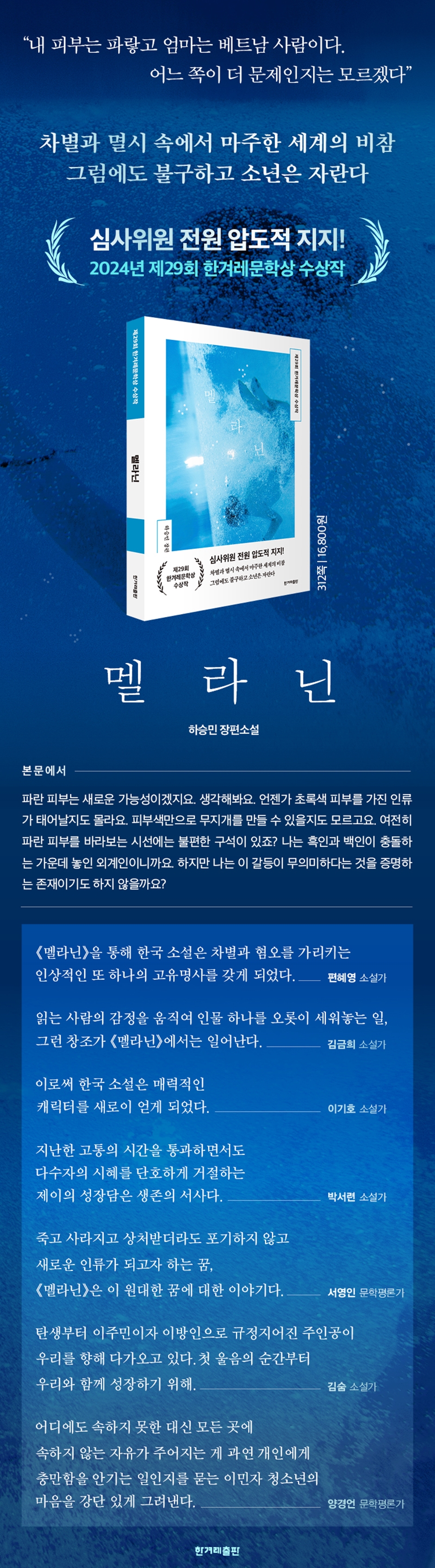
Overwhelming support from all judges! Winners of the 29th Hankyoreh Literary Award in 2024 “My skin is blue and my mother is Vietnamese. I don't know which one is more problematic" The misery of the world faced with discrimination and contempt Nevertheless, the boy grows up The Hankyoreh Literary Award, which was established in 1996 and has been loved by readers for a long time, including Shim Yun-kyung's "My Beautiful Garden," Park Min-gyu's "The Last Fan Club of Sammi Superstars," Choi Jin-young's "The Name of the Girl Who Passed You By," Jang Kang-myeong's "Bleach," Kang Hwa-gil's "Another Person," Park Seo-ryeon's "The Air Girl Kang Ju-ryong," and Kim Hee-jae's "Tank," is publishing its 29th award-winning work, "Melanin." Among the 240 entries, “Melanin” was the only one to receive the support of all judges and advance to the final round. After careful discussion, the seven judges chose Melanin as the winner, citing reasons such as “the incredible detail of the immigration history,” “the captivating sentences and sophisticated ending,” and “the sentiment and charm of the main boy.” Winner Seungmin Ha, who worked in the IT and finance industries, began working as a full-time writer in 2020. After sitting at his desk for eight hours every day, writing 3,000 characters as a task, and conducting meticulous research and reporting, he won the Hankyoreh Literary Award. Melanin is a coming-of-age novel about a mixed-race Korean-Vietnamese boy born with blue skin who experiences diaspora situations through immigration to the United States. The story unfolds as a series of events intertwined with historical events such as the 9/11 terrorist attacks, mass shootings, and the impeachment of the South Korean president, in which a person, who is considered to be of the lowest social class in society due to their skin color and race, is subjected to daily discrimination and contempt from their school friends, teachers, and neighbors. This work shines with the struggle of a boy who, despite experiencing the loss of those who loved and protected him, died or moved away, never losing his dignity and love as a human being. Novelist Kim Geum-hee cited the appeal of “Melanin” as “the fact that it meticulously crafts a boy’s story within a political and economic context, yet suddenly transports us to a dreamlike, fantastical, and poignant chapter.” Literary critic Seo Young-in commented that “Melanin” “encourages us to imagine a community that should be with the new humanity that emerged from obvious misfortune,” and novelist Pyeon Hye-young praised the novel, saying, “Through “Melanin,” Korean novels have acquired another impressive proper noun that refers to discrimination and hatred.” I dive into the deepest part of the lake and swim. Time how long you can hold your breath and test how deep you can dive. When I let out the breath I had been holding, stars dotted the black sky and white clouds drifted by on the wind. Chloe takes a sip of the drink she brought in a paper bag, and Selma giggles while taking a picture of us. Change the skin color in the photo to rainbow colors. Let's change the skin color of everyone we know to blue. Laugh loudly once more. Page 279 |
- You can preview some of the book's contents.
Preview
index
melanin
Author's Note
Recommendation
Author's Note
Recommendation
Detailed image
Into the book
The crime rate for people with blue skin was significantly lower than for people with other skin colors, but people didn't acknowledge the statistics.
He tried to justify his fear and discrimination, believing that blue skin was clearly the result of a mutant gene that increased violence, and that God would not have given such a horrible color to an innocent being.
--- pp.78~79
I suffered from a subtle sense of pressure and anxiety.
I was afraid of the middle schoolers who had lynched me in a group, of Jillian Bailey, who had identified me as a suspect in a robbery, of Francis Hoover, of Mitch Lambert.
I was afraid of Hugo Leander, who was proudly displaying the Confederate flag and burning the Pride flag.
“I was afraid of all the potential perpetrators who might harm me.”
--- p.127
I dived deeper.
All the bad memories were thrown away there.
As if walking slowly, the sound of my heart pounding, my body seemed to be flying lazily through the sky.
When I came out of the water, my breath tasted like grass, and my breath mixed with the fog faded into the blue air.
--- p.174
Blue skin would be a new possibility.
Think about it.
Maybe someday a human race with green skin will be born.
Maybe you could make a rainbow with just skin color.
There's still something uncomfortable about the gaze directed at blue-skinned people, isn't there? I'm an alien caught in the middle of a conflict between black and white people.
But am I not also the one who proves that this conflict is meaningless?
--- p.182
Rumors spread that the suspect was a Krishna devotee, leading to attacks on Hindus and people of Indian and Pakistani descent in the area.
Since it was revealed that the attack was committed by a Somali refugee living in Minnesota, criticism of refugee acceptance policies has become a hot topic.
When the article reported that the refugee had a history of psychiatric treatment, calls for better control and management of the mentally ill swept the community.
People turned their heads to find a target to hit closely whenever a new fact was revealed.
--- p.197
We were the embodiment of condensed anger and the agreed-upon target of attack.
They were persecuted but unable to rebel, and thus were individuals who could not unite.
It was an individual, a group, and also a concept.
They were a minority of evil beings and a symbol of danger.
People gave the unknown entity the name 'Blue Melanin'.
--- p.286
I was not a wise man who could belong everywhere by belonging nowhere.
I was an individual.
It was small and young blue.
He tried to justify his fear and discrimination, believing that blue skin was clearly the result of a mutant gene that increased violence, and that God would not have given such a horrible color to an innocent being.
--- pp.78~79
I suffered from a subtle sense of pressure and anxiety.
I was afraid of the middle schoolers who had lynched me in a group, of Jillian Bailey, who had identified me as a suspect in a robbery, of Francis Hoover, of Mitch Lambert.
I was afraid of Hugo Leander, who was proudly displaying the Confederate flag and burning the Pride flag.
“I was afraid of all the potential perpetrators who might harm me.”
--- p.127
I dived deeper.
All the bad memories were thrown away there.
As if walking slowly, the sound of my heart pounding, my body seemed to be flying lazily through the sky.
When I came out of the water, my breath tasted like grass, and my breath mixed with the fog faded into the blue air.
--- p.174
Blue skin would be a new possibility.
Think about it.
Maybe someday a human race with green skin will be born.
Maybe you could make a rainbow with just skin color.
There's still something uncomfortable about the gaze directed at blue-skinned people, isn't there? I'm an alien caught in the middle of a conflict between black and white people.
But am I not also the one who proves that this conflict is meaningless?
--- p.182
Rumors spread that the suspect was a Krishna devotee, leading to attacks on Hindus and people of Indian and Pakistani descent in the area.
Since it was revealed that the attack was committed by a Somali refugee living in Minnesota, criticism of refugee acceptance policies has become a hot topic.
When the article reported that the refugee had a history of psychiatric treatment, calls for better control and management of the mentally ill swept the community.
People turned their heads to find a target to hit closely whenever a new fact was revealed.
--- p.197
We were the embodiment of condensed anger and the agreed-upon target of attack.
They were persecuted but unable to rebel, and thus were individuals who could not unite.
It was an individual, a group, and also a concept.
They were a minority of evil beings and a symbol of danger.
People gave the unknown entity the name 'Blue Melanin'.
--- p.286
I was not a wise man who could belong everywhere by belonging nowhere.
I was an individual.
It was small and young blue.
--- p.291
Publisher's Review
“This skin color relegates me to the lowest rung of the social ladder.”
A sharp sense of problem, unique characters, a narrative interwoven with reality and fantasy…
A story of growth for a foreigner vividly portrayed through the history of inequality.
Jae-il, the boy protagonist of "Melanin," grew up with his patriarchal father's secret coldness and his neighbors' blatant contempt because of his blue skin.
At school, instead of his name, he was called by nicknames like “Avatar,” “Smurf,” “Doraemon,” and “Poop Boy,” and was always the target of hatred and avoidance.
For Jaeil, his mother, who had a strong and stubborn personality, was the only person he could rely on.
On the day we moved into our new villa, the couple living upstairs started whispering, “What’s with your blue skin? What’s with the house price?” My mother immediately ran up the stairs and knocked on the door.
They do not hesitate to fight back by shouting and swearing.
Jaeil is deeply heartbroken when his mother, who was preparing to immigrate to the United States, leaves for Vietnam and does not return.
In the experience of losing a loved one for the first time in his life, the boy is at a loss as to what to do and cannot even shed tears.
Korea was already a thing of the past.
The only world I owned was a small room in a cramped, dirty apartment in Georgia.
Between the musty wallpaper, the mechanical noise, and the unfamiliar language, I was shrinking like a jellyfish that had come ashore.
Page 56
However, even in the lonely and difficult life in America, there are people who help people in Japan.
Uncle Kang-woo readily provides a job for his father, who is always complaining and has no particular ability, and Chloe and Selma, whom he meets at Shaneville High School, become his strong supporters and friends.
Uncle Kang-woo runs a laundry and car wash and takes care of Jae-il like his own son.
He gives Jaeil the English name 'Jay' and also gives him advice on American culture and lifestyle.
Chloe, born to white parents, has blue skin and is willing to talk to Jaeil even when the students keep their distance from him.
Selma does not hesitate to speak out against her teacher who makes racist remarks like "ching-chang-chong" during class and helps Jae-il.
From then on, Chloe and Selma protect Jaeil from aggressive hate and bullying.
The three quickly become close as they talk about school life, career paths, music, movies, and relationships, just like teenagers do.
But the peaceful times for Jaeil do not last long.
I was having my first safe and cozy time in America.
I sat among my favorite Selma, who had blue skin like mine, and enjoyed a sense of belonging.
We would stay together until evening and then part ways.
My excitement subsided the moment I entered the house.
One evening, just before winter, a dark living room awaited me.
Page 121
After some time, Chloe moves to Minnesota.
The three of them don't talk as much as they used to, but they still communicate regularly.
While adjusting to her new surroundings, Chloe writes extensively on her blog.
Among them are revelations about the discrimination he felt as a blue-skinned person and the humiliation he experienced as a Zainichi.
The news spreads like wildfire, and Chloe becomes famous.
He was called “an icon of teenagers who dream of change” and received media attention.
Then one day, he is subjected to a terrible ordeal by a criminal who feels resentment towards him.
Blue skin, murder, suspect, arrest, cannibalism.
As I scrolled down the article, a picture of Chloe smiling appeared.
I opened Chloe's blog.
There were a lot of new comments.
Interspersed with the mourning and remembrance were occasional mockeries.
It's a good thing I was being picky.
I knew it would happen someday.
Will it be delicious? Some comments were filled with sushi emojis.
Page 195
Jaeil has a hard time getting over what happened to Chloe.
As someone with the same blue skin, I don't think I'll ever be able to shake off this pain.
Meanwhile, Uncle Kang-woo also experiences an unexpected incident.
He dies while receiving treatment after being shot by a gang.
Selma is caught in a forest fire and falls into a coma.
Then, Jaeil blames himself for all the misfortunes that happened around him.
He becomes pessimistic about life as he recalls the contempt and jeers he had to endure.
How can Jaeil overcome these adversities?
Can we restore love and human dignity?
Everyone close to me either died, was injured, or left me.
I don't know how it all came crashing down on me in Shaneville.
Maybe what people say is true.
This skin color may belong to an animal, not a human.
I may have been born with a sinister and dark nature.
Maybe this is a curse I was born with.
Pages 277-278
“I had to fight the system.”
Critically looking at the future of the community
The birth of a new humanity that overcomes misfortune and moves forward
"Melanin" is a novel about a boy with the world's rarest appearance who, despite the cruel reality, never loses his good will and pursues love.
“Jay, who has endured all this violent and harsh time, finally becomes an adult.” (Novelist Park Seo-ryeon) In this process, Jae-il shows his unique charm and vitality that cannot be easily schematized.
After a period of just cowering in the face of one-sided beatings and ridicule, I began to take action to prevent hatred from destroying my soul.
I no longer looked up to white people or feared black people.
I neither admired nor despised anyone.
By rendering humans colorless, we see people who are afraid of losing what they have, people who are tired of their workplaces and relationships, and people who are hiding in bunkers armed with patriotism and discipline, trembling.
We were both victims and perpetrators.
We were attacking each other in the dark._Page 291
Although cultural diversity and human prosperity are promoted, the reality is that discrimination and hatred are becoming more widespread.
In the midst of all this, the emergence of humans with blue skin raises sharp questions about minority identity.
In a world where diasporas are growing due to climate disasters and inter-state wars, Melanin points out the inevitable immigrant and class issues that arise from them through deeply realistic episodes and fantastical beings.
Through the figure of Zainichi, who realizes that racism is a limitation and misfortune created by humanity itself, we critically look at the future of the community we must build together, without naive romanticism or plausible optimism.
These struggles, and the determination to never give up on faith and love for humanity, make us even more eager to see what author Ha Seung-min will unfold in his works after Melanin.
The protagonist, who has been defined as an immigrant and a foreigner from birth, approaches us.
To grow with us from the moment of our first cry.
_Novelist Kim Soom, in 'Words of Recommendation'
Author's Note
Having arrived in Vietnam, Zainichi will soon travel to another world.
To the world where Chloe wanted to convey her voice while sitting in her small room.
To the world my uncle told me to explore, a world twenty times the size of America.
With Selma's support, Jaeil will leave.
I will go out and find another blue melanin.
A sharp sense of problem, unique characters, a narrative interwoven with reality and fantasy…
A story of growth for a foreigner vividly portrayed through the history of inequality.
Jae-il, the boy protagonist of "Melanin," grew up with his patriarchal father's secret coldness and his neighbors' blatant contempt because of his blue skin.
At school, instead of his name, he was called by nicknames like “Avatar,” “Smurf,” “Doraemon,” and “Poop Boy,” and was always the target of hatred and avoidance.
For Jaeil, his mother, who had a strong and stubborn personality, was the only person he could rely on.
On the day we moved into our new villa, the couple living upstairs started whispering, “What’s with your blue skin? What’s with the house price?” My mother immediately ran up the stairs and knocked on the door.
They do not hesitate to fight back by shouting and swearing.
Jaeil is deeply heartbroken when his mother, who was preparing to immigrate to the United States, leaves for Vietnam and does not return.
In the experience of losing a loved one for the first time in his life, the boy is at a loss as to what to do and cannot even shed tears.
Korea was already a thing of the past.
The only world I owned was a small room in a cramped, dirty apartment in Georgia.
Between the musty wallpaper, the mechanical noise, and the unfamiliar language, I was shrinking like a jellyfish that had come ashore.
Page 56
However, even in the lonely and difficult life in America, there are people who help people in Japan.
Uncle Kang-woo readily provides a job for his father, who is always complaining and has no particular ability, and Chloe and Selma, whom he meets at Shaneville High School, become his strong supporters and friends.
Uncle Kang-woo runs a laundry and car wash and takes care of Jae-il like his own son.
He gives Jaeil the English name 'Jay' and also gives him advice on American culture and lifestyle.
Chloe, born to white parents, has blue skin and is willing to talk to Jaeil even when the students keep their distance from him.
Selma does not hesitate to speak out against her teacher who makes racist remarks like "ching-chang-chong" during class and helps Jae-il.
From then on, Chloe and Selma protect Jaeil from aggressive hate and bullying.
The three quickly become close as they talk about school life, career paths, music, movies, and relationships, just like teenagers do.
But the peaceful times for Jaeil do not last long.
I was having my first safe and cozy time in America.
I sat among my favorite Selma, who had blue skin like mine, and enjoyed a sense of belonging.
We would stay together until evening and then part ways.
My excitement subsided the moment I entered the house.
One evening, just before winter, a dark living room awaited me.
Page 121
After some time, Chloe moves to Minnesota.
The three of them don't talk as much as they used to, but they still communicate regularly.
While adjusting to her new surroundings, Chloe writes extensively on her blog.
Among them are revelations about the discrimination he felt as a blue-skinned person and the humiliation he experienced as a Zainichi.
The news spreads like wildfire, and Chloe becomes famous.
He was called “an icon of teenagers who dream of change” and received media attention.
Then one day, he is subjected to a terrible ordeal by a criminal who feels resentment towards him.
Blue skin, murder, suspect, arrest, cannibalism.
As I scrolled down the article, a picture of Chloe smiling appeared.
I opened Chloe's blog.
There were a lot of new comments.
Interspersed with the mourning and remembrance were occasional mockeries.
It's a good thing I was being picky.
I knew it would happen someday.
Will it be delicious? Some comments were filled with sushi emojis.
Page 195
Jaeil has a hard time getting over what happened to Chloe.
As someone with the same blue skin, I don't think I'll ever be able to shake off this pain.
Meanwhile, Uncle Kang-woo also experiences an unexpected incident.
He dies while receiving treatment after being shot by a gang.
Selma is caught in a forest fire and falls into a coma.
Then, Jaeil blames himself for all the misfortunes that happened around him.
He becomes pessimistic about life as he recalls the contempt and jeers he had to endure.
How can Jaeil overcome these adversities?
Can we restore love and human dignity?
Everyone close to me either died, was injured, or left me.
I don't know how it all came crashing down on me in Shaneville.
Maybe what people say is true.
This skin color may belong to an animal, not a human.
I may have been born with a sinister and dark nature.
Maybe this is a curse I was born with.
Pages 277-278
“I had to fight the system.”
Critically looking at the future of the community
The birth of a new humanity that overcomes misfortune and moves forward
"Melanin" is a novel about a boy with the world's rarest appearance who, despite the cruel reality, never loses his good will and pursues love.
“Jay, who has endured all this violent and harsh time, finally becomes an adult.” (Novelist Park Seo-ryeon) In this process, Jae-il shows his unique charm and vitality that cannot be easily schematized.
After a period of just cowering in the face of one-sided beatings and ridicule, I began to take action to prevent hatred from destroying my soul.
I no longer looked up to white people or feared black people.
I neither admired nor despised anyone.
By rendering humans colorless, we see people who are afraid of losing what they have, people who are tired of their workplaces and relationships, and people who are hiding in bunkers armed with patriotism and discipline, trembling.
We were both victims and perpetrators.
We were attacking each other in the dark._Page 291
Although cultural diversity and human prosperity are promoted, the reality is that discrimination and hatred are becoming more widespread.
In the midst of all this, the emergence of humans with blue skin raises sharp questions about minority identity.
In a world where diasporas are growing due to climate disasters and inter-state wars, Melanin points out the inevitable immigrant and class issues that arise from them through deeply realistic episodes and fantastical beings.
Through the figure of Zainichi, who realizes that racism is a limitation and misfortune created by humanity itself, we critically look at the future of the community we must build together, without naive romanticism or plausible optimism.
These struggles, and the determination to never give up on faith and love for humanity, make us even more eager to see what author Ha Seung-min will unfold in his works after Melanin.
The protagonist, who has been defined as an immigrant and a foreigner from birth, approaches us.
To grow with us from the moment of our first cry.
_Novelist Kim Soom, in 'Words of Recommendation'
Author's Note
Having arrived in Vietnam, Zainichi will soon travel to another world.
To the world where Chloe wanted to convey her voice while sitting in her small room.
To the world my uncle told me to explore, a world twenty times the size of America.
With Selma's support, Jaeil will leave.
I will go out and find another blue melanin.
GOODS SPECIFICS
- Date of issue: July 25, 2024
- Page count, weight, size: 312 pages | 430g | 150*210*14mm
- ISBN13: 9791172130879
You may also like
카테고리
korean


korean

![GQ KOREA Mark (Monthly): December [2025]](http://librairie.coreenne.fr/cdn/shop/files/8ef265dbbfbf186523ed75ba7319009d.jpg?v=1765340328&width=3840)


