

Last Campaign
 |
Description
Book Introduction
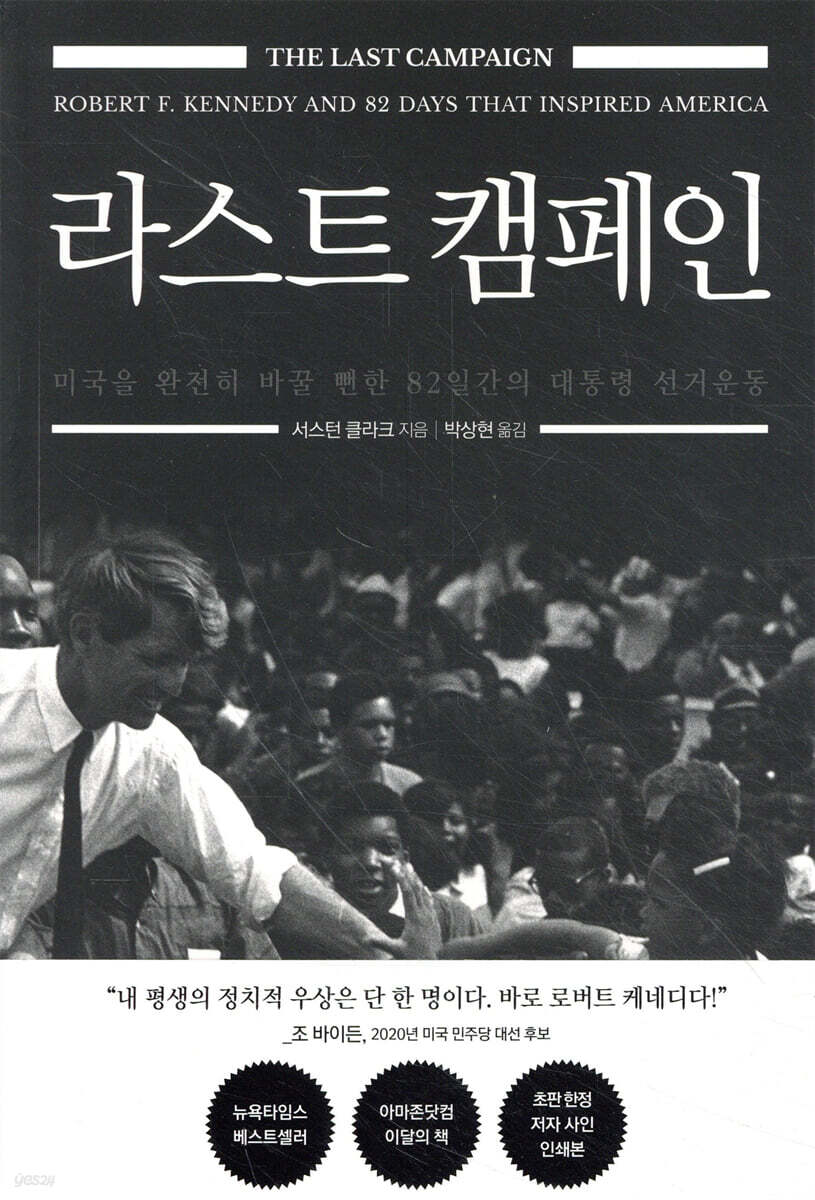
“There is only one political idol in my life. “It’s Robert Kennedy!” Joe Biden, US Democratic presidential candidate - New York Times Bestseller, Amazon.com Book of the Month - The story of Robert Kennedy, the idol of Joe Biden, Tim Cook, and Professor Michael Sandel. - Includes footage of Rev. King's memorial speech, which has 4 million views on YouTube. - Translation by the operator of the Facebook page "Washington Update," which specializes in U.S. politics. "The Last Campaign" is a book that captures the dramatic 82-day journey of Robert Kennedy, an enduring icon of American liberalism and a politician who is recalled whenever there is a riot, from his 1968 presidential bid to his assassination. Author Thurston Clark vividly portrays the figure of Robert Kennedy, a "revolutionary" who emerged from the shadow of his older brother, President Kennedy, to speak out and fundamentally change America, including his memorial speech for Dr. King, which has been viewed over 4 million times on YouTube and is considered one of the most moving impromptu speeches in American political history. The Korean edition was translated by columnist Park Sang-hyun, who connects with over 20,000 subscribers through his Facebook page and personal account, so that even those completely unfamiliar with American politics can immerse themselves in the story. He also kindly explains the book's significance today through the "Translator's Note." |
- You can preview some of the book's contents.
Preview
index
Translator's Note
Before reading the book
prolog
Part 1: Declaration of Candidacy
Chapter 1: The Inevitable Choice · March 16–17, 1968
Chapter 2: "Kennedy Goes All the Way" · March 17–18, 1968
Chapter 3: Standing Alone · March 21–31, 1968
Part 2: The Shadow of Death
Chapter 4: Good Times · March 31–April 4, 1968
Chapter 5: Indianapolis Speech, April 4–5, 1968
Chapter 6: "Guns on the Road to the White House" · April 5–7, 1968
Chapter 7: "The Prophet is Shot to Death" · April 9, 1968
Part 3 Republican-leaning areas
Chapter 8: The Enthusiastic Audience · April 10–15, 1968
Chapter 9: Meeting the Indian Boy · April 16–May 11, 1968
Chapter 10: "Am I Doing Well Here?" · April 22–24, 1968
Chapter 11: "You've Gotta Pay!" · April 26, 1968
Chapter 12: Parade with the Next President, April 27, 1968
Chapter 13: Mother In · May 3–14, 1963
Part 4: The Western United States
Chapter 14: "This is Nothing" · May 15–28, 1968
Chapter 15: The City of Resurrection · May 29, 1968
Chapter 16: "The Last Trustworthy Person" · May 30–June 3, 1968
Chapter 17: "This is how it ends" · June 4–5, 1968
Epilogue
Acknowledgements
References
Before reading the book
prolog
Part 1: Declaration of Candidacy
Chapter 1: The Inevitable Choice · March 16–17, 1968
Chapter 2: "Kennedy Goes All the Way" · March 17–18, 1968
Chapter 3: Standing Alone · March 21–31, 1968
Part 2: The Shadow of Death
Chapter 4: Good Times · March 31–April 4, 1968
Chapter 5: Indianapolis Speech, April 4–5, 1968
Chapter 6: "Guns on the Road to the White House" · April 5–7, 1968
Chapter 7: "The Prophet is Shot to Death" · April 9, 1968
Part 3 Republican-leaning areas
Chapter 8: The Enthusiastic Audience · April 10–15, 1968
Chapter 9: Meeting the Indian Boy · April 16–May 11, 1968
Chapter 10: "Am I Doing Well Here?" · April 22–24, 1968
Chapter 11: "You've Gotta Pay!" · April 26, 1968
Chapter 12: Parade with the Next President, April 27, 1968
Chapter 13: Mother In · May 3–14, 1963
Part 4: The Western United States
Chapter 14: "This is Nothing" · May 15–28, 1968
Chapter 15: The City of Resurrection · May 29, 1968
Chapter 16: "The Last Trustworthy Person" · May 30–June 3, 1968
Chapter 17: "This is how it ends" · June 4–5, 1968
Epilogue
Acknowledgements
References
Detailed image
.jpg)
Into the book
1968 was also the year when the Hong Kong flu spread throughout the world, including the United States, and killed nearly 4 million people.
In 1968, as in 2020, the biggest victims of the pandemic were poor Black people.
Could these similarities be a coincidence? Before reading this book, you might have thought they were.
But I guarantee that anyone who reads this book and closes the last chapter will say, “All of this was inevitable.”
Unsurprisingly, the most frequently quoted quote in this book is from Robert Kennedy, and the issue that appears most frequently in his speeches is the hardships and discrimination faced by black people in America.
---From "What 1968 and 2020 Have in Common"
“I am announcing today my candidacy for President of the United States.”
He then said that his reason for running was to bridge “the gap that exists today between black and white, rich and poor, young and old,” and ended his speech with a phrase that sounded like the words of his older brother, Kennedy.
Maybe it was because Ted Sorenson, who was his brother's speechwriter, wrote the speech.
---From "Presidential Election Speech"
Even as Bobby Kennedy, it was impossible not to think of President Kennedy.
I signed a book written by my late brother and received a quilt and a painting with his image as a gift.
In 1960, politicians who welcomed Bobby in their districts wore the PT109 tie pin that his brother had given them as a gift and greeted him in the auditorium and courthouse plaza where his brother had visited.
Bobby Kennedy was born in Detroit, where his brother began his 1960 campaign.
He campaigned at Kennedy Square, and John F.
We traveled along streets and highways named after Kennedy.
Whenever I sat in the back seat of an open car, I always thought of the welcoming crowd in Dallas (where my brother was assassinated).
---From "The Shadow of Brother Kennedy"
John Bartlow Martin said that although JFK sometimes made private jokes about his public statements, RFK (Robert F.
Kennedy) said he never did that.
He added, "Jack came across as a decisive leader, but Bobby seemed less sure of his own righteousness, more hesitant, more skeptical, and quite honest about it."
Pier Salinger, who worked as a press secretary under both men, said, “John Kennedy was very friendly to people, but very cold inside, while Bobby Kennedy was cold on the outside, but had a soft heart.”
He said that while JFK was “a great man,” RFK was “a revolutionary who wanted to fundamentally change life in America.”
---From "Robert Kennedy and John Kennedy"
Robert Kennedy continued to distance himself from the New Frontier policy in an interview with British broadcaster David Frost in Portland on the evening of March 25th.
“We live in different times,” he said, adding that he was worried about “what happens in 1968, not what happened in 1963.”
While New Frontier acknowledges that “everything about my life up until November 1963 revolved around President Kennedy,” saying that it was “part of a past life,” after Kennedy’s assassination in Dallas, “I had to play a different role.
“Because what I had then is no longer there,” he said.
---From "Standing Alone"
After Kennedy's plane landed, Richard Harwood boarded the plane and delivered the news of Martin Luther King Jr.'s death.
Kennedy looked dazed and threw his head back as if he had been shot.
Then he covered his face with his hands and muttered.
“Oh, when will this violence end?”
---From "News of the Death of Reverend Martin Luther King Jr."
At first, Kennedy spoke hesitantly and cautiously.
He repeated words and phrases as if trying to find the most appropriate expression, and sometimes paused after saying a word to think of what to say next.
His voice was weak and cracking, and tears welled up in his eyes.
Her hair was blowing in the wind, and her face, illuminated by the lights, was pale and possessed.
The audience was initially noisy and impatient, but as Kennedy began to speak, they quieted down and moved closer to the podium.
---From "Dr. King's Memorial Address"
Kennedy not only read and approved the City Club speech, but also revised it himself on the plane to Cleveland.
So it was ultimately Kennedy's decision to equate the violence inflicted on the poor by American corporations and institutions with mob shootings and Molotov cocktails.
It was because of Kennedy's words that Alice Roosevelt Longworth, daughter of President Theodore Roosevelt, said, "Bobby could have been a preacher of revolution."
Look photographer Stanley Tetrick said, “The congressman is a revolutionary at heart.
That's why he said, "It would be more appropriate to roam the forest with Fidel Castro or Che Guevara."
---From the "City Club Speech"
“Senator Kennedy was shot.
Is this possible? Is this possible? Yes, ladies and gentlemen.
Is this possible? I really got shot.
It's not just Senator Kennedy.
Oh my goodness.”
In 1968, as in 2020, the biggest victims of the pandemic were poor Black people.
Could these similarities be a coincidence? Before reading this book, you might have thought they were.
But I guarantee that anyone who reads this book and closes the last chapter will say, “All of this was inevitable.”
Unsurprisingly, the most frequently quoted quote in this book is from Robert Kennedy, and the issue that appears most frequently in his speeches is the hardships and discrimination faced by black people in America.
---From "What 1968 and 2020 Have in Common"
“I am announcing today my candidacy for President of the United States.”
He then said that his reason for running was to bridge “the gap that exists today between black and white, rich and poor, young and old,” and ended his speech with a phrase that sounded like the words of his older brother, Kennedy.
Maybe it was because Ted Sorenson, who was his brother's speechwriter, wrote the speech.
---From "Presidential Election Speech"
Even as Bobby Kennedy, it was impossible not to think of President Kennedy.
I signed a book written by my late brother and received a quilt and a painting with his image as a gift.
In 1960, politicians who welcomed Bobby in their districts wore the PT109 tie pin that his brother had given them as a gift and greeted him in the auditorium and courthouse plaza where his brother had visited.
Bobby Kennedy was born in Detroit, where his brother began his 1960 campaign.
He campaigned at Kennedy Square, and John F.
We traveled along streets and highways named after Kennedy.
Whenever I sat in the back seat of an open car, I always thought of the welcoming crowd in Dallas (where my brother was assassinated).
---From "The Shadow of Brother Kennedy"
John Bartlow Martin said that although JFK sometimes made private jokes about his public statements, RFK (Robert F.
Kennedy) said he never did that.
He added, "Jack came across as a decisive leader, but Bobby seemed less sure of his own righteousness, more hesitant, more skeptical, and quite honest about it."
Pier Salinger, who worked as a press secretary under both men, said, “John Kennedy was very friendly to people, but very cold inside, while Bobby Kennedy was cold on the outside, but had a soft heart.”
He said that while JFK was “a great man,” RFK was “a revolutionary who wanted to fundamentally change life in America.”
---From "Robert Kennedy and John Kennedy"
Robert Kennedy continued to distance himself from the New Frontier policy in an interview with British broadcaster David Frost in Portland on the evening of March 25th.
“We live in different times,” he said, adding that he was worried about “what happens in 1968, not what happened in 1963.”
While New Frontier acknowledges that “everything about my life up until November 1963 revolved around President Kennedy,” saying that it was “part of a past life,” after Kennedy’s assassination in Dallas, “I had to play a different role.
“Because what I had then is no longer there,” he said.
---From "Standing Alone"
After Kennedy's plane landed, Richard Harwood boarded the plane and delivered the news of Martin Luther King Jr.'s death.
Kennedy looked dazed and threw his head back as if he had been shot.
Then he covered his face with his hands and muttered.
“Oh, when will this violence end?”
---From "News of the Death of Reverend Martin Luther King Jr."
At first, Kennedy spoke hesitantly and cautiously.
He repeated words and phrases as if trying to find the most appropriate expression, and sometimes paused after saying a word to think of what to say next.
His voice was weak and cracking, and tears welled up in his eyes.
Her hair was blowing in the wind, and her face, illuminated by the lights, was pale and possessed.
The audience was initially noisy and impatient, but as Kennedy began to speak, they quieted down and moved closer to the podium.
---From "Dr. King's Memorial Address"
Kennedy not only read and approved the City Club speech, but also revised it himself on the plane to Cleveland.
So it was ultimately Kennedy's decision to equate the violence inflicted on the poor by American corporations and institutions with mob shootings and Molotov cocktails.
It was because of Kennedy's words that Alice Roosevelt Longworth, daughter of President Theodore Roosevelt, said, "Bobby could have been a preacher of revolution."
Look photographer Stanley Tetrick said, “The congressman is a revolutionary at heart.
That's why he said, "It would be more appropriate to roam the forest with Fidel Castro or Che Guevara."
---From the "City Club Speech"
“Senator Kennedy was shot.
Is this possible? Is this possible? Yes, ladies and gentlemen.
Is this possible? I really got shot.
It's not just Senator Kennedy.
Oh my goodness.”
---From "The Circumstances of the Robert Kennedy Assassination"
Publisher's Review
The striking similarities between 2020 and 1968 in the United States
America in 2020 resembles America in 1968 in many ways.
Like 2020, 1968 was a year of turmoil in the United States, with a presidential election, the Hong Kong flu pandemic, and anti-war protests centered on college campuses.
If the George Floyd and Jacob Blake incidents occurred in 2020, there was also a defining event in 1968 that plunged Black people into deep despair.
On April 4th, Martin Luther King, Jr., the most beloved leader among black people in American history, was shot and killed by a white man.
In the days following Dr. King's assassination, riots erupted in 119 cities, killing 46 people and injuring 2,500, leaving the United States reeling from the greatest destruction since the Civil War.
In this situation, there was only one major American city that did not experience violence: Indianapolis, the capital of Indiana.
How did the violence sweeping across America avoid Indianapolis?
An impromptu speech by a white politician that stopped a black riot
On the day that Dr. King was assassinated, President Kennedy's brother and Democratic presidential candidate Robert Kennedy was scheduled to campaign in a heavily black neighborhood in Indianapolis.
When Robert Kennedy heard the news of King's death while on his way to the campaign site, he debated whether to cancel the event.
In a situation where the scene could have been bloody due to excited black people, he threw away the speech written by his aide and gave an impromptu speech in a trembling voice.
In this prayer-like speech, Robert Kennedy mentioned his brother Kennedy's death and then recited a poem by Aeschylus to elicit sympathy and understanding from the audience.
And he hoped that most Americans were good people who “wanted justice” and asked them to join him in the noble cause of “purifying life in this world.”
When the speech ended, most of the audience was shocked, stood silently, cried, and then quietly dispersed.
Dr. King's memorial address, considered one of the most moving impromptu speeches in American political history, still resonates with many people even after 50 years (YouTube Robert F.
A search for “RFK MLK,” an acronym for Kennedy and Martin Luther King, reveals a video with over 4.2 million views and nearly 7,000 comments.
The 82-day presidential campaign that nearly transformed America
"The Last Campaign" is a book that tells the story of Robert Kennedy's election campaign in the 1968 presidential election.
In the United States, a “wounded nation” mired in the Vietnam War and complacent with the reality of poverty and inequality, Robert Kennedy declared his candidacy for president at the young age of 42.
In states with primaries, starting with Kansas and Indiana, and continuing through Oregon and California, John F.
He had been campaigning on the back of his older brother, President Kennedy, but he gradually found his own voice and succeeded in standing on his own.
Robert Kennedy was able to galvanize crowds into the White House with idealistic speeches about the sacrifice of young people and the moral shame caused by unjust wars, the hardships of the poor and minorities, and the responsibility of individual Americans to address these problems.
But “guns on the way to the White House” awaited.
When Reverend Martin Luther King Jr. was assassinated, Robert Kennedy, who calmed the black people with a moving speech, became the 'successor' who carried the torch of the civil rights movement and received the full support of black people, but as he received support, he also gained enemies.
Yet, Robert Kennedy kept his security detail to a minimum and exposed himself to the crowds, leading one reporter to call it “a very slow suicide.”
Finally, on June 6, 82 days after declaring his candidacy, Robert Kennedy was mysteriously assassinated by a Jordanian immigrant named Sirhan Sirhan, leaving many Americans who dreamed of change heartbroken.
What would America look like today if Robert Kennedy had become president? At the very least, there wouldn't have been the massive protests and riots by black people caused by police brutality.
* Robert F.
Who is Kennedy?
An iconic American liberal politician who served as Attorney General, Senator, and President. He is also known by the nicknames RFK and "Bobby."
Kennedy was the seventh of nine children born to John F.
He is eight years younger than Kennedy.
After graduating from Harvard University and the University of Virginia Law School, in 1952, John F.
When Kennedy ran for Senate, he served as campaign manager and played a crucial role in his victory.
The diligence and execution skills he displayed at this time earned him his brother's absolute trust and a reputation for being "ruthless."
When his older brother Kennedy became president in 1961, he was appointed Attorney General at the age of 35.
After taking office, he focused on improving civil rights for black people and eradicating organized crime, and was deeply involved in foreign affairs and security issues such as the Cuban Missile Crisis, being called the “number two man in Washington.”
After President Kennedy's assassination, he resigned from his cabinet post and ran for the New York State Senate in 1964, defeating the incumbent Republican and winning the seat.
When he officially declared his candidacy for president on March 16, 1968, he received enthusiastic support not only from intellectuals and young people who were fed up with the Johnson administration's policies, but also from minorities such as blacks and Mexicans.
During his campaign, Robert Kennedy sounded the alarm for those complacent in American society and sought to bridge the gaps between races, between rich and poor, and between generations.
In particular, the memorial speech delivered without a written address in Indianapolis immediately after the assassination of Reverend Martin Luther King on April 4th is considered one of the most moving speeches in American political history, and Indianapolis, the site of the speech, is famous for being a city that avoided the nationwide riots that followed Reverend King's death.
This episode was made into a documentary film titled "Rippe of Hope."
On June 5, two months after Dr. King's assassination, Robert Kennedy was shot and killed at the young age of 42 by a Jordanian immigrant named Sirhan Sirhan after delivering his primary victory speech in Los Angeles, California, leaving countless Americans who had hoped for change heartbroken.
On June 8, as the funeral train carrying Robert Kennedy's body departed New York City for Washington, D.C., where he was buried, two million Americans swarmed the tracks, forming a 360-kilometer-long human chain of grief and despair.
In 2018, the 50th anniversary of Robert Kennedy's death, the online video service Netflix released a four-part series about the life and legacy of Robert Kennedy, titled "Robert We Loved Kennedy."
* Key points from the interview with the author of Amazon.com's "Book of the Month"
Q: Bobby Kennedy was a presidential candidate for less than 100 days.
Why is the name of such a person still talked about today?
- Of course, the fact that he was the younger brother of the president who received much love from the people and was ultimately martyred, and the fact that he himself was assassinated are important factors.
But I still think Robert Kennedy remains relevant because he addressed issues that are still relevant to America today: race, poverty, and a senseless and unsupported war.
Robert Kennedy not only addressed these issues, but he addressed them with a candor and passion unmatched by any president or politician elected since 1968.
Q: Despite fears of assassination, Kennedy risked exposing himself to the crowd.
Was such behavior born of rebellion or an act of conviction?
- It was a rebellion and a belief.
Kennedy told reporters about President Johnson's bulletproof limousine:
“Let me tell you one thing.
If I get elected president, you'll never see me driving around in a fucking car like that again.
“We cannot allow our country to become one where the president is afraid to be with the people.”
When aides, concerned about the candidate's safety throughout the campaign, urged Kennedy to focus on TV studio campaigning and reduce field appearances, Kennedy said, "I have to make sure my supporters see me because there are too many people who don't like me."
According to aide Fred Dutton, Kennedy knew that crowds energized him like “a few drinks,” and that exposing himself to the crowd was the best way to let people know that his reputation as “ruthless” was unjust.
Q: Questions that begin with “what if” vaguely surround Bobby Kennedy and his legacy.
Was there one question that kept coming to mind as you wrote the book?
- A few “what if” questions kept coming to mind.
…what if Robert Kennedy had won the nomination and become president? It's doubtful there would have been a riot at the Democratic National Convention in Chicago that year.
The riot helped elect Richard Nixon as president and became a headache for the Democratic Party for the next 40 years.
Robert Kennedy, as president, would have withdrawn American troops from Vietnam soon after, and the list of Vietnam casualties would have been much shorter.
There would have been no US bombing of Cambodia, no Kent State University shooting, no Watergate.
America in 2020 resembles America in 1968 in many ways.
Like 2020, 1968 was a year of turmoil in the United States, with a presidential election, the Hong Kong flu pandemic, and anti-war protests centered on college campuses.
If the George Floyd and Jacob Blake incidents occurred in 2020, there was also a defining event in 1968 that plunged Black people into deep despair.
On April 4th, Martin Luther King, Jr., the most beloved leader among black people in American history, was shot and killed by a white man.
In the days following Dr. King's assassination, riots erupted in 119 cities, killing 46 people and injuring 2,500, leaving the United States reeling from the greatest destruction since the Civil War.
In this situation, there was only one major American city that did not experience violence: Indianapolis, the capital of Indiana.
How did the violence sweeping across America avoid Indianapolis?
An impromptu speech by a white politician that stopped a black riot
On the day that Dr. King was assassinated, President Kennedy's brother and Democratic presidential candidate Robert Kennedy was scheduled to campaign in a heavily black neighborhood in Indianapolis.
When Robert Kennedy heard the news of King's death while on his way to the campaign site, he debated whether to cancel the event.
In a situation where the scene could have been bloody due to excited black people, he threw away the speech written by his aide and gave an impromptu speech in a trembling voice.
In this prayer-like speech, Robert Kennedy mentioned his brother Kennedy's death and then recited a poem by Aeschylus to elicit sympathy and understanding from the audience.
And he hoped that most Americans were good people who “wanted justice” and asked them to join him in the noble cause of “purifying life in this world.”
When the speech ended, most of the audience was shocked, stood silently, cried, and then quietly dispersed.
Dr. King's memorial address, considered one of the most moving impromptu speeches in American political history, still resonates with many people even after 50 years (YouTube Robert F.
A search for “RFK MLK,” an acronym for Kennedy and Martin Luther King, reveals a video with over 4.2 million views and nearly 7,000 comments.
The 82-day presidential campaign that nearly transformed America
"The Last Campaign" is a book that tells the story of Robert Kennedy's election campaign in the 1968 presidential election.
In the United States, a “wounded nation” mired in the Vietnam War and complacent with the reality of poverty and inequality, Robert Kennedy declared his candidacy for president at the young age of 42.
In states with primaries, starting with Kansas and Indiana, and continuing through Oregon and California, John F.
He had been campaigning on the back of his older brother, President Kennedy, but he gradually found his own voice and succeeded in standing on his own.
Robert Kennedy was able to galvanize crowds into the White House with idealistic speeches about the sacrifice of young people and the moral shame caused by unjust wars, the hardships of the poor and minorities, and the responsibility of individual Americans to address these problems.
But “guns on the way to the White House” awaited.
When Reverend Martin Luther King Jr. was assassinated, Robert Kennedy, who calmed the black people with a moving speech, became the 'successor' who carried the torch of the civil rights movement and received the full support of black people, but as he received support, he also gained enemies.
Yet, Robert Kennedy kept his security detail to a minimum and exposed himself to the crowds, leading one reporter to call it “a very slow suicide.”
Finally, on June 6, 82 days after declaring his candidacy, Robert Kennedy was mysteriously assassinated by a Jordanian immigrant named Sirhan Sirhan, leaving many Americans who dreamed of change heartbroken.
What would America look like today if Robert Kennedy had become president? At the very least, there wouldn't have been the massive protests and riots by black people caused by police brutality.
* Robert F.
Who is Kennedy?
An iconic American liberal politician who served as Attorney General, Senator, and President. He is also known by the nicknames RFK and "Bobby."
Kennedy was the seventh of nine children born to John F.
He is eight years younger than Kennedy.
After graduating from Harvard University and the University of Virginia Law School, in 1952, John F.
When Kennedy ran for Senate, he served as campaign manager and played a crucial role in his victory.
The diligence and execution skills he displayed at this time earned him his brother's absolute trust and a reputation for being "ruthless."
When his older brother Kennedy became president in 1961, he was appointed Attorney General at the age of 35.
After taking office, he focused on improving civil rights for black people and eradicating organized crime, and was deeply involved in foreign affairs and security issues such as the Cuban Missile Crisis, being called the “number two man in Washington.”
After President Kennedy's assassination, he resigned from his cabinet post and ran for the New York State Senate in 1964, defeating the incumbent Republican and winning the seat.
When he officially declared his candidacy for president on March 16, 1968, he received enthusiastic support not only from intellectuals and young people who were fed up with the Johnson administration's policies, but also from minorities such as blacks and Mexicans.
During his campaign, Robert Kennedy sounded the alarm for those complacent in American society and sought to bridge the gaps between races, between rich and poor, and between generations.
In particular, the memorial speech delivered without a written address in Indianapolis immediately after the assassination of Reverend Martin Luther King on April 4th is considered one of the most moving speeches in American political history, and Indianapolis, the site of the speech, is famous for being a city that avoided the nationwide riots that followed Reverend King's death.
This episode was made into a documentary film titled "Rippe of Hope."
On June 5, two months after Dr. King's assassination, Robert Kennedy was shot and killed at the young age of 42 by a Jordanian immigrant named Sirhan Sirhan after delivering his primary victory speech in Los Angeles, California, leaving countless Americans who had hoped for change heartbroken.
On June 8, as the funeral train carrying Robert Kennedy's body departed New York City for Washington, D.C., where he was buried, two million Americans swarmed the tracks, forming a 360-kilometer-long human chain of grief and despair.
In 2018, the 50th anniversary of Robert Kennedy's death, the online video service Netflix released a four-part series about the life and legacy of Robert Kennedy, titled "Robert We Loved Kennedy."
* Key points from the interview with the author of Amazon.com's "Book of the Month"
Q: Bobby Kennedy was a presidential candidate for less than 100 days.
Why is the name of such a person still talked about today?
- Of course, the fact that he was the younger brother of the president who received much love from the people and was ultimately martyred, and the fact that he himself was assassinated are important factors.
But I still think Robert Kennedy remains relevant because he addressed issues that are still relevant to America today: race, poverty, and a senseless and unsupported war.
Robert Kennedy not only addressed these issues, but he addressed them with a candor and passion unmatched by any president or politician elected since 1968.
Q: Despite fears of assassination, Kennedy risked exposing himself to the crowd.
Was such behavior born of rebellion or an act of conviction?
- It was a rebellion and a belief.
Kennedy told reporters about President Johnson's bulletproof limousine:
“Let me tell you one thing.
If I get elected president, you'll never see me driving around in a fucking car like that again.
“We cannot allow our country to become one where the president is afraid to be with the people.”
When aides, concerned about the candidate's safety throughout the campaign, urged Kennedy to focus on TV studio campaigning and reduce field appearances, Kennedy said, "I have to make sure my supporters see me because there are too many people who don't like me."
According to aide Fred Dutton, Kennedy knew that crowds energized him like “a few drinks,” and that exposing himself to the crowd was the best way to let people know that his reputation as “ruthless” was unjust.
Q: Questions that begin with “what if” vaguely surround Bobby Kennedy and his legacy.
Was there one question that kept coming to mind as you wrote the book?
- A few “what if” questions kept coming to mind.
…what if Robert Kennedy had won the nomination and become president? It's doubtful there would have been a riot at the Democratic National Convention in Chicago that year.
The riot helped elect Richard Nixon as president and became a headache for the Democratic Party for the next 40 years.
Robert Kennedy, as president, would have withdrawn American troops from Vietnam soon after, and the list of Vietnam casualties would have been much shorter.
There would have been no US bombing of Cambodia, no Kent State University shooting, no Watergate.
GOODS SPECIFICS
- Date of issue: August 31, 2020
- Page count, weight, size: 440 pages | 750g | 155*225*30mm
- ISBN13: 9791187056355
- ISBN10: 1187056359
You may also like
카테고리
korean


korean

![GQ KOREA Mark (Monthly): December [2025]](http://librairie.coreenne.fr/cdn/shop/files/8ef265dbbfbf186523ed75ba7319009d.jpg?v=1765340328&width=3840)


