

Are you okay here now?
 |
Description
Book Introduction
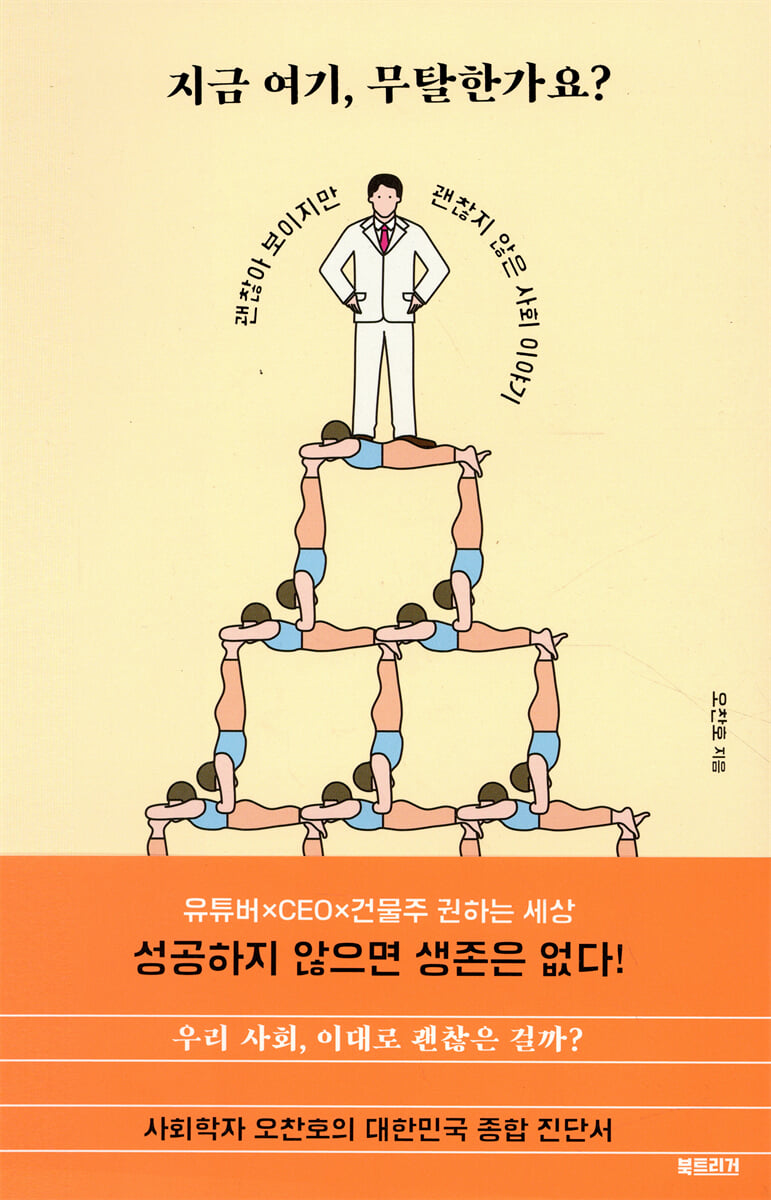
If you're feeling wronged, you should succeed? If you work hard, you can live well? For us who live in a world insensitive to inequality A very special lecture by sociologist Chan-ho Oh They say that if you work hard, you can achieve a decent living, but is that really true? The author of this book, Oh Chan-ho, argues that society isn't that flawless. The harsh reality of a world rife with inequality and discrimination has been laid bare by COVID-19. The self-employed are reeling, unemployment is rising, and vulnerable groups are in crisis. As society shakes, the weak fall first, but the world consoles us, telling us, "It's okay." This is an important point in time when one's perspective on 'society' is important. Think of rolling a dice. Each page is written about positive thinking, motivation, self-improvement, lessons from the rich, and how to win the competition. At home, school, and work, we roll dice and each time we provide information on this side. However, one side will not come out no matter how much you throw it, and even if it does come out, it is treated as a 'dud'. It is precisely the ‘eye that sees the social structure.’ Sociologist Oh Chan-ho, who began by sounding a strong alarm about the academic critique in our society with "We Support Discrimination" (2013), and then delved into issues such as gender discrimination and the civil service exam craze to break down stereotypes, points out the problems here and now in "Is Everything Okay Here and Now?" using 14 keywords that permeate South Korea. This book covers topics that are constantly in the news, such as real estate, education, income inequality, and politics, as well as topics that felt distant, such as refugees, the disabled, and the environment. By emphasizing only the 'positive' and ignoring the 'bad side of society', we unravel the complexly intertwined threads of society. Is a society where success is the only way to survive right? Is inequality justified? How can we solve serious social problems? Reading books and pondering these issues together will help you develop a balanced perspective on society. Why not listen to this special lecture on discrimination and inequality and begin preparing to create a society less vulnerable to any virus or natural disaster? |
- You can preview some of the book's contents.
Preview
index
prolog
First story_
Look, the world is not perfect after all.
[Environment] Are we truly all equal in the face of the environment?
Death from heat is not a natural disaster.
[Regional Gap] What does "regional" mean in Korean society?
_There is discrimination that people in Seoul absolutely do not know about.
[Education] Is a fair exam possible?
The saying, "If you feel wronged, pass" is wrong.
[Family] Does a 'normal family' really exist?
_The saying that being together makes you happy is now a thing of the past
Second story_
Courtesy is necessary for all beings in this world.
[Animals] Don't animals have rights?
_Courtesy is required for all living things.
[Refugee] Why do people hate refugees so much?
_South Korea's refugee acceptance rate is 0.4%, but if you still don't like refugees
[Disabled Persons] Why are the rights that are natural to the disabled considered special privileges?
_To those who think that doing a favor is a right
[Worker] Is it okay for a society to treat ordinary labor so trivially?
_Today, too, delivery workers risk their lives.
Third story_
The only way to eliminate inequality is to doubt it to the end.
[Real Estate] Is this world where people risk their lives to buy a home okay?
_Everyone dreams of being a building owner.
[Income Inequality] Has 'Class' Really Disappeared?
If nothing changes even if you try hard
[Religion] Is a society that relies on religion healthy?
_Nordic people rarely pray
[Media] Is the media and fake news okay?
The more I search for news, the more I become immersed in discrimination.
[Politics] Can there be an individual who is not involved in politics?
_'That's how' the world changes
Epilogue
First story_
Look, the world is not perfect after all.
[Environment] Are we truly all equal in the face of the environment?
Death from heat is not a natural disaster.
[Regional Gap] What does "regional" mean in Korean society?
_There is discrimination that people in Seoul absolutely do not know about.
[Education] Is a fair exam possible?
The saying, "If you feel wronged, pass" is wrong.
[Family] Does a 'normal family' really exist?
_The saying that being together makes you happy is now a thing of the past
Second story_
Courtesy is necessary for all beings in this world.
[Animals] Don't animals have rights?
_Courtesy is required for all living things.
[Refugee] Why do people hate refugees so much?
_South Korea's refugee acceptance rate is 0.4%, but if you still don't like refugees
[Disabled Persons] Why are the rights that are natural to the disabled considered special privileges?
_To those who think that doing a favor is a right
[Worker] Is it okay for a society to treat ordinary labor so trivially?
_Today, too, delivery workers risk their lives.
Third story_
The only way to eliminate inequality is to doubt it to the end.
[Real Estate] Is this world where people risk their lives to buy a home okay?
_Everyone dreams of being a building owner.
[Income Inequality] Has 'Class' Really Disappeared?
If nothing changes even if you try hard
[Religion] Is a society that relies on religion healthy?
_Nordic people rarely pray
[Media] Is the media and fake news okay?
The more I search for news, the more I become immersed in discrimination.
[Politics] Can there be an individual who is not involved in politics?
_'That's how' the world changes
Epilogue
Detailed image
.jpg)
Into the book
Did you guarantee everyone an annual salary of 100 million won?
We were simply told to provide the minimum safety measures to prevent anyone from falling in a crisis situation, but our society failed to do so.
The society created by those who were indifferent to reducing the extent of inequality, claiming that this was not a utopia, was turned upside down by a single shock.
The world, which shines its bright lights only on those who pass through the eye of a needle, is indifferent to everyone else.
We don't pay attention to those who lose their jobs just from two weeks of quarantine.
As the fragile society is shaken, the weak are falling first, but those who want to see society only in a positive light turn a blind eye to this.
To live as a good citizen, you need to be able to see the world from various perspectives. However, Korea is accustomed to covering up the harsh realities faced by the majority with beautiful stories that only a few can tell.
---From the "Prologue"
“Do you patent the sun?” This is the answer given by Dr. Jonas Salk, the developer of the polio vaccine, to a reporter’s question about who would own the patent.
The implication was that a vaccine that saves humanity should have the value of a public good, like the sun that provides light unconditionally.
Thanks to Dr. Salk, who gave up commercial interests and made the manufacturing method free, the world was freed from the fear of polio.
The fact that the sun is a public good means that all humans are equal before this immense natural entity.
But does the sun, a public good, affect all humanity equally, regardless of individual circumstances? … Are we truly equal before the environment? Even taking fine dust as an example, we know that some people "create" it, while others "drink" it.
It is clear that air is a public good that cannot be privately owned by any individual, but not everyone breathes the same amount of bad air.
Socioeconomic indicators show that people living in poor areas die more from fine dust.
---From "Environment - Is everyone truly equal in front of the environment?"
I found the cause in the excessive abundance of self-help discourse such as, "If you study hard, you can succeed."
When self-improvement goes beyond motivating individuals and becomes a standard for judging others, problems arise.
In particular, the likelihood of blaming those who are suffering due to a flawed social structure increases, saying it is their own fault.
Why would there be a problem with the desire to go to a prestigious university and then become a professional and live a stable life?
But a society that insists that everyone should have this kind of combative sense of purpose and refuses to properly understand the world's inequalities is problematic.
What about a community where the majority of people attribute poverty to individual responsibility and the poor treatment of irregular workers to "not studying hard"? If those who support discrimination because they studied hard become politicians and educators, social polarization will simply be accepted as an inevitable fact of life.
This way, the size of inequality cannot be reduced.
The stereotype that considers discrimination as not discrimination is making the world sick.
---From "Education - Is Fair Testing Possible?"
What is clear is that the vast majority of the economically active population in any society is made up of ordinary wage workers.
It has been like that in the past and it will be like that in the future.
A world where everyone is a venture capitalist and everyone is a YouTuber cannot exist, and it should not exist.
A society where many people walk on thin ice, where success is a jackpot and failure is a ruined life, can never be healthy.
The determination to take a gamble on life and the spirit of adventure should be respected as a personal choice, but no one should be forced to live life with clenched fists and risk taking.
How can a challenging life be a common mission when the circumstances are different?
Wouldn't a good society be one in which human dignity is guaranteed even if one lives an ordinary life?
In a society that focuses on the "majority" of ordinary people, rather than the "exceptions" who succeed, we constantly strive to understand labor without preconceived notions.
At school, you learn how to write an employment contract, gain an unbiased understanding of the need for labor unions, and experience collective bargaining between labor and management.
Starting in middle school, students receive training to become union representatives and negotiate wages with companies.
This is an unfamiliar story in our country, where workers are not systematically taught the right to live with dignity.
---From "Workers - Is it okay for a society to treat ordinary labor like this?"
There are two fathers in their forties, A and B.
I first moved into the same apartment complex 10 years ago.
The only difference is that A 'bought' a house and B 'lives' as a tenant in an apartment complex.
A used his parents' support as seed money to buy a house, and B saved up money on his own to pay the deposit.
Time passed.
B saved diligently for 10 years and saved money frugally, paying the deposit increase.
…The two who were quite close are now awkward with each other.
It's because their perspectives on the world are so different.
When B complains about the skyrocketing housing prices in South Korea, A responds coldly.
"But what if house prices fall now? People who own only one house can't go bankrupt, right?" The strange thing is, B wants to argue, "I worked hard too!" but there's a cosmic force preventing him from doing so.
When A bought a house, and when the price of A's house went up, people celebrated enthusiastically, saying, "There's joy after hardship!"
In this atmosphere, it seemed that the only thing that could be done to resent it was jealousy.
B mutters to himself, feeling dirty about being a 'loser'.
“Oh my, my life is so unfair.”
---From "Real Estate - Is this world where people risk their lives to buy a home okay?"
Does class exist in modern society? Unless you live in a country with a strict caste system, class is an unfamiliar concept.
In theory, classes cannot exist in Korean society.
In the world we live in, there is no bone rank system and no differences in social status based on scholars, farmers, artisans, and merchants.
This is not the era of secret deals to buy the genealogy of noblemen.
As can be seen from the fact that the value of equality, which states that “all human beings are born with dignity,” is included in the preamble to the Constitution, we live in a world where anyone can achieve success if they work hard.
The biographies I read in elementary school are full of stories of people who were poor when they were young but gained money and fame through hard work.
But can the world be explained by theory alone?
Stories of inequality are heard everywhere.
Many social critics express concern that class still exists today.
This is because there are many cases where it is difficult for a poor person to overcome poverty.
They are more likely to live in poverty because they do not receive enough support from their parents, which prevents them from focusing on their studies and, as a result, from being unable to secure stable jobs.
---From "Income Inequality - Has 'Class' Really Disappeared?"
Politics may not change everything, but we cannot deny that it has the power to change many things.
There are many people who say they are too busy trying to make a living to be interested in politics.
But my minimum wage is determined by politics.
Politics also determines whether people receive "holiday pay" for resting on weekends, or whether they receive "overtime pay" for working on public holidays or at night.
Politics also enabled blind hiring, which prohibits attaching photos or listing one's hometown on resumes.
After someone protested, demonstrated, and collected signatures from strangers to raise the issue, a 'rule' was created.
In other words, politics is a window that expands the scope of individual rights and a shield that prevents violations of rights.
Of course, there are also bad policies that lead to the opposite result.
The important thing is that politics has a huge impact on my life.
---From "Politics - Can there be individuals who are not involved in politics?"
The story of one side of the dice that we don't usually see is not unfamiliar, but it's not wrong.
But people who are only familiar with the other side say this because it is not familiar to them.
Radical, biased, violent, harsh, excessive, not moderate, etc.
When stereotypes become truth, talk of 'breaking stereotypes' becomes a cold meal.
Those who ignore the social structure often offer shallow prescriptions and consolation to struggling individuals.
The saying, "Happiness is in the mind," may be a good way to encourage people to love themselves as they are without comparing themselves to others, but it is not a panacea for solving all of their problems.
If there were a social system that guaranteed human dignity, wouldn't we be happy without much effort?
The proverb, "If you work hard, luck will follow," is intended to encourage us to grow quietly without being intimidated by the world, but as more and more people endlessly spit out such sorcery, the violence of the social structure that gradually reduces our luck is concealed.
We were simply told to provide the minimum safety measures to prevent anyone from falling in a crisis situation, but our society failed to do so.
The society created by those who were indifferent to reducing the extent of inequality, claiming that this was not a utopia, was turned upside down by a single shock.
The world, which shines its bright lights only on those who pass through the eye of a needle, is indifferent to everyone else.
We don't pay attention to those who lose their jobs just from two weeks of quarantine.
As the fragile society is shaken, the weak are falling first, but those who want to see society only in a positive light turn a blind eye to this.
To live as a good citizen, you need to be able to see the world from various perspectives. However, Korea is accustomed to covering up the harsh realities faced by the majority with beautiful stories that only a few can tell.
---From the "Prologue"
“Do you patent the sun?” This is the answer given by Dr. Jonas Salk, the developer of the polio vaccine, to a reporter’s question about who would own the patent.
The implication was that a vaccine that saves humanity should have the value of a public good, like the sun that provides light unconditionally.
Thanks to Dr. Salk, who gave up commercial interests and made the manufacturing method free, the world was freed from the fear of polio.
The fact that the sun is a public good means that all humans are equal before this immense natural entity.
But does the sun, a public good, affect all humanity equally, regardless of individual circumstances? … Are we truly equal before the environment? Even taking fine dust as an example, we know that some people "create" it, while others "drink" it.
It is clear that air is a public good that cannot be privately owned by any individual, but not everyone breathes the same amount of bad air.
Socioeconomic indicators show that people living in poor areas die more from fine dust.
---From "Environment - Is everyone truly equal in front of the environment?"
I found the cause in the excessive abundance of self-help discourse such as, "If you study hard, you can succeed."
When self-improvement goes beyond motivating individuals and becomes a standard for judging others, problems arise.
In particular, the likelihood of blaming those who are suffering due to a flawed social structure increases, saying it is their own fault.
Why would there be a problem with the desire to go to a prestigious university and then become a professional and live a stable life?
But a society that insists that everyone should have this kind of combative sense of purpose and refuses to properly understand the world's inequalities is problematic.
What about a community where the majority of people attribute poverty to individual responsibility and the poor treatment of irregular workers to "not studying hard"? If those who support discrimination because they studied hard become politicians and educators, social polarization will simply be accepted as an inevitable fact of life.
This way, the size of inequality cannot be reduced.
The stereotype that considers discrimination as not discrimination is making the world sick.
---From "Education - Is Fair Testing Possible?"
What is clear is that the vast majority of the economically active population in any society is made up of ordinary wage workers.
It has been like that in the past and it will be like that in the future.
A world where everyone is a venture capitalist and everyone is a YouTuber cannot exist, and it should not exist.
A society where many people walk on thin ice, where success is a jackpot and failure is a ruined life, can never be healthy.
The determination to take a gamble on life and the spirit of adventure should be respected as a personal choice, but no one should be forced to live life with clenched fists and risk taking.
How can a challenging life be a common mission when the circumstances are different?
Wouldn't a good society be one in which human dignity is guaranteed even if one lives an ordinary life?
In a society that focuses on the "majority" of ordinary people, rather than the "exceptions" who succeed, we constantly strive to understand labor without preconceived notions.
At school, you learn how to write an employment contract, gain an unbiased understanding of the need for labor unions, and experience collective bargaining between labor and management.
Starting in middle school, students receive training to become union representatives and negotiate wages with companies.
This is an unfamiliar story in our country, where workers are not systematically taught the right to live with dignity.
---From "Workers - Is it okay for a society to treat ordinary labor like this?"
There are two fathers in their forties, A and B.
I first moved into the same apartment complex 10 years ago.
The only difference is that A 'bought' a house and B 'lives' as a tenant in an apartment complex.
A used his parents' support as seed money to buy a house, and B saved up money on his own to pay the deposit.
Time passed.
B saved diligently for 10 years and saved money frugally, paying the deposit increase.
…The two who were quite close are now awkward with each other.
It's because their perspectives on the world are so different.
When B complains about the skyrocketing housing prices in South Korea, A responds coldly.
"But what if house prices fall now? People who own only one house can't go bankrupt, right?" The strange thing is, B wants to argue, "I worked hard too!" but there's a cosmic force preventing him from doing so.
When A bought a house, and when the price of A's house went up, people celebrated enthusiastically, saying, "There's joy after hardship!"
In this atmosphere, it seemed that the only thing that could be done to resent it was jealousy.
B mutters to himself, feeling dirty about being a 'loser'.
“Oh my, my life is so unfair.”
---From "Real Estate - Is this world where people risk their lives to buy a home okay?"
Does class exist in modern society? Unless you live in a country with a strict caste system, class is an unfamiliar concept.
In theory, classes cannot exist in Korean society.
In the world we live in, there is no bone rank system and no differences in social status based on scholars, farmers, artisans, and merchants.
This is not the era of secret deals to buy the genealogy of noblemen.
As can be seen from the fact that the value of equality, which states that “all human beings are born with dignity,” is included in the preamble to the Constitution, we live in a world where anyone can achieve success if they work hard.
The biographies I read in elementary school are full of stories of people who were poor when they were young but gained money and fame through hard work.
But can the world be explained by theory alone?
Stories of inequality are heard everywhere.
Many social critics express concern that class still exists today.
This is because there are many cases where it is difficult for a poor person to overcome poverty.
They are more likely to live in poverty because they do not receive enough support from their parents, which prevents them from focusing on their studies and, as a result, from being unable to secure stable jobs.
---From "Income Inequality - Has 'Class' Really Disappeared?"
Politics may not change everything, but we cannot deny that it has the power to change many things.
There are many people who say they are too busy trying to make a living to be interested in politics.
But my minimum wage is determined by politics.
Politics also determines whether people receive "holiday pay" for resting on weekends, or whether they receive "overtime pay" for working on public holidays or at night.
Politics also enabled blind hiring, which prohibits attaching photos or listing one's hometown on resumes.
After someone protested, demonstrated, and collected signatures from strangers to raise the issue, a 'rule' was created.
In other words, politics is a window that expands the scope of individual rights and a shield that prevents violations of rights.
Of course, there are also bad policies that lead to the opposite result.
The important thing is that politics has a huge impact on my life.
---From "Politics - Can there be individuals who are not involved in politics?"
The story of one side of the dice that we don't usually see is not unfamiliar, but it's not wrong.
But people who are only familiar with the other side say this because it is not familiar to them.
Radical, biased, violent, harsh, excessive, not moderate, etc.
When stereotypes become truth, talk of 'breaking stereotypes' becomes a cold meal.
Those who ignore the social structure often offer shallow prescriptions and consolation to struggling individuals.
The saying, "Happiness is in the mind," may be a good way to encourage people to love themselves as they are without comparing themselves to others, but it is not a panacea for solving all of their problems.
If there were a social system that guaranteed human dignity, wouldn't we be happy without much effort?
The proverb, "If you work hard, luck will follow," is intended to encourage us to grow quietly without being intimidated by the world, but as more and more people endlessly spit out such sorcery, the violence of the social structure that gradually reduces our luck is concealed.
---From the "Epilogue"
Publisher's Review
“It’s a lie that it’s worth living!”
A world that supports discrimination and turns a blind eye to inequality,
Look straight into a society where no one is okay!
Stories of inequality are heard everywhere.
According to Statistics Korea's 2019 Social Survey, only 22.7% of people believed that their generation's social and economic status was likely to rise.
This figure is about 10% lower than in 2009.
There is also a growing tendency to think more negatively about the possibility of social mobility in the younger generation.
Even at this very moment, our society is moving in a direction that is becoming more unequal.
Although 'classes' can be distinguished based on individual effort and ability, it is difficult to create a 'class society' where social mobility is nearly impossible.
In short, our society is not at all flawless.
"Is Everything Okay Here and Now?" is a book that lets me know that the world I live in is not okay at all, and helps me properly perceive society.
Oh Chan-ho, a contemporary sociologist who has a keener sense of Korean society than anyone else and strives to break down stereotypes, takes a sharp look at our society, where inequality, discrimination, and hatred are commonplace.
Regional disparities, income inequality, education, real estate, workers…
Through 14 keywords that permeate our society
Develop the power to doubt properly!
"Is Everything Okay Here and Now?" is a book that comprehensively diagnoses the health of our current era by reflecting on various social problems in South Korea.
First, in the first story (Look at this, the world is not perfect after all), we question and ponder things that we have previously overlooked as problems, such as the environment, regional disparities, education, and family.
Let's take 'education' as an example.
In general, we accept that selection through examinations is fair and that we should accept the results.
The resulting huge gap between rich and poor is also taken for granted.
However, the author asserts that 'there is no such thing as a fair test.'
It's just that humanity is creating a fairer testing system than yesterday.
He also points out that we need to consider whether the test results can justify the huge gap between rich and poor.
In addition, the author examines topics such as the environment (is everyone truly equal before the environment?), regional discrimination (what does 'regional' mean in Korean society?), and family (does a 'normal family' really exist?) with a sharp and incisive perspective.
The second story (Courtesy is Necessary for All Beings in This World) focuses on the suffering beings in our society: animals, refugees, the disabled, and workers.
Do animals truly have no rights? Why is there such hatred toward refugees? Why are rights that are so fundamental to the disabled considered privileges? The author endlessly questions a world rife with discrimination, hatred, and inequality.
If animals, refugees, and the disabled feel distant, what about labor issues? Countless people are "workers," yet they rarely give serious thought to labor issues.
This is because the term ‘worker’ is limited to manual laborers.
It is sometimes said that those who did not work hard during their school days are destined to do physical labor.
Can human dignity be preserved in a world that despises such ordinary labor? Furthermore, a society where many people feel insecure about their lives unless they're high-income professionals, popular YouTubers, or entrepreneurs can never be healthy.
The author raises his voice, saying that proper social policy cannot be created in such a world.
The third story (The Only Way to Eliminate Inequality: Doubting to the End) asks us to question the big frameworks surrounding society, such as real estate, income inequality, religion, media, and politics, and to ask questions about the world.
It is a world where you have to be at least a full-time employee at a large corporation to make a living (income inequality), and where everyone dreams of owning a nice house in the metropolitan area (real estate).
But no matter how much I try, things don't go my way, so I just pray to God (religion).
When we become accustomed to news full of bias and false information, it becomes difficult to find the real reason why the world has become so difficult to live in (media).
Eventually, you will fall into a sense of helplessness and will not even be bothered to vote (politics).
The author cautions against all of these attitudes, emphasizing that inequality can only be resolved by thoroughly questioning and examining the stereotypes we have taken for granted.
When individuals who actively participate in politics and attempt to break down entrenched preconceptions come together, society changes.
But in order for an individual to open his or her eyes, he or she must first question everything that surrounds him or her.
If you follow the author's sharp perspective on the world, you will soon learn how to 'properly doubt.'
In a world where people tell you it's okay
The courage to say 'no'
Gives wisdom to look at social structure!
The social problems the author points out are issues we face in our daily lives.
However, we have just turned a blind eye to it, saying that the world is like that or that it is not our business.
"Is everything okay here and now?" serves as an alarm bell for just such an attitude.
The author says that the attitude of only caring for oneself without concern for society and others will ultimately make our society sick.
Even those who discriminate can be discriminated against in some groups.
Moreover, it is difficult to believe that a society with inequality as the default will function properly for a long time.
Through this book, the author expresses concern about a society in which no one is okay, and appeals for the need to work together to solve the problem.
The answer to solving discrimination and inequality is ultimately 'a perspective on social structure.'
Those who turn a blind eye to the social structure often offer shallow prescriptions and consolation to individuals suffering from discrimination and inequality.
However, this cannot be a panacea to solve the problem.
If there is a social system that guarantees human dignity, we can be happy without tremendous effort.
Let's look at the familiar problems around us with unfamiliar eyes and cultivate the strength to shout "That's not true" to a society that comforts us with "It's okay."
A ‘slightly more peaceful society’ will be created as a result of the changes brought about by such individuals.
A world that supports discrimination and turns a blind eye to inequality,
Look straight into a society where no one is okay!
Stories of inequality are heard everywhere.
According to Statistics Korea's 2019 Social Survey, only 22.7% of people believed that their generation's social and economic status was likely to rise.
This figure is about 10% lower than in 2009.
There is also a growing tendency to think more negatively about the possibility of social mobility in the younger generation.
Even at this very moment, our society is moving in a direction that is becoming more unequal.
Although 'classes' can be distinguished based on individual effort and ability, it is difficult to create a 'class society' where social mobility is nearly impossible.
In short, our society is not at all flawless.
"Is Everything Okay Here and Now?" is a book that lets me know that the world I live in is not okay at all, and helps me properly perceive society.
Oh Chan-ho, a contemporary sociologist who has a keener sense of Korean society than anyone else and strives to break down stereotypes, takes a sharp look at our society, where inequality, discrimination, and hatred are commonplace.
Regional disparities, income inequality, education, real estate, workers…
Through 14 keywords that permeate our society
Develop the power to doubt properly!
"Is Everything Okay Here and Now?" is a book that comprehensively diagnoses the health of our current era by reflecting on various social problems in South Korea.
First, in the first story (Look at this, the world is not perfect after all), we question and ponder things that we have previously overlooked as problems, such as the environment, regional disparities, education, and family.
Let's take 'education' as an example.
In general, we accept that selection through examinations is fair and that we should accept the results.
The resulting huge gap between rich and poor is also taken for granted.
However, the author asserts that 'there is no such thing as a fair test.'
It's just that humanity is creating a fairer testing system than yesterday.
He also points out that we need to consider whether the test results can justify the huge gap between rich and poor.
In addition, the author examines topics such as the environment (is everyone truly equal before the environment?), regional discrimination (what does 'regional' mean in Korean society?), and family (does a 'normal family' really exist?) with a sharp and incisive perspective.
The second story (Courtesy is Necessary for All Beings in This World) focuses on the suffering beings in our society: animals, refugees, the disabled, and workers.
Do animals truly have no rights? Why is there such hatred toward refugees? Why are rights that are so fundamental to the disabled considered privileges? The author endlessly questions a world rife with discrimination, hatred, and inequality.
If animals, refugees, and the disabled feel distant, what about labor issues? Countless people are "workers," yet they rarely give serious thought to labor issues.
This is because the term ‘worker’ is limited to manual laborers.
It is sometimes said that those who did not work hard during their school days are destined to do physical labor.
Can human dignity be preserved in a world that despises such ordinary labor? Furthermore, a society where many people feel insecure about their lives unless they're high-income professionals, popular YouTubers, or entrepreneurs can never be healthy.
The author raises his voice, saying that proper social policy cannot be created in such a world.
The third story (The Only Way to Eliminate Inequality: Doubting to the End) asks us to question the big frameworks surrounding society, such as real estate, income inequality, religion, media, and politics, and to ask questions about the world.
It is a world where you have to be at least a full-time employee at a large corporation to make a living (income inequality), and where everyone dreams of owning a nice house in the metropolitan area (real estate).
But no matter how much I try, things don't go my way, so I just pray to God (religion).
When we become accustomed to news full of bias and false information, it becomes difficult to find the real reason why the world has become so difficult to live in (media).
Eventually, you will fall into a sense of helplessness and will not even be bothered to vote (politics).
The author cautions against all of these attitudes, emphasizing that inequality can only be resolved by thoroughly questioning and examining the stereotypes we have taken for granted.
When individuals who actively participate in politics and attempt to break down entrenched preconceptions come together, society changes.
But in order for an individual to open his or her eyes, he or she must first question everything that surrounds him or her.
If you follow the author's sharp perspective on the world, you will soon learn how to 'properly doubt.'
In a world where people tell you it's okay
The courage to say 'no'
Gives wisdom to look at social structure!
The social problems the author points out are issues we face in our daily lives.
However, we have just turned a blind eye to it, saying that the world is like that or that it is not our business.
"Is everything okay here and now?" serves as an alarm bell for just such an attitude.
The author says that the attitude of only caring for oneself without concern for society and others will ultimately make our society sick.
Even those who discriminate can be discriminated against in some groups.
Moreover, it is difficult to believe that a society with inequality as the default will function properly for a long time.
Through this book, the author expresses concern about a society in which no one is okay, and appeals for the need to work together to solve the problem.
The answer to solving discrimination and inequality is ultimately 'a perspective on social structure.'
Those who turn a blind eye to the social structure often offer shallow prescriptions and consolation to individuals suffering from discrimination and inequality.
However, this cannot be a panacea to solve the problem.
If there is a social system that guarantees human dignity, we can be happy without tremendous effort.
Let's look at the familiar problems around us with unfamiliar eyes and cultivate the strength to shout "That's not true" to a society that comforts us with "It's okay."
A ‘slightly more peaceful society’ will be created as a result of the changes brought about by such individuals.
GOODS SPECIFICS
- Date of issue: August 25, 2020
- Page count, weight, size: 228 pages | 356g | 135*210*20mm
- ISBN13: 9791189799304
- ISBN10: 1189799308
You may also like
카테고리
korean


korean

![GQ KOREA Mark (Monthly): December [2025]](http://librairie.coreenne.fr/cdn/shop/files/8ef265dbbfbf186523ed75ba7319009d.jpg?v=1765340328&width=3840)


