

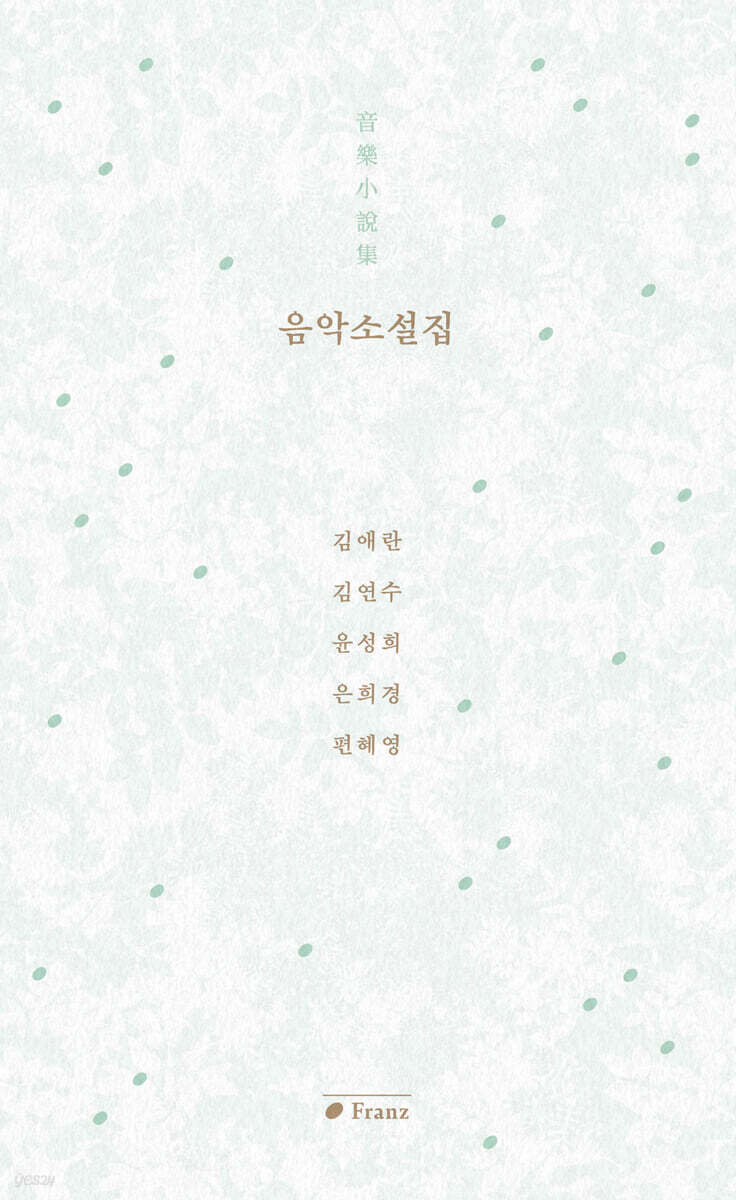
Music novel collection
 |
Description
Book Introduction
- A word from MD
-
The moment when music becomes a storyAn anthology of novels that only music publisher Franzmann can publish.
Five representative Korean literary authors each tell stories of the decisive moments they encountered through music.
The boundaries of life, deepened by encountering music, are beautifully drawn.
This book will surely be a comfort to read while listening to your own theme song during the long rainy season.
July 5, 2024. Novel/Poetry PD Kim Yu-ri
Music has always been a part of our lives.
A music novel anthology featuring Kim Ae-ran, Kim Yeon-su, Yoon Seong-hee, Eun Hee-kyung, and Pyeon Hye-young.
Franz, a music publishing company, presents 『Music Novels』, an anthology of novels themed around music.
When we put earphones in our ears on the bus to and from work, when we excitedly search for the concert hall of our favorite performer, when the sound of a song we hear while walking down the street gradually becomes clearer and pierces our hearts, we have experienced enriching moments when our senses are awakened as rhythm and beat are added to the dull, silent daily life.
The reason why that moment is remembered so vividly when looking back on the past is probably because the colorful music added to the ordinary daily life made that moment unique.
The power of music to expand the boundaries of life that surround us. Franz planned this anthology by focusing on the everyday power of music.
When a day is remembered with music, it means that moment remains with us as a story.
How did these five leading Korean novelists capture our daily lives, intertwined with music? Beyond sharing the theme of "music," these five novels, written freely, reveal stories as diverse as their distinct styles.
Kim Ae-ran, who has demonstrated a unique sense for revealing how closely related the situations of characters are to social conditions, portrays a time when a couple broke up for realistic reasons in “I Said Goodbye,” and sensitively captures the moments of misunderstanding, affection, deviation, and overlap when “music” and “life” are combined.
Kim Yeon-su, who has persuasively told the story that even if you experience the same thing, depending on your attitude towards it, the door to completely different possibilities can open, deals with the common music that connects the long-ago summer spent with her mother as a child and the summer passed with her lover in “Above the Sleep,” and describes the phase in which the truth of life unfolds anew depending on “interpretation” in beautiful and vivid language like a midsummer night’s walk.
Meanwhile, for Yoon Seong-hee, music is a dream.
Yoon Seong-hee, who knows full well that understanding a person begins with a persistent and detailed observation of them, makes us realize in "Lullaby" that a lullaby is a form of music that expresses deep love for someone through the struggle of a girl who tries to enter her mother's dream to fulfill her dream of meeting her mother.
Eun Hee-kyung, who expands the internal scale of the novel with an enterprising force that breaks boredom and repetition, depicts the emotional turmoil that unfolds as four people accidentally ride together in a four-person train compartment in "Weathering" and secretly care about one another.
What happens when "chance" intervenes? Like an orchestral piece with multiple instruments playing simultaneously, the novel is richly filled with the intersecting past and present surrounding the four characters.
By restraining her emotions, Pyeon Hye-young makes us feel what is not expressed more intensely. Her cool gaze and unadorned sentences are her signature style, but the warmth toward life that seeps out between them is fully conveyed to us.
"Green Sweater" follows the special two-day, one-night trip of a character who ends up with her mother's friends, carrying the green sweater she couldn't finish knitting before her mother died. It shows us what remains in us even after we part ways with someone, through specific mementos like cassette tapes, ten-won coins, and knitting yarn.
Additionally, the book concludes with interviews with the authors and editors, offering honest and humorous insights into each work, as well as insights into the specific methods and mindsets of the authors as they craft their novels.
The five stories of five novelists, each of whom has established themselves as representative Korean literature by building their own unique world of works, can be read as their own answers to the question of how to overcome life's unexpected events, such as an unexpected separation or death.
Just as the emotions within us are amplified and activated more than ever during the five minutes or so that music plays, the time spent with these five novels will be a time when we can experience the one-time moments in our lives with the greatest intensity and three-dimensionality.
A music novel anthology featuring Kim Ae-ran, Kim Yeon-su, Yoon Seong-hee, Eun Hee-kyung, and Pyeon Hye-young.
Franz, a music publishing company, presents 『Music Novels』, an anthology of novels themed around music.
When we put earphones in our ears on the bus to and from work, when we excitedly search for the concert hall of our favorite performer, when the sound of a song we hear while walking down the street gradually becomes clearer and pierces our hearts, we have experienced enriching moments when our senses are awakened as rhythm and beat are added to the dull, silent daily life.
The reason why that moment is remembered so vividly when looking back on the past is probably because the colorful music added to the ordinary daily life made that moment unique.
The power of music to expand the boundaries of life that surround us. Franz planned this anthology by focusing on the everyday power of music.
When a day is remembered with music, it means that moment remains with us as a story.
How did these five leading Korean novelists capture our daily lives, intertwined with music? Beyond sharing the theme of "music," these five novels, written freely, reveal stories as diverse as their distinct styles.
Kim Ae-ran, who has demonstrated a unique sense for revealing how closely related the situations of characters are to social conditions, portrays a time when a couple broke up for realistic reasons in “I Said Goodbye,” and sensitively captures the moments of misunderstanding, affection, deviation, and overlap when “music” and “life” are combined.
Kim Yeon-su, who has persuasively told the story that even if you experience the same thing, depending on your attitude towards it, the door to completely different possibilities can open, deals with the common music that connects the long-ago summer spent with her mother as a child and the summer passed with her lover in “Above the Sleep,” and describes the phase in which the truth of life unfolds anew depending on “interpretation” in beautiful and vivid language like a midsummer night’s walk.
Meanwhile, for Yoon Seong-hee, music is a dream.
Yoon Seong-hee, who knows full well that understanding a person begins with a persistent and detailed observation of them, makes us realize in "Lullaby" that a lullaby is a form of music that expresses deep love for someone through the struggle of a girl who tries to enter her mother's dream to fulfill her dream of meeting her mother.
Eun Hee-kyung, who expands the internal scale of the novel with an enterprising force that breaks boredom and repetition, depicts the emotional turmoil that unfolds as four people accidentally ride together in a four-person train compartment in "Weathering" and secretly care about one another.
What happens when "chance" intervenes? Like an orchestral piece with multiple instruments playing simultaneously, the novel is richly filled with the intersecting past and present surrounding the four characters.
By restraining her emotions, Pyeon Hye-young makes us feel what is not expressed more intensely. Her cool gaze and unadorned sentences are her signature style, but the warmth toward life that seeps out between them is fully conveyed to us.
"Green Sweater" follows the special two-day, one-night trip of a character who ends up with her mother's friends, carrying the green sweater she couldn't finish knitting before her mother died. It shows us what remains in us even after we part ways with someone, through specific mementos like cassette tapes, ten-won coins, and knitting yarn.
Additionally, the book concludes with interviews with the authors and editors, offering honest and humorous insights into each work, as well as insights into the specific methods and mindsets of the authors as they craft their novels.
The five stories of five novelists, each of whom has established themselves as representative Korean literature by building their own unique world of works, can be read as their own answers to the question of how to overcome life's unexpected events, such as an unexpected separation or death.
Just as the emotions within us are amplified and activated more than ever during the five minutes or so that music plays, the time spent with these five novels will be a time when we can experience the one-time moments in our lives with the greatest intensity and three-dimensionality.
- You can preview some of the book's contents.
Preview
index
I Said Hello - Kim Ae-ran · 007
Above the Water - Kim Yeon-su · 049
Lullaby - Yoon Seong-hee · 095
Weathering - Eun Hee-kyung · 129
Green Sweater - Hye-young Pyeon · 167
Interview
Between silence and noise, between music and story
Interviews with Five Writers and Editors · 199
Above the Water - Kim Yeon-su · 049
Lullaby - Yoon Seong-hee · 095
Weathering - Eun Hee-kyung · 129
Green Sweater - Hye-young Pyeon · 167
Interview
Between silence and noise, between music and story
Interviews with Five Writers and Editors · 199
Detailed image

Into the book
-What is your purpose in learning a foreign language?
I thought about it for a while and answered relatively honestly.
-Do you want to leave this place someday?
It was a vague hope that I had without any specific skills or qualifications.
I didn't say the most important reason, which was 'Studying a foreign language gives me the illusion that there are still possibilities and opportunities left for me...'
--- pp.16-17 Kim Ae-ran, from "I Said Hello"
I wanted to tell Robert this story.
But that didn't happen.
Not only was my skill lacking, but the inevitable omissions and losses that would occur if I awkwardly translated my feelings now would make each and every insignificant detail feel like the most important and precious part of my emotions.
It didn't matter if it was joy.
But sadness was different.
I wanted to speak about pain in the language of my sorrow, the root of my emotions, my mother tongue.
But even if you speak in your native language, will it really be fully conveyed?
--- p.46 Kim Ae-ran, from “I Said Hello”
If you feel like you're feeling down, get up right away and go to the nearest tree.
And then stand in a place where you can see the tree at a glance and look at it.
The key is to see the wind, but it is invisible, so you can only perceive it by the swaying of leaves and branches.
If you look at even the still trees, you will see that they will eventually shake somewhere.
Following the subtitles' description, I also looked at the tree on the screen.
--- pp.54-55 Kim Yeon-su, from “Above the Water”
That's when I heard the sound.
The sound of the piano.
The first note and the next note.
And then the notes that follow.
My mom was playing the piano behind me.
There was a piano there from the beginning, but I never saw my mom play it.
The piano sound I unexpectedly heard after expecting something terrible was so beautiful.
--- pp.66-67 Kim Yeon-su, from “Above the Water”
“I sleep because I want to dream about that child.
Some days I sleep all day.
But still, it never appears in my dreams.
“That’s scary.”
--- p.115 Yoon Seong-hee, from “Lullaby”
My mother and I laughed together when we were happy, but we pretended not to notice each other when we were sad.
Sometimes I was hurt by my mother who did not comfort me.
I wonder if my mother was hurt by me, too. Come to think of it, I rarely noticed her sadness.
Because Mom didn't get caught.
--- p.115 Yoon Seong-hee, from “Lullaby”
There are two ways to interpret the fact that you went to do something you really didn't want to do, but ended up ruining the journey.
It means that the time has come to quit, and that you are aware of that fact, even if unconsciously.
--- p.134 Eun Hee-kyung, from “Weathering”
The scenery seen from the reverse direction of a moving train was not something that passed by quickly.
It felt like I was sitting in one place for a long time, watching the things that were nearby slowly move away.
The nearby forests and fields, and the distant mountain peaks, were all covered in raindrops.
--- p.143 Eun Hee-kyung, from “Weathering”
My aunt began to carefully untie the part that had already been pulled.
I unraveled them one by one, being careful not to let the thread get tangled or come loose all at once.
My aunt did not hesitate to correct things that I thought were irreversible once I made a mistake.
--- pp.186-187 Hye-young Pyeon, from “Green Sweater”
I was immediately intimidated when the person I was most intimate with suddenly changed his face and showed contemptuous indifference.
No matter what I did, they blamed me and doubted me.
Because I didn't know how to part with the things I once loved.
I thought about it for a while and answered relatively honestly.
-Do you want to leave this place someday?
It was a vague hope that I had without any specific skills or qualifications.
I didn't say the most important reason, which was 'Studying a foreign language gives me the illusion that there are still possibilities and opportunities left for me...'
--- pp.16-17 Kim Ae-ran, from "I Said Hello"
I wanted to tell Robert this story.
But that didn't happen.
Not only was my skill lacking, but the inevitable omissions and losses that would occur if I awkwardly translated my feelings now would make each and every insignificant detail feel like the most important and precious part of my emotions.
It didn't matter if it was joy.
But sadness was different.
I wanted to speak about pain in the language of my sorrow, the root of my emotions, my mother tongue.
But even if you speak in your native language, will it really be fully conveyed?
--- p.46 Kim Ae-ran, from “I Said Hello”
If you feel like you're feeling down, get up right away and go to the nearest tree.
And then stand in a place where you can see the tree at a glance and look at it.
The key is to see the wind, but it is invisible, so you can only perceive it by the swaying of leaves and branches.
If you look at even the still trees, you will see that they will eventually shake somewhere.
Following the subtitles' description, I also looked at the tree on the screen.
--- pp.54-55 Kim Yeon-su, from “Above the Water”
That's when I heard the sound.
The sound of the piano.
The first note and the next note.
And then the notes that follow.
My mom was playing the piano behind me.
There was a piano there from the beginning, but I never saw my mom play it.
The piano sound I unexpectedly heard after expecting something terrible was so beautiful.
--- pp.66-67 Kim Yeon-su, from “Above the Water”
“I sleep because I want to dream about that child.
Some days I sleep all day.
But still, it never appears in my dreams.
“That’s scary.”
--- p.115 Yoon Seong-hee, from “Lullaby”
My mother and I laughed together when we were happy, but we pretended not to notice each other when we were sad.
Sometimes I was hurt by my mother who did not comfort me.
I wonder if my mother was hurt by me, too. Come to think of it, I rarely noticed her sadness.
Because Mom didn't get caught.
--- p.115 Yoon Seong-hee, from “Lullaby”
There are two ways to interpret the fact that you went to do something you really didn't want to do, but ended up ruining the journey.
It means that the time has come to quit, and that you are aware of that fact, even if unconsciously.
--- p.134 Eun Hee-kyung, from “Weathering”
The scenery seen from the reverse direction of a moving train was not something that passed by quickly.
It felt like I was sitting in one place for a long time, watching the things that were nearby slowly move away.
The nearby forests and fields, and the distant mountain peaks, were all covered in raindrops.
--- p.143 Eun Hee-kyung, from “Weathering”
My aunt began to carefully untie the part that had already been pulled.
I unraveled them one by one, being careful not to let the thread get tangled or come loose all at once.
My aunt did not hesitate to correct things that I thought were irreversible once I made a mistake.
--- pp.186-187 Hye-young Pyeon, from “Green Sweater”
I was immediately intimidated when the person I was most intimate with suddenly changed his face and showed contemptuous indifference.
No matter what I did, they blamed me and doubted me.
Because I didn't know how to part with the things I once loved.
--- p.195 Pyeon Hye-young, from “Green Sweater”
Publisher's Review
Five songs, five stories, five lives
“I don’t usually express my pain to others.
“It’s like a breakup song sung by a person.”
―Kim Ae-ran, "I Said Hello"
'Eunmi' has experienced two breakups in a row in recent years.
One is the breakup with her long-time boyfriend, Heon-su.
Another is the separation from my mother who passed away after suffering from an illness.
What Eun-mi chooses in the midst of sadness and isolation is to learn a foreign language.
Eun-mi, who had to quit her job to care for her mother and had a break in her career, knows full well that it will not be easy for her to find work again as a woman in her forties, but she decides to “start learning English right away,” and signs up for the video English site “Ecos.”
And one day while taking a class, I received this question from a native English teacher named Robert.
“But how do you say ‘hello’ in Korean?” That reminds Eunmi of a day seven years ago.
At that time, when she had naturally imagined a future with Heon-su, Eun-mi had a peaceful morning listening to "Love Hurts" that Heon-su had played.
At the time Eunmi heard that song, she had a lover and a family.
It was possible to securely envision a distant future rather than worrying about the immediate future.
But now that she no longer has a lover or family by her side and “the pressure of life is rising to her chin,” Eun-mi begins to reckon with what she can and cannot do, what she can and cannot say, what was possible and what never came to pass, in a situation where she cannot easily express her sorrow, like “Love Hearts,” which sounded like “a breakup song sung by someone who doesn’t express their pain well to others.”
“A summer night where light and darkness, silence and noise intersect
“It was a perfect orchestra in itself.”
―Kim Yeon-su, "Above the Water"
After her lover, Ki-jin, dies, Eun-hee loses her will to live. One day, when she finds it difficult to breathe, she searches for "how to breathe" on YouTube and comes across a video uploaded by a person named Yu-ju.
In the video, titled "Look at a Tree Whenever You Have Trouble Breathing," Yuju explains that when you have trouble breathing, you should go to a tree and look at it.
If you look at a tree quietly, you can find its swaying parts, and through that quiet immersion, you can forget that you are even breathing.
Eun-hee, who was unexpectedly impressed by Yu-ju's breathing technique, was watching another video uploaded by Yu-ju when she saw a familiar face appear on the screen and heard a familiar voice say this.
“Can we talk?” It was definitely Kijin’s voice.
And after the video edited with highlights quickly passed by, the title of the video appeared.
'A time traveler I met while eating omelet rice in Yeongcheon.'
Time traveler, what on earth does that mean? But Eun-hee knows something about 'Yeongcheon's Omelet Rice.'
It was a summer night a few years ago, when I was taking a walk with Kijin after seeing a concert, and Kijin, who had many secrets, rarely brought up a story about his past, and it was about 'Yeongcheon's Omelet Rice'.
The story of how he moved to Yeongcheon while living with his mother who was suffering from depression, and his life changed after eating an omelet rice at a famous Chinese restaurant in the neighborhood.
Why did Kijin go to Yeongcheon that day?
Were you going through enough difficulties to need a change in life?
Eun-hee looks back on her time with Ki-jin as she watches each of the videos uploaded by Yu-ju.
“I sang softly.
“It seemed like my mother was smiling while she was sleeping.”
―Yoon Seong-hee, "Lullaby"
Today is the fourth 'Matching Socks Day' since I entered high school.
The event of wearing matching socks to school after midterms and finals was created by the principal who was shocked by the incident where a student committed suicide by jumping from the rooftop after the finals.
Why mismatched socks? The principal couldn't forget the mismatched socks a friend had given him as a gift during his school days.
Then my friend gave me a gift and said this.
“Wear these socks on gloomy days.” With an excited heart, I put on black and white socks and headed to school. I spent the day laughing and chatting with my friends as usual.
But this ordinary daily life is shaken up when an accident occurs on the way home.
Because I was quickly crossing the crosswalk with only a few seconds left until the traffic light turned green, and was hit by a truck approaching from the right.
But the amazing thing happens next.
'I' am dead, but not completely dead.
So you can see the people around you and sing along.
Only, no one can see him or hear his voice.
After my own funeral, I follow my mother home.
Because I'm worried that my mother might be unable to sleep because she's sad about my death.
“The music that penetrated my ears was like the music of the forest, the rain, and the wind.
“I felt like a little kid being invited there for the first time.”
Eun Hee-kyung, "Weathering"
In July, when rain falls relentlessly, four people are sitting facing each other in a four-person train seat.
First of all, ‘Giuk’.
Ki-wook, who is in charge of hosting and providing music commentary for a classical music event held in City G, must arrive safely at the venue in four hours. However, he realizes that he has reserved the reservation for the next day, not the same day, and is forced to sit in the one remaining four-person seat.
The person sitting next to Ki-wook is an old man with graying hair.
He unfolds a large sheet of music paper, as if to block out any conversation with other people.
But the title of the song written on the staff catches Gi-wook's attention. It's a song that his eccentric and neurotic music teacher taught him in middle school.
Thinking about it, the old man's face somehow seemed to resemble the music teacher, so Ki-wook continued to look at him out of the corner of his eye.
There were also people who were surprised to see the sheet music the old man had spread out.
'Inseon' sitting right in front.
That song is the one that made it possible for me to start a love affair with my ex-lover.
Inseon, sitting on the train with a glimmer of hope that she might reunite with that person, begins to feel her heart pounding as she thinks that seeing the title of the song right before her eyes might be a kind of revelation.
And finally, the person sitting next to Inseon is his coworker, 'Junhee'.
When I heard the news of the death of a coworker's father, I went to pay my respects with my senior colleague, Inseon.
What will happen to Jun-hee and the other three people on this train ride, which they boarded not long after hearing the advice from their doctor to “think bright thoughts and go to happy places often”?
“That’s a song my mother sang a long time ago on this old cassette tape.
It meant that it might remain.”
―Pyeon Hye-young, "Green Sweater"
My mother's friend, Aunt Youngju, suddenly calls me after several years and asks me out of the blue to go to Ganghwa Island.
After my mother passed away, I lived with my aunt for a while, but as time passed, we lost contact for a long time.
Aunt Yeongju must have noticed my reluctance to go to Ganghwa Island, and she said, “I have money to give you,” and “It’s your mother’s money.”
He gives a practical reason, saying, “Naju didn’t pay.”
So, the person in Ganghwado is none other than Naju Imo, who borrowed money from my mother and never paid it back.
My mother, Aunt Yeongju, and Aunt Naju met and became friends in middle school, and they have been hanging out together for a long time and have strengthened their friendship.
But debt?
Before I could even figure out whether Aunt Naju had any pressing circumstances that would have made her need to borrow money from Mom, I concluded that that must be why Aunt Naju didn't come to Mom's funeral.
When you think about it that way, it seems like a natural progression to get the money back from your aunt.
Besides, I have a green sweater that my mother knitted before she died.
When I first saw that unfinished sweater, I naturally assumed that it was something my mother had started knitting for me.
But it was too big for that.
I wondered if my aunt knew who the owner of this sweater was, so I packed the sweater and headed to Ganghwa Island with my aunt.
But maybe I should have noticed when I saw Aunt Yeongju looking a bit nervous when I entered the restaurant where Aunt Naju worked.
That the purpose of this visit might not be to get the money back.
“I don’t usually express my pain to others.
“It’s like a breakup song sung by a person.”
―Kim Ae-ran, "I Said Hello"
'Eunmi' has experienced two breakups in a row in recent years.
One is the breakup with her long-time boyfriend, Heon-su.
Another is the separation from my mother who passed away after suffering from an illness.
What Eun-mi chooses in the midst of sadness and isolation is to learn a foreign language.
Eun-mi, who had to quit her job to care for her mother and had a break in her career, knows full well that it will not be easy for her to find work again as a woman in her forties, but she decides to “start learning English right away,” and signs up for the video English site “Ecos.”
And one day while taking a class, I received this question from a native English teacher named Robert.
“But how do you say ‘hello’ in Korean?” That reminds Eunmi of a day seven years ago.
At that time, when she had naturally imagined a future with Heon-su, Eun-mi had a peaceful morning listening to "Love Hurts" that Heon-su had played.
At the time Eunmi heard that song, she had a lover and a family.
It was possible to securely envision a distant future rather than worrying about the immediate future.
But now that she no longer has a lover or family by her side and “the pressure of life is rising to her chin,” Eun-mi begins to reckon with what she can and cannot do, what she can and cannot say, what was possible and what never came to pass, in a situation where she cannot easily express her sorrow, like “Love Hearts,” which sounded like “a breakup song sung by someone who doesn’t express their pain well to others.”
“A summer night where light and darkness, silence and noise intersect
“It was a perfect orchestra in itself.”
―Kim Yeon-su, "Above the Water"
After her lover, Ki-jin, dies, Eun-hee loses her will to live. One day, when she finds it difficult to breathe, she searches for "how to breathe" on YouTube and comes across a video uploaded by a person named Yu-ju.
In the video, titled "Look at a Tree Whenever You Have Trouble Breathing," Yuju explains that when you have trouble breathing, you should go to a tree and look at it.
If you look at a tree quietly, you can find its swaying parts, and through that quiet immersion, you can forget that you are even breathing.
Eun-hee, who was unexpectedly impressed by Yu-ju's breathing technique, was watching another video uploaded by Yu-ju when she saw a familiar face appear on the screen and heard a familiar voice say this.
“Can we talk?” It was definitely Kijin’s voice.
And after the video edited with highlights quickly passed by, the title of the video appeared.
'A time traveler I met while eating omelet rice in Yeongcheon.'
Time traveler, what on earth does that mean? But Eun-hee knows something about 'Yeongcheon's Omelet Rice.'
It was a summer night a few years ago, when I was taking a walk with Kijin after seeing a concert, and Kijin, who had many secrets, rarely brought up a story about his past, and it was about 'Yeongcheon's Omelet Rice'.
The story of how he moved to Yeongcheon while living with his mother who was suffering from depression, and his life changed after eating an omelet rice at a famous Chinese restaurant in the neighborhood.
Why did Kijin go to Yeongcheon that day?
Were you going through enough difficulties to need a change in life?
Eun-hee looks back on her time with Ki-jin as she watches each of the videos uploaded by Yu-ju.
“I sang softly.
“It seemed like my mother was smiling while she was sleeping.”
―Yoon Seong-hee, "Lullaby"
Today is the fourth 'Matching Socks Day' since I entered high school.
The event of wearing matching socks to school after midterms and finals was created by the principal who was shocked by the incident where a student committed suicide by jumping from the rooftop after the finals.
Why mismatched socks? The principal couldn't forget the mismatched socks a friend had given him as a gift during his school days.
Then my friend gave me a gift and said this.
“Wear these socks on gloomy days.” With an excited heart, I put on black and white socks and headed to school. I spent the day laughing and chatting with my friends as usual.
But this ordinary daily life is shaken up when an accident occurs on the way home.
Because I was quickly crossing the crosswalk with only a few seconds left until the traffic light turned green, and was hit by a truck approaching from the right.
But the amazing thing happens next.
'I' am dead, but not completely dead.
So you can see the people around you and sing along.
Only, no one can see him or hear his voice.
After my own funeral, I follow my mother home.
Because I'm worried that my mother might be unable to sleep because she's sad about my death.
“The music that penetrated my ears was like the music of the forest, the rain, and the wind.
“I felt like a little kid being invited there for the first time.”
Eun Hee-kyung, "Weathering"
In July, when rain falls relentlessly, four people are sitting facing each other in a four-person train seat.
First of all, ‘Giuk’.
Ki-wook, who is in charge of hosting and providing music commentary for a classical music event held in City G, must arrive safely at the venue in four hours. However, he realizes that he has reserved the reservation for the next day, not the same day, and is forced to sit in the one remaining four-person seat.
The person sitting next to Ki-wook is an old man with graying hair.
He unfolds a large sheet of music paper, as if to block out any conversation with other people.
But the title of the song written on the staff catches Gi-wook's attention. It's a song that his eccentric and neurotic music teacher taught him in middle school.
Thinking about it, the old man's face somehow seemed to resemble the music teacher, so Ki-wook continued to look at him out of the corner of his eye.
There were also people who were surprised to see the sheet music the old man had spread out.
'Inseon' sitting right in front.
That song is the one that made it possible for me to start a love affair with my ex-lover.
Inseon, sitting on the train with a glimmer of hope that she might reunite with that person, begins to feel her heart pounding as she thinks that seeing the title of the song right before her eyes might be a kind of revelation.
And finally, the person sitting next to Inseon is his coworker, 'Junhee'.
When I heard the news of the death of a coworker's father, I went to pay my respects with my senior colleague, Inseon.
What will happen to Jun-hee and the other three people on this train ride, which they boarded not long after hearing the advice from their doctor to “think bright thoughts and go to happy places often”?
“That’s a song my mother sang a long time ago on this old cassette tape.
It meant that it might remain.”
―Pyeon Hye-young, "Green Sweater"
My mother's friend, Aunt Youngju, suddenly calls me after several years and asks me out of the blue to go to Ganghwa Island.
After my mother passed away, I lived with my aunt for a while, but as time passed, we lost contact for a long time.
Aunt Yeongju must have noticed my reluctance to go to Ganghwa Island, and she said, “I have money to give you,” and “It’s your mother’s money.”
He gives a practical reason, saying, “Naju didn’t pay.”
So, the person in Ganghwado is none other than Naju Imo, who borrowed money from my mother and never paid it back.
My mother, Aunt Yeongju, and Aunt Naju met and became friends in middle school, and they have been hanging out together for a long time and have strengthened their friendship.
But debt?
Before I could even figure out whether Aunt Naju had any pressing circumstances that would have made her need to borrow money from Mom, I concluded that that must be why Aunt Naju didn't come to Mom's funeral.
When you think about it that way, it seems like a natural progression to get the money back from your aunt.
Besides, I have a green sweater that my mother knitted before she died.
When I first saw that unfinished sweater, I naturally assumed that it was something my mother had started knitting for me.
But it was too big for that.
I wondered if my aunt knew who the owner of this sweater was, so I packed the sweater and headed to Ganghwa Island with my aunt.
But maybe I should have noticed when I saw Aunt Yeongju looking a bit nervous when I entered the restaurant where Aunt Naju worked.
That the purpose of this visit might not be to get the money back.
GOODS SPECIFICS
- Date of issue: July 1, 2024
- Page count, weight, size: 272 pages | 308g | 123*200*15mm
- ISBN13: 9791197325892
- ISBN10: 1197325891
You may also like
카테고리
korean


korean

![GQ KOREA Mark (Monthly): December [2025]](http://librairie.coreenne.fr/cdn/shop/files/8ef265dbbfbf186523ed75ba7319009d.jpg?v=1765340328&width=3840)


