

Women in Film
 |
Description
Book Introduction
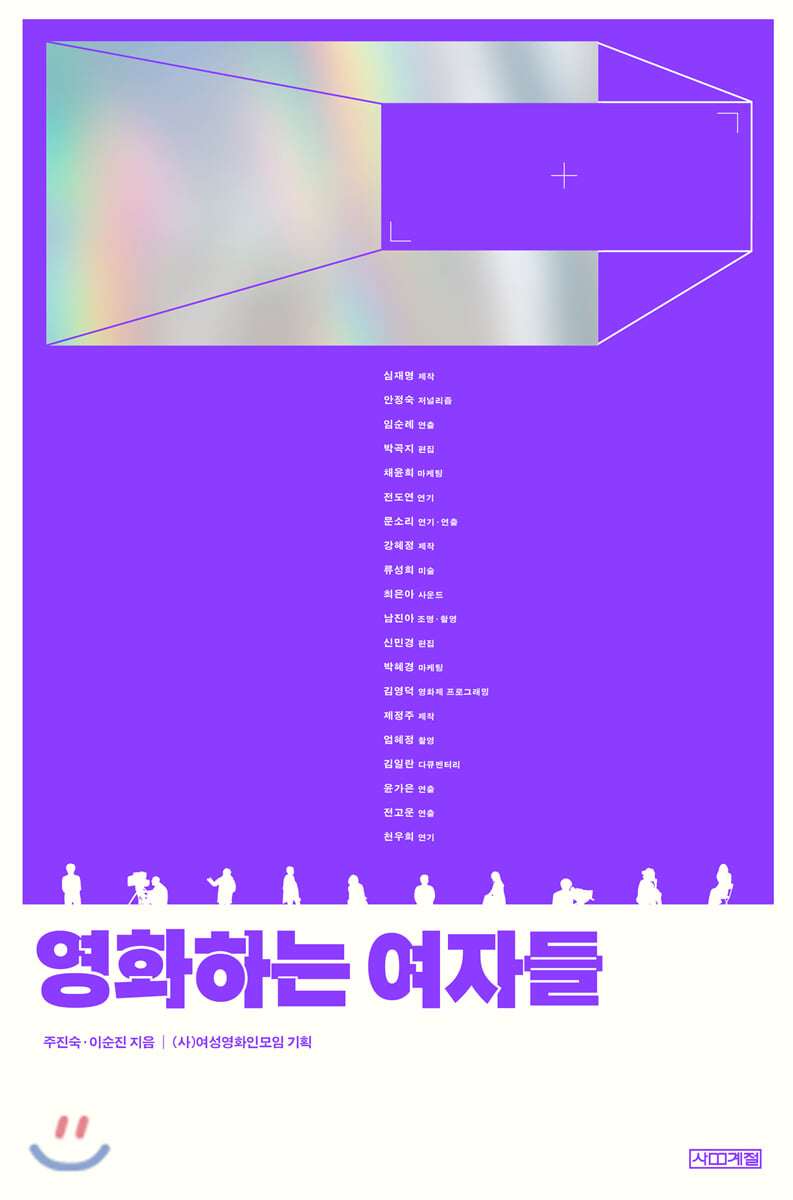
The Women in Film Korea, founded to advocate for the rights of female filmmakers and create an environment where more women can make better films, interviewed 20 leading female filmmakers in various fields who have been active in the film industry since the 1990s to mark its 20th anniversary. We met creators from all areas related to film, from production, directing, acting, cinematography, lighting, art, sound, editing, documentary, and marketing, as well as film festival programming and journalism, and included their work, life, and thoughts on film. Unlike the existing film history written by (male) researchers focusing on the artistic world of (male) film directors, this book, written by female filmmakers who directly asked and answered questions while thoroughly examining every corner of the film scene, aims to be a 'history for all of us.' The stories of change and challenges, achievements and frustrations, solidarity and cooperation they have experienced in their respective fields over the past 30 years are not only a lineage that will be clearly etched in the history of Korean cinema, but also a record of the struggles of working women as experts and laborers in their fields, as artists and everyday people. |
- You can preview some of the book's contents.
Preview
index
Entering 5
Part 1: Overcoming the Wall of Alienation to Dazzling Achievements - The 1990s
I am a woman, a filmmaker - Shim Jae-myung
Recording the Most Shining Moment in Korean Cinema - Ahn Jung-sook
The most flexible and longest-working creator - Lim Soon-rye
Park Gok-ji, a 30-year veteran editor who remembers the value of a single cut in the film era.
All the Beginnings of Korean Film Marketing - Chae Yoon-hee
Jeon Do-yeon, an actress who always seeks out better stories
Part 2: Wider and Deeper: The Age of Experts - The 2000s
The path of life and the path of film are not different - Moon So-ri
A solid producer who knows both fall and rise - Kang Hye-jeong
Ryu Seong-hee, creative production designer in charge of the film's visual elements
Better Work Environments Make Better Sound - Eun-ah Choi
A person who wants to create and record all the light in the movie - Nam Jin-ah
Shin Min-kyung, a creative editor who navigates genres and employs unconventional techniques
Marketing starts from the core: finding the prettiest face - Park Hye-kyung
Imagining the Future of Film Festivals in the Age of Netflix and YouTube - Kim Young-deok
Part 3: A Strong Self-Center and a New Sensibility - After the 2010s
I Want to Tell My Story, Even if It's Small - Jeong-ju Jeong
The Camera Doesn't Discriminate Against Gender - Eom Hye-jeong
Kim Il-ran, a recorder of the complexity of events and the multifaceted nature of humanity
I want to make films that children choose to see on their own - Yoon Ga-eun
My dream is to become a master of cute, fun, and independent female characters - Jeon Go-woon
The actor who never lets go of the question, "Why not?" - Chun Woo-hee
Women in Film Timeline
Part 1: Overcoming the Wall of Alienation to Dazzling Achievements - The 1990s
I am a woman, a filmmaker - Shim Jae-myung
Recording the Most Shining Moment in Korean Cinema - Ahn Jung-sook
The most flexible and longest-working creator - Lim Soon-rye
Park Gok-ji, a 30-year veteran editor who remembers the value of a single cut in the film era.
All the Beginnings of Korean Film Marketing - Chae Yoon-hee
Jeon Do-yeon, an actress who always seeks out better stories
Part 2: Wider and Deeper: The Age of Experts - The 2000s
The path of life and the path of film are not different - Moon So-ri
A solid producer who knows both fall and rise - Kang Hye-jeong
Ryu Seong-hee, creative production designer in charge of the film's visual elements
Better Work Environments Make Better Sound - Eun-ah Choi
A person who wants to create and record all the light in the movie - Nam Jin-ah
Shin Min-kyung, a creative editor who navigates genres and employs unconventional techniques
Marketing starts from the core: finding the prettiest face - Park Hye-kyung
Imagining the Future of Film Festivals in the Age of Netflix and YouTube - Kim Young-deok
Part 3: A Strong Self-Center and a New Sensibility - After the 2010s
I Want to Tell My Story, Even if It's Small - Jeong-ju Jeong
The Camera Doesn't Discriminate Against Gender - Eom Hye-jeong
Kim Il-ran, a recorder of the complexity of events and the multifaceted nature of humanity
I want to make films that children choose to see on their own - Yoon Ga-eun
My dream is to become a master of cute, fun, and independent female characters - Jeon Go-woon
The actor who never lets go of the question, "Why not?" - Chun Woo-hee
Women in Film Timeline
Detailed image

Into the book
The Renaissance of Korean Cinema: The Energy of Massive Change
Many things happened at once, such as film movement groups like Jangsan Gotmae taking the lead in fighting to abolish the censorship system, filmmakers in Chungmuro coming together to protest against the direct distribution of American films, and ultimately converting the Korean Film Council into the Korean Film Council.
The energy of Korean films was truly incredible.
I think this story, in which a democracy movement took place on one side of Korean society and filmmakers fiercely fought against the censorship system for creative freedom and fought to create policies for the development of Korean cinema, is a truly remarkable drama in itself.
Watching and recording it is what I did as a film journalist.
- Ahn Jeong-suk (film reporter)
--- p.37
Conditions of alienation and discrimination breed innovation.
The fact that the editor called Avid was introduced to Korea for the first time.
Since no one had ever done digital editing before, everyone thought it was an adventure, but Avid approached me first.
I won't take any money, so give it a try.
It was a system with a machine called Avid and a program and an operator.
We had nothing to lose and had to save money, so we took a bold shot.
That's how "Three Friends" became the first film in our country to be digitally edited.
I was trying to save money with a producer's mindset, and I had no reason to reject new technology.
- Im Soon-rye (film director)
--- p.62
All the firsts in Korean film marketing
I put a lot of thought into how I could use a differentiating strategy to make it known that "Shiri" was a masterpiece.
While talking to the production company, I found out that the actors were learning action skills, such as how to shoot guns, from action director Jeong Du-hong.
There was an action studio inside Boramae Park, and during the production presentation there, the actors performed gunfights and martial arts demonstrations.
… … It became a hot topic.
Because I've never done anything like that.
… … It was the first time that “Shiri” had a preview screening in a regular theater.
There were so many people who wanted to see it that we held a press preview at Synex in Dongbang Plaza.
Before, it was customary to do it only in small test rooms.
Since then, press previews have been held in several theaters and the cast has been giving stage greetings, which has become a promotional tool.
- Chae Yun-hee (marketer)
--- p.99~100
The Impact of the Digital Age on Actors' Performances
When shooting on film, we rehearse a lot to use less film, and everyone concentrates to reduce mistakes.
I think the process of focusing on the moment, thinking about it, and talking about it has decreased compared to before.
By drawing the overall picture in your head and concentrating in the moment, you can raise each god as if you were raising a child… … .
I don't know what this child will become, but if I had raised him with all my love at every moment, things would have become easier now.
Since we could edit on-site, I found it very strange to be in front of the on-site editing monitor and think, "What happened? What cuts do we need? What else should we try?"
But as time goes by, I think I would feel very anxious if there were no more on-site editing.
I got used to it before I knew it.
Looking back, we didn't have the convenience we have now, but the filmmaking process and set back then were really great.
- Jeon Do-yeon (actress)
--- p.114
Concerns and Will as a Female Actress
I'm always thinking about how female characters are portrayed in Korean films today and what I think female characters should be like.
I believe that all female characters can be independent, and that all films should have a high gender equality index.
It's difficult to achieve this goal perfectly when dealing with multiple lives in a story, but it's very important to me to think about how these things fit into the film's context in this era.
- Moon So-ri (actress, director)
--- p.141
Bong Joon-ho's films always present new challenges.
I was really tearing my hair out over the spoiler.
Because I even worried about whether I could reveal that Jessica was going to that house as a private tutor.
So it was a pretty interesting movie.
I had to show that it was a strange movie that showed the bare minimum but had a hook.
Director Bong Joon-ho and Director Kim Jee-woon's films are always fun to work on because they always present new challenges.
These two people never make the same movie.
'From now on, it's a new mission, a new genre.
There isn't even a genre.
It's something like 'I can't define it'.
Marketers also consider making-of interviews important.
A press release is supposed to cover up what needs to be covered up while conveying as much of the essence as possible. In such cases, it is really important to listen to the thoughts of the actors, director, and staff.
The press release for “Parasite” was written based on that.
- Park Hye-kyung (marketer)
--- p.250~251
Feminism is about giving voice to excluded voices.
I think that was the training I received through the women's movement.
What I mean is, I've learned that the feminist movement is always about asking, "If I agree with this person's argument, are there any other people who are excluded?"
The moment you focus on Aunt Yanghee, on the other hand, you notice immigrant women.
… … For example, something like this happened.
After the interview, I said goodbye to my aunt who was leaving for work, “Auntie, I hope your business goes well today.”
But then I was momentarily flustered.
"Huh? You want business to go well? What does it mean to want the prostitution business to go well?" The contradiction in that greeting, which might be easy for someone else, hit me hard, and I thought to myself, "If business is going well for my aunt, immigrant women have to go to second rounds. So what happens then?"
Regardless of how much I like my aunt, the fact that she serves the structure of prostitution and the conflict between her and the migrant women continue to be glaring.
I think maybe that's the tone of the movie.
- Kim Il-ran (documentary director)
--- p.325~326
The source of naturalness is collaboration with children.
I think we can work together because I don't have the concept of directing people to act as a director.
Of course, I'm in charge of balancing the structural flow of the story, but I feel like I'm working with the kids.
I keep thinking about 'what is the life of a movie with children?'
In fact, we are talking about a story that everyone knows, so we need to find a reason to watch it as a movie.
Finding truly authentic moments in film? … … I think we need to act in a way that children can do.
That's not something I can inject and get out of it.
In the most natural environment possible, children need to act in a way that they can believe in.
Memorizing lines and speaking them is usually not effective.
Because the lines are mine.
Sometimes, as we repeatedly practice improvisation and create scenes in the children's language, we revise the scenario.
… … So, in our movies, rather than playing a certain character, there are many cases where the child himself is revealed.
- Yoon Ga-eun (director)
Many things happened at once, such as film movement groups like Jangsan Gotmae taking the lead in fighting to abolish the censorship system, filmmakers in Chungmuro coming together to protest against the direct distribution of American films, and ultimately converting the Korean Film Council into the Korean Film Council.
The energy of Korean films was truly incredible.
I think this story, in which a democracy movement took place on one side of Korean society and filmmakers fiercely fought against the censorship system for creative freedom and fought to create policies for the development of Korean cinema, is a truly remarkable drama in itself.
Watching and recording it is what I did as a film journalist.
- Ahn Jeong-suk (film reporter)
--- p.37
Conditions of alienation and discrimination breed innovation.
The fact that the editor called Avid was introduced to Korea for the first time.
Since no one had ever done digital editing before, everyone thought it was an adventure, but Avid approached me first.
I won't take any money, so give it a try.
It was a system with a machine called Avid and a program and an operator.
We had nothing to lose and had to save money, so we took a bold shot.
That's how "Three Friends" became the first film in our country to be digitally edited.
I was trying to save money with a producer's mindset, and I had no reason to reject new technology.
- Im Soon-rye (film director)
--- p.62
All the firsts in Korean film marketing
I put a lot of thought into how I could use a differentiating strategy to make it known that "Shiri" was a masterpiece.
While talking to the production company, I found out that the actors were learning action skills, such as how to shoot guns, from action director Jeong Du-hong.
There was an action studio inside Boramae Park, and during the production presentation there, the actors performed gunfights and martial arts demonstrations.
… … It became a hot topic.
Because I've never done anything like that.
… … It was the first time that “Shiri” had a preview screening in a regular theater.
There were so many people who wanted to see it that we held a press preview at Synex in Dongbang Plaza.
Before, it was customary to do it only in small test rooms.
Since then, press previews have been held in several theaters and the cast has been giving stage greetings, which has become a promotional tool.
- Chae Yun-hee (marketer)
--- p.99~100
The Impact of the Digital Age on Actors' Performances
When shooting on film, we rehearse a lot to use less film, and everyone concentrates to reduce mistakes.
I think the process of focusing on the moment, thinking about it, and talking about it has decreased compared to before.
By drawing the overall picture in your head and concentrating in the moment, you can raise each god as if you were raising a child… … .
I don't know what this child will become, but if I had raised him with all my love at every moment, things would have become easier now.
Since we could edit on-site, I found it very strange to be in front of the on-site editing monitor and think, "What happened? What cuts do we need? What else should we try?"
But as time goes by, I think I would feel very anxious if there were no more on-site editing.
I got used to it before I knew it.
Looking back, we didn't have the convenience we have now, but the filmmaking process and set back then were really great.
- Jeon Do-yeon (actress)
--- p.114
Concerns and Will as a Female Actress
I'm always thinking about how female characters are portrayed in Korean films today and what I think female characters should be like.
I believe that all female characters can be independent, and that all films should have a high gender equality index.
It's difficult to achieve this goal perfectly when dealing with multiple lives in a story, but it's very important to me to think about how these things fit into the film's context in this era.
- Moon So-ri (actress, director)
--- p.141
Bong Joon-ho's films always present new challenges.
I was really tearing my hair out over the spoiler.
Because I even worried about whether I could reveal that Jessica was going to that house as a private tutor.
So it was a pretty interesting movie.
I had to show that it was a strange movie that showed the bare minimum but had a hook.
Director Bong Joon-ho and Director Kim Jee-woon's films are always fun to work on because they always present new challenges.
These two people never make the same movie.
'From now on, it's a new mission, a new genre.
There isn't even a genre.
It's something like 'I can't define it'.
Marketers also consider making-of interviews important.
A press release is supposed to cover up what needs to be covered up while conveying as much of the essence as possible. In such cases, it is really important to listen to the thoughts of the actors, director, and staff.
The press release for “Parasite” was written based on that.
- Park Hye-kyung (marketer)
--- p.250~251
Feminism is about giving voice to excluded voices.
I think that was the training I received through the women's movement.
What I mean is, I've learned that the feminist movement is always about asking, "If I agree with this person's argument, are there any other people who are excluded?"
The moment you focus on Aunt Yanghee, on the other hand, you notice immigrant women.
… … For example, something like this happened.
After the interview, I said goodbye to my aunt who was leaving for work, “Auntie, I hope your business goes well today.”
But then I was momentarily flustered.
"Huh? You want business to go well? What does it mean to want the prostitution business to go well?" The contradiction in that greeting, which might be easy for someone else, hit me hard, and I thought to myself, "If business is going well for my aunt, immigrant women have to go to second rounds. So what happens then?"
Regardless of how much I like my aunt, the fact that she serves the structure of prostitution and the conflict between her and the migrant women continue to be glaring.
I think maybe that's the tone of the movie.
- Kim Il-ran (documentary director)
--- p.325~326
The source of naturalness is collaboration with children.
I think we can work together because I don't have the concept of directing people to act as a director.
Of course, I'm in charge of balancing the structural flow of the story, but I feel like I'm working with the kids.
I keep thinking about 'what is the life of a movie with children?'
In fact, we are talking about a story that everyone knows, so we need to find a reason to watch it as a movie.
Finding truly authentic moments in film? … … I think we need to act in a way that children can do.
That's not something I can inject and get out of it.
In the most natural environment possible, children need to act in a way that they can believe in.
Memorizing lines and speaking them is usually not effective.
Because the lines are mine.
Sometimes, as we repeatedly practice improvisation and create scenes in the children's language, we revise the scenario.
… … So, in our movies, rather than playing a certain character, there are many cases where the child himself is revealed.
- Yoon Ga-eun (director)
--- p.349
Publisher's Review
We write our own history.
We have a shining lineage we'd be happy to stand behind.
For the first 30 years since the history of Korean cinema began in earnest in the 1950s, it was difficult to find women on the film set, except for actors.
After the first 30 years, when only five directors and a few dozen staff members left their mark, the second 30 years since the 1990s have seen countless women appear on the film scene.
Following in the footsteps of Im Soon-rye, who debuted as the sixth female director in 1994, female directors, as well as female creators active in all areas of film, including production, cinematography, lighting, art direction, sound, editing, and marketing, have created glorious moments in Korean cinema together.
While the spotlight of the media often falls on directors and actors who have won awards at prestigious film festivals around the world, behind the scenes, countless talented staff members participate, many of whom are women.
For example, the planner of “Connect” and “Joint Security Area JSA,” which opened a new era in Korean cinema, was Shim Jae-myung, the editor of “Shiri” was Park Gok-ji, and the marketer was Chae Yoon-hee.
If it weren't for art director Ryu Sung-hee, the films of Ryu Seung-wan, Bong Joon-ho, Park Chan-wook, Choi Dong-hoon, and Kim Jee-woon would have been different.
The fast and rhythmic scene transitions of the 10 million-viewer films “The Thieves” and “Assassination” came from the hands of editor Shin Min-kyung, and the person who established the film festival programming manual while going back and forth between the Busan International Film Festival and the Bucheon International Fantastic Film Festival was programmer Kim Young-deok.
Bold producer Kang Hye-jung has produced a string of blockbuster films, including “Berlin,” “Veteran,” and “Exit,” while Bong Joon-ho’s “Mother,” “Snowpiercer,” and “Parasite” have become a social sensation thanks to the collaboration with marketer Park Hye-kyung.
Many of the independent films and documentaries that have recently received attention, such as “Us,” “A Little Princess,” and “Accomplices,” were produced by female producers or directors.
Even in fields such as photography, lighting, and sound, which were traditionally considered male domains, women are no longer rare.
Despite their consistent activity over the past 30 years, their existence has often been regarded as a special or inconvenient exception.
In a reality where the idea that film is an art form that embodies the director's worldview is firmly established, the number of female directors still stands at only around 10 percent, and women who hold cameras, light equipment, or handle sound must risk having their skills questioned or losing opportunities.
Film criticism or film history narratives that focus on the director as an 'author' naturally tend to be male-dominated.
Therefore, the task of describing the activities of female filmmakers as “history” rather than “exception” must be undertaken by female filmmakers themselves.
The Women in Film Association, which had already compiled the names and activities of all female filmmakers active from the 1950s to the 1980s through the 『Dictionary of Women in Film』 in 2001, has described its second 30-year history since the 1990s through this book.
In doing so, it traces the lineage of 'women in film' from Lee Hae-yoon and Lee Kyung-ja, who started working in the film industry in the 1950s and organized the first female filmmakers' group, 'Youngheehoe', in the 1980s, to today in 2020.
In the first 30 years, when the mere fact that women were "surviving" in the film industry was important, we chose the format of a dictionary listing all names. However, in this book, which covers the second 30 years, we selected people who could show the changes in the film industry according to the flow of time and took the approach of hearing their voices directly.
The book is divided into three parts: the 1990s, when a new style of film and a welcoming audience emerged amid the influx of corporate capital into the film industry, the abolition of censorship, and the collapse of the traditional apprenticeship system; the 2000s, when world-class experts across all film fields emerged, raising both the quality and quantity of Korean films; and the 2010s and beyond, when creators with a new sensibility began to create unique stories with their own sense of issues. Included are interviews with 20 female filmmakers who represent each era.
This book, which contains the specific achievements of female filmmakers not as "great people" who survived harsh environments or as "victims" who were robbed of opportunities, but as pivotal figures who led the development of Korean cinema, will proudly prove that history can now be written solely through the achievements of women.
There is no longer a field in the film industry where women cannot dream.
The voices of women working in all areas of film: producing, directing, acting, cinematography, lighting, art direction, sound, editing, marketing, journalism, documentary, film festival programming…
The most significant feature of this book is that it broadly covers the specific work and expertise of field staff, concerns as professionals, and changes in the work environment, all of which have not been given much attention except in certain specialized fields.
In this book, the staff, who were previously seen as merely people performing assigned roles within the director's grand picture, introduce their work with affection and pride as partners and creators who work together to create the film.
Through their voices, we finally learn how the cinematographer's vision changes depending on his or her intentions, what concerns the lighting director has in the digital age, how the editing director controls the pace and rhythm of a film, and just how broad the scope of the art director's overall scope is.
Moreover, it offers a comprehensive look at all areas of the film industry, from the ethical concerns of documentary directors tackling sharp social issues, to the concerns of film festival programmers facing the age of Netflix and YouTube, to the insights of film journalists who have documented the dynamic changes in the film industry for 30 years.
“Memories of Murder” was a little different.
We called the work a rural noir, and in order to create a Korean noir, we wanted to work on maintaining a consistent tone of artistic elements from the filming stage, rather than in post-production.
Since I had to control various visual elements, I naturally had to take charge of the costumes, props, and sets.
It wasn't easy to get everyone's consent, as there were people who had been working much longer than me.
- Ryu Seong-hee (art director), page 175
The idea that digital is cheaper to produce than film seems to be a simple one.
When I took a picture, it wasn't like that.
Because it is more sensitive, has a different way of receiving and storing light, has different characteristics, and expresses depth differently, it requires more light and more detail to produce a picture as elegant as film.
- Nam Jin-ah (cinematographer and lighting director), p. 211
Working on music videos taught me character-focused editing.
Even when working on a film, I was able to think, 'Let's just look at the actors.'
Before, I learned that things like story, camera language, and art language were important, but in music videos, it doesn't matter if the camera goes beyond the image line, there really are no rules.
It's so free, following the lyrics and emotions of the music and the beat of the instrument.
Because the sound is central, it doesn't feel jarring even if you use a lot of cuts.
If a movie is a language that is completed step by step, then in a music video, you can use it just because it's good.
I've trained so much that I can even now say, "I just like it" (laughs). I think I can make some illogical connections.
- Shin Min-kyung (Editorial Director), p. 223
This book also addresses the changes that have occurred in the film industry since the standard labor contract and the so-called "52-hour workweek" were established.
For them, movies are not only art and a dream, but also a profession and a way of life.
There is a subtle difference in perspective between the generation that started working in the film industry in the 1990s, when overtime and all-nighters were routine, and the generation that entered the industry in the last 10 years. While the working environment in post-production fields such as sound and editing is relatively slow to change, the industry-wide effort to move in a better direction is a model for all industries.
For now, life has become one with dinner.
Until now, we thought that having the staff film for 20 hours straight or stay up all night would increase production efficiency, but now we don't film for more than 12 hours.
And as the sudden changes on set and the unpredictability of timing that come from the improvisation of directing have decreased, the scene has become much more democratic.
It has become a site where things must be done according to the agreed upon time and conditions, rather than being driven by the director's thoughts or stubbornness.
This change felt unfamiliar to some staff members, while it was welcome to others.
Nowadays, we take it for granted because the standard labor contract is applied to almost 90% of cases, but during the time of “Law of Sensuality,” the atmosphere was a mixture of various emotions, such as confusion and joy from the unfamiliar.
- Shim Jae-myeong (producer), pages 23-24
Overall, I think the current system is right.
But the problem is, there's something called breathing.
There are things that need to be taken care of and finished, but situations arise where you have to leave them behind.
Of course, since movies are also an industry, promises are important.
But as you do it, there are times when you think that what you came up with later will look much more beautiful.
Even then, there are times when time is running out and you just have to go.
Of course, it would be nice to make the best choice from the beginning, but that doesn't always happen, and from a director's perspective, there's a bitter feeling that there are more things to give up.
Of course, if you think about the assistants, the current method is right.
Work for a set amount of time and have some personal time.
- Nam Jin-ah (cinematographer and lighting director), page 215
It seems that post-production has become worse in some aspects as the standard labor contract has been applied to filming sites.
As the labor costs of field staff increased, the post-production budget actually decreased.
… … Field staff have individual contracts, but for post-production, production companies contract with companies.
Since we are workers of that company, we need to talk to the sound company representative about working conditions.
If we signed a direct contract with the production company, we could ask them to raise the unit price, but in reality, we are not the party contracting with them.
… … The Sound Branch of the Film Workers Union was established in August 2019.
From now on, I have to meet with representatives of sound companies and negotiate.
- Choi Eun-ah (sound editor), pp. 195-196
Above all, what binds them together is the common experience of being a minority, women, regardless of their field.
Depending on the nature of the job, we can examine the various challenges each person had to overcome to survive as a professional in an industry dominated by men.
These are stories that any woman working in Korean society, even if she is not in the film industry, can relate to.
(〈The Moment of Our Lives〉) Because the main characters are women and they lose in the end, I was able to see very clearly how much difficulty they went through.
… … I felt a lot while watching Director Im Soon-rye and CEO Shim Jae-myung.
Because I watched from the side as you navigated the rough waves.
… … I was very touched by the situation of female directors in the Korean film industry, the things they go through, and the path that producer Shim Jae-myung has taken and the things that he has gone through.
They had a huge impact on me.
- Moon So-ri (actress, director), pp. 136-137
To be honest, I'm on the tall side even in CGK right now.
I'm 176 centimeters tall.
But, that's what I always ask when I meet with directors.
Is it handheld?
I learned how to use a Steadicam when I was in school, so I said, “Yes, I can use a Steadicam too.”
But the funny thing is, because I have short hair, am tall, and am big, whenever I go to the bathroom, people say, “This is the women’s bathroom.”
… … Male directors always say things like, “Can you do handheld shooting? You’re a lot thinner than I thought.”
… … People usually think that in today’s world, if you have the skills, you can take pictures, and if you can’t take pictures, you don’t have the skills.
But that skill can only be recognized and improved if you are constantly given opportunities.
… … While men climb up one space at a time, women barely, luckily, manage to climb up one space.
The next space is not easy to climb.
Sometimes there is no next space to grab and climb up.
In my case, I grabbed one space and held on until the next space appeared.
- Eom Hye-jeong (cinematographer), pp. 303-306
When I turned 30, I heard a lot of talk about age.
Nowadays, actresses in their 30s are the most active, but back then, I often heard people say that it was ambiguous because of their age.
I'm too old to do a youth drama, but I'm also at an ambiguous age to play a mother or a woman who has established herself in society.
I thought a lot about what I should do in that ambiguous situation.
… … There are a lot of stereotypical roles.
That's why the stories women can tell, their positions, and the things they can express are limited.
… … Now, society has changed a lot, and there are many female directors and writers, so the things that can be expressed are more diverse than before.
It will change even more in the future.
- Chun Woo-hee (actress), pp. 386-387
A beautiful and strong solidarity among women within a single industry
The Women in Film and the Korean Film Gender Equality Center are strong
The Women in Film, which celebrates its 20th anniversary this year, was founded by film marketer Chae Yun-hee, along with film industry professionals such as Shim Jae-myeong and Lim Soon-rye, and film researchers including the two authors of this book, Joo Jin-sook and Lee Soon-jin. Since then, it has grown into a large organization with nearly 300 members.
Over the past 20 years, we have been working to create a gender-equal work environment, operate educational programs, conduct policy research, and host a festival for women in filmmaking, all to enable more women to work in better film settings. We have become a safe and trustworthy channel for women who dream of becoming filmmakers.
Despite the fact that the majority of its executives were active filmmakers or researchers, their willingness to dedicate their time and effort to addressing the challenges facing women in the film industry led to a long-term solidarity among women that few other industries have achieved.
The most meaningful fruit of that long history is the 'Korea Film Gender Equality Center Ddeundeun', which opened in 2018.
The sight of seniors constantly learning, fighting, and striving with a clear awareness that "I am a woman working in the film industry" and a sense of responsibility to create a better working environment for their juniors is like a movie in itself.
The film industry is the first to create a gender equality center led by the private sector and in collaboration with a public institution.
That's the pride of Denden.
Because it is led by the private sector, we are moving towards a system that reflects the unique characteristics of the field and the film industry.
So, we receive more reports than other centers, and support activities and preventive education are being conducted relatively well.
We are not experts in that field, we are filmmakers.
It's difficult because it's the first time we've done this, but Director Im Soon-rye, CEO Chae Yoon-hee, and I discuss and decide on any issues or incidents that arise, and we're organizing our positions.
As a result, there is a lot of work to do.
When we receive reports of sexual harassment or sexual violence, we continue to discuss with the Youngjinwi Committee how to handle them, how to support victims, how to provide preventive education, and how to train instructors in charge of such matters.
Director Im Soon-rye is working on this project while also taking time out from her own projects.
Film directors are usually so engrossed in their own films that it's not as easy as it sounds to get involved in or help with public affairs.
Even though CEO Chae Yun-hee and I are busy with our work, we are making time to do this.
Doing something new and unfamiliar, I'm once again feeling the solidarity among female filmmakers.
- Shim Jae-myeong (producer), page 30
This book is also the result of decades of strong solidarity among female filmmakers.
All the filmmakers who participated in this book are clearly aware of who is before them and what they must do for those who will come after them.
I am also constantly thinking about how to maintain and develop my identity as a woman within the realm of Korean cinema.
For those seeking to promote solidarity among women in society or at work, this book will be a very specific and helpful reference.
We have a shining lineage we'd be happy to stand behind.
For the first 30 years since the history of Korean cinema began in earnest in the 1950s, it was difficult to find women on the film set, except for actors.
After the first 30 years, when only five directors and a few dozen staff members left their mark, the second 30 years since the 1990s have seen countless women appear on the film scene.
Following in the footsteps of Im Soon-rye, who debuted as the sixth female director in 1994, female directors, as well as female creators active in all areas of film, including production, cinematography, lighting, art direction, sound, editing, and marketing, have created glorious moments in Korean cinema together.
While the spotlight of the media often falls on directors and actors who have won awards at prestigious film festivals around the world, behind the scenes, countless talented staff members participate, many of whom are women.
For example, the planner of “Connect” and “Joint Security Area JSA,” which opened a new era in Korean cinema, was Shim Jae-myung, the editor of “Shiri” was Park Gok-ji, and the marketer was Chae Yoon-hee.
If it weren't for art director Ryu Sung-hee, the films of Ryu Seung-wan, Bong Joon-ho, Park Chan-wook, Choi Dong-hoon, and Kim Jee-woon would have been different.
The fast and rhythmic scene transitions of the 10 million-viewer films “The Thieves” and “Assassination” came from the hands of editor Shin Min-kyung, and the person who established the film festival programming manual while going back and forth between the Busan International Film Festival and the Bucheon International Fantastic Film Festival was programmer Kim Young-deok.
Bold producer Kang Hye-jung has produced a string of blockbuster films, including “Berlin,” “Veteran,” and “Exit,” while Bong Joon-ho’s “Mother,” “Snowpiercer,” and “Parasite” have become a social sensation thanks to the collaboration with marketer Park Hye-kyung.
Many of the independent films and documentaries that have recently received attention, such as “Us,” “A Little Princess,” and “Accomplices,” were produced by female producers or directors.
Even in fields such as photography, lighting, and sound, which were traditionally considered male domains, women are no longer rare.
Despite their consistent activity over the past 30 years, their existence has often been regarded as a special or inconvenient exception.
In a reality where the idea that film is an art form that embodies the director's worldview is firmly established, the number of female directors still stands at only around 10 percent, and women who hold cameras, light equipment, or handle sound must risk having their skills questioned or losing opportunities.
Film criticism or film history narratives that focus on the director as an 'author' naturally tend to be male-dominated.
Therefore, the task of describing the activities of female filmmakers as “history” rather than “exception” must be undertaken by female filmmakers themselves.
The Women in Film Association, which had already compiled the names and activities of all female filmmakers active from the 1950s to the 1980s through the 『Dictionary of Women in Film』 in 2001, has described its second 30-year history since the 1990s through this book.
In doing so, it traces the lineage of 'women in film' from Lee Hae-yoon and Lee Kyung-ja, who started working in the film industry in the 1950s and organized the first female filmmakers' group, 'Youngheehoe', in the 1980s, to today in 2020.
In the first 30 years, when the mere fact that women were "surviving" in the film industry was important, we chose the format of a dictionary listing all names. However, in this book, which covers the second 30 years, we selected people who could show the changes in the film industry according to the flow of time and took the approach of hearing their voices directly.
The book is divided into three parts: the 1990s, when a new style of film and a welcoming audience emerged amid the influx of corporate capital into the film industry, the abolition of censorship, and the collapse of the traditional apprenticeship system; the 2000s, when world-class experts across all film fields emerged, raising both the quality and quantity of Korean films; and the 2010s and beyond, when creators with a new sensibility began to create unique stories with their own sense of issues. Included are interviews with 20 female filmmakers who represent each era.
This book, which contains the specific achievements of female filmmakers not as "great people" who survived harsh environments or as "victims" who were robbed of opportunities, but as pivotal figures who led the development of Korean cinema, will proudly prove that history can now be written solely through the achievements of women.
There is no longer a field in the film industry where women cannot dream.
The voices of women working in all areas of film: producing, directing, acting, cinematography, lighting, art direction, sound, editing, marketing, journalism, documentary, film festival programming…
The most significant feature of this book is that it broadly covers the specific work and expertise of field staff, concerns as professionals, and changes in the work environment, all of which have not been given much attention except in certain specialized fields.
In this book, the staff, who were previously seen as merely people performing assigned roles within the director's grand picture, introduce their work with affection and pride as partners and creators who work together to create the film.
Through their voices, we finally learn how the cinematographer's vision changes depending on his or her intentions, what concerns the lighting director has in the digital age, how the editing director controls the pace and rhythm of a film, and just how broad the scope of the art director's overall scope is.
Moreover, it offers a comprehensive look at all areas of the film industry, from the ethical concerns of documentary directors tackling sharp social issues, to the concerns of film festival programmers facing the age of Netflix and YouTube, to the insights of film journalists who have documented the dynamic changes in the film industry for 30 years.
“Memories of Murder” was a little different.
We called the work a rural noir, and in order to create a Korean noir, we wanted to work on maintaining a consistent tone of artistic elements from the filming stage, rather than in post-production.
Since I had to control various visual elements, I naturally had to take charge of the costumes, props, and sets.
It wasn't easy to get everyone's consent, as there were people who had been working much longer than me.
- Ryu Seong-hee (art director), page 175
The idea that digital is cheaper to produce than film seems to be a simple one.
When I took a picture, it wasn't like that.
Because it is more sensitive, has a different way of receiving and storing light, has different characteristics, and expresses depth differently, it requires more light and more detail to produce a picture as elegant as film.
- Nam Jin-ah (cinematographer and lighting director), p. 211
Working on music videos taught me character-focused editing.
Even when working on a film, I was able to think, 'Let's just look at the actors.'
Before, I learned that things like story, camera language, and art language were important, but in music videos, it doesn't matter if the camera goes beyond the image line, there really are no rules.
It's so free, following the lyrics and emotions of the music and the beat of the instrument.
Because the sound is central, it doesn't feel jarring even if you use a lot of cuts.
If a movie is a language that is completed step by step, then in a music video, you can use it just because it's good.
I've trained so much that I can even now say, "I just like it" (laughs). I think I can make some illogical connections.
- Shin Min-kyung (Editorial Director), p. 223
This book also addresses the changes that have occurred in the film industry since the standard labor contract and the so-called "52-hour workweek" were established.
For them, movies are not only art and a dream, but also a profession and a way of life.
There is a subtle difference in perspective between the generation that started working in the film industry in the 1990s, when overtime and all-nighters were routine, and the generation that entered the industry in the last 10 years. While the working environment in post-production fields such as sound and editing is relatively slow to change, the industry-wide effort to move in a better direction is a model for all industries.
For now, life has become one with dinner.
Until now, we thought that having the staff film for 20 hours straight or stay up all night would increase production efficiency, but now we don't film for more than 12 hours.
And as the sudden changes on set and the unpredictability of timing that come from the improvisation of directing have decreased, the scene has become much more democratic.
It has become a site where things must be done according to the agreed upon time and conditions, rather than being driven by the director's thoughts or stubbornness.
This change felt unfamiliar to some staff members, while it was welcome to others.
Nowadays, we take it for granted because the standard labor contract is applied to almost 90% of cases, but during the time of “Law of Sensuality,” the atmosphere was a mixture of various emotions, such as confusion and joy from the unfamiliar.
- Shim Jae-myeong (producer), pages 23-24
Overall, I think the current system is right.
But the problem is, there's something called breathing.
There are things that need to be taken care of and finished, but situations arise where you have to leave them behind.
Of course, since movies are also an industry, promises are important.
But as you do it, there are times when you think that what you came up with later will look much more beautiful.
Even then, there are times when time is running out and you just have to go.
Of course, it would be nice to make the best choice from the beginning, but that doesn't always happen, and from a director's perspective, there's a bitter feeling that there are more things to give up.
Of course, if you think about the assistants, the current method is right.
Work for a set amount of time and have some personal time.
- Nam Jin-ah (cinematographer and lighting director), page 215
It seems that post-production has become worse in some aspects as the standard labor contract has been applied to filming sites.
As the labor costs of field staff increased, the post-production budget actually decreased.
… … Field staff have individual contracts, but for post-production, production companies contract with companies.
Since we are workers of that company, we need to talk to the sound company representative about working conditions.
If we signed a direct contract with the production company, we could ask them to raise the unit price, but in reality, we are not the party contracting with them.
… … The Sound Branch of the Film Workers Union was established in August 2019.
From now on, I have to meet with representatives of sound companies and negotiate.
- Choi Eun-ah (sound editor), pp. 195-196
Above all, what binds them together is the common experience of being a minority, women, regardless of their field.
Depending on the nature of the job, we can examine the various challenges each person had to overcome to survive as a professional in an industry dominated by men.
These are stories that any woman working in Korean society, even if she is not in the film industry, can relate to.
(〈The Moment of Our Lives〉) Because the main characters are women and they lose in the end, I was able to see very clearly how much difficulty they went through.
… … I felt a lot while watching Director Im Soon-rye and CEO Shim Jae-myung.
Because I watched from the side as you navigated the rough waves.
… … I was very touched by the situation of female directors in the Korean film industry, the things they go through, and the path that producer Shim Jae-myung has taken and the things that he has gone through.
They had a huge impact on me.
- Moon So-ri (actress, director), pp. 136-137
To be honest, I'm on the tall side even in CGK right now.
I'm 176 centimeters tall.
But, that's what I always ask when I meet with directors.
Is it handheld?
I learned how to use a Steadicam when I was in school, so I said, “Yes, I can use a Steadicam too.”
But the funny thing is, because I have short hair, am tall, and am big, whenever I go to the bathroom, people say, “This is the women’s bathroom.”
… … Male directors always say things like, “Can you do handheld shooting? You’re a lot thinner than I thought.”
… … People usually think that in today’s world, if you have the skills, you can take pictures, and if you can’t take pictures, you don’t have the skills.
But that skill can only be recognized and improved if you are constantly given opportunities.
… … While men climb up one space at a time, women barely, luckily, manage to climb up one space.
The next space is not easy to climb.
Sometimes there is no next space to grab and climb up.
In my case, I grabbed one space and held on until the next space appeared.
- Eom Hye-jeong (cinematographer), pp. 303-306
When I turned 30, I heard a lot of talk about age.
Nowadays, actresses in their 30s are the most active, but back then, I often heard people say that it was ambiguous because of their age.
I'm too old to do a youth drama, but I'm also at an ambiguous age to play a mother or a woman who has established herself in society.
I thought a lot about what I should do in that ambiguous situation.
… … There are a lot of stereotypical roles.
That's why the stories women can tell, their positions, and the things they can express are limited.
… … Now, society has changed a lot, and there are many female directors and writers, so the things that can be expressed are more diverse than before.
It will change even more in the future.
- Chun Woo-hee (actress), pp. 386-387
A beautiful and strong solidarity among women within a single industry
The Women in Film and the Korean Film Gender Equality Center are strong
The Women in Film, which celebrates its 20th anniversary this year, was founded by film marketer Chae Yun-hee, along with film industry professionals such as Shim Jae-myeong and Lim Soon-rye, and film researchers including the two authors of this book, Joo Jin-sook and Lee Soon-jin. Since then, it has grown into a large organization with nearly 300 members.
Over the past 20 years, we have been working to create a gender-equal work environment, operate educational programs, conduct policy research, and host a festival for women in filmmaking, all to enable more women to work in better film settings. We have become a safe and trustworthy channel for women who dream of becoming filmmakers.
Despite the fact that the majority of its executives were active filmmakers or researchers, their willingness to dedicate their time and effort to addressing the challenges facing women in the film industry led to a long-term solidarity among women that few other industries have achieved.
The most meaningful fruit of that long history is the 'Korea Film Gender Equality Center Ddeundeun', which opened in 2018.
The sight of seniors constantly learning, fighting, and striving with a clear awareness that "I am a woman working in the film industry" and a sense of responsibility to create a better working environment for their juniors is like a movie in itself.
The film industry is the first to create a gender equality center led by the private sector and in collaboration with a public institution.
That's the pride of Denden.
Because it is led by the private sector, we are moving towards a system that reflects the unique characteristics of the field and the film industry.
So, we receive more reports than other centers, and support activities and preventive education are being conducted relatively well.
We are not experts in that field, we are filmmakers.
It's difficult because it's the first time we've done this, but Director Im Soon-rye, CEO Chae Yoon-hee, and I discuss and decide on any issues or incidents that arise, and we're organizing our positions.
As a result, there is a lot of work to do.
When we receive reports of sexual harassment or sexual violence, we continue to discuss with the Youngjinwi Committee how to handle them, how to support victims, how to provide preventive education, and how to train instructors in charge of such matters.
Director Im Soon-rye is working on this project while also taking time out from her own projects.
Film directors are usually so engrossed in their own films that it's not as easy as it sounds to get involved in or help with public affairs.
Even though CEO Chae Yun-hee and I are busy with our work, we are making time to do this.
Doing something new and unfamiliar, I'm once again feeling the solidarity among female filmmakers.
- Shim Jae-myeong (producer), page 30
This book is also the result of decades of strong solidarity among female filmmakers.
All the filmmakers who participated in this book are clearly aware of who is before them and what they must do for those who will come after them.
I am also constantly thinking about how to maintain and develop my identity as a woman within the realm of Korean cinema.
For those seeking to promote solidarity among women in society or at work, this book will be a very specific and helpful reference.
GOODS SPECIFICS
- Date of issue: August 21, 2020
- Page count, weight, size: 396 pages | 820g | 162*245*30mm
- ISBN13: 9791160946772
- ISBN10: 1160946779
You may also like
카테고리
korean


korean

![GQ KOREA Mark (Monthly): December [2025]](http://librairie.coreenne.fr/cdn/shop/files/8ef265dbbfbf186523ed75ba7319009d.jpg?v=1765340328&width=3840)


