

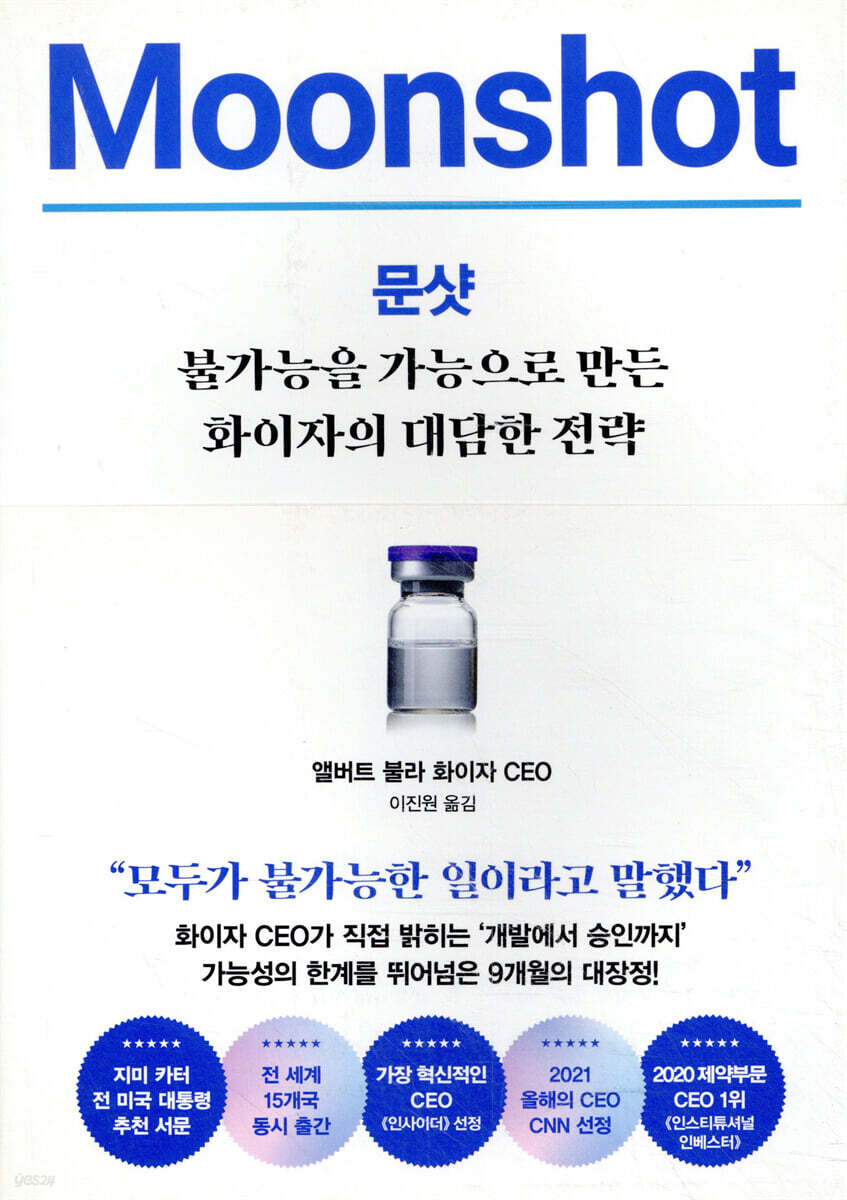
Moonshot: Pfizer's Bold Strategy to Make the Impossible Possible
 |
Description
Book Introduction
- A word from MD
-
Pfizer's vaccine development storyPfizer CEO Albert Bourla shares the story of the nine months leading up to the successful development and production of a COVID-19 vaccine.
From the decision to develop a vaccine at the risk of billions of dollars to the creation of the first mRNA vaccine.
Let's take a look at Pfizer's record of challenges and innovations that were urgent, intense, and ultimately successful.
March 18, 2022. Economics and Management PD Kim Sang-geun
“Everyone said it was impossible.”
The story behind the urgent vaccine development, revealed directly by Pfizer's CEO.
Pfizer's innovation born from an unprecedented crisis
Meet the impossible challenge of turning a crisis into an opportunity.
★★★★ Foreword by former U.S. President Jimmy Carter
★★★★ Simultaneously published in 15 countries worldwide in 2022!
"If you look at the complex process Pfizer went through to develop, research, and launch the first COVID-19 vaccine—the process of turning the impossible into possible—no one would be surprised."
-Former U.S. President Jimmy Carter
The emergence of COVID-19 in 2019 threw the world into chaos.
After the influenza pandemic that terrified the world in the early 20th century, no one could have imagined that in the global 21st century, countries and cities would be locked down by infectious diseases.
In this unprecedented crisis, it was not a superpower or a powerful leader, but a single company that saved the world: Pfizer, the first company to develop a COVID-19 vaccine.
Vaccines take years to develop and at least five years to become commercially available.
What story lies behind Pfizer's success in developing and producing a vaccine in just nine months? What domestic and international hurdles did they face as they prepare for the US presidential election?
《Moonshot: Pfizer's Bold Strategy to Make the Impossible Possible》, which will be published simultaneously in 15 countries around the world in March 2022, contains the story of challenges and innovations achieved over nine months by Pfizer, which developed the world's first mRNA vaccine and the first COVID-19 vaccine.
Pfizer CEO Albert Bourla, who spearheaded every step of the vaccine development process on the front lines of the pandemic, guides us through the story of the world's leading pharmaceutical company's transformation from an icon of conspiracy and mistrust to a company of trust and innovation.
The story behind the urgent vaccine development, revealed directly by Pfizer's CEO.
Pfizer's innovation born from an unprecedented crisis
Meet the impossible challenge of turning a crisis into an opportunity.
★★★★ Foreword by former U.S. President Jimmy Carter
★★★★ Simultaneously published in 15 countries worldwide in 2022!
"If you look at the complex process Pfizer went through to develop, research, and launch the first COVID-19 vaccine—the process of turning the impossible into possible—no one would be surprised."
-Former U.S. President Jimmy Carter
The emergence of COVID-19 in 2019 threw the world into chaos.
After the influenza pandemic that terrified the world in the early 20th century, no one could have imagined that in the global 21st century, countries and cities would be locked down by infectious diseases.
In this unprecedented crisis, it was not a superpower or a powerful leader, but a single company that saved the world: Pfizer, the first company to develop a COVID-19 vaccine.
Vaccines take years to develop and at least five years to become commercially available.
What story lies behind Pfizer's success in developing and producing a vaccine in just nine months? What domestic and international hurdles did they face as they prepare for the US presidential election?
《Moonshot: Pfizer's Bold Strategy to Make the Impossible Possible》, which will be published simultaneously in 15 countries around the world in March 2022, contains the story of challenges and innovations achieved over nine months by Pfizer, which developed the world's first mRNA vaccine and the first COVID-19 vaccine.
Pfizer CEO Albert Bourla, who spearheaded every step of the vaccine development process on the front lines of the pandemic, guides us through the story of the world's leading pharmaceutical company's transformation from an icon of conspiracy and mistrust to a company of trust and innovation.
- You can preview some of the book's contents.
Preview
index
Foreword | A Spark of Hope in a World Lacking Hope - Former U.S. President Jimmy Carter
Prologue | Opportunity Comes to the Prepared
Chapter 1.
Business as usual
"If not us, who will develop it?" | Three decisions made on an airplane | Moonshots, the beginning of a challenge
Chapter 2.
The obvious isn't always right
A New Hope: mRNA | Thinking Differently in Times of Crisis | Joining Hands with the Best Partners
Chapter 3.
A bold strategy that makes the impossible possible
The Vaccine Development Journey Begins | Forget the Speed and Process of the Past | Development of Ultra-Cryogenic Transport Containers
Chapter 4.
Lightspeed Project
We will change the world | Time is life | No one should be left behind | A CEO like a bulldozer
Chapter 5.
Ultimate joy
First Victory | 95.6 Percent Effective | A Tool to Turn the Pandemic Around
Chapter 6.
Past, Present, and Future
How I Got Here | The First News of Hope | The World's First COVID-19 Vaccine Approved
Chapter 7.
Production, the second miracle
Necessary sacrifice | Mass production plan | Pushing the boundaries of possibility | First vaccinations and global expansion | A victory we created together
Chapter 8.
Steps toward vaccine equality
Saving Lives for the Price of a Meal | The Underground Vaccine War | Vaccine Procurement and Equity | The Second Crisis Begins in India | Our Commitment to Vaccine Equity
Chapter 9.
Navigating the political minefield
Close negotiations to secure vaccines | Leaders excelling at crisis management | No one is safe until everyone is safe.
Chapter 10.
Beacon of Hope
The beginning of herd immunity trials | Israel's vaccination campaign | Breakthrough infections and the emergence of the delta variant | Simple solutions to a complex situation
Chapter 11.
The Science of Trust
The Unexpected Obstacle of Distrust | A Joint Pledge for Safety | Science Will Win
Chapter 12.
Patient-friendly and innovation-friendly suggestions
1.
Improving Accessibility and Insurance Coverage Practices | 2.
Establishing a Support System for Intellectual Property Rights Protection | 3.
Fostering the Future of Technology and Artificial Intelligence | 4.
Empowering Patients | 5.
Never stop innovating
Epilogue | Pfizer's Purpose-Driven Culture: Creating Change
Acknowledgements
Albert Bourla's Open Letter | We Stand with Science
Image source
References
Search
Prologue | Opportunity Comes to the Prepared
Chapter 1.
Business as usual
"If not us, who will develop it?" | Three decisions made on an airplane | Moonshots, the beginning of a challenge
Chapter 2.
The obvious isn't always right
A New Hope: mRNA | Thinking Differently in Times of Crisis | Joining Hands with the Best Partners
Chapter 3.
A bold strategy that makes the impossible possible
The Vaccine Development Journey Begins | Forget the Speed and Process of the Past | Development of Ultra-Cryogenic Transport Containers
Chapter 4.
Lightspeed Project
We will change the world | Time is life | No one should be left behind | A CEO like a bulldozer
Chapter 5.
Ultimate joy
First Victory | 95.6 Percent Effective | A Tool to Turn the Pandemic Around
Chapter 6.
Past, Present, and Future
How I Got Here | The First News of Hope | The World's First COVID-19 Vaccine Approved
Chapter 7.
Production, the second miracle
Necessary sacrifice | Mass production plan | Pushing the boundaries of possibility | First vaccinations and global expansion | A victory we created together
Chapter 8.
Steps toward vaccine equality
Saving Lives for the Price of a Meal | The Underground Vaccine War | Vaccine Procurement and Equity | The Second Crisis Begins in India | Our Commitment to Vaccine Equity
Chapter 9.
Navigating the political minefield
Close negotiations to secure vaccines | Leaders excelling at crisis management | No one is safe until everyone is safe.
Chapter 10.
Beacon of Hope
The beginning of herd immunity trials | Israel's vaccination campaign | Breakthrough infections and the emergence of the delta variant | Simple solutions to a complex situation
Chapter 11.
The Science of Trust
The Unexpected Obstacle of Distrust | A Joint Pledge for Safety | Science Will Win
Chapter 12.
Patient-friendly and innovation-friendly suggestions
1.
Improving Accessibility and Insurance Coverage Practices | 2.
Establishing a Support System for Intellectual Property Rights Protection | 3.
Fostering the Future of Technology and Artificial Intelligence | 4.
Empowering Patients | 5.
Never stop innovating
Epilogue | Pfizer's Purpose-Driven Culture: Creating Change
Acknowledgements
Albert Bourla's Open Letter | We Stand with Science
Image source
References
Search
Detailed image
.jpg)
Publisher's Review
A bold strategy that makes the impossible possible.
Pfizer's CEO reveals the story from development to approval.
A nine-month journey that pushed the boundaries of possibility
On December 31, 2019, Chinese authorities reported to the WHO that a mysterious virus causing pneumonia-like symptoms had been detected in a small cluster of patients in Wuhan.
This new virus, identified as SARS-CoV-2, was rapidly becoming a terrifying pandemic.
And on December 8, 2020, less than a year later, 90-year-old Margaret Keenan was vaccinated with the vaccine jointly developed by Pfizer and BioNTech at University Hospital Coventry in the UK.
It was the first mRNA vaccine to prevent COVID-19, the most deadly infectious disease in the past 100 years.
How did Pfizer's COVID-19 vaccine come to be? Under the philosophy that "time is life," Pfizer's "moonshot" made the impossible possible. Its core elements included an innovative organization that adapts to crisis situations, people who transcend their limitations, and the leadership of CEO Albert Bourla.
And this whole process took just nine months.
The 'Moonshot' was a challenge that began in 1949 to send humans to the moon, but for Pfizer, it became an innovative project that challenged the impossible.
The COVID-19 vaccine, born from Pfizer's moonshot, consolidates a decade of scientific knowledge in just nine months, and is having a ripple effect across many other scientific fields, significantly impacting life on Earth.
This book is a record of the challenges and innovations Pfizer has created during the pandemic.
Under the name of 'Project Lightspeed', the value of prioritizing life was there until the impossible was achieved by demonstrating superhuman strength.
Pfizer's moonshots—the challenges they faced, the lessons they learned, and the core values that made it all possible—will inspire us to create our own innovations or future moonshots.
■ “Opportunity comes to those who are prepared.”
In the pharmaceutical company of conspiracy and distrust
Key strategies for transforming into a research-focused, scientific innovation company
Albert Bourla, a Greek-American immigrant raised by Holocaust survivor parents, was appointed CEO of the American pharmaceutical giant Pfizer in January 2019.
This book closely depicts the process by which Albert Bourla and Pfizer successfully developed the first effective and safe COVID-19 vaccine, overcoming political and social pressure and crisis, from 2020 to early 2021, when the coronavirus began to spread globally in earnest.
In his second year as CEO, Albert Bourla decides to develop a vaccine, risking billions of dollars in losses.
Through research that breaks free from stereotypes and a creative development process that overcomes limitations, Pfizer succeeded in developing the world's first vaccine through joint research with BioNTech.
At the heart of it all was the leadership of Albert Bourla, who simplified the chain of command, streamlined decision-making, and acted as a direct project manager, along with employees who pushed themselves beyond their limits, unleashed creativity under pressure, and more.
The vaccine development, which poured billions of dollars into a project with uncertain success, was possible because of the "life-changing innovation" that he pioneered when he took office in 2019, despite opposition from everyone.
Pfizer has reorganized its core business units, including those producing erectile dysfunction treatment Viagra and nutritional supplement Centrum, and has chosen to focus on becoming a scientific innovation company focused on research and development for the next 10 years.
To achieve this, the company's culture was transformed and investments were completely reallocated, all of which was prepared before the COVID-19 pandemic began.
■ “Why mRNA vaccines?”
A CEO who made choices that did not guarantee success
In times of crisis, we must think differently.
When we decided to develop the most effective vaccine in the shortest possible time, we had several options.
For example, in Moderna's case, the issue would have been whether a COVID-19 vaccine was developed, not which technology was used.
― [Chapter 2 What is clear is not always right]
As an unprecedented pandemic crippled nations, cities, and economies, everyone began searching for a cure.
And along with treatments, there were those who wanted to create a vaccine that could prevent infection and end the pandemic.
Pfizer has been producing successful vaccines based on its long-accumulated research and technological capabilities, and has been able to choose from various technology platforms for vaccine development, including adenovirus, recombinant protein, and conjugation.
But the technology they chose was mRNA.
mRNA technology has great potential, but it is an unfinished platform that will take years to perfect.
While traditional vaccines activate the body's immune system by introducing a non-infectious part of the pathogen, mRNA vaccines teach the body to make its own vaccine without the actual pathogen.
It wasn't an easy decision to risk the company's life on a promising but unproven technology.
But the mRNA approach was the fastest way to find a solution, out of all the available technologies.
Pfizer had already formed an mRNA technology partnership with Germany's BioNTech in 2018 to develop an effective flu vaccine, and began research and development based on mutual trust.
They agreed to split all development costs and commercialization profits 50-50, but Pfizer agreed to bear the entire development cost first.
If the project failed, all losses would be borne by Pfizer.
Pfizer, the world's first company to develop an mRNA vaccine, had the following strategy:
1.
Time is life
2.
Think bigger and more creatively
3.
Simplify the chain of command
4.
Streamline your decision-making
5.
Break free from stereotypes
■ “How Pfizer Became a Game Changer”
The international community and politicians' secret war over vaccines
Behind-the-scenes stories from Pfizer's CEO
If a vaccine is approved before Election Day, some might see it as the result of political pressure from the White House.
On the other hand, if the vote is over and the vaccine is approved, it could be attributed to political pressure from the Biden camp.
In both cases, this did not help build public confidence in the vaccine and could have been a further blow to public health.
― [Chapter 11: The Science of Trust]
The vaccine development process was a constant battle.
Beyond the battle against the virus, there were practical challenges such as the production of the world's first commercial mRNA vaccine, the supply issues of distributing the vaccines around the world, and the technology needed to inoculate patients, as well as the invisible vaccine war waged by the major powers.
There has been an invisible, fierce competition in the international community to distribute vaccines around the world.
As the US presidential election approaches, a situation unfolds where the results of the election could change depending on the results of research.
Pfizer, caught between the Trump administration and the Biden campaign, is bucking external pressure and overcoming political challenges one by one.
Securing vaccines is a matter directly related to national security.
How did Albert Bourla, while personally fielding calls from world leaders, navigate the export restrictions imposed on vaccine producers under the Defense Acquisition Program Act (DPA), which prevented vaccines from being exported outside the United States? We'll explore Albert Bourla's leadership as he creatively developed his organization amidst domestic political dynamics, the international community, and the fight for equitable vaccine distribution, directly communicating with world leaders and solving problems.
Go beyond your limits
Break through bigger and more creatively
Moonshot: Pfizer's Bold Strategy to Make the Impossible Possible showcases Pfizer's innovations born from the unprecedented crisis of COVID-19.
In March 2020, Albert Bourla decided to develop a COVID-19 vaccine using a novel approach, mRNA technology, despite the risk of losing billions of dollars in an uncertain situation.
It had been only two years since he became CEO of Pfizer.
Research that breaks free from stereotypes, a creative development process that transcends limitations, and a radical reorganization of corporate culture and decision-making processes…
'Mission Possible', which was named 'Project at the speed of light', literally carried out all processes and achieved everything at the speed of light.
Albert Bourla, as a project manager himself, demonstrated innovation that transcended his own limitations, and through this process, was able to turn Pfizer's crisis into an opportunity.
Through Pfizer's "moonshot," which rose from the pharmaceutical company with the world's highest vaccine preference, the world's most influential CEO, and the lowest trust rating alongside the U.S. government and tobacco companies to the 4th most respected company after Apple and Google, we were able to encounter new innovations that respect the value of life, reorganize our thinking, and demonstrate trust.
We too can observe this process and create our own moonshots.
Pfizer's CEO reveals the story from development to approval.
A nine-month journey that pushed the boundaries of possibility
On December 31, 2019, Chinese authorities reported to the WHO that a mysterious virus causing pneumonia-like symptoms had been detected in a small cluster of patients in Wuhan.
This new virus, identified as SARS-CoV-2, was rapidly becoming a terrifying pandemic.
And on December 8, 2020, less than a year later, 90-year-old Margaret Keenan was vaccinated with the vaccine jointly developed by Pfizer and BioNTech at University Hospital Coventry in the UK.
It was the first mRNA vaccine to prevent COVID-19, the most deadly infectious disease in the past 100 years.
How did Pfizer's COVID-19 vaccine come to be? Under the philosophy that "time is life," Pfizer's "moonshot" made the impossible possible. Its core elements included an innovative organization that adapts to crisis situations, people who transcend their limitations, and the leadership of CEO Albert Bourla.
And this whole process took just nine months.
The 'Moonshot' was a challenge that began in 1949 to send humans to the moon, but for Pfizer, it became an innovative project that challenged the impossible.
The COVID-19 vaccine, born from Pfizer's moonshot, consolidates a decade of scientific knowledge in just nine months, and is having a ripple effect across many other scientific fields, significantly impacting life on Earth.
This book is a record of the challenges and innovations Pfizer has created during the pandemic.
Under the name of 'Project Lightspeed', the value of prioritizing life was there until the impossible was achieved by demonstrating superhuman strength.
Pfizer's moonshots—the challenges they faced, the lessons they learned, and the core values that made it all possible—will inspire us to create our own innovations or future moonshots.
■ “Opportunity comes to those who are prepared.”
In the pharmaceutical company of conspiracy and distrust
Key strategies for transforming into a research-focused, scientific innovation company
Albert Bourla, a Greek-American immigrant raised by Holocaust survivor parents, was appointed CEO of the American pharmaceutical giant Pfizer in January 2019.
This book closely depicts the process by which Albert Bourla and Pfizer successfully developed the first effective and safe COVID-19 vaccine, overcoming political and social pressure and crisis, from 2020 to early 2021, when the coronavirus began to spread globally in earnest.
In his second year as CEO, Albert Bourla decides to develop a vaccine, risking billions of dollars in losses.
Through research that breaks free from stereotypes and a creative development process that overcomes limitations, Pfizer succeeded in developing the world's first vaccine through joint research with BioNTech.
At the heart of it all was the leadership of Albert Bourla, who simplified the chain of command, streamlined decision-making, and acted as a direct project manager, along with employees who pushed themselves beyond their limits, unleashed creativity under pressure, and more.
The vaccine development, which poured billions of dollars into a project with uncertain success, was possible because of the "life-changing innovation" that he pioneered when he took office in 2019, despite opposition from everyone.
Pfizer has reorganized its core business units, including those producing erectile dysfunction treatment Viagra and nutritional supplement Centrum, and has chosen to focus on becoming a scientific innovation company focused on research and development for the next 10 years.
To achieve this, the company's culture was transformed and investments were completely reallocated, all of which was prepared before the COVID-19 pandemic began.
■ “Why mRNA vaccines?”
A CEO who made choices that did not guarantee success
In times of crisis, we must think differently.
When we decided to develop the most effective vaccine in the shortest possible time, we had several options.
For example, in Moderna's case, the issue would have been whether a COVID-19 vaccine was developed, not which technology was used.
― [Chapter 2 What is clear is not always right]
As an unprecedented pandemic crippled nations, cities, and economies, everyone began searching for a cure.
And along with treatments, there were those who wanted to create a vaccine that could prevent infection and end the pandemic.
Pfizer has been producing successful vaccines based on its long-accumulated research and technological capabilities, and has been able to choose from various technology platforms for vaccine development, including adenovirus, recombinant protein, and conjugation.
But the technology they chose was mRNA.
mRNA technology has great potential, but it is an unfinished platform that will take years to perfect.
While traditional vaccines activate the body's immune system by introducing a non-infectious part of the pathogen, mRNA vaccines teach the body to make its own vaccine without the actual pathogen.
It wasn't an easy decision to risk the company's life on a promising but unproven technology.
But the mRNA approach was the fastest way to find a solution, out of all the available technologies.
Pfizer had already formed an mRNA technology partnership with Germany's BioNTech in 2018 to develop an effective flu vaccine, and began research and development based on mutual trust.
They agreed to split all development costs and commercialization profits 50-50, but Pfizer agreed to bear the entire development cost first.
If the project failed, all losses would be borne by Pfizer.
Pfizer, the world's first company to develop an mRNA vaccine, had the following strategy:
1.
Time is life
2.
Think bigger and more creatively
3.
Simplify the chain of command
4.
Streamline your decision-making
5.
Break free from stereotypes
■ “How Pfizer Became a Game Changer”
The international community and politicians' secret war over vaccines
Behind-the-scenes stories from Pfizer's CEO
If a vaccine is approved before Election Day, some might see it as the result of political pressure from the White House.
On the other hand, if the vote is over and the vaccine is approved, it could be attributed to political pressure from the Biden camp.
In both cases, this did not help build public confidence in the vaccine and could have been a further blow to public health.
― [Chapter 11: The Science of Trust]
The vaccine development process was a constant battle.
Beyond the battle against the virus, there were practical challenges such as the production of the world's first commercial mRNA vaccine, the supply issues of distributing the vaccines around the world, and the technology needed to inoculate patients, as well as the invisible vaccine war waged by the major powers.
There has been an invisible, fierce competition in the international community to distribute vaccines around the world.
As the US presidential election approaches, a situation unfolds where the results of the election could change depending on the results of research.
Pfizer, caught between the Trump administration and the Biden campaign, is bucking external pressure and overcoming political challenges one by one.
Securing vaccines is a matter directly related to national security.
How did Albert Bourla, while personally fielding calls from world leaders, navigate the export restrictions imposed on vaccine producers under the Defense Acquisition Program Act (DPA), which prevented vaccines from being exported outside the United States? We'll explore Albert Bourla's leadership as he creatively developed his organization amidst domestic political dynamics, the international community, and the fight for equitable vaccine distribution, directly communicating with world leaders and solving problems.
Go beyond your limits
Break through bigger and more creatively
Moonshot: Pfizer's Bold Strategy to Make the Impossible Possible showcases Pfizer's innovations born from the unprecedented crisis of COVID-19.
In March 2020, Albert Bourla decided to develop a COVID-19 vaccine using a novel approach, mRNA technology, despite the risk of losing billions of dollars in an uncertain situation.
It had been only two years since he became CEO of Pfizer.
Research that breaks free from stereotypes, a creative development process that transcends limitations, and a radical reorganization of corporate culture and decision-making processes…
'Mission Possible', which was named 'Project at the speed of light', literally carried out all processes and achieved everything at the speed of light.
Albert Bourla, as a project manager himself, demonstrated innovation that transcended his own limitations, and through this process, was able to turn Pfizer's crisis into an opportunity.
Through Pfizer's "moonshot," which rose from the pharmaceutical company with the world's highest vaccine preference, the world's most influential CEO, and the lowest trust rating alongside the U.S. government and tobacco companies to the 4th most respected company after Apple and Google, we were able to encounter new innovations that respect the value of life, reorganize our thinking, and demonstrate trust.
We too can observe this process and create our own moonshots.
GOODS SPECIFICS
- Publication date: March 15, 2022
- Page count, weight, size: 328 pages | 562g | 150*215*30mm
- ISBN13: 9791168340169
- ISBN10: 1168340160
You may also like
카테고리
korean


korean

![GQ KOREA Mark (Monthly): December [2025]](http://librairie.coreenne.fr/cdn/shop/files/8ef265dbbfbf186523ed75ba7319009d.jpg?v=1765340328&width=3840)


