

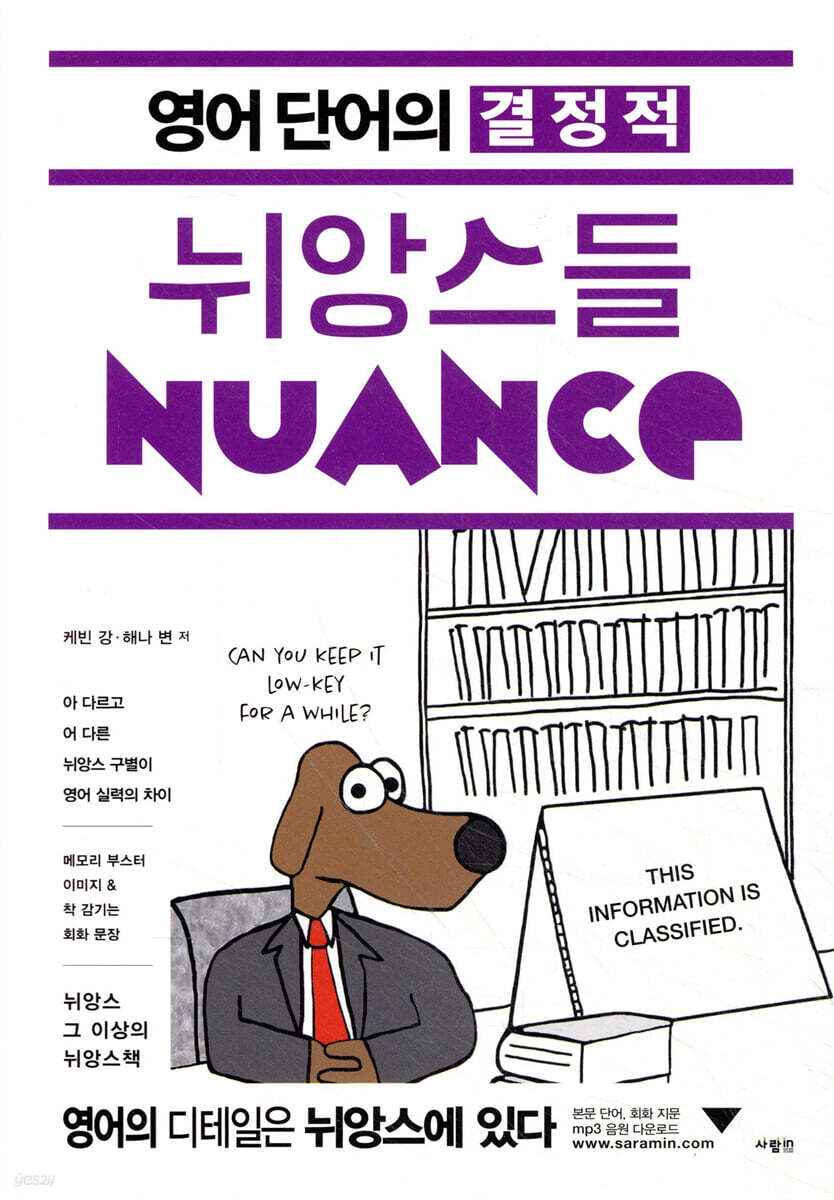
The Crucial Nuances of English Words
 |
Description
Book Introduction
English: People who are good at detail do well.
The details are hidden in the nuances of words!
"The Crucial Nuances of English Words" selects the words that learners most often confuse in conversation and writing, and explains in detail the nuances of their synonyms.
The basic common meaning of our words ‘lie, lie, falsehood, fabrication, and falsehood’ is ‘something that is not true and is presented as if it were true.’
However, since it has its own nuance and the target audience and situation in which it is used are different, if it is not used properly, it can lead to unintentional misunderstandings in communication.
This is the same in English.
What if we lumped together the aforementioned Korean words—bullshit, fib, lie, fabrication, and untruth—and used them indiscriminately as "lie"? Especially if we used "fib" (a lie) in a school essay or in front of a professor? It's hard to imagine, but most of us misuse synonyms without properly understanding the nuances of the words' inherent meanings.
In addition to misuse, there are countless cases of mistranslation in fingerprints.
In order to speak properly according to my intention and accurately understand the intention of a native speaker, it is essential to understand the nuances.
This book selects 164 units of similar words that are most often misused or confused in conversation and writing, providing clear nuances.
The details are hidden in the nuances of words!
"The Crucial Nuances of English Words" selects the words that learners most often confuse in conversation and writing, and explains in detail the nuances of their synonyms.
The basic common meaning of our words ‘lie, lie, falsehood, fabrication, and falsehood’ is ‘something that is not true and is presented as if it were true.’
However, since it has its own nuance and the target audience and situation in which it is used are different, if it is not used properly, it can lead to unintentional misunderstandings in communication.
This is the same in English.
What if we lumped together the aforementioned Korean words—bullshit, fib, lie, fabrication, and untruth—and used them indiscriminately as "lie"? Especially if we used "fib" (a lie) in a school essay or in front of a professor? It's hard to imagine, but most of us misuse synonyms without properly understanding the nuances of the words' inherent meanings.
In addition to misuse, there are countless cases of mistranslation in fingerprints.
In order to speak properly according to my intention and accurately understand the intention of a native speaker, it is essential to understand the nuances.
This book selects 164 units of similar words that are most often misused or confused in conversation and writing, providing clear nuances.
- You can preview some of the book's contents.
Preview
index
preface
Features and Uses of This Book
CHAPTER 1 Words that look similar but are clearly different
1 Skinny doesn't mean pretty thin
2 Heavy is not a word that should be used with offense.
3. Laugh and smile are distinguished by the presence or absence of laughter.
4 There is a difference between just crying and crying with your shoulders shaking.
5. Don't use want when you want something impossible.
Details of WANT, WOULD, HOPE, WISH
Does including 6 mean unconditionally containing?
There is no airport that says "postponed" for flight delays.
8 Look and see are divided depending on whether you are conscious or not.
9 Don't always use small just because it's small.
10 Is the large pizza big size or large size?
11 Many/Much in the plain sentence, actually has a quite formal tone
Toilet English expressions with various nuances
12. Is the pair of 'straw shoes have a pair' a pair or a couple?
13 When you believe in the existence of God, you don't use trust.
14 Isn't being a soft man a good thing?
15 Saving money and collecting stamps are different.
16 Which would you rather have: an equal partnership or a subordinate partnership?
17 People are smart, foxes are smart, clever
18 When you first discover something that wasn't there before, it's not find.
Closing remarks in letters and emails
19 It's a K-pop tour, not a K-pop travel.
20 Biological sex and social gender are different.
21. Even when blaming others, you have to consider the cause and effect.
22 You should use honorifics depending on the person.
23 'Very' also has strong and weak points
24 If you just replace it haphazardly, it will be a big problem.
Not all agents are the same!
CHAPTER 2 Detailed differences between representative words and related words by meaning
SECTION 1 Nouns
1 start / begin vs.
launch
2 stop vs. stop, halt
quit
3 change vs.
exchange
4 end vs. finish
finish
5 get vs.
obtain
6 help vs. assist
assist
7 use vs. use up
spend
8 deceive vs. deceive
cheat
9 repair vs. fix
fix
10 recover vs. recover
restore
11 expect vs. expect
anticipate
12 predict vs. foretell
foretell
13 calculate vs. calculate
compute .
14 fasten vs. fasten, fill, lock, fix
tie
15 shout vs. shout
scream
16 ignore vs. ignore
disregard
17 bother vs. inconvenience
annoy
18 assault, attack attack vs.
hit
Words with a nuance of acting 'secretly'
19 break vs. shatter
smash
20 fight vs. quarrel
quarrel
21 win vs. victory
defeat
22 kill vs.
murder
23 remove vs. eliminate, eliminate
erase
24 find vs. find out
detect
25 follow vs. follow
obey .
26 mix vs. mix, blend, mix
blend
27 assess vs. estimate
evaluate
28 answer vs. reply
reply
29 mean vs. indicate
represent
30 surprise vs.
shock
31 reduce vs. lower
shorten
32 expand vs. expand, expand
enlarge
33 connect / link vs. connect, connect
combine
34 raise vs. nurture, grow
bring up
35 eat vs.
devour
36 drink vs. drink
sip
Capturing the Nuances of Family Expressions in English
37 make vs. make
create
38 produce vs. produce
manufacture
39 attach vs. affix
stick
40 move vs. move
carry
41 share vs. divide
divide
42 hold vs. catch, hold
grab
43 teach vs. teach, inform
instruct
44 steal vs. rob
rob
45 promise vs. promise
pledge
46 show vs. show, indicate
display
47 examine vs. investigate, examine
inspect
48 check vs. confirm
confirm
49 release vs. send out, let go
discharge
50 meet vs. encounter
face
51 lend vs. lend
lease
52 watch vs. watch
observe
Nuances of English Expressions for Administrative Districts
SECTION 2 Nouns
1 food vs. food
dish
2 guests vs.
customer
3 rumors vs.
gossip
4 Doctor vs.
physician
5. Luggage, cargo load vs.
baggage / luggage
6 product vs.
goods
7 ways, methods, and methods vs.
method
8 fashion vs. trend
trend
9 Medicine vs. Drugs
drug
10 problem vs.
trouble
11 fear, dread, horror fear vs.
terror
12 Destiny vs. Destiny
fate
13 Income vs.
revenue
14 area vs. region, area, field
field
15 mistake vs. error
error
16 Cost vs. Fees
fee
17 Plan vs. Schedule
blueprint
18 Door, door vs.
gate
19 Money, Funds money vs.
fund
20 days, work vs.
job
21 way, road way vs.
street
22 Writing vs. Writing
composition
A world of diverse flavors, a place of pleasure
SECTION 3 Adjectives and Adverbs
1 kind vs.
generous
2 mild / gentle vs. mild, mild
compliant
3 mean vs. mean, vulgar
nasty
4 great vs. awesome, tremendous
superb
5 sad vs.
gloomy
6 same vs. same, identical
equal
7 clear vs. obvious
obvious
8 aggressive vs. reckless
offensive
9 necessary vs. necessary
essential
10 famous vs. known
popular
11 terrible, awful terrible vs.
disgusting .
12 clean vs.
tidy
13 dirty vs. filthy, messy
filthy
14 brave vs. courageous
courageous
15 dangerous vs. dangerous
risky
16 short vs.
brief
17 wide vs. extensive
broad
18 hard vs. hard
firm
19 sick vs. injured
hurt
20 fast vs.
quick
21 normal vs. ordinary
ordinary
22 strange vs. strange
weird
23 special vs. special
particular
24 real vs. actual
actual
25 informal vs. casual, everyday, everyday
natural
26 empty vs. empty, vacant
vacant
Uncovering the nuances of your relationship with your colleagues
Words to describe the weather
CHAPTER 3: Subtle Nuances Only Native Speakers Know
1 assert vs. assert, assert
claim
2 persuade vs. persuade
convince
3 exaggerate vs. exaggerate
overstate
4 Habits, habits habit vs.
custom
5 Character, Temperament characteristic vs.
character
6 Ability vs. Talent
capability
7 Research vs. Survey
study
8 action vs. action
behavior
9 Responsibility vs. Obligation
duty
10 situation, environment, position situation vs.
circumstance
11 Expert vs. Expert
professional
12 important vs. important
crucial
13 always, always, always vs.
all the time
14 sudden vs. abrupt
unexpected
15 later vs. later, after that.
afterward
16 continuous vs. continuing
infinite .
17 exact vs. exact
precise
18 sharp vs. sharp, keen
keen
19 false vs. fake
fake
20 Natural vs. Natural
pure
Nuances of words related to friends
CHAPTER 4 The Subtle Nuances of Informal and Formal Writing
1 lie, lie
2 difficult, tough
3 Easy
4 crazy, insane
5 Beginners, Novices
6 Stupid, clumsy.
7 Showing off, showing off
8 Angry, furious.
9 Secret, secret
10 Stingy, petty, frugal
11 lazy, easygoing, indolent
12 Happy, joyful
13 sad, gloomy
14 Rude, insolent.
15 likes
16 Dislike
17. To annoy, to irritate
18 Awesome, great
19 Seduce, tempt
20 Play, hang out
From the Cradle to the Grave: How to Express People by Age
INDEX index
Features and Uses of This Book
CHAPTER 1 Words that look similar but are clearly different
1 Skinny doesn't mean pretty thin
2 Heavy is not a word that should be used with offense.
3. Laugh and smile are distinguished by the presence or absence of laughter.
4 There is a difference between just crying and crying with your shoulders shaking.
5. Don't use want when you want something impossible.
Details of WANT, WOULD, HOPE, WISH
Does including 6 mean unconditionally containing?
There is no airport that says "postponed" for flight delays.
8 Look and see are divided depending on whether you are conscious or not.
9 Don't always use small just because it's small.
10 Is the large pizza big size or large size?
11 Many/Much in the plain sentence, actually has a quite formal tone
Toilet English expressions with various nuances
12. Is the pair of 'straw shoes have a pair' a pair or a couple?
13 When you believe in the existence of God, you don't use trust.
14 Isn't being a soft man a good thing?
15 Saving money and collecting stamps are different.
16 Which would you rather have: an equal partnership or a subordinate partnership?
17 People are smart, foxes are smart, clever
18 When you first discover something that wasn't there before, it's not find.
Closing remarks in letters and emails
19 It's a K-pop tour, not a K-pop travel.
20 Biological sex and social gender are different.
21. Even when blaming others, you have to consider the cause and effect.
22 You should use honorifics depending on the person.
23 'Very' also has strong and weak points
24 If you just replace it haphazardly, it will be a big problem.
Not all agents are the same!
CHAPTER 2 Detailed differences between representative words and related words by meaning
SECTION 1 Nouns
1 start / begin vs.
launch
2 stop vs. stop, halt
quit
3 change vs.
exchange
4 end vs. finish
finish
5 get vs.
obtain
6 help vs. assist
assist
7 use vs. use up
spend
8 deceive vs. deceive
cheat
9 repair vs. fix
fix
10 recover vs. recover
restore
11 expect vs. expect
anticipate
12 predict vs. foretell
foretell
13 calculate vs. calculate
compute .
14 fasten vs. fasten, fill, lock, fix
tie
15 shout vs. shout
scream
16 ignore vs. ignore
disregard
17 bother vs. inconvenience
annoy
18 assault, attack attack vs.
hit
Words with a nuance of acting 'secretly'
19 break vs. shatter
smash
20 fight vs. quarrel
quarrel
21 win vs. victory
defeat
22 kill vs.
murder
23 remove vs. eliminate, eliminate
erase
24 find vs. find out
detect
25 follow vs. follow
obey .
26 mix vs. mix, blend, mix
blend
27 assess vs. estimate
evaluate
28 answer vs. reply
reply
29 mean vs. indicate
represent
30 surprise vs.
shock
31 reduce vs. lower
shorten
32 expand vs. expand, expand
enlarge
33 connect / link vs. connect, connect
combine
34 raise vs. nurture, grow
bring up
35 eat vs.
devour
36 drink vs. drink
sip
Capturing the Nuances of Family Expressions in English
37 make vs. make
create
38 produce vs. produce
manufacture
39 attach vs. affix
stick
40 move vs. move
carry
41 share vs. divide
divide
42 hold vs. catch, hold
grab
43 teach vs. teach, inform
instruct
44 steal vs. rob
rob
45 promise vs. promise
pledge
46 show vs. show, indicate
display
47 examine vs. investigate, examine
inspect
48 check vs. confirm
confirm
49 release vs. send out, let go
discharge
50 meet vs. encounter
face
51 lend vs. lend
lease
52 watch vs. watch
observe
Nuances of English Expressions for Administrative Districts
SECTION 2 Nouns
1 food vs. food
dish
2 guests vs.
customer
3 rumors vs.
gossip
4 Doctor vs.
physician
5. Luggage, cargo load vs.
baggage / luggage
6 product vs.
goods
7 ways, methods, and methods vs.
method
8 fashion vs. trend
trend
9 Medicine vs. Drugs
drug
10 problem vs.
trouble
11 fear, dread, horror fear vs.
terror
12 Destiny vs. Destiny
fate
13 Income vs.
revenue
14 area vs. region, area, field
field
15 mistake vs. error
error
16 Cost vs. Fees
fee
17 Plan vs. Schedule
blueprint
18 Door, door vs.
gate
19 Money, Funds money vs.
fund
20 days, work vs.
job
21 way, road way vs.
street
22 Writing vs. Writing
composition
A world of diverse flavors, a place of pleasure
SECTION 3 Adjectives and Adverbs
1 kind vs.
generous
2 mild / gentle vs. mild, mild
compliant
3 mean vs. mean, vulgar
nasty
4 great vs. awesome, tremendous
superb
5 sad vs.
gloomy
6 same vs. same, identical
equal
7 clear vs. obvious
obvious
8 aggressive vs. reckless
offensive
9 necessary vs. necessary
essential
10 famous vs. known
popular
11 terrible, awful terrible vs.
disgusting .
12 clean vs.
tidy
13 dirty vs. filthy, messy
filthy
14 brave vs. courageous
courageous
15 dangerous vs. dangerous
risky
16 short vs.
brief
17 wide vs. extensive
broad
18 hard vs. hard
firm
19 sick vs. injured
hurt
20 fast vs.
quick
21 normal vs. ordinary
ordinary
22 strange vs. strange
weird
23 special vs. special
particular
24 real vs. actual
actual
25 informal vs. casual, everyday, everyday
natural
26 empty vs. empty, vacant
vacant
Uncovering the nuances of your relationship with your colleagues
Words to describe the weather
CHAPTER 3: Subtle Nuances Only Native Speakers Know
1 assert vs. assert, assert
claim
2 persuade vs. persuade
convince
3 exaggerate vs. exaggerate
overstate
4 Habits, habits habit vs.
custom
5 Character, Temperament characteristic vs.
character
6 Ability vs. Talent
capability
7 Research vs. Survey
study
8 action vs. action
behavior
9 Responsibility vs. Obligation
duty
10 situation, environment, position situation vs.
circumstance
11 Expert vs. Expert
professional
12 important vs. important
crucial
13 always, always, always vs.
all the time
14 sudden vs. abrupt
unexpected
15 later vs. later, after that.
afterward
16 continuous vs. continuing
infinite .
17 exact vs. exact
precise
18 sharp vs. sharp, keen
keen
19 false vs. fake
fake
20 Natural vs. Natural
pure
Nuances of words related to friends
CHAPTER 4 The Subtle Nuances of Informal and Formal Writing
1 lie, lie
2 difficult, tough
3 Easy
4 crazy, insane
5 Beginners, Novices
6 Stupid, clumsy.
7 Showing off, showing off
8 Angry, furious.
9 Secret, secret
10 Stingy, petty, frugal
11 lazy, easygoing, indolent
12 Happy, joyful
13 sad, gloomy
14 Rude, insolent.
15 likes
16 Dislike
17. To annoy, to irritate
18 Awesome, great
19 Seduce, tempt
20 Play, hang out
From the Cradle to the Grave: How to Express People by Age
INDEX index
Detailed image

Publisher's Review
When we don't feel like what the other person said was meant literally, we say this.
'I just heard it, but it gave off a bad vibe.' Nuance refers to the mysterious and subtle feeling that words give.
For example, there is a clear difference in connotation between 'You're so skinny' and 'You're so slender'.
The former conveys the neutral meaning of 'just dry' and the nuance of 'not good to look at', while the latter conveys the meaning of 'slim but attractive because she takes good care of herself'.
The English equivalents here are thin/skinny and slender, respectively.
Korean is my native language, so it's not a problem, but since each English word has its own nuance, if you recklessly change the meaning of something written in Korean just because it's similar, it can lead to unintentional misunderstandings.
So, nuance is not something you have to learn later after building your English skills, but something you absolutely have to learn from the moment you start studying vocabulary. However, it is true that it was difficult to learn it because I was so absorbed in English for exams and there was no book that properly covered nuance.
The use of precise words that eliminates misunderstandings is guaranteed by “The Crucial Nuances of English Words.”
1.
An explanation couldn't be clearer than this
It gathers together synonyms scattered throughout learners' minds in one place, and explains the nuances of individual words more clearly than any dictionary.
It is easy to understand because it explains one by one whether it is a word that should be used formally, how it sounds to the other person, and how it differs from other synonyms.
Since skinny jeans are worn by slim people, if you think skinny is a good thing and say "You look skinny" to a foreigner instead of "slender," you'll be in big trouble.
This means 'only the bones remain'.
Among the similar words that are lumped together and memorized, we have selected 164 units that are most easily misused or confused in conversation and writing, providing clear nuances.
2 Nuances fully explained with examples
We provide vivid conversational examples of how the synonyms are used in what situations and with what feeling, so you can be sure to check and move on.
3.
A perfect combination of words and images
Rather than a detailed explanation, we included images that make it easier to understand, helping to increase memory.
There's something about turning the pages, anticipating what image and meaning will appear next.
'I just heard it, but it gave off a bad vibe.' Nuance refers to the mysterious and subtle feeling that words give.
For example, there is a clear difference in connotation between 'You're so skinny' and 'You're so slender'.
The former conveys the neutral meaning of 'just dry' and the nuance of 'not good to look at', while the latter conveys the meaning of 'slim but attractive because she takes good care of herself'.
The English equivalents here are thin/skinny and slender, respectively.
Korean is my native language, so it's not a problem, but since each English word has its own nuance, if you recklessly change the meaning of something written in Korean just because it's similar, it can lead to unintentional misunderstandings.
So, nuance is not something you have to learn later after building your English skills, but something you absolutely have to learn from the moment you start studying vocabulary. However, it is true that it was difficult to learn it because I was so absorbed in English for exams and there was no book that properly covered nuance.
The use of precise words that eliminates misunderstandings is guaranteed by “The Crucial Nuances of English Words.”
1.
An explanation couldn't be clearer than this
It gathers together synonyms scattered throughout learners' minds in one place, and explains the nuances of individual words more clearly than any dictionary.
It is easy to understand because it explains one by one whether it is a word that should be used formally, how it sounds to the other person, and how it differs from other synonyms.
Since skinny jeans are worn by slim people, if you think skinny is a good thing and say "You look skinny" to a foreigner instead of "slender," you'll be in big trouble.
This means 'only the bones remain'.
Among the similar words that are lumped together and memorized, we have selected 164 units that are most easily misused or confused in conversation and writing, providing clear nuances.
2 Nuances fully explained with examples
We provide vivid conversational examples of how the synonyms are used in what situations and with what feeling, so you can be sure to check and move on.
3.
A perfect combination of words and images
Rather than a detailed explanation, we included images that make it easier to understand, helping to increase memory.
There's something about turning the pages, anticipating what image and meaning will appear next.
GOODS SPECIFICS
- Date of issue: September 10, 2020
- Page count, weight, size: 308 pages | 522g | 148*210*17mm
- ISBN13: 9788960498617
- ISBN10: 8960498610
You may also like
카테고리
korean


korean

![GQ KOREA Mark (Monthly): December [2025]](http://librairie.coreenne.fr/cdn/shop/files/8ef265dbbfbf186523ed75ba7319009d.jpg?v=1765340328&width=3840)


