

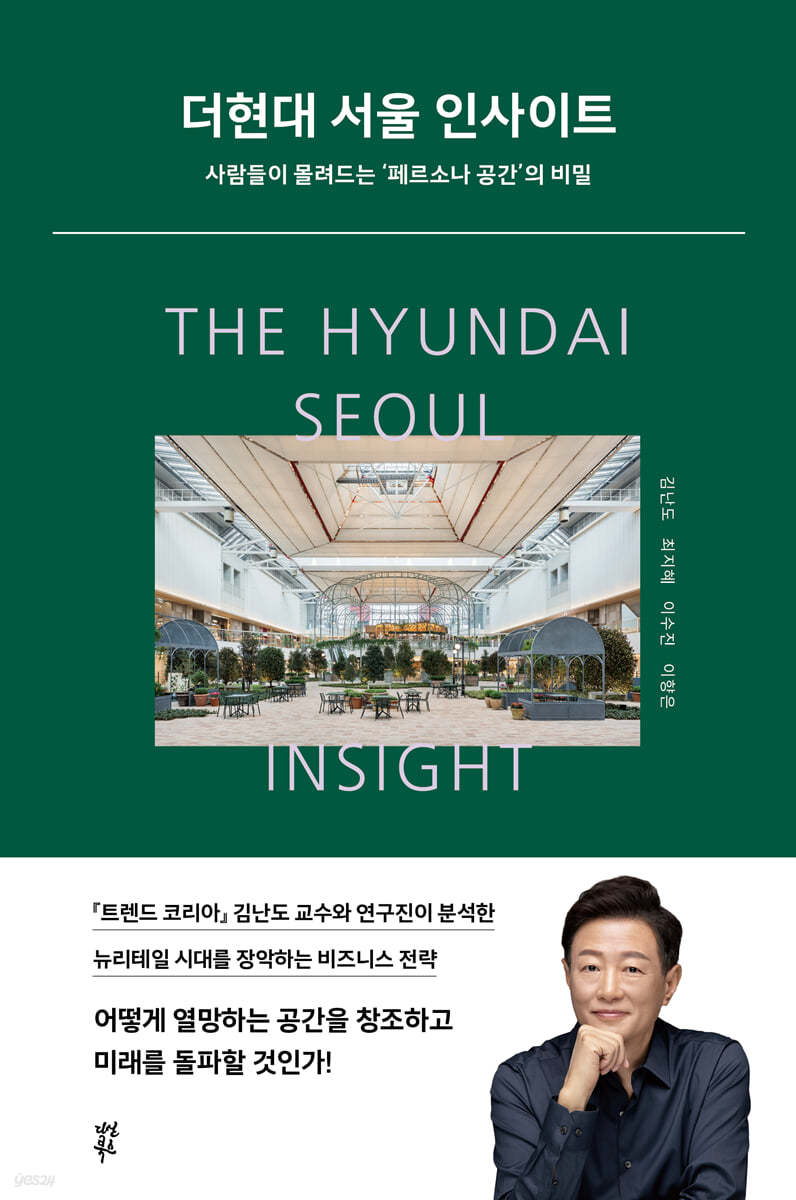
The Hyundai Seoul Insight
 |
Description
Book Introduction
『Trend Korea』 Professor Kim Nan-do and his research team analyzed Business Strategies to Master the New Retail Era “How to create the space you desire “Will you break through the future?” Stimulating customers' hidden desires with a firm taste All About Space Management: Persona Space Strategy The Hyundai Seoul opened in February 2021 in Yeouido, a department store wasteland, when the offline market was significantly shrinking due to the continued spread of COVID-19, without any stores of the three major luxury brands, including Louis Vuitton. At the time, not many people predicted the film's success. However, it achieved sales of 100 billion won in just one month and 663.7 billion won in its first year of operation, exceeding its sales target for 2022. The benefits of 『The Hyundai Seoul Insight』 are clear. In this era of digital advancements and the rise of contactless consumption due to the pandemic, this article provides insights into how offline businesses can survive. This is a strategy that maximizes customer experience by leveraging offline strengths, a counter-intuitive approach to the digital transformation era. Professor Kim Nan-do of the Seoul National University Consumer Trend Analysis Center and his research team, the authors of the Trend Korea series, analyze the success factors of The Hyundai Seoul from the perspective of a strategy they call the “persona space” strategy. The core of the persona space strategy, as demonstrated by the recent increase in experiential stores, is to increase loyalty by allowing customers to directly experience and empathize with the intangible value of the space, which naturally leads to consumption. This also applies to the case of Hyundai Department Store Seoul, which is leading the way in space management by strongly appealing to customers with the identity of its offline space rather than blindly following digital trends. This book will be a practical edition that analytically applies the theory of 'Trend Korea' to cases. Furthermore, following the author's previous work, Market Kurly Insight (2020, Dasan Books), which presented survival strategies for online companies, this study offers the completeness of suggesting survival strategies for offline companies through The Hyundai Seoul. The timing of this crisis calls for a management strategy for the space business, which is facing a digital age crisis. Furthermore, the distribution war is expected to intensify with the entry of online companies like Amazon and Coupang. This book provides clear answers about the potential and future of offline businesses in the era of the retail apocalypse. |
- You can preview some of the book's contents.
Preview
index
Introduction: Only the Trendy Survive
Prologue: The New Retail Era Has Arrived
■ PART1.
Identity: A new and unprecedented
01.
Target: MZ generation
02.
The Wife of Success: Changing Her Name
03.
Innovation: Don't Waste Your Crisis
■ PART2.
Spatial Design: Beyond Fantasy
01.
Structure and Spatial Planning: Restoring the Publicness of Space
02.
Appearance: The concept is a lighthouse.
03.
Basic Design: Turning Disadvantages into Advantages
04.
Interior: Unified yet diverse
05.
Landscape: Birds Flying In
■ PART3.
Merchandising: Only There
01.
Customer Analysis: Diversifying MZ Customer Personas
02.
Brand Sourcing: The Roles of Personality and Sales
03.
Partnership: From Mutual Growth to Growth
04.
Spatial Layout: 'Borderless', Breaking Down Boundaries
05.
Customer Flow and Layout: Simplicity is Beauty
06.
Visual Merchandising: The Courage Not to Do It
07.
Pop-up Stores: A Taste of Both Trend and Fun
08.
Customer Response and Service: Focus on Minor Inconveniences
■ PART4.
Communication: Communicate with taste
01.
Department store advertisements that don't feature department stores
02.
Sowing the Seeds Storytelling
03.
He who wants to be loved by everyone, is loved by no one.
04.
'Hip' content is more important than cool products
05.
The future direction of spatial cultural content after COVID-19
■ PART5.
Retail Tech: Wearing Space and Technology
01.
The Beginning of Digital, Uncommon Store
02.
Technology Drives Customer Experience
03.
In the era of retail's big blur, design shopping experiences with data.
Epilogue: Evolve into Persona Space
Detailed image

Into the book
This book is not just for department store or distribution workers.
This book is about the wisdom to survive in this turbulent era, where the world has changed when you wake up.
In other words, this book is about everyone's strategies for responding to the era of hybrid channels, where the distinction between online and offline is becoming meaningless.
Even if you're not a large company with capital, or even in the distribution industry, we've decided to find the answers that anyone who's wondering how to utilize space and how to achieve a balance between contactless and contactless in the post-COVID era will be looking for.
--- p.12
'This is my space' We want to name the space where individual customers can identify themselves as 'persona space'.
In other words, a persona space is a space designed to satisfy the user's personal tastes, interests, values, and lifestyle that match their persona.
Furthermore, it refers to a space that suggests and stimulates learning so that customers can discover their own tastes and other preferences within the space.
--- p.55
Here's a quiz. Which program, KBS's flagship music program "Open Concert" or "Gayo Stage," has higher viewership ratings? For reference, the July 26, 2021, "Gayo Stage" cast included Kang Hye-yeon, Kang Min-joo, Han Hye-jin, Kang So-ri, Song Dae-kwan, Heo Cham, Lee Ja-yeon, Tae Jin-ah, and Kim Sung-hwan. The "Open Concert" cast that same week included Song So-hee, Kim Jun-su, Kim Yeon-ja, Jannabi, and Choi Baek-ho. --- p. 64-65
If you asked someone who'd visited every department store in Korea to name the brands they carry and then guess which one they were, would they be able to answer correctly? In fact, because the brands in virtually every department store are largely the same, differentiating them based solely on brand is extremely difficult.
So location was important.
--- p.92
Layout not only serves to encourage purchases, but also serves as a means of conveying the brand's message.
For example, when you enter Uniqlo, the cramped store layout, filled from ceiling to floor with products, mannequins, and POP displays, overwhelms customers.
A display of items with a strong focus on one product conveys a clear message the brand wants to convey.
“Don’t hesitate, just buy it!” On the other hand, the ‘This is never that’ and ‘Kure’ stores in The Hyundai Seoul are different from Uniqlo stores.
Not only is the counter in the center, but even though it is a fashion store, there are no mannequins.
The products are displayed so sparsely that it feels like they are empty.
They say there wasn't even a logo in the beginning.
It is a completely different method from the existing display layout.
It's a layout that doesn't seem to have any interest in 'purchasing' at all.
--- p.161
It is often said that “Nike’s competitor is not Adidas, but Nintendo.”
This means that Nike doesn't have to fight Adidas for the sneaker market, but rather Nintendo for young people's free time.
In this case, Nike becomes not just a simple sports goods company, but a company responsible for youth leisure activities.
In this way, brands no longer define their identity by their industry.
The food industry aims to help consumers lead healthy lives, while the bedding industry aims to provide services that care for consumers' daily lives through sleep.
--- p.181
Is offline retail in crisis? It's simply a space filled with 100 items, as it was in the past.
The essential pleasure of shopping, of seeing the products with your own eyes and touching them with your own hands, will never disappear.
Retail tech will be the key to the future of distribution, captivating consumers who are always seeking new shopping experiences.
--- p.233
The two axes of consumption are need and desire.
While online channels satisfy the desire for necessity with convenience and affordability, offline spaces must satisfy the desire for identity through experience and fun.
The space where that desire for identity is realized is the persona space.
So, in this new retail era where all purchasing factors are swirling and intertwined, the goal that all consumer spaces should aim for becomes self-evident.
Evolve into 'Persona Space'.
--- p.263
This book is about the wisdom to survive in this turbulent era, where the world has changed when you wake up.
In other words, this book is about everyone's strategies for responding to the era of hybrid channels, where the distinction between online and offline is becoming meaningless.
Even if you're not a large company with capital, or even in the distribution industry, we've decided to find the answers that anyone who's wondering how to utilize space and how to achieve a balance between contactless and contactless in the post-COVID era will be looking for.
--- p.12
'This is my space' We want to name the space where individual customers can identify themselves as 'persona space'.
In other words, a persona space is a space designed to satisfy the user's personal tastes, interests, values, and lifestyle that match their persona.
Furthermore, it refers to a space that suggests and stimulates learning so that customers can discover their own tastes and other preferences within the space.
--- p.55
Here's a quiz. Which program, KBS's flagship music program "Open Concert" or "Gayo Stage," has higher viewership ratings? For reference, the July 26, 2021, "Gayo Stage" cast included Kang Hye-yeon, Kang Min-joo, Han Hye-jin, Kang So-ri, Song Dae-kwan, Heo Cham, Lee Ja-yeon, Tae Jin-ah, and Kim Sung-hwan. The "Open Concert" cast that same week included Song So-hee, Kim Jun-su, Kim Yeon-ja, Jannabi, and Choi Baek-ho. --- p. 64-65
If you asked someone who'd visited every department store in Korea to name the brands they carry and then guess which one they were, would they be able to answer correctly? In fact, because the brands in virtually every department store are largely the same, differentiating them based solely on brand is extremely difficult.
So location was important.
--- p.92
Layout not only serves to encourage purchases, but also serves as a means of conveying the brand's message.
For example, when you enter Uniqlo, the cramped store layout, filled from ceiling to floor with products, mannequins, and POP displays, overwhelms customers.
A display of items with a strong focus on one product conveys a clear message the brand wants to convey.
“Don’t hesitate, just buy it!” On the other hand, the ‘This is never that’ and ‘Kure’ stores in The Hyundai Seoul are different from Uniqlo stores.
Not only is the counter in the center, but even though it is a fashion store, there are no mannequins.
The products are displayed so sparsely that it feels like they are empty.
They say there wasn't even a logo in the beginning.
It is a completely different method from the existing display layout.
It's a layout that doesn't seem to have any interest in 'purchasing' at all.
--- p.161
It is often said that “Nike’s competitor is not Adidas, but Nintendo.”
This means that Nike doesn't have to fight Adidas for the sneaker market, but rather Nintendo for young people's free time.
In this case, Nike becomes not just a simple sports goods company, but a company responsible for youth leisure activities.
In this way, brands no longer define their identity by their industry.
The food industry aims to help consumers lead healthy lives, while the bedding industry aims to provide services that care for consumers' daily lives through sleep.
--- p.181
Is offline retail in crisis? It's simply a space filled with 100 items, as it was in the past.
The essential pleasure of shopping, of seeing the products with your own eyes and touching them with your own hands, will never disappear.
Retail tech will be the key to the future of distribution, captivating consumers who are always seeking new shopping experiences.
--- p.233
The two axes of consumption are need and desire.
While online channels satisfy the desire for necessity with convenience and affordability, offline spaces must satisfy the desire for identity through experience and fun.
The space where that desire for identity is realized is the persona space.
So, in this new retail era where all purchasing factors are swirling and intertwined, the goal that all consumer spaces should aim for becomes self-evident.
Evolve into 'Persona Space'.
--- p.263
--- p.12
Publisher's Review
In-depth interviews with 19 executives and staff at Seoul National University's Consumer Trend Analysis Center and The Hyundai Seoul.
Opportunities and insights to create a 'lifestyle landmark' beyond the consumption space.
A Paradigm Shift Strategy for Offline Business Survival in the Contactless Era
The Hyundai Seoul, a 'department store that is not a department store'
How did we overcome the COVID-19 era?
『Trend Korea』 Professor Kim Nan-do and his research team analyzed
Business Strategies to Master the New Retail Era
In 2020, people's lifestyles changed in an instant due to the unprecedented impact of the pandemic.
People's fear of contact naturally led to an inevitable and explosive shift toward non-face-to-face, online platforms. Consequently, even large offline stores, once considered distribution dinosaurs, began to shrink one after another, seemingly signaling the demise of offline retail.
This book examines the success factors of 'The Hyundai Seoul,' which demonstrated a vision for a new offline platform through the brand's innovative thinking and persistence in the unpredictable new normal era.
In February 2021, Hyundai Department Store opened its largest department store in Seoul, six years after opening its Pangyo branch in 2015.
It's been 10 years since a new department store opened in downtown Seoul.
Based on the internal consensus that "a department store of the future must change everything about existing department stores," we created a new type of flagship store, The Hyundai Seoul, by breaking the mold with a groundbreaking space design and innovative store layout.
With the theme of 'Echoes to the Future', it aims to be an innovative platform rather than a traditional shopping space.
Since its opening, it has been making history by attracting 2 million visitors and over 110,000 SNS uploads in the first month.
Yeouido, where The Hyundai Seoul is located, is a representative office space in Korea. It is a store that considers the 'wide area, global' target beyond the limitations of the region represented by the phenomenon of hollowing out the population, and it has a bold business strategy of setting the main target group as the MZ generation and introducing content that increases the experience and stay, and it has placed a huge indoor garden of 1,000 pyeong in the main space of the department store, and it has won the 'Monocle Top 50 Design Award', a design award newly established in 2021 by the world-renowned design magazine Monocle. By analyzing The Hyundai Seoul from various perspectives, we aim to present business solutions for the counterattack of offline, especially in the era of untact and the dominance of online platforms.
“People gather only where they know me!”
Insights for the future of consumption, relationships, and business
In the era of contactless, the industry is rapidly becoming more contactless.
The demise or even demise of offline spaces is a problem for all businesses, large and small, from small neighborhood restaurants that operate in physical spaces to sprawling megaplex theaters.
In the era of new retail, success depends on understanding what spaces excite customers and where they want to go.
According to the author, only spaces where target customers have a strong taste and can project their own identity as "this is my space" can arouse a desire to visit.
The author renames this space ‘persona space.’
A persona space is a space designed to satisfy the user's personal tastes, interests, values, and lifestyle that match their persona.
Furthermore, it refers to a space that suggests and stimulates learning so that customers can discover their own tastes in the space.
The future of traditional space-based industries depends on how they can transform into 'persona spaces.'
The success of Hyundai Seoul was a triumph of spatial strategy that tapped into the human instinct to yearn for self-identity.
This book explores the concept, practice, and importance of persona space strategy, encompassing space, merchandising, communication, and retail technology, establishing a new self-identity and target audience through the lens of Hyundai Seoul.
However, this book is not for department store or distribution workers.
This is a book about the wisdom to survive in a time of upheaval where the world has changed when you wake up.
It is not a guide for managing a large corporation.
This book is about everyone's strategies for coping with the era of hybrid channels, where the distinction between online and offline is becoming meaningless.
Opportunities and insights to create a 'lifestyle landmark' beyond the consumption space.
A Paradigm Shift Strategy for Offline Business Survival in the Contactless Era
The Hyundai Seoul, a 'department store that is not a department store'
How did we overcome the COVID-19 era?
『Trend Korea』 Professor Kim Nan-do and his research team analyzed
Business Strategies to Master the New Retail Era
In 2020, people's lifestyles changed in an instant due to the unprecedented impact of the pandemic.
People's fear of contact naturally led to an inevitable and explosive shift toward non-face-to-face, online platforms. Consequently, even large offline stores, once considered distribution dinosaurs, began to shrink one after another, seemingly signaling the demise of offline retail.
This book examines the success factors of 'The Hyundai Seoul,' which demonstrated a vision for a new offline platform through the brand's innovative thinking and persistence in the unpredictable new normal era.
In February 2021, Hyundai Department Store opened its largest department store in Seoul, six years after opening its Pangyo branch in 2015.
It's been 10 years since a new department store opened in downtown Seoul.
Based on the internal consensus that "a department store of the future must change everything about existing department stores," we created a new type of flagship store, The Hyundai Seoul, by breaking the mold with a groundbreaking space design and innovative store layout.
With the theme of 'Echoes to the Future', it aims to be an innovative platform rather than a traditional shopping space.
Since its opening, it has been making history by attracting 2 million visitors and over 110,000 SNS uploads in the first month.
Yeouido, where The Hyundai Seoul is located, is a representative office space in Korea. It is a store that considers the 'wide area, global' target beyond the limitations of the region represented by the phenomenon of hollowing out the population, and it has a bold business strategy of setting the main target group as the MZ generation and introducing content that increases the experience and stay, and it has placed a huge indoor garden of 1,000 pyeong in the main space of the department store, and it has won the 'Monocle Top 50 Design Award', a design award newly established in 2021 by the world-renowned design magazine Monocle. By analyzing The Hyundai Seoul from various perspectives, we aim to present business solutions for the counterattack of offline, especially in the era of untact and the dominance of online platforms.
“People gather only where they know me!”
Insights for the future of consumption, relationships, and business
In the era of contactless, the industry is rapidly becoming more contactless.
The demise or even demise of offline spaces is a problem for all businesses, large and small, from small neighborhood restaurants that operate in physical spaces to sprawling megaplex theaters.
In the era of new retail, success depends on understanding what spaces excite customers and where they want to go.
According to the author, only spaces where target customers have a strong taste and can project their own identity as "this is my space" can arouse a desire to visit.
The author renames this space ‘persona space.’
A persona space is a space designed to satisfy the user's personal tastes, interests, values, and lifestyle that match their persona.
Furthermore, it refers to a space that suggests and stimulates learning so that customers can discover their own tastes in the space.
The future of traditional space-based industries depends on how they can transform into 'persona spaces.'
The success of Hyundai Seoul was a triumph of spatial strategy that tapped into the human instinct to yearn for self-identity.
This book explores the concept, practice, and importance of persona space strategy, encompassing space, merchandising, communication, and retail technology, establishing a new self-identity and target audience through the lens of Hyundai Seoul.
However, this book is not for department store or distribution workers.
This is a book about the wisdom to survive in a time of upheaval where the world has changed when you wake up.
It is not a guide for managing a large corporation.
This book is about everyone's strategies for coping with the era of hybrid channels, where the distinction between online and offline is becoming meaningless.
GOODS SPECIFICS
- Publication date: February 25, 2022
- Page count, weight, size: 276 pages | 496g | 146*220*20mm
- ISBN13: 9791130680750
- ISBN10: 1130680754
You may also like
카테고리
korean


korean

![ELLE 엘르 스페셜 에디션 A형 : 12월 [2025]](http://librairie.coreenne.fr/cdn/shop/files/b8e27a3de6c9538896439686c6b0e8fb.jpg?v=1766436872&width=3840)


