

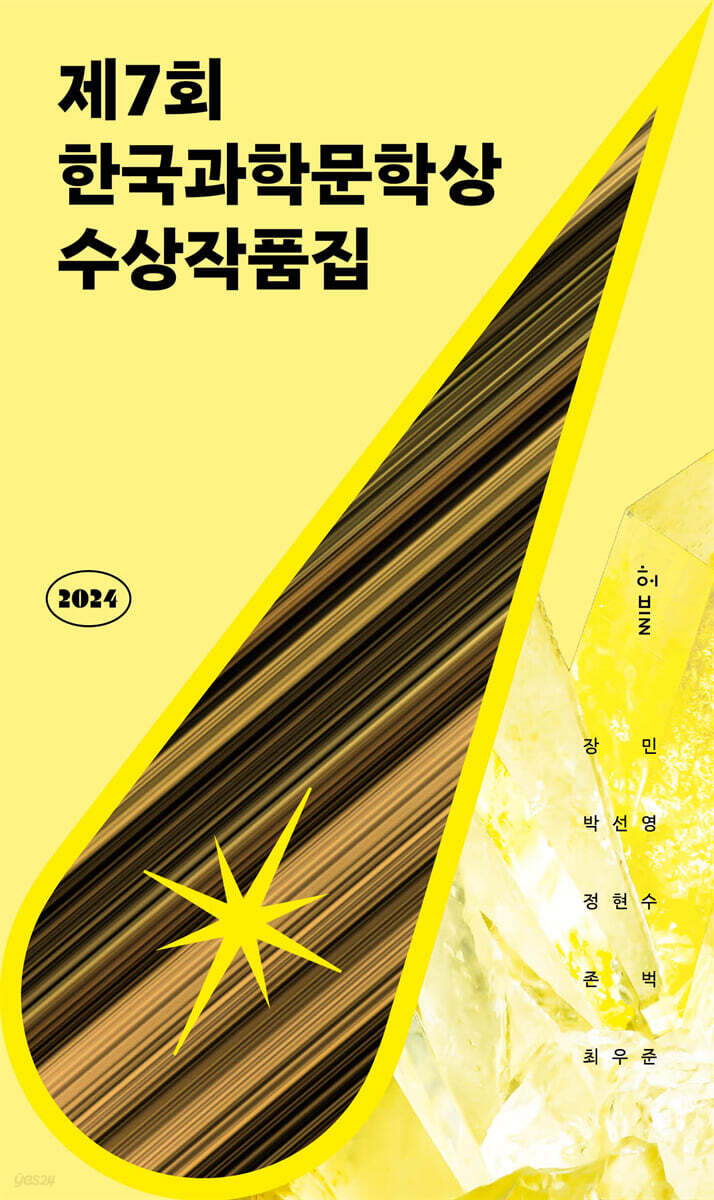
2024 7th Korea Science Literature Award Winners Collection
 |
Description
Book Introduction
- A word from MD
-
A new universe presented by five writers with unbridled imagination.Isn't science fiction the genre that pays the most attention to human instinct?
The Korean Science Literature Award, which has captured the sensibilities and concerns of the times through boundless imagination, is now in its 7th year.
A chance to experience a young and new world in five films, including "Our Reach," which shows the irony of reverse evolution.
June 4, 2024. Novel/Poetry PD Kim Yu-ri
Evolution into a new human race, extraterrestrial contact, AI singularity, the end of the world, distortion of space and time…
The first book by five authors who imagine a new universe, embracing a changing world.
How are sci-fi blockbuster stories like [Dune] and [The Three-Body Problem] born? Ironically, such massive worldviews, with their astronomical production costs, are only possible in the imagination, without any intention of visualization.
An imagination in a text that can create light with just these words, “Let there be light,” and that costs nothing to produce except paper and pen.
Since its establishment in 2016, the Korea Science Literature Award has been working with writers who utilize the imagination in their texts to express contemporary sensibilities and concerns in their own unique worlds.
Just as the previous 6th award-winning authors focused on the singularity of artificial intelligence, the 7th award-winning authors also focused on contemporary voices. This time, they presented diverse materials and worldviews based on the fears and anxieties we experience in this age of uncertainty.
Regarding the award-winning works that deal with the evolution of a new human race, extraterrestrial contact, artificial intelligence singularity, the end of the world, and the distortion of space and time, the judges (Koo Byung-mo, Kim Sung-joong, Kim Hee-sun, Kang Ji-hee, and In Ah-young) congratulated the authors on their birth, praising them as “energy so strong that it feels instinctive,” “wonderful and successful worldview,” and “lovely works that remain in the heart for a long time.”
New writers have emerged, demonstrating unstoppable imagination that resonates with the world.
Introducing them.
The winners of the 7th Korea Science Literature Award in the short story and mid-length story category are “Jang Min,” “Park Seon-yeong,” “Jeong Hyeon-su,” “John Buck,” and “Choi Woo-jun.”
The first book by five authors who imagine a new universe, embracing a changing world.
How are sci-fi blockbuster stories like [Dune] and [The Three-Body Problem] born? Ironically, such massive worldviews, with their astronomical production costs, are only possible in the imagination, without any intention of visualization.
An imagination in a text that can create light with just these words, “Let there be light,” and that costs nothing to produce except paper and pen.
Since its establishment in 2016, the Korea Science Literature Award has been working with writers who utilize the imagination in their texts to express contemporary sensibilities and concerns in their own unique worlds.
Just as the previous 6th award-winning authors focused on the singularity of artificial intelligence, the 7th award-winning authors also focused on contemporary voices. This time, they presented diverse materials and worldviews based on the fears and anxieties we experience in this age of uncertainty.
Regarding the award-winning works that deal with the evolution of a new human race, extraterrestrial contact, artificial intelligence singularity, the end of the world, and the distortion of space and time, the judges (Koo Byung-mo, Kim Sung-joong, Kim Hee-sun, Kang Ji-hee, and In Ah-young) congratulated the authors on their birth, praising them as “energy so strong that it feels instinctive,” “wonderful and successful worldview,” and “lovely works that remain in the heart for a long time.”
New writers have emerged, demonstrating unstoppable imagination that resonates with the world.
Introducing them.
The winners of the 7th Korea Science Literature Award in the short story and mid-length story category are “Jang Min,” “Park Seon-yeong,” “Jeong Hyeon-su,” “John Buck,” and “Choi Woo-jun.”
- You can preview some of the book's contents.
Preview
index
Jang Min, "Within Our Reach" · 7
Author's Note · 89
Park Seon-yeong, "The Universe of the Individual" · 95
Author's Note · 171
Jeong Hyeon-su, "The Void of Sky" · 179
Author's Note · 265
John Buck, "Atomic Bombing" · 271
Author's Note · 341
Choi Woo-jun, "The Moon is Full, the Cow is Empty" · 349
Author's Note · 389
2024 7th Korea Science Literature Award Review · 391
Author's Note · 89
Park Seon-yeong, "The Universe of the Individual" · 95
Author's Note · 171
Jeong Hyeon-su, "The Void of Sky" · 179
Author's Note · 265
John Buck, "Atomic Bombing" · 271
Author's Note · 341
Choi Woo-jun, "The Moon is Full, the Cow is Empty" · 349
Author's Note · 389
2024 7th Korea Science Literature Award Review · 391
Detailed image

Into the book
“You felt it too.
The moment we step into the suit, the planet becomes nothing more than a crumbling lump of ore.
That the world that surrounds us is actually very fragile.
“I’m just curious about our possibilities.”
--- Jang Min, from "Our Reach"
Make us bigger and evolve so that we can see the destruction of the universe.
If we can use the countless stars as stepping stones, we can become greater.
Because the distance our hands can reach is endless.
--- Jang Min, from "Our Reach"
I'm very curious to see what happens with the second flock of crows.
But the signal from the second flock of crows will not reach Earth until after I die.
Time goes by.
That's the law.
--- From Park Seon-yeong's "Personal Universe"
“But how can anyone know what infinite things might be happening within their personal universe? Unless they themselves realize it.
And there is no guarantee that those infinite universes will not be interconnected.”
--- From Park Seon-yeong's "Personal Universe"
“Humans want to be remembered as ‘humans, not robots,’ and they need ‘humans, not robots.’
But I want to be a robot that doesn't need to be loved by everyone and doesn't need to rely on anyone."
--- From Jeong Hyeon-su's "The Void of Sky"
If Lee Yeon-woo was the last to long for a robot, I was the last to long for a human.
The sun was not shining brightly, but it was a blank space in the sky where a gentle breeze was blowing.
--- From Jeong Hyeon-su's "The Void of Sky"
Numa muttered absentmindedly, looking at the red, wrinkled face with unfocused eyes.
“It was burned.
“It’s all gone.”
“Fire is born to burn everything,” answered a voice like sandpaper.
“Then everything is reborn.
You had a good dream.
“Drink some of this.”
--- From John Buck's "Exposure"
Numa crawled forward, covering his ears with one hand and groping in the darkness with the other.
The corpse of the exhausted dog, boiling like lava, touched his hand, but Numa felt no pain because his hand was also melting.
Although the lump on her face was emitting a dazzling fluorescent light, illuminating the darkness, Numa's pupils were already blackened and she had lost her sight.
Quite surprisingly, Numa's hearing survived and he was able to convey the end and beginning of the world through sound.
The vibrant commotion of atoms rumbling and tangled together.
--- From John Buck's "Rain Exposure"
One of them came up and spoke to Buford in English.
I'm sorry.
Please don't let this affect your world.
Buford asked back.
I was completely shocked.
"How is that so?" Cooley replied politely.
Forget it.
You can think of it as a one-night dream.
--- From Choi Woo-jun's "The Moon is Full and the Cow is Empty"
York left the room without saying anything.
He came out onto the street and went to church to pray for the first time in a long time.
He saw the dilapidated church in Tucson and for the first time in his life, he thought this.
I'm going to build a church with the money I've earned from the violin.
The largest church in the West, and indeed in all of America.
The moment we step into the suit, the planet becomes nothing more than a crumbling lump of ore.
That the world that surrounds us is actually very fragile.
“I’m just curious about our possibilities.”
--- Jang Min, from "Our Reach"
Make us bigger and evolve so that we can see the destruction of the universe.
If we can use the countless stars as stepping stones, we can become greater.
Because the distance our hands can reach is endless.
--- Jang Min, from "Our Reach"
I'm very curious to see what happens with the second flock of crows.
But the signal from the second flock of crows will not reach Earth until after I die.
Time goes by.
That's the law.
--- From Park Seon-yeong's "Personal Universe"
“But how can anyone know what infinite things might be happening within their personal universe? Unless they themselves realize it.
And there is no guarantee that those infinite universes will not be interconnected.”
--- From Park Seon-yeong's "Personal Universe"
“Humans want to be remembered as ‘humans, not robots,’ and they need ‘humans, not robots.’
But I want to be a robot that doesn't need to be loved by everyone and doesn't need to rely on anyone."
--- From Jeong Hyeon-su's "The Void of Sky"
If Lee Yeon-woo was the last to long for a robot, I was the last to long for a human.
The sun was not shining brightly, but it was a blank space in the sky where a gentle breeze was blowing.
--- From Jeong Hyeon-su's "The Void of Sky"
Numa muttered absentmindedly, looking at the red, wrinkled face with unfocused eyes.
“It was burned.
“It’s all gone.”
“Fire is born to burn everything,” answered a voice like sandpaper.
“Then everything is reborn.
You had a good dream.
“Drink some of this.”
--- From John Buck's "Exposure"
Numa crawled forward, covering his ears with one hand and groping in the darkness with the other.
The corpse of the exhausted dog, boiling like lava, touched his hand, but Numa felt no pain because his hand was also melting.
Although the lump on her face was emitting a dazzling fluorescent light, illuminating the darkness, Numa's pupils were already blackened and she had lost her sight.
Quite surprisingly, Numa's hearing survived and he was able to convey the end and beginning of the world through sound.
The vibrant commotion of atoms rumbling and tangled together.
--- From John Buck's "Rain Exposure"
One of them came up and spoke to Buford in English.
I'm sorry.
Please don't let this affect your world.
Buford asked back.
I was completely shocked.
"How is that so?" Cooley replied politely.
Forget it.
You can think of it as a one-night dream.
--- From Choi Woo-jun's "The Moon is Full and the Cow is Empty"
York left the room without saying anything.
He came out onto the street and went to church to pray for the first time in a long time.
He saw the dilapidated church in Tucson and for the first time in his life, he thought this.
I'm going to build a church with the money I've earned from the violin.
The largest church in the West, and indeed in all of America.
--- From Choi Woo-jun's "The Moon is Full and the Cow is Empty"
Publisher's Review
Jang Min's "Our Reach"
The evolution of humanity, which grew to a cosmic scale by wearing mechanical suits.
“A masterpiece that shows the irony of reverse evolution, something everyone can readily agree on.”
Kang Ji-hee (literary critic)
“Facing the inevitable death of the universe, what will we live for?”
In response to the above question, author Jang Min introduces a new species of human beings who wear mechanical suits and become as large as a planet.
Humanity, who wanted to explore space outside the solar system, developed a mechanical suit to block cosmic radiation, and the initial model of the suit was a whopping 18 meters in size.
Despite many concerns about the mechanical suit, the first pioneer group sets out and ultimately succeeds in pioneering.
Based on the resources collected from outer space, the pioneering group creates a larger suit and moves to another star system.
An unexpected problem occurs during this process: the brains of the members who began to feel the mechanical suit as if it were their own body began to distort their perception.
Because the spinal cord was connected to the suit, the brain felt the suit's massive body as its own, slowing down the nerve transmission speed.
This strange change causes various problems for the members, but the Pioneers do not care and continue to build larger suits.
Instead of gaining omnipotence through the suit, the members lost their humanity and were trapped in a desire for 'expansion'.
As the suit grows to 100 kilometers, the members begin to perceive 10 billion years as 120 million years, ultimately becoming immortal beings capable of infinite expansion.
The judges stated that they “could readily agree with the direction of the big question” regarding “Our Hands’ Reach” and that “this novel is a masterpiece that shows the irony of reverse evolution that humans, who have repeated external development and self-transformation, face at the end of it”, and selected it as the winner of the grand prize in the short story category.
Park Seon-yeong, "The Universe of the Individual"
The friendship between a girl and an alien being that transcends time and space and continues to this day.
“A wonderful and successful worldview, compelling and compelling to the reader.”
_Gu Byeong-mo (novelist)
“What would we feel if we received a letter of friendship from a distant universe?”
In response to the above question, author Park Seon-yeong deals with the friendship between a girl and an alien being, formed across light-years of space and time.
The story of Part 1 of the work begins when the girl 'Dami' hears the voice of an unknown being 'M' in her dream.
Although Mu is a quantum mechanical entity that is difficult for humans to understand, the two become close like friends through conversation.
Meanwhile, the two inevitably become unable to communicate, and Dami, missing Mu who has disappeared, takes the path of an astrophysicist.
Afterwards, Dami became a researcher and participated in a space exploration project using satellites.
Dami dreams of meeting Muwa through information sent by the satellite, but despairs at the fact that she can only receive information after her lifespan ends.
Even so, Dami closed her eyes after waiting her whole life for a reunion with Muwa.
After this, the second part of the work begins, and a long time has passed since Dami's death, and future humanity receives information from a satellite.
Jane and Kang Yoon-kyung, who were struggling to decipher the information, check Dami's research journal and, upon seeing the message that Muga sent to Dami, deduce that it was a signal sent to humanity by an alien being.
The judges selected “Personal Universe” as the winner of the Excellence Award in the Short Story category, stating that it “most outstandingly displays imagination in terms of the wonders of science” and “the reason readers are curious about the work’s worldview is because the worldview is successful and has the power to persuade them to do so.”
Jeong Hyeon-su, "The Void of Sky"
A dangerous pen pal romance between a robot and a human, with their identities hidden.
“A lovely work that stays true to the essence of science fiction and will linger in your heart for a long time.”
Kim Hee-sun (novelist)
“If I were a robot, what would I think of as human and human-like?”
In response to the above question, author Jeong Hyeon-su introduces a robot that hides its identity and shares a pen pal romance with a human.
In the near future, human residence and travel routes are legally determined based on ability and wealth.
The narrator of the story is a labor robot working under the postal worker who sorts mail, and lives with the urge to throw himself into the blank space in the sky where the sun shines brightly.
Then one day, he accidentally finds an email sent by Yeonwoo, a singer in her second year of debut, and decides that he cannot ignore the email from Yeonwoo, who is suffering from severe depression, so he replies.
He lied and said he was a man in his 30s.
That's how my pen pal relationship with Yeonwoo began.
Yeonwoo, who was suffering from all kinds of rumors and malicious comments, needed someone to talk to.
The speaker, who was replying with the hope that Yeon-woo would be happy, gradually feels that a different kind of heart is sprouting beyond the principle of 'protecting humanity'.
Meanwhile, Yeon-woo's mental health worsens, and she leaves a message suggesting an extreme choice. The narrator leaves his workplace without permission to save her.
In the end, he fails to meet Yeonwoo and loses consciousness due to exhaustion.
The narrator regains consciousness and finds himself strapped to an operating table, and then a surprising turn of events unfolds...
The judges selected "The Void of Sky" as the winner of the Excellence Award in the Short Story category, stating that it is "a good novel that is true to the essence of science fiction in that it allows us to look into and reflect on ourselves through 'another being'" and that it is "a novel that will remain in our hearts for a long time, a novel that the judges unanimously called 'lovely.'"
John Buck, "Rain Exposure"
Numa's journey as he flees the apocalyptic world and his own destiny.
“An energy so intense and compelling that it almost feels instinctive.”
Ina Young (literary critic)
“If humans were treated like machines in a world, what kind of lives would we live?”
In response to the above question, author John Buck presents the escape story of the protagonist, Numa, who refuses his fate and runs away from a vast world where revolution and apocalypse are intertwined.
A dystopia where the world's lowest class of slaves are forced to transform into robots.
To make matters worse, radiation-exposed patients appear in the tunnel where Numa works, and ore boils, a side effect of radiation exposure, appear on Numa's body.
Even in the midst of this chaos, the people of the tunnel are blinded by desire and are in a state of chaos, trying to figure out how much each other's boils are worth.
Numa, who escaped from the tunnel where only primal desires seethe, leaves his home and embarks on a journey without a destination.
Even in this desperate situation, whenever Numa gets tired and falls to his knees, a small favor reaches out and lifts him up, and one day, in a dream, Numa hears a faint song like an oracle.
It is the sound of the end, when everything explodes at the end of the world, and the sound of birth, when the world is reborn.
The judges stated that "Exposure" is "a good novel that is true to the essence of science fiction in that it allows us to look into ourselves and reflect on ourselves through 'another being'" and "a novel that will remain in our hearts for a long time, which the judges unanimously said was 'lovely'", and selected it as the winner of the Excellence Award in the short story category.
Choi Woo-jun, "The Moon is Full, the Cow is Empty"
A midnight drama about a multiverse traveler who changed human history and destiny.
“A work that makes me want to read it in series if you write it.”
_Kim Seong-jung (novelist)
“If the human before our eyes were to disappear due to conflict in another world, what would we feel?”
In answer to the above question, author Choi Woo-jun shows a mysterious incident that occurred during the Western Expedition of the 1800s.
A nobleman, a sheriff, and a coolie (indentured laborers from China or India brought in to replace black slaves) who have just met each other are riding together in a carriage in the middle of the night when the wheel breaks and they are forced to camp.
Three people telling their stories around a campfire.
The story begins with a nobleman's search for a rare, one-of-a-kind violin, followed by a sheriff's quest to solve a case involving a group of coolies stealing cattle from a farm, and the coolies' true identities are revealed.
Cooley is actually a multiverse traveler named 'Park Hyeong-su' from another parallel universe, and the incident involving the nobles and the sheriff was caused by him and other multiverse travelers causing a commotion.
While the outrageous and impossible events unfold, another multiverse traveler arrives, arrests Park Hyeong-su, and tells the remaining two to just forget about him before disappearing.
Naturally, these two people couldn't just forget and move on.
The sheriff decides to quit his job, and the nobleman prays to God and decides to build the largest church in America.
The judges stated, “We were completely captivated by the multiverse worldview of “The Moon is Full and the Cow is Empty” and “If someone were to write a series of novels called ‘The Tourist’, we would want to read them as well,” and selected it as the winner of the Excellence Award in the Short Story category.
The evolution of humanity, which grew to a cosmic scale by wearing mechanical suits.
“A masterpiece that shows the irony of reverse evolution, something everyone can readily agree on.”
Kang Ji-hee (literary critic)
“Facing the inevitable death of the universe, what will we live for?”
In response to the above question, author Jang Min introduces a new species of human beings who wear mechanical suits and become as large as a planet.
Humanity, who wanted to explore space outside the solar system, developed a mechanical suit to block cosmic radiation, and the initial model of the suit was a whopping 18 meters in size.
Despite many concerns about the mechanical suit, the first pioneer group sets out and ultimately succeeds in pioneering.
Based on the resources collected from outer space, the pioneering group creates a larger suit and moves to another star system.
An unexpected problem occurs during this process: the brains of the members who began to feel the mechanical suit as if it were their own body began to distort their perception.
Because the spinal cord was connected to the suit, the brain felt the suit's massive body as its own, slowing down the nerve transmission speed.
This strange change causes various problems for the members, but the Pioneers do not care and continue to build larger suits.
Instead of gaining omnipotence through the suit, the members lost their humanity and were trapped in a desire for 'expansion'.
As the suit grows to 100 kilometers, the members begin to perceive 10 billion years as 120 million years, ultimately becoming immortal beings capable of infinite expansion.
The judges stated that they “could readily agree with the direction of the big question” regarding “Our Hands’ Reach” and that “this novel is a masterpiece that shows the irony of reverse evolution that humans, who have repeated external development and self-transformation, face at the end of it”, and selected it as the winner of the grand prize in the short story category.
Park Seon-yeong, "The Universe of the Individual"
The friendship between a girl and an alien being that transcends time and space and continues to this day.
“A wonderful and successful worldview, compelling and compelling to the reader.”
_Gu Byeong-mo (novelist)
“What would we feel if we received a letter of friendship from a distant universe?”
In response to the above question, author Park Seon-yeong deals with the friendship between a girl and an alien being, formed across light-years of space and time.
The story of Part 1 of the work begins when the girl 'Dami' hears the voice of an unknown being 'M' in her dream.
Although Mu is a quantum mechanical entity that is difficult for humans to understand, the two become close like friends through conversation.
Meanwhile, the two inevitably become unable to communicate, and Dami, missing Mu who has disappeared, takes the path of an astrophysicist.
Afterwards, Dami became a researcher and participated in a space exploration project using satellites.
Dami dreams of meeting Muwa through information sent by the satellite, but despairs at the fact that she can only receive information after her lifespan ends.
Even so, Dami closed her eyes after waiting her whole life for a reunion with Muwa.
After this, the second part of the work begins, and a long time has passed since Dami's death, and future humanity receives information from a satellite.
Jane and Kang Yoon-kyung, who were struggling to decipher the information, check Dami's research journal and, upon seeing the message that Muga sent to Dami, deduce that it was a signal sent to humanity by an alien being.
The judges selected “Personal Universe” as the winner of the Excellence Award in the Short Story category, stating that it “most outstandingly displays imagination in terms of the wonders of science” and “the reason readers are curious about the work’s worldview is because the worldview is successful and has the power to persuade them to do so.”
Jeong Hyeon-su, "The Void of Sky"
A dangerous pen pal romance between a robot and a human, with their identities hidden.
“A lovely work that stays true to the essence of science fiction and will linger in your heart for a long time.”
Kim Hee-sun (novelist)
“If I were a robot, what would I think of as human and human-like?”
In response to the above question, author Jeong Hyeon-su introduces a robot that hides its identity and shares a pen pal romance with a human.
In the near future, human residence and travel routes are legally determined based on ability and wealth.
The narrator of the story is a labor robot working under the postal worker who sorts mail, and lives with the urge to throw himself into the blank space in the sky where the sun shines brightly.
Then one day, he accidentally finds an email sent by Yeonwoo, a singer in her second year of debut, and decides that he cannot ignore the email from Yeonwoo, who is suffering from severe depression, so he replies.
He lied and said he was a man in his 30s.
That's how my pen pal relationship with Yeonwoo began.
Yeonwoo, who was suffering from all kinds of rumors and malicious comments, needed someone to talk to.
The speaker, who was replying with the hope that Yeon-woo would be happy, gradually feels that a different kind of heart is sprouting beyond the principle of 'protecting humanity'.
Meanwhile, Yeon-woo's mental health worsens, and she leaves a message suggesting an extreme choice. The narrator leaves his workplace without permission to save her.
In the end, he fails to meet Yeonwoo and loses consciousness due to exhaustion.
The narrator regains consciousness and finds himself strapped to an operating table, and then a surprising turn of events unfolds...
The judges selected "The Void of Sky" as the winner of the Excellence Award in the Short Story category, stating that it is "a good novel that is true to the essence of science fiction in that it allows us to look into and reflect on ourselves through 'another being'" and that it is "a novel that will remain in our hearts for a long time, a novel that the judges unanimously called 'lovely.'"
John Buck, "Rain Exposure"
Numa's journey as he flees the apocalyptic world and his own destiny.
“An energy so intense and compelling that it almost feels instinctive.”
Ina Young (literary critic)
“If humans were treated like machines in a world, what kind of lives would we live?”
In response to the above question, author John Buck presents the escape story of the protagonist, Numa, who refuses his fate and runs away from a vast world where revolution and apocalypse are intertwined.
A dystopia where the world's lowest class of slaves are forced to transform into robots.
To make matters worse, radiation-exposed patients appear in the tunnel where Numa works, and ore boils, a side effect of radiation exposure, appear on Numa's body.
Even in the midst of this chaos, the people of the tunnel are blinded by desire and are in a state of chaos, trying to figure out how much each other's boils are worth.
Numa, who escaped from the tunnel where only primal desires seethe, leaves his home and embarks on a journey without a destination.
Even in this desperate situation, whenever Numa gets tired and falls to his knees, a small favor reaches out and lifts him up, and one day, in a dream, Numa hears a faint song like an oracle.
It is the sound of the end, when everything explodes at the end of the world, and the sound of birth, when the world is reborn.
The judges stated that "Exposure" is "a good novel that is true to the essence of science fiction in that it allows us to look into ourselves and reflect on ourselves through 'another being'" and "a novel that will remain in our hearts for a long time, which the judges unanimously said was 'lovely'", and selected it as the winner of the Excellence Award in the short story category.
Choi Woo-jun, "The Moon is Full, the Cow is Empty"
A midnight drama about a multiverse traveler who changed human history and destiny.
“A work that makes me want to read it in series if you write it.”
_Kim Seong-jung (novelist)
“If the human before our eyes were to disappear due to conflict in another world, what would we feel?”
In answer to the above question, author Choi Woo-jun shows a mysterious incident that occurred during the Western Expedition of the 1800s.
A nobleman, a sheriff, and a coolie (indentured laborers from China or India brought in to replace black slaves) who have just met each other are riding together in a carriage in the middle of the night when the wheel breaks and they are forced to camp.
Three people telling their stories around a campfire.
The story begins with a nobleman's search for a rare, one-of-a-kind violin, followed by a sheriff's quest to solve a case involving a group of coolies stealing cattle from a farm, and the coolies' true identities are revealed.
Cooley is actually a multiverse traveler named 'Park Hyeong-su' from another parallel universe, and the incident involving the nobles and the sheriff was caused by him and other multiverse travelers causing a commotion.
While the outrageous and impossible events unfold, another multiverse traveler arrives, arrests Park Hyeong-su, and tells the remaining two to just forget about him before disappearing.
Naturally, these two people couldn't just forget and move on.
The sheriff decides to quit his job, and the nobleman prays to God and decides to build the largest church in America.
The judges stated, “We were completely captivated by the multiverse worldview of “The Moon is Full and the Cow is Empty” and “If someone were to write a series of novels called ‘The Tourist’, we would want to read them as well,” and selected it as the winner of the Excellence Award in the Short Story category.
GOODS SPECIFICS
- Date of issue: May 27, 2024
- Page count, weight, size: 436 pages | 480g | 125*210*20mm
- ISBN13: 9791193078235
You may also like
카테고리
korean


korean

![GQ KOREA Mark (Monthly): December [2025]](http://librairie.coreenne.fr/cdn/shop/files/8ef265dbbfbf186523ed75ba7319009d.jpg?v=1765340328&width=3840)


