

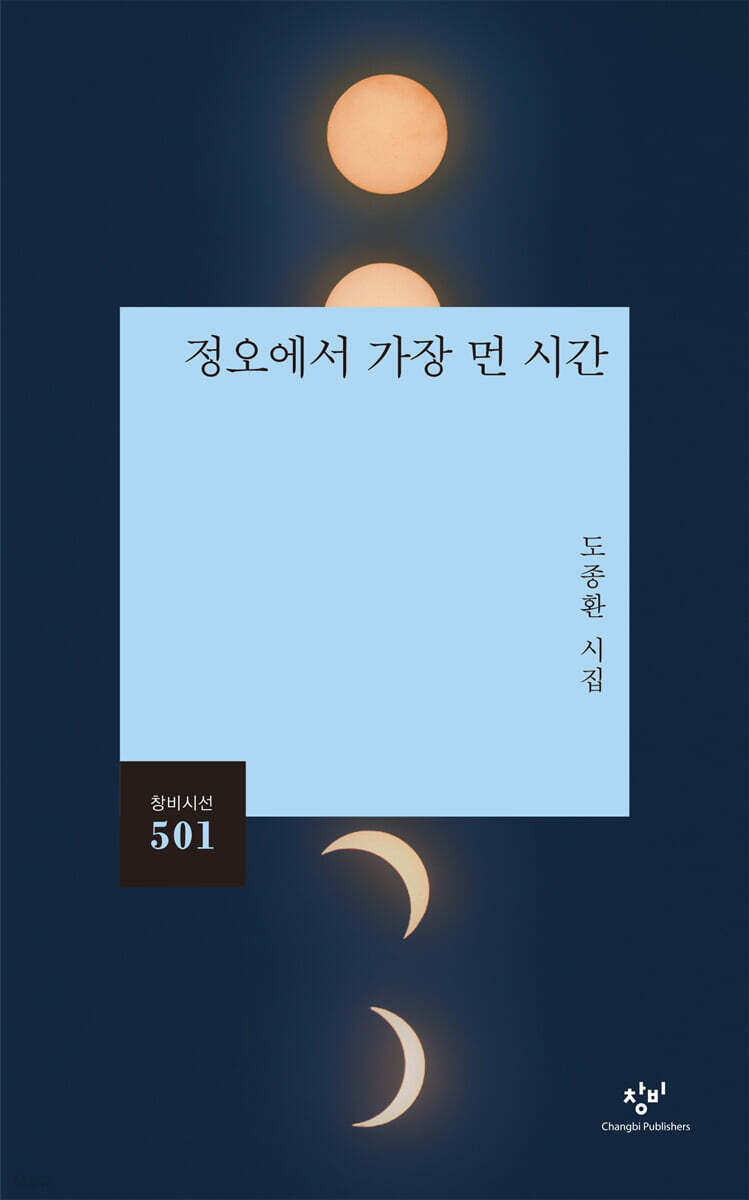
The furthest time from noon
 |
Description
Book Introduction
- A word from MD
-
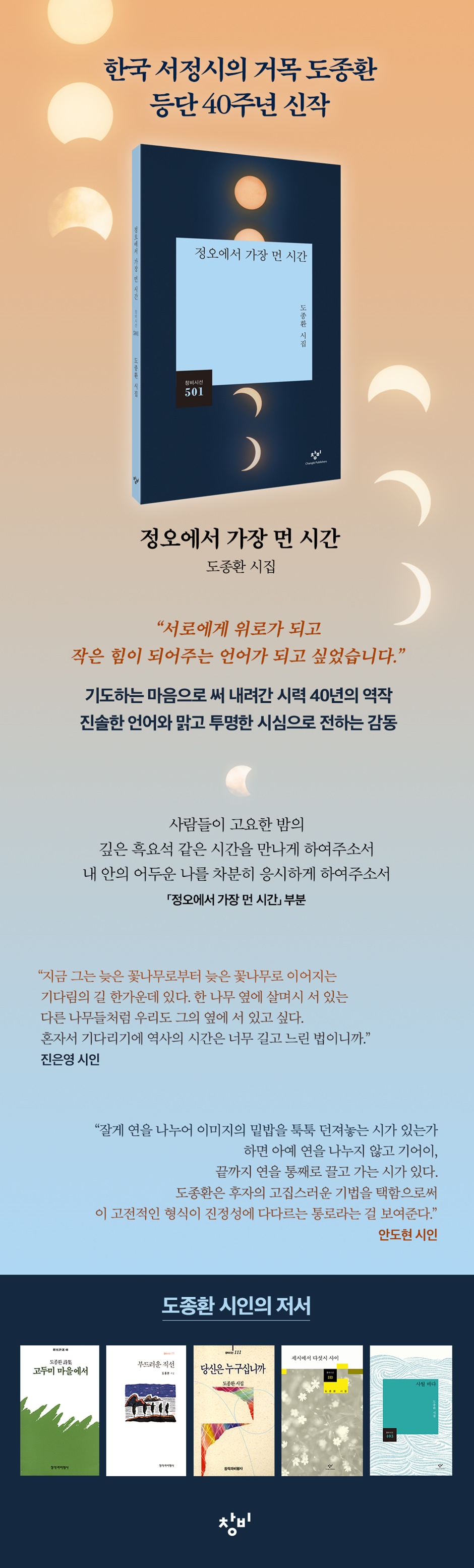
Poet Do Jong-hwan's masterpiece, celebrating his 40th anniversary since his debut.A new work by poet Do Jong-hwan, known as a master of Korean lyric poetry for works such as “You, the Dishflower.”
We have selected poems that provide comfort and strength to us who live in an age far removed from the brightest and most luminous hour, noon.
A poem with a profound resonance that makes us look into the darkest aspects of ourselves.
May 21, 2024. Novel/Poetry PD Kim Yu-ri
Please let me meet a time as deep as obsidian
Let me calmly look into the darkness within me.
Amidst the turbulent times, a noble soul stood out: Do Jong-hwan, a giant of Korean lyric poetry.
A masterpiece written over 40 years with a prayerful heart
Do Jong-hwan, a representative lyric poet of Korean poetry, who is celebrating his 40th anniversary this year, has published his twelfth poetry collection, “The Time Farthest from Noon,” as the 501st in the Changbi Poetry Series.
This is a meaningful poetry collection published eight years after 『April Sea』 (Changbi, 2016), which gave a poignant impression with the poem “Intense Hope” (Park Seong-woo, recommendation) that comforted the pain of the Sewol Ferry disaster.
The poet, while engaged in real-world politics as a three-term member of the National Assembly and Minister of Culture, Sports and Tourism, honestly expresses the “traces of agony” (in the poet’s words) of his “daily life like war.”
At the same time, as a human being who loves nature, he conveys his sincere reflections on life in a delicate and refined voice, along with the cyclical flow of the seasons.
The poet's firm heart, which has not lost its clear and transparent poetic mind for a long time, is deeply moving.
In particular, the aphorisms in the short poems, which reveal the depth of experience and inner strength, show the essence of lyricism and enhance the quality of the poetry collection.
In the midst of a dark age where people hate anything different from themselves and where harsh language of anger is rampant, the poet summons up Albert Camus's "Noon Thought."
It is the idea that by pursuing moderation without leaning to one side, one can reach unshakable harmony, that is, noon.
Politics and poetry, cities and nature.
The poet's precious enlightenment, which has been rigorously pushing himself and purifying his mind while simultaneously standing on two seemingly incompatible poles, is transformed into precise and beautiful poems.
Thus, his wrath, which rebukes the absurd world of today, is majestic.
A prayer that humbles oneself before nature and seeks enlightenment is sweet.
This collection of poems, which will be read as “the agony of a pure spiritualist” by modern people in a state of mental civil war, will become “bitter medicine for the mind” and “a whip” (Ando Hyun, recommendation), and will resonate deeply in the heart with a gentle yet heavy resonance.
Let me calmly look into the darkness within me.
Amidst the turbulent times, a noble soul stood out: Do Jong-hwan, a giant of Korean lyric poetry.
A masterpiece written over 40 years with a prayerful heart
Do Jong-hwan, a representative lyric poet of Korean poetry, who is celebrating his 40th anniversary this year, has published his twelfth poetry collection, “The Time Farthest from Noon,” as the 501st in the Changbi Poetry Series.
This is a meaningful poetry collection published eight years after 『April Sea』 (Changbi, 2016), which gave a poignant impression with the poem “Intense Hope” (Park Seong-woo, recommendation) that comforted the pain of the Sewol Ferry disaster.
The poet, while engaged in real-world politics as a three-term member of the National Assembly and Minister of Culture, Sports and Tourism, honestly expresses the “traces of agony” (in the poet’s words) of his “daily life like war.”
At the same time, as a human being who loves nature, he conveys his sincere reflections on life in a delicate and refined voice, along with the cyclical flow of the seasons.
The poet's firm heart, which has not lost its clear and transparent poetic mind for a long time, is deeply moving.
In particular, the aphorisms in the short poems, which reveal the depth of experience and inner strength, show the essence of lyricism and enhance the quality of the poetry collection.
In the midst of a dark age where people hate anything different from themselves and where harsh language of anger is rampant, the poet summons up Albert Camus's "Noon Thought."
It is the idea that by pursuing moderation without leaning to one side, one can reach unshakable harmony, that is, noon.
Politics and poetry, cities and nature.
The poet's precious enlightenment, which has been rigorously pushing himself and purifying his mind while simultaneously standing on two seemingly incompatible poles, is transformed into precise and beautiful poems.
Thus, his wrath, which rebukes the absurd world of today, is majestic.
A prayer that humbles oneself before nature and seeks enlightenment is sweet.
This collection of poems, which will be read as “the agony of a pure spiritualist” by modern people in a state of mental civil war, will become “bitter medicine for the mind” and “a whip” (Ando Hyun, recommendation), and will resonate deeply in the heart with a gentle yet heavy resonance.
- You can preview some of the book's contents.
Preview
index
Part 1
deep night
Day off
The furthest time from noon
cloudy day
outside
double rainbow
Sunset
Sunset 1
Sunset 2
Accompanying
star
still
Sa-ui-jae (Four Graces House)
salt
Three days later
His poetry
Prayer of a Leaf
Evening Star
Part 2
presentiment
September Typhoon
Public Prosecution
Even late-blooming flowers are beautiful.
Autumn mountain path
Autumn River
autumn trees
Thankful Things 2
It's been a long time since I left the forest.
fruition
plum tree
Four candles
Advent
Law book
White Prison
heresy
poor temple
night breeze
love
Part 3
new year
bean cake
Lausanne
Secular Confucianism
Heart warning
afternoon
heavy snow
Move in
winter tree
Rhododendron
early spring
early spring
letter
Thankful Thing 1
some flower tree
Flower tree
lilac
good tree
Part 4
Sarim (士林)
Departure
City Rose
knife
crash
The collapsed temple
at that time
lotus flower
Hot Solitude
July
Christmas night
winter mountains
new house
Waiting time for the car
Chuseok
charter
briefs
Eve
Commentary | Jin Eun-young
Poet's words
deep night
Day off
The furthest time from noon
cloudy day
outside
double rainbow
Sunset
Sunset 1
Sunset 2
Accompanying
star
still
Sa-ui-jae (Four Graces House)
salt
Three days later
His poetry
Prayer of a Leaf
Evening Star
Part 2
presentiment
September Typhoon
Public Prosecution
Even late-blooming flowers are beautiful.
Autumn mountain path
Autumn River
autumn trees
Thankful Things 2
It's been a long time since I left the forest.
fruition
plum tree
Four candles
Advent
Law book
White Prison
heresy
poor temple
night breeze
love
Part 3
new year
bean cake
Lausanne
Secular Confucianism
Heart warning
afternoon
heavy snow
Move in
winter tree
Rhododendron
early spring
early spring
letter
Thankful Thing 1
some flower tree
Flower tree
lilac
good tree
Part 4
Sarim (士林)
Departure
City Rose
knife
crash
The collapsed temple
at that time
lotus flower
Hot Solitude
July
Christmas night
winter mountains
new house
Waiting time for the car
Chuseok
charter
briefs
Eve
Commentary | Jin Eun-young
Poet's words
Detailed image
Into the book
It's the furthest time from noon now
All around is darkness like the bottom of the sea.
Deep inside us too
There are times when bright times come down like lights
There are times when it is shaded and away from the rising sun.
There are times when it gets so dark that you can't discern things.
They all flow into the swamp inside me and pool.
Let us accept each other as we are, with our shortcomings.
Don't let others be hell.
Everywhere is a battlefield
Please put an end to this civil war with your own hands.
People of the quiet night
Please let me meet a time as deep as obsidian
Let me calmly look into the darkness within me.
---From "The Time Farthest from Noon"
The weather is cloudy
Even if the weather is cloudy, the green leaves
I raise my body towards the cloudy sky.
Don't repay insult with insult
Let us not repay dishonor with dishonor.
It was cut off at each joint in late fall last year.
For every severed arm
The green leaves with a thousand hands and a thousand eyes
It's rising
Let's not try to return pain with pain
Let's not try to return extremes to extremes.
Still living green again
That's the greatest revenge
---From "Cloudy Day"
The stars are disappearing from the city sky
If I don't pay attention
My soul is being erased in the dust
Even the stars won't take notice
---From "Star"
Confronting the rotting things
It still can't shine white
In the midst of decaying flesh
While embracing and enduring corruption
The sharp white light fades
The smell of blood covered my body.
When people see that, they wonder what kind of salt that is.
The scriptures have written down in a sacred manner what I must do.
The role I play in this world is
Embracing and enduring a bloody world
Something that melts away if you hold on
My body is melting again today
The old appearance is erased
When people see that, they wonder what kind of salt that is.
---From "Salt"
I don't use the word "fruit" carelessly.
The weight of the word fullness
The colors and fragrance it creates
Thanks, but that's not what I made.
People notice the bursting flesh on my body
The leaves that came here together
I look at you with more affection
There are many traces of internal injuries inside my body,
The leaves torn by the typhoon have deeper wounds
The leaf that gave its flesh to the bug instead of me
One side of my body collapsed
After the water droplets poured on me, the leaves dried up and
Leaves with deep bruises
We came this far together
If I had come alone without them
I wouldn't have been able to get through the sharp edge of August.
From childhood until now, my body has been held
If there had been no dedication from the top
I would not have come to the time when it turned yellow and ripened.
I came with them
I am part of the tree, not the whole tree.
---From "Fruit"
Can you be so restrained in the face of achievement?
Can one be so humble in the face of trials?
The tree is full of flowers
Like a white plum blossom that is not arrogant
I let it fly away without catching even a single leaf
Like a cherry tree that doesn't grieve
---From "Flower Tree"
Why are lilacs there?
April
Calling earnestly
It's there
Why are you there
---From "Lilac"
A truly beautiful mountain
More beautiful in winter
A beautiful person
Even in the winter of your life, you are beautiful
All around is darkness like the bottom of the sea.
Deep inside us too
There are times when bright times come down like lights
There are times when it is shaded and away from the rising sun.
There are times when it gets so dark that you can't discern things.
They all flow into the swamp inside me and pool.
Let us accept each other as we are, with our shortcomings.
Don't let others be hell.
Everywhere is a battlefield
Please put an end to this civil war with your own hands.
People of the quiet night
Please let me meet a time as deep as obsidian
Let me calmly look into the darkness within me.
---From "The Time Farthest from Noon"
The weather is cloudy
Even if the weather is cloudy, the green leaves
I raise my body towards the cloudy sky.
Don't repay insult with insult
Let us not repay dishonor with dishonor.
It was cut off at each joint in late fall last year.
For every severed arm
The green leaves with a thousand hands and a thousand eyes
It's rising
Let's not try to return pain with pain
Let's not try to return extremes to extremes.
Still living green again
That's the greatest revenge
---From "Cloudy Day"
The stars are disappearing from the city sky
If I don't pay attention
My soul is being erased in the dust
Even the stars won't take notice
---From "Star"
Confronting the rotting things
It still can't shine white
In the midst of decaying flesh
While embracing and enduring corruption
The sharp white light fades
The smell of blood covered my body.
When people see that, they wonder what kind of salt that is.
The scriptures have written down in a sacred manner what I must do.
The role I play in this world is
Embracing and enduring a bloody world
Something that melts away if you hold on
My body is melting again today
The old appearance is erased
When people see that, they wonder what kind of salt that is.
---From "Salt"
I don't use the word "fruit" carelessly.
The weight of the word fullness
The colors and fragrance it creates
Thanks, but that's not what I made.
People notice the bursting flesh on my body
The leaves that came here together
I look at you with more affection
There are many traces of internal injuries inside my body,
The leaves torn by the typhoon have deeper wounds
The leaf that gave its flesh to the bug instead of me
One side of my body collapsed
After the water droplets poured on me, the leaves dried up and
Leaves with deep bruises
We came this far together
If I had come alone without them
I wouldn't have been able to get through the sharp edge of August.
From childhood until now, my body has been held
If there had been no dedication from the top
I would not have come to the time when it turned yellow and ripened.
I came with them
I am part of the tree, not the whole tree.
---From "Fruit"
Can you be so restrained in the face of achievement?
Can one be so humble in the face of trials?
The tree is full of flowers
Like a white plum blossom that is not arrogant
I let it fly away without catching even a single leaf
Like a cherry tree that doesn't grieve
---From "Flower Tree"
Why are lilacs there?
April
Calling earnestly
It's there
Why are you there
---From "Lilac"
A truly beautiful mountain
More beautiful in winter
A beautiful person
Even in the winter of your life, you are beautiful
---From "Winter Mountain"
Publisher's Review
The lessons of history, revisited amidst the whirlwind of political events
As with his previous work, this collection of poems is filled with the dual identities of a poet and a politician, and the experiences that arise from them.
When asked, “Why did you go into politics instead of writing poetry?” the poet confesses his pure heart, saying, “I wanted to change the world” (“Simgo”).
It also presents us with a thought-provoking, high-level metaphor that offers insight into history.
Let's look back at the political advancement of the Sarim (士林) class during the Joseon Dynasty.
Although Neo-Confucian scholars with great ambitions seized power under King Seonjo, Joseon soon faced a grave crisis as the destructive strife between factions intensified and foreign invasions occurred.
The poet applies the failure of the Sarim, who had to leave a record of the brutal punishment for future generations, to the current reality.
“The belief that the world we dreamed of would come” collapses, and we painfully realize “how difficult it is to correct hundreds of years of deep-rooted evils in just a few years.”
He asks with a blood-spitting heart, “Why did the country come to this state?” (“Sarim”).
At this time, the poetic speaker, who is hit by “arrows of misunderstanding” and “cut by the blade of accusation and grieved” (“New Year”), but does not blame “ghosts armed with hostility” (“The Hour Furthest from Noon”), is eye-catching.
While he is deeply despairing, he reflects, asking himself, “Isn’t it my own character that is becoming so corrupt?” (“Secular Confucianism”).
The scene where he looks up at the stars in the night sky and “calmly gazes at the dark me within me” (“The Hour Farthest from Noon”) is imbued with a divine energy that penetrates the essence of existence.
In this endless darkness of repentance, what guides me, lost as I am, are the teachings of the ancient sages who sought reason, cared for the well-being of the people, and were faithful to the ‘basics.’
'I' think of great teachers such as Dasan Jeong Yak-yong and Toegye Yi Hwang, and recite the Confucian spirits such as 'Geokmulchiji' (格物致知), 'Yongyonghusaeng' (利用厚生), and 'Gyeongsechiyong' (經世致用) to find the center of my wavering mind.
By overcoming suffering and frustration and fiercely pursuing the lessons of history and the original intention, we earnestly and earnestly call for the arrival of noon.
A poem that purifies the turbid world and calms the dizzy mind.
The beautiful natural objects contained throughout this collection of poems are closer to a medium for reflection and a direction in life than an object of appreciation.
The poet, exhausted from living in a city full of all kinds of insults and hatred, entrusts his body and mind to nature and gains “deep wisdom that clearly sees through the principles of death and eternal life” (“Heresy”).
For example, we learn the virtues of moderation and humility from looking at the “white plum blossoms that bloom in full bloom/but are not arrogant” (“Flowering Tree”), and we realize the piety of a life that follows the providence of nature from the virtue of the tree that “knows how to accept/every moment that comes to it” (“Autumn Tree”).
The feelings the poetic speaker feels from nature are close to the sublime.
Compared to that, the human heart is infinitely shabby, but by revealing even that shabbiness without hiding it, the poet gives readers a place to empathize.
This is why the calm sentence in which he says, while looking at the “turbid water” and the street trees “swept by a musty smell,” that he too “was called to the city and lived there for a long time” (from “City Rose”) reads bitterly.
But even if a street tree is covered in dirt, it cannot be anything other than a tree.
The same goes for poets.
Even if one lives in a place filled with worldly filth, a poet cannot help but be a poet as long as he holds nature in his heart.
Therefore, I pledge to accept this heavy and “ferocious fate as it is” (“Sauijae”).
Believing that this voyage of life, which faces fierce typhoons and waves, will “accumulate into a fierce and desperate time of life” (“Departure”), I decide to set sail again and again.
In the silent attitude that strengthens the will to live in the face of adversity, we can confirm the profound history of Do Jong-hwan's poetry.
A warm companionship as we navigate through times of injustice.
Even though he lives a life like war, the poet does not lose his gentleness, maintaining the belief that “the path of the world and the path of seeking truth are not very different” (“Prayer of a Leaf of Grass”).
Like a ‘soft straight line,’ it simultaneously cultivates a delicate sensibility and an upright scholarly spirit.
“Just looking at flowers like violets and celandine makes my heart soft,” and keeping in mind that “there are more things I’m not good at than things I’m good at/there are many people in the world who are better than me,” he always bends down to share warmth with the lower classes of the world.
To those who are tired and lonely, he offers sincere comfort, saying, “To live each day well/is the greatest revenge” (“It’s been a long time since I left the forest”).
Through this collection of poems, let us stand side by side with the “candle of love and compassion” (“Daerim”) that the poet illuminates in the shady alleys of life.
Just as the four seasons are fleeting, the darkness of midnight will eventually dissipate.
Even a single, delicate candle will one day become countless candles that will light up the “pitch-black world” (“Eve”) and eventually illuminate the world with the noonday sunlight.
Poet's words
“Why are you there?”
The flowers of April ask.
As I prepare my answer, the thoughts that gather around me scatter and fall like flower petals.
We are now at the 'furthest hour from noon'.
Noon is a bright and sunny time.
It is the time when living things are most active and alive.
It is a time when people and people, people and the world, people and nature coexist in a green and warm way.
Albert Camus said that noon is a balanced time.
Right now, our inner selves are out of balance and have gone to extremes.
The world is also moving towards extremes.
If the world is our inner self externalized, then the dark, rough, and brutal world is something we have created.
Courage without reflection, language without restraint, and politics without soul lead to a daily life that feels like war.
There is a saying, “A sentence as cold and clear as autumn water is not stained by dust.”
Living each day without being stained by dust and dirt is not easy.
The world is no different from the five turbid evils, and the inner self is becoming increasingly desolate, so it is difficult to maintain the spirit of poetry and the spirit of the times.
The time I spent with poetry was a time of restoring my spirituality.
It was a time of longing, a time of restoring calm and balance, a time of letting go of the dust.
I wanted to write poetry that maintains the dignity of poetry and does not lose its class, poetry that warms the heart, sentences that are as cold and clear as autumn water and cleanse the mind, and language that comforts and gives strength to each other.
“Why are you there?”
The trees of May also ask.
I first put out the traces of agony that have accumulated while I was unable to answer in poetry.
I bow my head deeply to those who have accompanied me to this moment, despite my many shortcomings and shortcomings, and to those who have accompanied me to this point.
Thank you.
April 2024
Do Jong-hwan
As with his previous work, this collection of poems is filled with the dual identities of a poet and a politician, and the experiences that arise from them.
When asked, “Why did you go into politics instead of writing poetry?” the poet confesses his pure heart, saying, “I wanted to change the world” (“Simgo”).
It also presents us with a thought-provoking, high-level metaphor that offers insight into history.
Let's look back at the political advancement of the Sarim (士林) class during the Joseon Dynasty.
Although Neo-Confucian scholars with great ambitions seized power under King Seonjo, Joseon soon faced a grave crisis as the destructive strife between factions intensified and foreign invasions occurred.
The poet applies the failure of the Sarim, who had to leave a record of the brutal punishment for future generations, to the current reality.
“The belief that the world we dreamed of would come” collapses, and we painfully realize “how difficult it is to correct hundreds of years of deep-rooted evils in just a few years.”
He asks with a blood-spitting heart, “Why did the country come to this state?” (“Sarim”).
At this time, the poetic speaker, who is hit by “arrows of misunderstanding” and “cut by the blade of accusation and grieved” (“New Year”), but does not blame “ghosts armed with hostility” (“The Hour Furthest from Noon”), is eye-catching.
While he is deeply despairing, he reflects, asking himself, “Isn’t it my own character that is becoming so corrupt?” (“Secular Confucianism”).
The scene where he looks up at the stars in the night sky and “calmly gazes at the dark me within me” (“The Hour Farthest from Noon”) is imbued with a divine energy that penetrates the essence of existence.
In this endless darkness of repentance, what guides me, lost as I am, are the teachings of the ancient sages who sought reason, cared for the well-being of the people, and were faithful to the ‘basics.’
'I' think of great teachers such as Dasan Jeong Yak-yong and Toegye Yi Hwang, and recite the Confucian spirits such as 'Geokmulchiji' (格物致知), 'Yongyonghusaeng' (利用厚生), and 'Gyeongsechiyong' (經世致用) to find the center of my wavering mind.
By overcoming suffering and frustration and fiercely pursuing the lessons of history and the original intention, we earnestly and earnestly call for the arrival of noon.
A poem that purifies the turbid world and calms the dizzy mind.
The beautiful natural objects contained throughout this collection of poems are closer to a medium for reflection and a direction in life than an object of appreciation.
The poet, exhausted from living in a city full of all kinds of insults and hatred, entrusts his body and mind to nature and gains “deep wisdom that clearly sees through the principles of death and eternal life” (“Heresy”).
For example, we learn the virtues of moderation and humility from looking at the “white plum blossoms that bloom in full bloom/but are not arrogant” (“Flowering Tree”), and we realize the piety of a life that follows the providence of nature from the virtue of the tree that “knows how to accept/every moment that comes to it” (“Autumn Tree”).
The feelings the poetic speaker feels from nature are close to the sublime.
Compared to that, the human heart is infinitely shabby, but by revealing even that shabbiness without hiding it, the poet gives readers a place to empathize.
This is why the calm sentence in which he says, while looking at the “turbid water” and the street trees “swept by a musty smell,” that he too “was called to the city and lived there for a long time” (from “City Rose”) reads bitterly.
But even if a street tree is covered in dirt, it cannot be anything other than a tree.
The same goes for poets.
Even if one lives in a place filled with worldly filth, a poet cannot help but be a poet as long as he holds nature in his heart.
Therefore, I pledge to accept this heavy and “ferocious fate as it is” (“Sauijae”).
Believing that this voyage of life, which faces fierce typhoons and waves, will “accumulate into a fierce and desperate time of life” (“Departure”), I decide to set sail again and again.
In the silent attitude that strengthens the will to live in the face of adversity, we can confirm the profound history of Do Jong-hwan's poetry.
A warm companionship as we navigate through times of injustice.
Even though he lives a life like war, the poet does not lose his gentleness, maintaining the belief that “the path of the world and the path of seeking truth are not very different” (“Prayer of a Leaf of Grass”).
Like a ‘soft straight line,’ it simultaneously cultivates a delicate sensibility and an upright scholarly spirit.
“Just looking at flowers like violets and celandine makes my heart soft,” and keeping in mind that “there are more things I’m not good at than things I’m good at/there are many people in the world who are better than me,” he always bends down to share warmth with the lower classes of the world.
To those who are tired and lonely, he offers sincere comfort, saying, “To live each day well/is the greatest revenge” (“It’s been a long time since I left the forest”).
Through this collection of poems, let us stand side by side with the “candle of love and compassion” (“Daerim”) that the poet illuminates in the shady alleys of life.
Just as the four seasons are fleeting, the darkness of midnight will eventually dissipate.
Even a single, delicate candle will one day become countless candles that will light up the “pitch-black world” (“Eve”) and eventually illuminate the world with the noonday sunlight.
Poet's words
“Why are you there?”
The flowers of April ask.
As I prepare my answer, the thoughts that gather around me scatter and fall like flower petals.
We are now at the 'furthest hour from noon'.
Noon is a bright and sunny time.
It is the time when living things are most active and alive.
It is a time when people and people, people and the world, people and nature coexist in a green and warm way.
Albert Camus said that noon is a balanced time.
Right now, our inner selves are out of balance and have gone to extremes.
The world is also moving towards extremes.
If the world is our inner self externalized, then the dark, rough, and brutal world is something we have created.
Courage without reflection, language without restraint, and politics without soul lead to a daily life that feels like war.
There is a saying, “A sentence as cold and clear as autumn water is not stained by dust.”
Living each day without being stained by dust and dirt is not easy.
The world is no different from the five turbid evils, and the inner self is becoming increasingly desolate, so it is difficult to maintain the spirit of poetry and the spirit of the times.
The time I spent with poetry was a time of restoring my spirituality.
It was a time of longing, a time of restoring calm and balance, a time of letting go of the dust.
I wanted to write poetry that maintains the dignity of poetry and does not lose its class, poetry that warms the heart, sentences that are as cold and clear as autumn water and cleanse the mind, and language that comforts and gives strength to each other.
“Why are you there?”
The trees of May also ask.
I first put out the traces of agony that have accumulated while I was unable to answer in poetry.
I bow my head deeply to those who have accompanied me to this moment, despite my many shortcomings and shortcomings, and to those who have accompanied me to this point.
Thank you.
April 2024
Do Jong-hwan
GOODS SPECIFICS
- Date of issue: May 10, 2024
- Pages, weight, size: 156 pages | 210g | 125*200*10mm
- ISBN13: 9788936425012
You may also like
카테고리
korean


korean

![GQ KOREA Mark (Monthly): December [2025]](http://librairie.coreenne.fr/cdn/shop/files/8ef265dbbfbf186523ed75ba7319009d.jpg?v=1765340328&width=3840)


