

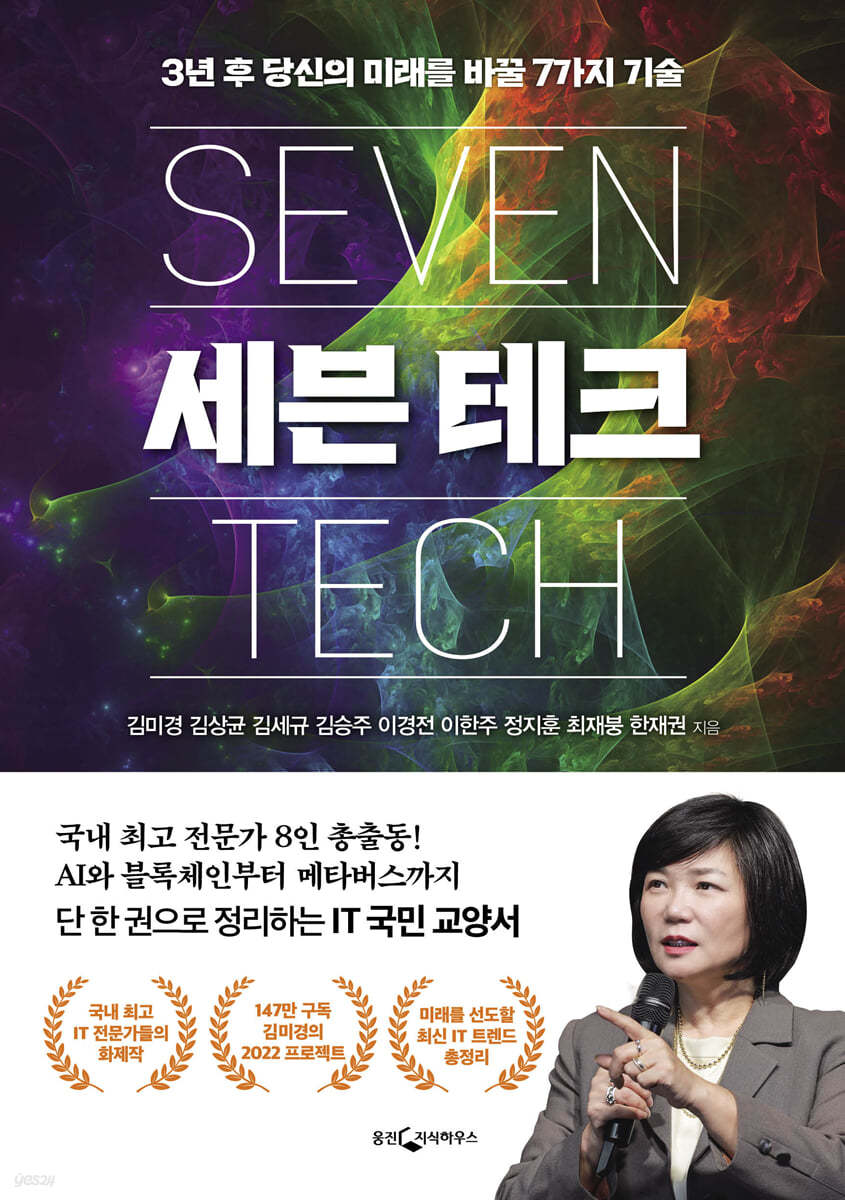
Seven Tech
 |
Description
Book Introduction
2022 marks the beginning of a digital convergence revolution. Are you ready to seize the opportunity and the future? Artificial intelligence, blockchain, virtual reality, robotics, the Internet of Things, cloud computing, and even the metaverse! Eight leading experts from various fields gathered together to provide essential knowledge for the digital revolution. Do you really know how these things connect and how they will change the world? The 2020 COVID-19 pandemic accelerated the third tech cycle, represented by artificial intelligence (AI) and the metaverse. This cycle is truly a revolution, not just because of the advancement of one or two technologies, like smartphones, but because it will completely change our daily lives as various technologies become intertwined. But as with many revolutions, most people only realize it was a revolution after the wave has swept the world. In 2007, when we were all excited about smartphones, someone was building a mobile messenger and turning it into a unicorn company. In the early days of YouTube, there were people who filmed their daily lives and gained millions of subscribers. What was different about these people who recognized the coming opportunity and seized the wealth? It wasn't because they had a detailed understanding of the technology. Observing and riding the wave of new technologies that are changing the world, avoiding the places that technology will disrupt and discovering the gaps of new opportunities—that is the true ability and culture of the new era. This is why understanding the Seven Techs, the "seven technologies that are one," is crucial to riding the 2022 tech revolution, fueled by the COVID-19 pandemic. This book, "Seven Tech," is a project planned by CEO Kim Mi-kyung, a self-development mentor in Korea and a living witness to the digital reboot, to draw the overall map of this urgent tech revolution. Led by Professor Ji-hoon Jeong, a leading expert in IT history, Professor Jae-boong Choi, who explained the new smartphone human race in "Phono Sapiens," Professor Sang-gyun Kim, a leading authority on the metaverse, Professor Jae-kwon Han, a leading figure in domestic robotics, Professor Gyeong-jeon Lee, who dispels misconceptions about AI and guides us into the future, Professor Seung-joo Kim, who preaches the potential of blockchain beyond Bitcoin, CEO Se-gyu Kim, who demonstrates the power of VR/AR that has now become a reality, and CEO Han-joo Lee, an evangelist of cloud computing, the foundation of the tech revolution, these top experts in Korea will kindly guide you through what Seven Tech is and why it is important. Unlike previous tech trend books that simply list overly academic information, Seven Tech raises bold questions from the reader's perspective, selecting only the truly core insights and vividly depicting how these seven tech revolutions are interconnected and will change our lives. In a world where knowledge and insight about technology connect not only to jobs and assets, but also to our dreams and future, Seven Tech aims to bring about true change as we stand again at the forefront of the tech revolution. |
- You can preview some of the book's contents.
Preview
index
Prologue - Bringing 7 Techs into My Reality and Dreaming of a New Future / Kim Mi-kyung
Lesson 1: IT Technology Beyond Imagination: "Seven Tech" / Jeong Ji-hoon
In a future society driven by imagination, those who are digitally adept will be the winners.
Lesson 2: Artificial Intelligence: Achieving Ultimate Value / Lee Kyung-jeon
AI is a technology that closely resembles people and their values.
Lesson 3: Blockchain: By Us, For Us / Seungju Kim
Blockchain is the economic infrastructure that's creating a new world.
Lesson 4: Perfectly Realistic Digital: VR/AR / Kim Se-gyu
VR/AR technologies, once considered a myth, are finally seeing the light of day.
Lesson 5: Robotics: Making Humans More Human / Jae-Kwon Han
“The human being of the future will speak clearly.
“How did we live without robots?”
Lesson 6: The Internet of Things: A New Standard for Civilization / Choi Jae-boong
"If everyone imagines the IoT, a truly amazing world will unfold."
Lesson 7: Cloud Computing: Unfamiliar Yet Familiar / Lee Han-joo
The era in which we all build our own clouds is just around the corner.
Lesson 8: A World Where Another Self Dreams: The Metaverse / Kim Sang-gyun
Let's not forget that the path to becoming the master of the world lies in the metaverse.
Lesson 1: IT Technology Beyond Imagination: "Seven Tech" / Jeong Ji-hoon
In a future society driven by imagination, those who are digitally adept will be the winners.
Lesson 2: Artificial Intelligence: Achieving Ultimate Value / Lee Kyung-jeon
AI is a technology that closely resembles people and their values.
Lesson 3: Blockchain: By Us, For Us / Seungju Kim
Blockchain is the economic infrastructure that's creating a new world.
Lesson 4: Perfectly Realistic Digital: VR/AR / Kim Se-gyu
VR/AR technologies, once considered a myth, are finally seeing the light of day.
Lesson 5: Robotics: Making Humans More Human / Jae-Kwon Han
“The human being of the future will speak clearly.
“How did we live without robots?”
Lesson 6: The Internet of Things: A New Standard for Civilization / Choi Jae-boong
"If everyone imagines the IoT, a truly amazing world will unfold."
Lesson 7: Cloud Computing: Unfamiliar Yet Familiar / Lee Han-joo
The era in which we all build our own clouds is just around the corner.
Lesson 8: A World Where Another Self Dreams: The Metaverse / Kim Sang-gyun
Let's not forget that the path to becoming the master of the world lies in the metaverse.
Detailed image

Into the book
As I studied the changes in the world, I realized something surprising.
While I was making money in the offline world, the world's money had already moved online.
My 'dead end' was a foregone conclusion, it was just accelerated by the coronavirus.
What's even more astonishing is that those who had already transitioned to the digital world ahead of others were actually experiencing several times the growth in the COVID-19 world.
While I was content with the reality before my eyes, they had already moved to a new 'online new city'.
And this difference was creating a huge gap in real time.
(…) Only by knowing Seven Tech can you plan new business models and breathe new imagination into dying businesses.
I can also predict where my money should go and plan my child's future.
Studying the Seven Techs would allow me to solve problems 100 times more effectively in real life, and it was clear that knowing the Seven Techs would create a huge gap over the next 10 years.
--- p.5~6
The seventh and final technology of Seven Tech is ‘Metaverse’.
All the technologies mentioned so far are ultimately technologies that accelerate the convergence of the digital and analog worlds.
So now we have to talk about a world where the two worlds are actually connected.
We need to be able to draw a comprehensive picture of how we will live in a world where we exist digitally.
A world where the digital world and the real world completely coexist is called the metaverse.
When all six of the technologies described above come together, the metaverse is finally formed.
In other words, the seven technologies of Seven Tech should not be viewed as separate entities, but rather as interconnected concepts.
--- p.45
While some voices worry that AI will lead to job losses, new automation technologies could actually create new jobs.
(…) The same goes for artificial intelligence. As data is generated for AI engines, new businesses are constantly being created.
A new job category emerging in the current non-face-to-face era is data labeler.
It involves entering the learning data needed to create artificial intelligence. In short, it involves giving each piece of data a name tag.
For example, for an AI to be able to recognize a picture of a dog as a dog, it would need to learn a large amount of data on dog pictures.
At this time, the person who accurately checks the parts of various photos where the dog is is the data labeler.
Of course, data labeling is not limited to photos, but also covers a wide range of tasks, including video, text, and voice.
(…) Worrying about job losses due to the emergence of artificial intelligence or robots is like not seeing both sides of the world.
We need to have eyes that can see what new opportunities are emerging behind the disappearing jobs.
--- p.84~87
There is a lot of talk about how blockchain will play a big role in the Fourth Industrial Revolution.
Why? First, in the era of the Fourth Industrial Revolution, data is crucial, and this data is precisely what makes money.
So every business wants to have more data.
But what happens if a single company monopolizes this data? A company without competition would naturally begin making unreasonable demands on its customers.
At this time, blockchain technology is needed to prevent one or two companies from monopolizing data.
In the era of the Fourth Industrial Revolution, data collected through the Internet will not be stored on a specific company's central server, but will be stored in a blockchain jointly managed by everyone.
There are already many customized businesses leveraging big data analysis, and with the advent of the Fourth Industrial Revolution, data-driven startups will become even more prevalent.
Ultimately, it leads to the construction of a smart city.
Looking at our country's current smart city pilot projects, we can see that blockchain is being considered as data infrastructure.
--- p.
150
The next photo is a scene from the 2014 movie Kingsman, where people wearing AR glasses are meeting with people who appear as holograms in front of them.
This is called a hologram meeting, and it brings agents from around the world into a London conference room using augmented reality, and everyone wears AR glasses and holds a meeting as if they were in the same space.
Could this really only be possible in a movie? But this scene, which seems like something we'd only see in the distant future, has already become a reality.
In March 2021, Microsoft unveiled Mesh, a mixed reality (MR)-based collaboration platform, at Ignite 2021, its annual conference for professionals and developers.
Microsoft announced that it will launch a mesh service in 2022, which will allow users to bring in holograms of partners overseas and meet them as if they were in the same space, simply by wearing AR glasses.
Microsoft calls this technology "Holo-Portation," which means teleporting as a hologram.
The idea of being able to work and communicate together without restrictions, anytime, anywhere, with just a click of a holographic rendering has become a reality.
It has become possible to actually have a hologram meeting like in the movie “Kingsman.”
--- p.
Pages 173-175, [Lesson 4: Completely Realistic Digital, 'VR--- p.AR']
With COVID-19 accelerating technological advancements, the technology that will most quickly change the world is undoubtedly robots.
Because among the Seven Technologies, the only one that is tangible and has the power to bring online technology into the physical world is the robot.
(…) The next five or ten years will be able to be predicted only by understanding the future that robots will create.
So how can we understand the world they will change? The best way to envision the future of robots is to understand Moravec's Paradox.
This paradox is a sentence summarized by Hans Moravec, a robotics engineer at Carnegie Mellon University, and is said to have shown the future of robots in just one sentence.
“What is difficult for humans is easy for robots, and what is difficult for robots is easy for humans.” This sentence, which at first glance seems like a pun, becomes increasingly meaningful the more you look at it.
In the future, how well we understand Moravec's paradox will be the standard for creating good business models.
--- p.
209~211
The new human race transformed taxis into Uber, motels into Airbnb, and TV into YouTube.
When they first created this new platform, many people were negative.
Everyone asked in unison, “How long can that last?”
But now everyone regrets it and says, “I should have invested back then.”
Moreover, with everything moving towards a non-face-to-face environment due to the coronavirus, digital civilization has now become the norm.
The generation that created and leads this digital civilization is Generation M.
Generation M is a generation born after 1980 who experienced the Internet from a young age.
(…) But what is more interesting is the activity of Generation Z, which comes after Generation M.
Generation Z has created another new continent: the metaverse.
The metaverse is a new continent created by Generation Z and Generation Alpha (those born after 2010, a generation that grew up experiencing technological advancements from a young age).
In the metaverse, a new character called an avatar, not me, is active. For this generation, who have been using smartphones since childhood, this is a very natural activity and life itself.
--- p.
266~267
Looking at the past history of the cloud, in the past, I personally built the computer performance and storage space I needed, placed a server in my building, and operated everything myself.
That's the old way of IT.
In the cloud world, however, there is no need for that.
I just need to rent the computing resources I need, when I need them, and for as long as I need them.
Instead, you pay the monthly fee.
This is similar to how, in the past, people kept their money in a safe at home, but now that banks have been around, they keep it in banks.
(…) We are already using cloud computing.
Many of the applications we use in our daily lives, such as Netflix, YouTube, Toss, Coupang, and TikTok, run on the cloud.
In addition, familiar services that we have heard a lot about in the industrial field are also being deployed in the cloud world.
Smart factories, smart cars, smart cities—all of these are running on the cloud.
Self-driving cars, which are a hot topic these days, also require an enormous amount of computing resources to operate.
(…) The foundation for the growth of the autonomous driving industry is the cloud.
--- p.
288~289
The metaverse is a new world that transcends reality, presenting a time and space that transcends reality. Ultimately, the idea that we might be able to connect something that directly sends and receives signals to the human brain is bound to take hold.
But I think those possibilities are coming true sooner and sooner than we think.
Of course, we can't implant a chip in a human's head yet, so we're trying a slightly safer method.
For example, there is a smart device developed by a company called Kernel Neurotech.
It is said that if you put on a smart device in the shape of a hat, which is like a hair loss treatment device, the device can read your emotions and intentions.
In other words, if you wear this hat, you are preparing for an era where you can comfortably watch TV by changing to the desired channel without touching the remote control.
It remembers the content that made me emotionally satisfied and focused last time and then plays content that can make me feel similar emotions.
(…) The future this company dreams of is one that seeks to improve the efficiency of life by faithfully following human emotions.
Currently, there is a growing number of companies attempting to read human intentions and emotions.
If we evolve further, wouldn't it be possible to inject signals into the human brain? Such surprising ideas will shape the future.
While I was making money in the offline world, the world's money had already moved online.
My 'dead end' was a foregone conclusion, it was just accelerated by the coronavirus.
What's even more astonishing is that those who had already transitioned to the digital world ahead of others were actually experiencing several times the growth in the COVID-19 world.
While I was content with the reality before my eyes, they had already moved to a new 'online new city'.
And this difference was creating a huge gap in real time.
(…) Only by knowing Seven Tech can you plan new business models and breathe new imagination into dying businesses.
I can also predict where my money should go and plan my child's future.
Studying the Seven Techs would allow me to solve problems 100 times more effectively in real life, and it was clear that knowing the Seven Techs would create a huge gap over the next 10 years.
--- p.5~6
The seventh and final technology of Seven Tech is ‘Metaverse’.
All the technologies mentioned so far are ultimately technologies that accelerate the convergence of the digital and analog worlds.
So now we have to talk about a world where the two worlds are actually connected.
We need to be able to draw a comprehensive picture of how we will live in a world where we exist digitally.
A world where the digital world and the real world completely coexist is called the metaverse.
When all six of the technologies described above come together, the metaverse is finally formed.
In other words, the seven technologies of Seven Tech should not be viewed as separate entities, but rather as interconnected concepts.
--- p.45
While some voices worry that AI will lead to job losses, new automation technologies could actually create new jobs.
(…) The same goes for artificial intelligence. As data is generated for AI engines, new businesses are constantly being created.
A new job category emerging in the current non-face-to-face era is data labeler.
It involves entering the learning data needed to create artificial intelligence. In short, it involves giving each piece of data a name tag.
For example, for an AI to be able to recognize a picture of a dog as a dog, it would need to learn a large amount of data on dog pictures.
At this time, the person who accurately checks the parts of various photos where the dog is is the data labeler.
Of course, data labeling is not limited to photos, but also covers a wide range of tasks, including video, text, and voice.
(…) Worrying about job losses due to the emergence of artificial intelligence or robots is like not seeing both sides of the world.
We need to have eyes that can see what new opportunities are emerging behind the disappearing jobs.
--- p.84~87
There is a lot of talk about how blockchain will play a big role in the Fourth Industrial Revolution.
Why? First, in the era of the Fourth Industrial Revolution, data is crucial, and this data is precisely what makes money.
So every business wants to have more data.
But what happens if a single company monopolizes this data? A company without competition would naturally begin making unreasonable demands on its customers.
At this time, blockchain technology is needed to prevent one or two companies from monopolizing data.
In the era of the Fourth Industrial Revolution, data collected through the Internet will not be stored on a specific company's central server, but will be stored in a blockchain jointly managed by everyone.
There are already many customized businesses leveraging big data analysis, and with the advent of the Fourth Industrial Revolution, data-driven startups will become even more prevalent.
Ultimately, it leads to the construction of a smart city.
Looking at our country's current smart city pilot projects, we can see that blockchain is being considered as data infrastructure.
--- p.
150
The next photo is a scene from the 2014 movie Kingsman, where people wearing AR glasses are meeting with people who appear as holograms in front of them.
This is called a hologram meeting, and it brings agents from around the world into a London conference room using augmented reality, and everyone wears AR glasses and holds a meeting as if they were in the same space.
Could this really only be possible in a movie? But this scene, which seems like something we'd only see in the distant future, has already become a reality.
In March 2021, Microsoft unveiled Mesh, a mixed reality (MR)-based collaboration platform, at Ignite 2021, its annual conference for professionals and developers.
Microsoft announced that it will launch a mesh service in 2022, which will allow users to bring in holograms of partners overseas and meet them as if they were in the same space, simply by wearing AR glasses.
Microsoft calls this technology "Holo-Portation," which means teleporting as a hologram.
The idea of being able to work and communicate together without restrictions, anytime, anywhere, with just a click of a holographic rendering has become a reality.
It has become possible to actually have a hologram meeting like in the movie “Kingsman.”
--- p.
Pages 173-175, [Lesson 4: Completely Realistic Digital, 'VR--- p.AR']
With COVID-19 accelerating technological advancements, the technology that will most quickly change the world is undoubtedly robots.
Because among the Seven Technologies, the only one that is tangible and has the power to bring online technology into the physical world is the robot.
(…) The next five or ten years will be able to be predicted only by understanding the future that robots will create.
So how can we understand the world they will change? The best way to envision the future of robots is to understand Moravec's Paradox.
This paradox is a sentence summarized by Hans Moravec, a robotics engineer at Carnegie Mellon University, and is said to have shown the future of robots in just one sentence.
“What is difficult for humans is easy for robots, and what is difficult for robots is easy for humans.” This sentence, which at first glance seems like a pun, becomes increasingly meaningful the more you look at it.
In the future, how well we understand Moravec's paradox will be the standard for creating good business models.
--- p.
209~211
The new human race transformed taxis into Uber, motels into Airbnb, and TV into YouTube.
When they first created this new platform, many people were negative.
Everyone asked in unison, “How long can that last?”
But now everyone regrets it and says, “I should have invested back then.”
Moreover, with everything moving towards a non-face-to-face environment due to the coronavirus, digital civilization has now become the norm.
The generation that created and leads this digital civilization is Generation M.
Generation M is a generation born after 1980 who experienced the Internet from a young age.
(…) But what is more interesting is the activity of Generation Z, which comes after Generation M.
Generation Z has created another new continent: the metaverse.
The metaverse is a new continent created by Generation Z and Generation Alpha (those born after 2010, a generation that grew up experiencing technological advancements from a young age).
In the metaverse, a new character called an avatar, not me, is active. For this generation, who have been using smartphones since childhood, this is a very natural activity and life itself.
--- p.
266~267
Looking at the past history of the cloud, in the past, I personally built the computer performance and storage space I needed, placed a server in my building, and operated everything myself.
That's the old way of IT.
In the cloud world, however, there is no need for that.
I just need to rent the computing resources I need, when I need them, and for as long as I need them.
Instead, you pay the monthly fee.
This is similar to how, in the past, people kept their money in a safe at home, but now that banks have been around, they keep it in banks.
(…) We are already using cloud computing.
Many of the applications we use in our daily lives, such as Netflix, YouTube, Toss, Coupang, and TikTok, run on the cloud.
In addition, familiar services that we have heard a lot about in the industrial field are also being deployed in the cloud world.
Smart factories, smart cars, smart cities—all of these are running on the cloud.
Self-driving cars, which are a hot topic these days, also require an enormous amount of computing resources to operate.
(…) The foundation for the growth of the autonomous driving industry is the cloud.
--- p.
288~289
The metaverse is a new world that transcends reality, presenting a time and space that transcends reality. Ultimately, the idea that we might be able to connect something that directly sends and receives signals to the human brain is bound to take hold.
But I think those possibilities are coming true sooner and sooner than we think.
Of course, we can't implant a chip in a human's head yet, so we're trying a slightly safer method.
For example, there is a smart device developed by a company called Kernel Neurotech.
It is said that if you put on a smart device in the shape of a hat, which is like a hair loss treatment device, the device can read your emotions and intentions.
In other words, if you wear this hat, you are preparing for an era where you can comfortably watch TV by changing to the desired channel without touching the remote control.
It remembers the content that made me emotionally satisfied and focused last time and then plays content that can make me feel similar emotions.
(…) The future this company dreams of is one that seeks to improve the efficiency of life by faithfully following human emotions.
Currently, there is a growing number of companies attempting to read human intentions and emotions.
If we evolve further, wouldn't it be possible to inject signals into the human brain? Such surprising ideas will shape the future.
--- p.
352~353
352~353
Publisher's Review
2022 marks the beginning of a digital convergence revolution.
Are you ready to seize the opportunity and the future?
The 2020 COVID-19 pandemic accelerated the third tech cycle, represented by artificial intelligence (AI) and the metaverse.
This cycle is truly a revolution, not just because of the advancement of one or two technologies, like smartphones, but because it will completely change our daily lives as various technologies become intertwined.
But as with many revolutions, most people only realize it was a revolution after the wave has swept the world.
In 2007, when we were all excited about smartphones, someone was building a mobile messenger and turning it into a unicorn company. In the early days of YouTube, there were people who filmed their daily lives and gained millions of subscribers.
What was different about these people who recognized the coming opportunity and seized the wealth? It wasn't because they had a detailed understanding of the technology.
Observing and riding the wave of new technologies that are changing the world, avoiding the places that technology will disrupt and discovering the gaps of new opportunities—that is the true ability and culture of the new era.
This is why understanding the Seven Techs, the "seven technologies that are one," is crucial to riding the 2022 tech revolution, fueled by the COVID-19 pandemic.
And finally, the third tech cycle is just beginning.
The huge opportunity you missed when smartphones became widespread in 2007 is coming back.
Even at this very moment, a new level of marketing war is unfolding on the metaverse platform 'Zepeto', where the virtual and the real are mixed, with automobile companies developing VR content, and distributors and manufacturers developing AR technology.
Traditional finance is competing with blockchain startups, and the apartment market is being embraced by the Internet of Things (IoT).
Knowledge for knowledge's sake is not necessary.
Rather than delving deeply into each technology individually, we need to gain a broader insight into the opportunities these technologies, when combined, will create for the world.
I need to be able to realistically assess the impact these Seven Techs will have on my job and my business, and the opportunities they will bring to help me achieve my dreams.
Even if you're not the CEO of a major corporation, this is why you absolutely must be knowledgeable about Seven Tech.
Artificial intelligence, blockchain, virtual reality, robotics, the Internet of Things, cloud computing, and even the metaverse!
Do you really know how these things connect and how they will change the world?
In the era of the Fourth Industrial Revolution, to foresee the future, we must be able to decipher the massive tech cycles that drive the world.
First, the first cycle is the 'PC·Windows·Internet cycle' from the late 1980s to the late 2000s.
This was a time when personal computers became widespread, user convenience was greatly improved with the advent of Windows 95, and a knowledge revolution was triggered by the emergence of high-speed Internet and web services, allowing anyone to obtain the information they wanted with just a click.
The second cycle is the 'mobile cycle' which started in 2007.
Since the iPhone was released in 2007, people have entered a world where they can access the Internet anytime, anywhere, and solve anything through their mobile devices, regardless of location.
And the core technology of the third cycle, which was ignited by the 2020 COVID-19 pandemic, is ‘Seven Tech.’
Seven Tech refers to seven IT technologies that will revolutionize the world in the future more than ever before.
Cloud computing, the Internet of Things, artificial intelligence, blockchain, robotics, augmented reality and virtual reality, and the metaverse are the main characters.
Cloud Computing: The Social Overhead Capital of the Digital World
The Internet of Things: A Bridge Connecting the Real and Digital Worlds
Artificial intelligence that dramatically upgrades the value of data
Blockchain, a new economic infrastructure that encompasses the digital and real worlds.
Robotics: Revolutionizing Humanity's Daily Lives
Future interface technologies: augmented reality/virtual reality
The complete coexistence of two worlds, the 'metaverse'
If we remember how the advent of computers and the birth of smartphones changed the world, we cannot help but say that the world that the spread of Seven Tech will change will be 'beyond imagination.'
To seize the opportunity to create unprecedented value by seamlessly crossing the boundaries between the digital and physical worlds and transcending physical limitations, we must study Seven Tech now.
For essential knowledge in the digital revolution
Eight leading experts from each field gathered together.
This book, "Seven Tech," is a project planned by CEO Kim Mi-kyung, a self-development mentor in Korea and a living witness to the digital reboot, to draw the overall map of this urgent tech revolution. Led by Professor Ji-hoon Jeong, a leading expert in IT history, Professor Jae-boong Choi, who explained the new smartphone human race in "Phono Sapiens," Professor Sang-gyun Kim, a leading authority on the metaverse, Professor Jae-kwon Han, a leading figure in domestic robotics, Professor Gyeong-jeon Lee, who dispels misconceptions about AI and guides us into the future, Professor Seung-joo Kim, who preaches the potential of blockchain beyond Bitcoin, CEO Se-gyu Kim, who demonstrates the power of VR/AR that has now become a reality, and CEO Han-joo Lee, an evangelist of cloud computing, the foundation of the tech revolution, these top experts in Korea will kindly guide you through what "Seven Tech" is and why it is important.
Unlike previous tech trend books that simply list overly academic information, Seven Tech raises bold questions from the reader's perspective, selecting only the truly core insights and vividly depicting how these seven tech revolutions are interconnected and will change our lives.
In a world where knowledge and insight about technology connect not only to jobs and assets, but also to our dreams and future, Seven Tech aims to bring about true change as we stand again at the forefront of the tech revolution.
Are you ready to seize the opportunity and the future?
The 2020 COVID-19 pandemic accelerated the third tech cycle, represented by artificial intelligence (AI) and the metaverse.
This cycle is truly a revolution, not just because of the advancement of one or two technologies, like smartphones, but because it will completely change our daily lives as various technologies become intertwined.
But as with many revolutions, most people only realize it was a revolution after the wave has swept the world.
In 2007, when we were all excited about smartphones, someone was building a mobile messenger and turning it into a unicorn company. In the early days of YouTube, there were people who filmed their daily lives and gained millions of subscribers.
What was different about these people who recognized the coming opportunity and seized the wealth? It wasn't because they had a detailed understanding of the technology.
Observing and riding the wave of new technologies that are changing the world, avoiding the places that technology will disrupt and discovering the gaps of new opportunities—that is the true ability and culture of the new era.
This is why understanding the Seven Techs, the "seven technologies that are one," is crucial to riding the 2022 tech revolution, fueled by the COVID-19 pandemic.
And finally, the third tech cycle is just beginning.
The huge opportunity you missed when smartphones became widespread in 2007 is coming back.
Even at this very moment, a new level of marketing war is unfolding on the metaverse platform 'Zepeto', where the virtual and the real are mixed, with automobile companies developing VR content, and distributors and manufacturers developing AR technology.
Traditional finance is competing with blockchain startups, and the apartment market is being embraced by the Internet of Things (IoT).
Knowledge for knowledge's sake is not necessary.
Rather than delving deeply into each technology individually, we need to gain a broader insight into the opportunities these technologies, when combined, will create for the world.
I need to be able to realistically assess the impact these Seven Techs will have on my job and my business, and the opportunities they will bring to help me achieve my dreams.
Even if you're not the CEO of a major corporation, this is why you absolutely must be knowledgeable about Seven Tech.
Artificial intelligence, blockchain, virtual reality, robotics, the Internet of Things, cloud computing, and even the metaverse!
Do you really know how these things connect and how they will change the world?
In the era of the Fourth Industrial Revolution, to foresee the future, we must be able to decipher the massive tech cycles that drive the world.
First, the first cycle is the 'PC·Windows·Internet cycle' from the late 1980s to the late 2000s.
This was a time when personal computers became widespread, user convenience was greatly improved with the advent of Windows 95, and a knowledge revolution was triggered by the emergence of high-speed Internet and web services, allowing anyone to obtain the information they wanted with just a click.
The second cycle is the 'mobile cycle' which started in 2007.
Since the iPhone was released in 2007, people have entered a world where they can access the Internet anytime, anywhere, and solve anything through their mobile devices, regardless of location.
And the core technology of the third cycle, which was ignited by the 2020 COVID-19 pandemic, is ‘Seven Tech.’
Seven Tech refers to seven IT technologies that will revolutionize the world in the future more than ever before.
Cloud computing, the Internet of Things, artificial intelligence, blockchain, robotics, augmented reality and virtual reality, and the metaverse are the main characters.
Cloud Computing: The Social Overhead Capital of the Digital World
The Internet of Things: A Bridge Connecting the Real and Digital Worlds
Artificial intelligence that dramatically upgrades the value of data
Blockchain, a new economic infrastructure that encompasses the digital and real worlds.
Robotics: Revolutionizing Humanity's Daily Lives
Future interface technologies: augmented reality/virtual reality
The complete coexistence of two worlds, the 'metaverse'
If we remember how the advent of computers and the birth of smartphones changed the world, we cannot help but say that the world that the spread of Seven Tech will change will be 'beyond imagination.'
To seize the opportunity to create unprecedented value by seamlessly crossing the boundaries between the digital and physical worlds and transcending physical limitations, we must study Seven Tech now.
For essential knowledge in the digital revolution
Eight leading experts from each field gathered together.
This book, "Seven Tech," is a project planned by CEO Kim Mi-kyung, a self-development mentor in Korea and a living witness to the digital reboot, to draw the overall map of this urgent tech revolution. Led by Professor Ji-hoon Jeong, a leading expert in IT history, Professor Jae-boong Choi, who explained the new smartphone human race in "Phono Sapiens," Professor Sang-gyun Kim, a leading authority on the metaverse, Professor Jae-kwon Han, a leading figure in domestic robotics, Professor Gyeong-jeon Lee, who dispels misconceptions about AI and guides us into the future, Professor Seung-joo Kim, who preaches the potential of blockchain beyond Bitcoin, CEO Se-gyu Kim, who demonstrates the power of VR/AR that has now become a reality, and CEO Han-joo Lee, an evangelist of cloud computing, the foundation of the tech revolution, these top experts in Korea will kindly guide you through what "Seven Tech" is and why it is important.
Unlike previous tech trend books that simply list overly academic information, Seven Tech raises bold questions from the reader's perspective, selecting only the truly core insights and vividly depicting how these seven tech revolutions are interconnected and will change our lives.
In a world where knowledge and insight about technology connect not only to jobs and assets, but also to our dreams and future, Seven Tech aims to bring about true change as we stand again at the forefront of the tech revolution.
GOODS SPECIFICS
- Date of issue: February 10, 2022
- Page count, weight, size: 384 pages | 500g | 135*210*30mm
- ISBN13: 9788901255712
- ISBN10: 8901255715
You may also like
카테고리
korean


korean

![GQ KOREA Mark (Monthly): December [2025]](http://librairie.coreenne.fr/cdn/shop/files/8ef265dbbfbf186523ed75ba7319009d.jpg?v=1765340328&width=3840)


