

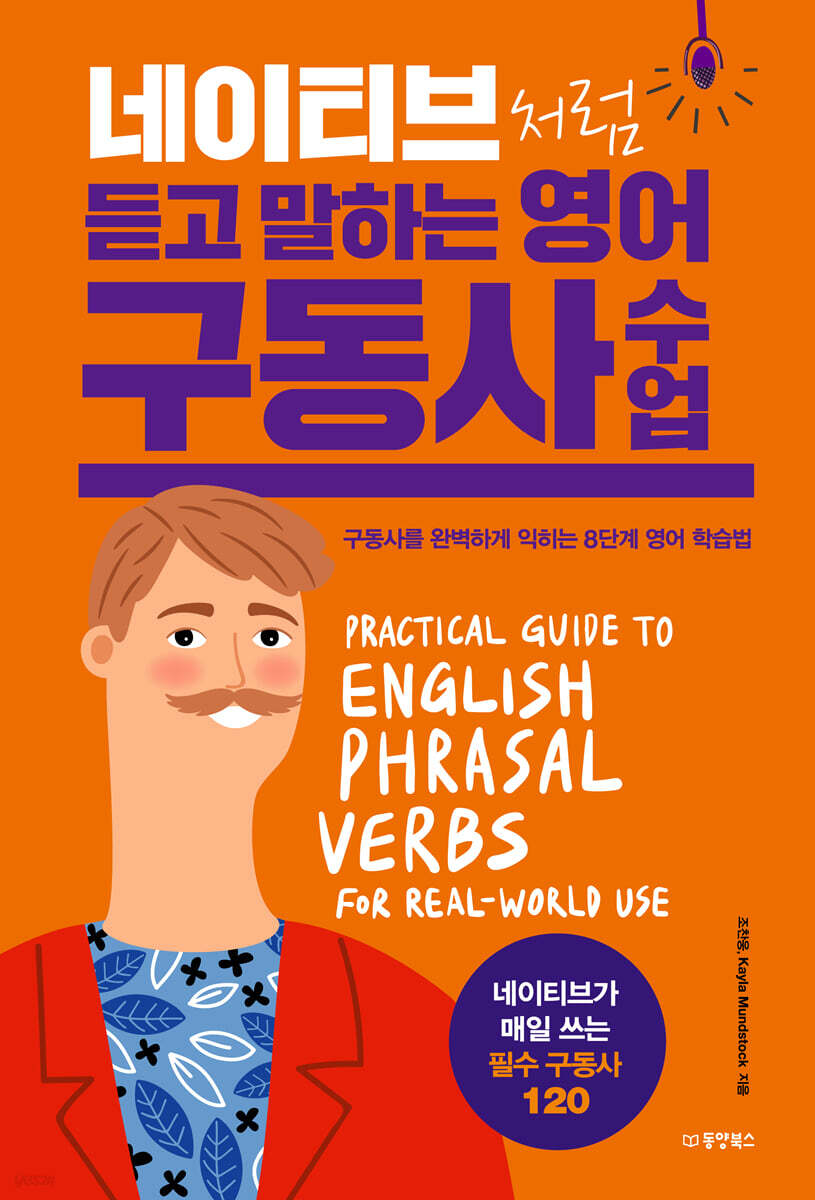
English Phrasal Verbs Lesson to Listen and Speak Like a Native
 |
Description
Book Introduction
English is completed with verbs The author has met learners who speak English naturally and those who convey only basic meaning. There are several reasons for this difference, but I think one of the important factors is the 'appropriate use of verbs.' Native speakers use phrasal verbs more than individual verbs in everyday life. The reason why English learners cannot advance from beginner to intermediate or from intermediate to advanced is because they lack the ability to use phrasal verbs. Studying English requires consistency and is difficult to do alone, but these days, thanks to various media, studying alone is possible. English verbs can be mastered on your own, but simply memorizing their meanings is not effective. The most effective way is to understand the meaning of the verb and use it in a variety of contexts. Because English is not something you know, it's something you do. This book analyzes native speaker conversation patterns to select the most frequently used verbs, allowing you to learn and use them like a native speaker. Previously, there was no book that could help English learners properly internalize phrasal verbs, but this book will perfectly satisfy that need. |
- You can preview some of the book's contents.
Preview
index
Prologue 4
Understanding Verbs 6
Book Structure and Features 10
PART 1 English Phrasal Verbs Used to Talk About Basic Life
1 Food cut back on / cross out / go with 17
2 Music come out / come around / put up with 25
3 Exercise come across / bring out / get ahead 33
4 Clothing look down on / pick out / show off 41
5 sleep set aside / hold off / give in 49
6 Economy fall behind / figure out / do without 57
7 Learning check out / check up on / get away with 65
8 Environment look into / set apart / end up 73
9 Housing work on / put together / top off 81
10 rest move on / catch up on / count on 89
PART 2 English Phrasal Verbs to Use When Talking About a Rich Life
11 Shopping stand out / shop around / settle for 99
12 Reading take up / take away / think over 107
13 Performance find out / give away / blend in 115
14 travel fill out / fit in / get around 123
15 movie mix up / point out / stick around 131
16 Webtoon tap into / get across / come up with 139
17 Hobby pass out / pick up / pay off 147
18 Drink talk into / walk away / throw up 155
19 Leisure look up / go ahead / go for 163
20 Exhibition pop up / set up / stop by 171
PART 3 English Phrasal Verbs Used to Talk About Social Life
21 Parenting come down with / go around / mess up 181
22 Marriage bring up / rush into / rely on 189
23 Pet care for / make out / run into 197
24 Working from home look after / miss out on / turn around 205
25 Transportation get by / walk through / work out 213
26 Driving look up to / wear out / turn out 221
27 Job change pull off / take on / talk out of 229
28 Social media fall for / turn down / get back to 237
29 Self-Development settle down / take off / wrap up 245
30 Preparing for retirement go through / go away / pass away 253
PART 4 English Phrasal Verbs Used to Talk About Other Daily Life
31 Emotions get to / carry on / get over 263
32 Make-up go against / hold back / run out of 271
33 Cold pass around / stock up on / make up for 279
34 Cleaning fall apart / get into / give up 287
35 Family stand up for / go over / take after 295
36 friendship get along with / make up with / get together 303
37 Weather call off / move up / make up 311
38 Habit stick to / go off / throw on 319
39 Memories stand up to / leave out / keep up with 327
40 Recycle put off / sort out / throw away 335
Index 343
Understanding Verbs 6
Book Structure and Features 10
PART 1 English Phrasal Verbs Used to Talk About Basic Life
1 Food cut back on / cross out / go with 17
2 Music come out / come around / put up with 25
3 Exercise come across / bring out / get ahead 33
4 Clothing look down on / pick out / show off 41
5 sleep set aside / hold off / give in 49
6 Economy fall behind / figure out / do without 57
7 Learning check out / check up on / get away with 65
8 Environment look into / set apart / end up 73
9 Housing work on / put together / top off 81
10 rest move on / catch up on / count on 89
PART 2 English Phrasal Verbs to Use When Talking About a Rich Life
11 Shopping stand out / shop around / settle for 99
12 Reading take up / take away / think over 107
13 Performance find out / give away / blend in 115
14 travel fill out / fit in / get around 123
15 movie mix up / point out / stick around 131
16 Webtoon tap into / get across / come up with 139
17 Hobby pass out / pick up / pay off 147
18 Drink talk into / walk away / throw up 155
19 Leisure look up / go ahead / go for 163
20 Exhibition pop up / set up / stop by 171
PART 3 English Phrasal Verbs Used to Talk About Social Life
21 Parenting come down with / go around / mess up 181
22 Marriage bring up / rush into / rely on 189
23 Pet care for / make out / run into 197
24 Working from home look after / miss out on / turn around 205
25 Transportation get by / walk through / work out 213
26 Driving look up to / wear out / turn out 221
27 Job change pull off / take on / talk out of 229
28 Social media fall for / turn down / get back to 237
29 Self-Development settle down / take off / wrap up 245
30 Preparing for retirement go through / go away / pass away 253
PART 4 English Phrasal Verbs Used to Talk About Other Daily Life
31 Emotions get to / carry on / get over 263
32 Make-up go against / hold back / run out of 271
33 Cold pass around / stock up on / make up for 279
34 Cleaning fall apart / get into / give up 287
35 Family stand up for / go over / take after 295
36 friendship get along with / make up with / get together 303
37 Weather call off / move up / make up 311
38 Habit stick to / go off / throw on 319
39 Memories stand up to / leave out / keep up with 327
40 Recycle put off / sort out / throw away 335
Index 343
Detailed image

Into the book
1.
Listen to the basic explanation
In addition to meaning 'to cut', 'cut' also means 'to reduce'.
If you cut a long string, its length will decrease, right? It's easy to remember if you think of it this way.
Usually, the word 'back' is added to the end to clearly mean 'reduce'.
Cut back on is used when specifying the target to be reduced, and when the target is clear in the context, cut back alone is sufficient.
This expression is especially often used when talking about New Year's resolutions.
For example, when you decide to cut back on junk food in the new year, you might say, “I'm trying to cut back on eating junk food.”
Please note that cut back is different from give up, which is quitting completely.
For example, you can think of it as the difference between cutting down on cigarettes and quitting smoking.
--- From the text
2.
See from a native speaker's perspective
When we “cut back” on something, we reduce how often we do that thing.
We spend less, do less, or use something less.
We usually cut back on things that are not good for us.
We can also “cut back” plants or trees when they’re getting too big.
When we cut off branches or make a plant smaller, then we are cutting it back.
To cut back on something means to reduce the frequency with which you do it.
It means consuming less, doing less, or using less of something.
We usually use cut back when we want to reduce things that are not good for us.
Additionally, you can cut back plants or trees when they grow too large.
If you cut a branch or make the plant smaller, you are cutting it back.
--- From the text
3.
Start with a short sentence
I need to cut back on how often I order food.
We need to reduce the number of times we order delivery food.
I think those plants in front of the bank need to be cut back.
I think the plants in front of the bank need to be reduced a bit.
--- From the text
4.
Repeat in conversation
A: I've been drinking way too much coffee these days.
B How much coffee are you having per day?
A: I usually have 4 or 5 cups a day.
If I don't drink coffee, I get ahead.
B It would probably be a good idea to cut back.
A: I've been drinking too much coffee lately.
B: How many cups do you drink a day?
A: I usually drink about 4 to 5 cups a day.
If I don't drink coffee, I get a headache.
B: I think it would be better to cut back a bit.
--- From the text
5.
Repeated practice in short texts
I decided to cut back on watching Netflix.
I was spending hours watching TV shows and movies every day.
I realize now that I've just been wasting my time.
I decided to cut down on watching Netflix.
I was watching TV shows and movies for hours every day.
Now I realize I'm wasting my time
--- From the text
6.
Learn with short quizzes
Q Imagine you like to drink.
You used to only drink with your friends, but now you drink when you're home alone.
You are worried that you are drinking too much.
What should you do?
Q Imagine you like alcohol.
I used to only drink with friends, but now I drink it even when I'm home alone.
You are worried that you are drinking too much.
What should I do?
A I need to cut down on drinking.
Meal Prep for the Week
A week's worth of meal prep
I decided to cut down on carbohydrates and sugar.
For this, I will start cooking at home.
Make a grocery list full of healthy foods at home.
Sometimes you have to delete items when you make a mistake.
Then go to the store.
I try to buy foods that pair well with other healthy foods.
As I got better at cooking, this also became easier.
--- From the text
7.
Complete the verb by filling it in
I've decided to ____ back on carbs and sugars.
In order to do that, I'm going to start cooking my meals at home.
I make a grocery list at home filled with healthy food.
Sometimes I have to ____ out items when I make a mistake.
Then, I head to the store.
I try to buy food that ____ with other healthy food.
As I've gotten better at cooking, it's gotten easier to do.
--- From the text
8.
Complete the sentence by filling in the adverb/preposition
I've decided to cut ____ on carbs and sugars.
In order to do that, I'm going to start cooking my meals at home.
I make a grocery list at home filled with healthy food.
Sometimes I have to cross ____ items when I make a mistake.
Then, I head to the store.
I try to buy food that goes ____ other healthy food.
As I've gotten better at cooking, it's gotten easier to do.
Listen to the basic explanation
In addition to meaning 'to cut', 'cut' also means 'to reduce'.
If you cut a long string, its length will decrease, right? It's easy to remember if you think of it this way.
Usually, the word 'back' is added to the end to clearly mean 'reduce'.
Cut back on is used when specifying the target to be reduced, and when the target is clear in the context, cut back alone is sufficient.
This expression is especially often used when talking about New Year's resolutions.
For example, when you decide to cut back on junk food in the new year, you might say, “I'm trying to cut back on eating junk food.”
Please note that cut back is different from give up, which is quitting completely.
For example, you can think of it as the difference between cutting down on cigarettes and quitting smoking.
--- From the text
2.
See from a native speaker's perspective
When we “cut back” on something, we reduce how often we do that thing.
We spend less, do less, or use something less.
We usually cut back on things that are not good for us.
We can also “cut back” plants or trees when they’re getting too big.
When we cut off branches or make a plant smaller, then we are cutting it back.
To cut back on something means to reduce the frequency with which you do it.
It means consuming less, doing less, or using less of something.
We usually use cut back when we want to reduce things that are not good for us.
Additionally, you can cut back plants or trees when they grow too large.
If you cut a branch or make the plant smaller, you are cutting it back.
--- From the text
3.
Start with a short sentence
I need to cut back on how often I order food.
We need to reduce the number of times we order delivery food.
I think those plants in front of the bank need to be cut back.
I think the plants in front of the bank need to be reduced a bit.
--- From the text
4.
Repeat in conversation
A: I've been drinking way too much coffee these days.
B How much coffee are you having per day?
A: I usually have 4 or 5 cups a day.
If I don't drink coffee, I get ahead.
B It would probably be a good idea to cut back.
A: I've been drinking too much coffee lately.
B: How many cups do you drink a day?
A: I usually drink about 4 to 5 cups a day.
If I don't drink coffee, I get a headache.
B: I think it would be better to cut back a bit.
--- From the text
5.
Repeated practice in short texts
I decided to cut back on watching Netflix.
I was spending hours watching TV shows and movies every day.
I realize now that I've just been wasting my time.
I decided to cut down on watching Netflix.
I was watching TV shows and movies for hours every day.
Now I realize I'm wasting my time
--- From the text
6.
Learn with short quizzes
Q Imagine you like to drink.
You used to only drink with your friends, but now you drink when you're home alone.
You are worried that you are drinking too much.
What should you do?
Q Imagine you like alcohol.
I used to only drink with friends, but now I drink it even when I'm home alone.
You are worried that you are drinking too much.
What should I do?
A I need to cut down on drinking.
Meal Prep for the Week
A week's worth of meal prep
I decided to cut down on carbohydrates and sugar.
For this, I will start cooking at home.
Make a grocery list full of healthy foods at home.
Sometimes you have to delete items when you make a mistake.
Then go to the store.
I try to buy foods that pair well with other healthy foods.
As I got better at cooking, this also became easier.
--- From the text
7.
Complete the verb by filling it in
I've decided to ____ back on carbs and sugars.
In order to do that, I'm going to start cooking my meals at home.
I make a grocery list at home filled with healthy food.
Sometimes I have to ____ out items when I make a mistake.
Then, I head to the store.
I try to buy food that ____ with other healthy food.
As I've gotten better at cooking, it's gotten easier to do.
--- From the text
8.
Complete the sentence by filling in the adverb/preposition
I've decided to cut ____ on carbs and sugars.
In order to do that, I'm going to start cooking my meals at home.
I make a grocery list at home filled with healthy food.
Sometimes I have to cross ____ items when I make a mistake.
Then, I head to the store.
I try to buy food that goes ____ other healthy food.
As I've gotten better at cooking, it's gotten easier to do.
--- From the text
Publisher's Review
This book is not just another verb book.
This is a project that makes it actually usable.
The key to memorizing verbs is ‘how often you look at them again.’
No one can memorize verbs in one go.
Even if you have seen it once, the key to memorizing verbs is actually how often you see it.
If you plan to review the material multiple times within a set timeframe, the content should be optimized so that the second viewing feels like the first time you're studying it.
The time we have is limited.
How many hours a day can a student or working adult studying verbs consistently commit to? I think about an hour is realistic.
So, you need to be able to learn verbs in various non-causal contexts so that you can fill in the frequency within them.
This book is the solution to achieving that goal.
It will serve as a tool to help you memorize verbs efficiently.
This is a project that makes it actually usable.
The key to memorizing verbs is ‘how often you look at them again.’
No one can memorize verbs in one go.
Even if you have seen it once, the key to memorizing verbs is actually how often you see it.
If you plan to review the material multiple times within a set timeframe, the content should be optimized so that the second viewing feels like the first time you're studying it.
The time we have is limited.
How many hours a day can a student or working adult studying verbs consistently commit to? I think about an hour is realistic.
So, you need to be able to learn verbs in various non-causal contexts so that you can fill in the frequency within them.
This book is the solution to achieving that goal.
It will serve as a tool to help you memorize verbs efficiently.
GOODS SPECIFICS
- Date of issue: August 23, 2024
- Page count, weight, size: 344 pages | 812g | 170*250*21mm
- ISBN13: 9791172100636
- ISBN10: 1172100632
You may also like
카테고리
korean


korean

![GQ KOREA Mark (Monthly): December [2025]](http://librairie.coreenne.fr/cdn/shop/files/8ef265dbbfbf186523ed75ba7319009d.jpg?v=1765340328&width=3840)


