

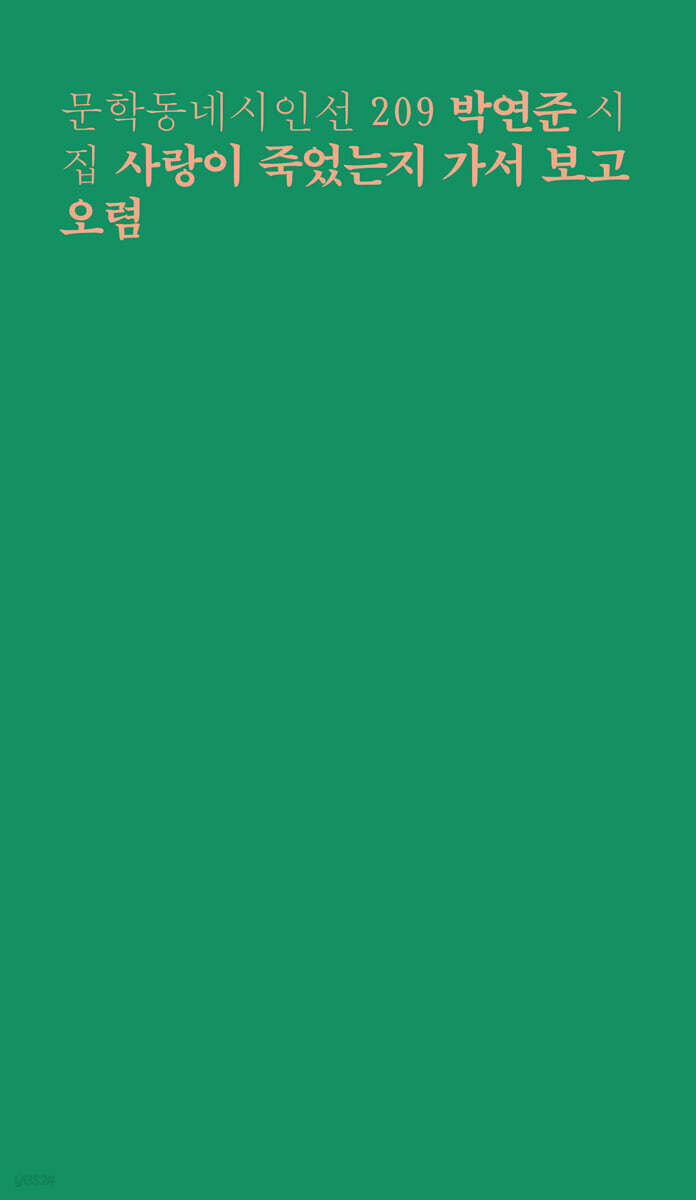
Go and see if love is dead.
 |
Description
Book Introduction
- A word from MD
-
Why do poems keep being born?A new poetry collection by poet Park Yeon-jun, celebrating his 20th anniversary since his debut.
It is full of gazes that look at small things like stones and birds for a long time and find the truth in them.
Let's read the poem out loud, following the poet's dissonance.
Between death and life, love and separation, another poem will be born that awaits us.
April 16, 2024. Novel/Poetry PD Kim Yu-ri
“Can I bump into you and break your forehead?
I flew away before the question was even finished
“My forehead is broken”
Birth from breaking
Love that comes from being messy
A world that comes from a small human, a small universe, and a small me
Poet Park Yeon-jun, who debuted in 2004 by winning the Joongang New Writer's Award and has received much love from readers across genres including poetry, prose, and novels, is publishing his fifth poetry collection, "Go and See if Love is Dead."
This new poetry collection, published five years after the poetry collection 『Night, Rain, Snake』 (Hyundae Literature, 2019) and in the year marking the 20th anniversary of his debut, adds to its specialness.
The speaker of Park Yeon-jun, who 20 years ago denied life and the world in 『The Scream of Eyelashes』(Changbi, 2007) and spoke without hesitation of the pain that tears life and flesh, has become “able to mediate the discord between me and myself” (from Shin Hyeong-cheol, commentary on 『Father Called Me Sister-in-Law』, Munhakdongne, 2012) in the poetic world of passionate sorrow written after losing loved ones.
Afterwards, he received praise for “the aesthetics of cheerful and lively eroticism that emanates through secretive and delicate language” (Cho Jae-ryong, commentary on 『Venus Pudica』, Changbi, 2017), and he displayed a captivating sense of rhythm, saying, “My poetry is the music that I write and you play” (from an essay included in 『Night, Rain, Snake』), and ended up sharing a quiet night with the readers.
In this collection of poems, we meet a speaker who focuses more on 'small things'.
These 58 poems seem to say that it is the job of poetry to closely examine the microscopic world of small humans, small universes, and small selves, and that it is the poet's responsibility to reveal that small things are not trivial but closer to the essence.
“If you speak small, you become a small human being (…) When you open a notebook, there/ is a square for small humans/ Flat, neither dead nor living/ Names/ A trivial list walks around/ Wearing small name tags, small, small” (“Small Human”)… The smaller we become, the less distinctions we make, and we will be able to “draw the smallest circle in the world” (“Salvation”).
You will learn to feel the pain of “buying and selling small deaths/ loving small deaths/ and small deaths feeding us” (“When the Little Pig Rides in a Cart”).
It is also true that anything big is possible only when small things come together closely.
I flew away before the question was even finished
“My forehead is broken”
Birth from breaking
Love that comes from being messy
A world that comes from a small human, a small universe, and a small me
Poet Park Yeon-jun, who debuted in 2004 by winning the Joongang New Writer's Award and has received much love from readers across genres including poetry, prose, and novels, is publishing his fifth poetry collection, "Go and See if Love is Dead."
This new poetry collection, published five years after the poetry collection 『Night, Rain, Snake』 (Hyundae Literature, 2019) and in the year marking the 20th anniversary of his debut, adds to its specialness.
The speaker of Park Yeon-jun, who 20 years ago denied life and the world in 『The Scream of Eyelashes』(Changbi, 2007) and spoke without hesitation of the pain that tears life and flesh, has become “able to mediate the discord between me and myself” (from Shin Hyeong-cheol, commentary on 『Father Called Me Sister-in-Law』, Munhakdongne, 2012) in the poetic world of passionate sorrow written after losing loved ones.
Afterwards, he received praise for “the aesthetics of cheerful and lively eroticism that emanates through secretive and delicate language” (Cho Jae-ryong, commentary on 『Venus Pudica』, Changbi, 2017), and he displayed a captivating sense of rhythm, saying, “My poetry is the music that I write and you play” (from an essay included in 『Night, Rain, Snake』), and ended up sharing a quiet night with the readers.
In this collection of poems, we meet a speaker who focuses more on 'small things'.
These 58 poems seem to say that it is the job of poetry to closely examine the microscopic world of small humans, small universes, and small selves, and that it is the poet's responsibility to reveal that small things are not trivial but closer to the essence.
“If you speak small, you become a small human being (…) When you open a notebook, there/ is a square for small humans/ Flat, neither dead nor living/ Names/ A trivial list walks around/ Wearing small name tags, small, small” (“Small Human”)… The smaller we become, the less distinctions we make, and we will be able to “draw the smallest circle in the world” (“Salvation”).
You will learn to feel the pain of “buying and selling small deaths/ loving small deaths/ and small deaths feeding us” (“When the Little Pig Rides in a Cart”).
It is also true that anything big is possible only when small things come together closely.
- You can preview some of the book's contents.
Preview
index
Poet's words
Part 1: Here, broken things are called the faces of love.
White Ears / Phoenix / Sewing Machine and Oven / A Donkey Walks Carrying My Love / Salt and Pepper / Novel / Animal Sounds When I Cry / I Carefully Forget Your Memorial Day / June Garden / Maria Elena 1 / Maria Elena 2 / Sleet / February Morning / Dance Score
Part 2: Even in lonely moments, I'm busy.
A small human/ When a small pig rides a cart/ It gets thinner in the evening/ Delivery, people/ In the parking lot/ A fist spread on a pillow/ A small person measures height/ Diving/ Alone and the world/ Hot words/ Cried on Wednesday/ Arrival - To the owner/ Talking about the misery of a person who is ugly and without kindness/ Salvation/ Gyeongju 1/ Gyeongju 2 - At Daereungwon
Part 3: Unspoken Poems, Speaking Pictures
I lost / The one who chases and the one who doesn't run away / I am a skirt that lost the lower half of my body / We love scales / The night is the arrival of broken love / The bathtub / I will play 'stupidly and violently' / A few wounds / Love is asleep / Bronze mirror / Kiki, kiki, kikiki
Part 4: Watching the Stones Fall
Invocation/ How to sweep away sadness from the night fog - 1988/ How about saying it like this/ A ritual for the green ghost - 2022-10-29/ Words of music/ Piano practice/ A train rolling with adjectives/ A noun soaring with love/ Hello, Earthling/ Class time/ Admit/ To you/ The baby born yesterday also experienced the night/ Disownment/ Buy an umbrella/ Splitting raindrops/ A dead bird
Preface | The Dazzling Fall of the Phoenix
Shin Mina (poet)
Part 1: Here, broken things are called the faces of love.
White Ears / Phoenix / Sewing Machine and Oven / A Donkey Walks Carrying My Love / Salt and Pepper / Novel / Animal Sounds When I Cry / I Carefully Forget Your Memorial Day / June Garden / Maria Elena 1 / Maria Elena 2 / Sleet / February Morning / Dance Score
Part 2: Even in lonely moments, I'm busy.
A small human/ When a small pig rides a cart/ It gets thinner in the evening/ Delivery, people/ In the parking lot/ A fist spread on a pillow/ A small person measures height/ Diving/ Alone and the world/ Hot words/ Cried on Wednesday/ Arrival - To the owner/ Talking about the misery of a person who is ugly and without kindness/ Salvation/ Gyeongju 1/ Gyeongju 2 - At Daereungwon
Part 3: Unspoken Poems, Speaking Pictures
I lost / The one who chases and the one who doesn't run away / I am a skirt that lost the lower half of my body / We love scales / The night is the arrival of broken love / The bathtub / I will play 'stupidly and violently' / A few wounds / Love is asleep / Bronze mirror / Kiki, kiki, kikiki
Part 4: Watching the Stones Fall
Invocation/ How to sweep away sadness from the night fog - 1988/ How about saying it like this/ A ritual for the green ghost - 2022-10-29/ Words of music/ Piano practice/ A train rolling with adjectives/ A noun soaring with love/ Hello, Earthling/ Class time/ Admit/ To you/ The baby born yesterday also experienced the night/ Disownment/ Buy an umbrella/ Splitting raindrops/ A dead bird
Preface | The Dazzling Fall of the Phoenix
Shin Mina (poet)
Into the book
Here, broken things are called the faces of love.
Born to break and evaporate
Hating hatching
Dying at the speed of flight
---From "The Phoenix"
Getting old is
Wearing the wrinkled clothes of time
The smell of bread is rising from around the corner.
The time to buy bread disappears.
I wish I could bake a smile
---From "The Sewing Machine and the Oven"
Love, old age, and sorrow,
Which of the three is stronger?
I'm curious, so I brought a scale.
Strength is not weight
I can't hear the force
---From "The Sewing Machine and the Oven"
Loving your body means
It means loving the cloak of the soul
Every night I lie in bed and shake
The cloaks of the soul,
Look
Slowly aging in each room
Crying Coats
---From "The Donkey Walks Carrying My Love"
If you talk about trivial things, they become trivial.
When you open the notebook there
Square for Little People
Flat, neither dead nor alive
names
A small list walks around
Wear a small name tag and make it small
When spring comes
We need to get rid of anything that isn't spring.
---From "Little Man"
I slept curled up and strained, and my fists turned into fists.
I didn't mean to become this strong
Knees, hips, back, waist
Became one lump
How can I unfold myself?
I sobbed so hard that my fist shook.
Wake up
Dry enough to crumble
---From "A Fist Unfolding on a Pillow"
Alone, very small
Alone is everything
Even when I'm lonely, I'm busy.
One day, I was alone, like the CRT turning off
It's disconnected
---From "Alone and the World"
The baby born yesterday also had a night's sleep.
The baby born yesterday also had dark hair, each strand woven by the night.
Even the baby born yesterday must have felt the night covering the world and making it disappear all at once.
I was born into this world and all I ever had was night.
Isn't it beautiful?
Born to break and evaporate
Hating hatching
Dying at the speed of flight
---From "The Phoenix"
Getting old is
Wearing the wrinkled clothes of time
The smell of bread is rising from around the corner.
The time to buy bread disappears.
I wish I could bake a smile
---From "The Sewing Machine and the Oven"
Love, old age, and sorrow,
Which of the three is stronger?
I'm curious, so I brought a scale.
Strength is not weight
I can't hear the force
---From "The Sewing Machine and the Oven"
Loving your body means
It means loving the cloak of the soul
Every night I lie in bed and shake
The cloaks of the soul,
Look
Slowly aging in each room
Crying Coats
---From "The Donkey Walks Carrying My Love"
If you talk about trivial things, they become trivial.
When you open the notebook there
Square for Little People
Flat, neither dead nor alive
names
A small list walks around
Wear a small name tag and make it small
When spring comes
We need to get rid of anything that isn't spring.
---From "Little Man"
I slept curled up and strained, and my fists turned into fists.
I didn't mean to become this strong
Knees, hips, back, waist
Became one lump
How can I unfold myself?
I sobbed so hard that my fist shook.
Wake up
Dry enough to crumble
---From "A Fist Unfolding on a Pillow"
Alone, very small
Alone is everything
Even when I'm lonely, I'm busy.
One day, I was alone, like the CRT turning off
It's disconnected
---From "Alone and the World"
The baby born yesterday also had a night's sleep.
The baby born yesterday also had dark hair, each strand woven by the night.
Even the baby born yesterday must have felt the night covering the world and making it disappear all at once.
I was born into this world and all I ever had was night.
Isn't it beautiful?
---From "The baby born yesterday also experienced the night"
Publisher's Review
The resolution to “From now on, I will serve only the small things” (“June Garden”) creates a strange and beautiful dissonance when combined with the “broken/shattered things” scattered throughout the poetry collection.
If the obsession with 'small humans' is the face of Park Yeon-jun's poetic world today, then the utterance of actively breaking or being shattered by something can be said to be the center of attention that his poetic world has actively explored and built up over the years.
His birth comes from breaking.
It leads to dissociation rather than cohesion, disintegration rather than union, and diversity of non-meaning rather than organic unity of meaning.
What is the essence of love to him? It's messy.
“Tangledness is the essence of love/ It cannot be converged/ It is like a drop of water falling down and rupturing the round life” (“The Donkey Walks Carrying My Love”).
Love has just emerged from the birth canal of death and is reborn with a damp shell on its head.
_Poet Shin Mi-na, from the preface, “The Dazzling Light of the Phoenix ‘Falling with Effort’”
Here, broken things are called the faces of love.
Born to break and evaporate
Hating hatching
Dying at the speed of flight
(……)
“Go and see if love is dead,
“It hasn’t moved for days.”
When I speak, the pebble flies
When I come back
Not yet?, I'm doing it
_From "Phoenix"
The poem used as the title of the poetry collection, ‘Go and see if love is dead,’ is meaningful.
This is so because it can be read as worrying that love might be dead, and also as checking that it might not be dead yet, and it can be read as fear of checking that, but also as the excitement of one who waits for it.
It is also a conversation between a phoenix that does not stop even though it knows its forehead will shatter and it will die at the speed of its flight, and a pebble that seems to have never broken yet, giving a reserved answer that love is not 'yet' dead.
In a brief interview with the editor ahead of publication, the poet said of the poem he chose as the title, “It contains the various emotions we can have when we toss and turn in love,” and “I hoped that this request would be the face of the poetry collection.”
Love poetry, from the cool, lustful love of the night to the boiling, uncontrollable love, to the love that resembles the recklessness and boldness of the phoenix, the gradation of love we expect from Park Yeon-jun's world of poetry is fully displayed in this collection.
Of course, his readers will also guess that savoring it will be painful.
The center of pain is eating away at the flesh
Settle in my soul
It wasn't me who was crucified.
The cross came to me and was nailed to me.
The transparent and beautiful cross continues,
What is being transferred into me
_「I lost my lower body in a skirt - a broken spine」
I've spent too much time wasting love
Now my face is a trash can
Dead rain
pouring down on the face
I'm ugly because sadness has taken over my face.
Because I messed it up
(…)
Ultimately, the disease goes to the receptor.
To the place that allowed acceptance
I know a few places
Don't worry
Love is clean and healed
To the point where I didn't even know it was love
_From "The Donkey Walks Carrying My Love"
On the other hand, it may not always be desirable to equate the poet and the speaker, but there are poems that stand out that make us ponder the fact that this collection of poems was written while the author was in his thirties and forties.
At twenty, I died nine times a day.
When I think about myself at thirty, I sometimes think I'm dead.
At forty, I don't die easily.
_From "Poet"
Changes in the world of poetry cannot be unrelated to the poet's biological age and the experiences he or she has had in the meantime.
In particular, in the case of poet Park Yeon-jun, “Between the ages of thirty and forty, / there was prose” (same poem). The time spent writing with different bodies and voices through prose collections and novels must have clearly influenced his poetry writing.
Could one say that one of the changes along these lines is that, compared to previous collections, aging has become as concrete as death? "Growing old/is wearing the crumpled clothes of time."
“The smell of bread rises from around the corner/ The time to buy bread disappears.”
“I wish I could bake his back, his face, his smile/ as if I were baking bread” (“Sewing Machine and Oven”). We, who cannot do that, spend more time engrossed in sewing than baking, and we will occasionally stop our hands from playing in front of the sewing machine at the poet’s question, “Which of the three, love, old age, or sorrow, is stronger?”
“Without sewing anything” (same poem)
If the 'phoenix' is flying in the introduction of the poetry collection, the 'dead bird' is lying at the end of the poetry collection.
“A dead bird with its beak buried inwards/ and its thin legs stretched out.”
The poet says, “It doesn’t really matter how you got here,” “You’ve lived it all” (“The Dead Bird”). This has happened to the phoenix many times before.
“The baby born yesterday also experienced the night” and “has dark hair, each strand woven by the night.” (“The baby born yesterday also experienced the night”) In this way, within the cycle or mystery of repeated birth, death, and rebirth, the poet, who has come to aspire to be a “small human” who speaks “small,” is meticulously depicting a “small universe” that is newly opening up before us.
◎ Mini-interview with poet Park Yeon-jun
1.
This is my first poetry collection in a long time since my 2019 poetry collection, Night, Rain, Snake.
This is your fifth poetry collection, published in celebration of your 20th anniversary. How do you feel this collection is similar to and different from the previous four?
While writing the poems included in this collection, I had the experience of perceiving time as a place.
The time I spend writing poetry feels like a sanctuary, or a hideaway, to me.
It was quite nice to experience time alone writing poetry, like a small room where I could open the door and hide whenever I felt tired.
Having written a lot of prose over the past ten years since 2014, I think I've been healing(?) the 'hard working hours' that prose requires by spending time writing poetry.
The reason I use the word 'healing' is because all work causes fatigue and creates pain in some way.
These 10 years are also precious to me because they allowed me to live as a full-time writer.
I didn't want to think of writing poetry as a 'job' that I had to feel obligated to do, so I stopped accepting requests for a certain period of time.
About half of the poems in the collection were written freely, without any request.
Since most of the poems included in previous poetry collections were published poems, it could be said that the attitude and position from which poetry is born have changed.
The similarity is… well…
The rhythm is similar to the human voice, so I think it would be similar.
I feel like I'm becoming more and more calm when I write poetry.
Maybe it's because I'm getting older (laughs).
2.
The title, "Go and see if love is dead," can be read as worrying that love might be dead, or checking to see if love is still alive. I'm curious about how you decided on this title.
The title is a line from the poem “Phoenix.”
I remember writing this poem in one breath and feeling satisfied after writing it.
It's rare that I like a poem right away.
The phrase "go and see if love is dead" implies a feeling of worry that love might be dead, a fear of finding out if it really is, or a "fearful joy" as if waiting for love's death.
It contains the various emotions we can have when we are in love and tossing and turning.
I wish this request was the face of the poem.
I am attracted to the stone that flies away with innocence, confirms the life or death of love, and answers 'not yet'.
A stone is a being that sees, a being that must see and convey the truth, amidst the dark foreboding and ominous excitement contained in the word 'yet'.
That's something young beings are good at.
3.
If there is a poem in this collection that you particularly cherish, please tell us which one it is and why.
Suddenly, the song "The donkey walks carrying my love" comes to mind.
I wrote this poem in a whirlwind, and as I was writing, I kept discovering things and being surprised.
I don't know what I want to write about, but I'm in a state where words are flowing freely, wandering in the dark, moving forward fearlessly, and discovering and seeing something new.
It's amazing.
4.
A small human, a small universe, a small me, a small green onion, etc.? This is a poetry collection where the adjective 'small' is found throughout.
Is there a reason why you are so preoccupied with small things, things that have become smaller, and things that have been broken into small pieces?
I was so obsessed with the concepts of ‘small people’ and ‘small things’ that I even considered titled my poetry collection ‘Little People.’
One day this sentence came to mind.
“If you speak small, you become a small human being.” This sentence seems to contain many problematic things, from the microscopic to the macroscopic, from microscopic to human, from animal to non-animal, from me to us…
In poetry, I could only speak in one sentence, sporadically.
I believe that literature begins with a careful examination of 'small beings' and then moves on to distant places.
I think I like to look at small things for a long time and persistently try to unravel them.
5.
Please say a few words of greeting to the readers who will encounter this poetry collection.
April is a beautiful and sad month.
The flowers bloomed again.
The poems were also reborn.
I would like to present a new collection of poems to you, relying on the small hope and quiet positivity contained in the adverb 'again.'
Why do poems keep being born? This is spring, and I want to hear the answer from you.
Please spread it out anywhere, read it, and read it.
■ Poet's Note
One summer evening
If you are crying under the palm leaves
One summer evening
If my face was ugly
That's because sadness has taken over his face.
April 2024
Park Yeon-jun
If the obsession with 'small humans' is the face of Park Yeon-jun's poetic world today, then the utterance of actively breaking or being shattered by something can be said to be the center of attention that his poetic world has actively explored and built up over the years.
His birth comes from breaking.
It leads to dissociation rather than cohesion, disintegration rather than union, and diversity of non-meaning rather than organic unity of meaning.
What is the essence of love to him? It's messy.
“Tangledness is the essence of love/ It cannot be converged/ It is like a drop of water falling down and rupturing the round life” (“The Donkey Walks Carrying My Love”).
Love has just emerged from the birth canal of death and is reborn with a damp shell on its head.
_Poet Shin Mi-na, from the preface, “The Dazzling Light of the Phoenix ‘Falling with Effort’”
Here, broken things are called the faces of love.
Born to break and evaporate
Hating hatching
Dying at the speed of flight
(……)
“Go and see if love is dead,
“It hasn’t moved for days.”
When I speak, the pebble flies
When I come back
Not yet?, I'm doing it
_From "Phoenix"
The poem used as the title of the poetry collection, ‘Go and see if love is dead,’ is meaningful.
This is so because it can be read as worrying that love might be dead, and also as checking that it might not be dead yet, and it can be read as fear of checking that, but also as the excitement of one who waits for it.
It is also a conversation between a phoenix that does not stop even though it knows its forehead will shatter and it will die at the speed of its flight, and a pebble that seems to have never broken yet, giving a reserved answer that love is not 'yet' dead.
In a brief interview with the editor ahead of publication, the poet said of the poem he chose as the title, “It contains the various emotions we can have when we toss and turn in love,” and “I hoped that this request would be the face of the poetry collection.”
Love poetry, from the cool, lustful love of the night to the boiling, uncontrollable love, to the love that resembles the recklessness and boldness of the phoenix, the gradation of love we expect from Park Yeon-jun's world of poetry is fully displayed in this collection.
Of course, his readers will also guess that savoring it will be painful.
The center of pain is eating away at the flesh
Settle in my soul
It wasn't me who was crucified.
The cross came to me and was nailed to me.
The transparent and beautiful cross continues,
What is being transferred into me
_「I lost my lower body in a skirt - a broken spine」
I've spent too much time wasting love
Now my face is a trash can
Dead rain
pouring down on the face
I'm ugly because sadness has taken over my face.
Because I messed it up
(…)
Ultimately, the disease goes to the receptor.
To the place that allowed acceptance
I know a few places
Don't worry
Love is clean and healed
To the point where I didn't even know it was love
_From "The Donkey Walks Carrying My Love"
On the other hand, it may not always be desirable to equate the poet and the speaker, but there are poems that stand out that make us ponder the fact that this collection of poems was written while the author was in his thirties and forties.
At twenty, I died nine times a day.
When I think about myself at thirty, I sometimes think I'm dead.
At forty, I don't die easily.
_From "Poet"
Changes in the world of poetry cannot be unrelated to the poet's biological age and the experiences he or she has had in the meantime.
In particular, in the case of poet Park Yeon-jun, “Between the ages of thirty and forty, / there was prose” (same poem). The time spent writing with different bodies and voices through prose collections and novels must have clearly influenced his poetry writing.
Could one say that one of the changes along these lines is that, compared to previous collections, aging has become as concrete as death? "Growing old/is wearing the crumpled clothes of time."
“The smell of bread rises from around the corner/ The time to buy bread disappears.”
“I wish I could bake his back, his face, his smile/ as if I were baking bread” (“Sewing Machine and Oven”). We, who cannot do that, spend more time engrossed in sewing than baking, and we will occasionally stop our hands from playing in front of the sewing machine at the poet’s question, “Which of the three, love, old age, or sorrow, is stronger?”
“Without sewing anything” (same poem)
If the 'phoenix' is flying in the introduction of the poetry collection, the 'dead bird' is lying at the end of the poetry collection.
“A dead bird with its beak buried inwards/ and its thin legs stretched out.”
The poet says, “It doesn’t really matter how you got here,” “You’ve lived it all” (“The Dead Bird”). This has happened to the phoenix many times before.
“The baby born yesterday also experienced the night” and “has dark hair, each strand woven by the night.” (“The baby born yesterday also experienced the night”) In this way, within the cycle or mystery of repeated birth, death, and rebirth, the poet, who has come to aspire to be a “small human” who speaks “small,” is meticulously depicting a “small universe” that is newly opening up before us.
◎ Mini-interview with poet Park Yeon-jun
1.
This is my first poetry collection in a long time since my 2019 poetry collection, Night, Rain, Snake.
This is your fifth poetry collection, published in celebration of your 20th anniversary. How do you feel this collection is similar to and different from the previous four?
While writing the poems included in this collection, I had the experience of perceiving time as a place.
The time I spend writing poetry feels like a sanctuary, or a hideaway, to me.
It was quite nice to experience time alone writing poetry, like a small room where I could open the door and hide whenever I felt tired.
Having written a lot of prose over the past ten years since 2014, I think I've been healing(?) the 'hard working hours' that prose requires by spending time writing poetry.
The reason I use the word 'healing' is because all work causes fatigue and creates pain in some way.
These 10 years are also precious to me because they allowed me to live as a full-time writer.
I didn't want to think of writing poetry as a 'job' that I had to feel obligated to do, so I stopped accepting requests for a certain period of time.
About half of the poems in the collection were written freely, without any request.
Since most of the poems included in previous poetry collections were published poems, it could be said that the attitude and position from which poetry is born have changed.
The similarity is… well…
The rhythm is similar to the human voice, so I think it would be similar.
I feel like I'm becoming more and more calm when I write poetry.
Maybe it's because I'm getting older (laughs).
2.
The title, "Go and see if love is dead," can be read as worrying that love might be dead, or checking to see if love is still alive. I'm curious about how you decided on this title.
The title is a line from the poem “Phoenix.”
I remember writing this poem in one breath and feeling satisfied after writing it.
It's rare that I like a poem right away.
The phrase "go and see if love is dead" implies a feeling of worry that love might be dead, a fear of finding out if it really is, or a "fearful joy" as if waiting for love's death.
It contains the various emotions we can have when we are in love and tossing and turning.
I wish this request was the face of the poem.
I am attracted to the stone that flies away with innocence, confirms the life or death of love, and answers 'not yet'.
A stone is a being that sees, a being that must see and convey the truth, amidst the dark foreboding and ominous excitement contained in the word 'yet'.
That's something young beings are good at.
3.
If there is a poem in this collection that you particularly cherish, please tell us which one it is and why.
Suddenly, the song "The donkey walks carrying my love" comes to mind.
I wrote this poem in a whirlwind, and as I was writing, I kept discovering things and being surprised.
I don't know what I want to write about, but I'm in a state where words are flowing freely, wandering in the dark, moving forward fearlessly, and discovering and seeing something new.
It's amazing.
4.
A small human, a small universe, a small me, a small green onion, etc.? This is a poetry collection where the adjective 'small' is found throughout.
Is there a reason why you are so preoccupied with small things, things that have become smaller, and things that have been broken into small pieces?
I was so obsessed with the concepts of ‘small people’ and ‘small things’ that I even considered titled my poetry collection ‘Little People.’
One day this sentence came to mind.
“If you speak small, you become a small human being.” This sentence seems to contain many problematic things, from the microscopic to the macroscopic, from microscopic to human, from animal to non-animal, from me to us…
In poetry, I could only speak in one sentence, sporadically.
I believe that literature begins with a careful examination of 'small beings' and then moves on to distant places.
I think I like to look at small things for a long time and persistently try to unravel them.
5.
Please say a few words of greeting to the readers who will encounter this poetry collection.
April is a beautiful and sad month.
The flowers bloomed again.
The poems were also reborn.
I would like to present a new collection of poems to you, relying on the small hope and quiet positivity contained in the adverb 'again.'
Why do poems keep being born? This is spring, and I want to hear the answer from you.
Please spread it out anywhere, read it, and read it.
■ Poet's Note
One summer evening
If you are crying under the palm leaves
One summer evening
If my face was ugly
That's because sadness has taken over his face.
April 2024
Park Yeon-jun
GOODS SPECIFICS
- Date of issue: April 15, 2024
- Page count, weight, size: 164 pages | 200g | 130*224*8mm
- ISBN13: 9788954699440
- ISBN10: 8954699448
You may also like
카테고리
korean


korean

![GQ KOREA Mark (Monthly): December [2025]](http://librairie.coreenne.fr/cdn/shop/files/8ef265dbbfbf186523ed75ba7319009d.jpg?v=1765340328&width=3840)


