

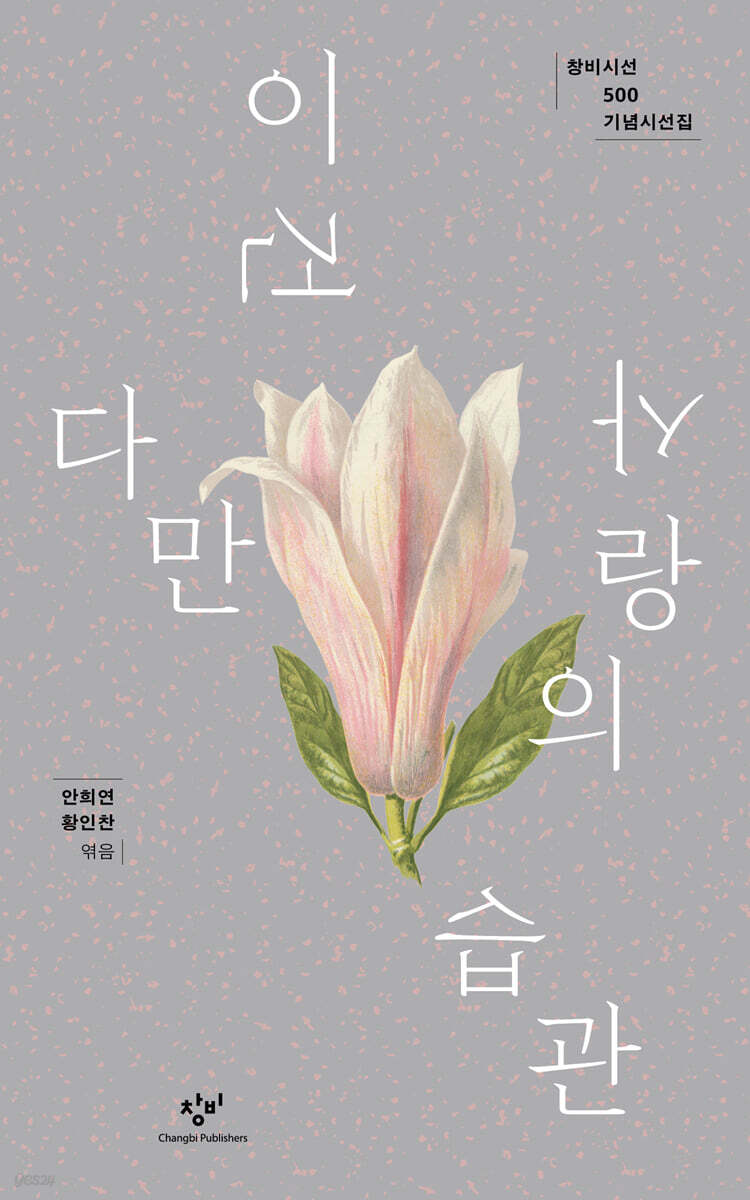
This is just a habit of love
 |
Description
Book Introduction
The sensibility of this era that we want to feel,
This one book is enough
The landscape of tomorrow drawn by the trajectory of Changbi's vision
Our habit of love that we spread on top of it
Since its first publication in 1975, Changbi Poetry Collection has been at the forefront of Korean literature, receiving both critical acclaim and public acclaim. To mark its 500th issue, the collection of poems, “This is Just a Habit of Love,” has been published.
The two poets who have come forward are Ahn Hee-yeon and Hwang In-chan, who are loved by readers these days for their outstanding sensibility and are also known for their keen eye for poetry.
One poem was selected from each collection of poems from number 401 to 499, and in the case of poets who published two volumes, only one poem was selected, making a total of 90 poems in one volume.
This anthology of poems “focuses on revealing the individuality of each poet rather than simply organizing and summarizing the flow of Changbi poetry that has unfolded over the past eight years” (Editor’s Note).
Changbi Poetry Series is more harmonious between new and old generations than any other domestic poetry series, and its poetic trends are also diverse.
Even the poets Kim Yong-taek, born in 1948 (『To You Who Came In Crying』, Changbi Poetry Series 401) and Han Jae-beom, born in 2000 (『Do You Know What's Funny』, Changbi Poetry Series 499), who decorate the beginning and end of the anthology, differ greatly not only in age but also in the way they handle poetic language and develop poetry. However, the Changbi Poetry Series in its 400s is splendid with a full-color spectrum thanks to the poetic territory expanded by the struggle not to be trapped in the stale dichotomies such as purity/participation.
Because of this, you can enjoy a unique and outstanding work of art no matter which page you open in 『This is Just a Habit of Love』.
The true value of this anthology is especially revealed when you read it calmly from beginning to end.
Thanks to the organization that closely follows the publication order and the meticulous and rigorous selection process, this single volume alone allows readers to gauge the rapidly changing landscape of contemporary Korean poetry and see how the sensibilities of this era resonate and resonate with our own poetry.
This one book is enough
The landscape of tomorrow drawn by the trajectory of Changbi's vision
Our habit of love that we spread on top of it
Since its first publication in 1975, Changbi Poetry Collection has been at the forefront of Korean literature, receiving both critical acclaim and public acclaim. To mark its 500th issue, the collection of poems, “This is Just a Habit of Love,” has been published.
The two poets who have come forward are Ahn Hee-yeon and Hwang In-chan, who are loved by readers these days for their outstanding sensibility and are also known for their keen eye for poetry.
One poem was selected from each collection of poems from number 401 to 499, and in the case of poets who published two volumes, only one poem was selected, making a total of 90 poems in one volume.
This anthology of poems “focuses on revealing the individuality of each poet rather than simply organizing and summarizing the flow of Changbi poetry that has unfolded over the past eight years” (Editor’s Note).
Changbi Poetry Series is more harmonious between new and old generations than any other domestic poetry series, and its poetic trends are also diverse.
Even the poets Kim Yong-taek, born in 1948 (『To You Who Came In Crying』, Changbi Poetry Series 401) and Han Jae-beom, born in 2000 (『Do You Know What's Funny』, Changbi Poetry Series 499), who decorate the beginning and end of the anthology, differ greatly not only in age but also in the way they handle poetic language and develop poetry. However, the Changbi Poetry Series in its 400s is splendid with a full-color spectrum thanks to the poetic territory expanded by the struggle not to be trapped in the stale dichotomies such as purity/participation.
Because of this, you can enjoy a unique and outstanding work of art no matter which page you open in 『This is Just a Habit of Love』.
The true value of this anthology is especially revealed when you read it calmly from beginning to end.
Thanks to the organization that closely follows the publication order and the meticulous and rigorous selection process, this single volume alone allows readers to gauge the rapidly changing landscape of contemporary Korean poetry and see how the sensibilities of this era resonate and resonate with our own poetry.
- You can preview some of the book's contents.
Preview
index
Kim Yong-taek_ A long-held thought
Kim Kyung-hoo_ Helpless
Do Jong-hwan_ The rest of the day
Lee Jeong-rok_ Magpie New Year
Lee Seol-ya_ International Date Line
Shin Du-ho_ Global Village
An Mi-ok_ Candle
Park Yeon-jun_ A Silent Fight
Shin Yong-mok_ I wanted to sing a song with my voice gone
Park Sung-woo_ Another day
Lee Si-young_ Swing
Park Shin-gyu_ Proposal
Lee Mountain_ Lush and beautiful
Park Cheol_ Clothesline
Jang Seok-nam_ Travel Notes
Park Ra-yeon_ Somehow the harmony
Lim Gyeong-seop_ Coming to the Light
Kim Myung-soo_ When passing under a tall oak tree
Kim Jeong-hwan_ Empty Flower Pot
Kim Joong-il: Apologizing again today
Lee Dae-heum_ Magnolia
Kim Sai_ Sometimes joy
Na Hee-deok_ The person who turns on the heart
Lee Ki-in_ Always polite
Jeong Hee-seong_ Yeondu
Park So-ran_ Midnight Diner
Lee Kyung-rim_ West
Jeon Dong-gyun_ This is so quiet
Noh Hyang-rim_ On the camellia forest path
Park Kyung-hee_ An empty house
Yuiwoo_ It's time to go home now
Go Young-min_ Tofu
Hwang In-chan: "Everyone says they're sorry when I say I love them."
Lee Young-jae: On the Elegant and Violent Habits of Romanticism
Son Taek-su_ With the light that blooms when leaves sway
Lee Jeong-hoon_ About the End
Baekmusan_The power of stillness
Lee San-ha_ Birds and Rabbits
Goh Hyeong-ryeol_ Flower Seed
Park Hyung-jun_ Moon Stone
An Hee-yeon_ Stollen
Kim Hyun_ If I were a bird
Park Seung-min_ Mu-hyeon-geum (stringless zither)
Ahn Do-hyun_ Homey
Yoo Byeong-rok: I decided not to make any promises.
Choi Jeong-rye_ Where is the end of the world?
Jeong Hyeon-woo_ The back side of love
Kwak Jae-gu_ Longing
Shinmi Na_ The texture of eggplant
Lee Sang-guk_ Today
Kim Seung-hee_Hall of Love
Ji-eun Choi: Is there a story in this dream, like the dark side of the moon, that I don't know?
Lee Moon-jae_ Long-held sorrow
Kwon Chang-seop_ I Miss Understanding
Kim Seon-woo: Shall we become a leaf worshiper now?
Lee Geun-hwa_ Standing at the center of the world
Kang Ji-i_ Sea Soap
Jeong Da-yeon_ The Shape of Love
Lee Jong-min_ Torn Page
Lim Seon-gi_ Dream 2
Kim Soo-woo_ Even after creating God
Shim Jae-hwi_ High Spring Bus
Choi Baek-gyu_ Rainy season
Song Jin-kwon_ The beauty I saw for the first time
Jo On-yoon_ Centering
Moon Tae-jun_ A house with a bird and a tangerine tree
Choi Ji-in_ The person waiting
Shin Cheol-gyu_ The Reservoir in My Ear
Kim Yu-rim_ We are the chimney bird
Shin Dong-ho_ A garden with endlessly forking paths
Song Kyung-dong_ The police line within us
Lee Yong-hoon_ The bear is doing a handstand
Yoo Hye-bin_ Low-Blowing Wind
Jeon Wook-jin_ Reality
Jeong Ho-seung_ Leaving home
Yoo Su-yeon_ The mold of the idea of the future
Yeoseil_ Common Sense
Lee Dong-woo_ stitch marks
Son Yu-mi_ Happening at the same time
Joo Min-hyeon_ Acorn Jelly
Jeong Geut-byeol_Imitating Apple
Yoo Hyun-ah: I work on Saturdays too
Chae Gil-woo_ Seaweed soup
Hwang Yu-won_ The sheep are leisurely grazing
Kim Hae-ja_ Rolling time like a ball
Jang Iji_ Postcard
Kang Woo-geun_ Someone with my heart lives on another planet.
Nam Gil-soon_ Daytime work
Jung Woo-young_ Dongbaek,
Han Jae-beom_ Reusable
Editor's Note
Works submitted
Kim Kyung-hoo_ Helpless
Do Jong-hwan_ The rest of the day
Lee Jeong-rok_ Magpie New Year
Lee Seol-ya_ International Date Line
Shin Du-ho_ Global Village
An Mi-ok_ Candle
Park Yeon-jun_ A Silent Fight
Shin Yong-mok_ I wanted to sing a song with my voice gone
Park Sung-woo_ Another day
Lee Si-young_ Swing
Park Shin-gyu_ Proposal
Lee Mountain_ Lush and beautiful
Park Cheol_ Clothesline
Jang Seok-nam_ Travel Notes
Park Ra-yeon_ Somehow the harmony
Lim Gyeong-seop_ Coming to the Light
Kim Myung-soo_ When passing under a tall oak tree
Kim Jeong-hwan_ Empty Flower Pot
Kim Joong-il: Apologizing again today
Lee Dae-heum_ Magnolia
Kim Sai_ Sometimes joy
Na Hee-deok_ The person who turns on the heart
Lee Ki-in_ Always polite
Jeong Hee-seong_ Yeondu
Park So-ran_ Midnight Diner
Lee Kyung-rim_ West
Jeon Dong-gyun_ This is so quiet
Noh Hyang-rim_ On the camellia forest path
Park Kyung-hee_ An empty house
Yuiwoo_ It's time to go home now
Go Young-min_ Tofu
Hwang In-chan: "Everyone says they're sorry when I say I love them."
Lee Young-jae: On the Elegant and Violent Habits of Romanticism
Son Taek-su_ With the light that blooms when leaves sway
Lee Jeong-hoon_ About the End
Baekmusan_The power of stillness
Lee San-ha_ Birds and Rabbits
Goh Hyeong-ryeol_ Flower Seed
Park Hyung-jun_ Moon Stone
An Hee-yeon_ Stollen
Kim Hyun_ If I were a bird
Park Seung-min_ Mu-hyeon-geum (stringless zither)
Ahn Do-hyun_ Homey
Yoo Byeong-rok: I decided not to make any promises.
Choi Jeong-rye_ Where is the end of the world?
Jeong Hyeon-woo_ The back side of love
Kwak Jae-gu_ Longing
Shinmi Na_ The texture of eggplant
Lee Sang-guk_ Today
Kim Seung-hee_Hall of Love
Ji-eun Choi: Is there a story in this dream, like the dark side of the moon, that I don't know?
Lee Moon-jae_ Long-held sorrow
Kwon Chang-seop_ I Miss Understanding
Kim Seon-woo: Shall we become a leaf worshiper now?
Lee Geun-hwa_ Standing at the center of the world
Kang Ji-i_ Sea Soap
Jeong Da-yeon_ The Shape of Love
Lee Jong-min_ Torn Page
Lim Seon-gi_ Dream 2
Kim Soo-woo_ Even after creating God
Shim Jae-hwi_ High Spring Bus
Choi Baek-gyu_ Rainy season
Song Jin-kwon_ The beauty I saw for the first time
Jo On-yoon_ Centering
Moon Tae-jun_ A house with a bird and a tangerine tree
Choi Ji-in_ The person waiting
Shin Cheol-gyu_ The Reservoir in My Ear
Kim Yu-rim_ We are the chimney bird
Shin Dong-ho_ A garden with endlessly forking paths
Song Kyung-dong_ The police line within us
Lee Yong-hoon_ The bear is doing a handstand
Yoo Hye-bin_ Low-Blowing Wind
Jeon Wook-jin_ Reality
Jeong Ho-seung_ Leaving home
Yoo Su-yeon_ The mold of the idea of the future
Yeoseil_ Common Sense
Lee Dong-woo_ stitch marks
Son Yu-mi_ Happening at the same time
Joo Min-hyeon_ Acorn Jelly
Jeong Geut-byeol_Imitating Apple
Yoo Hyun-ah: I work on Saturdays too
Chae Gil-woo_ Seaweed soup
Hwang Yu-won_ The sheep are leisurely grazing
Kim Hae-ja_ Rolling time like a ball
Jang Iji_ Postcard
Kang Woo-geun_ Someone with my heart lives on another planet.
Nam Gil-soon_ Daytime work
Jung Woo-young_ Dongbaek,
Han Jae-beom_ Reusable
Editor's Note
Works submitted
Detailed image
.jpg)
Into the book
Going a little deeper into isolation
I wish I could build a two-story house and live there.
In spring, forsythia, violets, and magnolias bloom.
In winter, anywhere with snow on the mountain behind me would be nice.
I don't want a lake with floating storks,
I wish there was a place where the shadow of the roof was reflected in the rapids.
--- From "Do Jong-hwan_ The Rest of the Day"
curious
People are afraid of their own horrors
How to endure
A list of sins that only you know
How to erase
Even if I sleep for half the day and wake up
It doesn't disappear
--- From "An Mi-ok_ Candle"
This trip is purely
To see my footprints
It changes depending on the path you walk
That depth
Length of attraction
Occurring at blurred boundaries
some melody
--- From "Jang Seok-nam_ Travel Notes"
Would you like to hear the song of the heart?
This bag contains pounding hearts
The heart of the dry season and the heart of the rainy season
The heart of the morning and the heart of the evening
Everything that makes my heart flutter becomes a song
--- From "Na Hee-deok_ The person who turns on the heart"
I once thought I had mastered the art of farming by buying a hoe.
It bends inward and cannot extend outward, but only points inward.
I said I was farming three or four pyeong of land.
Homie said he lived by poking dots on the ground.
--- From "Ando Hyun_ Homie"
I ate a melon and got a bug in it
I asked inside.
I don't want to learn this kind of sadness.
--- From "Jung Hyun-woo_ The Back Side of Love"
So all this becomes a thing of the past
If the movie goes on for a long time outside the screen
They might call it a memory
I wish I could build a two-story house and live there.
In spring, forsythia, violets, and magnolias bloom.
In winter, anywhere with snow on the mountain behind me would be nice.
I don't want a lake with floating storks,
I wish there was a place where the shadow of the roof was reflected in the rapids.
--- From "Do Jong-hwan_ The Rest of the Day"
curious
People are afraid of their own horrors
How to endure
A list of sins that only you know
How to erase
Even if I sleep for half the day and wake up
It doesn't disappear
--- From "An Mi-ok_ Candle"
This trip is purely
To see my footprints
It changes depending on the path you walk
That depth
Length of attraction
Occurring at blurred boundaries
some melody
--- From "Jang Seok-nam_ Travel Notes"
Would you like to hear the song of the heart?
This bag contains pounding hearts
The heart of the dry season and the heart of the rainy season
The heart of the morning and the heart of the evening
Everything that makes my heart flutter becomes a song
--- From "Na Hee-deok_ The person who turns on the heart"
I once thought I had mastered the art of farming by buying a hoe.
It bends inward and cannot extend outward, but only points inward.
I said I was farming three or four pyeong of land.
Homie said he lived by poking dots on the ground.
--- From "Ando Hyun_ Homie"
I ate a melon and got a bug in it
I asked inside.
I don't want to learn this kind of sadness.
--- From "Jung Hyun-woo_ The Back Side of Love"
So all this becomes a thing of the past
If the movie goes on for a long time outside the screen
They might call it a memory
--- From "Jeon Wook-jin_ Reality"
Publisher's Review
The value and potential of Changbi's perspective
Together with those who love poetry
The mid-2010s, when Changbi Poetry Series No. 401 was published, was a time when comprehensive review and reflection on Korean literature was in full swing.
In line with this, Changbi Siseon explored the maximum potential of poetry.
He endeavored to expand his scope by arranging poetry collections that infuse youthful sensibilities in various ways and seek to evolve lyricism.
As if to prove this, the twenty-one poets included in 『This is Just a Habit of Love』, including Ahn Mi-ok, Jeong Hyeon-woo, Choi Ji-eun, Lee Jong-min, Choi Baek-gyu, Jo On-yun, Yoo Hye-bin, Jeon Wook-jin, Yoo Su-yeon, Kang Woo-geun, and Han Jae-beom, are new poets whose works are being published in their first poetry collections.
This is a prime example of Changbi's attempt to break away from the existing inertia and keep pace with the rapidly changing landscape of the generation.
Of course, we did not forget to carry on the existing values.
The star-studded names that make their presence felt in this anthology, such as Kim Yong-taek, Lee Si-yeong, Kim Jeong-hwan, Noh Hyang-rim, Do Jong-hwan, Baek Musan, Ahn Do-hyeon, Jeong Ho-seung, and Choi Jeong-rye, demonstrate that the legacy of our poetry has been proudly carried on through the Changbi Poetry Collection.
We can also see that the core value of Changbi's poetry, which is to dream of tomorrow together and explore the possibilities of a new world through poetry, has become deeper and broader.
All the poets who were not specifically named earlier took up poetry as a weapon on behalf of the working people, on behalf of the world in ruins, on behalf of the marginalized and excluded, and these voices are fully contained in "This is Just a Habit of Love."
In that sense, this commemorative anthology can be said to be a culmination of Changbi Poetry’s consistent efforts.
These results were possible thanks to the readers who cherished and supported Changbi's poetry.
“If there were no lovers of poetry, poetry would be nothing more than empty sounds dissipating into the air.
But if we truly love poetry, and if we can open our hearts to the unfamiliar voice that poetry tells us, we can become new, and poetry can go further with us” (Editor’s Note).
That is why Changbi Sight hopes to see far-off places together with its readers as a habit.
It is for this reason that the title of the poetry collection commemorating the 500th issue of Changbi Poetry Series was chosen as “This is Just a Habit of Love.”
Editor's Note
These days, hope and prospects are more urgent than ever.
In these times, when we have become so accustomed to pessimism that we easily forget that we are pessimistic, poetry is special and precious to us.
Poetry allows us to dream of other worlds and brings to light worlds we could not have imagined.
Unlocking the world's possibilities is what poetry does best.
A book of poetry is equivalent to a world, and reading a book of poetry is like encountering a world. Therefore, as we love poetry, we come to realize our own potential, which we were not even aware of, while reading a book of poetry.
Humans become pessimistic when they feel they have few options, but perhaps we are not truly without a way out.
Perhaps what we lack is the power to imagine another world.
We can borrow that power for a moment through poetry.
At least, that is what Changbi Sight has been dreaming of through poetry.
(…)
This collection of poems covers a period of eight years, but if we consider the period from 1975, when Shin Kyeong-rim's "Farming" was published, nearly 50 years have passed.
This amazing trajectory of Changbi Poetry 500 was created together with readers who have consistently read and loved Changbi Poetry.
In order for a poetry collection to function as a single world, it must be done through the active reading behavior of the reader.
Without those who love poetry, poetry would be nothing more than empty sounds dissipating into the air.
But if we truly love poetry, if we can open our hearts to the unfamiliar voice it speaks to us, we can become new, and poetry can go further with us.
From that point on, we can discover a landscape that continues into tomorrow.
The landscape will shine with the colorful images of the future.
Together with those who love poetry
The mid-2010s, when Changbi Poetry Series No. 401 was published, was a time when comprehensive review and reflection on Korean literature was in full swing.
In line with this, Changbi Siseon explored the maximum potential of poetry.
He endeavored to expand his scope by arranging poetry collections that infuse youthful sensibilities in various ways and seek to evolve lyricism.
As if to prove this, the twenty-one poets included in 『This is Just a Habit of Love』, including Ahn Mi-ok, Jeong Hyeon-woo, Choi Ji-eun, Lee Jong-min, Choi Baek-gyu, Jo On-yun, Yoo Hye-bin, Jeon Wook-jin, Yoo Su-yeon, Kang Woo-geun, and Han Jae-beom, are new poets whose works are being published in their first poetry collections.
This is a prime example of Changbi's attempt to break away from the existing inertia and keep pace with the rapidly changing landscape of the generation.
Of course, we did not forget to carry on the existing values.
The star-studded names that make their presence felt in this anthology, such as Kim Yong-taek, Lee Si-yeong, Kim Jeong-hwan, Noh Hyang-rim, Do Jong-hwan, Baek Musan, Ahn Do-hyeon, Jeong Ho-seung, and Choi Jeong-rye, demonstrate that the legacy of our poetry has been proudly carried on through the Changbi Poetry Collection.
We can also see that the core value of Changbi's poetry, which is to dream of tomorrow together and explore the possibilities of a new world through poetry, has become deeper and broader.
All the poets who were not specifically named earlier took up poetry as a weapon on behalf of the working people, on behalf of the world in ruins, on behalf of the marginalized and excluded, and these voices are fully contained in "This is Just a Habit of Love."
In that sense, this commemorative anthology can be said to be a culmination of Changbi Poetry’s consistent efforts.
These results were possible thanks to the readers who cherished and supported Changbi's poetry.
“If there were no lovers of poetry, poetry would be nothing more than empty sounds dissipating into the air.
But if we truly love poetry, and if we can open our hearts to the unfamiliar voice that poetry tells us, we can become new, and poetry can go further with us” (Editor’s Note).
That is why Changbi Sight hopes to see far-off places together with its readers as a habit.
It is for this reason that the title of the poetry collection commemorating the 500th issue of Changbi Poetry Series was chosen as “This is Just a Habit of Love.”
Editor's Note
These days, hope and prospects are more urgent than ever.
In these times, when we have become so accustomed to pessimism that we easily forget that we are pessimistic, poetry is special and precious to us.
Poetry allows us to dream of other worlds and brings to light worlds we could not have imagined.
Unlocking the world's possibilities is what poetry does best.
A book of poetry is equivalent to a world, and reading a book of poetry is like encountering a world. Therefore, as we love poetry, we come to realize our own potential, which we were not even aware of, while reading a book of poetry.
Humans become pessimistic when they feel they have few options, but perhaps we are not truly without a way out.
Perhaps what we lack is the power to imagine another world.
We can borrow that power for a moment through poetry.
At least, that is what Changbi Sight has been dreaming of through poetry.
(…)
This collection of poems covers a period of eight years, but if we consider the period from 1975, when Shin Kyeong-rim's "Farming" was published, nearly 50 years have passed.
This amazing trajectory of Changbi Poetry 500 was created together with readers who have consistently read and loved Changbi Poetry.
In order for a poetry collection to function as a single world, it must be done through the active reading behavior of the reader.
Without those who love poetry, poetry would be nothing more than empty sounds dissipating into the air.
But if we truly love poetry, if we can open our hearts to the unfamiliar voice it speaks to us, we can become new, and poetry can go further with us.
From that point on, we can discover a landscape that continues into tomorrow.
The landscape will shine with the colorful images of the future.
GOODS SPECIFICS
- Date of issue: March 29, 2024
- Page count, weight, size: 192 pages | 260g | 125*200*12mm
- ISBN13: 9788936402945
- ISBN10: 8936402943
You may also like
카테고리
korean


korean

![GQ KOREA Mark (Monthly): December [2025]](http://librairie.coreenne.fr/cdn/shop/files/8ef265dbbfbf186523ed75ba7319009d.jpg?v=1765340328&width=3840)


