

Kakadu
 |
Description
Book Introduction
- A word from MD
-
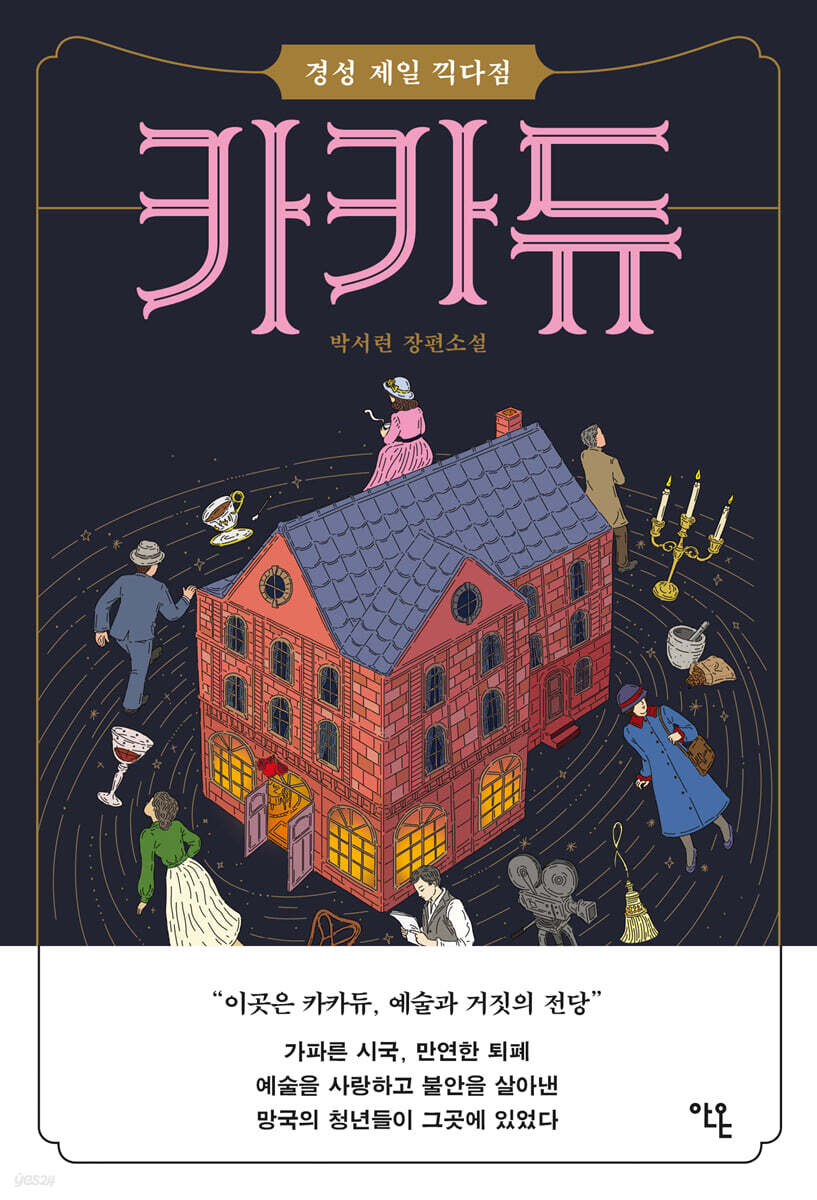
Come to Kakadu, Korea's first Western-style teahouse.A new novel by author Park Seo-ryeon.
If you are a reader who enjoyed reading 『The Girl Who Made Me Feel Good』, this will hit the spot.
The main characters are real figures from modern and contemporary history, including Hawaiian-born Alice Hyun and film director Lee Kyung-son.
A work that depicts the cross-section of an artist and a human being who was constantly shaken by the fate of his era and country.
April 2, 2024. Novel/Poetry PD Kim Yu-ri
The young people of a ruined country who loved art and lived through anxiety
I was at the Western-style cafe 'Kakadu' in Gwanhun-dong, Gyeongseong.
Gwanhun-dong, in the heart of Gyeongseong, where the heat of the March 1st Movement still lingers.
A Western-style cafe called 'Kakadu', created by a Korean, opens there.
Lee Kyung-son, a filmmaker with a history of short-lived success and frequent failures, and Hyun Alice, a new woman with a secret hidden behind her melodramatic face, are his partners there.
Kakadu is a gathering place for young artists to discuss literature, film, love and the times.
The peaceful atmosphere of the coffee shop, which seemed like a romantic temple filled with the scent of coffee, soon reveals its unsettling truth...
《Kakadu》 is a heartwarming message from young people who survived the harsh reality of the Japanese colonial period.
This is a conversation that tells us how we endured a world where we “don’t know how to live,” “it seems like it’ll be a mess no matter how we live,” and “it seems like it won’t change at all until the end,” and how we should endure it now.
They gathered at the coffee shop in 1928 and offer you a cup of coffee here.
This is only possible at Kakadu, the best coffee shop in Gyeongseong.
I was at the Western-style cafe 'Kakadu' in Gwanhun-dong, Gyeongseong.
Gwanhun-dong, in the heart of Gyeongseong, where the heat of the March 1st Movement still lingers.
A Western-style cafe called 'Kakadu', created by a Korean, opens there.
Lee Kyung-son, a filmmaker with a history of short-lived success and frequent failures, and Hyun Alice, a new woman with a secret hidden behind her melodramatic face, are his partners there.
Kakadu is a gathering place for young artists to discuss literature, film, love and the times.
The peaceful atmosphere of the coffee shop, which seemed like a romantic temple filled with the scent of coffee, soon reveals its unsettling truth...
《Kakadu》 is a heartwarming message from young people who survived the harsh reality of the Japanese colonial period.
This is a conversation that tells us how we endured a world where we “don’t know how to live,” “it seems like it’ll be a mess no matter how we live,” and “it seems like it won’t change at all until the end,” and how we should endure it now.
They gathered at the coffee shop in 1928 and offer you a cup of coffee here.
This is only possible at Kakadu, the best coffee shop in Gyeongseong.
- You can preview some of the book's contents.
Preview
index
Part 1 Mi-ok
Part 2 Busan
Part 3 Kakadu
Part 4 Alice
Epilogue Christmas
Author's Note
References
Part 2 Busan
Part 3 Kakadu
Part 4 Alice
Epilogue Christmas
Author's Note
References
Into the book
I believe in art.
Adore beauty as if you believed in God.
I believe in love as much as I pursue beauty.
And then Alice appeared.
This is the most accurate summary of everything that happened to me.
--- p.9
Fearing that I might lose sight of the woman, I hurriedly grabbed my camera and film canister and ran to the waiting room.
The luggage was heavy and I had been running without any plan, so I opened the door with a loud bang and went in, and the woman looked at me.
The eyes were large and round, but extended sideways as long as the eyebrows. One eye had a dark double eyelid, while the other had a strangely narrow inner double eyelid that seemed to be a single eyelid. The narrow bridge of the nose carefully and precariously balanced the seemingly asymmetrical eyes, and beneath them, the lips, like red periods, were placed neatly, the size of a newborn's.
It's a new wave, a new wave.
It is the face of a new era.
--- pp.35-36
“I am Raun Gyu from Ranam.”
Who… … was about to ask, when Ungyu raised his thumb and pointed to his chest with an exaggerated gesture like a Westerner.
The accent was a bit peculiar, but upon closer inspection, it was the remnants of the terrible Northeastern dialect that had been almost completely erased through effort.
He said he came because he liked the movie.
He said that his first choice was to be an actor, and if given the opportunity, he would also like to try directing.
In other words, Ungyu has been my rival since his appearance.
I also joined Chosun Cinema as a director, but when the director found out about my age, he changed his attitude and said it was too early for me to become a director, so I ended up as an assistant director.
Whenever I beg you to come, it's only because of my age.
He is a terrible director and is incredibly childish.
I never asked Ungyu his age when I first saw him, nor ever since, but we both knew that he was older and I was relatively younger.
If my brother came in with the intention of becoming a director, there was a good chance he would surpass me and become a director.
But somehow I liked him.
--- pp.82-83
Alice suddenly appeared in front of me (as always).
It was a pleasure to see Alice, not only because she was my niece whom I hadn't seen in a long time, but also because she was my helper who would help me achieve my vague dreams.
“But what if you kick out your friend because of me?”
“No, I’ve already seen everything I need to see today.”
“There’s still not a single cafe in Gyeongseong. If there were one, we could go there and talk.”
“It’s not that there aren’t any, but I think most of them are for foreigners only.”
Just then, Alice's eyes sparkled.
“So, sir, why don’t we open a cafe?”
--- pp.122-123
In our store, which borrowed its name from [Green Parrot], there wasn't even a hint of blue, let alone green.
But that's why, that's why Alice and I felt our shop was so unique.
Our Kakadu are black, red and white.
We borrowed the space and the name, but we intend to create our own without imitating anything else.
In a store about to open, a store with no name but three red buckets as its sign, I reflected on my determination and pledge.
A strange confidence welled up in me, like a newly transplanted organ I had never known existed before, and it felt new and perfectly suited to my body.
I was the rabbit who put a cleaned liver in my body, and I was Prometheus who made peace with Zeus and got a new liver that would never wear out again.
How delightful and desolate it is to talk about things that do not exist.
--- pp.155-156
"Merry Christmas."
I stupidly followed Alice's words.
"Merry Christmas."
When I left the store with a feeling that I couldn't possibly describe in words, and when I was finally alone and started walking down the street alone, I was... ...happy.
I was proud.
Adding a few drops of another color, such as black or white, to a two-liter can of red paint will not make the two liters of red a completely different color.
My happiness was as self-evident as two liters of red.
In a vague way, I wished every future Christmas could be like this, and I couldn't think of a single reason why it couldn't be.
And the very next moment, he was arrested by the Japanese police.
--- p.244
After a while, Alice turned around and started walking again.
This is what happened after I said something in a low voice.
We were standing far apart and the sleet was falling between us, so I couldn't hear Alice.
I can only guess the content from the shape of the lips and the very thin sound of the voice.
… … Don’t do that.
Alice said so.
Don't come or die.
Alice was trying to forbid me from doing something, and I couldn't figure out what it was.
When we returned to the chapel, the play was over.
Adore beauty as if you believed in God.
I believe in love as much as I pursue beauty.
And then Alice appeared.
This is the most accurate summary of everything that happened to me.
--- p.9
Fearing that I might lose sight of the woman, I hurriedly grabbed my camera and film canister and ran to the waiting room.
The luggage was heavy and I had been running without any plan, so I opened the door with a loud bang and went in, and the woman looked at me.
The eyes were large and round, but extended sideways as long as the eyebrows. One eye had a dark double eyelid, while the other had a strangely narrow inner double eyelid that seemed to be a single eyelid. The narrow bridge of the nose carefully and precariously balanced the seemingly asymmetrical eyes, and beneath them, the lips, like red periods, were placed neatly, the size of a newborn's.
It's a new wave, a new wave.
It is the face of a new era.
--- pp.35-36
“I am Raun Gyu from Ranam.”
Who… … was about to ask, when Ungyu raised his thumb and pointed to his chest with an exaggerated gesture like a Westerner.
The accent was a bit peculiar, but upon closer inspection, it was the remnants of the terrible Northeastern dialect that had been almost completely erased through effort.
He said he came because he liked the movie.
He said that his first choice was to be an actor, and if given the opportunity, he would also like to try directing.
In other words, Ungyu has been my rival since his appearance.
I also joined Chosun Cinema as a director, but when the director found out about my age, he changed his attitude and said it was too early for me to become a director, so I ended up as an assistant director.
Whenever I beg you to come, it's only because of my age.
He is a terrible director and is incredibly childish.
I never asked Ungyu his age when I first saw him, nor ever since, but we both knew that he was older and I was relatively younger.
If my brother came in with the intention of becoming a director, there was a good chance he would surpass me and become a director.
But somehow I liked him.
--- pp.82-83
Alice suddenly appeared in front of me (as always).
It was a pleasure to see Alice, not only because she was my niece whom I hadn't seen in a long time, but also because she was my helper who would help me achieve my vague dreams.
“But what if you kick out your friend because of me?”
“No, I’ve already seen everything I need to see today.”
“There’s still not a single cafe in Gyeongseong. If there were one, we could go there and talk.”
“It’s not that there aren’t any, but I think most of them are for foreigners only.”
Just then, Alice's eyes sparkled.
“So, sir, why don’t we open a cafe?”
--- pp.122-123
In our store, which borrowed its name from [Green Parrot], there wasn't even a hint of blue, let alone green.
But that's why, that's why Alice and I felt our shop was so unique.
Our Kakadu are black, red and white.
We borrowed the space and the name, but we intend to create our own without imitating anything else.
In a store about to open, a store with no name but three red buckets as its sign, I reflected on my determination and pledge.
A strange confidence welled up in me, like a newly transplanted organ I had never known existed before, and it felt new and perfectly suited to my body.
I was the rabbit who put a cleaned liver in my body, and I was Prometheus who made peace with Zeus and got a new liver that would never wear out again.
How delightful and desolate it is to talk about things that do not exist.
--- pp.155-156
"Merry Christmas."
I stupidly followed Alice's words.
"Merry Christmas."
When I left the store with a feeling that I couldn't possibly describe in words, and when I was finally alone and started walking down the street alone, I was... ...happy.
I was proud.
Adding a few drops of another color, such as black or white, to a two-liter can of red paint will not make the two liters of red a completely different color.
My happiness was as self-evident as two liters of red.
In a vague way, I wished every future Christmas could be like this, and I couldn't think of a single reason why it couldn't be.
And the very next moment, he was arrested by the Japanese police.
--- p.244
After a while, Alice turned around and started walking again.
This is what happened after I said something in a low voice.
We were standing far apart and the sleet was falling between us, so I couldn't hear Alice.
I can only guess the content from the shape of the lips and the very thin sound of the voice.
… … Don’t do that.
Alice said so.
Don't come or die.
Alice was trying to forbid me from doing something, and I couldn't figure out what it was.
When we returned to the chapel, the play was over.
--- pp.330-331
Publisher's Review
■ Historical novels for a new era
Even if I fail, I must not do it this time, I must remember everything in detail… … .
I don't know what to do with remembering it, but I just remember it...
-Page 157
As shown in "The Girl Who Worked at the Gym," the author extracts narrative truth from historical facts that could easily be overlooked in the records of a minority.
If the previous work was a story about female workers in Pyongyang, this work is a story about young artists, bohemians, and communists in Gyeongseong.
Not only are Kakadu's partners Lee Gyeong-son and Hyeon Alice both real people, but also cultural and artistic figures of the time, such as Na Un-gyu, Kim Myeong-sun, and Lee Eum-jeon (Lee Ae-ri-su), as well as Sim Hun, Kim Gu, and Park Heon-yeong, appear in the novel in various ways.
Lee Gyeong-son struggles to create his own masterpiece while sharing Na Un-gyu's friendship, and Hyun Alice boldly rebels against the patriarchal society and develops her own thoughts.
But their conversations and activities, their laughter and silence, all of them cannot help but be pitiful and uneasy.
Because they are the youth of a ruined country.
Because they are all colonial artists.
Park Seo-ryeon calls out the names of young artists who actually lived during that time and places them in the hall of fame of novels.
It is faithful to the brief historical record, but fills in the gaps with narrative imagination.
Thus, Kakadu touches on the truth that history has not yet grasped.
It did not exist only in the context of huge events, great figures, and symbolic settings.
A hundred years ago, at the Port of Busan, in the office of Gyeongseong Film Company, in a tiny teahouse, on the streets of the Shanghai Concession, history walked one step, or rather, half a step, until it reached here, and we, today, read the memories of those steps.
In a time of steep decline and rampant decadence, they gathered in 'Kakadu'.
A hundred years later, where will we gather and what will we pursue? Perhaps we can find some hints in the new-age historical novel, "Kakadu."
■ In the Hall of Art and Lies
Finally, Alice found something she loved more than her father or mother.
It was an idea, not a person or a thing.
-Page 260
The author follows the actions of the protagonist, Lee Gyeong-son, in relatively detailed and calm manner.
Even if you just list the names of the works he participated in and the colleagues he worked with, it's like reading the art history of that era.
Born into a wealthy family, Lee Gyeong-son, who grew up wealthy but wandered in the colonial reality and eventually wanted to become an artist, defines himself as a bohemian.
Although the Manse Movement warms my heart, I also easily agree to inevitable compromises.
He fails as an artist, tries to forget his failures, and runs away from them over and over again.
Just as the anxiety that sprouted between aspiration and pessimism was eating away at him, his cousin Alice Hyun appeared before him.
And he proposes a cafe partnership.
Kakadu, a shelter and studio for artists, Kakadu, a literary café for Koreans… … .
In Kakadu, he finds some relief.
And you find yourself drowning in an unknown emotion.
Not much is known about Hyun Alice's life compared to Lee Gyeong-son's.
Born in Hawaii, he obtained a U.S. passport, experienced life in Gyeongseong, Shanghai, and Hawaii, and was influenced by his father, who devoted himself to the independence movement as a pastor.
He also had a husband and children, a hesitant love and a firm conviction.
Hyun Alice, a woman who can suddenly appear anywhere and leave anywhere, suddenly appears in front of her cousin, Lee Gyeong-son, just like before.
Hyun Alice proposes a joint venture to Lee Gyeong-son.
With three red bowls hanging on the door and a decadent interior, Kakadu, a Western-style cafe, opens its doors and gradually becomes known as a literary cafe in Gwanhun-dong and a coffee house with a beautiful madam… … .
Madame Hyun Alice there is suspicious.
Communist Hyun Alice and Bohemian Lee Gyeong-son were putting on a play that no one would notice was a play.
Even if I fail, I must not do it this time, I must remember everything in detail… … .
I don't know what to do with remembering it, but I just remember it...
-Page 157
As shown in "The Girl Who Worked at the Gym," the author extracts narrative truth from historical facts that could easily be overlooked in the records of a minority.
If the previous work was a story about female workers in Pyongyang, this work is a story about young artists, bohemians, and communists in Gyeongseong.
Not only are Kakadu's partners Lee Gyeong-son and Hyeon Alice both real people, but also cultural and artistic figures of the time, such as Na Un-gyu, Kim Myeong-sun, and Lee Eum-jeon (Lee Ae-ri-su), as well as Sim Hun, Kim Gu, and Park Heon-yeong, appear in the novel in various ways.
Lee Gyeong-son struggles to create his own masterpiece while sharing Na Un-gyu's friendship, and Hyun Alice boldly rebels against the patriarchal society and develops her own thoughts.
But their conversations and activities, their laughter and silence, all of them cannot help but be pitiful and uneasy.
Because they are the youth of a ruined country.
Because they are all colonial artists.
Park Seo-ryeon calls out the names of young artists who actually lived during that time and places them in the hall of fame of novels.
It is faithful to the brief historical record, but fills in the gaps with narrative imagination.
Thus, Kakadu touches on the truth that history has not yet grasped.
It did not exist only in the context of huge events, great figures, and symbolic settings.
A hundred years ago, at the Port of Busan, in the office of Gyeongseong Film Company, in a tiny teahouse, on the streets of the Shanghai Concession, history walked one step, or rather, half a step, until it reached here, and we, today, read the memories of those steps.
In a time of steep decline and rampant decadence, they gathered in 'Kakadu'.
A hundred years later, where will we gather and what will we pursue? Perhaps we can find some hints in the new-age historical novel, "Kakadu."
■ In the Hall of Art and Lies
Finally, Alice found something she loved more than her father or mother.
It was an idea, not a person or a thing.
-Page 260
The author follows the actions of the protagonist, Lee Gyeong-son, in relatively detailed and calm manner.
Even if you just list the names of the works he participated in and the colleagues he worked with, it's like reading the art history of that era.
Born into a wealthy family, Lee Gyeong-son, who grew up wealthy but wandered in the colonial reality and eventually wanted to become an artist, defines himself as a bohemian.
Although the Manse Movement warms my heart, I also easily agree to inevitable compromises.
He fails as an artist, tries to forget his failures, and runs away from them over and over again.
Just as the anxiety that sprouted between aspiration and pessimism was eating away at him, his cousin Alice Hyun appeared before him.
And he proposes a cafe partnership.
Kakadu, a shelter and studio for artists, Kakadu, a literary café for Koreans… … .
In Kakadu, he finds some relief.
And you find yourself drowning in an unknown emotion.
Not much is known about Hyun Alice's life compared to Lee Gyeong-son's.
Born in Hawaii, he obtained a U.S. passport, experienced life in Gyeongseong, Shanghai, and Hawaii, and was influenced by his father, who devoted himself to the independence movement as a pastor.
He also had a husband and children, a hesitant love and a firm conviction.
Hyun Alice, a woman who can suddenly appear anywhere and leave anywhere, suddenly appears in front of her cousin, Lee Gyeong-son, just like before.
Hyun Alice proposes a joint venture to Lee Gyeong-son.
With three red bowls hanging on the door and a decadent interior, Kakadu, a Western-style cafe, opens its doors and gradually becomes known as a literary cafe in Gwanhun-dong and a coffee house with a beautiful madam… … .
Madame Hyun Alice there is suspicious.
Communist Hyun Alice and Bohemian Lee Gyeong-son were putting on a play that no one would notice was a play.
GOODS SPECIFICS
- Date of issue: March 13, 2024
- Page count, weight, size: 360 pages | 380g | 128*188*17mm
- ISBN13: 9791192638331
- ISBN10: 1192638336
You may also like
카테고리
korean


korean

![GQ KOREA Mark (Monthly): December [2025]](http://librairie.coreenne.fr/cdn/shop/files/8ef265dbbfbf186523ed75ba7319009d.jpg?v=1765340328&width=3840)


