

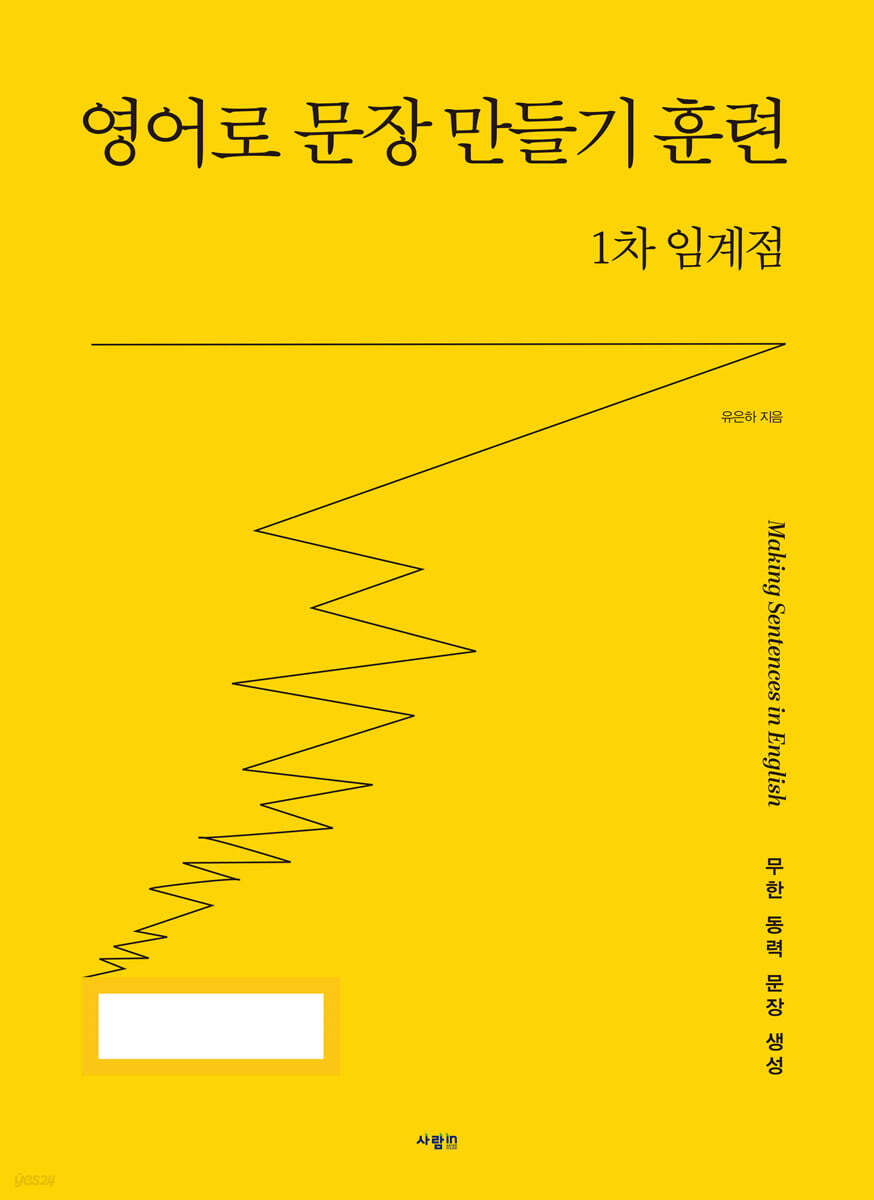
First critical point in sentence-making training in English
 |
Description
Book Introduction
This book will help you make sentences in English! The first threshold for English is being able to produce basic and conversational sentences without hesitation as soon as Korean comes to mind, and this can only be overcome through practice. Half of creating these sentences is establishing the 'subject + predicate framework' of the entire sentence, but this is not easy to do because the Korean language has a different word order from English. I can't move forward because my first steps are creaking. "The First Threshold of Sentence Creation Training in English" identifies the reason why sentence creation training is difficult to sustain, and visualizes all Korean sentences in this book as English sentence structures, allowing learners to acquire the "subject + predicate framework" and convert Korean sentences that come to mind into English sentences in the shortest possible time. |
- You can preview some of the book's contents.
Preview
index
PART 1 BASE OF ENGLISH COMMENTS
CHAPTER 1 From Skeleton Sentences to Expanded Sentences
UNIT 1 From skeletal sentences to expanded sentences
UNIT 2 Add complements to the skeleton sentence to make an expanded sentence 1
UNIT 3 Add complements to the skeleton sentence to make an expanded sentence 2
UNIT 4 Adding an object to a skeleton sentence to make an extended sentence
WRITING TIPS 34
UNIT 5 From skeleton sentences to sentences that give to others
UNIT 6 Sentences that clarify the object in the skeleton sentence 1
UNIT 7 Sentences that clarify the object in the skeleton sentence 2
CHAPTER 2 Clarifying the Intention of a Sentence with Tense and Auxiliary Verbs
UNIT 1 Present Tense
UNIT 2 PAST TENSE
UNIT 3 Future Tense 1
UNIT 4 Future Tense 2
UNIT 5 Present Progressive 1
UNIT 6 Present Progressive 2
WRITING TIPS
UNIT 7 Past Progressive
UNIT 8 Present Perfect 1
UNIT 9 Present Perfect 2
UNIT 10 Present Perfect Continuous
UNIT 11 Auxiliary Verbs can
UNIT 12 Auxiliary Verbs could
UNIT 13 Auxiliary verb should / had better
UNIT 14 Auxiliary Verbs have to
WRITING TIPS
LET'S WRITE A STORY
PART 2 English Writing
CHAPTER 1 Extending Noun Place with Modifiers
UNIT 1 Noun + Prepositional Phrase (Adjective Phrase) 1
UNIT 2 Noun + Prepositional Phrase (Adjective Phrase) 2
UNIT 3 Noun + Present Participle
UNIT 4 Noun + Past Participle
UNIT 5 Noun + to-infinitive phrase
UNIT 6 Noun + Relative Pronoun Clause 1
UNIT 7 Noun + Relative Pronoun Clause 2
UNIT 8 Noun + Relative Adverb Clause
WRITING TIPS
CHAPTER 2 Modifying and Extending Verbs and Adjectives
UNIT 1 Prepositional Phrases (Adverbial Phrases)
UNIT 2 to-infinitive phrase 1
UNIT 3 to-infinitive phrase 2
UNIT 4 Present Participle (Simultaneous Action)
CHAPTER 3 Extending with Long Nouns
UNIT 1 Noun Phrases 1 (Gerund Phrases)
UNIT 2 Noun Phrases 2 (To-Infinitive Phrases 1)
UNIT 3 Noun Phrase 3 (To-Infinitive Phrase 2)
UNIT 4 Noun Phrase 4 (Subject of the Infinitive)
UNIT 5 Noun Phrases 5 (Interrogative Word + To-Infinitive Phrase)
UNIT 6 NOUN CLAUSES 1
UNIT 7 NOUN CLAUSES 2
UNIT 8 Noun Clauses 3
UNIT 9 Noun Clauses Led by Interrogative Words 1
UNIT 10 Noun Clauses Led by Interrogative Words 2
UNIT 11 Noun Clauses Led by Interrogative Words 3
CHAPTER 4 Modifying and Extending Sentences
UNIT 1 Time Conjunctions 1
UNIT 2 Time Conjunctions 2
UNIT 3 Conditional Conjunctions
UNIT 4 Reason Conjunctions
UNIT 5 Concessionary Conjunctions 1
UNIT 6 Concession Conjunctions 2
WRITING TIPS
UNIT 7 Participle Phrases 1
UNIT 8 Participle Phrases 2
UNIT 9 Participle Phrases 3
LET'S WRITE AN ESSAY
ANSWERS
CHAPTER 1 From Skeleton Sentences to Expanded Sentences
UNIT 1 From skeletal sentences to expanded sentences
UNIT 2 Add complements to the skeleton sentence to make an expanded sentence 1
UNIT 3 Add complements to the skeleton sentence to make an expanded sentence 2
UNIT 4 Adding an object to a skeleton sentence to make an extended sentence
WRITING TIPS 34
UNIT 5 From skeleton sentences to sentences that give to others
UNIT 6 Sentences that clarify the object in the skeleton sentence 1
UNIT 7 Sentences that clarify the object in the skeleton sentence 2
CHAPTER 2 Clarifying the Intention of a Sentence with Tense and Auxiliary Verbs
UNIT 1 Present Tense
UNIT 2 PAST TENSE
UNIT 3 Future Tense 1
UNIT 4 Future Tense 2
UNIT 5 Present Progressive 1
UNIT 6 Present Progressive 2
WRITING TIPS
UNIT 7 Past Progressive
UNIT 8 Present Perfect 1
UNIT 9 Present Perfect 2
UNIT 10 Present Perfect Continuous
UNIT 11 Auxiliary Verbs can
UNIT 12 Auxiliary Verbs could
UNIT 13 Auxiliary verb should / had better
UNIT 14 Auxiliary Verbs have to
WRITING TIPS
LET'S WRITE A STORY
PART 2 English Writing
CHAPTER 1 Extending Noun Place with Modifiers
UNIT 1 Noun + Prepositional Phrase (Adjective Phrase) 1
UNIT 2 Noun + Prepositional Phrase (Adjective Phrase) 2
UNIT 3 Noun + Present Participle
UNIT 4 Noun + Past Participle
UNIT 5 Noun + to-infinitive phrase
UNIT 6 Noun + Relative Pronoun Clause 1
UNIT 7 Noun + Relative Pronoun Clause 2
UNIT 8 Noun + Relative Adverb Clause
WRITING TIPS
CHAPTER 2 Modifying and Extending Verbs and Adjectives
UNIT 1 Prepositional Phrases (Adverbial Phrases)
UNIT 2 to-infinitive phrase 1
UNIT 3 to-infinitive phrase 2
UNIT 4 Present Participle (Simultaneous Action)
CHAPTER 3 Extending with Long Nouns
UNIT 1 Noun Phrases 1 (Gerund Phrases)
UNIT 2 Noun Phrases 2 (To-Infinitive Phrases 1)
UNIT 3 Noun Phrase 3 (To-Infinitive Phrase 2)
UNIT 4 Noun Phrase 4 (Subject of the Infinitive)
UNIT 5 Noun Phrases 5 (Interrogative Word + To-Infinitive Phrase)
UNIT 6 NOUN CLAUSES 1
UNIT 7 NOUN CLAUSES 2
UNIT 8 Noun Clauses 3
UNIT 9 Noun Clauses Led by Interrogative Words 1
UNIT 10 Noun Clauses Led by Interrogative Words 2
UNIT 11 Noun Clauses Led by Interrogative Words 3
CHAPTER 4 Modifying and Extending Sentences
UNIT 1 Time Conjunctions 1
UNIT 2 Time Conjunctions 2
UNIT 3 Conditional Conjunctions
UNIT 4 Reason Conjunctions
UNIT 5 Concessionary Conjunctions 1
UNIT 6 Concession Conjunctions 2
WRITING TIPS
UNIT 7 Participle Phrases 1
UNIT 8 Participle Phrases 2
UNIT 9 Participle Phrases 3
LET'S WRITE AN ESSAY
ANSWERS
Detailed image

Publisher's Review
We'll identify the root cause of the first English threshold you've struggled to overcome on your own and provide solutions!
Whether it's language or work, you have to reach a critical point and overcome it before you can move on to the next level.
Unlike listening and reading, sentence creation in English is an output process that requires direct results, and it is an area with many hurdles that make it difficult to overcome the critical point.
"English Sentence Creation Training: 1st Critical Point" identifies the problems that prevented training from continuing and provides solutions to help you continue to the end.
I don't like long study times - 20 minutes a day, 55 days is enough to finish easily.
Considering the shorter attention spans in the video age, we structured each unit to be completed in 20 minutes a day, when you think, "I could do more..."
If you want to reach the critical point faster and do 2 units at a time, you can finish it cleanly in a month.
English thinking doesn't work - all Korean sentences are presented in English sentence structure.
Unless you are born again as a native speaker, it is difficult for Koreans to think in English.
So, I have no choice but to try to write sentences that conform to the English sentence structure as much as possible.
To this end, all Korean sentences in this book have been arranged in English sentence order.
Just as you learn to follow along if you keep listening, and you get used to it if you keep seeing it, if you keep seeing Korean sentences arranged in English sentence order, when the Korean sentence comes to mind, you will unconsciously arrange it in English sentence order.
Repetition is disgusting - cleverly catch the point that makes you want to write more.
No one likes to write long sentences over and over again from the beginning.
You need to think, ‘This much is worth writing about.’ or ‘Oh, I could write more, but I’m done.’ This is the only way to continue learning.
By pinpointing these points precisely, you can keep writing without feeling bored even if you repeat them, and you can keep writing as if you were possessed.
When you encounter an expression you don't know, you want to give up. - You can continue training by providing hints at the right time.
When you try to translate Korean into English one-to-one, it often doesn't work.
This is also a major obstacle that hinders writing practice.
But it is also true that with just a little hint, you can move forward.
When learners encounter expressions they may not know, hints are provided at appropriate locations to help them move on without giving up.
It's boring if only easy things keep coming out - a gradual structure that gradually becomes more difficult to try.
The critical point can be reached and surpassed by gradually increasing the level.
At first, you will create English sentences very easily, then in the next step, you will apply them in the form of a sentence, then in the next step, you will create sentences by mixing expressions from the form of a sentence, and in the last step, you will look at hint expressions and combine what you have learned before to create sentences, so you can continue training without getting bored.
Whether it's language or work, you have to reach a critical point and overcome it before you can move on to the next level.
Unlike listening and reading, sentence creation in English is an output process that requires direct results, and it is an area with many hurdles that make it difficult to overcome the critical point.
"English Sentence Creation Training: 1st Critical Point" identifies the problems that prevented training from continuing and provides solutions to help you continue to the end.
I don't like long study times - 20 minutes a day, 55 days is enough to finish easily.
Considering the shorter attention spans in the video age, we structured each unit to be completed in 20 minutes a day, when you think, "I could do more..."
If you want to reach the critical point faster and do 2 units at a time, you can finish it cleanly in a month.
English thinking doesn't work - all Korean sentences are presented in English sentence structure.
Unless you are born again as a native speaker, it is difficult for Koreans to think in English.
So, I have no choice but to try to write sentences that conform to the English sentence structure as much as possible.
To this end, all Korean sentences in this book have been arranged in English sentence order.
Just as you learn to follow along if you keep listening, and you get used to it if you keep seeing it, if you keep seeing Korean sentences arranged in English sentence order, when the Korean sentence comes to mind, you will unconsciously arrange it in English sentence order.
Repetition is disgusting - cleverly catch the point that makes you want to write more.
No one likes to write long sentences over and over again from the beginning.
You need to think, ‘This much is worth writing about.’ or ‘Oh, I could write more, but I’m done.’ This is the only way to continue learning.
By pinpointing these points precisely, you can keep writing without feeling bored even if you repeat them, and you can keep writing as if you were possessed.
When you encounter an expression you don't know, you want to give up. - You can continue training by providing hints at the right time.
When you try to translate Korean into English one-to-one, it often doesn't work.
This is also a major obstacle that hinders writing practice.
But it is also true that with just a little hint, you can move forward.
When learners encounter expressions they may not know, hints are provided at appropriate locations to help them move on without giving up.
It's boring if only easy things keep coming out - a gradual structure that gradually becomes more difficult to try.
The critical point can be reached and surpassed by gradually increasing the level.
At first, you will create English sentences very easily, then in the next step, you will apply them in the form of a sentence, then in the next step, you will create sentences by mixing expressions from the form of a sentence, and in the last step, you will look at hint expressions and combine what you have learned before to create sentences, so you can continue training without getting bored.
GOODS SPECIFICS
- Date of issue: July 15, 2024
- Page count, weight, size: 280 pages | 708g | 188*257*17mm
- ISBN13: 9791171010875
- ISBN10: 1171010877
You may also like
카테고리
korean


korean

![GQ KOREA Mark (Monthly): December [2025]](http://librairie.coreenne.fr/cdn/shop/files/8ef265dbbfbf186523ed75ba7319009d.jpg?v=1765340328&width=3840)


