

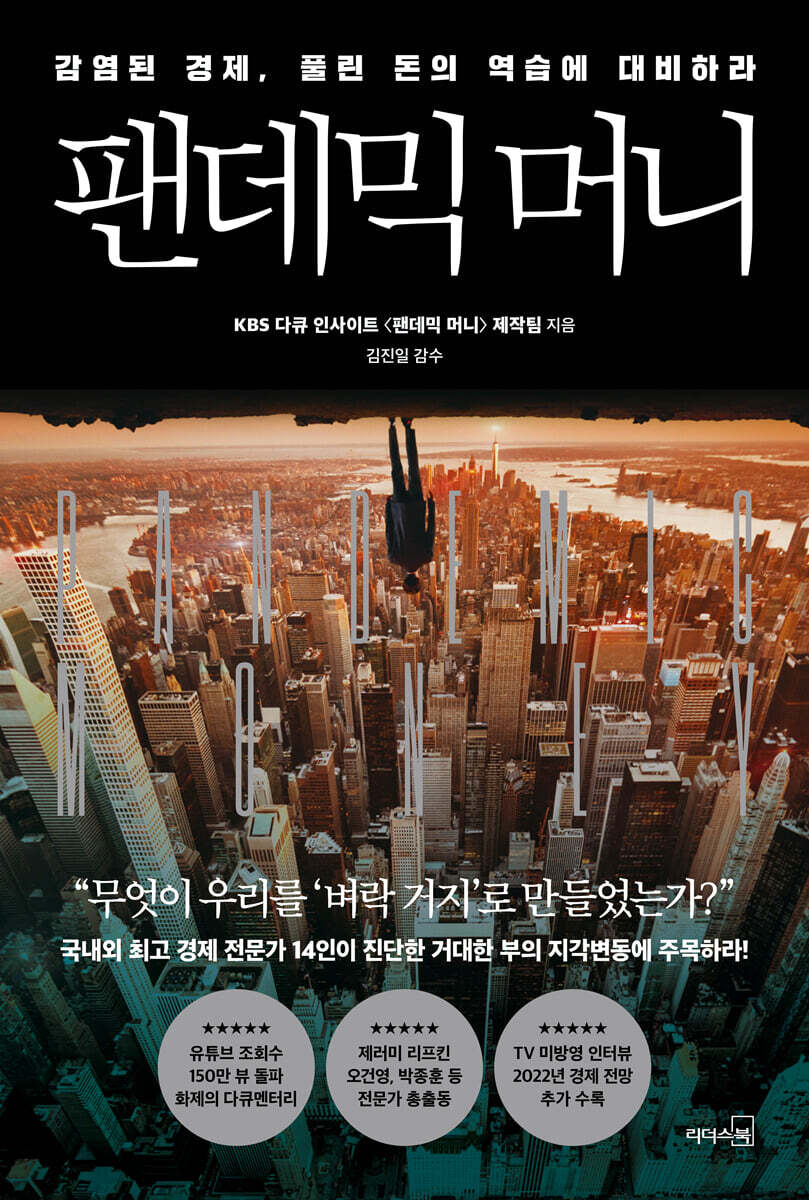
Pandemic Money
 |
Description
Book Introduction
- A word from MD
-
Overflowing money, uncertain futureA global economic crisis triggered by the pandemic.
Governments and central banks around the world tried to overcome the crisis by circulating large amounts of money in the short term.
Although we eventually averted the worst of the crisis, asset prices soared and the value of currency fell, making our lives difficult.
A must-read for exploring and preparing for future risks and opportunities in a disrupted world of money.
December 14, 2021. Economics and Management PD Kim Sang-geun
What made us 'sudden beggars'?
Pay attention to the massive shift in wealth perception, as diagnosed by 14 of the top economic experts from Korea and abroad!
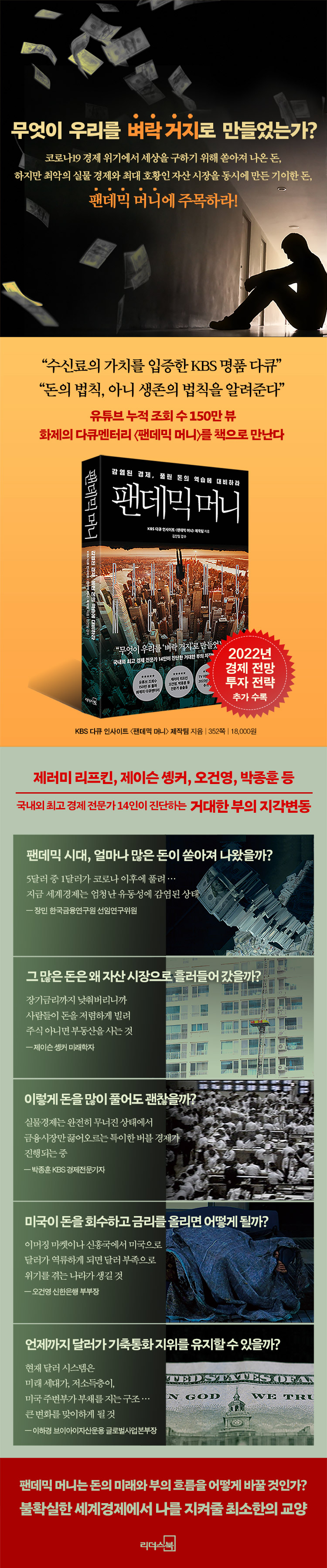
The 2021 documentary "Pandemic Money," which received rave reviews from viewers, including "A masterpiece documentary that proves the value of subscription fees," has been made into a book.
Why does this paradoxical reality arise, where the worst real economy since World War II intersects with the greatest asset market boom?
To find the answer, the production team of "Pandemic Money" met with top domestic and international economic experts, including Jeremy Rifkin, Jason Schenker, Oh Kun-young, and Park Jong-hoon, and deeply traced the process of how the dollar, the key currency, works and how the enormous amount of money released creates bubbles and debt, ultimately causing an economic crisis.
In particular, 『Pandemic Money: Prepare for the Infected Economy and the Counterattack of Loose Money』 includes interviews with experts that were not fully shown in the broadcast.
We also spoke with Professor Kim Jin-il, a monetary policy expert at Korea University, and Oh Geon-young, a financial expert and Vice President at Shinhan Bank, about the changing economic environment and asset markets in 2022.
How is "pandemic money," a surge of money aimed at saving the world from the COVID-19 economic crisis, changing the rules of money? Can we survive this new money game? This book provides insight into the tectonic shifts pandemic money will bring to the global economy and monetary order, and empowers readers to anticipate the flow of wealth ahead of time.
Pay attention to the massive shift in wealth perception, as diagnosed by 14 of the top economic experts from Korea and abroad!
The 2021 documentary "Pandemic Money," which received rave reviews from viewers, including "A masterpiece documentary that proves the value of subscription fees," has been made into a book.
Why does this paradoxical reality arise, where the worst real economy since World War II intersects with the greatest asset market boom?
To find the answer, the production team of "Pandemic Money" met with top domestic and international economic experts, including Jeremy Rifkin, Jason Schenker, Oh Kun-young, and Park Jong-hoon, and deeply traced the process of how the dollar, the key currency, works and how the enormous amount of money released creates bubbles and debt, ultimately causing an economic crisis.
In particular, 『Pandemic Money: Prepare for the Infected Economy and the Counterattack of Loose Money』 includes interviews with experts that were not fully shown in the broadcast.
We also spoke with Professor Kim Jin-il, a monetary policy expert at Korea University, and Oh Geon-young, a financial expert and Vice President at Shinhan Bank, about the changing economic environment and asset markets in 2022.
How is "pandemic money," a surge of money aimed at saving the world from the COVID-19 economic crisis, changing the rules of money? Can we survive this new money game? This book provides insight into the tectonic shifts pandemic money will bring to the global economy and monetary order, and empowers readers to anticipate the flow of wealth ahead of time.
- You can preview some of the book's contents.
Preview
index
INTRO A World Divided by Corona
Introduction: What is Pandemic Money?
PART 1: Humanity's Largest Currency Experiment
POINT 1: What is quantitative easing?
POINT 2 A world of money supported by money
POINT 3 Sandcastle on Sandcastle
INTERVIEW: Oh Geon-young | Park Jong-hoon
PART 2: A Survival Game Where Debt Makes Money
POINT 1: The corporate stock buyback craze
POINT 2: Individual Investors Become Big Players in the Asset Market
POINT 3 Where did all that money go?
INTERVIEW: Nomi Prince | Hong Ki-hoon
PART 3: The Glamorous Money Party, and Beyond
POINT 1 America is Resurrected
POINT 2: The Inflation Debate
POINT 3 So when will the US raise interest rates?
INTERVIEW: Kim Jin-il | Kim Hak-gyun | Jang Min
PART 4 The Power of the Dollar to Move the World
POINT 1: The Beginning and End of the Gold Standard
POINT 2: The War on Inflation
POINT 3 How long will the dollar hegemony last?
INTERVIEW: Lee Ha-kyung | Ahn Yu-hwa | Ryu Rui
PART 5: Signals of a Survival Crisis
POINT 1 Tapering is coming
POINT 2: The Canary in the Coal Mine
POINT 3 Signals of Crisis
INTERVIEW: Yoon Seok-cheon | Richard Koo
INTERVIEW: Jeremy Rifkin | Jason Schenker
OUTRO: Economy and Investment in the COVID-19 Era
Detailed image
Into the book
The money poured in to save the world from the COVID-19 economic crisis, but it also shook trust in the transactions that humanity holds most dear. The money that infected the entire world with massive liquidity as deadly as the virus. The strange money that simultaneously created a crashing real economy and a booming asset market. We decided to call this money "pandemic money."
--- p.5
Just look at 2020.
It was a year in which the real economy collapsed at an unprecedented rate, while asset prices were unprecedentedly hot.
So what could have filled the gap between these two?
You can't say it's everything, but you can think of it as the 'power of money' filling in the gaps.
--- p.35
Quantitative easing is the same in 2008 and 2020, the problem is the scale and speed.
During the 2008 global financial crisis, about $4 trillion was injected over six years, but this time, $3 trillion was injected in just three months.
You've made a ton of money in a really short period of time.
--- p.69
Who would be interested in the value of labor when this phenomenon, in which those who have money become richer through monetary phenomena and those who cannot access the market become relatively poorer, is bound to continue?
I'm going to buy stocks, I'm going to buy real estate, I'm going to buy cryptocurrencies.
That has become a way of survival itself.
--- p.115
The current dollar system has a contradiction in that economic entities bear the burden of debt very unfairly.
When looking at it from a generational perspective, future generations are bearing the burden of current debt, and when looking at it from a class perspective, it is a structure in which the low-income class bears the burden of debt and the privileged class benefits.
Finally, in terms of geopolitical relations between countries, the periphery of the dollar system bears the burden of debt, while the United States, at the center, benefits.
The dollar-centric economic order is about to undergo a massive transformation.
--- p.238
When money moves, there are two factors to consider.
Interest rates and growth.
Money moves from areas with low interest rates to areas with high interest rates and from areas with weak growth to areas with strong growth.
So, as the U.S. economy recovers, interest rates rise, and growth begins, dollars will flow back to the U.S. from emerging markets and emerging economies.
Then some countries may face a crisis due to a dollar shortage.
--- p.265
Wealth inequality across generations, classes, and countries has widened further during the COVID-19 pandemic.
Now money is everywhere, yet at the same time it feels like a mirage, nowhere to be found.
Even after COVID-19 passes, the debt incurred during the pandemic will not disappear along with the epidemic.
What else can save the world then?
Now is the time to come together and search for the signals that pandemic money is sending us.
--- p.286
Asset markets may become more volatile in the tapering phase going forward.
Therefore, it is important to be interested in and study various economic scenarios and assets.
It seems appropriate to diversify investments by selecting assets that can survive each scenario and constructing a portfolio.
--- p.5
Just look at 2020.
It was a year in which the real economy collapsed at an unprecedented rate, while asset prices were unprecedentedly hot.
So what could have filled the gap between these two?
You can't say it's everything, but you can think of it as the 'power of money' filling in the gaps.
--- p.35
Quantitative easing is the same in 2008 and 2020, the problem is the scale and speed.
During the 2008 global financial crisis, about $4 trillion was injected over six years, but this time, $3 trillion was injected in just three months.
You've made a ton of money in a really short period of time.
--- p.69
Who would be interested in the value of labor when this phenomenon, in which those who have money become richer through monetary phenomena and those who cannot access the market become relatively poorer, is bound to continue?
I'm going to buy stocks, I'm going to buy real estate, I'm going to buy cryptocurrencies.
That has become a way of survival itself.
--- p.115
The current dollar system has a contradiction in that economic entities bear the burden of debt very unfairly.
When looking at it from a generational perspective, future generations are bearing the burden of current debt, and when looking at it from a class perspective, it is a structure in which the low-income class bears the burden of debt and the privileged class benefits.
Finally, in terms of geopolitical relations between countries, the periphery of the dollar system bears the burden of debt, while the United States, at the center, benefits.
The dollar-centric economic order is about to undergo a massive transformation.
--- p.238
When money moves, there are two factors to consider.
Interest rates and growth.
Money moves from areas with low interest rates to areas with high interest rates and from areas with weak growth to areas with strong growth.
So, as the U.S. economy recovers, interest rates rise, and growth begins, dollars will flow back to the U.S. from emerging markets and emerging economies.
Then some countries may face a crisis due to a dollar shortage.
--- p.265
Wealth inequality across generations, classes, and countries has widened further during the COVID-19 pandemic.
Now money is everywhere, yet at the same time it feels like a mirage, nowhere to be found.
Even after COVID-19 passes, the debt incurred during the pandemic will not disappear along with the epidemic.
What else can save the world then?
Now is the time to come together and search for the signals that pandemic money is sending us.
--- p.286
Asset markets may become more volatile in the tapering phase going forward.
Therefore, it is important to be interested in and study various economic scenarios and assets.
It seems appropriate to diversify investments by selecting assets that can survive each scenario and constructing a portfolio.
--- p.348
Publisher's Review
“What made us ‘sudden beggars’?”
The worst real economy since World War II
Delving into the contradictory realities of the booming asset markets.
The biggest concern in the global economy today is none other than ‘price.’
This is because prices, which had not risen despite large-scale monetary policy since the 2008 global financial crisis, have recently risen to 4-6 percent, exceeding the management target of 2 percent.
Accordingly, central banks around the world, concerned about prolonged inflation, are raising interest rates and reducing or withdrawing monetary policy.
The worries of ordinary people are deepening due to soaring food and housing prices, increasing debt, and increasing interest burden.
But on the other hand, 'money parties' are taking place every day.
According to the World Inequality Lab, 2020 was the year when the wealth of the world's billionaires grew the most sharply in history.
The "Korea Wealth Report," published annually by a Korean financial institution, revealed that the minimum total assets considered by Korea's wealthy have doubled in two years, from 5 billion won in 2019 to 10 billion won this year.
This was the result of a sharp rise in asset prices, including stocks, real estate, and cryptocurrencies.
After the COVID-19 pandemic, we are seeing two worlds.
The real economy has fallen to its lowest point and the asset market is enjoying unprecedented prosperity.
Why does this immense paradox arise, where prosperity in crisis intersects with poverty in abundance? Why doesn't our lives improve the more we work? And what is it that has suddenly turned us into "instant beggars"?
"A masterpiece among masterpieces, worthy of the phrase 'worth the subscription fee' a hundred times over."
A hot documentary that has surpassed 1.5 million cumulative views on YouTube.
KBS Documentary Insight "Pandemic Money" Now Available as a Book
To find the answer, KBS's documentary Insight "Pandemic Money" delves into how the dollar, the world's reserve currency, works, and how the massive amount of money released creates bubbles and debt, ultimately triggering an economic crisis.
We also met with leading international scholars such as Jeremy Rifkin and Jason Schenker, as well as top domestic economic experts such as Kim Jin-il, Park Jong-hoon, and Oh Geon-young, and discussed how the laws of money and the mechanisms of asset growth are changing in the pandemic era.
The viewers' reaction was enthusiastic.
There were many favorable reviews such as, “A luxury documentary that proves the value of subscription fees” and “It teaches the laws of money, no, the laws of survival.”
Even after the broadcast, there was a steady stream of viewers, and the cumulative number of views on YouTube exceeded 1.5 million in just six months, creating a rare buzz for a documentary.
In addition, it was recognized for both its popularity and artistic value by winning the PD of the Month Award from the Korea PD Association in the TV Current Affairs and Culture Regular Category and the Good Program of the Month Award from the Korea Communications Standards Commission.
??Pandemic Money: Prepare for the Infected Economy and the Backlash of Loose Money?? provides in-depth coverage of topics not covered in the broadcast.
We took great care to make it easy to understand useful financial knowledge by maximizing the use of visual aids introduced in the broadcast and adding explanations for unfamiliar economic concepts.
We've compiled expert interviews covering recent macroeconomic issues, expected policy changes in 2022, and future outlook.
Kim Jin-il, a monetary policy expert and professor of economics at Korea University, reviewed the content to ensure accuracy and reliability.
“We are on a path that no human has ever traveled before.”
Money pouring in to save the world from the COVID-19 economic crisis
How does 'pandemic money' change social structures, monetary order, and the flow of wealth?
What is pandemic money? It refers to the enormous amount of money poured into the world to overcome the economic crisis caused by COVID-19.
Its origins date back to the 2008 financial crisis.
When large investment banks like Lehman Brothers went bankrupt and paralyzed the global financial system, the Federal Reserve, the central bank of the United States, implemented a policy of "quantitative easing" to supply dollars by purchasing bonds and other assets in the market.
As abundant liquidity flowed into asset markets and prices of real estate, stocks, and other assets rose, people felt like they had become wealthy and increased their spending, and the economy gradually recovered.
The problem is that the COVID-19 pandemic hit before the money could be recovered.
In the face of an unprecedented health crisis, governments around the world are once again starting to loosen their purse strings, recalling memories of 2008.
More, faster.
The crisis was that serious and the market atmosphere was terrified.
Ultimately, money has become so abundant in the market that it is said that one in five dollars in the world has been released since COVID-19.
Thanks to the swift response of governments around the world, households and businesses on the brink of bankruptcy were barely able to avoid the worst-case scenario, and the economy was able to avoid it.
But as abundant liquidity pushed up the prices of stocks, real estate, raw materials, and virtual assets, polarization deepened, with winners amassing ever-greater wealth and losers being pushed further out.
The fear of being left behind or left out while everyone else is making money has given rise to new words like 'young-geul', 'debt-tu', and 'Donghak ants', and has sparked a frenzy of investment that borders on speculation.
This book is a stark warning that we are fast approaching a strange world of money, where debt fuels debt and bubbles breed bigger bubbles.
The era of zero interest rates is over.
A global economy infected with liquidity, amid growing bubble fears.
Read the crisis signals sent by pandemic money.
But this kind of uneasy 'money party' cannot continue indefinitely.
Last November, Federal Reserve Chairman Jerome Powell finally announced 'tapering'.
Tapering means reducing the water flow from the faucet. It doesn't mean that money will stop flowing out immediately, but it means that less money will be released than before.
In addition, the market expects interest rates to rise when tapering ends next year.
The dollar is America's money, but it is also the world's money.
Therefore, this shift in US policy will have a significant impact on our country's economy.
This book briefly looks back in time to see how the fate of nations around the world became intertwined with the dollar, and why, while the US economy grew on the strength of money, crises emerged outside the United States.
In fact, the 1997 foreign exchange crisis we experienced was also related to the U.S. interest rate hike, and after the 2008 global financial crisis, countries such as Greece, Southern European countries, Brazil, and China were hit hard for similar reasons.
The same goes for when pandemic money is recovered.
This is because, at this time, the global financial markets could experience a taper tantrum, just as a patient who has stopped taking painkillers suddenly experiences pain.
Rising interest rates and falling asset prices will force households and businesses to tighten their belts, potentially extinguishing the spark of economic recovery that has been so desperately needed.
As we approach the third anniversary of the COVID-19 pandemic, it's crucial to pay attention to the crisis signals sent by pandemic money.
“We live in a bubble.”
In the midst of a huge shift in the perception of wealth
Minimum economic knowledge for wise choices
At one time, Japan was the world's second-largest economy.
However, since the real estate bubble burst in the 1990s, the country has been unable to escape the swamp of low growth and deflation.
The aftereffects of the bubble economy leave deep, irreversible scars.
This is also why global investors such as Jeremy Grantham and Charlie Munger have recently expressed concerns about overheating in the asset market.
Unlike when the overall index was good, when market uncertainty is increasing and tensions are high, the gap between those who can read the macroeconomic trends and those who cannot will widen further.
And even after the pandemic money subsides, factors that increase uncertainty will continue to emerge, such as the emergence of mutant viruses, the US-China trade conflict and climate change agreements, declining productivity due to low birth rates and an aging population, and inflation caused by rising wages and supply shocks.
Living amidst the changing laws of money, countless indicators pointing to a bubble, and the uncertainty surrounding us, can we survive in this new money game? This book, which offers insight into the pandemic money era, connects macroeconomic variables like interest rates, stock prices, currency, exchange rates, and inflation to interpret real-world changes and empowers you to proactively identify opportunities.
The worst real economy since World War II
Delving into the contradictory realities of the booming asset markets.
The biggest concern in the global economy today is none other than ‘price.’
This is because prices, which had not risen despite large-scale monetary policy since the 2008 global financial crisis, have recently risen to 4-6 percent, exceeding the management target of 2 percent.
Accordingly, central banks around the world, concerned about prolonged inflation, are raising interest rates and reducing or withdrawing monetary policy.
The worries of ordinary people are deepening due to soaring food and housing prices, increasing debt, and increasing interest burden.
But on the other hand, 'money parties' are taking place every day.
According to the World Inequality Lab, 2020 was the year when the wealth of the world's billionaires grew the most sharply in history.
The "Korea Wealth Report," published annually by a Korean financial institution, revealed that the minimum total assets considered by Korea's wealthy have doubled in two years, from 5 billion won in 2019 to 10 billion won this year.
This was the result of a sharp rise in asset prices, including stocks, real estate, and cryptocurrencies.
After the COVID-19 pandemic, we are seeing two worlds.
The real economy has fallen to its lowest point and the asset market is enjoying unprecedented prosperity.
Why does this immense paradox arise, where prosperity in crisis intersects with poverty in abundance? Why doesn't our lives improve the more we work? And what is it that has suddenly turned us into "instant beggars"?
"A masterpiece among masterpieces, worthy of the phrase 'worth the subscription fee' a hundred times over."
A hot documentary that has surpassed 1.5 million cumulative views on YouTube.
KBS Documentary Insight "Pandemic Money" Now Available as a Book
To find the answer, KBS's documentary Insight "Pandemic Money" delves into how the dollar, the world's reserve currency, works, and how the massive amount of money released creates bubbles and debt, ultimately triggering an economic crisis.
We also met with leading international scholars such as Jeremy Rifkin and Jason Schenker, as well as top domestic economic experts such as Kim Jin-il, Park Jong-hoon, and Oh Geon-young, and discussed how the laws of money and the mechanisms of asset growth are changing in the pandemic era.
The viewers' reaction was enthusiastic.
There were many favorable reviews such as, “A luxury documentary that proves the value of subscription fees” and “It teaches the laws of money, no, the laws of survival.”
Even after the broadcast, there was a steady stream of viewers, and the cumulative number of views on YouTube exceeded 1.5 million in just six months, creating a rare buzz for a documentary.
In addition, it was recognized for both its popularity and artistic value by winning the PD of the Month Award from the Korea PD Association in the TV Current Affairs and Culture Regular Category and the Good Program of the Month Award from the Korea Communications Standards Commission.
??Pandemic Money: Prepare for the Infected Economy and the Backlash of Loose Money?? provides in-depth coverage of topics not covered in the broadcast.
We took great care to make it easy to understand useful financial knowledge by maximizing the use of visual aids introduced in the broadcast and adding explanations for unfamiliar economic concepts.
We've compiled expert interviews covering recent macroeconomic issues, expected policy changes in 2022, and future outlook.
Kim Jin-il, a monetary policy expert and professor of economics at Korea University, reviewed the content to ensure accuracy and reliability.
“We are on a path that no human has ever traveled before.”
Money pouring in to save the world from the COVID-19 economic crisis
How does 'pandemic money' change social structures, monetary order, and the flow of wealth?
What is pandemic money? It refers to the enormous amount of money poured into the world to overcome the economic crisis caused by COVID-19.
Its origins date back to the 2008 financial crisis.
When large investment banks like Lehman Brothers went bankrupt and paralyzed the global financial system, the Federal Reserve, the central bank of the United States, implemented a policy of "quantitative easing" to supply dollars by purchasing bonds and other assets in the market.
As abundant liquidity flowed into asset markets and prices of real estate, stocks, and other assets rose, people felt like they had become wealthy and increased their spending, and the economy gradually recovered.
The problem is that the COVID-19 pandemic hit before the money could be recovered.
In the face of an unprecedented health crisis, governments around the world are once again starting to loosen their purse strings, recalling memories of 2008.
More, faster.
The crisis was that serious and the market atmosphere was terrified.
Ultimately, money has become so abundant in the market that it is said that one in five dollars in the world has been released since COVID-19.
Thanks to the swift response of governments around the world, households and businesses on the brink of bankruptcy were barely able to avoid the worst-case scenario, and the economy was able to avoid it.
But as abundant liquidity pushed up the prices of stocks, real estate, raw materials, and virtual assets, polarization deepened, with winners amassing ever-greater wealth and losers being pushed further out.
The fear of being left behind or left out while everyone else is making money has given rise to new words like 'young-geul', 'debt-tu', and 'Donghak ants', and has sparked a frenzy of investment that borders on speculation.
This book is a stark warning that we are fast approaching a strange world of money, where debt fuels debt and bubbles breed bigger bubbles.
The era of zero interest rates is over.
A global economy infected with liquidity, amid growing bubble fears.
Read the crisis signals sent by pandemic money.
But this kind of uneasy 'money party' cannot continue indefinitely.
Last November, Federal Reserve Chairman Jerome Powell finally announced 'tapering'.
Tapering means reducing the water flow from the faucet. It doesn't mean that money will stop flowing out immediately, but it means that less money will be released than before.
In addition, the market expects interest rates to rise when tapering ends next year.
The dollar is America's money, but it is also the world's money.
Therefore, this shift in US policy will have a significant impact on our country's economy.
This book briefly looks back in time to see how the fate of nations around the world became intertwined with the dollar, and why, while the US economy grew on the strength of money, crises emerged outside the United States.
In fact, the 1997 foreign exchange crisis we experienced was also related to the U.S. interest rate hike, and after the 2008 global financial crisis, countries such as Greece, Southern European countries, Brazil, and China were hit hard for similar reasons.
The same goes for when pandemic money is recovered.
This is because, at this time, the global financial markets could experience a taper tantrum, just as a patient who has stopped taking painkillers suddenly experiences pain.
Rising interest rates and falling asset prices will force households and businesses to tighten their belts, potentially extinguishing the spark of economic recovery that has been so desperately needed.
As we approach the third anniversary of the COVID-19 pandemic, it's crucial to pay attention to the crisis signals sent by pandemic money.
“We live in a bubble.”
In the midst of a huge shift in the perception of wealth
Minimum economic knowledge for wise choices
At one time, Japan was the world's second-largest economy.
However, since the real estate bubble burst in the 1990s, the country has been unable to escape the swamp of low growth and deflation.
The aftereffects of the bubble economy leave deep, irreversible scars.
This is also why global investors such as Jeremy Grantham and Charlie Munger have recently expressed concerns about overheating in the asset market.
Unlike when the overall index was good, when market uncertainty is increasing and tensions are high, the gap between those who can read the macroeconomic trends and those who cannot will widen further.
And even after the pandemic money subsides, factors that increase uncertainty will continue to emerge, such as the emergence of mutant viruses, the US-China trade conflict and climate change agreements, declining productivity due to low birth rates and an aging population, and inflation caused by rising wages and supply shocks.
Living amidst the changing laws of money, countless indicators pointing to a bubble, and the uncertainty surrounding us, can we survive in this new money game? This book, which offers insight into the pandemic money era, connects macroeconomic variables like interest rates, stock prices, currency, exchange rates, and inflation to interpret real-world changes and empowers you to proactively identify opportunities.
GOODS SPECIFICS
- Publication date: December 7, 2021
- Page count, weight, size: 352 pages | 594g | 150*218*30mm
- ISBN13: 9788901254715
- ISBN10: 8901254719
You may also like
카테고리
korean


korean

![ELLE 엘르 스페셜 에디션 A형 : 12월 [2025]](http://librairie.coreenne.fr/cdn/shop/files/b8e27a3de6c9538896439686c6b0e8fb.jpg?v=1766436872&width=3840)


