

Patterson
 |
Description
Book Introduction
- A word from MD
-
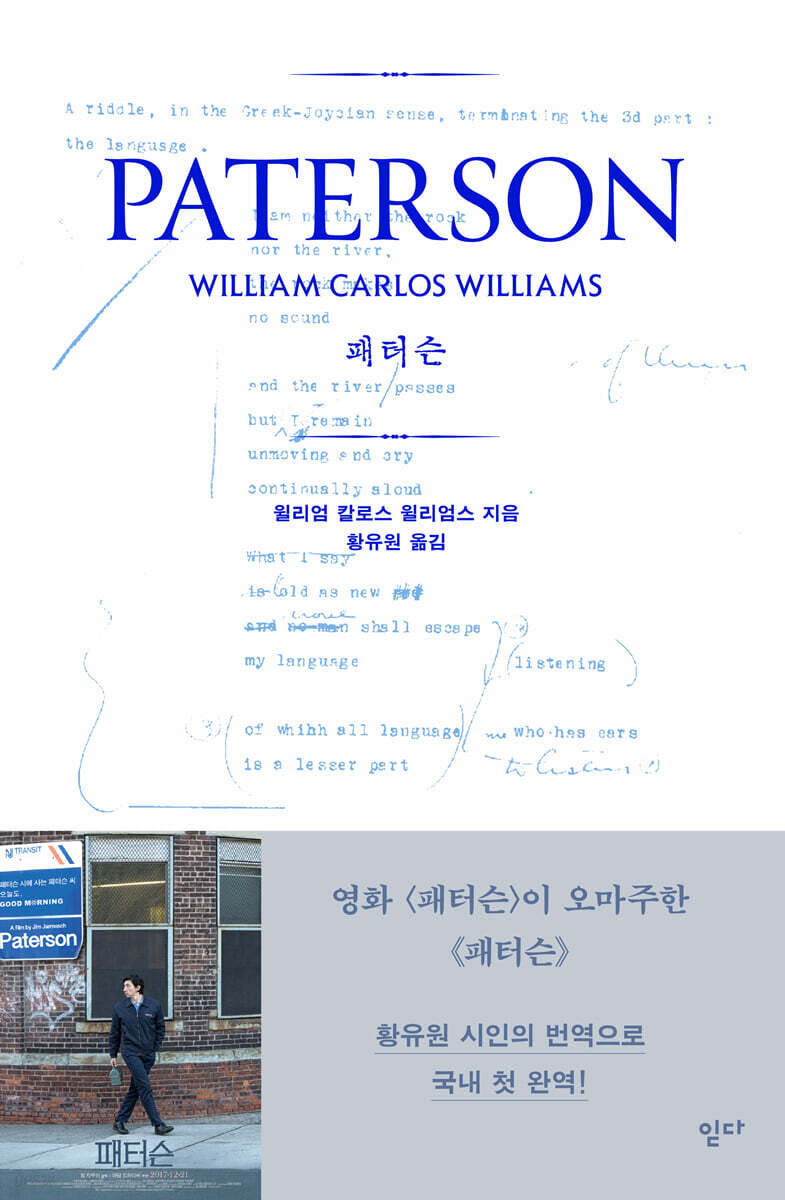
A masterpiece by the greatest poet of the 20th centuryA poetry collection to which Jim Jarmusch's film Paterson pays homage.
The first complete translation was published in Korea through poet Hwang Yu-won.
This translation preserves the style of William Carlos Williams, a Beat Generation literary pioneer who made a significant mark on 20th-century American modern literature.
A waterfall-like epic based on the history of the city of Paterson.
April 16, 2024. Novel/Poetry PD Kim Yu-ri
The greatest poet of the 20th century, winner of the National Book Award and Pulitzer Prize!
The poetry collection "Paterson," to which Jim Jarmusch's film "Paterson" pays homage
The first complete translation in Korea, translated by poet Hwang Yu-won!
When most people hear the word 'Paterson', they probably think of Jim Jarmusch's 2017 film [Paterson].
The film was greatly loved by audiences, and that affection still remains today.
Along with the popularity of the film, much attention was also focused on the city of Paterson, where the main character Paterson lives, and the poetry collection of William Carlos Williams that he was reading.
However, to this day, the complete translation of the poetry collection "Paterson" has not been published in Korea, and readers are very disappointed about this.
In line with these expectations, poet Hwang Yu-won and the publishing company Iwda are publishing a complete translation of the poetry collection “Paterson.”
The name William Carlos Williams brings to mind figures like Ezra Pound and Allen Ginsberg, as Williams is considered the creator of Imagism and a pioneer of Beat Generation literature.
As it left a significant mark on the history of American 20th-century modern literature, the rhythm and meter of the verses and words in “Paterson” are both original and experimental.
In order not to damage the meaning and image, the original composition was preserved as much as possible in the editing, and poet Hwang Yu-won studied and deconstructed Williams's rhythm and language to fit the Korean language and restored it as much as possible.
The poetry collection "Paterson," to which Jim Jarmusch's film "Paterson" pays homage
The first complete translation in Korea, translated by poet Hwang Yu-won!
When most people hear the word 'Paterson', they probably think of Jim Jarmusch's 2017 film [Paterson].
The film was greatly loved by audiences, and that affection still remains today.
Along with the popularity of the film, much attention was also focused on the city of Paterson, where the main character Paterson lives, and the poetry collection of William Carlos Williams that he was reading.
However, to this day, the complete translation of the poetry collection "Paterson" has not been published in Korea, and readers are very disappointed about this.
In line with these expectations, poet Hwang Yu-won and the publishing company Iwda are publishing a complete translation of the poetry collection “Paterson.”
The name William Carlos Williams brings to mind figures like Ezra Pound and Allen Ginsberg, as Williams is considered the creator of Imagism and a pioneer of Beat Generation literature.
As it left a significant mark on the history of American 20th-century modern literature, the rhythm and meter of the verses and words in “Paterson” are both original and experimental.
In order not to damage the meaning and image, the original composition was preserved as much as possible in the editing, and poet Hwang Yu-won studied and deconstructed Williams's rhythm and language to fit the Korean language and restored it as much as possible.
- You can preview some of the book's contents.
Preview
index
William Carlos Williams on Paterson_May 31, 1951
Author's Note
Volume 1
Volume 2
Volume 3
Volume 4
Volume 5
Commentary on the work
Author's Note
Volume 1
Volume 2
Volume 3
Volume 4
Volume 5
Commentary on the work
Detailed image

Into the book
So the city I wanted to target had to be a place I knew inside and out.
New York was too big, too big a collection of aspects of the world.
I wanted something closer to home, something familiar.
Choosing Paterson as my reality was intentional.
The suburb where I live is neither prominent nor diverse enough to achieve my goals.
There were other candidates, but I think Paterson was the best.
--- p.7
Paterson is a four-volume poem about a man who is himself a city—any imaginary city, every detail of which echoes his innermost beliefs—and who begins, pursues, achieves, and ends his life in the ways that various aspects of the city embody.
Volume 1 introduces the natural elements of the city.
Volume 2 consists of modern replicas.
Volume 3 will explore the language that will give voice to those clones, and Volume 4, as a river flowing beneath a waterfall, will be a recollection of episodes—all the episodes that anyone can achieve in a lifetime.
--- p.10
“Strict beauty is the object of inquiry.
But how can we find beauty when it is trapped in the heart, beyond the reach of any advice?”
--- p.15
From individual things
To begin with,
And by defective means
I'll gather them all together and universalize them-
--- p.15
Speak! Through things, not ideas.
Patterson
The seed has left, resting
Write.
Someone on the bus
I see his thoughts sitting and standing.
his
Thoughts shine and scatter-
--- p.23
Outside
Outside of me
What world exists,
He growled at my sudden appearance.
-I
Approaching specifically,
(For me) it doesn't move
world-
--- p.67
Wither and fall to the ground
Rotten and rising
Again with one flower.
But you guys
It never withers - but it's all around me
Just blooming flowers.
In it, I see myself
Forever forgotten - yours
In the midst of creation and dissolution
I find my .
.
Despair!
--- p.110
But spring will come and flowers will bloom
Man must babble about his own destruction.
.
--- p.113
Love is not a comfort, but rather
Nail in the skull
--- p.117
The realm of poetry is the world.
When the sun rises, it rises in poetry
When the sun sets, darkness falls
The poem becomes dark.
--- p.140
Looking death straight in the eye is nothing but love
Isn't it true that love and marriage give birth to-
Not infamy, not death
--- p.149
Give up
Poetry.
Give up the milk of art
Persistence.
--- p.151
But you are the dead one
It's a dream
--- p.172
It is dangerous to leave something poorly written as is.
A single word written accidentally on a piece of paper can destroy the world.
Watch carefully and erase, I tell myself, while you still have the strength to do so, because everything written, once it has escaped, goes into the hearts of thousands and rots, its fruits turn to soot, and all libraries, of course, end up ashes.
--- p.180
The past is upstream, the future is downstream
And now it pours down: a roar,
The current roar, the words-
That, inevitably, is my only concern.
--- p.202
Don't you think we need to kill the clear sentence? And expand our meaning—into a chain of words.
Sentences, but not grammatically correct sentences: a dead waterfall as determined by teachers.
What value do you think it has? What value is better than sleep in restoring us?
New York was too big, too big a collection of aspects of the world.
I wanted something closer to home, something familiar.
Choosing Paterson as my reality was intentional.
The suburb where I live is neither prominent nor diverse enough to achieve my goals.
There were other candidates, but I think Paterson was the best.
--- p.7
Paterson is a four-volume poem about a man who is himself a city—any imaginary city, every detail of which echoes his innermost beliefs—and who begins, pursues, achieves, and ends his life in the ways that various aspects of the city embody.
Volume 1 introduces the natural elements of the city.
Volume 2 consists of modern replicas.
Volume 3 will explore the language that will give voice to those clones, and Volume 4, as a river flowing beneath a waterfall, will be a recollection of episodes—all the episodes that anyone can achieve in a lifetime.
--- p.10
“Strict beauty is the object of inquiry.
But how can we find beauty when it is trapped in the heart, beyond the reach of any advice?”
--- p.15
From individual things
To begin with,
And by defective means
I'll gather them all together and universalize them-
--- p.15
Speak! Through things, not ideas.
Patterson
The seed has left, resting
Write.
Someone on the bus
I see his thoughts sitting and standing.
his
Thoughts shine and scatter-
--- p.23
Outside
Outside of me
What world exists,
He growled at my sudden appearance.
-I
Approaching specifically,
(For me) it doesn't move
world-
--- p.67
Wither and fall to the ground
Rotten and rising
Again with one flower.
But you guys
It never withers - but it's all around me
Just blooming flowers.
In it, I see myself
Forever forgotten - yours
In the midst of creation and dissolution
I find my .
.
Despair!
--- p.110
But spring will come and flowers will bloom
Man must babble about his own destruction.
.
--- p.113
Love is not a comfort, but rather
Nail in the skull
--- p.117
The realm of poetry is the world.
When the sun rises, it rises in poetry
When the sun sets, darkness falls
The poem becomes dark.
--- p.140
Looking death straight in the eye is nothing but love
Isn't it true that love and marriage give birth to-
Not infamy, not death
--- p.149
Give up
Poetry.
Give up the milk of art
Persistence.
--- p.151
But you are the dead one
It's a dream
--- p.172
It is dangerous to leave something poorly written as is.
A single word written accidentally on a piece of paper can destroy the world.
Watch carefully and erase, I tell myself, while you still have the strength to do so, because everything written, once it has escaped, goes into the hearts of thousands and rots, its fruits turn to soot, and all libraries, of course, end up ashes.
--- p.180
The past is upstream, the future is downstream
And now it pours down: a roar,
The current roar, the words-
That, inevitably, is my only concern.
--- p.202
Don't you think we need to kill the clear sentence? And expand our meaning—into a chain of words.
Sentences, but not grammatically correct sentences: a dead waterfall as determined by teachers.
What value do you think it has? What value is better than sleep in restoring us?
--- p.260
Publisher's Review
A Waterway in Modern American History, Paterson
This magnificent and grand epic begins at the Passaic River and the Great Falls.
To read this poetry collection, which is somewhat more complex and deconstructive than the film, it would be a good idea to take a brief look into the history of the city of Paterson.
Williams created his poetry collection, Paterson, based on the history of the city of Paterson, in a modern civilization that meanders like a river and pours like a waterfall.
City Paterson “lies in the valley beneath the Passaic Falls/With his back outlined by the waters the falls have sent down.
He lies/on his right side,/with his head by the thundering sound of water that fills his dreams! Forever asleep,/his dreams walk/around the city he insists on remaining anonymous.”
Volume 1 of the collection primarily narrates Paterson's history, and Alexander Hamilton, the first U.S. Secretary of the Treasury and one of the "Founding Fathers," who appears frequently in the poems, "witnessed the Falls in 1778 and was struck by what was then an overwhelming force."
. .
“A stone aqueduct was planned to run in a straight line along the planned road to Newark, with outlets for various factories every 1.5 to 3 kilometers along the river.”
Thus, in 1792, the city of Paterson was created.
Paterson's early industries consisted of cotton and steel mills that were powered by water mills built on dams and canals above the falls, and it is also famous for producing the 'Patterson Colt' pistol.
With this rapid development of urban industry, “factories attracted a multi-racial population.”
As the race became more diverse, various discriminations and oppressions arose, and these issues went beyond conflicts and sparked strikes and labor disputes.
Williams juxtaposed excerpts from local newspapers and archives to illustrate the conflicts, problems, and abuses that arose in these radically industrialized cities.
The prose texts collaged with the poetry of the poems boldly and vividly reveal the city's historicity and reality.
Paterson was created based on the history of this city.
Williams advocated that poetry should be expressed “not as ideas but in things,” and his writing style created a literary movement called “Imagism.”
One of the things Williams valued most when writing Paterson was writing "as if speaking."
Williams's characteristically vivid colloquial sense, sometimes overly elliptically omitted, so much so that it was inevitable to add words before and after the translation into Korean.
His frequent quotations of letters almost verbatim should be viewed in the same context.
The insertion of different 'voices' from various people succeeds in making Paterson seem like a single, polyphonic mass of sound, a living, breathing, gigantic organism.
_From the 'Work Commentary'
Paterson's world, transformed by the language of the city and the notes of a waterfall.
“The waterfall makes a roaring noise as it hits the rocks below.
In our imagination, this loud noise is a word or a voice, especially a horse.
It is poetry itself as an answer.” Williams begins Paterson with a general observation of natural elements and then finds his own form.
I called my protagonist Mr. Patterson.
When I talk about Paterson throughout the poem, I'm talking about both the man, Paterson, and the city.
I continued writing for eight years, publishing each chapter as it was completed.
There was a lot of media interest and some encouraging words were heard.
I've been thinking about all that for a long time.
I knew you had something to say to me.
I knew I wanted to say it in my own way.
I knew it wasn't in a finished form, but I knew it wasn't formless.
I had to invent my own format.
If you can call it a form, that is.
Paterson is the mythical figure of the city and the protagonist of the poem.
Volume 1, entitled 'Outlines of Giants', depicts the overall landscape of Paterson, gathering together the natural elements that make up the city.
The line, “I will begin/from the individual things,/(...)/and gather them all together and make them universal,” outlines the narrative style of this collection and Williams’s work.
In Volume 2, Williams expands the meaning of the urban space called Paterson, recreating the various aspects of civilization, objects, and humans in modern language.
As the title suggests, “Sunday in the Park,” the poem features multiple voices in various forms.
Williams believed that Paterson's history was soon to become American history, so he "began reading everything he could about the history of Passaic Falls, the park in the foothills beyond, and its early inhabitants."
The poetry's liveliness was greatly enhanced by cross-editing prose, poetry, and historical sources cited from various places.
In Volume 3, “The Library,” the poet says, “We seek, we seek/Following the wind/Until we do not know whether it is the wind that rules us/or the power of the wind.”
On February 8, 1902, a fire destroyed the Danforth Public Library, the Passaic River overflowed in March of that year, and a devastating tornado struck the city later that year.
The library is rebuilt on a new site, but the poet realizes that the ultimate end of 'beautiful things' is death.
In Volume 4, “Running to the Sea,” the sea is seen as the place where all rivers flow, and modern civilization is viewed gloomily and pessimistically by comparing it to Paterson’s urban situation and history.
In the fifth volume published in 1958, the poet tried to maintain the unity of the previous Paterson worldview.
“Paterson’s world/awakens/its rocks and streams/from a feeble but/long winter’s sleep,” and with tragic footwork, like a satyr dancing, Paterson’s world continues.
As readers read Paterson, they can glimpse why Jim Jarmusch chose this collection of poetry over the many other works of poetry, and how it was used and borrowed in the film.
The main characters, Patterson, a city bus driver, and Williams, a pediatrician who closely cared for patients.
The perspectives of two people who, starting from “individual things” and moving towards “universal” life, were able to observe the life of the entire city through the lives and observations of individuals.
You realize that those gazes are quite similar and connected.
Now, let's take a walk through every corner of Paterson with William Carlos Williams' poetry collection, Paterson.
It's time to get up close and personal with the city's history, nature, and residents.
Editor's Note
I am the editor of the Korean edition of William Carlos Williams's Paterson.
This collection of poems is quite different in density and texture from Jim Jarmusch's film [Paterson], but it allows us to encounter a different Paterson from the one in the film.
Paterson's magnificent, mythical natural landscapes and the bustling, vibrant history of the city are interspersed throughout the poetry collection.
Before reading in earnest, we recommend that you first read the commentary on poet Hwang Yu-won's work and the editor's book review included in the collection.
Welcome to Paterson.
This magnificent and grand epic begins at the Passaic River and the Great Falls.
To read this poetry collection, which is somewhat more complex and deconstructive than the film, it would be a good idea to take a brief look into the history of the city of Paterson.
Williams created his poetry collection, Paterson, based on the history of the city of Paterson, in a modern civilization that meanders like a river and pours like a waterfall.
City Paterson “lies in the valley beneath the Passaic Falls/With his back outlined by the waters the falls have sent down.
He lies/on his right side,/with his head by the thundering sound of water that fills his dreams! Forever asleep,/his dreams walk/around the city he insists on remaining anonymous.”
Volume 1 of the collection primarily narrates Paterson's history, and Alexander Hamilton, the first U.S. Secretary of the Treasury and one of the "Founding Fathers," who appears frequently in the poems, "witnessed the Falls in 1778 and was struck by what was then an overwhelming force."
. .
“A stone aqueduct was planned to run in a straight line along the planned road to Newark, with outlets for various factories every 1.5 to 3 kilometers along the river.”
Thus, in 1792, the city of Paterson was created.
Paterson's early industries consisted of cotton and steel mills that were powered by water mills built on dams and canals above the falls, and it is also famous for producing the 'Patterson Colt' pistol.
With this rapid development of urban industry, “factories attracted a multi-racial population.”
As the race became more diverse, various discriminations and oppressions arose, and these issues went beyond conflicts and sparked strikes and labor disputes.
Williams juxtaposed excerpts from local newspapers and archives to illustrate the conflicts, problems, and abuses that arose in these radically industrialized cities.
The prose texts collaged with the poetry of the poems boldly and vividly reveal the city's historicity and reality.
Paterson was created based on the history of this city.
Williams advocated that poetry should be expressed “not as ideas but in things,” and his writing style created a literary movement called “Imagism.”
One of the things Williams valued most when writing Paterson was writing "as if speaking."
Williams's characteristically vivid colloquial sense, sometimes overly elliptically omitted, so much so that it was inevitable to add words before and after the translation into Korean.
His frequent quotations of letters almost verbatim should be viewed in the same context.
The insertion of different 'voices' from various people succeeds in making Paterson seem like a single, polyphonic mass of sound, a living, breathing, gigantic organism.
_From the 'Work Commentary'
Paterson's world, transformed by the language of the city and the notes of a waterfall.
“The waterfall makes a roaring noise as it hits the rocks below.
In our imagination, this loud noise is a word or a voice, especially a horse.
It is poetry itself as an answer.” Williams begins Paterson with a general observation of natural elements and then finds his own form.
I called my protagonist Mr. Patterson.
When I talk about Paterson throughout the poem, I'm talking about both the man, Paterson, and the city.
I continued writing for eight years, publishing each chapter as it was completed.
There was a lot of media interest and some encouraging words were heard.
I've been thinking about all that for a long time.
I knew you had something to say to me.
I knew I wanted to say it in my own way.
I knew it wasn't in a finished form, but I knew it wasn't formless.
I had to invent my own format.
If you can call it a form, that is.
Paterson is the mythical figure of the city and the protagonist of the poem.
Volume 1, entitled 'Outlines of Giants', depicts the overall landscape of Paterson, gathering together the natural elements that make up the city.
The line, “I will begin/from the individual things,/(...)/and gather them all together and make them universal,” outlines the narrative style of this collection and Williams’s work.
In Volume 2, Williams expands the meaning of the urban space called Paterson, recreating the various aspects of civilization, objects, and humans in modern language.
As the title suggests, “Sunday in the Park,” the poem features multiple voices in various forms.
Williams believed that Paterson's history was soon to become American history, so he "began reading everything he could about the history of Passaic Falls, the park in the foothills beyond, and its early inhabitants."
The poetry's liveliness was greatly enhanced by cross-editing prose, poetry, and historical sources cited from various places.
In Volume 3, “The Library,” the poet says, “We seek, we seek/Following the wind/Until we do not know whether it is the wind that rules us/or the power of the wind.”
On February 8, 1902, a fire destroyed the Danforth Public Library, the Passaic River overflowed in March of that year, and a devastating tornado struck the city later that year.
The library is rebuilt on a new site, but the poet realizes that the ultimate end of 'beautiful things' is death.
In Volume 4, “Running to the Sea,” the sea is seen as the place where all rivers flow, and modern civilization is viewed gloomily and pessimistically by comparing it to Paterson’s urban situation and history.
In the fifth volume published in 1958, the poet tried to maintain the unity of the previous Paterson worldview.
“Paterson’s world/awakens/its rocks and streams/from a feeble but/long winter’s sleep,” and with tragic footwork, like a satyr dancing, Paterson’s world continues.
As readers read Paterson, they can glimpse why Jim Jarmusch chose this collection of poetry over the many other works of poetry, and how it was used and borrowed in the film.
The main characters, Patterson, a city bus driver, and Williams, a pediatrician who closely cared for patients.
The perspectives of two people who, starting from “individual things” and moving towards “universal” life, were able to observe the life of the entire city through the lives and observations of individuals.
You realize that those gazes are quite similar and connected.
Now, let's take a walk through every corner of Paterson with William Carlos Williams' poetry collection, Paterson.
It's time to get up close and personal with the city's history, nature, and residents.
Editor's Note
I am the editor of the Korean edition of William Carlos Williams's Paterson.
This collection of poems is quite different in density and texture from Jim Jarmusch's film [Paterson], but it allows us to encounter a different Paterson from the one in the film.
Paterson's magnificent, mythical natural landscapes and the bustling, vibrant history of the city are interspersed throughout the poetry collection.
Before reading in earnest, we recommend that you first read the commentary on poet Hwang Yu-won's work and the editor's book review included in the collection.
Welcome to Paterson.
GOODS SPECIFICS
- Date of issue: March 29, 2024
- Format: Hardcover book binding method guide
- Page count, weight, size: 344 pages | 542g | 140*215*20mm
- ISBN13: 9791193240335
- ISBN10: 1193240336
You may also like
카테고리
korean


korean

![GQ KOREA Mark (Monthly): December [2025]](http://librairie.coreenne.fr/cdn/shop/files/8ef265dbbfbf186523ed75ba7319009d.jpg?v=1765340328&width=3840)


