

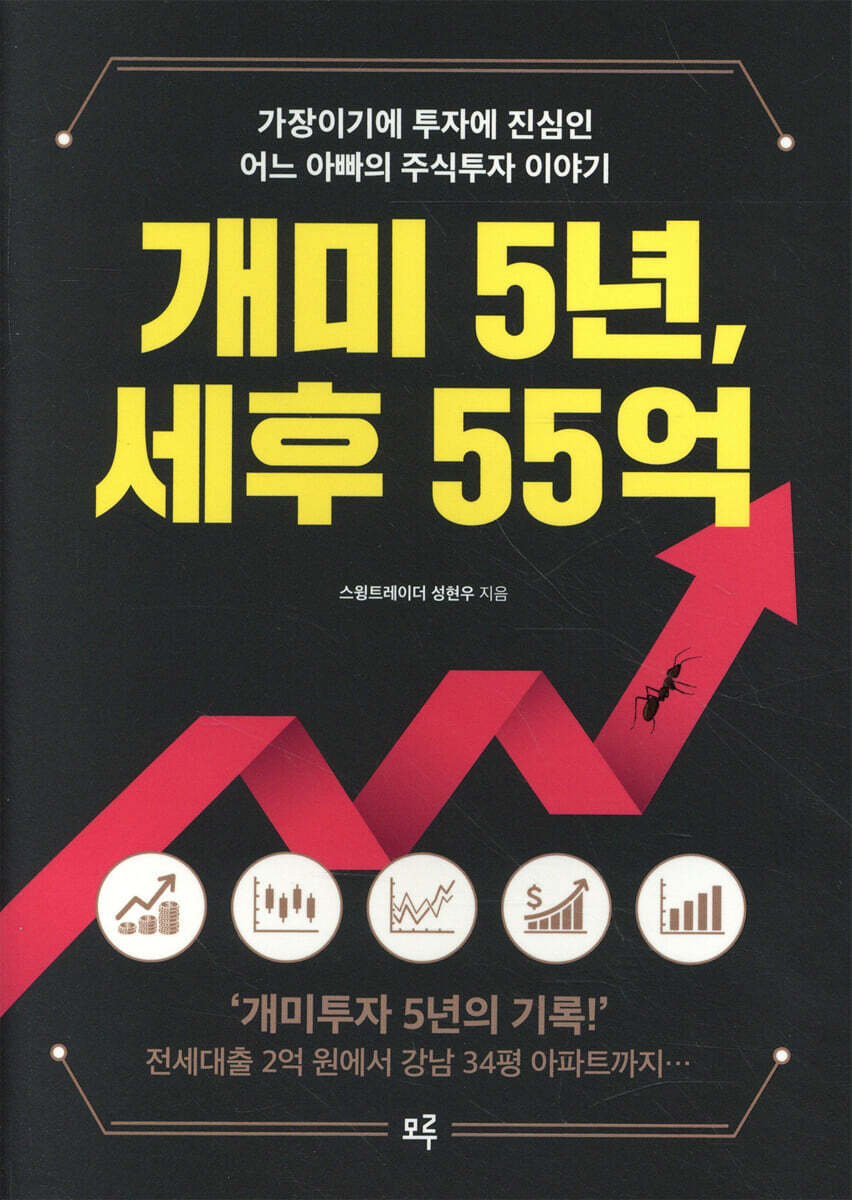
5 years of ants, 5.5 billion won after tax
 |
Description
Book Introduction
This is a surprising story that will help you re-evaluate your approach to stock investing, give you hope that you can reap big returns from it, and prove that if you put your heart and soul into anything, it will come true! The author said this in his first meeting with the publisher: “Don’t misunderstand. I didn't write this book to brag or publicize how much money I made through stock investing. Even though I am a doctor, as I have experienced and felt, it is difficult to take responsibility for the happiness of my family with just my earned income. “I wrote this manuscript because I thought my stock investment experience and story might be helpful to ordinary fathers in this day and age, when even a small spark of hope is hard to find.” His stock investment, which he started to create a strong foundation for his family's happiness and children's safety, was interesting, moving, and special. With a passion that is hotter than any stock expert, a sincerity that adds to the urgency at every moment, and sometimes even a bold courage that is almost reckless, he finally built up assets of 5.5 billion won after tax in just 5 years. However, people are more interested in the profits and the amount of money a small investor earns than in the process of investing in stocks that he struggled through. However, making a lot of money is never easy. It is a law of the world that there can be no good result without a difficult process. Perhaps the author asks this question to many people who want to achieve real success in stock investing. “How much passion, sincerity, and urgency do your stock investments reflect?” |
- You can preview some of the book's contents.
Preview
index
Introduction_5 Years of Ant Investment Record_4
Chapter 1: Know Thyself
Money is attracted to people's attention _ 19
Books that helped me invest in stocks _ 22
Finding the Right Investment Style for You _ 30
I've done everything others tell me not to do _ 36
Seeing is believing _ 40
The Difference Between Investing and Speculation _ 43
"Do you have any good sources?" Was I really that great? _ 48
The 10,000-Hour Rule for Stock Investing _ 51
5 years of ants, 5.5 billion won after tax
Chapter 2: Life and Stocks, Ultimately, a Battle of Timing
When you read the world, you see money: Cheonjiin (Heaven, Earth, and Man) Investment Method _ 59
How to Discover the Heaven, Earth, and Human Stocks _ 65
Opportunity comes to those who are prepared, disguised as coincidence _ 71
Criteria for Stock Selection _ 76
Read trends, not prices _ 81
The Nature of Stock Price Cycles: The 9/3 Rule _ 85
Invest in companies that suit you, rather than those that others recommend. _ 88
My excessive greed for profit is tormenting me _ 95
Reading the Marketplace _ 99
Chapter 3: Swing Trader's One-Shot, One-Kill, Sniper Trading Method
When and how to live.
If you only had one shot _ 107
How much to invest.
Can you handle it? _ 117
Money Has a Personality _ 122
If you're scared, give up! Memories of a Short Sell _ 126
Pay attention to the slope of the 5-day moving average and the 60-minute chart for additional buying! _ 130
Real-World Sniper Trading Case Study 1: SK Bioscience: Buy Like a Butterfly, Sell Like a Bee _ 133
Real-World Sniper Trading Case Study 2: Krafton: Standing on the Opposite Side of the Ants _ 138
Real-life sniper trading case 3 Kolon Industries: Tragedy and comedy (feat.
Samsung Electronics) _ 144
Words of Advice _ 149
Chapter 4 Mr.
John Bur's technology
Real decline and fake decline.
How to Determine the Minutes _ 157
Read the intent, not the price.
Why? _ 160
Complete Breeding 1 Force Story _ 163
Complete Breeding 2 Master of the Mind _ 167
Profits are proportional to the amount of fear and pain endured _ 170
Hey young man, aren't you afraid? _ 174
Stock Management _ 181
Chapter 5: Selling Techniques
Sell Signs, Thoughts on Technical Indicators _ 189
One-shot, one-kill, sniper sell_193
Stop loss is also selling _ 199
Memories of 500 Million Losses _ 204
Beware of Market Pain, Red Flag Sign _ 208
Chapter 6: Self-management that completes the game
Don't blame anyone.
The Enemy Is Within Me _ 215
The Aesthetics of Moderation _ 219
Waiting (feat.
Netmarble) _ 223
Distinction between Sensitivity and Discernment _ 227
Build your business with stocks.
Karma _ 230
Beginner's Lucky: Why Beginners Make Money _ 234
Stocks are Physiognomy _ 237
Give a tenth of your income to your family _ 240
Overcoming a Slump _ 243
If you do nothing, nothing happens _ 247
There is no money in the world that can be lost _ 250
Be generous with your gains, strict with your losses _ 253
Don't try to fill in the gaps all at once _ 257
Don't doubt yourself _ 261
Go with the flow in stocks and life _ 264
Wait, the great wave is coming again _ 267
Outgoing Article: Are You Serious About Stocks? _ 272
Chapter 1: Know Thyself
Money is attracted to people's attention _ 19
Books that helped me invest in stocks _ 22
Finding the Right Investment Style for You _ 30
I've done everything others tell me not to do _ 36
Seeing is believing _ 40
The Difference Between Investing and Speculation _ 43
"Do you have any good sources?" Was I really that great? _ 48
The 10,000-Hour Rule for Stock Investing _ 51
5 years of ants, 5.5 billion won after tax
Chapter 2: Life and Stocks, Ultimately, a Battle of Timing
When you read the world, you see money: Cheonjiin (Heaven, Earth, and Man) Investment Method _ 59
How to Discover the Heaven, Earth, and Human Stocks _ 65
Opportunity comes to those who are prepared, disguised as coincidence _ 71
Criteria for Stock Selection _ 76
Read trends, not prices _ 81
The Nature of Stock Price Cycles: The 9/3 Rule _ 85
Invest in companies that suit you, rather than those that others recommend. _ 88
My excessive greed for profit is tormenting me _ 95
Reading the Marketplace _ 99
Chapter 3: Swing Trader's One-Shot, One-Kill, Sniper Trading Method
When and how to live.
If you only had one shot _ 107
How much to invest.
Can you handle it? _ 117
Money Has a Personality _ 122
If you're scared, give up! Memories of a Short Sell _ 126
Pay attention to the slope of the 5-day moving average and the 60-minute chart for additional buying! _ 130
Real-World Sniper Trading Case Study 1: SK Bioscience: Buy Like a Butterfly, Sell Like a Bee _ 133
Real-World Sniper Trading Case Study 2: Krafton: Standing on the Opposite Side of the Ants _ 138
Real-life sniper trading case 3 Kolon Industries: Tragedy and comedy (feat.
Samsung Electronics) _ 144
Words of Advice _ 149
Chapter 4 Mr.
John Bur's technology
Real decline and fake decline.
How to Determine the Minutes _ 157
Read the intent, not the price.
Why? _ 160
Complete Breeding 1 Force Story _ 163
Complete Breeding 2 Master of the Mind _ 167
Profits are proportional to the amount of fear and pain endured _ 170
Hey young man, aren't you afraid? _ 174
Stock Management _ 181
Chapter 5: Selling Techniques
Sell Signs, Thoughts on Technical Indicators _ 189
One-shot, one-kill, sniper sell_193
Stop loss is also selling _ 199
Memories of 500 Million Losses _ 204
Beware of Market Pain, Red Flag Sign _ 208
Chapter 6: Self-management that completes the game
Don't blame anyone.
The Enemy Is Within Me _ 215
The Aesthetics of Moderation _ 219
Waiting (feat.
Netmarble) _ 223
Distinction between Sensitivity and Discernment _ 227
Build your business with stocks.
Karma _ 230
Beginner's Lucky: Why Beginners Make Money _ 234
Stocks are Physiognomy _ 237
Give a tenth of your income to your family _ 240
Overcoming a Slump _ 243
If you do nothing, nothing happens _ 247
There is no money in the world that can be lost _ 250
Be generous with your gains, strict with your losses _ 253
Don't try to fill in the gaps all at once _ 257
Don't doubt yourself _ 261
Go with the flow in stocks and life _ 264
Wait, the great wave is coming again _ 267
Outgoing Article: Are You Serious About Stocks? _ 272
Detailed image

Into the book
* Many people may be curious about how I was able to make a lot of money through stock investment while running a hospital.
I will reveal the details in the text, but through a long period of trial and error, I was able to perfect my investment method, which is suitable for the situation where I have to see a doctor every day.
This might be a helpful story for professional investors.
After five years of investing in stocks, I went from being a bad credit debtor to the owner of a 34-pyeong apartment in Gangnam, Seoul, but it still doesn't feel real.
I never dreamed that my vague dream of owning a home would come true in just five years.
If someone like me, who was burdened with debt, had said five years ago, "I'm going to buy a 30-pyeong apartment in Gangnam, Seoul within five years!", they would have likely been called crazy.
Isn't it nearly impossible to buy an apartment in Gangnam worth billions of won without a loan?
But then something happened to me that I thought was impossible.
---From the "Introductory Note"
** Looking back, after I decided to invest in stocks, I think I tried to read a lot of classic books on stock investment and financial management that were familiar to the public.
For the first three years after I started investing, I read over 30 books a year, or nearly 100 books, whenever I had time.
And I would stop by the stock book section of the bookstore to see if there were any new books worth reading.
However, any book should resonate with me and be especially helpful in actual trading.
No matter how many books you read, it is a separate issue from being good at stock trading.
Still, reading books on stock investment, knowingly or unknowingly, influences our investment decisions and thinking.
Even these days, I consistently buy and read books on stock investment, thinking that it is like fertilizing my stock farm.
---From "Books that helped me invest in stocks"
** I also tried many different things when I was a beginner.
I tried portfolio construction and experimented with short-term trading, closing price betting, and opening price betting, but the results were not very good.
So, I went through trial and error for about a year.
The trading method that best suited my lifestyle as a full-time worker was swing trading.
At first, I took a strategy of investing for a few days with short-term swings, but it was very stressful to do it while also receiving treatment.
So, I felt comfortable with swing investing, focusing on just one stock for a medium-term investment period of no more than one month and no more than six months, and the results were good.
That's why my pen name is Swing Trader.
My main occupation is a doctor.
I spend nearly 10 hours a day in the clinic meeting patients.
For a doctor to become obsessed with short-term trading is tantamount to suicide in stock investing.
You can't help but lose both rabbits: patients and stocks.
---From "Investment Style That Fits Me"
** Let's say someone does me a favor and gives me some good information, some advanced information.
If you believe that information and invest a large sum of money to make money, that's great, but if things go wrong and you lose money, you'll obviously blame that person.
I have had many such experiences and have observed them from the side.
So now I'm reluctant to recommend stocks to my acquaintances.
Isn't it human nature to blame others when things go well?
Like everyone else, I hate it when my life is swayed by what other people say.
I feel more comfortable with the thought that even if I fail, it will be because of my choice, and even if I prosper, it will be because of my choice.
When you're investing in stocks, you'll sometimes hear acquaintances say things like, "You know this! This stock will rise for this reason!"
When asked where the information came from, he said he heard it from a high-ranking official at a securities firm.
Was I truly such a great being that a high-ranking official at a securities firm would leak confidential information without compensation? --- From "Are there any good sources?"
** I already knew from the news that SK Bioscience was not producing flu vaccines, so it was nothing special, but the words kept ringing in my ears.
I know better than most people the capabilities of SK Bioscience, which produces flu vaccines, especially SkyCellflu.
This is because we directly participate in vaccination programs every year and administer vaccines to patients.
But it sounded strange to give up the stable revenue from flu production, which was like 'swimming with your feet on the ground'.
It was well known that SK Bioscience would not produce a flu vaccine in 2021.
I interpreted that piece of news that had already been made public as a declaration by the company that it would focus on producing a domestically produced coronavirus vaccine instead of a flu vaccine.
---From "The Method of Discovering the Heaven, Earth, and Human Stocks"
** No matter how attractive a stock is, there are things we must check.
Let me summarize and introduce a few of them.
Is there a risk of default?
Are there a lot of convertible bond (CB) issuances (are they suppressing stock prices and lowering convertible bond prices?: refixing)?
Are you obsessed with issuing stock options? (In this case, it is difficult to tell whether you are running a business or trying to make money with stocks.)
?Are there any issues related to inheritance?
Are insiders selling stock?
It is very important to remember the above.
It's good for your mental health to consider these companies as bad stocks, even if they seem attractive.
I don't even look at stocks like that.
Even if we inherit, let's inherit from a normal company.
If you are a reader who is not yet married, remember that you must meet someone of the opposite sex who is attractive and respectable enough to be willing to take responsibility for, in order to have a happy marriage.
In that sense, stocks are love.
Even if such a company is inherited, it provides at least a chance to escape with the principal someday.
---From “Standards for Stock Selection”
** Discernment cannot be acquired through study.
For example, if you look at just one candle chart, it is just a candle chart.
However, if you imagine the emotions of market participants through the minute charts that the charts show, the one-dimensional charts appear more three-dimensional.
The same goes for Hogachang.
I look at the hogachang and imagine what the participants' emotions are like.
Sometimes, when I am unsure whether a stock will sell or not, I am prepared to buy a few orders in a stock with a thin order book, and I even intentionally buy 6 or 10 orders in the order book and continue to buy recklessly to see if it goes up.
Then, you get the feeling that someone, whether it's the power behind the scenes or the biggest player in the industry, appears and gets angry and threatens, saying, "Get out, get out!"
This is a kind of game that calls itself a power test, and the interesting thing is that each main gun has a different personality.
Some guns are meticulous, some guns are fiery, and some guns are petty.
In this way, the nature of the main gun can be known by looking at how it is traded in the order book and how the order book is managed.
I look at the order book and charts to determine whether the main gun is smart or stupid, and if I feel that the trader is one step ahead of me, I don't react.
Even if I try to respond, I will inevitably fall for their tricks and lose my supplies because they are smarter than me.
---From "Reading Emotions in the Market"
** Looking at the long-term moving averages, the 5-day and 20-day lines are in reverse alignment, but the 60-day and 120-day lines are still in positive alignment.
Another feature of this chart is that the moving averages are clustered together.
What does it mean when moving averages converge? When moving averages converge, there is strong resistance from bottom to top, and strong support when they break through from top to bottom.
Because it is the average price that everyone knows, everyone wants to protect, and everyone wants to buy.
Although it is a result-oriented story, Fila Holdings saw a significant rise in the stock price in May and June due to the explosive growth in golf sales at its U.S. subsidiary Acushnet, despite the pandemic, and the moving averages changed from a partial reverse alignment to a positive alignment.
In stock investing, it's important to read moving averages, but it's also helpful to constantly imagine how the moving averages will change in the future.
I will reveal the details in the text, but through a long period of trial and error, I was able to perfect my investment method, which is suitable for the situation where I have to see a doctor every day.
This might be a helpful story for professional investors.
After five years of investing in stocks, I went from being a bad credit debtor to the owner of a 34-pyeong apartment in Gangnam, Seoul, but it still doesn't feel real.
I never dreamed that my vague dream of owning a home would come true in just five years.
If someone like me, who was burdened with debt, had said five years ago, "I'm going to buy a 30-pyeong apartment in Gangnam, Seoul within five years!", they would have likely been called crazy.
Isn't it nearly impossible to buy an apartment in Gangnam worth billions of won without a loan?
But then something happened to me that I thought was impossible.
---From the "Introductory Note"
** Looking back, after I decided to invest in stocks, I think I tried to read a lot of classic books on stock investment and financial management that were familiar to the public.
For the first three years after I started investing, I read over 30 books a year, or nearly 100 books, whenever I had time.
And I would stop by the stock book section of the bookstore to see if there were any new books worth reading.
However, any book should resonate with me and be especially helpful in actual trading.
No matter how many books you read, it is a separate issue from being good at stock trading.
Still, reading books on stock investment, knowingly or unknowingly, influences our investment decisions and thinking.
Even these days, I consistently buy and read books on stock investment, thinking that it is like fertilizing my stock farm.
---From "Books that helped me invest in stocks"
** I also tried many different things when I was a beginner.
I tried portfolio construction and experimented with short-term trading, closing price betting, and opening price betting, but the results were not very good.
So, I went through trial and error for about a year.
The trading method that best suited my lifestyle as a full-time worker was swing trading.
At first, I took a strategy of investing for a few days with short-term swings, but it was very stressful to do it while also receiving treatment.
So, I felt comfortable with swing investing, focusing on just one stock for a medium-term investment period of no more than one month and no more than six months, and the results were good.
That's why my pen name is Swing Trader.
My main occupation is a doctor.
I spend nearly 10 hours a day in the clinic meeting patients.
For a doctor to become obsessed with short-term trading is tantamount to suicide in stock investing.
You can't help but lose both rabbits: patients and stocks.
---From "Investment Style That Fits Me"
** Let's say someone does me a favor and gives me some good information, some advanced information.
If you believe that information and invest a large sum of money to make money, that's great, but if things go wrong and you lose money, you'll obviously blame that person.
I have had many such experiences and have observed them from the side.
So now I'm reluctant to recommend stocks to my acquaintances.
Isn't it human nature to blame others when things go well?
Like everyone else, I hate it when my life is swayed by what other people say.
I feel more comfortable with the thought that even if I fail, it will be because of my choice, and even if I prosper, it will be because of my choice.
When you're investing in stocks, you'll sometimes hear acquaintances say things like, "You know this! This stock will rise for this reason!"
When asked where the information came from, he said he heard it from a high-ranking official at a securities firm.
Was I truly such a great being that a high-ranking official at a securities firm would leak confidential information without compensation? --- From "Are there any good sources?"
** I already knew from the news that SK Bioscience was not producing flu vaccines, so it was nothing special, but the words kept ringing in my ears.
I know better than most people the capabilities of SK Bioscience, which produces flu vaccines, especially SkyCellflu.
This is because we directly participate in vaccination programs every year and administer vaccines to patients.
But it sounded strange to give up the stable revenue from flu production, which was like 'swimming with your feet on the ground'.
It was well known that SK Bioscience would not produce a flu vaccine in 2021.
I interpreted that piece of news that had already been made public as a declaration by the company that it would focus on producing a domestically produced coronavirus vaccine instead of a flu vaccine.
---From "The Method of Discovering the Heaven, Earth, and Human Stocks"
** No matter how attractive a stock is, there are things we must check.
Let me summarize and introduce a few of them.
Is there a risk of default?
Are there a lot of convertible bond (CB) issuances (are they suppressing stock prices and lowering convertible bond prices?: refixing)?
Are you obsessed with issuing stock options? (In this case, it is difficult to tell whether you are running a business or trying to make money with stocks.)
?Are there any issues related to inheritance?
Are insiders selling stock?
It is very important to remember the above.
It's good for your mental health to consider these companies as bad stocks, even if they seem attractive.
I don't even look at stocks like that.
Even if we inherit, let's inherit from a normal company.
If you are a reader who is not yet married, remember that you must meet someone of the opposite sex who is attractive and respectable enough to be willing to take responsibility for, in order to have a happy marriage.
In that sense, stocks are love.
Even if such a company is inherited, it provides at least a chance to escape with the principal someday.
---From “Standards for Stock Selection”
** Discernment cannot be acquired through study.
For example, if you look at just one candle chart, it is just a candle chart.
However, if you imagine the emotions of market participants through the minute charts that the charts show, the one-dimensional charts appear more three-dimensional.
The same goes for Hogachang.
I look at the hogachang and imagine what the participants' emotions are like.
Sometimes, when I am unsure whether a stock will sell or not, I am prepared to buy a few orders in a stock with a thin order book, and I even intentionally buy 6 or 10 orders in the order book and continue to buy recklessly to see if it goes up.
Then, you get the feeling that someone, whether it's the power behind the scenes or the biggest player in the industry, appears and gets angry and threatens, saying, "Get out, get out!"
This is a kind of game that calls itself a power test, and the interesting thing is that each main gun has a different personality.
Some guns are meticulous, some guns are fiery, and some guns are petty.
In this way, the nature of the main gun can be known by looking at how it is traded in the order book and how the order book is managed.
I look at the order book and charts to determine whether the main gun is smart or stupid, and if I feel that the trader is one step ahead of me, I don't react.
Even if I try to respond, I will inevitably fall for their tricks and lose my supplies because they are smarter than me.
---From "Reading Emotions in the Market"
** Looking at the long-term moving averages, the 5-day and 20-day lines are in reverse alignment, but the 60-day and 120-day lines are still in positive alignment.
Another feature of this chart is that the moving averages are clustered together.
What does it mean when moving averages converge? When moving averages converge, there is strong resistance from bottom to top, and strong support when they break through from top to bottom.
Because it is the average price that everyone knows, everyone wants to protect, and everyone wants to buy.
Although it is a result-oriented story, Fila Holdings saw a significant rise in the stock price in May and June due to the explosive growth in golf sales at its U.S. subsidiary Acushnet, despite the pandemic, and the moving averages changed from a partial reverse alignment to a positive alignment.
In stock investing, it's important to read moving averages, but it's also helpful to constantly imagine how the moving averages will change in the future.
---From "When and How Will We Live?"
Publisher's Review
* His choice was stocks, as he had almost no experience in the stock market.
: The author realized that he could never afford a house in Seoul with his own earned income, especially since he was burdened with debt. What caught his attention was stock investment, which he had tried only once during an accounting class in college.
The result of my first year of stock investing was, as most investors experience, a minus 6% account.
An ordinary person would have given up on stocks and found another way, but the author diagnosed that the problem lies in investing by following others' methods without considering one's own job and lifestyle.
After focusing on creating my own trading method, I started applying it in practice.
* Apply your own method of 'one-shot, one-kill, sniper trading method' to trading.
: After a year and a half of investing in stocks, author Seonghyeon Woo created an investment method that suited his environment and circumstances, and he focused in particular on creating a trading method that did not interfere with his main job as a doctor.
He revealed that he made a lot of profit by applying the conditions such as ① a time frame that suits him (mid-term investment), ② stock selection that suits him (market leaders, stocks of interest, turnaround stocks), and ③ the number of stocks that suits him (focusing on one stock) to actual situations.
“I came to a conclusion by combining the three conditions. Like the line from Yoo Oh-seong in the movie [Attack the Gas Station], I decided to ‘choose one at a time and go for it.’
In other words, the mid-term swing strategy of selecting one stock and investing for 1 to 6 months was the most suitable for me, and the performance was also very good!”
* What we should pay more attention to than the 5.5 billion won in profits is our attitude toward stocks.
: This book is filled with information on stock study methods, trading methods, self-management methods, and investment know-how that will be helpful to numerous investors, as well as the author's five years of experience in stock investment.
It is also an extraordinary stock investment record of an ordinary ant who made a profit of 5.5 billion won from negative assets.
But what's really important here is not the 5.5 billion won profit result, but the difficult process of making the profit.
The author has tried to fulfill his public duty as a successful individual investor by honestly revealing his own experiences and knowledge, as well as his know-how for stock market success, without exaggeration.
In other words, it is honest investment advice for those who want to succeed in stocks.
Readers who come across this book will not only realize at least the following two facts, but will also have the opportunity to examine their own investment methods, which are accustomed to creating overdraft accounts.
"Oh my goodness! You even studied that much to invest in stocks?"
"That's amazing! You even resorted to such methods to make a profit?"
: The author realized that he could never afford a house in Seoul with his own earned income, especially since he was burdened with debt. What caught his attention was stock investment, which he had tried only once during an accounting class in college.
The result of my first year of stock investing was, as most investors experience, a minus 6% account.
An ordinary person would have given up on stocks and found another way, but the author diagnosed that the problem lies in investing by following others' methods without considering one's own job and lifestyle.
After focusing on creating my own trading method, I started applying it in practice.
* Apply your own method of 'one-shot, one-kill, sniper trading method' to trading.
: After a year and a half of investing in stocks, author Seonghyeon Woo created an investment method that suited his environment and circumstances, and he focused in particular on creating a trading method that did not interfere with his main job as a doctor.
He revealed that he made a lot of profit by applying the conditions such as ① a time frame that suits him (mid-term investment), ② stock selection that suits him (market leaders, stocks of interest, turnaround stocks), and ③ the number of stocks that suits him (focusing on one stock) to actual situations.
“I came to a conclusion by combining the three conditions. Like the line from Yoo Oh-seong in the movie [Attack the Gas Station], I decided to ‘choose one at a time and go for it.’
In other words, the mid-term swing strategy of selecting one stock and investing for 1 to 6 months was the most suitable for me, and the performance was also very good!”
* What we should pay more attention to than the 5.5 billion won in profits is our attitude toward stocks.
: This book is filled with information on stock study methods, trading methods, self-management methods, and investment know-how that will be helpful to numerous investors, as well as the author's five years of experience in stock investment.
It is also an extraordinary stock investment record of an ordinary ant who made a profit of 5.5 billion won from negative assets.
But what's really important here is not the 5.5 billion won profit result, but the difficult process of making the profit.
The author has tried to fulfill his public duty as a successful individual investor by honestly revealing his own experiences and knowledge, as well as his know-how for stock market success, without exaggeration.
In other words, it is honest investment advice for those who want to succeed in stocks.
Readers who come across this book will not only realize at least the following two facts, but will also have the opportunity to examine their own investment methods, which are accustomed to creating overdraft accounts.
"Oh my goodness! You even studied that much to invest in stocks?"
"That's amazing! You even resorted to such methods to make a profit?"
GOODS SPECIFICS
- Date of issue: December 1, 2021
- Page count, weight, size: 276 pages | 496g | 153*215*20mm
- ISBN13: 9791197001932
- ISBN10: 119700193X
You may also like
카테고리
korean


korean

![ELLE 엘르 스페셜 에디션 A형 : 12월 [2025]](http://librairie.coreenne.fr/cdn/shop/files/b8e27a3de6c9538896439686c6b0e8fb.jpg?v=1766436872&width=3840)


