

Maniac
 |
Description
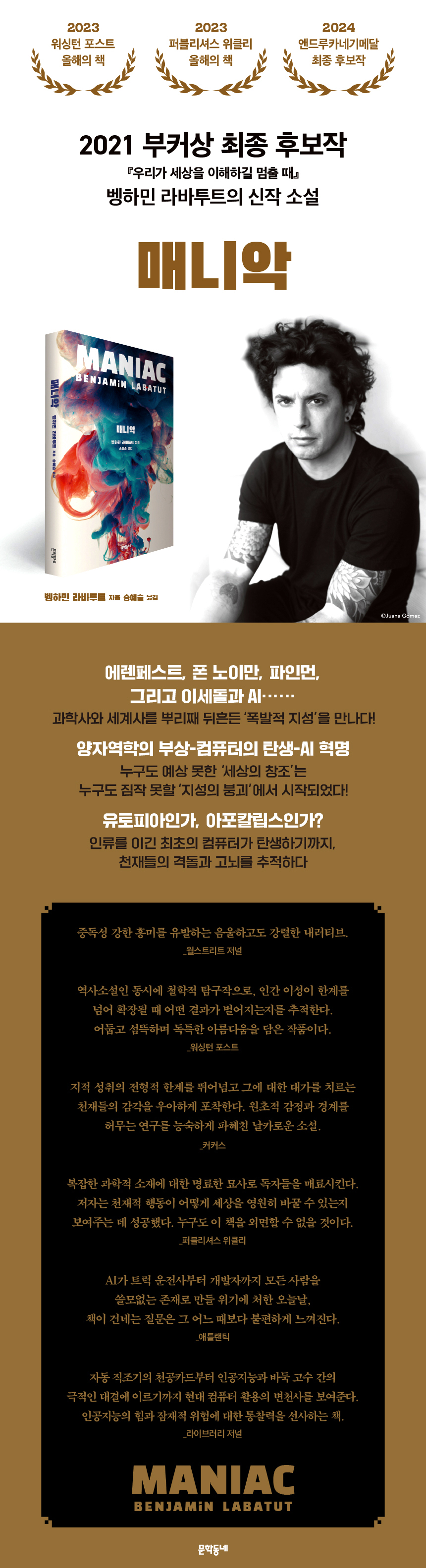
Book Introduction
“The monsters we are creating now will change history, “If history remains in the future!” John von Neumann Ehrenfest, von Neumann, Feynman, and Lee Sedol and AI… … Meet the 'explosive intellect' that shook the history of science and world history to its core! Benjamin Labatut, author of When We Stop Understanding the World, a 2021 Booker Prize finalist and translated into over 30 languages worldwide, returns with another controversial work. While the previous work focused on the inner lives of several scientists who brought about a tectonic shift in the modern scientific world, the new work, "Maniac," 1. Paul Ehrenfest (physicist) 2. John von Neumann (mathematician, physicist, computer scientist) ③ This novel focuses on the inner self and actions of Lee Sedol (a Go player) and the world that changes drastically as a result. Like the previous work, it is a non-fiction novel written as fiction based on facts. The story begins with Ehrenfest's discovery of irrationality (uncertainty, quantum mechanics) → the invention of the maniac computer by von Neumann → its further development creates a flow that leads to the current AI (AlphaGo). In particular, the Lee Sedol part, which concludes the third part, vividly unfolds like a movie, a battlefield where the past and present of Baduk and AI, the East and the West, and humans and machines collide and confront each other. * Maniac 1. madman, -mad 2. An abbreviation for Mathematical Analyzer, Numerical Integrator and Computer, the name of the computer created by John von Neumann. 3. The title of this novel, which guides you into the maddening mental world of geniuses who brought about a cataclysmic change in world history. |
- You can preview some of the book's contents.
Preview
index
Part 1: Discovery of Foul or Irrationality
Part 2 John or the Mad Dream of Reason
Chapter 1: The Limits of Logic
Chapter 2: The Precarious Balance of Fear
Chapter 3: Ghosts in the Machine
Part 3: The Delusion of Sedol or Artificial Intelligence
Acknowledgements
Part 2 John or the Mad Dream of Reason
Chapter 1: The Limits of Logic
Chapter 2: The Precarious Balance of Fear
Chapter 3: Ghosts in the Machine
Part 3: The Delusion of Sedol or Artificial Intelligence
Acknowledgements
Detailed image
Into the book
Paul became convinced that he was strangely connected to the Pythagorean sage Nelly had spoken of, and from then on he began to see disharmony and turmoil everywhere.
It became impossible to discern any rational order, natural laws, or repetitive patterns that governed the universe.
All that was visible was a vast, over-proliferated world, tainted with chaos and absurdity, without even a trace of meaningful intelligence behind it.
(...) Moreover, he discerned the presence of irrationality even more clearly in the papers and lectures of his colleagues, which were overflowing with ideas that everyone called revolutionary, but in his eyes were nothing more than the industrialization of physics.
Paul wrote to Einstein, expressing his frustration, lamenting that somehow a dark, unconscious force was creeping into the scientific worldview, confusing reason with its opposite.
--- p.28
Von Neumann's doctoral thesis provided an early indication of the style he would consistently apply in his research.
His style was to dive headfirst into a topic, strip it down to its most basic axioms, and then reduce whatever he was analyzing to a question of pure logic.
His surreal ability to see into the essence of things, or conversely, his peculiar shortsightedness to see only the fundamentals, was the secret of his genius and at the same time the reason for his childish moral ignorance.
--- p.105
He was a little devil, but to those who saw the coming madness and escaped from Germany in time, he was an angel.
I can't tell you how lucky I am that he was still a young boy when I taught him.
Because the cursor is different.
Of course, he was a giant in the world of mathematics, but God knows.
How foolish and dangerous he is! A bundle of contradictions.
It felt like I was talking to two people at the same time.
A person who is intelligent but childish, insightful but surprisingly shallow.
--- p.106
Mathematics is the discipline that is closest to the spirit of God.
Therefore, we must approach it with a worshipful heart.
There is real power in mathematics, and that power can easily be abused.
That power was born from a faculty that only humans possess, but instead of sharp teeth, claws, and toenails, our gracious God gifted us with a power that was just as dangerous and deadly.
(...) The abilities he possessed were so rare and beautiful that just watching them brought tears to my eyes.
Yeah, I saw that, but I saw something else too.
An evil, machine-like intelligence that has lost its self-control and binds us all.
But why were you silent? Because he was so superior.
--- p.111
Although much has been written about Gödel's mental breakdown, many agree that the type of paranoia he suffered from was both the cause of his downfall and the root of his mathematical achievements.
A professor who observed Gödel in his very young years at the University of Vienna said he was not sure whether his instability was due to the nature of his research, or whether he could think like Gödel only if he was in an unstable state to begin with.
I think both perspectives are correct.
(...) There were several secret strings connected between Yanos and Gödel.
They were buried in the same graveyard just a few feet apart, so they were connected even in death.
Janos's reaction to Gödel's great idea was initially unremarkable.
Because of this, Yanoshi's grand project was ruined, but it was not like Yanoshi to give in to disappointment.
He acted as if nothing had happened.
But the incident clearly changed him.
That too, completely.
Even if others didn't know, I knew.
“He wasn’t who he used to be.”
--- p.124~125
His response to the nuclear dilemma perfectly reflected his best and worst.
A character who is flawlessly logical, yet completely counterintuitive, and thoroughly rational to the point of bordering on psychopathic.
A fact that many people don't know, but my husband viewed life purely as a game.
All human activities, no matter how fatal or serious, were viewed through that lens.
(...) I know this because my lovely husband is the one who came up with one of the most dangerous ideas in human history.
The idea was so evil and cynical that it's a miracle we survived it.
--- p.165~166
So he built that machine.
“This type of device is so groundbreakingly new that much of its usefulness will only become clear once it is actually in operation,” he told me.
He knew.
The real problem isn't building a machine, it's asking the right questions in a language the machine can understand.
And he was the only one who could speak that language.
We owe Johnny so much.
Johnny didn't just give us one of the most important technological breakthroughs of the 20th century.
He left behind a part of his spirit.
The name we gave to this machine was Mathematical Analyzer, Numerical Integrator and Computer.
In short, MANIAC.
--- p.192
He may not have seen the danger lurking in his thoughts, but I, as an 'ordinary person', have personally experienced what it is like to live with someone who is extremely exceptional.
Having grown up next to Yeonchi, I knew exactly what that felt like.
I witnessed with my own eyes how renowned scientists and thinkers cowered and became speechless before him, and how they were ashamed of his superiority.
(...) They watched helplessly as Yeonchi surpassed in a matter of minutes what they had worked hard to achieve for months, if not years.
The 'god' that future technology will create will make all of us feel what I feel in front of him.
But he didn't realize that.
He failed to understand that his own desire for the prosperity of humanity could lead to its destruction.
(...) For example, he devoted himself to studying the similarities between the structure of human thought and the way digital computers work.
--- p.268~269
No one knew what was going on inside AlphaGo's strange algorithm or what its capabilities were.
Was the previous black move 15 really that crude and amateurish? Even DeepMind programmers couldn't figure it out.
AlphaGo made its own decisions without any supervision, while humans simply watched.
Demis Hassabis explained it this way long before the Great War.
“We have programmed this machine, but we have no idea what numbers it will play.
Because it is an emergent phenomenon that arises from training.
We simply create a dataset and a training algorithm.
The moves AlphaGo chooses are out of our hands and far superior to what comes out of our heads.
So, this program can be said to be autonomous in nature.
--- p.365
After losing to AlphaGo, Lee Sedol won every game in a row for several months.
When someone asked him his secret, he replied:
“Don’t rely on instinct.
“I will calculate as precisely as possible.” Lee Sedol, who seemed poised to continue his career for several more years with a string of victories and a new style of play, shocked the world in November 2019 by suddenly announcing his retirement.
(...) In his farewell match, Lee Sedol was more eager than ever to face HanDol, an artificial intelligence software developed by NHN Entertainment of Korea, rather than his long-time friend and rival Gu Ri or Ke Jie, a rising star who was dominating the international stage.
It became impossible to discern any rational order, natural laws, or repetitive patterns that governed the universe.
All that was visible was a vast, over-proliferated world, tainted with chaos and absurdity, without even a trace of meaningful intelligence behind it.
(...) Moreover, he discerned the presence of irrationality even more clearly in the papers and lectures of his colleagues, which were overflowing with ideas that everyone called revolutionary, but in his eyes were nothing more than the industrialization of physics.
Paul wrote to Einstein, expressing his frustration, lamenting that somehow a dark, unconscious force was creeping into the scientific worldview, confusing reason with its opposite.
--- p.28
Von Neumann's doctoral thesis provided an early indication of the style he would consistently apply in his research.
His style was to dive headfirst into a topic, strip it down to its most basic axioms, and then reduce whatever he was analyzing to a question of pure logic.
His surreal ability to see into the essence of things, or conversely, his peculiar shortsightedness to see only the fundamentals, was the secret of his genius and at the same time the reason for his childish moral ignorance.
--- p.105
He was a little devil, but to those who saw the coming madness and escaped from Germany in time, he was an angel.
I can't tell you how lucky I am that he was still a young boy when I taught him.
Because the cursor is different.
Of course, he was a giant in the world of mathematics, but God knows.
How foolish and dangerous he is! A bundle of contradictions.
It felt like I was talking to two people at the same time.
A person who is intelligent but childish, insightful but surprisingly shallow.
--- p.106
Mathematics is the discipline that is closest to the spirit of God.
Therefore, we must approach it with a worshipful heart.
There is real power in mathematics, and that power can easily be abused.
That power was born from a faculty that only humans possess, but instead of sharp teeth, claws, and toenails, our gracious God gifted us with a power that was just as dangerous and deadly.
(...) The abilities he possessed were so rare and beautiful that just watching them brought tears to my eyes.
Yeah, I saw that, but I saw something else too.
An evil, machine-like intelligence that has lost its self-control and binds us all.
But why were you silent? Because he was so superior.
--- p.111
Although much has been written about Gödel's mental breakdown, many agree that the type of paranoia he suffered from was both the cause of his downfall and the root of his mathematical achievements.
A professor who observed Gödel in his very young years at the University of Vienna said he was not sure whether his instability was due to the nature of his research, or whether he could think like Gödel only if he was in an unstable state to begin with.
I think both perspectives are correct.
(...) There were several secret strings connected between Yanos and Gödel.
They were buried in the same graveyard just a few feet apart, so they were connected even in death.
Janos's reaction to Gödel's great idea was initially unremarkable.
Because of this, Yanoshi's grand project was ruined, but it was not like Yanoshi to give in to disappointment.
He acted as if nothing had happened.
But the incident clearly changed him.
That too, completely.
Even if others didn't know, I knew.
“He wasn’t who he used to be.”
--- p.124~125
His response to the nuclear dilemma perfectly reflected his best and worst.
A character who is flawlessly logical, yet completely counterintuitive, and thoroughly rational to the point of bordering on psychopathic.
A fact that many people don't know, but my husband viewed life purely as a game.
All human activities, no matter how fatal or serious, were viewed through that lens.
(...) I know this because my lovely husband is the one who came up with one of the most dangerous ideas in human history.
The idea was so evil and cynical that it's a miracle we survived it.
--- p.165~166
So he built that machine.
“This type of device is so groundbreakingly new that much of its usefulness will only become clear once it is actually in operation,” he told me.
He knew.
The real problem isn't building a machine, it's asking the right questions in a language the machine can understand.
And he was the only one who could speak that language.
We owe Johnny so much.
Johnny didn't just give us one of the most important technological breakthroughs of the 20th century.
He left behind a part of his spirit.
The name we gave to this machine was Mathematical Analyzer, Numerical Integrator and Computer.
In short, MANIAC.
--- p.192
He may not have seen the danger lurking in his thoughts, but I, as an 'ordinary person', have personally experienced what it is like to live with someone who is extremely exceptional.
Having grown up next to Yeonchi, I knew exactly what that felt like.
I witnessed with my own eyes how renowned scientists and thinkers cowered and became speechless before him, and how they were ashamed of his superiority.
(...) They watched helplessly as Yeonchi surpassed in a matter of minutes what they had worked hard to achieve for months, if not years.
The 'god' that future technology will create will make all of us feel what I feel in front of him.
But he didn't realize that.
He failed to understand that his own desire for the prosperity of humanity could lead to its destruction.
(...) For example, he devoted himself to studying the similarities between the structure of human thought and the way digital computers work.
--- p.268~269
No one knew what was going on inside AlphaGo's strange algorithm or what its capabilities were.
Was the previous black move 15 really that crude and amateurish? Even DeepMind programmers couldn't figure it out.
AlphaGo made its own decisions without any supervision, while humans simply watched.
Demis Hassabis explained it this way long before the Great War.
“We have programmed this machine, but we have no idea what numbers it will play.
Because it is an emergent phenomenon that arises from training.
We simply create a dataset and a training algorithm.
The moves AlphaGo chooses are out of our hands and far superior to what comes out of our heads.
So, this program can be said to be autonomous in nature.
--- p.365
After losing to AlphaGo, Lee Sedol won every game in a row for several months.
When someone asked him his secret, he replied:
“Don’t rely on instinct.
“I will calculate as precisely as possible.” Lee Sedol, who seemed poised to continue his career for several more years with a string of victories and a new style of play, shocked the world in November 2019 by suddenly announcing his retirement.
(...) In his farewell match, Lee Sedol was more eager than ever to face HanDol, an artificial intelligence software developed by NHN Entertainment of Korea, rather than his long-time friend and rival Gu Ri or Ke Jie, a rising star who was dominating the international stage.
--- p.399~400
Publisher's Review
The Rise of Quantum Mechanics - The Birth of the Computer - The AI Revolution
The 'creation of the world' that no one expected
It started with a 'collapse of intelligence' that no one could have guessed!
Geniuses in the history of science, aliens different from us... Everyone has probably felt curious and intrigued about the minds of geniuses whom we would never dare to approach.
In fact, scientists who studied the brain of the 'genius of the century' Einstein only confirmed the disheartening fact that his brain was not much different from that of an ordinary person, but the thinking that took place inside it was clearly very different from ours.
So, what kind of thoughts unfold in the minds of geniuses, and how does that process lead to new creations?
The mad mental world of geniuses unfolding in 『Maniac』 provides its own answer to that question.
We see that the 'explosive intelligence' that the 'human brain' could not handle eventually led to collapse, and that collapse gave rise to an explosion of 'new creation'.
Utopia or Apocalypse?
Tracing the clashes and struggles of geniuses leading up to the birth of the first computer that defeated humanity.
In this dark and captivating novel based on real people and events, Labatutt places John von Neumann at the center of a trilogy that begins with physicist Paul Ehrenfest, who was devastated by the power of science and technology to become a tyrannical force, and concludes a century later with the match between South Korean Go master Lee Sedol and AlphaGo.
In other words, 『Maniac』 is a work that contains the answer to the core question of the von Neumann Project, namely, 'Is it possible to create a self-replicating machine with an intelligence that evolves beyond human understanding or control?' Although the ambitious project remained unfinished, it left another mark on human history as it led to the challenges of later scholars.
The moment when the mad intellect of geniuses explodes toward something that does not exist in the world, something completely new, something decisive that allows us to step into the realm of the divine, we encounter a world unlike any we have ever known.
Maniacs and nuclear weapons, the most ingenious and the most destructive of human inventions, were born at precisely the same time, opening a Pandora's box that would ultimately lead humanity to destruction.
In "Maniac," we come face to face with the anguish, clashes, conflicts, and longings of the geniuses who participated in the Manhattan Project, and we see the true faces of the scientists that were not captured in the film [Oppenheimer].
Was what they truly dreamed of a utopia or an apocalypse?
Although the answer to this question cannot be clearly given, the birth of AlphaGo, the "self-thinking and evolving machine" that John von Neumann so dreamed and longed for, reveals the amount of worry, agony, effort, and sweat of many people that go into the creation of a great creation that shook world history, and it brings new surprise and admiration.
* 2023 Washington Post Book of the Year
* 2023 Publisher's Weekly Book of the Year
* 2024 Andrew Carnegie Medal Finalist
A dizzying tightrope walk between fiction and non-fiction, and the overwhelming thrill that comes at the end!
No one can ignore this book.
As quantum mechanics triumphs over the classical system of physics, Paul Ehrenfest speaks of the irrationality discovered as the old certainties of classical physics crumble.
He describes it as “a mad rationality, a ghost that haunts the soul of science.”
This intellect, in its most inhuman form, was utterly indifferent to humanity's deepest needs.
Paul saw this mad rationality, this ghost that haunted the soul of science.
That entity, a formless spectre, a demonic spirit, hovered over the heads of my colleagues at meetings and conferences, peering over their shoulders as they wrote down equations and then slyly poking them in the ribs.
This truly evil force, logical and at the same time terribly irrational, was still immature and dormant, but undoubtedly growing in size.
Eager to jump into the world, they were poised to invade our lives through technology, luring smart people with whispers of superhuman strength and godlike control.
_ Page 37 of the text
Ehrenfest's warning sets the tone for Maniac, which explores how such geniuses began to unleash their ghosts with dazzling and devastating results.
And after a short and fascinating account of the death of Ehrenfest, who murdered himself and his son when the Nazis came to power in 1933, we meet John von Neumann, who contributed to the Manhattan Project, laid the foundations of modern computing ('Maniac' was the name of the computer he developed), and foresaw the possibility of artificial intelligence.
Von Neumann, who amazed those around him with his genius talent, innovated in every field he touched, including inventing game theory and the first programmable computer, and pioneering AI, digital life, and cellular automata.
The story of von Neumann is one of the most exciting new voices in modern literature, and Maniac traces the impact of his unique legacy on the dreams and nightmares of the 20th century and the early days of AI.
“How can a machine survive and come to life on its own? I think I can formulate this problem as thoroughly as Turing conceived his machine.” Yeonchi wrote to me a few months before he died.
He said he had already planned to prove the proposition that "there exists a kind of automaton called Aleph-zero, which has the property that if you give it a description of something, it will absorb that information and create two copies of itself."
_ Page 294 of the text
The program mastered all these games without any reliance on human experience.
All I did was tell them the rules and let them play on their own.
At first, the numbers were random, but soon they evolved into beings that could not be defeated.
Now it has become the world's strongest in Go, chess and shogi.
Its name is AlphaZero.
_ Page 406 of the text
A look into the minds of the designers of the nuclear age can help us understand the current battle for artificial intelligence.
In the competitiveness, arrogance, and ravenous curiosity of scientists like von Neumann, we may find an explanation for why today's AI pioneers are so eager to press forward despite the risks.
In fact, the last part of the book deals with the historic match between Lee Sedol and the artificial intelligence 'AlphaGo' created by Demis Hassabis. The moment when the long journey that started from Ehrenfest and continued through von Neumann to AlphaGo comes to an end is shocking and brings overwhelming thrills.
When historians look back on our time and choose the moment when true artificial intelligence first shone, they will likely choose a single move: move 37, played in the second match between Lee Sedol and AlphaGo on March 10, 2016.
It was a number that no computer had ever done before.
It was not a number that a human could consider.
It was something new, a radical break with the wisdom accumulated over thousands of years, a complete break with tradition.
_Page 360 of the text
The match between AlphaGo and Lee Sedol captured the world's attention. Was Lee Sedol's defeat a defeat for humanity? In an era where computers can act intelligently, what does our future hold? As international reviews such as "A book that provides insight into the power and potential dangers of artificial intelligence" (Library Journal) and "In today's world, where AI threatens to render everyone from truck drivers to developers obsolete, the questions it poses feel more uncomfortable than ever" (The Atlantic) show, this book is both a declaration of war and a warning about how the "new creation" born from the long-standing concerns and efforts of scientists will drastically change our world.
But at the same time, "Maniac" shows the hope that humanity can hold.
Lee Sedol's decisive blow, the "God's Move," that defeated AlphaGo is more than just a Go move; it is a dramatic symbol of the power and hope of humanity.
“0.0001,” the junior researcher answered.
Silence fell.
One in ten thousand.
In the second game, when AlphaGo made its presence felt in the world of Go with its groundbreaking move 37, the probability given to its own move was exactly the same.
In the end, the AlphaGo network also acknowledged the name given to Lee Sedol's move by Chinese professional player Gu Li.
It was truly a divine move, a stroke of divine hand.
A number that only one person out of ten thousand could come up with.
That's why AlphaGo was flustered by Lee Sedol's moves.
It was a move that not only far surpassed human experience, but also surpassed AlphaGo's seemingly infinite abilities.
Lee Sedol and the computer, facing each other, transcended the limits of Go, unfolding a strange and terrifying beauty and a logic stronger than reason, sending ripples that reached far and wide.
_Page 393
Labatutt handles all of this with impressive skill, unraveling complex ideas in long, elegant sentences that propel the book forward at a brisk pace.
As the Wall Street Journal wrote, it is “a darkly compelling narrative with addictive intrigue,” and as Publisher’s Weekly put it, “no one can turn away from this book.”
The 'creation of the world' that no one expected
It started with a 'collapse of intelligence' that no one could have guessed!
Geniuses in the history of science, aliens different from us... Everyone has probably felt curious and intrigued about the minds of geniuses whom we would never dare to approach.
In fact, scientists who studied the brain of the 'genius of the century' Einstein only confirmed the disheartening fact that his brain was not much different from that of an ordinary person, but the thinking that took place inside it was clearly very different from ours.
So, what kind of thoughts unfold in the minds of geniuses, and how does that process lead to new creations?
The mad mental world of geniuses unfolding in 『Maniac』 provides its own answer to that question.
We see that the 'explosive intelligence' that the 'human brain' could not handle eventually led to collapse, and that collapse gave rise to an explosion of 'new creation'.
Utopia or Apocalypse?
Tracing the clashes and struggles of geniuses leading up to the birth of the first computer that defeated humanity.
In this dark and captivating novel based on real people and events, Labatutt places John von Neumann at the center of a trilogy that begins with physicist Paul Ehrenfest, who was devastated by the power of science and technology to become a tyrannical force, and concludes a century later with the match between South Korean Go master Lee Sedol and AlphaGo.
In other words, 『Maniac』 is a work that contains the answer to the core question of the von Neumann Project, namely, 'Is it possible to create a self-replicating machine with an intelligence that evolves beyond human understanding or control?' Although the ambitious project remained unfinished, it left another mark on human history as it led to the challenges of later scholars.
The moment when the mad intellect of geniuses explodes toward something that does not exist in the world, something completely new, something decisive that allows us to step into the realm of the divine, we encounter a world unlike any we have ever known.
Maniacs and nuclear weapons, the most ingenious and the most destructive of human inventions, were born at precisely the same time, opening a Pandora's box that would ultimately lead humanity to destruction.
In "Maniac," we come face to face with the anguish, clashes, conflicts, and longings of the geniuses who participated in the Manhattan Project, and we see the true faces of the scientists that were not captured in the film [Oppenheimer].
Was what they truly dreamed of a utopia or an apocalypse?
Although the answer to this question cannot be clearly given, the birth of AlphaGo, the "self-thinking and evolving machine" that John von Neumann so dreamed and longed for, reveals the amount of worry, agony, effort, and sweat of many people that go into the creation of a great creation that shook world history, and it brings new surprise and admiration.
* 2023 Washington Post Book of the Year
* 2023 Publisher's Weekly Book of the Year
* 2024 Andrew Carnegie Medal Finalist
A dizzying tightrope walk between fiction and non-fiction, and the overwhelming thrill that comes at the end!
No one can ignore this book.
As quantum mechanics triumphs over the classical system of physics, Paul Ehrenfest speaks of the irrationality discovered as the old certainties of classical physics crumble.
He describes it as “a mad rationality, a ghost that haunts the soul of science.”
This intellect, in its most inhuman form, was utterly indifferent to humanity's deepest needs.
Paul saw this mad rationality, this ghost that haunted the soul of science.
That entity, a formless spectre, a demonic spirit, hovered over the heads of my colleagues at meetings and conferences, peering over their shoulders as they wrote down equations and then slyly poking them in the ribs.
This truly evil force, logical and at the same time terribly irrational, was still immature and dormant, but undoubtedly growing in size.
Eager to jump into the world, they were poised to invade our lives through technology, luring smart people with whispers of superhuman strength and godlike control.
_ Page 37 of the text
Ehrenfest's warning sets the tone for Maniac, which explores how such geniuses began to unleash their ghosts with dazzling and devastating results.
And after a short and fascinating account of the death of Ehrenfest, who murdered himself and his son when the Nazis came to power in 1933, we meet John von Neumann, who contributed to the Manhattan Project, laid the foundations of modern computing ('Maniac' was the name of the computer he developed), and foresaw the possibility of artificial intelligence.
Von Neumann, who amazed those around him with his genius talent, innovated in every field he touched, including inventing game theory and the first programmable computer, and pioneering AI, digital life, and cellular automata.
The story of von Neumann is one of the most exciting new voices in modern literature, and Maniac traces the impact of his unique legacy on the dreams and nightmares of the 20th century and the early days of AI.
“How can a machine survive and come to life on its own? I think I can formulate this problem as thoroughly as Turing conceived his machine.” Yeonchi wrote to me a few months before he died.
He said he had already planned to prove the proposition that "there exists a kind of automaton called Aleph-zero, which has the property that if you give it a description of something, it will absorb that information and create two copies of itself."
_ Page 294 of the text
The program mastered all these games without any reliance on human experience.
All I did was tell them the rules and let them play on their own.
At first, the numbers were random, but soon they evolved into beings that could not be defeated.
Now it has become the world's strongest in Go, chess and shogi.
Its name is AlphaZero.
_ Page 406 of the text
A look into the minds of the designers of the nuclear age can help us understand the current battle for artificial intelligence.
In the competitiveness, arrogance, and ravenous curiosity of scientists like von Neumann, we may find an explanation for why today's AI pioneers are so eager to press forward despite the risks.
In fact, the last part of the book deals with the historic match between Lee Sedol and the artificial intelligence 'AlphaGo' created by Demis Hassabis. The moment when the long journey that started from Ehrenfest and continued through von Neumann to AlphaGo comes to an end is shocking and brings overwhelming thrills.
When historians look back on our time and choose the moment when true artificial intelligence first shone, they will likely choose a single move: move 37, played in the second match between Lee Sedol and AlphaGo on March 10, 2016.
It was a number that no computer had ever done before.
It was not a number that a human could consider.
It was something new, a radical break with the wisdom accumulated over thousands of years, a complete break with tradition.
_Page 360 of the text
The match between AlphaGo and Lee Sedol captured the world's attention. Was Lee Sedol's defeat a defeat for humanity? In an era where computers can act intelligently, what does our future hold? As international reviews such as "A book that provides insight into the power and potential dangers of artificial intelligence" (Library Journal) and "In today's world, where AI threatens to render everyone from truck drivers to developers obsolete, the questions it poses feel more uncomfortable than ever" (The Atlantic) show, this book is both a declaration of war and a warning about how the "new creation" born from the long-standing concerns and efforts of scientists will drastically change our world.
But at the same time, "Maniac" shows the hope that humanity can hold.
Lee Sedol's decisive blow, the "God's Move," that defeated AlphaGo is more than just a Go move; it is a dramatic symbol of the power and hope of humanity.
“0.0001,” the junior researcher answered.
Silence fell.
One in ten thousand.
In the second game, when AlphaGo made its presence felt in the world of Go with its groundbreaking move 37, the probability given to its own move was exactly the same.
In the end, the AlphaGo network also acknowledged the name given to Lee Sedol's move by Chinese professional player Gu Li.
It was truly a divine move, a stroke of divine hand.
A number that only one person out of ten thousand could come up with.
That's why AlphaGo was flustered by Lee Sedol's moves.
It was a move that not only far surpassed human experience, but also surpassed AlphaGo's seemingly infinite abilities.
Lee Sedol and the computer, facing each other, transcended the limits of Go, unfolding a strange and terrifying beauty and a logic stronger than reason, sending ripples that reached far and wide.
_Page 393
Labatutt handles all of this with impressive skill, unraveling complex ideas in long, elegant sentences that propel the book forward at a brisk pace.
As the Wall Street Journal wrote, it is “a darkly compelling narrative with addictive intrigue,” and as Publisher’s Weekly put it, “no one can turn away from this book.”
GOODS SPECIFICS
- Date of issue: January 26, 2024
- Page count, weight, size: 412 pages | 422g | 140*210*20mm
- ISBN13: 9788954697934
- ISBN10: 8954697933
You may also like
카테고리
korean


korean

![GQ KOREA Mark (Monthly): December [2025]](http://librairie.coreenne.fr/cdn/shop/files/8ef265dbbfbf186523ed75ba7319009d.jpg?v=1765340328&width=3840)


