

How to perceive the world
 |
Description
Book Introduction
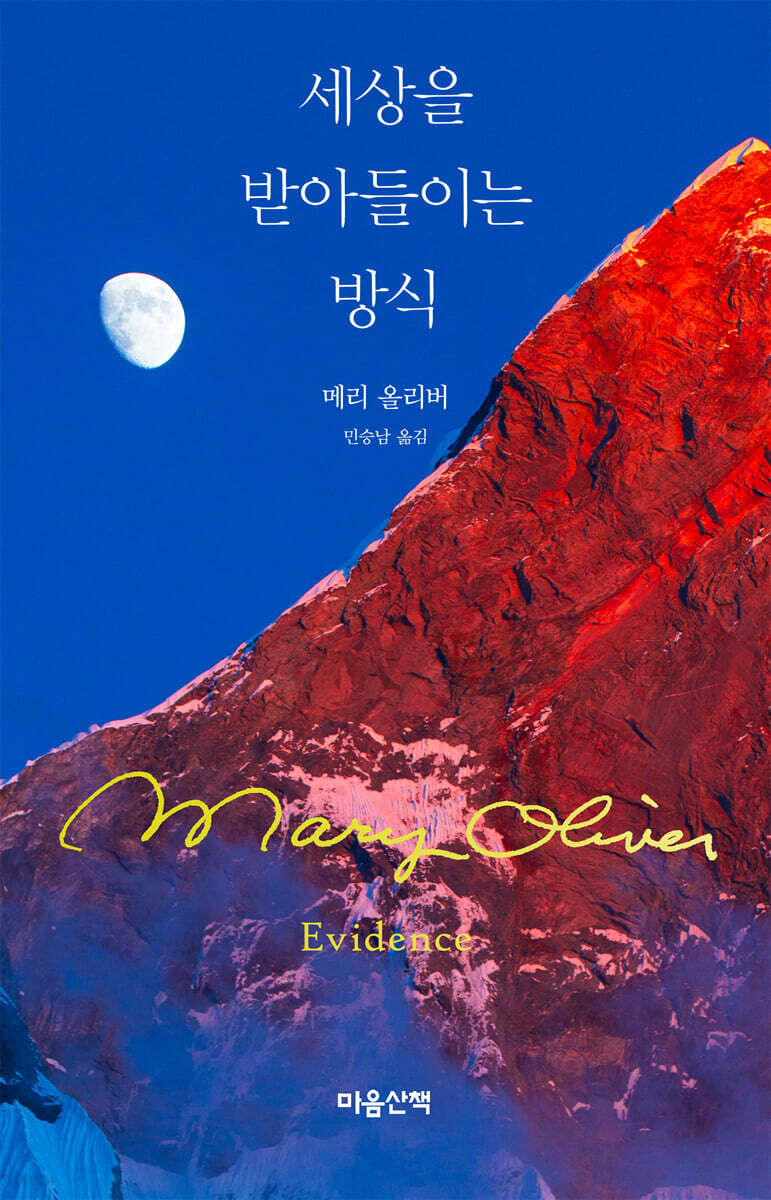
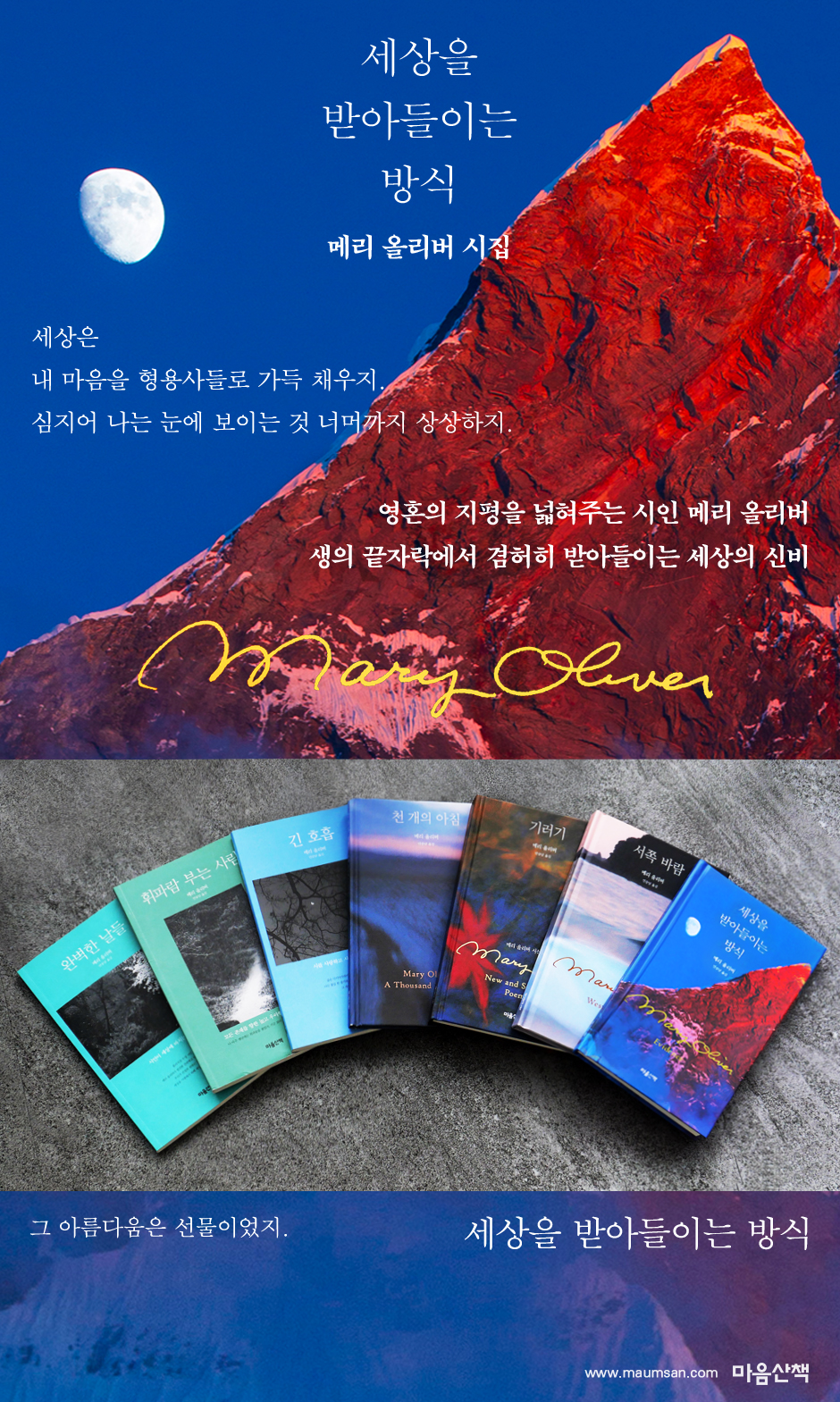
“The world fills my heart with adjectives. “I even imagine beyond what I see” The mysteries of the world, humbly accepted at the end of life Mary Oliver, a poet who broadens the horizons of the soul Mary Oliver, winner of the National Book Award and the Pulitzer Prize and called “America’s greatest poet” (The New York Times), has published her poetry collection, “A Way of Embracing the World,” as a book to open the new year of 2024. This is the fourth poetry collection to be published by Maumsanchaek, which has consistently introduced Mary Oliver's poetry and prose in Korea, following 『A Thousand Mornings』, 『Wild Geese』, and 『West Wind』. The poet used to wake up at dawn and walk alone through Provincetown, an artist's paradise. I wandered through the vast forests, fields, sand dunes, and beaches, trying to see, hear, and feel the natural scenery with my whole body. Whenever I was suddenly overcome by the feeling of becoming one with the world, I wrote it down in beautiful, concise sentences in my notebook. "The Way We Accept the World" contains poems written by Mary Oliver in her mid-seventies, as she delved deeply into the relationship between humans and nature and broadened her spiritual horizons. So, it shows that one is willing to shake off the pain of a long life and submit to the divine law of death. It is a complete expression of the finiteness and mystery of life, felt not only through the growth and decay of natural objects, but also while watching the end of loved ones. In the end, the poet, with his old body, comes to “feel the days when he has wings” (“Hallelujah”). Mary Oliver, who accepted the inevitable sense of mortality at the end of life with humble joy rather than fear. Having spent a long time in communion with nature and come to love all things and himself, he embraces the world with warm and generous arms in “The Way of Accepting the World.” Thus, the poet's heartfelt and sincere poems give us comfort like a blessing. |
- You can preview some of the book's contents.
Preview
index
yellow
swan
Poetry of the Heart
Eagle Prince
Lee Tae-baek and the moon
Thinking of the whirlpool
Little Egret
violet
Then the bluebird sang
We are trembling with joy
spring
A poet who always carries a notebook
Another acacia tree
hallelujah
early morning
water
If you tell the truth about it, your mind will not be able to bear it.
Empty branches in an orchard
Lessons from James Wright
deep summer
Almost like a conversation
There are a lot of mockingbirds in this book
pray
In the pond
First of all, sweet grass
I am grateful to the sparrow, who has a truly delicate and humble voice.
Winter landscape
I want to write something very simple
evidence
I am standing
Schubert
Moon and Water
When I was young and poor
On the Clarion River
Philip's birthday
What I want to be
About angels and trees
I met a wolf
Just rain
Riddle, yeah
Imagine
First Days in San Miguel de Allende
trees
sick, not sick
A unique and vibrant life
Another summer has begun
Translator's Note
Author's chronology
Tributes to Mary Oliver
swan
Poetry of the Heart
Eagle Prince
Lee Tae-baek and the moon
Thinking of the whirlpool
Little Egret
violet
Then the bluebird sang
We are trembling with joy
spring
A poet who always carries a notebook
Another acacia tree
hallelujah
early morning
water
If you tell the truth about it, your mind will not be able to bear it.
Empty branches in an orchard
Lessons from James Wright
deep summer
Almost like a conversation
There are a lot of mockingbirds in this book
pray
In the pond
First of all, sweet grass
I am grateful to the sparrow, who has a truly delicate and humble voice.
Winter landscape
I want to write something very simple
evidence
I am standing
Schubert
Moon and Water
When I was young and poor
On the Clarion River
Philip's birthday
What I want to be
About angels and trees
I met a wolf
Just rain
Riddle, yeah
Imagine
First Days in San Miguel de Allende
trees
sick, not sick
A unique and vibrant life
Another summer has begun
Translator's Note
Author's chronology
Tributes to Mary Oliver
Detailed image
Into the book
I wish you too would stop for a moment / and praise / those slender stems, those leaves, those sacred seeds
---From "Another Acacia Tree"
Sometimes I feel blessed just by standing / anywhere /
---From "Early Morning"
May I never lose my vitality, / May I never lose my recklessness.
---From "Prayer"
The person I love is old and sick.
/ I watched the lights go out one by one.
/ All I could do was // take what was given to us / and remember that we must give back when the time comes.
---From "On the Clarion River"
An attitude of obedience to the most sacred law / to live / until one is no longer alive.
---From "A Unique and Vibrant Life"
Summer begins again.
/ How many summers / do I still have left?
---From "Another Acacia Tree"
Sometimes I feel blessed just by standing / anywhere /
---From "Early Morning"
May I never lose my vitality, / May I never lose my recklessness.
---From "Prayer"
The person I love is old and sick.
/ I watched the lights go out one by one.
/ All I could do was // take what was given to us / and remember that we must give back when the time comes.
---From "On the Clarion River"
An attitude of obedience to the most sacred law / to live / until one is no longer alive.
---From "A Unique and Vibrant Life"
Summer begins again.
/ How many summers / do I still have left?
---From "Another Summer Begins"
Publisher's Review
“The world fills my heart with adjectives.
“I even imagine beyond what I see”
The mysteries of the world, humbly accepted at the end of life
Mary Oliver, a poet who broadens the horizons of the soul
Mary Oliver, winner of the National Book Award and the Pulitzer Prize and called “America’s greatest poet” (The New York Times), has published her poetry collection, “A Way of Embracing the World,” as a book to open the new year of 2024.
This is the fourth poetry collection to be published by Maumsanchaek, which has consistently introduced Mary Oliver's poetry and prose in Korea, following 『A Thousand Mornings』, 『Wild Geese』, and 『West Wind』.
The poet used to wake up at dawn and walk alone through Provincetown, an artist's paradise.
I wandered through the vast forests, fields, sand dunes, and beaches, trying to see, hear, and feel the natural scenery with my whole body.
Whenever I was suddenly overcome by the feeling of becoming one with the world, I wrote it down in beautiful, concise sentences in my notebook.
"The Way We Accept the World" contains poems written by Mary Oliver in her mid-seventies, as she delved deeply into the relationship between humans and nature and broadened her spiritual horizons.
So, it shows that one is willing to shake off the pain of a long life and submit to the divine law of death.
It is a complete expression of the finiteness and mystery of life, felt not only through the growth and decay of natural objects, but also while watching the end of loved ones.
In the end, the poet, with his old body, comes to “feel the days when he has wings” (“Hallelujah”).
Mary Oliver, who accepted the inevitable sense of mortality at the end of life with humble joy rather than fear.
Having spent a long time in communion with nature and come to love all things and himself, he embraces the world with warm and generous arms in “The Way of Accepting the World.”
Thus, the poet's heartfelt and sincere poems give us comfort like a blessing.
Someone // came to me / stayed / and slowly // became everything that changed my life.
/ Oh, I wish everyone // had that kind of luck.
_From "Painful, Not Painful"
“That beauty was a gift.”
The healing power and inclusiveness of nature
Mary Oliver was sexually abused by her father as a child and, unable to bear to stay home, wandered through the woods with a book of Walt Whitman's poetry.
I felt so much pain that I wanted to disappear from the world without a trace, but I gradually regained peace as I surrendered myself to the flowers blooming in the fields, the leaves swaying in the wind, the roaring river, and the blue moonlight.
The poet, who wrote about his experience of healing his heart in nature, learned how to affirm and praise the world.
In his old age, he was able to move freely from “the motionless blackness” (“Winter Landscape”) and “the lightless cellar” (“Evidence”) to “the sunlit road” (“First Days in San Miguel de Allende”).
I wake up / and spend the last hour of darkness / alone with the moon.
/ The moon / listens to my complaints like a good friend / and with its light / gives me certain comfort.
_From "Moon and Water"
Freed from the shadows of the past, the poet shows a much broader inclusiveness.
"At the Pond" depicts the encounter between a poet and newborn baby geese.
In this poem, five of the six baby geese grow well and have strong wings, but one grows slowly and never flies.
Then, the poet bids farewell to the geese that are leaving for a long distance in the fall, and quietly embraces the one remaining one.
Nature holds many mysteries, // some of them harsh.
/ (…) / And how do I / accept the world? / I was happy for the five chicks that flew away / and // for the two parents / and I held the wingless one that had to stay / in my heart.
_From "At the Pond"
“I am part of the divine.”
A sublime gaze encompassing life and death
In "The Way We Perceive the World," Mary Oliver is keenly aware of the landscape beyond life.
In "Thinking of the Wanderer," the poet encounters a deer limping on one leg while walking through a green swamp one afternoon.
He names the deer "Whirlwind" after seeing its crippled legs dart around in the air, and refers to himself as "just a harmless mumbling."
The two share a bond that transcends language and race, but before long, the wandering young man is shot by an arrow and dies.
At this point, the poet does not mourn or feel pity for the deer's death, but laments that "we all leave behind unfinished lives."
In "On the Clarion River," the attitude that seems to transcend life and death is also vivid.
In this work, the poet listens intently to the river's story all afternoon.
If God exists, I imagine it would be butter and luck, the tick that killed my dog, lilies, forests, deserts, melting ice caps, and potentially all of us.
It is about discovering the form of God, a kind of divinity, in all beings in the world.
In this way, 『The Way We Embrace the World』 tells us that we can be “small pieces of God’s intention and hope.”
It leads us to realize the sublimity inherent in life through an attitude of reverence for all things.
All beautiful things fulfill their original function of moving the beholder / leading him to sublime thoughts.
/ Glory be to the great teacher called the world.
_From "Evidence"
“I even imagine beyond what I see”
The mysteries of the world, humbly accepted at the end of life
Mary Oliver, a poet who broadens the horizons of the soul
Mary Oliver, winner of the National Book Award and the Pulitzer Prize and called “America’s greatest poet” (The New York Times), has published her poetry collection, “A Way of Embracing the World,” as a book to open the new year of 2024.
This is the fourth poetry collection to be published by Maumsanchaek, which has consistently introduced Mary Oliver's poetry and prose in Korea, following 『A Thousand Mornings』, 『Wild Geese』, and 『West Wind』.
The poet used to wake up at dawn and walk alone through Provincetown, an artist's paradise.
I wandered through the vast forests, fields, sand dunes, and beaches, trying to see, hear, and feel the natural scenery with my whole body.
Whenever I was suddenly overcome by the feeling of becoming one with the world, I wrote it down in beautiful, concise sentences in my notebook.
"The Way We Accept the World" contains poems written by Mary Oliver in her mid-seventies, as she delved deeply into the relationship between humans and nature and broadened her spiritual horizons.
So, it shows that one is willing to shake off the pain of a long life and submit to the divine law of death.
It is a complete expression of the finiteness and mystery of life, felt not only through the growth and decay of natural objects, but also while watching the end of loved ones.
In the end, the poet, with his old body, comes to “feel the days when he has wings” (“Hallelujah”).
Mary Oliver, who accepted the inevitable sense of mortality at the end of life with humble joy rather than fear.
Having spent a long time in communion with nature and come to love all things and himself, he embraces the world with warm and generous arms in “The Way of Accepting the World.”
Thus, the poet's heartfelt and sincere poems give us comfort like a blessing.
Someone // came to me / stayed / and slowly // became everything that changed my life.
/ Oh, I wish everyone // had that kind of luck.
_From "Painful, Not Painful"
“That beauty was a gift.”
The healing power and inclusiveness of nature
Mary Oliver was sexually abused by her father as a child and, unable to bear to stay home, wandered through the woods with a book of Walt Whitman's poetry.
I felt so much pain that I wanted to disappear from the world without a trace, but I gradually regained peace as I surrendered myself to the flowers blooming in the fields, the leaves swaying in the wind, the roaring river, and the blue moonlight.
The poet, who wrote about his experience of healing his heart in nature, learned how to affirm and praise the world.
In his old age, he was able to move freely from “the motionless blackness” (“Winter Landscape”) and “the lightless cellar” (“Evidence”) to “the sunlit road” (“First Days in San Miguel de Allende”).
I wake up / and spend the last hour of darkness / alone with the moon.
/ The moon / listens to my complaints like a good friend / and with its light / gives me certain comfort.
_From "Moon and Water"
Freed from the shadows of the past, the poet shows a much broader inclusiveness.
"At the Pond" depicts the encounter between a poet and newborn baby geese.
In this poem, five of the six baby geese grow well and have strong wings, but one grows slowly and never flies.
Then, the poet bids farewell to the geese that are leaving for a long distance in the fall, and quietly embraces the one remaining one.
Nature holds many mysteries, // some of them harsh.
/ (…) / And how do I / accept the world? / I was happy for the five chicks that flew away / and // for the two parents / and I held the wingless one that had to stay / in my heart.
_From "At the Pond"
“I am part of the divine.”
A sublime gaze encompassing life and death
In "The Way We Perceive the World," Mary Oliver is keenly aware of the landscape beyond life.
In "Thinking of the Wanderer," the poet encounters a deer limping on one leg while walking through a green swamp one afternoon.
He names the deer "Whirlwind" after seeing its crippled legs dart around in the air, and refers to himself as "just a harmless mumbling."
The two share a bond that transcends language and race, but before long, the wandering young man is shot by an arrow and dies.
At this point, the poet does not mourn or feel pity for the deer's death, but laments that "we all leave behind unfinished lives."
In "On the Clarion River," the attitude that seems to transcend life and death is also vivid.
In this work, the poet listens intently to the river's story all afternoon.
If God exists, I imagine it would be butter and luck, the tick that killed my dog, lilies, forests, deserts, melting ice caps, and potentially all of us.
It is about discovering the form of God, a kind of divinity, in all beings in the world.
In this way, 『The Way We Embrace the World』 tells us that we can be “small pieces of God’s intention and hope.”
It leads us to realize the sublimity inherent in life through an attitude of reverence for all things.
All beautiful things fulfill their original function of moving the beholder / leading him to sublime thoughts.
/ Glory be to the great teacher called the world.
_From "Evidence"
GOODS SPECIFICS
- Date of issue: January 5, 2024
- Page count, weight, size: 232 pages | 398g | 130*204*17mm
- ISBN13: 9788960908581
- ISBN10: 8960908584
You may also like
카테고리
korean


korean

![GQ KOREA Mark (Monthly): December [2025]](http://librairie.coreenne.fr/cdn/shop/files/8ef265dbbfbf186523ed75ba7319009d.jpg?v=1765340328&width=3840)


