

The dog on my table
 |
Description
Book Introduction
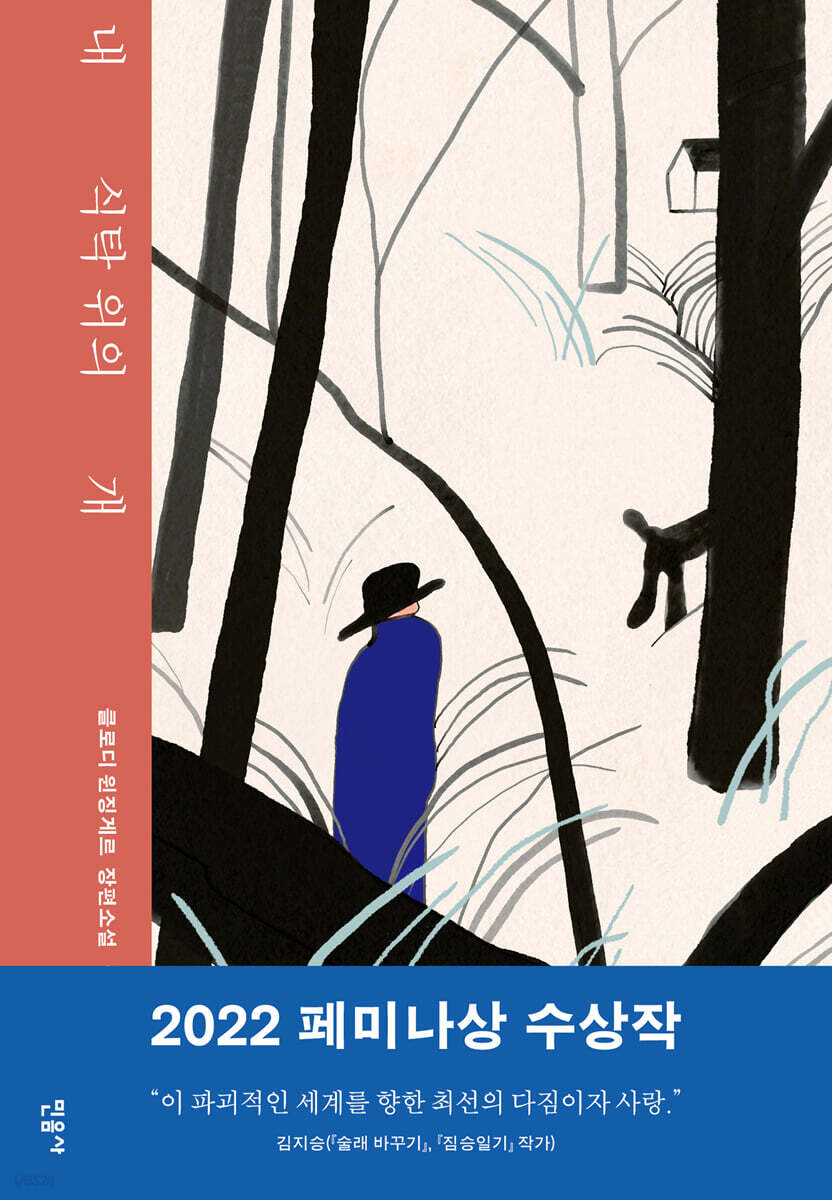
2022 Femina Award Winner “Even with tears in my eyes, I write without wavering.” An abused dog appears before an old couple in the forest. About the vast world that dog taught me and how to love it. The 2022 Femina Award-winning novel, "A Dog on My Table," which movingly depicts the changes that occur in the daily lives and hearts of an elderly couple living alone in a forest far from the world after an abused dog appears before them one day, has been published by Minumsa. The author, Claudie Winzinger, is an eighty-three-year-old writer and sculptor who is being introduced to Korea for the first time. Although he debuted as a novelist at the late age of 70, he is already a famous artist in France, having published books about life in the Vanbois Forest in the Vosges Mountains of Alsace since the 1970s and has been actively engaged in a series of related plastic art activities. In 1965, when hippie culture was flourishing, Claudie Winzinger and her husband Francis Winzinger left the consumer society and moved to the Banbua Forest to experiment with a new way of life. They have lived there for over 60 years and still live there today. The couple raised sheep and farmed there, living a near-subsistence life, while also creating and writing about nature-themed sculptural art pieces, such as dyeing wool with lichen and printing images of grass. Winzinger, whose almost every novel since her debut has been nominated for a major literary award, finally won the Prix Femina, one of France's three major literary awards, in 2022 for her eleventh novel, The Dog on My Table. In France, Winzinger's thoroughly non-mainstream literature emerged as a central figure in response to the demands of the times. |
- You can preview some of the book's contents.
Preview
index
Dog on My Table 11
Translator's Note 387
Translator's Note 387
Into the book
I saw the shadow creeping between the bracken leaves.
It was passing through a place where digitalis grew.
A broken piece of chain came into view.
fugitive.
The fugitive was approaching.
It seemed like they noticed me before I noticed them.
At that moment, it disappeared behind a bracken tree as tall as a person, then reappeared a little distance away and eventually ran away.
I stood up to get a better view of my opponent's movements.
It had gone off the side road and was now coming straight down towards me.
I slowed down at ten paces, hesitated, and then stopped in place.
The shaggy, gray ball of fur was starving and exhausted.
Large brown eyes were watching me from deep within, without averting their gaze.
Where on earth did you come from?
--- p.12
At that moment, a sentence flashed through my mind like lightning.
Yes, I said yes.
I would agree.
That's how the dog got the name 'Yes'.
I said.
I'm here, yes.
I squatted down and ran my fingers through the fur on the dog's neck.
Long strawberry stems, birch leaves, and that wet fur covered in moss.
The fugitive seemed to have been hit by the rain before me.
It smelled like wet dog, probably coming from the west where it had rained earlier.
--- p.15
Grieg and I, the two of us, settled here three years ago.
There were very few items that were brought from the old house and were being used or stored.
The things occupying that place were things I had laughed at my whole life.
Stockpiles of food, metal cans, glass bottles, and plastic containers with tight-fitting lids filled the deep walls, shelves upon shelves.
In fact, shortly after we arrived here in Buabani, all kinds of small forest rodents came to our kitchen and each one took a load of food.
The spectacled dormouse came every night and took the sugar cubes made from sugarcane, the field mice took the walnuts as big as themselves one by one until they were all gone, the mice poked holes in the coconut milk cartons and stole them, and the rats that rustled faintly in the attic grabbed the bread in their paws and dragged it noisily back to their secret hideout.
But I have never seen a striped mouse before.
It would be nice to see a striped mouse right in front of your nose at least once in your life, or to catch a glimpse of its bulging, black, sparkling eyes, those eyes that reflect the world upside down like water droplets.
--- p.20~21
Yes, he wouldn't have been caught in the pedophile's trap that chained him up for long.
It probably wouldn't have been more than a week.
Oh, be careful.
Pedophilia and zoophilia are not the same.
But why can't I see these two as the same? Is it because we humans are special? Are humans truly superior to other species? No.
It's just different.
Therefore, the two are not the same.
But I was lost in thought that evening as to why the little dog looked at me with such incredible equalism.
It was the dog's eyes that made me discover equality and reminded me of it.
But why did the dog gobble up the food we gave it and then immediately run away? Why did it reject the possibility of friendship when it seemed like it might? Why did it have to run away?
--- p.40~41
Because I feel weaker than ever before in my life.
This is the conclusion I reached after running to the end.
You must return your weapons and accept failure.
I thought to myself.
I'm really old now.
Yeah, I'm old.
The body is tumbling.
You won't be able to wander through the forest anymore.
(…) But the place I want to go is still the forest.
Only there can I speak.
Talking about the forest.
In my head, in my heart, deep inside my skin, that's what I want.
To write another book, a story of the forest, a story of a dark forest covered in fluff.
--- p.50
It was a forgotten house, more forgotten than any house we had ever lived in, sitting amidst the white rubble.
A house that is the prototype of non-historical purity, but fragmented into pieces.
Despite this, or perhaps because of it, there was an indescribable vitality in the absence of final salvation.
That's why we were so fascinated by it.
But the house was nothing compared to the grassland that spread out below.
A piece of the Holocene era abandoned by capitalism.
The meadow was full of flowers.
It was silent.
It was full of life.
It was unrealistic.
It didn't look like an abandoned place at all.
(…) After completing all the genealogical research there, Grieg and I were finally able to purchase the house and 63 acres of meadow.
I didn't want to pay attention to the premonitions the name attached to it evoked.
We took that premonition in two ways: Grieg felt himself exiled, and he always rejoiced at the fact.
I even pondered the meaning of that sentence.
He said he was cast out of a sinful world.
In other words, we were once again correcting the meaning.
It means that we, innocent and exiled, are reborn somewhere else.
--- p.69~70
No way, you're not abnormal.
The emotions you feel are not yours alone.
I'm sure there's a sister somewhere out there who thinks like you.
There actually was one such being.
Didn't Janet Frame write in "Towards Another Summer"—her first novel and the inspiration for "An Angel at My Table," a book she had refused to publish while alive and which was only released posthumously after she had reaffirmed her decision twelve times—that she was not human, but a migratory bird feared by humans? The shock I felt upon reading this book, the astonishment and joy that overwhelmed me, explained the alienation that had been deep within me.
But what a wonderful thing it is.
Sometimes, the mystery of what it means to be human disappears, and suddenly, as if I were encountering the thrill of love, the one and only true love, the human being feels strangely close to me.
Or perhaps you come across a small forest of friendship, deep, secret, and full of echoes.
It was passing through a place where digitalis grew.
A broken piece of chain came into view.
fugitive.
The fugitive was approaching.
It seemed like they noticed me before I noticed them.
At that moment, it disappeared behind a bracken tree as tall as a person, then reappeared a little distance away and eventually ran away.
I stood up to get a better view of my opponent's movements.
It had gone off the side road and was now coming straight down towards me.
I slowed down at ten paces, hesitated, and then stopped in place.
The shaggy, gray ball of fur was starving and exhausted.
Large brown eyes were watching me from deep within, without averting their gaze.
Where on earth did you come from?
--- p.12
At that moment, a sentence flashed through my mind like lightning.
Yes, I said yes.
I would agree.
That's how the dog got the name 'Yes'.
I said.
I'm here, yes.
I squatted down and ran my fingers through the fur on the dog's neck.
Long strawberry stems, birch leaves, and that wet fur covered in moss.
The fugitive seemed to have been hit by the rain before me.
It smelled like wet dog, probably coming from the west where it had rained earlier.
--- p.15
Grieg and I, the two of us, settled here three years ago.
There were very few items that were brought from the old house and were being used or stored.
The things occupying that place were things I had laughed at my whole life.
Stockpiles of food, metal cans, glass bottles, and plastic containers with tight-fitting lids filled the deep walls, shelves upon shelves.
In fact, shortly after we arrived here in Buabani, all kinds of small forest rodents came to our kitchen and each one took a load of food.
The spectacled dormouse came every night and took the sugar cubes made from sugarcane, the field mice took the walnuts as big as themselves one by one until they were all gone, the mice poked holes in the coconut milk cartons and stole them, and the rats that rustled faintly in the attic grabbed the bread in their paws and dragged it noisily back to their secret hideout.
But I have never seen a striped mouse before.
It would be nice to see a striped mouse right in front of your nose at least once in your life, or to catch a glimpse of its bulging, black, sparkling eyes, those eyes that reflect the world upside down like water droplets.
--- p.20~21
Yes, he wouldn't have been caught in the pedophile's trap that chained him up for long.
It probably wouldn't have been more than a week.
Oh, be careful.
Pedophilia and zoophilia are not the same.
But why can't I see these two as the same? Is it because we humans are special? Are humans truly superior to other species? No.
It's just different.
Therefore, the two are not the same.
But I was lost in thought that evening as to why the little dog looked at me with such incredible equalism.
It was the dog's eyes that made me discover equality and reminded me of it.
But why did the dog gobble up the food we gave it and then immediately run away? Why did it reject the possibility of friendship when it seemed like it might? Why did it have to run away?
--- p.40~41
Because I feel weaker than ever before in my life.
This is the conclusion I reached after running to the end.
You must return your weapons and accept failure.
I thought to myself.
I'm really old now.
Yeah, I'm old.
The body is tumbling.
You won't be able to wander through the forest anymore.
(…) But the place I want to go is still the forest.
Only there can I speak.
Talking about the forest.
In my head, in my heart, deep inside my skin, that's what I want.
To write another book, a story of the forest, a story of a dark forest covered in fluff.
--- p.50
It was a forgotten house, more forgotten than any house we had ever lived in, sitting amidst the white rubble.
A house that is the prototype of non-historical purity, but fragmented into pieces.
Despite this, or perhaps because of it, there was an indescribable vitality in the absence of final salvation.
That's why we were so fascinated by it.
But the house was nothing compared to the grassland that spread out below.
A piece of the Holocene era abandoned by capitalism.
The meadow was full of flowers.
It was silent.
It was full of life.
It was unrealistic.
It didn't look like an abandoned place at all.
(…) After completing all the genealogical research there, Grieg and I were finally able to purchase the house and 63 acres of meadow.
I didn't want to pay attention to the premonitions the name attached to it evoked.
We took that premonition in two ways: Grieg felt himself exiled, and he always rejoiced at the fact.
I even pondered the meaning of that sentence.
He said he was cast out of a sinful world.
In other words, we were once again correcting the meaning.
It means that we, innocent and exiled, are reborn somewhere else.
--- p.69~70
No way, you're not abnormal.
The emotions you feel are not yours alone.
I'm sure there's a sister somewhere out there who thinks like you.
There actually was one such being.
Didn't Janet Frame write in "Towards Another Summer"—her first novel and the inspiration for "An Angel at My Table," a book she had refused to publish while alive and which was only released posthumously after she had reaffirmed her decision twelve times—that she was not human, but a migratory bird feared by humans? The shock I felt upon reading this book, the astonishment and joy that overwhelmed me, explained the alienation that had been deep within me.
But what a wonderful thing it is.
Sometimes, the mystery of what it means to be human disappears, and suddenly, as if I were encountering the thrill of love, the one and only true love, the human being feels strangely close to me.
Or perhaps you come across a small forest of friendship, deep, secret, and full of echoes.
--- p.80
Publisher's Review
In a time when there is no longer any hope,
A novel that moves us to a place where we must love more.
The novel's title, "A Dog at My Table," is a variation on "An Angel at My Table," by Australian novelist Janet Frame, whom Claudie Winzinger considers her spiritual twin. It is a call to hospitality, inviting species other than our own, and the most fragile of us humans.
This novel, which is the author's autobiographical story, depicts a love that expands beyond the boundaries of species through the surprising and touching friendship that sprouts between an elderly couple and a dog named "Yes," who has been abused by humans. At the same time, the author, in his 80s, explores the time of old age as he rapidly ages day by day, and ponders in delicate and poetic language how to live in a world in the era of climate crisis that brings new shocks every year and collapses.
As a winner of the Prix Femina, which was established by female writers as an alternative to the male-dominated Prix Goncourt, "A Dog on My Table" addresses the most pressing issues that literature needs to address today, though they are not often discussed in the mainstream.
What kind of stories can novels tell when there is no more hope in this world?
As we read the story of a writer who retreated from what people believed was the whole world and lived a different life, meeting a fragile animal and discovering another world, broadening his horizons, we are reminded of the reality we stand in now.
And we can reimagine the world we and future generations will live in, and hopefully some will dream of a slightly different life and even find some hope.
In the words of author Kim Ji-seung, who wrote the book's recommendation, "Beyond the 'predicament of defining the boundaries of sex or species' that Ellen Cixous spoke of, Claudie Wunzinger moves us at the speed of a moraine to a place where we must love more because we are "greater beings" in the sense of responsibility." In this winter, when the highest temperature and the highest rainfall in December are renewed every day, in days when we are truly thinking about everyone's survival, 『The Dog on My Table』 makes us decide on "our best commitment and love toward this destructive world" in that place where we must love more.
Because there is no other way to meet the future time and future literature before us.
“Yes, I said yes.
I would agree.”
I, Sophie, a novelist, and my husband, Grieg, live in Bouavany, which means "banished forest."
It's been almost 60 years since I left the city and came to the mountains of Alsace to experiment with a completely new way of life before I turned 30.
As I approach my eighties, even walking becomes difficult for me, and I can no longer do the hiking, swimming in the lake, or mountain climbing that I used to enjoy. Not only that, but I even had to be hospitalized quite a while ago.
One autumn evening, a dog with a broken leash appears before the couple, who have nothing else to enjoy besides napping and reading and writing.
Where did it come from, in this deserted mountain? As the beast lay there, obediently showing its belly to a stranger, the final line of James Joyce's novel "Ulysses" flashed through my mind.
“Yes, I said yes.
I would agree.” A dog whose genitals were horribly torn as if it had been abused by an animal abuser was given a name that was full of positivity toward life.
Although the dog's wounds were tended to and food and drink were given, it soon disappeared into the darkness again.
The next day I leave for Lyon for a bookstore event that had been planned for a long time.
Although he lives buried in the mountains, he never loses connection with the world, meeting readers after publishing his novels.
I chose to live in the mountains to find an alternative, but I feel the destruction of nature with my whole body year after year.
Today, I came to the city to speak as a woman, a human being living in nature, and a writer representing the periphery.
But the event ends unsatisfactorily, and I return home on a train delayed by the strike.
But it's not just Grieg who welcomes me home.
Yes, who disappeared two days ago, is back.
Yes shows us a closeness as if he has lived with us for a long time, and I, who discovered in Yes an attitude of equality with us humans, quickly become his best friend.
Thanks to Yes, I am slowly regaining physical abilities I thought were forever lost and rediscovering the wonders of life.
Grieg also comes out of his room and begins reading a book with Yes and going outside.
The monotonous and heavy daily life of an elderly couple begins to change little by little, but in a revolutionary way, thanks to a dog that appears in the twilight of their lives.
Now they can have a serious conversation about aging and death.
And one day, when I see Yes trembling with fear at the sight of the silhouettes of strangers appearing on the distant path outside the window, I decide to leave Yes behind to figure out what's going on, and go on an expedition that is nothing short of an adventure for an old man...
A novel that moves us to a place where we must love more.
The novel's title, "A Dog at My Table," is a variation on "An Angel at My Table," by Australian novelist Janet Frame, whom Claudie Winzinger considers her spiritual twin. It is a call to hospitality, inviting species other than our own, and the most fragile of us humans.
This novel, which is the author's autobiographical story, depicts a love that expands beyond the boundaries of species through the surprising and touching friendship that sprouts between an elderly couple and a dog named "Yes," who has been abused by humans. At the same time, the author, in his 80s, explores the time of old age as he rapidly ages day by day, and ponders in delicate and poetic language how to live in a world in the era of climate crisis that brings new shocks every year and collapses.
As a winner of the Prix Femina, which was established by female writers as an alternative to the male-dominated Prix Goncourt, "A Dog on My Table" addresses the most pressing issues that literature needs to address today, though they are not often discussed in the mainstream.
What kind of stories can novels tell when there is no more hope in this world?
As we read the story of a writer who retreated from what people believed was the whole world and lived a different life, meeting a fragile animal and discovering another world, broadening his horizons, we are reminded of the reality we stand in now.
And we can reimagine the world we and future generations will live in, and hopefully some will dream of a slightly different life and even find some hope.
In the words of author Kim Ji-seung, who wrote the book's recommendation, "Beyond the 'predicament of defining the boundaries of sex or species' that Ellen Cixous spoke of, Claudie Wunzinger moves us at the speed of a moraine to a place where we must love more because we are "greater beings" in the sense of responsibility." In this winter, when the highest temperature and the highest rainfall in December are renewed every day, in days when we are truly thinking about everyone's survival, 『The Dog on My Table』 makes us decide on "our best commitment and love toward this destructive world" in that place where we must love more.
Because there is no other way to meet the future time and future literature before us.
“Yes, I said yes.
I would agree.”
I, Sophie, a novelist, and my husband, Grieg, live in Bouavany, which means "banished forest."
It's been almost 60 years since I left the city and came to the mountains of Alsace to experiment with a completely new way of life before I turned 30.
As I approach my eighties, even walking becomes difficult for me, and I can no longer do the hiking, swimming in the lake, or mountain climbing that I used to enjoy. Not only that, but I even had to be hospitalized quite a while ago.
One autumn evening, a dog with a broken leash appears before the couple, who have nothing else to enjoy besides napping and reading and writing.
Where did it come from, in this deserted mountain? As the beast lay there, obediently showing its belly to a stranger, the final line of James Joyce's novel "Ulysses" flashed through my mind.
“Yes, I said yes.
I would agree.” A dog whose genitals were horribly torn as if it had been abused by an animal abuser was given a name that was full of positivity toward life.
Although the dog's wounds were tended to and food and drink were given, it soon disappeared into the darkness again.
The next day I leave for Lyon for a bookstore event that had been planned for a long time.
Although he lives buried in the mountains, he never loses connection with the world, meeting readers after publishing his novels.
I chose to live in the mountains to find an alternative, but I feel the destruction of nature with my whole body year after year.
Today, I came to the city to speak as a woman, a human being living in nature, and a writer representing the periphery.
But the event ends unsatisfactorily, and I return home on a train delayed by the strike.
But it's not just Grieg who welcomes me home.
Yes, who disappeared two days ago, is back.
Yes shows us a closeness as if he has lived with us for a long time, and I, who discovered in Yes an attitude of equality with us humans, quickly become his best friend.
Thanks to Yes, I am slowly regaining physical abilities I thought were forever lost and rediscovering the wonders of life.
Grieg also comes out of his room and begins reading a book with Yes and going outside.
The monotonous and heavy daily life of an elderly couple begins to change little by little, but in a revolutionary way, thanks to a dog that appears in the twilight of their lives.
Now they can have a serious conversation about aging and death.
And one day, when I see Yes trembling with fear at the sight of the silhouettes of strangers appearing on the distant path outside the window, I decide to leave Yes behind to figure out what's going on, and go on an expedition that is nothing short of an adventure for an old man...
GOODS SPECIFICS
- Date of issue: December 15, 2023
- Format: Hardcover book binding method guide
- Page count, weight, size: 396 pages | 438g | 122*188*22mm
- ISBN13: 9788937454769
- ISBN10: 8937454769
You may also like
카테고리
korean


korean

![GQ KOREA Mark (Monthly): December [2025]](http://librairie.coreenne.fr/cdn/shop/files/8ef265dbbfbf186523ed75ba7319009d.jpg?v=1765340328&width=3840)


