

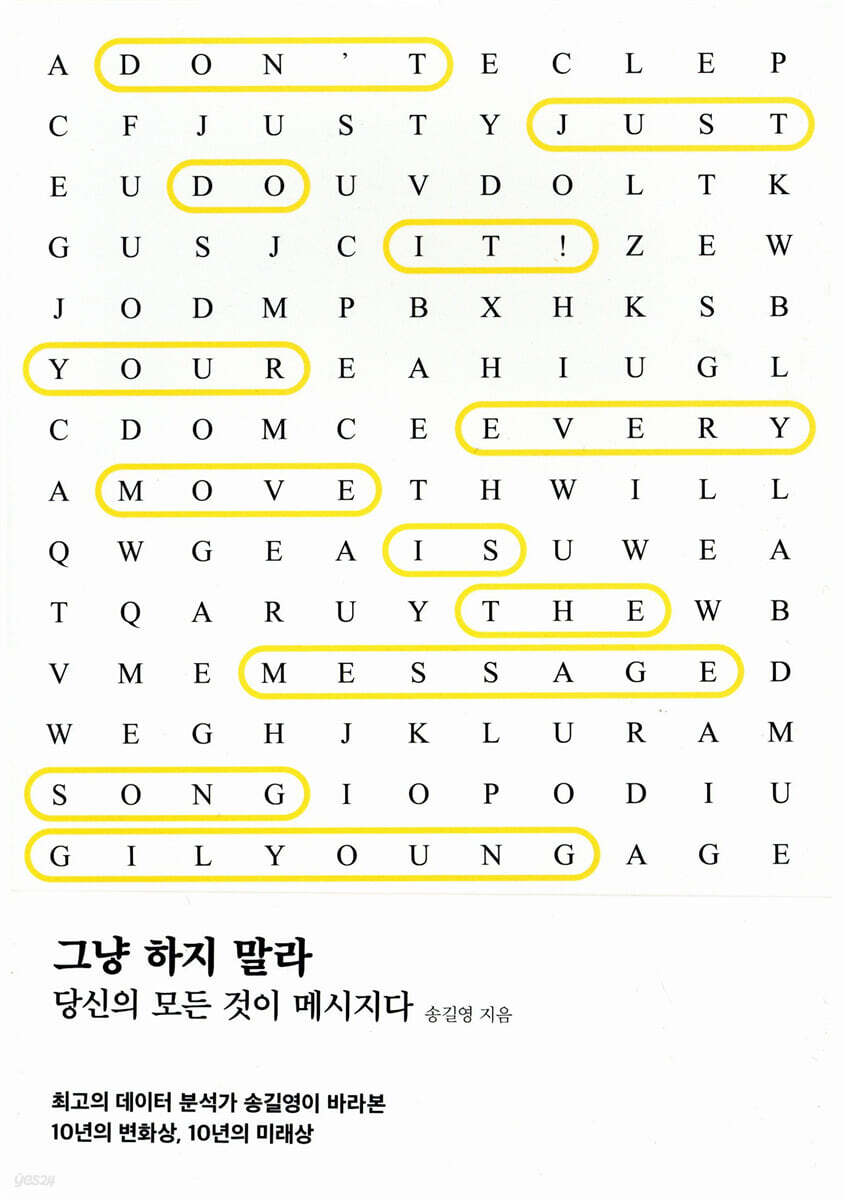
Just don't do it
 |
Description
Book Introduction
- A word from MD
-
You can't just do it like you used to“Every act of daily life has meaning and desire,” says data analyst Song Gil-young.
This is why we need to pay attention to social big data.
Because by reading the minds of people living in this period, we can predict the changes in the next period.
This book looks back on the past ten years and envisions the future.
October 15, 2021. Economics and Management PD Kang Min-ji
The view of Korea's best data analyst, Song Gil-young
10 Years of Change, 10 Years of Future
We often think that we can't know the future, but that's not true.
If we can look at the past and present and understand the desires of the people contained within them, we can know much about the changes in the future.
Song Gil-young, recognized as Korea's top data analyst, traces how people's daily lives and thoughts have changed based on big data he has analyzed for over 20 years.
By doing so, we present the main axes of change that will occur in the future, the values of our society, and the growth grammar of individuals and organizations that fit them.
If you dream of a future where you possess your own expertise and maintain control, let's explore the future our hearts envision with the author's guidance.
10 Years of Change, 10 Years of Future
We often think that we can't know the future, but that's not true.
If we can look at the past and present and understand the desires of the people contained within them, we can know much about the changes in the future.
Song Gil-young, recognized as Korea's top data analyst, traces how people's daily lives and thoughts have changed based on big data he has analyzed for over 20 years.
By doing so, we present the main axes of change that will occur in the future, the values of our society, and the growth grammar of individuals and organizations that fit them.
If you dream of a future where you possess your own expertise and maintain control, let's explore the future our hearts envision with the author's guidance.
- You can preview some of the book's contents.
Preview
index
Prologue | We Saw the Future
Part 1: A Sense of Déjà Vu: A Pulled Future
Different stories about dogs
The obvious becomes no longer obvious
Kimchi: When you look closely, it's an old problem.
A future already seen
Constant of Change 1: Differentiating Societies
Constant of Change 2: Longevity
Constant of Change 3: The Spread of Contactless
Don't Just Do It
Part 2: The Liquefaction of Values
“Do I really have to go to work?”
Suspected practices
The foundation of my thoughts is shaken
When you think about it again from the beginning
Common experiences, greater possibilities for imagination
Question your own values
Part 3: Adaptation: The Realization of Thought
pushed adaptation
Clear data, clear consensus
If there's one thing we've learned from the crisis: the receptivity to innovation.
If there's one thing we've learned from the crisis: rational thinking.
The entire process is revealed
It's hard to fool anyone anymore
How Adapted Are You to a Transparent Society?
Another moonshot
Transparently, transparently
Part 4: Growth: Dreaming of Taking Control of Your Life
Cultivate your mind rather than your performance
But it's time to wake up to reality
The person who puts the spoon on is the worst
I want to grow but I'm stuck in a box
If you are an ordinary newlywed couple in Pangyo
Awakening the Self: Taking Control of Your Life
Everything about you is a message
Fundamentally, are you real?
How to be real
Not to be announced, but to be discovered
Selling the total amount of worries
10-Year Strategy: Rational Thinking, Genuine Business, and Mature Coexistence
Epilogue | Ten Years Later, Embarrassed Again
Part 1: A Sense of Déjà Vu: A Pulled Future
Different stories about dogs
The obvious becomes no longer obvious
Kimchi: When you look closely, it's an old problem.
A future already seen
Constant of Change 1: Differentiating Societies
Constant of Change 2: Longevity
Constant of Change 3: The Spread of Contactless
Don't Just Do It
Part 2: The Liquefaction of Values
“Do I really have to go to work?”
Suspected practices
The foundation of my thoughts is shaken
When you think about it again from the beginning
Common experiences, greater possibilities for imagination
Question your own values
Part 3: Adaptation: The Realization of Thought
pushed adaptation
Clear data, clear consensus
If there's one thing we've learned from the crisis: the receptivity to innovation.
If there's one thing we've learned from the crisis: rational thinking.
The entire process is revealed
It's hard to fool anyone anymore
How Adapted Are You to a Transparent Society?
Another moonshot
Transparently, transparently
Part 4: Growth: Dreaming of Taking Control of Your Life
Cultivate your mind rather than your performance
But it's time to wake up to reality
The person who puts the spoon on is the worst
I want to grow but I'm stuck in a box
If you are an ordinary newlywed couple in Pangyo
Awakening the Self: Taking Control of Your Life
Everything about you is a message
Fundamentally, are you real?
How to be real
Not to be announced, but to be discovered
Selling the total amount of worries
10-Year Strategy: Rational Thinking, Genuine Business, and Mature Coexistence
Epilogue | Ten Years Later, Embarrassed Again
Into the book
I dare say we have seen the future.
But at the time, I didn't know it was the future.
I just thought it was a small change that came and went, or a strange trend.
However, as I witnessed countless instances of changes accumulating, influencing each other, and creating even greater changes, I came to believe that the world has a mechanism whereby the direction of change is agreed upon, like an organic organism.
So to speak, what we saw before was a future that had already come.
As these experiences were repeated, a phrase that became a kind of mantra for me developed.
What happens happens not because of fatalism or a predetermined outcome.
Because we prefer it, because we want it.
What happens happens at the point where each and every member of the human species, whose destiny is to live in groups, wants to reach, at the point where each person's desires are agreed upon.
Our future is a crucible of greater desires, created when our individual desires collide, meet, and drive each other.
--- From the "Prologue"
It has been less than 20 years since dogs became pets, objects of cuteness, and companions who share our lives.
If you think about it, the very creation of the keyword 'companion' is proof that consideration for others has begun.
These days, people even refer to themselves as 'companions'.
Could it be that humans, once the lords of creation, have begun to relinquish their status and recognize themselves as beings who coexist with nature? Humans are creatures who fight even within their own species, and the keyword "companion" seems to embody a broader, more expansive perspective on the previously narrow concept of community.
I guess that also means we have become more humble.
We can also measure precisely when this meaningful change began.
The term 'companion animal' nearly doubled between 2016 and 2018, while the term 'companion plant' nearly quadrupled.
Even without big data, we can infer the rise of pet ownership from the fact that people have been single and childless for over 10 years.
Because humans are fundamentally lonely beings, they need someone to be with.
The point is that just working hard is not the answer.
If you work hard in the wrong direction, you will burn out.
According to a newspaper article, being a telemarketer was a promising career in 2002.
However, in 2015, it was ranked as the number one job that will disappear.
Someone in 2002 might have risked their life for something that would become a declining industry in less than 15 years.
You have to think about the direction first, and then do it faithfully.
It's not difficult.
You just have to think first.
What's going to happen will happen.
Don't just try it and then think about it, don't try it and then verify it, think about it first.
It should be 'Think first', not 'Just do it'.
--- From Chapter 1, "A Sense of Déjà Vu: A Pulled Future"
In Korean society, the term "working from home" was virtually non-existent until the fourth quarter of 2019, just before the COVID-19 outbreak.
Non-existent here means that the word exists in the dictionary but has no real existence.
Something like a unicorn, for example.
Even when it was written, it came out with words like ‘bitcoin,’ ‘small capital,’ and ‘investment.’
The term "working from home" was mainly used in articles about illegal multi-level marketing.
Conversely, as soon as the term “working from home” came out, we began to believe and filter it out.
That's a dangerous method and you'll be in trouble if you get caught.
This is why a significant number of established companies have adopted telecommuting, a practice that was previously unacceptable in our society.
Even major overseas companies are moving to maintain remote work practices and not physically maintain headquarters buildings even after the COVID-19 pandemic is over.
I tried working from home during the pandemic and my performance didn't decline.
If we remove the assumption we've had for so long—that we must go to work—our pursuit of efficiency becomes limitless.
What will happen if working from home becomes accepted in our society? If you don't have to go to the office, do you really need an office? Furthermore, some companies offer employee benefits like subsidies for key money or monthly rent, but is that really necessary? Many companies offer transportation subsidies for commuting, but this raises questions about their necessity.
Furthermore, if you don't necessarily have to work face-to-face, there's no need to hire someone from the same country.
In this way, the thinking continues to expand.
At first, many people said this.
Working from home is a temporary emergency measure, so things will go back to how they were when the coronavirus pandemic is over.
However, I believe the debate surrounding telecommuting will intensify in the future, not only from an economic perspective but also from a welfare perspective.
This is because the metaverse has emerged as a powerful alternative.
Because the starting point principle breaks down, the standards at each stage change, so we must continue to pay attention to what changes as innovation spreads.
Those who define their job as monitoring, supervising, and directing the work of their employees cannot help but be perplexed by the current changes.
If they are within sight, they can be monitored, but if they are not scattered and visible, they cannot be confirmed, so a kind of anxiety or fear arises.
There are also posts expressing concern that employees are not doing their jobs well, and that if they do, they will no longer be needed as managers.
So I'm in this awkward situation where I want my employees to work hard, but I also want them to be a little bit more lax so I can encourage them.
In normal times, this mentality manifested itself as office patrols, with people carrying backpacks and checking employees' monitors. However, working from home has changed to checking them at any time.
I keep asking questions through this wonderful channel called Messenger.
“Manager Kim, what are you doing now?” “I’m writing a three-page report.” If Manager Kim’s response is delayed, I’m suspicious.
It means leaving the seat empty and talking.
The company messenger has a feature that changes the green light to yellow or red if no input is made on the computer for a few minutes.
As soon as the color changed, the manager started talking to him, and Manager Kim, exhausted and angry, closed the app.
The name is 'Zarianbium'.
This app lets you shake your mouse periodically to avoid being marked as away from your partner's messenger.
It is truly a battle of spears and shields.
The reason these tricks are so prevalent is because they are selling the process, not the result.
Wouldn't it be okay for employees to drink tea or listen to music, as long as they're performing well?
Yet, this is what happens when you demand diligence from your employees and try to manage the process.
Employees who had been working from home due to social distancing are back in the office after a few weeks.
It's nice to see you after a long time.
So the manager speaks.
"Oh my, how have you been? It's nice to see everyone from our department after so long.
“How about we all have a beer together after work?” Then the team member says.
“Boss, we want to do that too, but it’s better to be careful for now. We’ll have a company dinner later when the coronavirus situation is over.” So the manager was disappointed, but on his way home from work, he passed by the restaurant and saw that all the team members were gathered there except him. It’s a sad story.
Many people call the changes brought about by COVID-19 "non-face-to-face," but as I mentioned earlier, I'd like to describe them as "optional face-to-face."
Even if it's a gathering of people from the same company, I don't like vertical gatherings with the manager, but I like horizontal gatherings where team members get together without formality.
In this case, the coronavirus was used as an excuse to get rid of the manager who was passing around bomb shots and forcing toasts.
--- From Chapter 2, “Change: Liquefaction of Values”
In addition, various policies and ideas were mobilized, such as Taiwan's real-name mask system and Korea's drive-thru system.
These were all new attempts that each country had put together with their own wisdom.
The subsequent results will determine the success or failure of these efforts, and each country will produce a white paper once the pandemic is over.
And wouldn't a 'white paper of white papers' be published that synthesizes these white papers?
If a white paper describes all the environmental factors and causes of the coronavirus outbreak, the responses, and the resulting outcomes, then each country has made different attempts, so a white paper is a compilation of each country's trial and error.
By doing so, humanity will become wiser.
With so many new initiatives being undertaken simultaneously, the results being monitored in real time, and the collective evaluation of those outcomes, wouldn't the lessons learned be useful for improving human life, if only we were mature enough not to repeat the same mistakes?
I hope so.
A professor I know told me to come into the metaverse lab and sit down by 9 a.m. because he was going to be giving presentations to graduate students one by one while supervising their thesis.
The students' reactions to it were interesting.
Normally, I would be a little late and would just sit idly during presentations, but when I saw my avatar and the professor in the metaverse space, I arrived on time and sat in my chair with good posture.
There is cognitive confusion between virtual space and real space.
Moreover, since you can see what each person is doing in that space, there is a high possibility that you will lose the leisure time you enjoyed doing other things while working in the office.
If this happens, companies may take the lead in introducing the metaverse.
This also seems to be a change that transparency will bring.
--- From Chapter 3, “Adaptation: The Actualization of Thought”
Relationships within the workplace also change.
Ten years ago, there was a certain hierarchy where seniors set an example and expected passion from juniors, and they expressed 'respect' accordingly.
Not so now.
What is required now is 'don't bother me' and 'don't treat me rudely'.
Someone who would have been your eternal boss in the past is now just a temporary colleague.
I can't stand it when my colleagues are rude to me, and even then, I don't bother to show the virtue of making promises for the future, because the relationship is temporary.
Do you know what's scariest about being a colleague, not a boss? It's being angry at your coworker for not doing their job.
This is why the word 'incompetent' is the most common word used in recent data when referring to superiors.
In the past, your boss wouldn't say anything if you didn't do your work.
I used to just let it go, but now both superiors and employees judge each other based on ability.
If your boss is perceived as a colleague rather than a manager, then now he or she has to work too.
Of course, new employees who demand abilities from their superiors should do the same.
In this way, we are moving towards a society where everyone works.
As marriage becomes more difficult, blind dates also pursue efficiency.
It's a waste of money to search for it.
If you like the other person, that's great, but if you don't, you should get out right away.
So we meet at 3pm.
If that's the case, I won't even eat with you.
If it's not something you want to just throw away, the rule is to meet three times in three weeks.
This is actually what is posted on the Blind app.
Everyone wants to know the rules, such as whether it's okay to bring a car to a blind date, and how to pay for it.
The national rules are easy.
Because there is no need to be mindful.
There is no need to consider positive or negative, just do as it is decided.
It's a kind of insurance that eliminates the risk of making mistakes.
That's why big data is good.
Because it's the national rule.
There is an underlying feeling here that ‘others are like that too.’
It means you just have to go halfway.
'Is it the rule to give your parents a monthly allowance after getting a job?' 'How many hours of studying at a cafe is the rule?' 'What time should I vacuum the apartment?' 'If you dated for a year and broke up, how long should you wait before dating again?' It's endless.
After asking the national rules like this, collect all of these.
Drinking a glass of water on an empty stomach in the morning is healthy, isn't it? Doing five minutes of yoga, 15 minutes of meditation, and reading a line of a book are all things you should consider. So, put all of that together and create a routine.
What do you do in the morning, what do you do for lunch, what do you do in the evening? As the number of things increases, the day can end with just the routine.
Purchasing something is a sign of alignment with the values a brand espouses, embracing content is a declaration of intellectual taste, and following someone demonstrates solidarity. These actions ultimately proclaim my lifestyle to the world.
I'm sending a signal that I'm living this life.
If you understand these actions comprehensively, you will understand me.
Everything about me becomes a message that describes me.
There is an old saying, 'Earn like a dog and spend like a prime minister.'
This contained the meaning that if one accumulates wealth and uses it for good, one can be forgiven of past mistakes, regardless of the means used.
But now it is not acceptable to earn money like a dog.
Any attempt to accumulate wealth while destroying the environment, neglecting social responsibility, or failing to adhere to standards of transparency is itself a violation.
So this is like a premise.
This is a problem that requires redefining our industry and reviewing our processes based on these standards, not something that can be silenced by post-money settlements after making money.
It is also a more difficult problem as it requires fundamental improvement of the constitution.
Companies that only pursue efficiency will no longer be able to prove their raison d'être.
Because we will be demanding an organizational vision that encompasses each individual's concerns and life vision.
We will be required to present a vision that transcends efficiency and transcends meaning, and to communicate with consumers and society who wholeheartedly empathize with this vision.
We need to 'really' do this, even if it means the verification process is becoming more sophisticated.
When people know you're really doing it, they'll support you with their purchases.
In other words, consumption behavior rises to a level where it is not just for oneself, but also agrees with and supports the other person's philosophy.
On the other hand, a selfish vision that fails to adhere to the principle of coexistence will not be accepted, leading to a lack of genuine participation and societal support, potentially shaking the very foundation of the business.
I've been giving lectures for over 10 years now, but I generally prefer not to broadcast them.
It lacks liveliness and interaction, and above all, questions and answers are impossible.
When you ask and answer questions, you can see the depth of that person's worries.
Answering questions that were thrown out on the spot and not planned in advance means that you have studied a lot and thought about it in advance.
I think about this in advance and stick to live performances because when I can sell my knowledge, my authenticity can be recognized as expertise.
When living a life of live broadcasting, the choice lies with us: whether to seek the safety of recorded broadcasts or to live independently, based on accumulated expertise.
There is a story in an interview video I did in 2016 that many people could relate to.
I was worried that I wouldn't know what to do when I was told to do what I like.
At that time, I told him that no matter what he did, it would take him 10 years to become an expert, so he should start now without putting it off.
If you like cats, raise a cat for 10 years and study cats. If everyone likes cats in 10 years, you will probably be a master.
But then a cat really appeared.
In 2016, there was only one cat YouTube channel with over 50,000 subscribers.
But now, five years later, even the 10th place has over 200,000 subscribers.
The power of passion is so strong that it can create such a huge interest and market.
What I didn't realize was that it could be done in just five years, not just ten.
I've found that depending on the level of immersion and momentum, the time it takes for my work to produce results can be shortened.
I think that the life skills I naturally acquire in the process of living my life in this way are 'growth'.
The old boatman had never been to a gym in his life, but he had great muscles.
It's a life muscle.
If I work every day, I will build muscle inside me.
This life muscle is, so to speak, an indicator of growth.
It's not about working out to build muscle or living a life to grow.
The result of my constant adaptation to life is growth, which is a life muscle.
But at the time, I didn't know it was the future.
I just thought it was a small change that came and went, or a strange trend.
However, as I witnessed countless instances of changes accumulating, influencing each other, and creating even greater changes, I came to believe that the world has a mechanism whereby the direction of change is agreed upon, like an organic organism.
So to speak, what we saw before was a future that had already come.
As these experiences were repeated, a phrase that became a kind of mantra for me developed.
What happens happens not because of fatalism or a predetermined outcome.
Because we prefer it, because we want it.
What happens happens at the point where each and every member of the human species, whose destiny is to live in groups, wants to reach, at the point where each person's desires are agreed upon.
Our future is a crucible of greater desires, created when our individual desires collide, meet, and drive each other.
--- From the "Prologue"
It has been less than 20 years since dogs became pets, objects of cuteness, and companions who share our lives.
If you think about it, the very creation of the keyword 'companion' is proof that consideration for others has begun.
These days, people even refer to themselves as 'companions'.
Could it be that humans, once the lords of creation, have begun to relinquish their status and recognize themselves as beings who coexist with nature? Humans are creatures who fight even within their own species, and the keyword "companion" seems to embody a broader, more expansive perspective on the previously narrow concept of community.
I guess that also means we have become more humble.
We can also measure precisely when this meaningful change began.
The term 'companion animal' nearly doubled between 2016 and 2018, while the term 'companion plant' nearly quadrupled.
Even without big data, we can infer the rise of pet ownership from the fact that people have been single and childless for over 10 years.
Because humans are fundamentally lonely beings, they need someone to be with.
The point is that just working hard is not the answer.
If you work hard in the wrong direction, you will burn out.
According to a newspaper article, being a telemarketer was a promising career in 2002.
However, in 2015, it was ranked as the number one job that will disappear.
Someone in 2002 might have risked their life for something that would become a declining industry in less than 15 years.
You have to think about the direction first, and then do it faithfully.
It's not difficult.
You just have to think first.
What's going to happen will happen.
Don't just try it and then think about it, don't try it and then verify it, think about it first.
It should be 'Think first', not 'Just do it'.
--- From Chapter 1, "A Sense of Déjà Vu: A Pulled Future"
In Korean society, the term "working from home" was virtually non-existent until the fourth quarter of 2019, just before the COVID-19 outbreak.
Non-existent here means that the word exists in the dictionary but has no real existence.
Something like a unicorn, for example.
Even when it was written, it came out with words like ‘bitcoin,’ ‘small capital,’ and ‘investment.’
The term "working from home" was mainly used in articles about illegal multi-level marketing.
Conversely, as soon as the term “working from home” came out, we began to believe and filter it out.
That's a dangerous method and you'll be in trouble if you get caught.
This is why a significant number of established companies have adopted telecommuting, a practice that was previously unacceptable in our society.
Even major overseas companies are moving to maintain remote work practices and not physically maintain headquarters buildings even after the COVID-19 pandemic is over.
I tried working from home during the pandemic and my performance didn't decline.
If we remove the assumption we've had for so long—that we must go to work—our pursuit of efficiency becomes limitless.
What will happen if working from home becomes accepted in our society? If you don't have to go to the office, do you really need an office? Furthermore, some companies offer employee benefits like subsidies for key money or monthly rent, but is that really necessary? Many companies offer transportation subsidies for commuting, but this raises questions about their necessity.
Furthermore, if you don't necessarily have to work face-to-face, there's no need to hire someone from the same country.
In this way, the thinking continues to expand.
At first, many people said this.
Working from home is a temporary emergency measure, so things will go back to how they were when the coronavirus pandemic is over.
However, I believe the debate surrounding telecommuting will intensify in the future, not only from an economic perspective but also from a welfare perspective.
This is because the metaverse has emerged as a powerful alternative.
Because the starting point principle breaks down, the standards at each stage change, so we must continue to pay attention to what changes as innovation spreads.
Those who define their job as monitoring, supervising, and directing the work of their employees cannot help but be perplexed by the current changes.
If they are within sight, they can be monitored, but if they are not scattered and visible, they cannot be confirmed, so a kind of anxiety or fear arises.
There are also posts expressing concern that employees are not doing their jobs well, and that if they do, they will no longer be needed as managers.
So I'm in this awkward situation where I want my employees to work hard, but I also want them to be a little bit more lax so I can encourage them.
In normal times, this mentality manifested itself as office patrols, with people carrying backpacks and checking employees' monitors. However, working from home has changed to checking them at any time.
I keep asking questions through this wonderful channel called Messenger.
“Manager Kim, what are you doing now?” “I’m writing a three-page report.” If Manager Kim’s response is delayed, I’m suspicious.
It means leaving the seat empty and talking.
The company messenger has a feature that changes the green light to yellow or red if no input is made on the computer for a few minutes.
As soon as the color changed, the manager started talking to him, and Manager Kim, exhausted and angry, closed the app.
The name is 'Zarianbium'.
This app lets you shake your mouse periodically to avoid being marked as away from your partner's messenger.
It is truly a battle of spears and shields.
The reason these tricks are so prevalent is because they are selling the process, not the result.
Wouldn't it be okay for employees to drink tea or listen to music, as long as they're performing well?
Yet, this is what happens when you demand diligence from your employees and try to manage the process.
Employees who had been working from home due to social distancing are back in the office after a few weeks.
It's nice to see you after a long time.
So the manager speaks.
"Oh my, how have you been? It's nice to see everyone from our department after so long.
“How about we all have a beer together after work?” Then the team member says.
“Boss, we want to do that too, but it’s better to be careful for now. We’ll have a company dinner later when the coronavirus situation is over.” So the manager was disappointed, but on his way home from work, he passed by the restaurant and saw that all the team members were gathered there except him. It’s a sad story.
Many people call the changes brought about by COVID-19 "non-face-to-face," but as I mentioned earlier, I'd like to describe them as "optional face-to-face."
Even if it's a gathering of people from the same company, I don't like vertical gatherings with the manager, but I like horizontal gatherings where team members get together without formality.
In this case, the coronavirus was used as an excuse to get rid of the manager who was passing around bomb shots and forcing toasts.
--- From Chapter 2, “Change: Liquefaction of Values”
In addition, various policies and ideas were mobilized, such as Taiwan's real-name mask system and Korea's drive-thru system.
These were all new attempts that each country had put together with their own wisdom.
The subsequent results will determine the success or failure of these efforts, and each country will produce a white paper once the pandemic is over.
And wouldn't a 'white paper of white papers' be published that synthesizes these white papers?
If a white paper describes all the environmental factors and causes of the coronavirus outbreak, the responses, and the resulting outcomes, then each country has made different attempts, so a white paper is a compilation of each country's trial and error.
By doing so, humanity will become wiser.
With so many new initiatives being undertaken simultaneously, the results being monitored in real time, and the collective evaluation of those outcomes, wouldn't the lessons learned be useful for improving human life, if only we were mature enough not to repeat the same mistakes?
I hope so.
A professor I know told me to come into the metaverse lab and sit down by 9 a.m. because he was going to be giving presentations to graduate students one by one while supervising their thesis.
The students' reactions to it were interesting.
Normally, I would be a little late and would just sit idly during presentations, but when I saw my avatar and the professor in the metaverse space, I arrived on time and sat in my chair with good posture.
There is cognitive confusion between virtual space and real space.
Moreover, since you can see what each person is doing in that space, there is a high possibility that you will lose the leisure time you enjoyed doing other things while working in the office.
If this happens, companies may take the lead in introducing the metaverse.
This also seems to be a change that transparency will bring.
--- From Chapter 3, “Adaptation: The Actualization of Thought”
Relationships within the workplace also change.
Ten years ago, there was a certain hierarchy where seniors set an example and expected passion from juniors, and they expressed 'respect' accordingly.
Not so now.
What is required now is 'don't bother me' and 'don't treat me rudely'.
Someone who would have been your eternal boss in the past is now just a temporary colleague.
I can't stand it when my colleagues are rude to me, and even then, I don't bother to show the virtue of making promises for the future, because the relationship is temporary.
Do you know what's scariest about being a colleague, not a boss? It's being angry at your coworker for not doing their job.
This is why the word 'incompetent' is the most common word used in recent data when referring to superiors.
In the past, your boss wouldn't say anything if you didn't do your work.
I used to just let it go, but now both superiors and employees judge each other based on ability.
If your boss is perceived as a colleague rather than a manager, then now he or she has to work too.
Of course, new employees who demand abilities from their superiors should do the same.
In this way, we are moving towards a society where everyone works.
As marriage becomes more difficult, blind dates also pursue efficiency.
It's a waste of money to search for it.
If you like the other person, that's great, but if you don't, you should get out right away.
So we meet at 3pm.
If that's the case, I won't even eat with you.
If it's not something you want to just throw away, the rule is to meet three times in three weeks.
This is actually what is posted on the Blind app.
Everyone wants to know the rules, such as whether it's okay to bring a car to a blind date, and how to pay for it.
The national rules are easy.
Because there is no need to be mindful.
There is no need to consider positive or negative, just do as it is decided.
It's a kind of insurance that eliminates the risk of making mistakes.
That's why big data is good.
Because it's the national rule.
There is an underlying feeling here that ‘others are like that too.’
It means you just have to go halfway.
'Is it the rule to give your parents a monthly allowance after getting a job?' 'How many hours of studying at a cafe is the rule?' 'What time should I vacuum the apartment?' 'If you dated for a year and broke up, how long should you wait before dating again?' It's endless.
After asking the national rules like this, collect all of these.
Drinking a glass of water on an empty stomach in the morning is healthy, isn't it? Doing five minutes of yoga, 15 minutes of meditation, and reading a line of a book are all things you should consider. So, put all of that together and create a routine.
What do you do in the morning, what do you do for lunch, what do you do in the evening? As the number of things increases, the day can end with just the routine.
Purchasing something is a sign of alignment with the values a brand espouses, embracing content is a declaration of intellectual taste, and following someone demonstrates solidarity. These actions ultimately proclaim my lifestyle to the world.
I'm sending a signal that I'm living this life.
If you understand these actions comprehensively, you will understand me.
Everything about me becomes a message that describes me.
There is an old saying, 'Earn like a dog and spend like a prime minister.'
This contained the meaning that if one accumulates wealth and uses it for good, one can be forgiven of past mistakes, regardless of the means used.
But now it is not acceptable to earn money like a dog.
Any attempt to accumulate wealth while destroying the environment, neglecting social responsibility, or failing to adhere to standards of transparency is itself a violation.
So this is like a premise.
This is a problem that requires redefining our industry and reviewing our processes based on these standards, not something that can be silenced by post-money settlements after making money.
It is also a more difficult problem as it requires fundamental improvement of the constitution.
Companies that only pursue efficiency will no longer be able to prove their raison d'être.
Because we will be demanding an organizational vision that encompasses each individual's concerns and life vision.
We will be required to present a vision that transcends efficiency and transcends meaning, and to communicate with consumers and society who wholeheartedly empathize with this vision.
We need to 'really' do this, even if it means the verification process is becoming more sophisticated.
When people know you're really doing it, they'll support you with their purchases.
In other words, consumption behavior rises to a level where it is not just for oneself, but also agrees with and supports the other person's philosophy.
On the other hand, a selfish vision that fails to adhere to the principle of coexistence will not be accepted, leading to a lack of genuine participation and societal support, potentially shaking the very foundation of the business.
I've been giving lectures for over 10 years now, but I generally prefer not to broadcast them.
It lacks liveliness and interaction, and above all, questions and answers are impossible.
When you ask and answer questions, you can see the depth of that person's worries.
Answering questions that were thrown out on the spot and not planned in advance means that you have studied a lot and thought about it in advance.
I think about this in advance and stick to live performances because when I can sell my knowledge, my authenticity can be recognized as expertise.
When living a life of live broadcasting, the choice lies with us: whether to seek the safety of recorded broadcasts or to live independently, based on accumulated expertise.
There is a story in an interview video I did in 2016 that many people could relate to.
I was worried that I wouldn't know what to do when I was told to do what I like.
At that time, I told him that no matter what he did, it would take him 10 years to become an expert, so he should start now without putting it off.
If you like cats, raise a cat for 10 years and study cats. If everyone likes cats in 10 years, you will probably be a master.
But then a cat really appeared.
In 2016, there was only one cat YouTube channel with over 50,000 subscribers.
But now, five years later, even the 10th place has over 200,000 subscribers.
The power of passion is so strong that it can create such a huge interest and market.
What I didn't realize was that it could be done in just five years, not just ten.
I've found that depending on the level of immersion and momentum, the time it takes for my work to produce results can be shortened.
I think that the life skills I naturally acquire in the process of living my life in this way are 'growth'.
The old boatman had never been to a gym in his life, but he had great muscles.
It's a life muscle.
If I work every day, I will build muscle inside me.
This life muscle is, so to speak, an indicator of growth.
It's not about working out to build muscle or living a life to grow.
The result of my constant adaptation to life is growth, which is a life muscle.
--- From Chapter 4, “Growth: Dreaming of Taking Control of Life”
Publisher's Review
Change has accelerated, and the future has been pulled forward!
How will we adapt and thrive in these chaotic times?
The words of the 'Red Queen' are a revelation.
When Alice in 'Through the Looking Glass' couldn't move forward even a single step no matter how much she ran, the Red Queen said.
“Here, you have to run as fast as you can to stay in place.
“To get ahead, you have to run twice as fast.”
Isn't today's world a mirror? The reason we feel like we're falling behind, even though we're not trying, is because the world is changing faster than we are.
Innovation is often thought of as a very forward-thinking practice, but in reality it is about keeping up with change and maintaining the status quo.
Are you adapting well to the present and keeping pace with change?
The already burdensome changes have become even more rapid recently.
The way we work, relate, and live is rapidly changing in the wake of COVID-19.
Even working from home is like that.
Until 2019, working from home was a style of work that only cutting-edge Silicon Valley companies could afford, but in reality, it was only featured in advertisements that lured people in with phrases like "no-capital startup, high-profit item."
However, in the midst of the COVID-19 pandemic, sound companies were the first to adopt the technology, and it quickly became established in Korean society.
The conventional wisdom that students should go to school has collapsed, and even basic income, once considered a radical idea, is being experimented with under the name of "disaster relief funds."
Agenda that seemed like it would take a long time for social debate to be realized are now being attempted all at once.
The future that was so far away has been pulled forward by COVID-19.
In a world where what was once taken for granted is no longer taken for granted, the old ways of doing things no longer apply.
How can we adapt to this accelerating pace of change? What will people want, and where will they spend their money? How should companies innovate their work methods? How can individuals avoid being swept away by change, maintain their self-esteem, and take control of their lives?
This book contains such content.
Don't believe, question, think!
A new era, a professional standard
Song Gil-young describes data analysis as “the work of digging into people’s minds.”
The countless posts, photos, and videos people post on social media reflect their individual interests, thoughts, and desires.
By observing the points where each person's desires converge, we can identify trends and read the flow of society.
And by observing how each person's desires collide and what kind of agreement is reached, we can foresee the direction of change, that is, the future.
This book contains the past and present changes he witnessed while analyzing data, and the future that is envisioned through these changes.
The best data insights of our time, combined with outstanding explanatory power, vividly depict the changing landscape of our lives.
Living alone, living longer, being automated… the changes already underway will only accelerate.
The data analysis skills honed by the entire nation while monitoring the trend of confirmed COVID-19 cases will be put to use in our daily lives.
Advances in science and technology will help everyone make decisions based on real-time data generated not just in the past but also in the present.
Accordingly, your lifestyle and direction of growth will also change.
The new era will favor professionals who fit the requirements rather than those with specific specifications.
I'm not talking about experts who boast about their education or career, but experts who love their work and are good at it because of it.
The old cliché of authenticity will have real power.
The more automated and infinitely replicated the world becomes, the more people seek the 'real thing'.
Those who are not genuine, those who do not do the work but just take advantage of the situation, will lose their position.
As seen in the tracking of confirmed coronavirus cases, all processes are recorded and cannot be deceived.
With the advancement and systemization of science and technology, society has become increasingly transparent, and individuals can now accomplish tasks that were previously only possible with large organizations.
In this world, we cannot beat artificial intelligence with a 'let's just go halfway' attitude.
The old virtue of 'diligence' cannot protect my business from machines.
Now, to do human work, 'thinking' is necessary.
You must first think about the direction in which you want to change, and then be faithful to it.
Don't think about it after you've done it, think about it first.
That's why I say, 'Just don't do it.'
This book will serve as a solid foundation for that idea.
We will teach you how to innovate to adapt to current changes without being stuck in the standards of the past.
By doing so, you will be in the present, not the past, and even in the future.
How will we adapt and thrive in these chaotic times?
The words of the 'Red Queen' are a revelation.
When Alice in 'Through the Looking Glass' couldn't move forward even a single step no matter how much she ran, the Red Queen said.
“Here, you have to run as fast as you can to stay in place.
“To get ahead, you have to run twice as fast.”
Isn't today's world a mirror? The reason we feel like we're falling behind, even though we're not trying, is because the world is changing faster than we are.
Innovation is often thought of as a very forward-thinking practice, but in reality it is about keeping up with change and maintaining the status quo.
Are you adapting well to the present and keeping pace with change?
The already burdensome changes have become even more rapid recently.
The way we work, relate, and live is rapidly changing in the wake of COVID-19.
Even working from home is like that.
Until 2019, working from home was a style of work that only cutting-edge Silicon Valley companies could afford, but in reality, it was only featured in advertisements that lured people in with phrases like "no-capital startup, high-profit item."
However, in the midst of the COVID-19 pandemic, sound companies were the first to adopt the technology, and it quickly became established in Korean society.
The conventional wisdom that students should go to school has collapsed, and even basic income, once considered a radical idea, is being experimented with under the name of "disaster relief funds."
Agenda that seemed like it would take a long time for social debate to be realized are now being attempted all at once.
The future that was so far away has been pulled forward by COVID-19.
In a world where what was once taken for granted is no longer taken for granted, the old ways of doing things no longer apply.
How can we adapt to this accelerating pace of change? What will people want, and where will they spend their money? How should companies innovate their work methods? How can individuals avoid being swept away by change, maintain their self-esteem, and take control of their lives?
This book contains such content.
Don't believe, question, think!
A new era, a professional standard
Song Gil-young describes data analysis as “the work of digging into people’s minds.”
The countless posts, photos, and videos people post on social media reflect their individual interests, thoughts, and desires.
By observing the points where each person's desires converge, we can identify trends and read the flow of society.
And by observing how each person's desires collide and what kind of agreement is reached, we can foresee the direction of change, that is, the future.
This book contains the past and present changes he witnessed while analyzing data, and the future that is envisioned through these changes.
The best data insights of our time, combined with outstanding explanatory power, vividly depict the changing landscape of our lives.
Living alone, living longer, being automated… the changes already underway will only accelerate.
The data analysis skills honed by the entire nation while monitoring the trend of confirmed COVID-19 cases will be put to use in our daily lives.
Advances in science and technology will help everyone make decisions based on real-time data generated not just in the past but also in the present.
Accordingly, your lifestyle and direction of growth will also change.
The new era will favor professionals who fit the requirements rather than those with specific specifications.
I'm not talking about experts who boast about their education or career, but experts who love their work and are good at it because of it.
The old cliché of authenticity will have real power.
The more automated and infinitely replicated the world becomes, the more people seek the 'real thing'.
Those who are not genuine, those who do not do the work but just take advantage of the situation, will lose their position.
As seen in the tracking of confirmed coronavirus cases, all processes are recorded and cannot be deceived.
With the advancement and systemization of science and technology, society has become increasingly transparent, and individuals can now accomplish tasks that were previously only possible with large organizations.
In this world, we cannot beat artificial intelligence with a 'let's just go halfway' attitude.
The old virtue of 'diligence' cannot protect my business from machines.
Now, to do human work, 'thinking' is necessary.
You must first think about the direction in which you want to change, and then be faithful to it.
Don't think about it after you've done it, think about it first.
That's why I say, 'Just don't do it.'
This book will serve as a solid foundation for that idea.
We will teach you how to innovate to adapt to current changes without being stuck in the standards of the past.
By doing so, you will be in the present, not the past, and even in the future.
GOODS SPECIFICS
- Publication date: October 5, 2021
- Page count, weight, size: 284 pages | 368g | 140*200*20mm
- ISBN13: 9791191211467
- ISBN10: 1191211460
You may also like
카테고리
korean


korean

![GQ KOREA Mark (Monthly): December [2025]](http://librairie.coreenne.fr/cdn/shop/files/8ef265dbbfbf186523ed75ba7319009d.jpg?v=1765340328&width=3840)


