

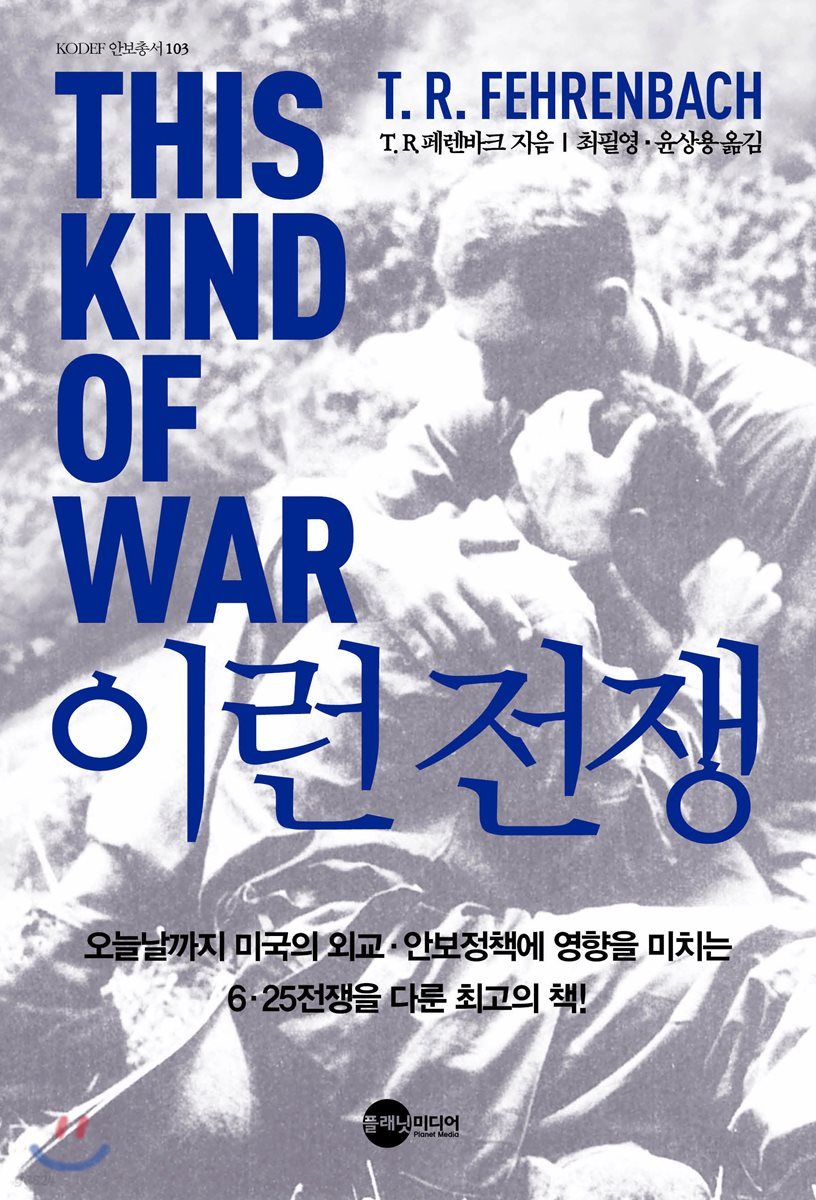
This kind of war
 |
Description
Book Introduction
- A word from MD
-
The Korean War as Seen by U.S. SoldiersAn American version of the Jingbirok, which looks at the Korean War from an American perspective and asks about the meaning of the war.
The author, who experienced the war firsthand, collected a vast amount of data, including official records, testimonies from American soldiers, newspapers, and memoirs, and completed it through meticulous verification.
Since its publication in 1963, it has been considered the best book on the Korean War.
June 21, 2019. Social and Political PD Son Min-gyu
The Korean edition of "This Kind of War," which drew great public attention after former U.S. Secretary of Defense Mattis strongly recommended reading it, has been published ahead of the 69th anniversary of the Korean War.
This book is written by T., a veteran of the Korean War and a historical writer.
This is an unprecedented history of the Korean War, published in 1963 by R. Fehrenbach after meticulously verifying a vast amount of data, including vivid testimonies of American soldiers who participated in the Korean War, official records, operational plans, telegrams, diaries, historical records, memoirs, and newspapers.
This book, which stands out for the author's sharp analysis and insight, is not only a comprehensive history that looks at and analyzes the Korean War from an American perspective, but can also be considered an American version of the Jingbirok (懲毖錄), which looks back on the "America that did not prepare for war" and reflects on the lessons of the Korean War.
Even now, 56 years after its publication in 1963, it is still recognized as a masterpiece dealing with the Korean War, and has been designated as required reading at the United States Military Academy and the United States Army Command and General Staff College. It is still considered the best book dealing with the Korean War, which has influenced American foreign and security policy to this day.
This book illustrates, through vivid examples, the courage, weakness, dark ordeals, heroic sacrifices, and sometimes tragic mistakes of individual soldiers, from privates to generals, that determine life and death on the fiercest battlefields.
As we read the passages that meticulously examine and analyze the diplomatic twists and turns of the Korean War and the strategic shifts of the war, touching on the White House, the U.S. Congress, the United Nations, and even the communist bloc, we are confronted with the uncomfortable reality that the strategic goals and tactical realities envisioned by the United States were dissonant at the operational level of the Korean Peninsula campaign.
Another strength of this book is that it objectively and candidly examines the state of the Republic of Korea and its military from a third-party perspective, against the backdrop of the unique characteristics of Korea's modern society and history in the international situation at the time.
More importantly, the multifaceted and incisive assessments made ten years after the end of the Korean War, while calmly looking back on the war, remain relevant today, a little over a year before the 70th anniversary of the Korean War, in understanding the security environment surrounding the Korean Peninsula and responding to challenges.
This book is written by T., a veteran of the Korean War and a historical writer.
This is an unprecedented history of the Korean War, published in 1963 by R. Fehrenbach after meticulously verifying a vast amount of data, including vivid testimonies of American soldiers who participated in the Korean War, official records, operational plans, telegrams, diaries, historical records, memoirs, and newspapers.
This book, which stands out for the author's sharp analysis and insight, is not only a comprehensive history that looks at and analyzes the Korean War from an American perspective, but can also be considered an American version of the Jingbirok (懲毖錄), which looks back on the "America that did not prepare for war" and reflects on the lessons of the Korean War.
Even now, 56 years after its publication in 1963, it is still recognized as a masterpiece dealing with the Korean War, and has been designated as required reading at the United States Military Academy and the United States Army Command and General Staff College. It is still considered the best book dealing with the Korean War, which has influenced American foreign and security policy to this day.
This book illustrates, through vivid examples, the courage, weakness, dark ordeals, heroic sacrifices, and sometimes tragic mistakes of individual soldiers, from privates to generals, that determine life and death on the fiercest battlefields.
As we read the passages that meticulously examine and analyze the diplomatic twists and turns of the Korean War and the strategic shifts of the war, touching on the White House, the U.S. Congress, the United Nations, and even the communist bloc, we are confronted with the uncomfortable reality that the strategic goals and tactical realities envisioned by the United States were dissonant at the operational level of the Korean Peninsula campaign.
Another strength of this book is that it objectively and candidly examines the state of the Republic of Korea and its military from a third-party perspective, against the backdrop of the unique characteristics of Korea's modern society and history in the international situation at the time.
More importantly, the multifaceted and incisive assessments made ten years after the end of the Korean War, while calmly looking back on the war, remain relevant today, a little over a year before the 70th anniversary of the Korean War, in understanding the security environment surrounding the Korean Peninsula and responding to challenges.
- You can preview some of the book's contents.
Preview
index
Recommendation
Author's Preface
Acknowledgements
Part 1: Beginning
Chapter 1: Saturday Night in Seoul
Chapter 2: Ito Hirobumi's Crimes
Chapter 3: To start a war
Chapter 4: General Chae Byeong-deok's Plan
Chapter 5: The Great Disaster
Chapter 6: The Cloak of the United Nations
Part 2 Battle
Chapter 7: Special Task Force Smith
Chapter 8: The Lost A Company
Chapter 9 Daejeon
Chapter 10 Retreat
Chapter 11: The Line of Defense
Chapter 12 Fire Brigade
Chapter 13: Death on the Nakdong River
Chapter 14: The Turning Point
Chapter 15: The Recapture of Seoul
Chapter 16: Revenge
Chapter 17 Sweet Victory
Chapter 18 In the Land of Dreams
Chapter 19 Gunuri
Chapter 20: Into the Valley of Death
Chapter 21: The Night of Terror
Chapter 22 Jang Jin-ho
Chapter 23: Jipyeong-ri
Chapter 24: Caesar's Grief
Chapter 25: The Proud Legion
Chapter 26: Gloucester Hill
Chapter 27: The Valley of Death
Chapter 28: The May Massacre
Part 3: Blundering
Chapter 29 Armistice Talks
Chapter 30: Bloody Ridge
Chapter 31: The Captain's Ridge
Chapter 32 Deadlock
Chapter 33 Beyond the Barbed Wire
Chapter 34 Frustration
Chapter 35 Geoje Island
Chapter 36: Twenty rolls of toilet paper and one liter of Mercurochrome
Chapter 37 Summer, Winter, Spring, and Fall
Chapter 38: The Last Spring
Chapter 39: Armistice
Chapter 40: Lessons
Chronology
Major weapons used in the Korean War
Translator's Note
Author's Preface
Acknowledgements
Part 1: Beginning
Chapter 1: Saturday Night in Seoul
Chapter 2: Ito Hirobumi's Crimes
Chapter 3: To start a war
Chapter 4: General Chae Byeong-deok's Plan
Chapter 5: The Great Disaster
Chapter 6: The Cloak of the United Nations
Part 2 Battle
Chapter 7: Special Task Force Smith
Chapter 8: The Lost A Company
Chapter 9 Daejeon
Chapter 10 Retreat
Chapter 11: The Line of Defense
Chapter 12 Fire Brigade
Chapter 13: Death on the Nakdong River
Chapter 14: The Turning Point
Chapter 15: The Recapture of Seoul
Chapter 16: Revenge
Chapter 17 Sweet Victory
Chapter 18 In the Land of Dreams
Chapter 19 Gunuri
Chapter 20: Into the Valley of Death
Chapter 21: The Night of Terror
Chapter 22 Jang Jin-ho
Chapter 23: Jipyeong-ri
Chapter 24: Caesar's Grief
Chapter 25: The Proud Legion
Chapter 26: Gloucester Hill
Chapter 27: The Valley of Death
Chapter 28: The May Massacre
Part 3: Blundering
Chapter 29 Armistice Talks
Chapter 30: Bloody Ridge
Chapter 31: The Captain's Ridge
Chapter 32 Deadlock
Chapter 33 Beyond the Barbed Wire
Chapter 34 Frustration
Chapter 35 Geoje Island
Chapter 36: Twenty rolls of toilet paper and one liter of Mercurochrome
Chapter 37 Summer, Winter, Spring, and Fall
Chapter 38: The Last Spring
Chapter 39: Armistice
Chapter 40: Lessons
Chronology
Major weapons used in the Korean War
Translator's Note
Publisher's Review
The Korean War was caused by lack of preparation and misjudgment about war.
It was a strange war created by the fear of escalation into World War III!
*
Influencing American foreign and security policy to this day
The best book about the Korean War!
*
Fehrenbach, a veteran of the Korean War and a historical writer
A compilation of vivid testimonies and extensive data from American soldiers who participated in the Korean War.
The unprecedented history of the Korean War
In this book, author Fehrenbach strongly criticizes that the United States was completely unprepared for war in terms of training, equipment, and discipline during the Korean War, that it ignored information about the possibility of North Korea invading South Korea before the war broke out, and that after the war broke out, it confidently misjudged that the Chinese military would not intervene. In addition, although it held nuclear weapons, it avoided an all-out war with the Soviet Union for fear of it escalating into World War III using nuclear weapons, and instead waged a limited war by advocating a containment policy to only block the expansion of the communist bloc's power, showing no will to fight.
Author Fehrenbach said, “A nation that is not prepared for all kinds of war should renounce war as a national policy.
A people who are not ready to fight must be mentally prepared to surrender.
“It is foolish, bordering on criminal, to force soldiers and civilians into limited, bloody ground operations without preparing them for such,” he said, adding, “From the rapid retreat at Osan to the withdrawal from the Chongchon River, to the heroic resistance at Jipyeong-ni, the Imjin River, the Soyang River, and Pork Chop Hill, these are lessons the United States and other nations must learn from Korea.”
This kind of foolish, almost criminal, act actually occurred during the Korean War, which claimed over two million lives across the bloody valleys, hills, and ridges of Korea.
The author says, “The lesson of the Korean War is that this kind of war actually happened.”
The author also said, “The Korean War was not a war that tested strength, but a war that tested will.
…the great test facing the United States was not whether it had the power to completely destroy the Soviet Union (which it did), but whether its leaders were willing to fight for a more orderly world rather than succumb to fanatic violence.”
What matters in war is the will to fight, and the U.S. government at the time had absolutely no will to fight.
During the Korean War, the U.S. government had no intention of fighting alone, nor did it intend to wage an all-out war against the Soviet Union.
That is why, under the guise of collective security, we had no choice but to wage a limited war, with one foot in the more important Europe and the other in the less important Asia, while wearing the mantle of the United Nations and allies.
The United States did not call the Korean War the "Korean Conflict," but rather the "Korean War," and entered the war with the hope that it would be resolved within a few days or months, only to face the disaster of that hope soon turning into despair.
And the price was paid entirely by soldiers who were sent to Korea without any noble cause and without any knowledge.
This book covers the history of the Korean War in detail, chronologically, from the situation in South Korea before the outbreak of the Korean War, to the background of the war, the defeat of Task Force Smith, the first US military unit to engage in combat at Osan after the outbreak of the war, the desperate defense of the Nakdong River defense line, the Incheon Landing Operation that turned the tide of the war, the moving recapture of Seoul, the UN forces' advance toward the Yalu River, the unexpected intervention of the Chinese army, the Battle of Chosin Reservoir in sub-zero cold, the US Marines' evacuation from Hungnam, the Battle of Jipyeong-ri, President Harry Truman's dismissal of UN Commander MacArthur due to disagreements, the Battle of Gloucester Hill, the issue of prisoners of war, the armistice talks that lasted for two years, the Battle of Bloody Ridge and the Battle of Heartbreak Ridge, the subsequent stalemate in the war, the Geoje Island POW camp, and the signing of the armistice agreement. It is therefore of high historical value.
Author Fehrenbach also participated in the Korean War as the commander of the 72nd Tank Battalion of the 2nd US Division, but he does not mention his participation anywhere in this book.
It seems that he tried to look at the Korean War objectively from a third-party perspective, completely excluding his own experiences and emotions.
In this book, he demonstrates remarkable insight and foresight in identifying the nature, attributes, and dilemmas of the free world and the communist world, war and humanity, politicians and soldiers, society and the military.
Above all, the book's virtue lies in its moving, and at times painful, portrayal of the soldiers who had to bear the brunt of the wrong decisions made by political leaders and military commanders.
This book delves into political and military mistakes and gives a raw look at the brave souls of soldiers who bled and died because of these mistakes.
This book contains a human drama of life and death that cannot be expressed simply by the number of casualties.
It was a strange war created by the fear of escalation into World War III!
*
Influencing American foreign and security policy to this day
The best book about the Korean War!
*
Fehrenbach, a veteran of the Korean War and a historical writer
A compilation of vivid testimonies and extensive data from American soldiers who participated in the Korean War.
The unprecedented history of the Korean War
In this book, author Fehrenbach strongly criticizes that the United States was completely unprepared for war in terms of training, equipment, and discipline during the Korean War, that it ignored information about the possibility of North Korea invading South Korea before the war broke out, and that after the war broke out, it confidently misjudged that the Chinese military would not intervene. In addition, although it held nuclear weapons, it avoided an all-out war with the Soviet Union for fear of it escalating into World War III using nuclear weapons, and instead waged a limited war by advocating a containment policy to only block the expansion of the communist bloc's power, showing no will to fight.
Author Fehrenbach said, “A nation that is not prepared for all kinds of war should renounce war as a national policy.
A people who are not ready to fight must be mentally prepared to surrender.
“It is foolish, bordering on criminal, to force soldiers and civilians into limited, bloody ground operations without preparing them for such,” he said, adding, “From the rapid retreat at Osan to the withdrawal from the Chongchon River, to the heroic resistance at Jipyeong-ni, the Imjin River, the Soyang River, and Pork Chop Hill, these are lessons the United States and other nations must learn from Korea.”
This kind of foolish, almost criminal, act actually occurred during the Korean War, which claimed over two million lives across the bloody valleys, hills, and ridges of Korea.
The author says, “The lesson of the Korean War is that this kind of war actually happened.”
The author also said, “The Korean War was not a war that tested strength, but a war that tested will.
…the great test facing the United States was not whether it had the power to completely destroy the Soviet Union (which it did), but whether its leaders were willing to fight for a more orderly world rather than succumb to fanatic violence.”
What matters in war is the will to fight, and the U.S. government at the time had absolutely no will to fight.
During the Korean War, the U.S. government had no intention of fighting alone, nor did it intend to wage an all-out war against the Soviet Union.
That is why, under the guise of collective security, we had no choice but to wage a limited war, with one foot in the more important Europe and the other in the less important Asia, while wearing the mantle of the United Nations and allies.
The United States did not call the Korean War the "Korean Conflict," but rather the "Korean War," and entered the war with the hope that it would be resolved within a few days or months, only to face the disaster of that hope soon turning into despair.
And the price was paid entirely by soldiers who were sent to Korea without any noble cause and without any knowledge.
This book covers the history of the Korean War in detail, chronologically, from the situation in South Korea before the outbreak of the Korean War, to the background of the war, the defeat of Task Force Smith, the first US military unit to engage in combat at Osan after the outbreak of the war, the desperate defense of the Nakdong River defense line, the Incheon Landing Operation that turned the tide of the war, the moving recapture of Seoul, the UN forces' advance toward the Yalu River, the unexpected intervention of the Chinese army, the Battle of Chosin Reservoir in sub-zero cold, the US Marines' evacuation from Hungnam, the Battle of Jipyeong-ri, President Harry Truman's dismissal of UN Commander MacArthur due to disagreements, the Battle of Gloucester Hill, the issue of prisoners of war, the armistice talks that lasted for two years, the Battle of Bloody Ridge and the Battle of Heartbreak Ridge, the subsequent stalemate in the war, the Geoje Island POW camp, and the signing of the armistice agreement. It is therefore of high historical value.
Author Fehrenbach also participated in the Korean War as the commander of the 72nd Tank Battalion of the 2nd US Division, but he does not mention his participation anywhere in this book.
It seems that he tried to look at the Korean War objectively from a third-party perspective, completely excluding his own experiences and emotions.
In this book, he demonstrates remarkable insight and foresight in identifying the nature, attributes, and dilemmas of the free world and the communist world, war and humanity, politicians and soldiers, society and the military.
Above all, the book's virtue lies in its moving, and at times painful, portrayal of the soldiers who had to bear the brunt of the wrong decisions made by political leaders and military commanders.
This book delves into political and military mistakes and gives a raw look at the brave souls of soldiers who bled and died because of these mistakes.
This book contains a human drama of life and death that cannot be expressed simply by the number of casualties.
GOODS SPECIFICS
- Date of issue: June 14, 2019
- Page count, weight, size: 824 pages | 1,019g | 153*225*40mm
- ISBN13: 9791187822318
- ISBN10: 1187822310
You may also like
카테고리
korean


korean

![GQ KOREA Mark (Monthly): December [2025]](http://librairie.coreenne.fr/cdn/shop/files/8ef265dbbfbf186523ed75ba7319009d.jpg?v=1765340328&width=3840)


