

Future wealth
 |
Description
Book Introduction
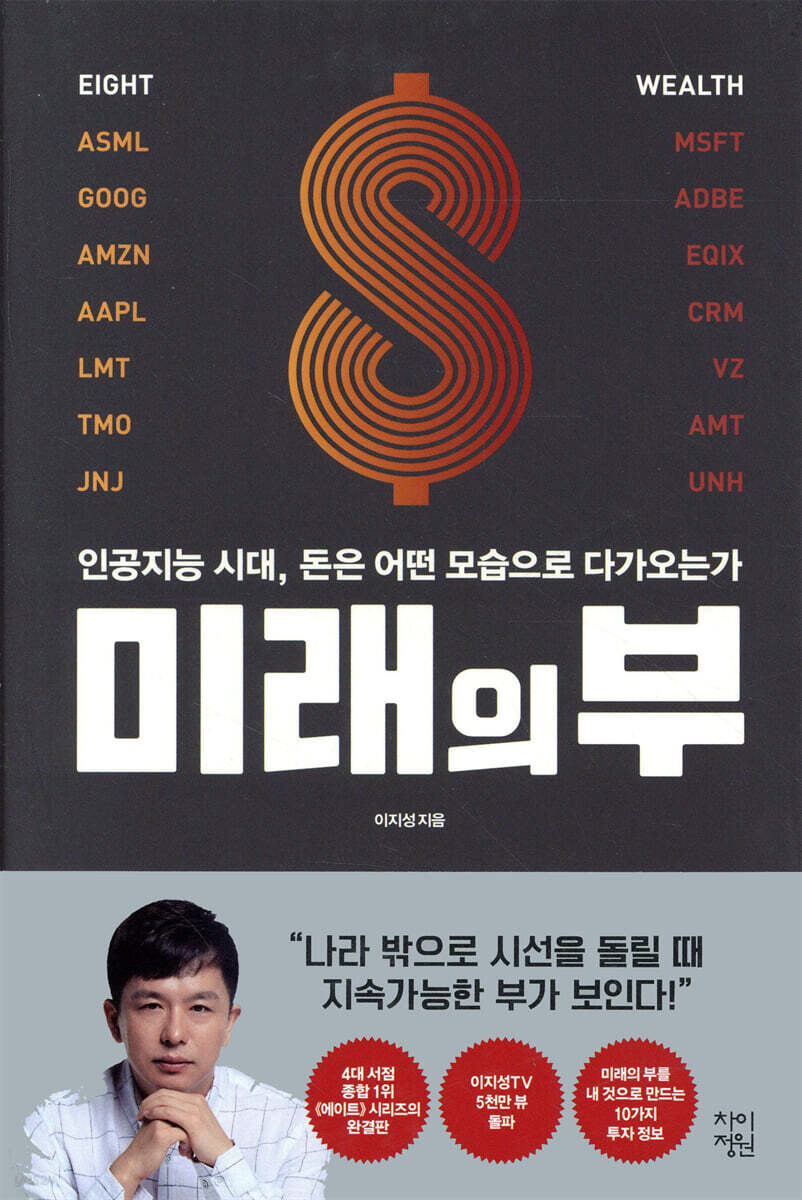
Oil into data, real estate into data centers The Fourth Industrial Revolution Accelerated by COVID-19 The most friendly and intuitive guide to keeping up with the flow of wealth. The author found the answer to the bleak future our people face—skyrocketing real estate prices, an aging population, economic difficulties—in long-term investment in blue-chip U.S. stocks. The long-term investment in blue-chip U.S. stocks discussed here is different from the recent stock investment craze that seeks high returns in a short period of time. This book is the most accessible and intuitive guide to the United States and its stock market, particularly long-term investment in blue-chip stocks, which hold all the keys to the Fourth Industrial Revolution, including non-memory semiconductors, autonomous driving, data centers, cloud services, and the healthcare industry. The author emphasizes that reading the visions of the countries and companies that will lead the global economy in the era of artificial intelligence, which will last for over 100 years, and making long-term investments in its value requires extensive study, patience, and strong faith. 『The Wealth of the Future』 is largely divided into three parts. Part 1 provides a sobering look at the bleak future facing South Korea and suggests solutions. In Part 2, you will learn how to stick to your investment principles and beliefs without being swayed by any waves through the philosophy of investment guru Warren Buffett. In the final part 3, we will look at 10 perspectives on how and where to start investing. In particular, the 10 pieces of information about the "wealth of the future" that unfold in Part 3 are the minimum economic knowledge and code of conduct that we must begin acquiring right now to protect the dignity of our lives in the future. After reading "Future Wealth," you'll find yourself immediately searching for and downloading a foreign stock app. Instead of buying the sneakers you were thinking of buying, you'll start buying Nike stock, and instead of replacing the cell phone you were thinking of replacing, you'll start buying Apple stock, preparing to ride the new wave of wealth. It's never an easy path, but if you have the will, you can start right now. This book has that kind of power. |
- You can preview some of the book's contents.
Preview
index
Prologue_What Should I, You, and We Prepare?
PART 1_A New Addition Is Coming
: Where Does Money Flow in the Age of Artificial Intelligence?
A future I have never experienced or imagined
-Who will be the leader of the new era?
-The existing wealth formula has been completely broken.
Inconvenient Truths About South Korea's Future
-The poor become the urban mainstream
A country where growing old is a sin
The most miserable generation in the history of the Republic of Korea is coming.
Japan's first experience with the "hell for the elderly"
Your retirement is falling apart right now.
-Poverty never makes people happy.
Why the National Pension Service Became an Investment Guru
-But why is it going downhill?
-Pension never guarantees our old age.
The 'magic scam' of private pensions
Ride the new wave of wealth
-Warning from the world's top retirement financial planning expert.
-1.3 billion, the minimum expenses required after retirement
-Start right now
PART 2_Are you prepared to endure for 30 years?
: Learning Long-Term Investment Methods in Blue Chip Stocks from Buffett
What Happens When Long-Term and Compensation Meet
-The unwritten rules of success in the US stock market
-The only person who is not crazy in a crazy market
-The key is the inflation effect.
The Miracle of Long-Term Compound Investment in Blue Chip Stocks
The faith or courage to withstand the crash
-The time he spent studying for one investment, 50 years
-When everyone abandons you, that's when you love.
The rich are never impatient
-The key is principles and philosophy.
Apple stock may be the cheapest it's ever been.
PART 3_Now, where to invest
: 10 Ways to Create Future Wealth
Future Wealth 01: Invest, Not Speculate
-You get back as much as you love.
-Time taken for 100 million to become 80.4 billion
-The magic of money begetting money
-We can't find the number one company of the future.
Future Wealth 02: Focus on Non-Memory Semiconductors, the "Brains of AI"
Worker Semiconductor vs. Genius Semiconductor
Samsung Electronics is not the world's number one.
Who is the absolute leader in the semiconductor market?
The U.S. and China's Struggle for Hegemony in the Fourth Industrial Revolution
-An alien company called ASML
Future Wealth 03_Why Buffett Loves Apple So Much
Jobs's 'Reality Distortion Field' and 'R=VD'
$2 trillion market cap, this is just the beginning.
Apple is not a manufacturing company.
Why Apple, a "40 trillion won cash tycoon," took out a loan.
-Weakness analysis is more important than strength analysis.
Future Wealth 04: The Data Economy is the "Oil of the Fourth Industrial Revolution."
-All your information is being sold right now.
-Data will follow the exact path of oil.
Why Baedal Minjok was sold for 5 trillion won
-14 million vs 330,000, will it be a game?
Future Wealth 05_Now, all the world's information and money is gathered in the cloud.
-Quantum computers with superpowers
-Where the monster lives, analyzing 100 million pieces of data per second.
Salesforce, the undisputed leader in SaaS
Salesforce vs. Microsoft: Who Will Win?
How Amazon Became a Cloud Company
The world is currently in a cloud war.
-The power to overcome repeated short-term and large-scale crashes
-The cloud has only just begun.
Future Wealth 06: A Whole New Real Estate Is Coming: Data Centers
Intel, the "undisputed semiconductor powerhouse," faces a crisis.
-A new sun called Nvidia is rising.
-Hot potato, cancer
-IT REIT, a futuristic real estate
-Who will be the winner who will end the Spring and Autumn Period and the Warring States Period?
Future Wealth 07_Beyond 5G to 6G: The Battle for Global Hegemony
Verizon vs. AT&T
Huawei's downfall and Nokia's comeback
The war over 6G hegemony has begun.
Future Wealth 08: The Key Is Autonomous Driving, Not Electricity
Autonomous driving is not a new technology.
-But why are people so crazy about electric cars?
-Is Lidar really a good stock?
Electric vehicle batteries: Caution is the answer.
-The fierce battle between Tesla and anti-Tesla camps
Risks Tesla Must Overcome
Apple Car: A Game-Changing Autonomous Vehicle Market
The era of autonomous driving that will usher in a new era
Future Wealth 09_OTT, Dominating Our Daily Lives
-Can Netflix maintain its top spot?
-Why it's called 'Google'
Future Wealth 10: Healthcare is the Answer in an Aging Society
- A company that has maintained a triple-A credit rating for 30 years.
The Future of the Healthcare Industry: Digital Healthcare
Apple, Amazon, and Google have plans.
The moment the telemedicine market opens
Epilogue: Why You Should Start Investing Now
main
PART 1_A New Addition Is Coming
: Where Does Money Flow in the Age of Artificial Intelligence?
A future I have never experienced or imagined
-Who will be the leader of the new era?
-The existing wealth formula has been completely broken.
Inconvenient Truths About South Korea's Future
-The poor become the urban mainstream
A country where growing old is a sin
The most miserable generation in the history of the Republic of Korea is coming.
Japan's first experience with the "hell for the elderly"
Your retirement is falling apart right now.
-Poverty never makes people happy.
Why the National Pension Service Became an Investment Guru
-But why is it going downhill?
-Pension never guarantees our old age.
The 'magic scam' of private pensions
Ride the new wave of wealth
-Warning from the world's top retirement financial planning expert.
-1.3 billion, the minimum expenses required after retirement
-Start right now
PART 2_Are you prepared to endure for 30 years?
: Learning Long-Term Investment Methods in Blue Chip Stocks from Buffett
What Happens When Long-Term and Compensation Meet
-The unwritten rules of success in the US stock market
-The only person who is not crazy in a crazy market
-The key is the inflation effect.
The Miracle of Long-Term Compound Investment in Blue Chip Stocks
The faith or courage to withstand the crash
-The time he spent studying for one investment, 50 years
-When everyone abandons you, that's when you love.
The rich are never impatient
-The key is principles and philosophy.
Apple stock may be the cheapest it's ever been.
PART 3_Now, where to invest
: 10 Ways to Create Future Wealth
Future Wealth 01: Invest, Not Speculate
-You get back as much as you love.
-Time taken for 100 million to become 80.4 billion
-The magic of money begetting money
-We can't find the number one company of the future.
Future Wealth 02: Focus on Non-Memory Semiconductors, the "Brains of AI"
Worker Semiconductor vs. Genius Semiconductor
Samsung Electronics is not the world's number one.
Who is the absolute leader in the semiconductor market?
The U.S. and China's Struggle for Hegemony in the Fourth Industrial Revolution
-An alien company called ASML
Future Wealth 03_Why Buffett Loves Apple So Much
Jobs's 'Reality Distortion Field' and 'R=VD'
$2 trillion market cap, this is just the beginning.
Apple is not a manufacturing company.
Why Apple, a "40 trillion won cash tycoon," took out a loan.
-Weakness analysis is more important than strength analysis.
Future Wealth 04: The Data Economy is the "Oil of the Fourth Industrial Revolution."
-All your information is being sold right now.
-Data will follow the exact path of oil.
Why Baedal Minjok was sold for 5 trillion won
-14 million vs 330,000, will it be a game?
Future Wealth 05_Now, all the world's information and money is gathered in the cloud.
-Quantum computers with superpowers
-Where the monster lives, analyzing 100 million pieces of data per second.
Salesforce, the undisputed leader in SaaS
Salesforce vs. Microsoft: Who Will Win?
How Amazon Became a Cloud Company
The world is currently in a cloud war.
-The power to overcome repeated short-term and large-scale crashes
-The cloud has only just begun.
Future Wealth 06: A Whole New Real Estate Is Coming: Data Centers
Intel, the "undisputed semiconductor powerhouse," faces a crisis.
-A new sun called Nvidia is rising.
-Hot potato, cancer
-IT REIT, a futuristic real estate
-Who will be the winner who will end the Spring and Autumn Period and the Warring States Period?
Future Wealth 07_Beyond 5G to 6G: The Battle for Global Hegemony
Verizon vs. AT&T
Huawei's downfall and Nokia's comeback
The war over 6G hegemony has begun.
Future Wealth 08: The Key Is Autonomous Driving, Not Electricity
Autonomous driving is not a new technology.
-But why are people so crazy about electric cars?
-Is Lidar really a good stock?
Electric vehicle batteries: Caution is the answer.
-The fierce battle between Tesla and anti-Tesla camps
Risks Tesla Must Overcome
Apple Car: A Game-Changing Autonomous Vehicle Market
The era of autonomous driving that will usher in a new era
Future Wealth 09_OTT, Dominating Our Daily Lives
-Can Netflix maintain its top spot?
-Why it's called 'Google'
Future Wealth 10: Healthcare is the Answer in an Aging Society
- A company that has maintained a triple-A credit rating for 30 years.
The Future of the Healthcare Industry: Digital Healthcare
Apple, Amazon, and Google have plans.
The moment the telemedicine market opens
Epilogue: Why You Should Start Investing Now
main
Detailed image

Into the book
A new era lies before us.
This is the post-COVID-19 era.
As the new culture that has recently begun takes hold, a new economic trend will emerge in our country.
In fact, this is a phenomenon that is already occurring in the United States.
The global economy is now shifting its focus to American big tech companies such as Google, Amazon, and Microsoft.
As a clear example, Apple's market capitalization has surpassed the combined market capitalization of the entire Korean stock market.
The market capitalization of a company called Apple is higher than the combined stock market capitalization of the entire stock market of South Korea, one of the world's top 10 economies.
--- p.22~23
I have been saying on Easy TV that if you invest in blue-chip American stocks for 30 years, anyone can become very wealthy after 30 years.
However, most of them said they did not want to think about the distant future, saying, “What will I do if I have money in 30 years?” or “What will be the use of becoming rich in 30 years?”
But think about the future report the government has given us.
We will need 2 to 3 billion won in the next 30 years.
The time when we really need money is not when we are young, but when we are old.
Right now, you can get by with your youth as a foundation, but when you get old and weak, won't you need money to survive?
Money in old age is not a matter of being rich or poor, but a matter of being able to live or not, that is, a matter of survival.
--- p.71
It is said that when Google's self-driving cars are released into the world, the traffic accident rate will drop to close to 0%.
No, there is no need to go to the future.
Aren't we now searching for information using the Google search bar for free?
Considering these points, we can conclude that Google is a company truly necessary for the future of humanity.
In other words, you can cheer by buying stocks.
This mindset can also be applied to Apple.
The world has changed thanks to the iPhone, and don't you feel truly grateful for that? Buying stocks and becoming a shareholder with that mindset is what I call investing.
--- p.113~114
You can never be a long-term investor if you don't have a genuine interest in the company you're investing in.
Owning stock in a company that has been around for more than 10 years is never easy.
You have to really like, or rather love, a company to be able to hold its stock for a long time.
Who doesn't know that you should hold stocks for the long term - 10, 20, 30 years?
This is a fact that everyone who knows even a little about stocks knows.
But 99% of people know this but don't put it into practice.
Why is that? Because there is no understanding or love for that company.
In short, it is because they only see companies in terms of money.
Samsung, Google, and Apple are viewed only in terms of money.
So, even if the stock price falls just a little, you start to consider selling.
Or, once you have made a certain amount of profit, you sell it without mercy and turn around.
With this mindset, you can never make long-term investments, and of course, it will be difficult to make a lot of money.
--- p.115
I have one prerequisite for stock investment.
It has to be a company that is already the best, already number one in the world.
But it shouldn't just stop at being number one.
It should be a company that is just starting now, has a 10-20x growth outlook in 10 years, 50-100x growth in 30 years, and has a 70-80% chance of maintaining its top position in 100 years.
The point is that you need to find and invest in a company that is currently number one and will remain number one for the next 100 years.
The number one company I'm talking about is one that will be number one not only now but also in the future.
--- p.123
The best stocks always feel expensive.
So I don't buy it.
But if you don't buy it now, you'll definitely regret it in 10 years.
Let's type Google, Apple, Amazon, and Microsoft stocks into the Google search bar.
Then, a stock price graph for the past 20 to 30 years appears.
But do you know what these four companies are all about? They're all on the rise.
The graph is really pretty.
Companies like Nike, Coca-Cola, Starbucks, Disney, and LVMH also have beautiful graphs that have steadily risen for 20 to 30 years.
Companies that have been on an upward trend for the past 20 to 30 years will continue to do so for the next 30 years.
The overall U.S. stock market has also been on an upward trend for 30 years.
But the graph of the Korean KOSPI market is not like that.
The stock market graphs of emerging countries such as Thailand, Vietnam, and Brazil are also similar to ours.
--- p.127
After the discovery of oil, large oil companies such as Rockefeller's Standard Oil emerged and monopolized the American oil industry.
At the time, Standard Oil was a company like Google, Apple, and Microsoft today.
Even then, someone would have done this.
“How can the oil economy expand further when Standard Oil has already become such a successful and wealthy company?” (Omitted) The conclusion was a victory for those who were optimistic about the future of the oil economy.
The oil economy, which was centered in the United States and Europe, expanded over time to Asia, then to Africa and the Middle East, and then to the entire world.
This is exactly what happened in the 100 years since the discovery of oil.
--- p.180
Compared to Japan, which is experiencing a long-term recession, our country's economic situation, including exports, is currently slightly better.
But, to use an analogy, South Korea is like a commoner who works for a large company but doesn't even have a building of his own.
In Japan, the father worked at Samsung, but the son worked part-time at a convenience store, but quit soon after and spent a year unemployed, making it an ambiguous situation.
But in Japan, there is a building that my father bought in Gangnam when he was doing well.
Thanks to purchasing a building in a very good location, there are no vacancies and the monthly rent of 50 million won is paid regularly.
So, even if my son doesn't get a job, he will earn 600 million won a year.
This is the difference between South Korea and Japan.
--- p.187~188
So, what does it mean for me to invest in blue-chip US stocks for the long term? It means I'm prepared to experience at least 300 corrections, with stock prices dropping by 6% or 15% each time.
'I will endure the pain of my hands shaking when I look at the stock prices on my smartphone more than 300 times.
One day, I turned on my smartphone and checked my stocks, only to find that they had plummeted by more than 98%.
And I can afford that 98% price drop to last for more than 10 years.
'I am willing to accept that after overcoming all these crises and recovering to the original state of the stock price and finally rising, the global financial crisis will strike again and the stock price will plummet by 64% overnight.'
Becoming rich is never that easy.
That's why philosophy and principles are important.
Only those with a solid foundation in philosophy and principles can remain steadfast in the midst of short-term and major market crashes, believing in the inherent value of a company and continuing to invest.
This is the post-COVID-19 era.
As the new culture that has recently begun takes hold, a new economic trend will emerge in our country.
In fact, this is a phenomenon that is already occurring in the United States.
The global economy is now shifting its focus to American big tech companies such as Google, Amazon, and Microsoft.
As a clear example, Apple's market capitalization has surpassed the combined market capitalization of the entire Korean stock market.
The market capitalization of a company called Apple is higher than the combined stock market capitalization of the entire stock market of South Korea, one of the world's top 10 economies.
--- p.22~23
I have been saying on Easy TV that if you invest in blue-chip American stocks for 30 years, anyone can become very wealthy after 30 years.
However, most of them said they did not want to think about the distant future, saying, “What will I do if I have money in 30 years?” or “What will be the use of becoming rich in 30 years?”
But think about the future report the government has given us.
We will need 2 to 3 billion won in the next 30 years.
The time when we really need money is not when we are young, but when we are old.
Right now, you can get by with your youth as a foundation, but when you get old and weak, won't you need money to survive?
Money in old age is not a matter of being rich or poor, but a matter of being able to live or not, that is, a matter of survival.
--- p.71
It is said that when Google's self-driving cars are released into the world, the traffic accident rate will drop to close to 0%.
No, there is no need to go to the future.
Aren't we now searching for information using the Google search bar for free?
Considering these points, we can conclude that Google is a company truly necessary for the future of humanity.
In other words, you can cheer by buying stocks.
This mindset can also be applied to Apple.
The world has changed thanks to the iPhone, and don't you feel truly grateful for that? Buying stocks and becoming a shareholder with that mindset is what I call investing.
--- p.113~114
You can never be a long-term investor if you don't have a genuine interest in the company you're investing in.
Owning stock in a company that has been around for more than 10 years is never easy.
You have to really like, or rather love, a company to be able to hold its stock for a long time.
Who doesn't know that you should hold stocks for the long term - 10, 20, 30 years?
This is a fact that everyone who knows even a little about stocks knows.
But 99% of people know this but don't put it into practice.
Why is that? Because there is no understanding or love for that company.
In short, it is because they only see companies in terms of money.
Samsung, Google, and Apple are viewed only in terms of money.
So, even if the stock price falls just a little, you start to consider selling.
Or, once you have made a certain amount of profit, you sell it without mercy and turn around.
With this mindset, you can never make long-term investments, and of course, it will be difficult to make a lot of money.
--- p.115
I have one prerequisite for stock investment.
It has to be a company that is already the best, already number one in the world.
But it shouldn't just stop at being number one.
It should be a company that is just starting now, has a 10-20x growth outlook in 10 years, 50-100x growth in 30 years, and has a 70-80% chance of maintaining its top position in 100 years.
The point is that you need to find and invest in a company that is currently number one and will remain number one for the next 100 years.
The number one company I'm talking about is one that will be number one not only now but also in the future.
--- p.123
The best stocks always feel expensive.
So I don't buy it.
But if you don't buy it now, you'll definitely regret it in 10 years.
Let's type Google, Apple, Amazon, and Microsoft stocks into the Google search bar.
Then, a stock price graph for the past 20 to 30 years appears.
But do you know what these four companies are all about? They're all on the rise.
The graph is really pretty.
Companies like Nike, Coca-Cola, Starbucks, Disney, and LVMH also have beautiful graphs that have steadily risen for 20 to 30 years.
Companies that have been on an upward trend for the past 20 to 30 years will continue to do so for the next 30 years.
The overall U.S. stock market has also been on an upward trend for 30 years.
But the graph of the Korean KOSPI market is not like that.
The stock market graphs of emerging countries such as Thailand, Vietnam, and Brazil are also similar to ours.
--- p.127
After the discovery of oil, large oil companies such as Rockefeller's Standard Oil emerged and monopolized the American oil industry.
At the time, Standard Oil was a company like Google, Apple, and Microsoft today.
Even then, someone would have done this.
“How can the oil economy expand further when Standard Oil has already become such a successful and wealthy company?” (Omitted) The conclusion was a victory for those who were optimistic about the future of the oil economy.
The oil economy, which was centered in the United States and Europe, expanded over time to Asia, then to Africa and the Middle East, and then to the entire world.
This is exactly what happened in the 100 years since the discovery of oil.
--- p.180
Compared to Japan, which is experiencing a long-term recession, our country's economic situation, including exports, is currently slightly better.
But, to use an analogy, South Korea is like a commoner who works for a large company but doesn't even have a building of his own.
In Japan, the father worked at Samsung, but the son worked part-time at a convenience store, but quit soon after and spent a year unemployed, making it an ambiguous situation.
But in Japan, there is a building that my father bought in Gangnam when he was doing well.
Thanks to purchasing a building in a very good location, there are no vacancies and the monthly rent of 50 million won is paid regularly.
So, even if my son doesn't get a job, he will earn 600 million won a year.
This is the difference between South Korea and Japan.
--- p.187~188
So, what does it mean for me to invest in blue-chip US stocks for the long term? It means I'm prepared to experience at least 300 corrections, with stock prices dropping by 6% or 15% each time.
'I will endure the pain of my hands shaking when I look at the stock prices on my smartphone more than 300 times.
One day, I turned on my smartphone and checked my stocks, only to find that they had plummeted by more than 98%.
And I can afford that 98% price drop to last for more than 10 years.
'I am willing to accept that after overcoming all these crises and recovering to the original state of the stock price and finally rising, the global financial crisis will strike again and the stock price will plummet by 64% overnight.'
Becoming rich is never that easy.
That's why philosophy and principles are important.
Only those with a solid foundation in philosophy and principles can remain steadfast in the midst of short-term and major market crashes, believing in the inherent value of a company and continuing to invest.
--- p.214
Publisher's Review
Oil into data, real estate into data centers
The Fourth Industrial Revolution Accelerated by COVID-19
The most friendly and intuitive guide to keeping up with the flow of wealth.
Due to the coronavirus disease-19 (COVID-19), humanity has entered the so-called 'untact era' where people do not come into contact with each other.
Artificial intelligence and IT technologies, which were optional just two years ago, have come to dominate our daily lives in the wake of COVID-19.
In August 2020, the Dow Jones Industrial Average, which represents the stock prices of 30 leading U.S. companies, removed the oil company ExxonMobil from its index after 92 years and replaced it with the cloud company Salesforce. This was a symbolic event that signaled the end of the Third Industrial Revolution, which was characterized by the oil economy, and the arrival of the Fourth Industrial Revolution.
Lee Ji-seong, author of the bestselling books 『Eight』 and 『Eight: Think』, has returned with 『Future Wealth』, the final and practical installment of the 'Eight Series'.
This book, which was completed based on the '4th Industrial Revolution US Stock Special Lecture' that received explosive interest with over 50 million views through the YouTube channel 'Lee Ji-seong TV', reads the flow of wealth that will be reorganized in the era of artificial intelligence that has already deeply entered our lives due to COVID-19 and presents a new method to create 'future wealth'.
The author found the answer to the bleak future our people face—skyrocketing real estate prices, an aging population, economic difficulties—in long-term investment in blue-chip U.S. stocks.
The long-term investment in blue-chip U.S. stocks discussed here is different from the recent stock investment craze that seeks high returns in a short period of time.
This book is the most accessible and intuitive guide to the United States and its stock market, particularly long-term investment in blue-chip stocks, which hold all the keys to the Fourth Industrial Revolution, including non-memory semiconductors, autonomous driving, data centers, cloud services, and the healthcare industry.
The author emphasizes that reading the visions of the countries and companies that will lead the global economy in the era of artificial intelligence, which will last for over 100 years, and making long-term investments in its value requires extensive study, patience, and strong faith.
This book is largely divided into three parts.
Part 1 provides a sobering look at the bleak future facing South Korea and suggests solutions.
In Part 2, you will learn how to stick to your investment principles and beliefs without being swayed by any waves through the philosophy of investment guru Warren Buffett.
In the final part 3, we will look at 10 perspectives on how and where to start investing.
In particular, the 10 pieces of information about the "wealth of the future" that unfold in Part 3 are the minimum economic knowledge and code of conduct that we must begin acquiring right now to protect the dignity of our lives in the future.
After reading this book, you'll find yourself immediately searching for and downloading foreign stock apps.
Instead of buying the sneakers you were thinking of buying, you'll start buying Nike stock, and instead of replacing the cell phone you were thinking of replacing, you'll start buying Apple stock, preparing to ride the new wave of wealth.
It's never an easy path, but if you have the will, you can start right away.
This book has that kind of power.
The old formula for wealth has been completely broken.
Are you prepared for the recession that will come in seven years?
Now the concept of wealth has completely changed.
The days of saving hard-earned money in the bank and earning interest to live off of are long gone, and the dream of becoming a building owner has also gone up in smoke due to skyrocketing real estate prices.
In a situation where all the previously known 'formulas for wealth' have been shattered, it is natural that the younger generation, unable to make money, is crazy about coins and stocks without any discernment.
But what is the result?
There may be some who have made profits for a short time, but it is difficult to find someone who continues to invest with a long-term perspective and a distant future in mind.
This book, "Future Wealth," predicts that approximately seven years from now, as the COVID-19 pandemic ends and we recover from the crisis, we will experience an explosive convergence of social negatives, including the rise of single-person households, mass unemployment, and an aging population.
The author boldly explores the dark and precarious future that lies before us.
The section on the pension system and job problems, which are worsening due to continuous population decline and rapid increase in the elderly population, is particularly dismal.
In this way, the era of artificial intelligence will bring us conveniences we could never have imagined in the past, but at the same time, it will seriously threaten human dignity.
If you fail to recognize this change, your future will be anything but hopeful, even after COVID-19 is over.
A new paradigm of wealth brought about by the Fourth Industrial Revolution
“When you look outside the country, you see sustainable wealth!”
The country cannot guarantee my future, and even my family cannot protect my future.
I have to take responsibility for my own future.
To take responsibility for yourself, you have to think differently than before.
You have to learn new things and develop new skills.
You should spend the rest of your life as a wise investor with a sound investment philosophy, accumulating wealth knowledge and maximizing your ability to ride the flow of wealth.
The good news is that the Fourth Industrial Revolution and the era of artificial intelligence have just begun.
Currently, the era of the Fourth Industrial Revolution is less than 10 years old, considering that it will take 100 years.
Eunma Apartment, which can be considered an indicator of Gangnam real estate, has risen 96-fold over the past 40 years.
Are you thinking that real estate is the only way to become rich? It's too early to jump to conclusions.
There are some that have risen more than 8 times compared to Eunma Apartment during the same period.
It is Samsung Electronics stock.
While Eunma Apartment rose 96-fold, Samsung Electronics rose a whopping 804-fold.
If you consider dividends and dividend reinvestment, it's an astronomical amount.
This is the power of blue chip stocks, especially the best stocks.
So what about IT companies like Google and Apple? As we all know, the era of artificial intelligence, the Fourth Industrial Revolution, is just beginning.
If so, these global big tech companies will be worth at least 100 times more than they are now in 30 years.
This is not just a claim made by this book.
Legendary investors, including Warren Buffett, all tell the same story.
“Buy blue-chip stocks like Google and Apple, hold them for 30 years, and pass them on to your children.
Then, in 30 years, your child will have earned more than 100 times the amount.”
This is a 'formula', not a prediction or assumption.
Remember, the best moment to create future wealth is always 'now'.
The best stocks always feel expensive.
But if you don't buy it now, you'll definitely regret it in 10 years.
You must prepare right now, from this moment you are reading this book.
Google, Apple, Microsoft, and Amazon may be at their cheapest today.
You can't turn back time and buy an apartment in Gangnam, but you can buy Apple stock right now.
Now is the chance to make up for the regret of not investing in Gangnam 30 years ago.
Oil into data, real estate into data centers
10 Investment Tips for Reading the Reshaping Flow of Wealth
Four years ago, in May 2017, the British weekly magazine The Economist declared that "the world's most valuable resource is no longer oil, but data."
We have entered a world where only those with "artificial intelligence technology" encompassing markets such as semiconductors, 5G, self-driving cars, and the Internet of Things, as well as "data power" that will drive cloud services, OTT, and healthcare, will win.
In this way, the entire economy is being redefined around the IT industry.
This book highlights the following ten points to help you participate in the upcoming wealth restructuring.
● 1.
Invest, not speculate
Let's face it, even if you went back to the 1970s, you wouldn't be able to see Samsung's potential.
Instead, we need to look at the era we will live in and begin value investing accordingly.
You can't buy an apartment in Gangnam right away, but you can become the owner of a top company.
Invest in the best companies.
Withstand the waves of decline by studying and supporting the company.
● 2.
Focus on non-memory semiconductors, the "brains of AI."
From TSMC, often called the Samsung Electronics of Taiwan, to ASML, which is called an "alien company" for its unrivaled technological prowess, we take a look at the semiconductor market, a core technology for artificial intelligence.
Among them, Korea's position in the 'non-memory semiconductor' market, which is related to artificial intelligence and has limitless growth potential, is not as large as expected.
Now that the era of artificial intelligence has arrived, let's take a closer look at who will be the absolute leader in the semiconductor market.
● 3.
Why Buffett Loves Apple So Much
As of 2021, Apple's market capitalization is larger than the combined market capitalization of the entire Korean stock market.
This chapter analyzes the strengths and weaknesses of Apple, the IT company with the largest market capitalization in the United States and a success comparable to the size of a country's economy.
What is the driving force behind Apple's growth, elevating mobile phones from mere telephones to a part of life?
What potential did Buffett see in Apple, which had already grown to the point where it couldn't get any bigger?
● 4.
The data economy is the "oil of the Fourth Industrial Revolution."
There's a machine that holds your hand all day long and forces you to voluntarily hand over all your sensitive information, including your assets and personal information.
It's a smartphone.
The information we provide ourselves, or data, flows into big data, is bought and sold by companies that need the information, and creates another economy.
This phenomenon is exactly the same as the path that oil has taken in the era of the Third Industrial Revolution.
● 5.
Now all the world's information and money is gathered in the cloud.
Do you remember the match between AlphaGo and Lee Sedol?
The cloud is where artificial intelligence, like AlphaGo, has already entered every aspect of our lives.
Companies no longer buy land or build offices to maintain their systems.
However, we only use cloud services provided by companies such as Amazon, Google, MS, and Salesforce.
We analyze the absolute powerhouses of the nascent cloud market and look ahead to its future.
● 6.
A whole new real estate is coming: data centers.
A huge building built on a large site, each floor filled with high-performance computers.
A data center is a giant computer in itself.
This chapter analyzes the data center industry, which is based on advanced semiconductor technology, and examines the strengths and weaknesses of semiconductor market leaders such as Intel, Nvidia, Synopsys, and Cadence.
We also introduce IT REITs, which are attracting attention as ‘future real estate’ based on communication towers, logistics warehouses, etc.
● 7.
Beyond 5G to 6G: The Battle for Global Hegemony
We take a look at the 5G market, the backbone and spine of the 4th Industrial Revolution.
While 2nd to 4th generation mobile communications were limited to the role of communication networks, 5G goes beyond the realm of mobile phones and implements core technologies of the 4th Industrial Revolution, such as the Internet of Things, autonomous driving, and augmented reality, through ultra-high speeds, ultra-low latency, and hyper-connectivity.
We will examine the future direction of 6G hegemony through the fierce competition between major American telecommunications companies such as Verizon and AT&T and non-American companies such as Huawei and Nokia.
● 8.
The key isn't 'electricity,' it's 'autonomous driving.'
Among Koreans who have already started investing in US stocks, the hottest topic of interest is Tesla.
This chapter examines the "Tesla risk" caused by variables such as the emergence of the Apple Car and the worsening US-China relationship, and reawakens the essence of autonomous driving hidden behind Tesla's frenzied popularity.
At the same time, we examine promising companies developing key components in the autonomous vehicle market, such as radar and batteries, and discuss the future of autonomous driving that will transform our lives.
● 9. OTT, Dominating Our Daily Lives
What do you see on your smartphone that you never let go of?
The number one OTT market share worldwide is YouTube, a video service operated by Google.
In addition to YouTube, we analyze global OTT companies such as Netflix, Disney, and HBO, which have already penetrated deeply into our daily lives, and explore the market's expansion potential.
● 10.
In an aging society, the answer is healthcare.
The era of full-scale aging is coming.
By 2030, the global elderly population is projected to increase by more than 20% compared to today.
An aging population can cause problems such as pension depletion, but from a different perspective, it can also be an opportunity to open up new markets.
It is the healthcare market.
This chapter focuses on the various growth trends in the healthcare industry, including health insurance, medical devices, and robotic surgery, including the healthcare powerhouse Johnson & Johnson.
The ten pieces of information we've looked at so far are the keys to navigating the crises facing our generation.
Now it's clear what to choose.
Rather than worrying about the mass unemployment that will result from falling behind in the race against artificial intelligence, we should become the masters of that artificial intelligence.
To do that, rather than buying the item you want, you should buy stock in the company that makes that item.
That's a much smarter investment.
The coming era of artificial intelligence will change everything, from food, clothing, shelter, culture, and even values and philosophy.
Not to mention the children's generation.
Some may ask:
'Why do Korean citizens buy American stocks?'
To this the author responds as follows:
The reason I recommend US stocks is because they're the path forward for South Korea. Have you forgotten what happened during the IMF crisis? The dollar withdrew, and the country collapsed overnight.
Even in March 2020, when COVID-19 began to spread, there were rumors that the country would collapse as the dollar suddenly disappeared.
South Korean citizens should hold more dollar assets than they do now.
In other words, we need to buy more blue-chip U.S. stocks.
We need to buy a lot of blue-chip American stocks like Google, Apple, and Microsoft, so that South Korean citizens own a significant portion of the total stocks of these companies.
What would happen then? All those great companies would become South Korean companies.
In other words, buying blue-chip American stocks is truly patriotic. (Page 188)
As we navigate the unprecedented disaster of COVID-19, people have realized that their assets are the only thing that can protect them.
You need to build your economic knowledge and protect your own money.
Neither the government nor the banks will ever protect my assets.
Who are you? Are you someone who always spends money online or through smartphone apps?
Or are you someone who invests even a small amount of money in a super-excellent IT company that will lead the future?
The flow of money and the times is changing so clearly.
What about you?
Are you ready to ride this wave?
The Fourth Industrial Revolution Accelerated by COVID-19
The most friendly and intuitive guide to keeping up with the flow of wealth.
Due to the coronavirus disease-19 (COVID-19), humanity has entered the so-called 'untact era' where people do not come into contact with each other.
Artificial intelligence and IT technologies, which were optional just two years ago, have come to dominate our daily lives in the wake of COVID-19.
In August 2020, the Dow Jones Industrial Average, which represents the stock prices of 30 leading U.S. companies, removed the oil company ExxonMobil from its index after 92 years and replaced it with the cloud company Salesforce. This was a symbolic event that signaled the end of the Third Industrial Revolution, which was characterized by the oil economy, and the arrival of the Fourth Industrial Revolution.
Lee Ji-seong, author of the bestselling books 『Eight』 and 『Eight: Think』, has returned with 『Future Wealth』, the final and practical installment of the 'Eight Series'.
This book, which was completed based on the '4th Industrial Revolution US Stock Special Lecture' that received explosive interest with over 50 million views through the YouTube channel 'Lee Ji-seong TV', reads the flow of wealth that will be reorganized in the era of artificial intelligence that has already deeply entered our lives due to COVID-19 and presents a new method to create 'future wealth'.
The author found the answer to the bleak future our people face—skyrocketing real estate prices, an aging population, economic difficulties—in long-term investment in blue-chip U.S. stocks.
The long-term investment in blue-chip U.S. stocks discussed here is different from the recent stock investment craze that seeks high returns in a short period of time.
This book is the most accessible and intuitive guide to the United States and its stock market, particularly long-term investment in blue-chip stocks, which hold all the keys to the Fourth Industrial Revolution, including non-memory semiconductors, autonomous driving, data centers, cloud services, and the healthcare industry.
The author emphasizes that reading the visions of the countries and companies that will lead the global economy in the era of artificial intelligence, which will last for over 100 years, and making long-term investments in its value requires extensive study, patience, and strong faith.
This book is largely divided into three parts.
Part 1 provides a sobering look at the bleak future facing South Korea and suggests solutions.
In Part 2, you will learn how to stick to your investment principles and beliefs without being swayed by any waves through the philosophy of investment guru Warren Buffett.
In the final part 3, we will look at 10 perspectives on how and where to start investing.
In particular, the 10 pieces of information about the "wealth of the future" that unfold in Part 3 are the minimum economic knowledge and code of conduct that we must begin acquiring right now to protect the dignity of our lives in the future.
After reading this book, you'll find yourself immediately searching for and downloading foreign stock apps.
Instead of buying the sneakers you were thinking of buying, you'll start buying Nike stock, and instead of replacing the cell phone you were thinking of replacing, you'll start buying Apple stock, preparing to ride the new wave of wealth.
It's never an easy path, but if you have the will, you can start right away.
This book has that kind of power.
The old formula for wealth has been completely broken.
Are you prepared for the recession that will come in seven years?
Now the concept of wealth has completely changed.
The days of saving hard-earned money in the bank and earning interest to live off of are long gone, and the dream of becoming a building owner has also gone up in smoke due to skyrocketing real estate prices.
In a situation where all the previously known 'formulas for wealth' have been shattered, it is natural that the younger generation, unable to make money, is crazy about coins and stocks without any discernment.
But what is the result?
There may be some who have made profits for a short time, but it is difficult to find someone who continues to invest with a long-term perspective and a distant future in mind.
This book, "Future Wealth," predicts that approximately seven years from now, as the COVID-19 pandemic ends and we recover from the crisis, we will experience an explosive convergence of social negatives, including the rise of single-person households, mass unemployment, and an aging population.
The author boldly explores the dark and precarious future that lies before us.
The section on the pension system and job problems, which are worsening due to continuous population decline and rapid increase in the elderly population, is particularly dismal.
In this way, the era of artificial intelligence will bring us conveniences we could never have imagined in the past, but at the same time, it will seriously threaten human dignity.
If you fail to recognize this change, your future will be anything but hopeful, even after COVID-19 is over.
A new paradigm of wealth brought about by the Fourth Industrial Revolution
“When you look outside the country, you see sustainable wealth!”
The country cannot guarantee my future, and even my family cannot protect my future.
I have to take responsibility for my own future.
To take responsibility for yourself, you have to think differently than before.
You have to learn new things and develop new skills.
You should spend the rest of your life as a wise investor with a sound investment philosophy, accumulating wealth knowledge and maximizing your ability to ride the flow of wealth.
The good news is that the Fourth Industrial Revolution and the era of artificial intelligence have just begun.
Currently, the era of the Fourth Industrial Revolution is less than 10 years old, considering that it will take 100 years.
Eunma Apartment, which can be considered an indicator of Gangnam real estate, has risen 96-fold over the past 40 years.
Are you thinking that real estate is the only way to become rich? It's too early to jump to conclusions.
There are some that have risen more than 8 times compared to Eunma Apartment during the same period.
It is Samsung Electronics stock.
While Eunma Apartment rose 96-fold, Samsung Electronics rose a whopping 804-fold.
If you consider dividends and dividend reinvestment, it's an astronomical amount.
This is the power of blue chip stocks, especially the best stocks.
So what about IT companies like Google and Apple? As we all know, the era of artificial intelligence, the Fourth Industrial Revolution, is just beginning.
If so, these global big tech companies will be worth at least 100 times more than they are now in 30 years.
This is not just a claim made by this book.
Legendary investors, including Warren Buffett, all tell the same story.
“Buy blue-chip stocks like Google and Apple, hold them for 30 years, and pass them on to your children.
Then, in 30 years, your child will have earned more than 100 times the amount.”
This is a 'formula', not a prediction or assumption.
Remember, the best moment to create future wealth is always 'now'.
The best stocks always feel expensive.
But if you don't buy it now, you'll definitely regret it in 10 years.
You must prepare right now, from this moment you are reading this book.
Google, Apple, Microsoft, and Amazon may be at their cheapest today.
You can't turn back time and buy an apartment in Gangnam, but you can buy Apple stock right now.
Now is the chance to make up for the regret of not investing in Gangnam 30 years ago.
Oil into data, real estate into data centers
10 Investment Tips for Reading the Reshaping Flow of Wealth
Four years ago, in May 2017, the British weekly magazine The Economist declared that "the world's most valuable resource is no longer oil, but data."
We have entered a world where only those with "artificial intelligence technology" encompassing markets such as semiconductors, 5G, self-driving cars, and the Internet of Things, as well as "data power" that will drive cloud services, OTT, and healthcare, will win.
In this way, the entire economy is being redefined around the IT industry.
This book highlights the following ten points to help you participate in the upcoming wealth restructuring.
● 1.
Invest, not speculate
Let's face it, even if you went back to the 1970s, you wouldn't be able to see Samsung's potential.
Instead, we need to look at the era we will live in and begin value investing accordingly.
You can't buy an apartment in Gangnam right away, but you can become the owner of a top company.
Invest in the best companies.
Withstand the waves of decline by studying and supporting the company.
● 2.
Focus on non-memory semiconductors, the "brains of AI."
From TSMC, often called the Samsung Electronics of Taiwan, to ASML, which is called an "alien company" for its unrivaled technological prowess, we take a look at the semiconductor market, a core technology for artificial intelligence.
Among them, Korea's position in the 'non-memory semiconductor' market, which is related to artificial intelligence and has limitless growth potential, is not as large as expected.
Now that the era of artificial intelligence has arrived, let's take a closer look at who will be the absolute leader in the semiconductor market.
● 3.
Why Buffett Loves Apple So Much
As of 2021, Apple's market capitalization is larger than the combined market capitalization of the entire Korean stock market.
This chapter analyzes the strengths and weaknesses of Apple, the IT company with the largest market capitalization in the United States and a success comparable to the size of a country's economy.
What is the driving force behind Apple's growth, elevating mobile phones from mere telephones to a part of life?
What potential did Buffett see in Apple, which had already grown to the point where it couldn't get any bigger?
● 4.
The data economy is the "oil of the Fourth Industrial Revolution."
There's a machine that holds your hand all day long and forces you to voluntarily hand over all your sensitive information, including your assets and personal information.
It's a smartphone.
The information we provide ourselves, or data, flows into big data, is bought and sold by companies that need the information, and creates another economy.
This phenomenon is exactly the same as the path that oil has taken in the era of the Third Industrial Revolution.
● 5.
Now all the world's information and money is gathered in the cloud.
Do you remember the match between AlphaGo and Lee Sedol?
The cloud is where artificial intelligence, like AlphaGo, has already entered every aspect of our lives.
Companies no longer buy land or build offices to maintain their systems.
However, we only use cloud services provided by companies such as Amazon, Google, MS, and Salesforce.
We analyze the absolute powerhouses of the nascent cloud market and look ahead to its future.
● 6.
A whole new real estate is coming: data centers.
A huge building built on a large site, each floor filled with high-performance computers.
A data center is a giant computer in itself.
This chapter analyzes the data center industry, which is based on advanced semiconductor technology, and examines the strengths and weaknesses of semiconductor market leaders such as Intel, Nvidia, Synopsys, and Cadence.
We also introduce IT REITs, which are attracting attention as ‘future real estate’ based on communication towers, logistics warehouses, etc.
● 7.
Beyond 5G to 6G: The Battle for Global Hegemony
We take a look at the 5G market, the backbone and spine of the 4th Industrial Revolution.
While 2nd to 4th generation mobile communications were limited to the role of communication networks, 5G goes beyond the realm of mobile phones and implements core technologies of the 4th Industrial Revolution, such as the Internet of Things, autonomous driving, and augmented reality, through ultra-high speeds, ultra-low latency, and hyper-connectivity.
We will examine the future direction of 6G hegemony through the fierce competition between major American telecommunications companies such as Verizon and AT&T and non-American companies such as Huawei and Nokia.
● 8.
The key isn't 'electricity,' it's 'autonomous driving.'
Among Koreans who have already started investing in US stocks, the hottest topic of interest is Tesla.
This chapter examines the "Tesla risk" caused by variables such as the emergence of the Apple Car and the worsening US-China relationship, and reawakens the essence of autonomous driving hidden behind Tesla's frenzied popularity.
At the same time, we examine promising companies developing key components in the autonomous vehicle market, such as radar and batteries, and discuss the future of autonomous driving that will transform our lives.
● 9. OTT, Dominating Our Daily Lives
What do you see on your smartphone that you never let go of?
The number one OTT market share worldwide is YouTube, a video service operated by Google.
In addition to YouTube, we analyze global OTT companies such as Netflix, Disney, and HBO, which have already penetrated deeply into our daily lives, and explore the market's expansion potential.
● 10.
In an aging society, the answer is healthcare.
The era of full-scale aging is coming.
By 2030, the global elderly population is projected to increase by more than 20% compared to today.
An aging population can cause problems such as pension depletion, but from a different perspective, it can also be an opportunity to open up new markets.
It is the healthcare market.
This chapter focuses on the various growth trends in the healthcare industry, including health insurance, medical devices, and robotic surgery, including the healthcare powerhouse Johnson & Johnson.
The ten pieces of information we've looked at so far are the keys to navigating the crises facing our generation.
Now it's clear what to choose.
Rather than worrying about the mass unemployment that will result from falling behind in the race against artificial intelligence, we should become the masters of that artificial intelligence.
To do that, rather than buying the item you want, you should buy stock in the company that makes that item.
That's a much smarter investment.
The coming era of artificial intelligence will change everything, from food, clothing, shelter, culture, and even values and philosophy.
Not to mention the children's generation.
Some may ask:
'Why do Korean citizens buy American stocks?'
To this the author responds as follows:
The reason I recommend US stocks is because they're the path forward for South Korea. Have you forgotten what happened during the IMF crisis? The dollar withdrew, and the country collapsed overnight.
Even in March 2020, when COVID-19 began to spread, there were rumors that the country would collapse as the dollar suddenly disappeared.
South Korean citizens should hold more dollar assets than they do now.
In other words, we need to buy more blue-chip U.S. stocks.
We need to buy a lot of blue-chip American stocks like Google, Apple, and Microsoft, so that South Korean citizens own a significant portion of the total stocks of these companies.
What would happen then? All those great companies would become South Korean companies.
In other words, buying blue-chip American stocks is truly patriotic. (Page 188)
As we navigate the unprecedented disaster of COVID-19, people have realized that their assets are the only thing that can protect them.
You need to build your economic knowledge and protect your own money.
Neither the government nor the banks will ever protect my assets.
Who are you? Are you someone who always spends money online or through smartphone apps?
Or are you someone who invests even a small amount of money in a super-excellent IT company that will lead the future?
The flow of money and the times is changing so clearly.
What about you?
Are you ready to ride this wave?
GOODS SPECIFICS
- Publication date: July 26, 2021
- Format: Hardcover book binding method guide
- Page count, weight, size: 304 pages | 550g | 148*219*22mm
- ISBN13: 9791191360196
- ISBN10: 1191360199
You may also like
카테고리
korean


korean

![ELLE 엘르 스페셜 에디션 A형 : 12월 [2025]](http://librairie.coreenne.fr/cdn/shop/files/b8e27a3de6c9538896439686c6b0e8fb.jpg?v=1766436872&width=3840)


