

grid
 |
Description
Book Introduction
- A word from MD
-
In the age of climate crisis, a second electricity infrastructure revolution is coming.
Currently, we do not have a grid, an electricity supply system that can use renewable energy.
If we are not going to abandon the electricity that sustains modern society, we will ultimately have to change the grid.
A book that explores the challenges facing today's grid, the 21st-century revolution in electrical infrastructure, and the resulting seismic shifts in technology and industry.
June 25, 2021. Economics and Management PD Kang Hyun-jung
Climate catastrophe, future energy, and
A massive transformation of 21st century electrical infrastructure!
Currently, we do not have an electricity supply system, a 'grid', that can use renewable energy.
That's because the 20th-century grid was built around oil, coal, plutonium, and natural gas, not variable power sources like wind and solar.
And if there is no grid, there is no electricity.
Without electricity, there are no smartphones, no air conditioning, and no online classes.
Cryptocurrencies will naturally disappear, and factories, police, military, and hospitals will be at risk.
So, unless we abandon the electricity that sustains modern society, we will ultimately have to change the grid, and indeed, the grid is rapidly changing.
"The Grid" reveals the challenges facing today's grids, including the rise of renewable energy generation and demand, the expansion of distributed power sources, and the decentralization of the electricity industry. It also specifically predicts where and how the 21st-century electricity infrastructure revolution and the resulting tectonic shifts in technology and industry will occur.
A massive transformation of 21st century electrical infrastructure!
Currently, we do not have an electricity supply system, a 'grid', that can use renewable energy.
That's because the 20th-century grid was built around oil, coal, plutonium, and natural gas, not variable power sources like wind and solar.
And if there is no grid, there is no electricity.
Without electricity, there are no smartphones, no air conditioning, and no online classes.
Cryptocurrencies will naturally disappear, and factories, police, military, and hospitals will be at risk.
So, unless we abandon the electricity that sustains modern society, we will ultimately have to change the grid, and indeed, the grid is rapidly changing.
"The Grid" reveals the challenges facing today's grids, including the rise of renewable energy generation and demand, the expansion of distributed power sources, and the decentralization of the electricity industry. It also specifically predicts where and how the 21st-century electricity infrastructure revolution and the resulting tectonic shifts in technology and industry will occur.
- You can preview some of the book's contents.
Preview
index
Entering
Chapter 1 At the crossroads where the wind blows
Chapter 2 When the grid got the wire
Chapter 3: The Law of Insulation, and the End of Law
Chapter 4 America in Cardigans
Chapter 5: The Grid on the Brink of Collapse
Chapter 6: Killing Two Birds with One Stone
Chapter 7: A Tale of Two Storms
Chapter 8: In Search of the Holy Grail
Chapter 9: Zeitgeist
Going out
Acknowledgements
Translator's Note
main
Chapter 1 At the crossroads where the wind blows
Chapter 2 When the grid got the wire
Chapter 3: The Law of Insulation, and the End of Law
Chapter 4 America in Cardigans
Chapter 5: The Grid on the Brink of Collapse
Chapter 6: Killing Two Birds with One Stone
Chapter 7: A Tale of Two Storms
Chapter 8: In Search of the Holy Grail
Chapter 9: Zeitgeist
Going out
Acknowledgements
Translator's Note
main
Detailed image

Into the book
Energy is a hot topic these days.
…it is true that changing energy sources can reduce oil spills, explosions, man-made earthquakes, and mine collapses (which often occur with devastating consequences, often without warning or mercy).
To reduce the risk of extreme storms and intense blizzards, and to manage rising tides and melting ice caps, we must transform our electricity supply systems to more sustainable forms.
Today, changing the way energy is created and used is more important than ever.
---From "Entering"
A crucial problem is that the grid is out of sight of these massive renewable energy expansion plans.
Many people treat the grid as if it doesn't even exist.
In other words, you and I, state legislators, federal legislators, entrepreneurs, startup founders, and climate change experts—we all dream big, crank our coffee machines, snap beautiful sunset photos, and envision the future, but we're setting inflated goals for the future while ignoring the fact that to realize all that we envision, we'll have to accomplish the significant task of adapting the technological monument that is the grid.
As it has been in the past, the grid will exist in the future.
It is time to pay attention to this fact, which is obvious but has been briefly forgotten by everyone.
Unless we understand the incredible complexity of this machine and can change it, we will never be able to move toward a future where we can brighten our days and nights, reduce extreme weather events, or successfully limit global heating.
---From "Entering"
Now is the time for a new perspective on the grid, a reinvention of the entire system.
Parts of the grid will have to be rebuilt.
Even if wind and solar aren't introduced on a large scale, it will happen eventually.
Renewable energy has only accelerated the realization that the grid needs to change.
To borrow a sentence from an article in the Los Angeles Times, “The problem is that renewable energy puts unprecedented strain on a grid designed in the last century.”
---From "Chapter 1, At the Crossroads Where the Wind Blows"
In 1956, the Niagara Falls Power Plant disappeared when the edge of the cliff on which it stood collapsed.
The accident was one of the largest industrial accidents in the United States to that time.
Let's hear the story of John Haney, who worked as a security guard at the power plant at the time.
“Water was flowing back into the facility.
I remember going to great lengths to keep the generator from getting wet, because if water got on it it would be a disaster.
The power plant building appears to have been under tremendous pressure.
The window facing the river shattered with a loud bang, and the concrete floor was completely warped, so I had to jump across it.
At that moment, the wall facing the waterfall collapsed.
I moved towards the elevator.
“Water and rocks were falling into the bay in front of the power plant.”
---From "Chapter 2: When the Grid Got the Wire"
Today, renewable energy generation capacity accounts for about 13% of the total installed power capacity in the United States.
But that's not the point.
What's truly remarkable is that 53.5% of new renewable energy generation capacity installed in the United States in 2014 was wind or solar.
Texas has set a goal of generating 75% of its electricity from renewable energy by 2050.
For the entire United States, it is expected to reach 20% by 2030.
But the National Renewable Energy Laboratory, which Carter helped found, says that existing technologies alone could provide 80 percent of the electricity needed in the United States from renewable energy.
---From "America in a Cardigan"
Reactive power is something that is more difficult to understand than watts; it is something that does not exist.
But before the Energy Policy Act changed the grid to allow for profitable use, every utility that operated a power plant that produced watts was producing less and less reactive power.
This is because the voltage was maintained with reactive power while the frequency of the current was synchronized.
As the flow of money shifted away from power plants and focused on transporting generated power, after 2000 all operators began to shift away from generating reactive power and focus their efforts on the watt market.
The task of generating reactive power was gradually abandoned.
This growing grid shortage of reactive power is said to have been a key factor in the "Great Northeastern Blackout of August 2003" and a factor in the series of blackouts that occurred in the western U.S. interconnect in the summer of 1996.
---Chapter 5: The Grid on the Brink of Collapse
In no other American city has the gap between customer and utility priorities been greater than in Boulder, Colorado, known as the "smart grid city."
Xcel, a Midwestern utility serving eight states, decided to implement a pilot model of the future grid for communities where residents would be most receptive to cutting-edge technologies to reduce energy consumption.
Boulder and St. Cloud, Minnesota were considered candidates, with Boulder ultimately being selected.
Excel decided not only to install smart meters, but also to thoroughly overhaul the grid.
Excel had an ambitious blueprint for building a truly smart grid.
This new grid will feature smart wires, smart appliances, smart thermostats that communicate with each other, and ultimately, home solar power systems, energy storage devices, and grid-connected electric vehicles.
---From "Chapter 6: Killing Two Birds with One Stone"
Whether in the American Southwest, Northwest, or Hawaii, people are installing solar panels on any south-facing fixed structure: homes, garages, office buildings, carports, vacant lots, even RVs.
The computer services industry that fills Silicon Valley, electricity-dependent businesses, college campuses, military bases, prisons, and even the Connecticut state government are creating microgrids, small grids that can operate in isolation from the grid in the event of a grid-wide crisis.
Like grids, these relatively large microgrids rely on expertise in every area, from planning to construction, installation, and management.
However, for distributed solar power generation, third-party ownership (which means a private company that installs panels on a home, garage, or other facility leases the panels) is the rule.
75% of California's home solar systems are installed this way.
…it is true that changing energy sources can reduce oil spills, explosions, man-made earthquakes, and mine collapses (which often occur with devastating consequences, often without warning or mercy).
To reduce the risk of extreme storms and intense blizzards, and to manage rising tides and melting ice caps, we must transform our electricity supply systems to more sustainable forms.
Today, changing the way energy is created and used is more important than ever.
---From "Entering"
A crucial problem is that the grid is out of sight of these massive renewable energy expansion plans.
Many people treat the grid as if it doesn't even exist.
In other words, you and I, state legislators, federal legislators, entrepreneurs, startup founders, and climate change experts—we all dream big, crank our coffee machines, snap beautiful sunset photos, and envision the future, but we're setting inflated goals for the future while ignoring the fact that to realize all that we envision, we'll have to accomplish the significant task of adapting the technological monument that is the grid.
As it has been in the past, the grid will exist in the future.
It is time to pay attention to this fact, which is obvious but has been briefly forgotten by everyone.
Unless we understand the incredible complexity of this machine and can change it, we will never be able to move toward a future where we can brighten our days and nights, reduce extreme weather events, or successfully limit global heating.
---From "Entering"
Now is the time for a new perspective on the grid, a reinvention of the entire system.
Parts of the grid will have to be rebuilt.
Even if wind and solar aren't introduced on a large scale, it will happen eventually.
Renewable energy has only accelerated the realization that the grid needs to change.
To borrow a sentence from an article in the Los Angeles Times, “The problem is that renewable energy puts unprecedented strain on a grid designed in the last century.”
---From "Chapter 1, At the Crossroads Where the Wind Blows"
In 1956, the Niagara Falls Power Plant disappeared when the edge of the cliff on which it stood collapsed.
The accident was one of the largest industrial accidents in the United States to that time.
Let's hear the story of John Haney, who worked as a security guard at the power plant at the time.
“Water was flowing back into the facility.
I remember going to great lengths to keep the generator from getting wet, because if water got on it it would be a disaster.
The power plant building appears to have been under tremendous pressure.
The window facing the river shattered with a loud bang, and the concrete floor was completely warped, so I had to jump across it.
At that moment, the wall facing the waterfall collapsed.
I moved towards the elevator.
“Water and rocks were falling into the bay in front of the power plant.”
---From "Chapter 2: When the Grid Got the Wire"
Today, renewable energy generation capacity accounts for about 13% of the total installed power capacity in the United States.
But that's not the point.
What's truly remarkable is that 53.5% of new renewable energy generation capacity installed in the United States in 2014 was wind or solar.
Texas has set a goal of generating 75% of its electricity from renewable energy by 2050.
For the entire United States, it is expected to reach 20% by 2030.
But the National Renewable Energy Laboratory, which Carter helped found, says that existing technologies alone could provide 80 percent of the electricity needed in the United States from renewable energy.
---From "America in a Cardigan"
Reactive power is something that is more difficult to understand than watts; it is something that does not exist.
But before the Energy Policy Act changed the grid to allow for profitable use, every utility that operated a power plant that produced watts was producing less and less reactive power.
This is because the voltage was maintained with reactive power while the frequency of the current was synchronized.
As the flow of money shifted away from power plants and focused on transporting generated power, after 2000 all operators began to shift away from generating reactive power and focus their efforts on the watt market.
The task of generating reactive power was gradually abandoned.
This growing grid shortage of reactive power is said to have been a key factor in the "Great Northeastern Blackout of August 2003" and a factor in the series of blackouts that occurred in the western U.S. interconnect in the summer of 1996.
---Chapter 5: The Grid on the Brink of Collapse
In no other American city has the gap between customer and utility priorities been greater than in Boulder, Colorado, known as the "smart grid city."
Xcel, a Midwestern utility serving eight states, decided to implement a pilot model of the future grid for communities where residents would be most receptive to cutting-edge technologies to reduce energy consumption.
Boulder and St. Cloud, Minnesota were considered candidates, with Boulder ultimately being selected.
Excel decided not only to install smart meters, but also to thoroughly overhaul the grid.
Excel had an ambitious blueprint for building a truly smart grid.
This new grid will feature smart wires, smart appliances, smart thermostats that communicate with each other, and ultimately, home solar power systems, energy storage devices, and grid-connected electric vehicles.
---From "Chapter 6: Killing Two Birds with One Stone"
Whether in the American Southwest, Northwest, or Hawaii, people are installing solar panels on any south-facing fixed structure: homes, garages, office buildings, carports, vacant lots, even RVs.
The computer services industry that fills Silicon Valley, electricity-dependent businesses, college campuses, military bases, prisons, and even the Connecticut state government are creating microgrids, small grids that can operate in isolation from the grid in the event of a grid-wide crisis.
Like grids, these relatively large microgrids rely on expertise in every area, from planning to construction, installation, and management.
However, for distributed solar power generation, third-party ownership (which means a private company that installs panels on a home, garage, or other facility leases the panels) is the rule.
75% of California's home solar systems are installed this way.
---From "Chapter 7: The Story of Two Storms"
Publisher's Review
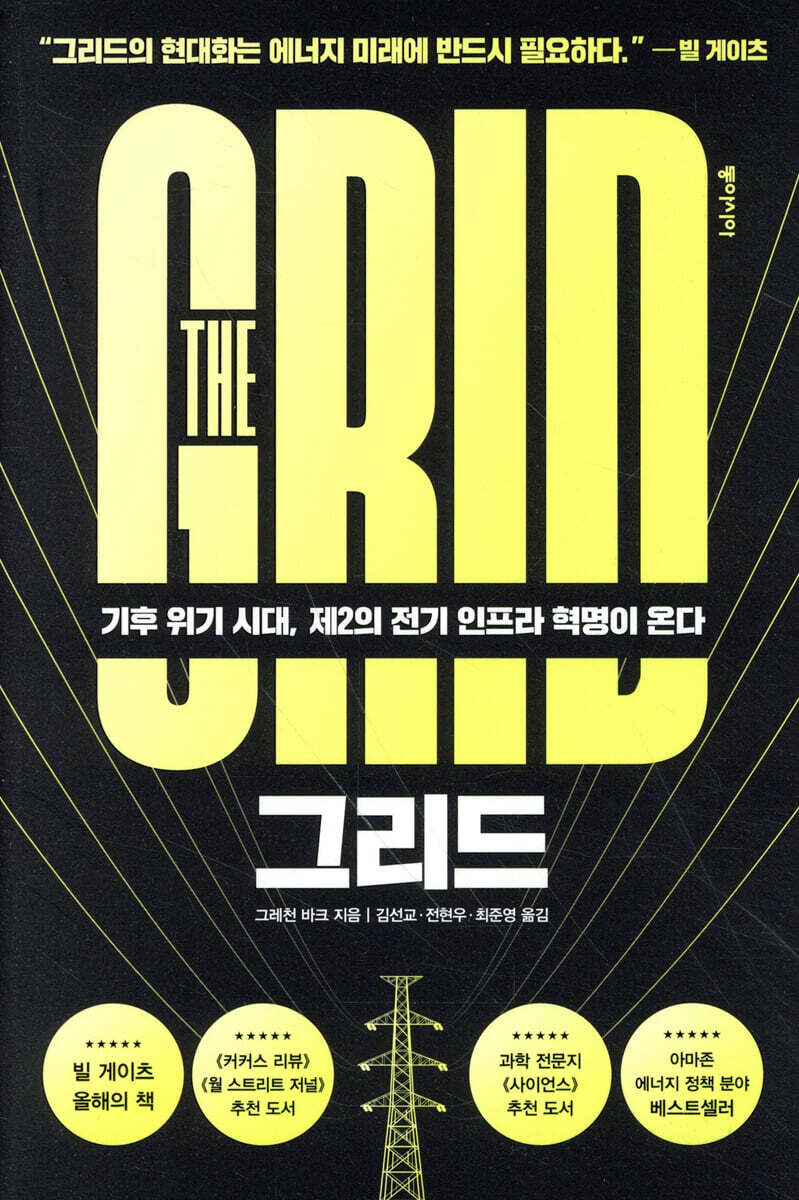
Bill Gates' Book of the Year
Rave reviews from the Wall Street Journal and Kirkus Reviews
Recommended Reading from Science Magazine
Amazon's Bestseller in Energy Policy
Books recommended by Professor Cho Cheon-ho, Special Advisor on Climate Change
Representative Lee So-young strongly recommends former Minister Yoon Sang-jik.
Climate catastrophe, future energy, and
A massive transformation of 21st century electrical infrastructure!
The climate crisis is irreversible, and the collapse of our electricity infrastructure is inevitable.
According to recent studies, if we continue to emit carbon dioxide at the current rate, the global temperature will rise by 4.5 degrees by the end of the 21st century, and even if we stop emitting carbon dioxide immediately, we face a global heating of 2 degrees.
And if global temperatures rise by just 2 degrees, many cities will become uninhabitable, and more than 400 million people will die from heat waves and water shortages.
As the climate crisis is an unavoidable reality, it is forcing us to use renewable energy.
But surprisingly, we currently do not have an electricity supply system, a 'grid', that can use renewable energy.
That's because the 20th-century grid was built around oil, coal, plutonium, and natural gas, not variable power sources like wind and solar.
And if there is no grid, there is no electricity.
Without electricity, there are no smartphones, no air conditioning, and no online classes.
Cryptocurrencies will naturally disappear, and factories, police, military, and hospitals will be at risk.
So, unless we abandon the electricity that sustains modern society, we will ultimately have to change the grid, and indeed, the grid is rapidly changing.
This book shows what challenges today's grids face, surrounding the rise of renewable energy generation and demand, the expansion of distributed power sources, and the decentralization of the electricity industry. It also specifically predicts where and how the 21st-century electricity infrastructure revolution and the resulting tectonic shifts in technology and industry will occur.
If there was an oil shock in the 20th century,
In the 21st century there will be electric shocks!
Energy issues are hot.
The word 'energy' is constantly being used here and there.
In 2021, the U.S. government pledged to reduce greenhouse gases by at least 50% by 2030.
Accordingly, California has declared that it will produce 50% of its electricity from renewable energy by 2030, and Hawaii has declared that it will produce 100% of its electricity from renewable energy by 2032.
Denmark currently generates more than 53.4% of its electricity from renewable energy, but has announced its goal of achieving 100% wind power by 2050.
And now, similar movements are occurring around the world at an unprecedented pace and scale.
Renewable energy is not only politically correct, it is also becoming a more economically sound choice.
For example, even people who weren't particularly concerned about the environment are now installing solar panels on their homes for economic reasons.
By installing these small 'power plants' to generate electricity, you get reimbursed for your contribution to the overall power supply through your electricity bill.
As a result, home solar systems are growing at a rapid pace, as those who rely entirely on the grid without renewable energy plants are shouldering most of the costs of maintaining the existing grid.
But the more we use this 'green' energy, the more vulnerable the grid becomes.
Renewable energy plants are unstable and send variable currents into the grid, which can eat away at and destroy the grid.
The results are already showing up in large-scale blackouts like the Texas power outage.
A massive expansion of renewable energy will require a complete restructuring of the grid.
But the grid is an infrastructure that extends everywhere, from smartphone batteries, input/output ports, chargers, plugs, outlets, wires, transformers, utility poles, low-voltage distribution lines, substations, synchrophasers, switches, fuses, high-voltage transmission lines, and even power plants.
Therefore, the grid crisis is also a crisis of modern industry and society.
But if you think about it the other way around, “if done right, these structural changes will be a tremendous opportunity.”
The energy crisis that has landed on Jeju Island,
2025, the coming future and opportunities!
Google and Apple are already preparing for the future.
Google operates its headquarters and data centers as "microgrids," and Apple is building its own system to provide services even when disconnected from the existing grid.
The U.S. military is also converting its entire power grid to microgrids, and the Connecticut and New York state governments are also pursuing similar projects, albeit with different details.
Other leading companies, including Citibank, BusinessWeek, and the Edison Electric Institute, also predict that the way we generate and manage electricity will soon come to an end.
Due to the high volatility of renewable energy, demand and research on energy storage technologies such as power-to-heat (P2H), green hydrogen (P2G), and energy storage systems (ESS) are also rapidly increasing.
Because electric vehicles are essentially large batteries on wheels, they are expected to be more strongly promoted and expanded rapidly accordingly.
Today, sunlight, water, and wind are eliminating street power lines, expanding mobile power generation facilities, and integrating smart technologies.
The renewable energy crisis is not just a story for the United States and Europe.
In Jeju Island, too, situations where the power grid cannot accommodate the excess electricity generated by renewable energy are occurring on a daily basis.
Because large-scale wind and solar power plants produce excess electricity with nowhere to send it, renewable energy plants are being disconnected from the grid more frequently, leading to concerns about grid collapse.
Experts say the same problem will appear inland by 2025.
But a delayed crisis can always be turned into a prepared opportunity.
In the 'Translator's Note' of this book, experts forecast the future in line with this very situation.
Rave reviews from the Wall Street Journal and Kirkus Reviews
Recommended Reading from Science Magazine
Amazon's Bestseller in Energy Policy
Books recommended by Professor Cho Cheon-ho, Special Advisor on Climate Change
Representative Lee So-young strongly recommends former Minister Yoon Sang-jik.
Climate catastrophe, future energy, and
A massive transformation of 21st century electrical infrastructure!
The climate crisis is irreversible, and the collapse of our electricity infrastructure is inevitable.
According to recent studies, if we continue to emit carbon dioxide at the current rate, the global temperature will rise by 4.5 degrees by the end of the 21st century, and even if we stop emitting carbon dioxide immediately, we face a global heating of 2 degrees.
And if global temperatures rise by just 2 degrees, many cities will become uninhabitable, and more than 400 million people will die from heat waves and water shortages.
As the climate crisis is an unavoidable reality, it is forcing us to use renewable energy.
But surprisingly, we currently do not have an electricity supply system, a 'grid', that can use renewable energy.
That's because the 20th-century grid was built around oil, coal, plutonium, and natural gas, not variable power sources like wind and solar.
And if there is no grid, there is no electricity.
Without electricity, there are no smartphones, no air conditioning, and no online classes.
Cryptocurrencies will naturally disappear, and factories, police, military, and hospitals will be at risk.
So, unless we abandon the electricity that sustains modern society, we will ultimately have to change the grid, and indeed, the grid is rapidly changing.
This book shows what challenges today's grids face, surrounding the rise of renewable energy generation and demand, the expansion of distributed power sources, and the decentralization of the electricity industry. It also specifically predicts where and how the 21st-century electricity infrastructure revolution and the resulting tectonic shifts in technology and industry will occur.
If there was an oil shock in the 20th century,
In the 21st century there will be electric shocks!
Energy issues are hot.
The word 'energy' is constantly being used here and there.
In 2021, the U.S. government pledged to reduce greenhouse gases by at least 50% by 2030.
Accordingly, California has declared that it will produce 50% of its electricity from renewable energy by 2030, and Hawaii has declared that it will produce 100% of its electricity from renewable energy by 2032.
Denmark currently generates more than 53.4% of its electricity from renewable energy, but has announced its goal of achieving 100% wind power by 2050.
And now, similar movements are occurring around the world at an unprecedented pace and scale.
Renewable energy is not only politically correct, it is also becoming a more economically sound choice.
For example, even people who weren't particularly concerned about the environment are now installing solar panels on their homes for economic reasons.
By installing these small 'power plants' to generate electricity, you get reimbursed for your contribution to the overall power supply through your electricity bill.
As a result, home solar systems are growing at a rapid pace, as those who rely entirely on the grid without renewable energy plants are shouldering most of the costs of maintaining the existing grid.
But the more we use this 'green' energy, the more vulnerable the grid becomes.
Renewable energy plants are unstable and send variable currents into the grid, which can eat away at and destroy the grid.
The results are already showing up in large-scale blackouts like the Texas power outage.
A massive expansion of renewable energy will require a complete restructuring of the grid.
But the grid is an infrastructure that extends everywhere, from smartphone batteries, input/output ports, chargers, plugs, outlets, wires, transformers, utility poles, low-voltage distribution lines, substations, synchrophasers, switches, fuses, high-voltage transmission lines, and even power plants.
Therefore, the grid crisis is also a crisis of modern industry and society.
But if you think about it the other way around, “if done right, these structural changes will be a tremendous opportunity.”
The energy crisis that has landed on Jeju Island,
2025, the coming future and opportunities!
Google and Apple are already preparing for the future.
Google operates its headquarters and data centers as "microgrids," and Apple is building its own system to provide services even when disconnected from the existing grid.
The U.S. military is also converting its entire power grid to microgrids, and the Connecticut and New York state governments are also pursuing similar projects, albeit with different details.
Other leading companies, including Citibank, BusinessWeek, and the Edison Electric Institute, also predict that the way we generate and manage electricity will soon come to an end.
Due to the high volatility of renewable energy, demand and research on energy storage technologies such as power-to-heat (P2H), green hydrogen (P2G), and energy storage systems (ESS) are also rapidly increasing.
Because electric vehicles are essentially large batteries on wheels, they are expected to be more strongly promoted and expanded rapidly accordingly.
Today, sunlight, water, and wind are eliminating street power lines, expanding mobile power generation facilities, and integrating smart technologies.
The renewable energy crisis is not just a story for the United States and Europe.
In Jeju Island, too, situations where the power grid cannot accommodate the excess electricity generated by renewable energy are occurring on a daily basis.
Because large-scale wind and solar power plants produce excess electricity with nowhere to send it, renewable energy plants are being disconnected from the grid more frequently, leading to concerns about grid collapse.
Experts say the same problem will appear inland by 2025.
But a delayed crisis can always be turned into a prepared opportunity.
In the 'Translator's Note' of this book, experts forecast the future in line with this very situation.
GOODS SPECIFICS
- Publication date: June 23, 2021
- Page count, weight, size: 532 pages | 590g | 145*215*25mm
- ISBN13: 9788962623758
- ISBN 10: 8962623757
You may also like
카테고리
korean


korean

![ELLE 엘르 스페셜 에디션 A형 : 12월 [2025]](http://librairie.coreenne.fr/cdn/shop/files/b8e27a3de6c9538896439686c6b0e8fb.jpg?v=1766436872&width=3840)


