

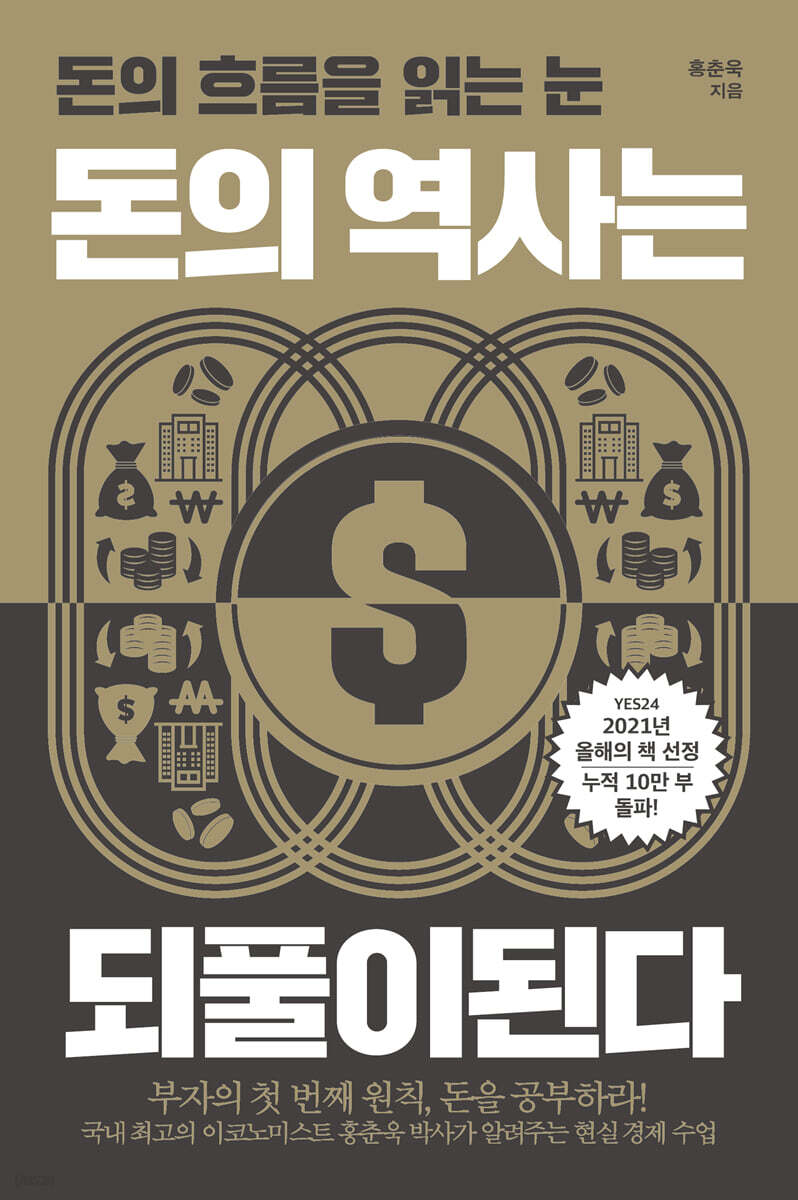
The history of money repeats itself
 |
Description
Book Introduction
- A word from MD
-
A new book by Dr. Hong Chun-wook, Korea's top economistWith 28 years of experience studying money, Dr. Hong Chun-wook, Korea's leading economist, has compiled "How to Read the Flow of Money," the legacy he hopes to pass on to his son.
We've compiled insights into money, offering essential insights for successful investment and asset building in this era of persistently low interest rates.
June 15, 2021. Economics and Management PD Kang Hyun-jung
To take control of your money, you need to read its flow!
28 years of studying money, Korea's best economist!
Dr. Hong Chun-wook shares his "realistic" economics lessons and the best investment strategies.
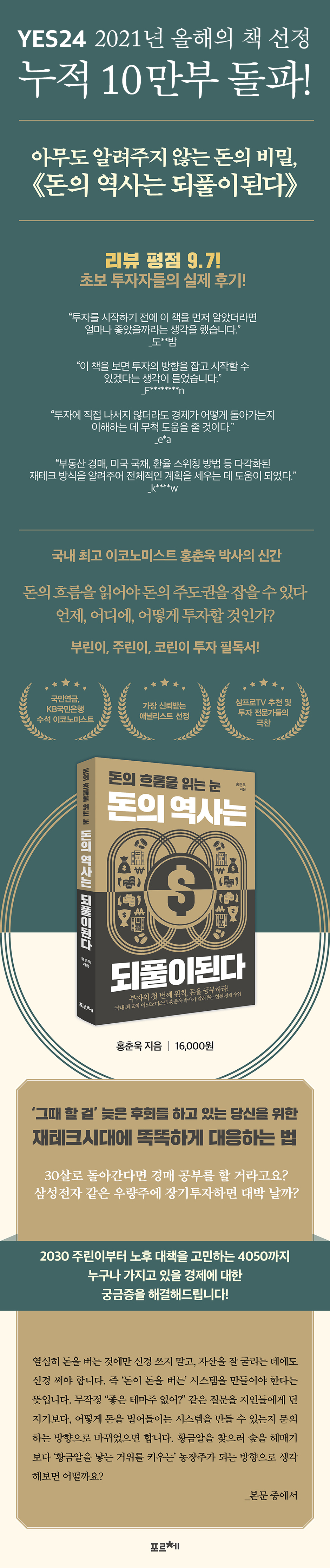
『The History of Money Repeats Itself』 Dr. Hong Chun-wook, Korea's top economist, has put all his know-how from 28 years of studying money into this book, which contains practical advice on economic trends, real estate, stocks, and investments, including how to read the flow of money.
To take control of money, we must know how to read the flow of money.
Dr. Hong Chun-wook chose "reading the flow of money" as the most important inheritance to pass on to his son. By compiling his insights on money, he offers practical investment methods to protect yourself in uncertain times.
The author's solid investment track record, built as an economist at banks and securities firms, an investment management manager at the National Pension Service, and an economics and management scholar, provides clear direction for how to proceed in these uncertain times of COVID-19 and low interest rates.
The author's expert analysis of three financial variables—interest rates, stock prices, and exchange rates—that have a significant impact on our lives but are largely unknown, is a valuable aid in understanding economic trends.
As an economic commentator for the public, this book's greatest strength is its insightful coverage of the latest economic data and key issues, while also providing insightful information about the real world and money.
This is an essential investment guide, especially for novice investors like Joo-rin and Burin, who are unsure of what to pay attention to and focus on when making decisions involving money.
28 years of studying money, Korea's best economist!
Dr. Hong Chun-wook shares his "realistic" economics lessons and the best investment strategies.
『The History of Money Repeats Itself』 Dr. Hong Chun-wook, Korea's top economist, has put all his know-how from 28 years of studying money into this book, which contains practical advice on economic trends, real estate, stocks, and investments, including how to read the flow of money.
To take control of money, we must know how to read the flow of money.
Dr. Hong Chun-wook chose "reading the flow of money" as the most important inheritance to pass on to his son. By compiling his insights on money, he offers practical investment methods to protect yourself in uncertain times.
The author's solid investment track record, built as an economist at banks and securities firms, an investment management manager at the National Pension Service, and an economics and management scholar, provides clear direction for how to proceed in these uncertain times of COVID-19 and low interest rates.
The author's expert analysis of three financial variables—interest rates, stock prices, and exchange rates—that have a significant impact on our lives but are largely unknown, is a valuable aid in understanding economic trends.
As an economic commentator for the public, this book's greatest strength is its insightful coverage of the latest economic data and key issues, while also providing insightful information about the real world and money.
This is an essential investment guide, especially for novice investors like Joo-rin and Burin, who are unsure of what to pay attention to and focus on when making decisions involving money.
- You can preview some of the book's contents.
Preview
index
Prologue: In the era of zero interest rates, we've entered a world where investment is the only way to survive.
Chapter 1.
If you want to make money, you have to study money first.
People who stayed still and became 'sudden beggars'
Why did they jump into stock investing?
Economic Freedom: The Long and Hard Road
If you want to become rich, change your thinking right now.
The Inconvenient Truth About Money and Happiness
MONEY TALK The Fallacy of Averages: What happens when Warren Buffett walks into a bar with 10 people?
MONEY TALK Is the 'Easterlin Paradox' true?
Chapter 2.
It's the age of investment, let's make some money.
If you were to go back to being 30, would you study auctions?
Signs that the real estate market is about to bottom out
A recession is another opportunity
Invest in safe assets that are unshaken by crises.
Knowing the exchange rate is essential for investing well.
Let's stock up on recession-resistant U.S. Treasury bonds.
Action Plan for Dollar Asset Investment
Let's keep an eye on the war between the dollar and cryptocurrencies.
MONEY TALK: The Housing Market Bubble Level as Seen Through the Housing Affordability Index
MONEY TALK: The Relationship Between U.S. Treasury Yields and the Korean Stock Market
MONEY TALK: Learn about U.S. Treasury bond index funds listed in Korea.
Chapter 3.
Should I buy Korean stocks or not?
Why is the Korean stock market so volatile?
The Korean stock market will survive only if dividends are raised.
Will long-term investments in blue-chip stocks like Samsung Electronics lead to a huge hit?
MONEY TALK: Focus on Companies with High Dividend Yields
Chapter 4.
The Best Survival Strategy in a Recession
Korea becomes Japan?
The burden on the Korean economy grows amidst the era of containment of China.
The trauma of the foreign exchange crisis weighing on the Korean economy
Job opportunities remain open even as exports increase
MONEY TALK How should we evaluate the ranking of innovative countries?
MONEY TALK How will free trade affect the economy?
MONEY TALK How will population decline affect asset markets?
Chapter 5.
Signs that can foretell an economic crisis
Beware of the dangers of unanimity and the over-lending boom.
The risk of external shocks triggering a recession
The inversion of short-term and long-term interest rates is a signal of a recession.
MONEY TALK How can we tell if the over-lending boom is coming to an end?
MONEY TALK Why are long-term interest rates higher than short-term interest rates?
MONEY TALK How can we check the trend of the U.S. short-term and long-term interest rate differential?
Chapter 6.
Buying Timing for a Losing Investment
Let's keep an eye on companies whose major shareholders are stepping up to buy them.
Reading Dividend Signals
When stock prices plummet, it's time to buy quality growth stocks.
How to use the MONEY TALK electronic disclosure system 'DART'?
MONEY TALK: Let's examine the stock price reaction after the dividend expansion announcement.
Chapter 7.
Momentum Investing vs. Value Investing: Which One Should I Choose?
The vast majority of market participants are momentum investors.
Where have all those great companies gone?
Even Warren Buffett finds it difficult to stick to his investment principles.
MONEY TALK: Will momentum strategies work in Korea?
MONEY TALK Should I invest like Warren Buffett?
Chapter 8.
Teacher Hong's financial struggles
In my 20s, I was a young person who jumped into stocks without thinking and kept failing.
In my 30s, I finally succeeded in buying my own home.
People in their 40s are learning about exchange rate switching strategies.
People in their 50s are using a "National Pension-style" asset allocation strategy.
MONEY TALK: When financial markets panic, respond with rebalancing.
MONEY TALK Looking forward to the development of a smart 'automatic asset allocation fund'
References
Chapter 1.
If you want to make money, you have to study money first.
People who stayed still and became 'sudden beggars'
Why did they jump into stock investing?
Economic Freedom: The Long and Hard Road
If you want to become rich, change your thinking right now.
The Inconvenient Truth About Money and Happiness
MONEY TALK The Fallacy of Averages: What happens when Warren Buffett walks into a bar with 10 people?
MONEY TALK Is the 'Easterlin Paradox' true?
Chapter 2.
It's the age of investment, let's make some money.
If you were to go back to being 30, would you study auctions?
Signs that the real estate market is about to bottom out
A recession is another opportunity
Invest in safe assets that are unshaken by crises.
Knowing the exchange rate is essential for investing well.
Let's stock up on recession-resistant U.S. Treasury bonds.
Action Plan for Dollar Asset Investment
Let's keep an eye on the war between the dollar and cryptocurrencies.
MONEY TALK: The Housing Market Bubble Level as Seen Through the Housing Affordability Index
MONEY TALK: The Relationship Between U.S. Treasury Yields and the Korean Stock Market
MONEY TALK: Learn about U.S. Treasury bond index funds listed in Korea.
Chapter 3.
Should I buy Korean stocks or not?
Why is the Korean stock market so volatile?
The Korean stock market will survive only if dividends are raised.
Will long-term investments in blue-chip stocks like Samsung Electronics lead to a huge hit?
MONEY TALK: Focus on Companies with High Dividend Yields
Chapter 4.
The Best Survival Strategy in a Recession
Korea becomes Japan?
The burden on the Korean economy grows amidst the era of containment of China.
The trauma of the foreign exchange crisis weighing on the Korean economy
Job opportunities remain open even as exports increase
MONEY TALK How should we evaluate the ranking of innovative countries?
MONEY TALK How will free trade affect the economy?
MONEY TALK How will population decline affect asset markets?
Chapter 5.
Signs that can foretell an economic crisis
Beware of the dangers of unanimity and the over-lending boom.
The risk of external shocks triggering a recession
The inversion of short-term and long-term interest rates is a signal of a recession.
MONEY TALK How can we tell if the over-lending boom is coming to an end?
MONEY TALK Why are long-term interest rates higher than short-term interest rates?
MONEY TALK How can we check the trend of the U.S. short-term and long-term interest rate differential?
Chapter 6.
Buying Timing for a Losing Investment
Let's keep an eye on companies whose major shareholders are stepping up to buy them.
Reading Dividend Signals
When stock prices plummet, it's time to buy quality growth stocks.
How to use the MONEY TALK electronic disclosure system 'DART'?
MONEY TALK: Let's examine the stock price reaction after the dividend expansion announcement.
Chapter 7.
Momentum Investing vs. Value Investing: Which One Should I Choose?
The vast majority of market participants are momentum investors.
Where have all those great companies gone?
Even Warren Buffett finds it difficult to stick to his investment principles.
MONEY TALK: Will momentum strategies work in Korea?
MONEY TALK Should I invest like Warren Buffett?
Chapter 8.
Teacher Hong's financial struggles
In my 20s, I was a young person who jumped into stocks without thinking and kept failing.
In my 30s, I finally succeeded in buying my own home.
People in their 40s are learning about exchange rate switching strategies.
People in their 50s are using a "National Pension-style" asset allocation strategy.
MONEY TALK: When financial markets panic, respond with rebalancing.
MONEY TALK Looking forward to the development of a smart 'automatic asset allocation fund'
References
Detailed image
Into the book
What was the most talked-about buzzword of 2020? There were many, but the phrase "sudden beggar" ("sudden beggar") struck me the most.
A sudden break-even is when you suddenly find yourself feeling poor, even though you had money like before, without doing anything special.
This is an expression that describes the phenomenon of falling into relative poverty even though one's income or assets have not significantly changed from before.
In a society like ours where people are so concerned about others' reputations, it's hard not to feel stressed when the wealth gap widens so dramatically.
Especially if you haven't joined the investment wave these days, the feeling of being suddenly broke can be even more intense.
---From "People Who Became 'Suddenly Poor' After Staying Still"
I wish people wouldn't feel guilty about using money to alleviate the inconveniences or frustrations they encounter in life.
This is because human time is limited, and the wages that an individual can earn through physical labor are also limited.
So, don't just focus on making money, but also on managing your assets well.
That means we need to create a system where 'money makes money'.
Rather than simply asking people questions like, "Are there any good theme stocks?", I hope they'll shift their focus to asking how they can create a system that makes money.
Instead of wandering the forest looking for golden eggs, why not think about becoming a farmer who "raises the goose that lays golden eggs"?
---From "If you want to become rich, change your thinking right away"
Some people ask, “Should I study auctions now that the auction market is so hot?”
To conclude, I think studying auctions is essential for the 2030 generation.
Because the auction winning bid rate fluctuates several times a year.
The most representative period was early 2019.
At the time, the global economy was experiencing significant difficulties due to the aftermath of the US-China trade dispute, and the Bank of Korea had raised its policy interest rate to 1.75%.
Two of the three factors that determine the direction of real estate prices have moved in a negative direction (the three factors that determine the direction of real estate prices will be discussed in detail in the next section).
As a result, the auction market entered an ice age.
In particular, the successful bid rate for apartments in Seoul, especially those in Gangnam, has plummeted.
In March 2019, the apartment bid-to-sale rate in this area was 66.7%.
At the time, there was a temporary shock factor, such as about 10 auctioned properties of a specific apartment in Seocho-gu being sold at around 50%, which may have also influenced the sharp drop in the apartment auction price rate.
However, even when looking at all apartments in Seoul, it is quite surprising that the auction winning bid rate for apartments in Seoul fell to about 82% during the same period.
---From "If I were to go back to being 30, would I study auctions?"
The most important principle when raising seed money in a difficult environment is to invest in assets that increase in value during a recession.
In the words of investor Nassim Nicholas Taleb, famous for predicting the 2008 crisis, "anti-fragile" assets are the best places to raise seed money.
Antifragility here refers to assets or characteristics that have the property of being resilient in times of crisis.
A representative example is ‘US Treasury bonds’.
Looking at the price movement of the listed index fund (305080) investing in U.S. Treasury bonds, we can see that it rose 16.4% as of the end of March 2020 compared to the end of 2019.
The spread of the coronavirus has frozen the economy and caused panic in financial markets, but the price of U.S. Treasury bonds has actually surged.
---From "Let's invest in safe assets that are not shaken by crises"
The key takeaways from this investment case study for dual-income couples are as follows:
Even if you assume that your savings don't increase by a single won each year for 20 years, if you implement the so-called "switching strategy" of investing in dollar assets and then switching to won assets, your investment principal will more than double.
Moreover, if you had some seed money or increased your savings each year, your investment performance would have been even greater.
There is one more advantage to utilizing this switching strategy.
That means your retirement age is automatically determined.
That is, you can invest in Korean Won during a period of rapid exchange rate fluctuations, say once every five or ten years, and when you see results, you can quit your job as you have always dreamed.
This means that the best time to retire is when exchange rate gains are maximized and Korean assets are traded cheaply.
---From "Action Plan for Dollar Asset Investment"
Therefore, rather than investing 100% in Korean stocks, diversifying your investments into US bonds and other assets is a way to increase returns and reduce investment risk.
Of course, no matter how much you diversify your investments, you can't completely eliminate risk.
But trying to avoid all risk can be the riskiest choice in the investing world.
The more you try to avoid taking any risks, the lower your investment performance will be.
For example, while bank deposits may be the safest investment, it's important to keep in mind that in an environment of ultra-low interest rates that fall below the consumer price inflation rate, they can actually lead to real losses.
Therefore, we recommend investing in a way that aims for the expected returns from stock investments while controlling the level of risk at a certain level (for example, a negative return once every 10 years) through diversification.
- p.111, from “Why is the Korean stock market so volatile?”
If we summarize the story in Chapter 4, we can see three facts.
First, the Korean economy's growth rate has slowed compared to the past as investment has contracted since the foreign exchange crisis.
Second, while innovative industries such as semiconductors and automobiles, where investment is concentrated, are still experiencing high growth, jobs in these sectors have not increased as quickly as expected.
Third, as the information and communications revolution progresses, production efficiency increases, and the impact of globalization intensifies, competition for jobs in domestic industries such as construction and the restaurant industry has become more intense than before.
Considering these circumstances, it seems unlikely that our country's perceived economic situation will improve significantly.
As the minimum wage rises, the influx of foreign workers is likely to increase further, and key export industries that drive innovation are increasingly reducing hiring, including by abolishing public recruitment.
Therefore, I believe that active 'investment' is essential, except for a very few capable (and lucky) people.
---From "Employment Doors That Won't Open Even If Exports Increase"
When a recession hits and you sell your dollars to buy stocks, it would be a good idea to prioritize companies with the following characteristics and include them on your buying list.
1.
After a stock price crash, when a controlling shareholder actively purchases stocks or gives them to his or her children
2.
When raising dividends or paying new dividends even during a recession
3.
When a high-quality growth stock with five characteristics (brand power, switching costs, secrecy, price competitiveness, and platform) crashes in a panic
---From "When Stock Prices Crash, It's Time to Buy Quality Growth Stocks"
Here, the National Pension Style does not mean investing in the same way as the National Pension, but rather appropriately allocating domestic and foreign assets and 'rebalancing' them in a timely manner.
This is how you consistently achieve your target asset ratio.
As my case demonstrates, rebalancing not only improves returns but also avoids the risk of your holdings suddenly losing value.
In other words, by holding assets (dollar government bonds) that move in the opposite direction to stocks, losses are limited even in a crash like the one in March 2020. In addition, during the rebalancing process, the company continuously "buys low" by selling assets that have risen significantly in value and purchasing assets that have fallen in value.
As we've seen before, the most popular piece of information when buying stocks during the March 2020 stock market crash was "buyouts by major shareholders."
When a stock price plummets, it is a very positive sign when a major shareholder buys back shares directly or gives them to his or her children.
From the perspective of an insider who knows the company's situation best, it can be seen as an action that announces internally and externally that one has judged that 'this company is cheap.'
I bought stocks when rebalancing during my investment process, but you don't have to buy only stocks.
There are a variety of listed index funds, so investing in one that suits your preferences is a good option.
A sudden break-even is when you suddenly find yourself feeling poor, even though you had money like before, without doing anything special.
This is an expression that describes the phenomenon of falling into relative poverty even though one's income or assets have not significantly changed from before.
In a society like ours where people are so concerned about others' reputations, it's hard not to feel stressed when the wealth gap widens so dramatically.
Especially if you haven't joined the investment wave these days, the feeling of being suddenly broke can be even more intense.
---From "People Who Became 'Suddenly Poor' After Staying Still"
I wish people wouldn't feel guilty about using money to alleviate the inconveniences or frustrations they encounter in life.
This is because human time is limited, and the wages that an individual can earn through physical labor are also limited.
So, don't just focus on making money, but also on managing your assets well.
That means we need to create a system where 'money makes money'.
Rather than simply asking people questions like, "Are there any good theme stocks?", I hope they'll shift their focus to asking how they can create a system that makes money.
Instead of wandering the forest looking for golden eggs, why not think about becoming a farmer who "raises the goose that lays golden eggs"?
---From "If you want to become rich, change your thinking right away"
Some people ask, “Should I study auctions now that the auction market is so hot?”
To conclude, I think studying auctions is essential for the 2030 generation.
Because the auction winning bid rate fluctuates several times a year.
The most representative period was early 2019.
At the time, the global economy was experiencing significant difficulties due to the aftermath of the US-China trade dispute, and the Bank of Korea had raised its policy interest rate to 1.75%.
Two of the three factors that determine the direction of real estate prices have moved in a negative direction (the three factors that determine the direction of real estate prices will be discussed in detail in the next section).
As a result, the auction market entered an ice age.
In particular, the successful bid rate for apartments in Seoul, especially those in Gangnam, has plummeted.
In March 2019, the apartment bid-to-sale rate in this area was 66.7%.
At the time, there was a temporary shock factor, such as about 10 auctioned properties of a specific apartment in Seocho-gu being sold at around 50%, which may have also influenced the sharp drop in the apartment auction price rate.
However, even when looking at all apartments in Seoul, it is quite surprising that the auction winning bid rate for apartments in Seoul fell to about 82% during the same period.
---From "If I were to go back to being 30, would I study auctions?"
The most important principle when raising seed money in a difficult environment is to invest in assets that increase in value during a recession.
In the words of investor Nassim Nicholas Taleb, famous for predicting the 2008 crisis, "anti-fragile" assets are the best places to raise seed money.
Antifragility here refers to assets or characteristics that have the property of being resilient in times of crisis.
A representative example is ‘US Treasury bonds’.
Looking at the price movement of the listed index fund (305080) investing in U.S. Treasury bonds, we can see that it rose 16.4% as of the end of March 2020 compared to the end of 2019.
The spread of the coronavirus has frozen the economy and caused panic in financial markets, but the price of U.S. Treasury bonds has actually surged.
---From "Let's invest in safe assets that are not shaken by crises"
The key takeaways from this investment case study for dual-income couples are as follows:
Even if you assume that your savings don't increase by a single won each year for 20 years, if you implement the so-called "switching strategy" of investing in dollar assets and then switching to won assets, your investment principal will more than double.
Moreover, if you had some seed money or increased your savings each year, your investment performance would have been even greater.
There is one more advantage to utilizing this switching strategy.
That means your retirement age is automatically determined.
That is, you can invest in Korean Won during a period of rapid exchange rate fluctuations, say once every five or ten years, and when you see results, you can quit your job as you have always dreamed.
This means that the best time to retire is when exchange rate gains are maximized and Korean assets are traded cheaply.
---From "Action Plan for Dollar Asset Investment"
Therefore, rather than investing 100% in Korean stocks, diversifying your investments into US bonds and other assets is a way to increase returns and reduce investment risk.
Of course, no matter how much you diversify your investments, you can't completely eliminate risk.
But trying to avoid all risk can be the riskiest choice in the investing world.
The more you try to avoid taking any risks, the lower your investment performance will be.
For example, while bank deposits may be the safest investment, it's important to keep in mind that in an environment of ultra-low interest rates that fall below the consumer price inflation rate, they can actually lead to real losses.
Therefore, we recommend investing in a way that aims for the expected returns from stock investments while controlling the level of risk at a certain level (for example, a negative return once every 10 years) through diversification.
- p.111, from “Why is the Korean stock market so volatile?”
If we summarize the story in Chapter 4, we can see three facts.
First, the Korean economy's growth rate has slowed compared to the past as investment has contracted since the foreign exchange crisis.
Second, while innovative industries such as semiconductors and automobiles, where investment is concentrated, are still experiencing high growth, jobs in these sectors have not increased as quickly as expected.
Third, as the information and communications revolution progresses, production efficiency increases, and the impact of globalization intensifies, competition for jobs in domestic industries such as construction and the restaurant industry has become more intense than before.
Considering these circumstances, it seems unlikely that our country's perceived economic situation will improve significantly.
As the minimum wage rises, the influx of foreign workers is likely to increase further, and key export industries that drive innovation are increasingly reducing hiring, including by abolishing public recruitment.
Therefore, I believe that active 'investment' is essential, except for a very few capable (and lucky) people.
---From "Employment Doors That Won't Open Even If Exports Increase"
When a recession hits and you sell your dollars to buy stocks, it would be a good idea to prioritize companies with the following characteristics and include them on your buying list.
1.
After a stock price crash, when a controlling shareholder actively purchases stocks or gives them to his or her children
2.
When raising dividends or paying new dividends even during a recession
3.
When a high-quality growth stock with five characteristics (brand power, switching costs, secrecy, price competitiveness, and platform) crashes in a panic
---From "When Stock Prices Crash, It's Time to Buy Quality Growth Stocks"
Here, the National Pension Style does not mean investing in the same way as the National Pension, but rather appropriately allocating domestic and foreign assets and 'rebalancing' them in a timely manner.
This is how you consistently achieve your target asset ratio.
As my case demonstrates, rebalancing not only improves returns but also avoids the risk of your holdings suddenly losing value.
In other words, by holding assets (dollar government bonds) that move in the opposite direction to stocks, losses are limited even in a crash like the one in March 2020. In addition, during the rebalancing process, the company continuously "buys low" by selling assets that have risen significantly in value and purchasing assets that have fallen in value.
As we've seen before, the most popular piece of information when buying stocks during the March 2020 stock market crash was "buyouts by major shareholders."
When a stock price plummets, it is a very positive sign when a major shareholder buys back shares directly or gives them to his or her children.
From the perspective of an insider who knows the company's situation best, it can be seen as an action that announces internally and externally that one has judged that 'this company is cheap.'
I bought stocks when rebalancing during my investment process, but you don't have to buy only stocks.
There are a variety of listed index funds, so investing in one that suits your preferences is a good option.
---From "Using the 'National Pension Style' Asset Allocation Strategy in Your 50s"
Publisher's Review
Income is the problem? No, it's the decline in assets!
In this strange zero-interest-rate era where everyone is getting rich except me, investing isn't a choice, it's a necessity!
Dr. Hong Chun-wook's investment lessons for the future, unwavering even in times of crisis.
As the era of low interest rates becomes entrenched, it has become impossible to accumulate assets simply through savings.
In short, ‘investment is not a choice, but a necessity.’
Even people who previously didn't have much interest in studying difficult financial management are now jumping into the stock and real estate markets without hesitation.
However, the author emphasizes that investing skills are an area that requires learning and mastery.
In order to prepare for an uncertain future, it is said that above all else, one must 'study money' and acquire financial knowledge.
It explains that it is important to have knowledge of what lower interest rates mean and how they significantly impact society, why the economy is constantly cyclical, why the stock market is prone to repeated panics and bubbles, why the Korean stock market experiences violent ups and downs, and when real estate prices plummet.
The author also advises that instead of worrying about the bleak future of the real estate market, the Korean economy entering a long-term recession, or the widening income gap, you should assess your current position and investments to prepare for these issues.
He emphasizes that investing is almost the only way to prepare for the future, and therefore, one should not shy away from studying financial technology.
As Korea's leading economic expert, the author offers clear, practical advice on investing, explaining what investing is, how to get started, and what action plan to develop, for those who dream of financial freedom but fear investing.
Why are millennials jumping into investing?
What should be changed for those in their 40s without any retirement plans?
From the 2030 generation to the 4050 generation
Wealth Scenarios and Investment Guides: Turning Uncertainty into Opportunity
Recently, the younger generation, known as millennials, has begun to enter the asset market in earnest.
As the low-growth trend continues, these people are suffering from a triple whammy of unemployment, widening income gap, and rising housing costs, and they are increasingly thinking that they need to bet on 'financial technology'.
Dr. Hong Chun-wook explains that this investment craze is driven by the perception that the smart millennial generation, known as having the greatest specs since Dangun, has a bleak future and no way to keep up with rising housing prices.
Throughout this book, the author offers comfort to those in their 20s and 30s, offering thoughtful advice on practical financial strategies for those in their 30s.
To briefly introduce a representative strategy, I advise signing up for foreign currency deposits and ETFs, and starting to study auctions.
The author argues that while Korea may be a strong company and a good country in many ways, it is unfortunately vulnerable to external pressures, and that a strategy of holding a certain amount of foreign currency could provide strength in times of crisis.
In other words, in terms of financial technology, he emphasizes that Korea is a country where opportunities often come.
The author also does not miss out on advice for those in their 40s, that is, the older generation.
Dr. Hong points out that although Korean households in their 40s are showing the highest income levels of their lifetimes, they are recording low net worth (total assets minus debt) and household resources are woefully inadequate for retirement planning, and if things continue like this, “South Korea’s 40-somethings are doomed.”
Therefore, I advise you to thoroughly recognize this reality, actively invest at a level where 'risk management' is possible, and begin retirement planning right away.
In other words, it is emphasized that pursuing absolute safe assets is a 100% surefire way to failure.
Even if it means taking on some risk, it is advised to invest a portion of your total assets in overseas bond products to ensure stable performance even if domestic problems arise, and to manage a portion of your assets by investing in stocks to prepare for a low-interest rate environment.
In particular, if you refer to the last chapter of this book, "Mr. Hong's Financial Struggles," which summarizes Dr. Hong Chun-wook's 28 years of investment experience, you will be able to obtain specific information on how to develop financial planning and asset allocation strategies according to life cycle.
In this strange zero-interest-rate era where everyone is getting rich except me, investing isn't a choice, it's a necessity!
Dr. Hong Chun-wook's investment lessons for the future, unwavering even in times of crisis.
As the era of low interest rates becomes entrenched, it has become impossible to accumulate assets simply through savings.
In short, ‘investment is not a choice, but a necessity.’
Even people who previously didn't have much interest in studying difficult financial management are now jumping into the stock and real estate markets without hesitation.
However, the author emphasizes that investing skills are an area that requires learning and mastery.
In order to prepare for an uncertain future, it is said that above all else, one must 'study money' and acquire financial knowledge.
It explains that it is important to have knowledge of what lower interest rates mean and how they significantly impact society, why the economy is constantly cyclical, why the stock market is prone to repeated panics and bubbles, why the Korean stock market experiences violent ups and downs, and when real estate prices plummet.
The author also advises that instead of worrying about the bleak future of the real estate market, the Korean economy entering a long-term recession, or the widening income gap, you should assess your current position and investments to prepare for these issues.
He emphasizes that investing is almost the only way to prepare for the future, and therefore, one should not shy away from studying financial technology.
As Korea's leading economic expert, the author offers clear, practical advice on investing, explaining what investing is, how to get started, and what action plan to develop, for those who dream of financial freedom but fear investing.
Why are millennials jumping into investing?
What should be changed for those in their 40s without any retirement plans?
From the 2030 generation to the 4050 generation
Wealth Scenarios and Investment Guides: Turning Uncertainty into Opportunity
Recently, the younger generation, known as millennials, has begun to enter the asset market in earnest.
As the low-growth trend continues, these people are suffering from a triple whammy of unemployment, widening income gap, and rising housing costs, and they are increasingly thinking that they need to bet on 'financial technology'.
Dr. Hong Chun-wook explains that this investment craze is driven by the perception that the smart millennial generation, known as having the greatest specs since Dangun, has a bleak future and no way to keep up with rising housing prices.
Throughout this book, the author offers comfort to those in their 20s and 30s, offering thoughtful advice on practical financial strategies for those in their 30s.
To briefly introduce a representative strategy, I advise signing up for foreign currency deposits and ETFs, and starting to study auctions.
The author argues that while Korea may be a strong company and a good country in many ways, it is unfortunately vulnerable to external pressures, and that a strategy of holding a certain amount of foreign currency could provide strength in times of crisis.
In other words, in terms of financial technology, he emphasizes that Korea is a country where opportunities often come.
The author also does not miss out on advice for those in their 40s, that is, the older generation.
Dr. Hong points out that although Korean households in their 40s are showing the highest income levels of their lifetimes, they are recording low net worth (total assets minus debt) and household resources are woefully inadequate for retirement planning, and if things continue like this, “South Korea’s 40-somethings are doomed.”
Therefore, I advise you to thoroughly recognize this reality, actively invest at a level where 'risk management' is possible, and begin retirement planning right away.
In other words, it is emphasized that pursuing absolute safe assets is a 100% surefire way to failure.
Even if it means taking on some risk, it is advised to invest a portion of your total assets in overseas bond products to ensure stable performance even if domestic problems arise, and to manage a portion of your assets by investing in stocks to prepare for a low-interest rate environment.
In particular, if you refer to the last chapter of this book, "Mr. Hong's Financial Struggles," which summarizes Dr. Hong Chun-wook's 28 years of investment experience, you will be able to obtain specific information on how to develop financial planning and asset allocation strategies according to life cycle.
GOODS SPECIFICS
- Publication date: June 16, 2021
- Page count, weight, size: 276 pages | 458g | 143*215*17mm
- ISBN13: 9791191393163
- ISBN10: 119139316X
You may also like
카테고리
korean


korean

![GQ KOREA Mark (Monthly): December [2025]](http://librairie.coreenne.fr/cdn/shop/files/8ef265dbbfbf186523ed75ba7319009d.jpg?v=1765340328&width=3840)


