

About pain
 |
Description
Book Introduction
- A word from MD
-
A new novel by the Booker Prize finalist, Novelist Jeong Bo-raA new work by author Jeong Bo-ra, who was shortlisted for the Booker Prize for “Cursed Rabbit” after four years.
As painkillers were developed to relieve pain, humanity was liberated from pain.
Then, a new religion emerged that claimed that suffering could save humanity, and many incidents and accidents occurred.
A science fiction novel that explores the source and meaning of suffering.
September 5, 2023. Novel/Poetry PD Kim Yu-ri
“A captivating novel that will have you swept away on waves of thought!”
Booker Prize finalist, Jeong Bo-ra's new novel, her first in four years
The new work of author Jeong Bo-ra, who shocked readers not only in Korea but also around the world by being shortlisted for the Booker Prize with “Cursed Rabbit,” is being published by Dasan Books.
"On Pain" is a full-length novel presented four years after "The Red Knife," and it further highlights Jeong Bo-ra's characteristically meticulous and intense setting, coolly penetrating prose, and darkly sparkling thoughts.
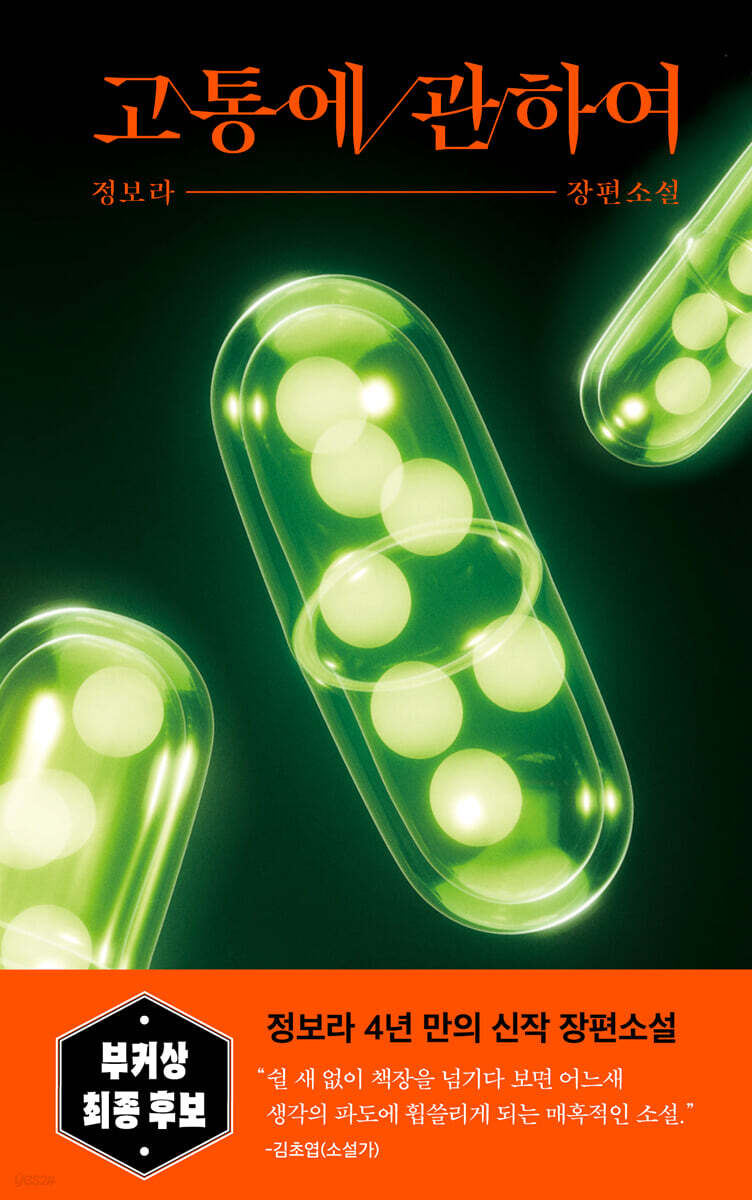
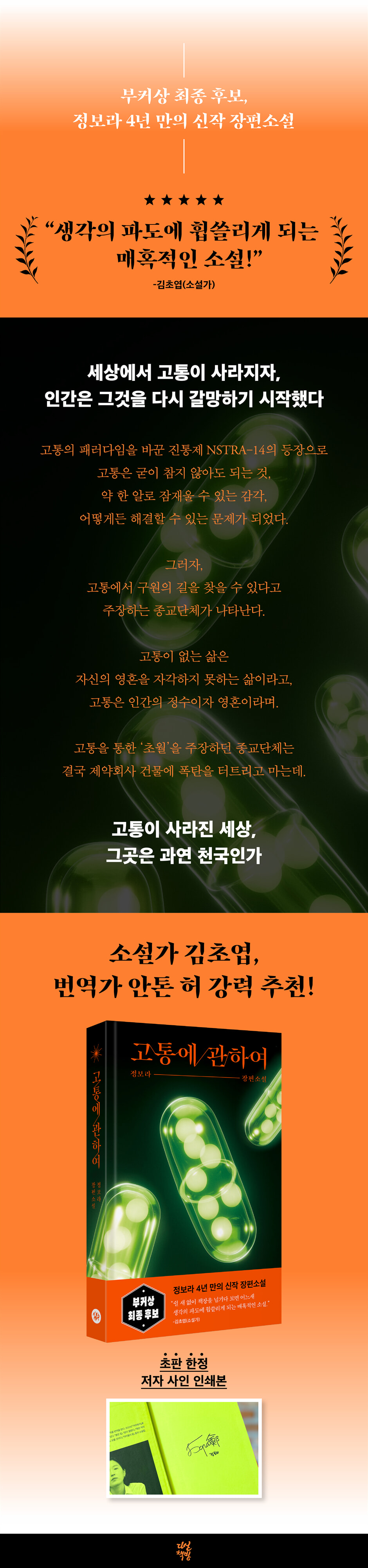
The story begins with a conflict between a pharmaceutical company that created the painkiller 'NSTRA-14', which neutralizes pain, and a religious group that claims that pain leads to salvation for humans.
Through the fascinating possibility of the novel called information, it dissects the very roots of the sensation called "pain," offering readers both philosophical insight and the thrill of a story that persistently pierces their inner selves.
Booker Prize finalist, Jeong Bo-ra's new novel, her first in four years
The new work of author Jeong Bo-ra, who shocked readers not only in Korea but also around the world by being shortlisted for the Booker Prize with “Cursed Rabbit,” is being published by Dasan Books.
"On Pain" is a full-length novel presented four years after "The Red Knife," and it further highlights Jeong Bo-ra's characteristically meticulous and intense setting, coolly penetrating prose, and darkly sparkling thoughts.
The story begins with a conflict between a pharmaceutical company that created the painkiller 'NSTRA-14', which neutralizes pain, and a religious group that claims that pain leads to salvation for humans.
Through the fascinating possibility of the novel called information, it dissects the very roots of the sensation called "pain," offering readers both philosophical insight and the thrill of a story that persistently pierces their inner selves.
- You can preview some of the book's contents.
Preview
index
Part 1 | Memory: The Hippocampus
Part 2 | Temperature: Somatosensory Area
Part 3 | Emotions: The Limbic System
Part 4 | Logic and Judgment: The Frontal Lobe
Part 5 | Enlightenment: The Hypothalamus
Part 6 | Life: With Your Whole Body
Part 2 | Temperature: Somatosensory Area
Part 3 | Emotions: The Limbic System
Part 4 | Logic and Judgment: The Frontal Lobe
Part 5 | Enlightenment: The Hypothalamus
Part 6 | Life: With Your Whole Body
Detailed image
Into the book
With the advent of NSTRA-14, the concept of pain has been narrowed to a range of pains that focus on physical sensations.
Questions about suffering in its social, cultural, philosophical, and spiritual meanings have gradually disappeared.
Pain was a medical problem, and medicine was advancing along with science and technology, so pain was a problem that could be solved and resolved through taking medication, getting injections, or other procedures or treatments.
The pain was not bearable.
Because there is no need to endure it.
Enduring pain was itself suspected to be a sign of mental illness.
---From "Part 1 Memory: Hippocampus"
Any joy or pleasure belongs solely to the person experiencing it, and the same goes for pain and suffering.
Humans have long tried to convey, communicate, and share the sensations and thoughts experienced by their bodies to others through language or other means, but no method of expression is ultimately sufficient.
There is no such thing as a perfect way to communicate.
Because humans are isolated within their own bodies from the moment they are born until the moment they die.
---From "Part 2 Temperature: Somatosensory Area"
Kyung was often very sick.
I had severe menstrual and ovulation cramps, migraines, my arms would hurt for no reason from having to poke my veins to inject medication, and my stomach, which had been damaged when I attempted suicide, would periodically hurt.
Kyung refused painkillers.
Kyung experienced all kinds of effects and side effects of various drugs during her 10 years of growing up, and as a result, she did not trust medicine.
Kyung was afraid of medicine.
Convincing Kyung to take even a single pill of common digestive medicine was one of Hyun's greatest accomplishments during their short marriage.
---From "Part 3 Emotions: Limbic System"
The new detective shined a flashlight around.
The stairs were made of human corpses.
An arm, half rotten and half detached, shot up and grabbed the rookie detective's pants.
The eyeball with its eyelid fallen off spoke to Detective Ryun.
-Pain is sacred.
The hand bone that grabbed Detective Ryun's ankle spoke.
-There is salvation in suffering.
A skull rose above the arm that was holding the new detective's pants.
-Only suffering is the source of humanity.
---From "Part 4: Logic and Judgment: Frontal Lobe"
It was joy and anger and sadness, pain and ecstasy, a captivating allure and boundless fear, an absolute terror that made you want to scream and run away.
That's why it was painful.
When the body doesn't know how to interpret all the information it physically senses, the mind defines it as pain.
Therefore, joy, rapture, transcendence, and perhaps even salvation, when human beings cannot understand, interpret, and accept them, are all suffering.
-We'll meet again.
---From "Part 5 Enlightenment: Hypothalamus"
If you become immersed in the search for pain, you will end up constantly looking back on the pain of the past.
Then, I ended up going back to the pain I had tried to escape from and ended up having to live in it again.
And if you're caught up in the past like that, you can't move forward.
Once you've asked all the questions you need to ask, there comes a point where you can no longer dwell on the same questions.
Kyung also realized that fact clearly.
The way Tae was hurt was similar to hers, but not the same.
Her way of understanding the process of recovery and the memories of pain was as different as heaven and earth from Tae's.
So I couldn't waste any more time asking the same questions, trying to dig up the past.
Questions about suffering in its social, cultural, philosophical, and spiritual meanings have gradually disappeared.
Pain was a medical problem, and medicine was advancing along with science and technology, so pain was a problem that could be solved and resolved through taking medication, getting injections, or other procedures or treatments.
The pain was not bearable.
Because there is no need to endure it.
Enduring pain was itself suspected to be a sign of mental illness.
---From "Part 1 Memory: Hippocampus"
Any joy or pleasure belongs solely to the person experiencing it, and the same goes for pain and suffering.
Humans have long tried to convey, communicate, and share the sensations and thoughts experienced by their bodies to others through language or other means, but no method of expression is ultimately sufficient.
There is no such thing as a perfect way to communicate.
Because humans are isolated within their own bodies from the moment they are born until the moment they die.
---From "Part 2 Temperature: Somatosensory Area"
Kyung was often very sick.
I had severe menstrual and ovulation cramps, migraines, my arms would hurt for no reason from having to poke my veins to inject medication, and my stomach, which had been damaged when I attempted suicide, would periodically hurt.
Kyung refused painkillers.
Kyung experienced all kinds of effects and side effects of various drugs during her 10 years of growing up, and as a result, she did not trust medicine.
Kyung was afraid of medicine.
Convincing Kyung to take even a single pill of common digestive medicine was one of Hyun's greatest accomplishments during their short marriage.
---From "Part 3 Emotions: Limbic System"
The new detective shined a flashlight around.
The stairs were made of human corpses.
An arm, half rotten and half detached, shot up and grabbed the rookie detective's pants.
The eyeball with its eyelid fallen off spoke to Detective Ryun.
-Pain is sacred.
The hand bone that grabbed Detective Ryun's ankle spoke.
-There is salvation in suffering.
A skull rose above the arm that was holding the new detective's pants.
-Only suffering is the source of humanity.
---From "Part 4: Logic and Judgment: Frontal Lobe"
It was joy and anger and sadness, pain and ecstasy, a captivating allure and boundless fear, an absolute terror that made you want to scream and run away.
That's why it was painful.
When the body doesn't know how to interpret all the information it physically senses, the mind defines it as pain.
Therefore, joy, rapture, transcendence, and perhaps even salvation, when human beings cannot understand, interpret, and accept them, are all suffering.
-We'll meet again.
---From "Part 5 Enlightenment: Hypothalamus"
If you become immersed in the search for pain, you will end up constantly looking back on the pain of the past.
Then, I ended up going back to the pain I had tried to escape from and ended up having to live in it again.
And if you're caught up in the past like that, you can't move forward.
Once you've asked all the questions you need to ask, there comes a point where you can no longer dwell on the same questions.
Kyung also realized that fact clearly.
The way Tae was hurt was similar to hers, but not the same.
Her way of understanding the process of recovery and the memories of pain was as different as heaven and earth from Tae's.
So I couldn't waste any more time asking the same questions, trying to dig up the past.
---From "Part 6 Life: With My Whole Body"
Publisher's Review
“Where does pain begin and what scars does it leave behind?
“A profound sci-fi thriller that asks questions that are never easy to answer.” - Kim Cho-yeop
Author Jeong Bo-ra's new novel, her first in four years
Highly recommended by novelist Kim Cho-yeop and translator Anton Heo!
Dasan Books presents a new full-length novel by author Jeong Bo-ra, who made the world aware of the appeal of the K-genre by being a finalist for the Booker International Prize.
The full-length novel 『On Pain』, published four years after 『Red Knife』, was serialized to rave reviews on the reading platform Milli's Library and became a hot topic.
In particular, this full-length novel is the first thriller the author has written, stepping out of the world of horror and fantasy where he has mainly resided, and it is a novel that stands at a turning point in the 'Jungbora World' where the author will encounter new possibilities.
Unlike his previous work, which dramatically revealed the crazy and wild, bizarre side of the world and gave readers the thrill of a twisted story, his new work, "On Pain," is desolate and chilling.
And there is a strange warmth.
Perhaps this gap comes from the intersection between this novel and the reality we live in.
The novels of Jeong Bo-ra, which once offered a terrible and beautiful revenge on those who created a world that was somehow wrong, now speak of "let's eat well and live well" in a rough and crazy world.
Let's stop destroying ourselves by reliving the painful past and move towards a world where we can 'live with dignity in the way we choose.'
That is why we feel warmth in this novel, which is imbued with the determination of a person who fought against the world and dreamed of overthrowing it.
“No joy, no rapture, no transcendence, perhaps even salvation,
“Whenever humans cannot understand, interpret, and accept, it is all suffering.”
Tae, the perpetrator of the pharmaceutical company bombing, and Kyung, the victim who lost her parents in the attack.
Han, who remains loyal to the sect to survive, and Yeop, who endlessly searches for the source of suffering.
The advent of the perfect painkiller, non-addictive and side-effect-free. With NSTRA-14 becoming a universal painkiller, the paradigm of pain shifts.
But as the pain disappears, people who seek pain instead appear.
A new religious cult claims that feeling pain makes us human and terrorizes pharmaceutical companies.
After a terrorist incident that shook the world, a horrific murder occurs in a quiet religious community.
The victims of the incident, whose bodies were covered in torture marks and whose bodies were found to have large amounts of drugs, were all leaders of the religious sect.
In order to uncover the real culprit, the detectives bring in Tae, the terrorist who was serving a life sentence, into the world.
The memory of 'Tae' begins at the classroom.
'Tae' grew up in a religious facility with his older brother 'Han'.
Tae's belief in serving suffering and burdening everyone with the burden of suffering only resulted in innocent victims.
The parents of 'Kyung', who ran a pharmaceutical company, also lost their lives at this time.
With Tae's help, the detectives capture Han, who has left the church and is living in seclusion, but release him without revealing any truth.
Detectives investigating a wasteland near a lake, where a pharmaceutical company has withdrawn and all the people have left, discover an illegal drug manufacturing facility and 'Han', who has been hiding after being released from detention.
'Han' strongly insists that he is not the murderer, and 'Tae' also says that he does not seem to be the culprit, but countless pieces of evidence point to 'Han' as the culprit.
Han is locked up in the detention center again.
As weather warnings sound for impending tornadoes, another murder occurs.
"Han," who had been locked in a detention cell, was found dead. The CCTV stopped working for a mere three minutes, and no one entered or exited the detention cell before or after that three-minute period.
Even if you search through all the CCTV installed in the police station, everyone's alibi is perfect.
Except for one person, 'Yeop', the psychiatrist in charge of 'Tae'.
The detectives try to find the doctor in the CCTV footage, but at that moment, a tornado strikes and the police station building loses power.
After a while, the tornado passes and when the lights come back on, the doctor is nowhere to be found.
Tae, who was left alone in the detention center, thinks of him.
Questions about terrorism, a sobering attitude toward the church, special insights into suffering… … .
'Yeop', who seemed to know everything about 'Tae' and the 'pain' surrounding him. What on earth is his true identity?
What did he hope to gain from the fight between the religious community and the pharmaceutical companies?
“Everyone’s life is different and their experiences of suffering are different,
Each person's response to pain was also different.
“His pain was his own.”
Another way to enter the 'Information World'
A deep and long exploration of suffering, crafted into a novel
Despite the premise of a powerful painkiller that changed the paradigm of pain, the various pains the characters had to face in their daily lives are very familiar to us.
This is because the desire to move towards a better place and a higher level, even if it means exposing one's body and mind to harsh environments, is still valid for people living in Korea today.
We have endured, persevered, and persevered through the painful times we endured to reach our goals, calling it the 'meaning of life.'
Author Jeong Bo-ra, who has keenly captured the twisted aspects of this 'normality', disassembles and reassembles the meaning of suffering from medical, philosophical, and historical perspectives, ultimately presenting it as a single conclusion.
Let's put those painful memories, those moments deeply engraved in our bodies and minds, into the past.
Let's take a step forward into the future we were unable to reach.
The fear of a life of constant pursuit, where you can't even add a specific explanation after 'if you don't do it'.
There is no social safety net to care for the elderly who collect waste paper, and once you are a non-regular worker, you are a non-regular worker for life. In this age of centenarians, I am afraid that I will be left in poverty, cursing my tenacious life that will not die.
So, I worked really hard and lived hard, not even sleeping or eating, not knowing where I was going.
But then I realized that it wasn't something that could be achieved just by trying hard.
-From the author's note
“A profound sci-fi thriller that asks questions that are never easy to answer.” - Kim Cho-yeop
Author Jeong Bo-ra's new novel, her first in four years
Highly recommended by novelist Kim Cho-yeop and translator Anton Heo!
Dasan Books presents a new full-length novel by author Jeong Bo-ra, who made the world aware of the appeal of the K-genre by being a finalist for the Booker International Prize.
The full-length novel 『On Pain』, published four years after 『Red Knife』, was serialized to rave reviews on the reading platform Milli's Library and became a hot topic.
In particular, this full-length novel is the first thriller the author has written, stepping out of the world of horror and fantasy where he has mainly resided, and it is a novel that stands at a turning point in the 'Jungbora World' where the author will encounter new possibilities.
Unlike his previous work, which dramatically revealed the crazy and wild, bizarre side of the world and gave readers the thrill of a twisted story, his new work, "On Pain," is desolate and chilling.
And there is a strange warmth.
Perhaps this gap comes from the intersection between this novel and the reality we live in.
The novels of Jeong Bo-ra, which once offered a terrible and beautiful revenge on those who created a world that was somehow wrong, now speak of "let's eat well and live well" in a rough and crazy world.
Let's stop destroying ourselves by reliving the painful past and move towards a world where we can 'live with dignity in the way we choose.'
That is why we feel warmth in this novel, which is imbued with the determination of a person who fought against the world and dreamed of overthrowing it.
“No joy, no rapture, no transcendence, perhaps even salvation,
“Whenever humans cannot understand, interpret, and accept, it is all suffering.”
Tae, the perpetrator of the pharmaceutical company bombing, and Kyung, the victim who lost her parents in the attack.
Han, who remains loyal to the sect to survive, and Yeop, who endlessly searches for the source of suffering.
The advent of the perfect painkiller, non-addictive and side-effect-free. With NSTRA-14 becoming a universal painkiller, the paradigm of pain shifts.
But as the pain disappears, people who seek pain instead appear.
A new religious cult claims that feeling pain makes us human and terrorizes pharmaceutical companies.
After a terrorist incident that shook the world, a horrific murder occurs in a quiet religious community.
The victims of the incident, whose bodies were covered in torture marks and whose bodies were found to have large amounts of drugs, were all leaders of the religious sect.
In order to uncover the real culprit, the detectives bring in Tae, the terrorist who was serving a life sentence, into the world.
The memory of 'Tae' begins at the classroom.
'Tae' grew up in a religious facility with his older brother 'Han'.
Tae's belief in serving suffering and burdening everyone with the burden of suffering only resulted in innocent victims.
The parents of 'Kyung', who ran a pharmaceutical company, also lost their lives at this time.
With Tae's help, the detectives capture Han, who has left the church and is living in seclusion, but release him without revealing any truth.
Detectives investigating a wasteland near a lake, where a pharmaceutical company has withdrawn and all the people have left, discover an illegal drug manufacturing facility and 'Han', who has been hiding after being released from detention.
'Han' strongly insists that he is not the murderer, and 'Tae' also says that he does not seem to be the culprit, but countless pieces of evidence point to 'Han' as the culprit.
Han is locked up in the detention center again.
As weather warnings sound for impending tornadoes, another murder occurs.
"Han," who had been locked in a detention cell, was found dead. The CCTV stopped working for a mere three minutes, and no one entered or exited the detention cell before or after that three-minute period.
Even if you search through all the CCTV installed in the police station, everyone's alibi is perfect.
Except for one person, 'Yeop', the psychiatrist in charge of 'Tae'.
The detectives try to find the doctor in the CCTV footage, but at that moment, a tornado strikes and the police station building loses power.
After a while, the tornado passes and when the lights come back on, the doctor is nowhere to be found.
Tae, who was left alone in the detention center, thinks of him.
Questions about terrorism, a sobering attitude toward the church, special insights into suffering… … .
'Yeop', who seemed to know everything about 'Tae' and the 'pain' surrounding him. What on earth is his true identity?
What did he hope to gain from the fight between the religious community and the pharmaceutical companies?
“Everyone’s life is different and their experiences of suffering are different,
Each person's response to pain was also different.
“His pain was his own.”
Another way to enter the 'Information World'
A deep and long exploration of suffering, crafted into a novel
Despite the premise of a powerful painkiller that changed the paradigm of pain, the various pains the characters had to face in their daily lives are very familiar to us.
This is because the desire to move towards a better place and a higher level, even if it means exposing one's body and mind to harsh environments, is still valid for people living in Korea today.
We have endured, persevered, and persevered through the painful times we endured to reach our goals, calling it the 'meaning of life.'
Author Jeong Bo-ra, who has keenly captured the twisted aspects of this 'normality', disassembles and reassembles the meaning of suffering from medical, philosophical, and historical perspectives, ultimately presenting it as a single conclusion.
Let's put those painful memories, those moments deeply engraved in our bodies and minds, into the past.
Let's take a step forward into the future we were unable to reach.
The fear of a life of constant pursuit, where you can't even add a specific explanation after 'if you don't do it'.
There is no social safety net to care for the elderly who collect waste paper, and once you are a non-regular worker, you are a non-regular worker for life. In this age of centenarians, I am afraid that I will be left in poverty, cursing my tenacious life that will not die.
So, I worked really hard and lived hard, not even sleeping or eating, not knowing where I was going.
But then I realized that it wasn't something that could be achieved just by trying hard.
-From the author's note
GOODS SPECIFICS
- Date of issue: August 31, 2023
- Format: Hardcover book binding method guide
- Page count, weight, size: 340 pages | 400g | 116*190*30mm
- ISBN13: 9791130698205
- ISBN10: 1130698203
You may also like
카테고리
korean


korean

![GQ KOREA Mark (Monthly): December [2025]](http://librairie.coreenne.fr/cdn/shop/files/8ef265dbbfbf186523ed75ba7319009d.jpg?v=1765340328&width=3840)


