

Please save me
 |
Description
Book Introduction
- A word from MD
-
A stock investment journal written by a psychiatrist.
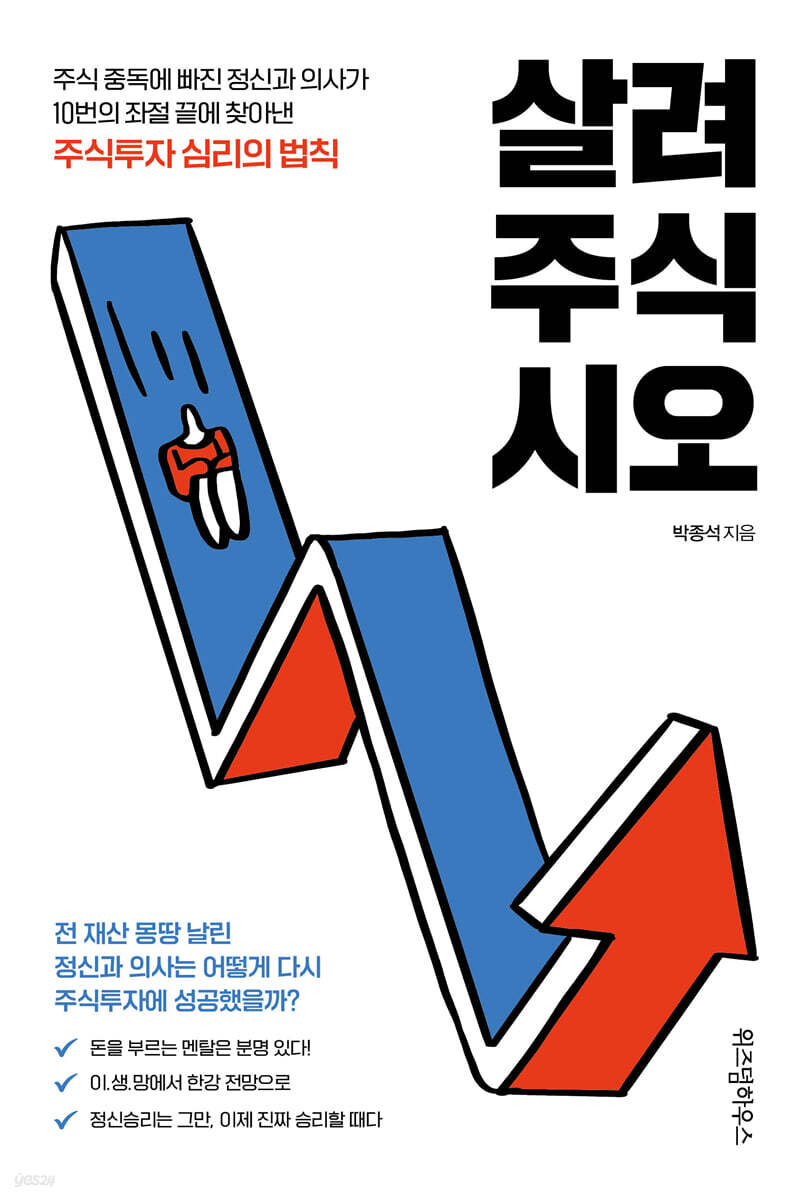
Please save me!A harrowing investment story written by a psychiatrist who lost his entire fortune and was fired due to stock addiction.
This book will help you make stable investments by thoroughly examining your investment psychology.
It covers in an interesting way the mentality that is bound to lead to investment failure, ten cognitive errors that investors make, and the MBTI type that is suitable for investment.
May 28, 2021. Economics and Management PD Kang Hyun-jung
"Please Save Me" is a desperate investment record written by a psychiatrist who suffered from stock addiction and even considered extreme choices.
In 2020, many investors jumped into the stock market and made a lot of money.
But the market has changed.
You can no longer make money the way you did last year.
Every time stock prices fluctuate, beginners' mentality tends to waver.
The reason is simple.
This is because they do not know their own psychology accurately and are swayed by psychology rather than data.
Most people get swayed by their emotions when they see falling prices and make foolish decisions.
Author Jong-Seok Park, who was confident in his mental health, also failed for the same reason, and this served as an opportunity to start studying and arm himself with an unwavering investment mentality.
The author is now using this effectively in his own investments with great success.
After reading this book, you will be able to examine your investment mentality and no longer be swayed by mood or emotion when buying or selling stocks.
In 2020, many investors jumped into the stock market and made a lot of money.
But the market has changed.
You can no longer make money the way you did last year.
Every time stock prices fluctuate, beginners' mentality tends to waver.
The reason is simple.
This is because they do not know their own psychology accurately and are swayed by psychology rather than data.
Most people get swayed by their emotions when they see falling prices and make foolish decisions.
Author Jong-Seok Park, who was confident in his mental health, also failed for the same reason, and this served as an opportunity to start studying and arm himself with an unwavering investment mentality.
The author is now using this effectively in his own investments with great success.
After reading this book, you will be able to examine your investment mentality and no longer be swayed by mood or emotion when buying or selling stocks.
- You can preview some of the book's contents.
Preview
index
Entering_Even I, who believed I was a psychologist, was taken advantage of.
PART 1: The Mentality That Inevitably Leads to Investment Failure
Can psychiatrists control desires?
The mentality of the general public is different from that of investors.
If you want to invest well, start by developing empathy.
Why I Failed in Stocks
KOSPI 1400: A God-given Opportunity
Investing requires self-esteem too.
Liquidity Rally: Hell for Some, Heaven for Others
Five Investment Methods of the Rich That Beginners Don't Know
MBTI Suitable for Investment
TIP: How to Invest According to Your MBTI Type
PART 2: Investing to Win Over Mental Health
Oh my, just because the stock price fluctuates, does that mean my life will fluctuate too?
Dopamine Investor vs.
Serotonin-type investor
How to Be Reborn with a Brain That Controls Desire
Self-reproach and rumination
Ten Cognitive Errors Investors Make
Investors with panic disorder
If a person with obsessive-compulsive disorder trades stocks
Resting is also an investment
TIP: Burnout also occurs in stock investing.
PART 3: Investing Lessons Learned Through Failure
Humans repeat the same mistakes.
Humans really do repeat the same mistakes.
Even though I knew the bad outcome would be obvious
Stocks also have defense mechanisms.
TIP: Who's better at investing: liberal arts students or science students?
PART 4 Beginners Follow Psychology, Experts Follow Data
Am I investing or gambling?
Why do stocks fall when I buy them!
PBR, PER? What are they?
Be sure to check this in your financial statements.
Five Things to Check Before Investing in TIP
PART 5: Turning Psychology to Your Side Increases Profits
If the stock you bought 3 minutes ago suddenly plummets
When the stock I sold skyrocketed an hour later
Can personality change?
Self-objectification, the beginning of cognitive therapy
We are lazier than we think
Developing Successful Investing Habits
Stock investing requires the same level of care as choosing a partner.
The Secret to Getting Rich: Creating Your Own Financial Statement
How to Build Resilience
Transitioning to a mid- to long-term investor
There is a way to tip John Burr
PART 6 Nine Investment Principles to Boost Your Returns
I never regret selling it and then going up.
Three things to check on the chart
Risk analysis available to the general public
The proportion of the dollar, gold, safe assets, and stocks
Timing to invest in deposits, bonds, real estate, and stocks
To become a master, you must be good at cutting off hands.
How to Protect Yourself from the Fear of a Crash
Breaking free from confirmation bias and overconfidence
Five Steps to Curing Stock Addiction
TIP Self-Diagnosis Test: Find Out If You're Addicted to Stocks!
Let's hear from someone who lost even more money when they failed at investing.
PART 1: The Mentality That Inevitably Leads to Investment Failure
Can psychiatrists control desires?
The mentality of the general public is different from that of investors.
If you want to invest well, start by developing empathy.
Why I Failed in Stocks
KOSPI 1400: A God-given Opportunity
Investing requires self-esteem too.
Liquidity Rally: Hell for Some, Heaven for Others
Five Investment Methods of the Rich That Beginners Don't Know
MBTI Suitable for Investment
TIP: How to Invest According to Your MBTI Type
PART 2: Investing to Win Over Mental Health
Oh my, just because the stock price fluctuates, does that mean my life will fluctuate too?
Dopamine Investor vs.
Serotonin-type investor
How to Be Reborn with a Brain That Controls Desire
Self-reproach and rumination
Ten Cognitive Errors Investors Make
Investors with panic disorder
If a person with obsessive-compulsive disorder trades stocks
Resting is also an investment
TIP: Burnout also occurs in stock investing.
PART 3: Investing Lessons Learned Through Failure
Humans repeat the same mistakes.
Humans really do repeat the same mistakes.
Even though I knew the bad outcome would be obvious
Stocks also have defense mechanisms.
TIP: Who's better at investing: liberal arts students or science students?
PART 4 Beginners Follow Psychology, Experts Follow Data
Am I investing or gambling?
Why do stocks fall when I buy them!
PBR, PER? What are they?
Be sure to check this in your financial statements.
Five Things to Check Before Investing in TIP
PART 5: Turning Psychology to Your Side Increases Profits
If the stock you bought 3 minutes ago suddenly plummets
When the stock I sold skyrocketed an hour later
Can personality change?
Self-objectification, the beginning of cognitive therapy
We are lazier than we think
Developing Successful Investing Habits
Stock investing requires the same level of care as choosing a partner.
The Secret to Getting Rich: Creating Your Own Financial Statement
How to Build Resilience
Transitioning to a mid- to long-term investor
There is a way to tip John Burr
PART 6 Nine Investment Principles to Boost Your Returns
I never regret selling it and then going up.
Three things to check on the chart
Risk analysis available to the general public
The proportion of the dollar, gold, safe assets, and stocks
Timing to invest in deposits, bonds, real estate, and stocks
To become a master, you must be good at cutting off hands.
How to Protect Yourself from the Fear of a Crash
Breaking free from confirmation bias and overconfidence
Five Steps to Curing Stock Addiction
TIP Self-Diagnosis Test: Find Out If You're Addicted to Stocks!
Let's hear from someone who lost even more money when they failed at investing.
Detailed image
Into the book
Perhaps this book is a record of my shameful failures.
For the past 10 years, since 2011, I have been repeating trial and error, and sometimes, I have made the same mistakes over and over again and shuddered with deep guilt.
But I still invest in stocks.
As I grew from an immature thirty-year-old youth to a forty-year-old man, all the ups and downs of life, all the ups and downs, all the ups and downs, all the ups and downs I experienced through stock investment were stored in my neurons and DNA.
I realized that those experiences affected not only my emotions and feelings, but also my daily life, interpersonal relationships, and personality.
Because I realized that my investment method and attitude can affect my personal maturity and development.
--- p.13
If you lack empathy, you will often suffer losses when investing.
Those who say “Yes” when everyone else says “No” go against the trend and fail miserably.
In mid-November 2020, when the country was determined to release money, the KOSPI finally broke through its long trading range and surpassed 2,500, and everyone, including experts, analysts, and even the neighborhood grandparents, shouted for buys.
When both Donghak Ants and Seohak Ants gathered their souls and started buying stocks, there were quite a few people who got on the inverse.
Foreigners, institutions, and retail investors are working together like never before to drive up the stock market, but those who are swimming against the current, like salmon swimming against the current, are investors who lack empathy.
--- p.33
Personally, I think the type best suited for stock investment is ESTJ or ENTJ.
First of all, the planned judgment type (J) is much more suitable for mid- to long-term investment than the improvisational perception type (P).
And the thinking type (T) is much more familiar with data, numbers, probability and statistics than the feeling type (F), who is often swayed by emotions.
There may be some debate as to whether extroversion (E) or introversion (I) is better suited for stock investing.
However, I believe that extroverts are better suited for long-term investing than introverts, who are more likely to repeatedly blame themselves and regret their mistakes.
A person with the Sensing (S) type will have sufficient data on already known stocks and will make investments based on financial statements or performance.
Intuitive (N) types are not necessarily obsessed with information or numbers, and sometimes they will boldly invest in value-oriented growth stocks or stocks with high volatility but with the potential to hit the jackpot.
--- p.65
What does it take to stabilize the reward circuitry of a stock-addicted person? Advice from others? Patience? No.
People who are addicted to casinos or have gotten a taste for drugs don't listen to other people's advice until they are broke or ruined.
This is because the frontal lobe, which is the brake of addiction, is paralyzed.
In reality, how many people can truly control their desires? Unless you're Confucius or a religious person, humans are fundamentally ruled by desire.
We have to do this difficult work because that's how we make money.
Of course, even extreme dopamine investors can make big profits by investing in stocks for just a day or two, but in the long run, most will end up ruined.
It is impossible for someone who has ever experienced the upper limit to buy Samsung Electronics stock and be satisfied with a 2-3% return.
The investment amount and target rate of return continue to increase, and at some point, a bitter failure must be experienced.
It is an inevitable process.
--- p.91
Beginners always grab the topknot.
Any stock.
If I buy large-cap stocks, small-cap stocks, bio, automobile, IT, and even US or Chinese stocks, they all fall.
The stocks that were just watched continue to rise.
3rd anniversary, 4th anniversary… .
It's dangerous now, so I'm sure I'll fall, right? Oh my, it's the 5th consecutive attack.
'This has to go further.
It's not too late.
I got on the running horse with the mindset that it would be okay since I would only eat 10%, no, 30%, but shockingly, from that moment on, the stock price plummeted as if it were a lie.
Why on earth does this only happen to me? Maybe I'm cursed, maybe three generations of my ancestors sold out the country, or maybe I have a natural talent for losing money.
Of course, you may not have any ability to read charts at all, or you may be a total idiot who only picks tactical stocks.
What on earth should I do in this situation?
--- p.193
No, you shouldn't consider it a mistake to sell and then go up in price.
It's not a mistake, it's a record.
It is an opportunity and lesson to gain new enlightenment.
A truly smart investor doesn't regret selling a stock for 100,000 won this morning if the price skyrockets by lunchtime.
After coolly analyzing how long this trend will continue, I sell and buy it back at 120,000 won on the same day.
Because I believe it will be 150,000 won.
For the past 10 years, since 2011, I have been repeating trial and error, and sometimes, I have made the same mistakes over and over again and shuddered with deep guilt.
But I still invest in stocks.
As I grew from an immature thirty-year-old youth to a forty-year-old man, all the ups and downs of life, all the ups and downs, all the ups and downs, all the ups and downs I experienced through stock investment were stored in my neurons and DNA.
I realized that those experiences affected not only my emotions and feelings, but also my daily life, interpersonal relationships, and personality.
Because I realized that my investment method and attitude can affect my personal maturity and development.
--- p.13
If you lack empathy, you will often suffer losses when investing.
Those who say “Yes” when everyone else says “No” go against the trend and fail miserably.
In mid-November 2020, when the country was determined to release money, the KOSPI finally broke through its long trading range and surpassed 2,500, and everyone, including experts, analysts, and even the neighborhood grandparents, shouted for buys.
When both Donghak Ants and Seohak Ants gathered their souls and started buying stocks, there were quite a few people who got on the inverse.
Foreigners, institutions, and retail investors are working together like never before to drive up the stock market, but those who are swimming against the current, like salmon swimming against the current, are investors who lack empathy.
--- p.33
Personally, I think the type best suited for stock investment is ESTJ or ENTJ.
First of all, the planned judgment type (J) is much more suitable for mid- to long-term investment than the improvisational perception type (P).
And the thinking type (T) is much more familiar with data, numbers, probability and statistics than the feeling type (F), who is often swayed by emotions.
There may be some debate as to whether extroversion (E) or introversion (I) is better suited for stock investing.
However, I believe that extroverts are better suited for long-term investing than introverts, who are more likely to repeatedly blame themselves and regret their mistakes.
A person with the Sensing (S) type will have sufficient data on already known stocks and will make investments based on financial statements or performance.
Intuitive (N) types are not necessarily obsessed with information or numbers, and sometimes they will boldly invest in value-oriented growth stocks or stocks with high volatility but with the potential to hit the jackpot.
--- p.65
What does it take to stabilize the reward circuitry of a stock-addicted person? Advice from others? Patience? No.
People who are addicted to casinos or have gotten a taste for drugs don't listen to other people's advice until they are broke or ruined.
This is because the frontal lobe, which is the brake of addiction, is paralyzed.
In reality, how many people can truly control their desires? Unless you're Confucius or a religious person, humans are fundamentally ruled by desire.
We have to do this difficult work because that's how we make money.
Of course, even extreme dopamine investors can make big profits by investing in stocks for just a day or two, but in the long run, most will end up ruined.
It is impossible for someone who has ever experienced the upper limit to buy Samsung Electronics stock and be satisfied with a 2-3% return.
The investment amount and target rate of return continue to increase, and at some point, a bitter failure must be experienced.
It is an inevitable process.
--- p.91
Beginners always grab the topknot.
Any stock.
If I buy large-cap stocks, small-cap stocks, bio, automobile, IT, and even US or Chinese stocks, they all fall.
The stocks that were just watched continue to rise.
3rd anniversary, 4th anniversary… .
It's dangerous now, so I'm sure I'll fall, right? Oh my, it's the 5th consecutive attack.
'This has to go further.
It's not too late.
I got on the running horse with the mindset that it would be okay since I would only eat 10%, no, 30%, but shockingly, from that moment on, the stock price plummeted as if it were a lie.
Why on earth does this only happen to me? Maybe I'm cursed, maybe three generations of my ancestors sold out the country, or maybe I have a natural talent for losing money.
Of course, you may not have any ability to read charts at all, or you may be a total idiot who only picks tactical stocks.
What on earth should I do in this situation?
--- p.193
No, you shouldn't consider it a mistake to sell and then go up in price.
It's not a mistake, it's a record.
It is an opportunity and lesson to gain new enlightenment.
A truly smart investor doesn't regret selling a stock for 100,000 won this morning if the price skyrockets by lunchtime.
After coolly analyzing how long this trend will continue, I sell and buy it back at 120,000 won on the same day.
Because I believe it will be 150,000 won.
--- p.253
Publisher's Review
"Can I go in now with my friend who made money?"
A book that will keep beginner stock investors on their toes, turning blue when you buy.
“I doubled my money with OOO, you should do some stocks too.” I started investing in stocks late, just listening to my friend.
It's already gone up 10% in just a few minutes since the market opened! I knew I absolutely had to buy this, so I poured in my entire savings.
But how did this happen?
As soon as I bought it, it turned blue.
In 2020, no matter what stock you bought, you made money.
But now things are different.
The stock market is efficient, but the investments I make as a human are inefficient.
As Kostolany said, ‘investing is a psychological game.’
Humans repeat mistakes and only realize it after losing a lot of things.
But is it really necessary to lose so much to realize something? First, we should learn from the stories of those who have experienced loss and minimize our mistakes.
"Please Save Me" is a desperate investment record written by a psychiatrist who considered extreme measures due to failed stock investments.
After reading this book, you'll be able to reflect on the investment decisions you make every day and develop an investment mindset that's destined for success.
“Before you look at the financial statements, look inside your head!”
A painful lesson from a psychiatrist who bounced back from the stock market's bottom.
“I should have bought Tesla back then.” “I shouldn’t have sold Samsung Electronics back then.” Investors are always fixated on the outcome and reminisce about the past.
Even people with great character have a hard time keeping their composure when a stock that was cut this morning hits its upper limit by lunchtime, or a stock that was skyrocketing plummets immediately after purchase.
The most difficult moment when investing in stocks is when you blame yourself.
Self-reproach is a human instinct, so there is nothing we can do about it.
However, self-reproach makes people more anxious and makes them repeat the same mistakes despite wanting to do better.
The reason humans repeat mistakes is because they were born that way.
To become a wise investor, you must go against these human instincts.
The reason we must do this difficult task is because only then can we succeed in investing and make money.
To break free from the shackles of self-reproach, you must first recognize the mistakes you make without even realizing it.
When you become aware of something, your behavior changes, and when this becomes a routine, you will rarely make mistakes.
Just as you fall in love with a woman who looks and has a personality similar to your first love, a morning person will wake up early in the morning without difficulty throughout their life, and a person who likes tuna sashimi will never dislike tuna sashimi as they get older,
So what we have to do is clear.
Reviewing my mistakes and engraving new routines into my bones and brain.
Having navigated the river of devastating investment failure, the author now wants to help you reflect on your mistakes and properly correct your actions.
By using this book to put your mind on your side, you will be able to experience the joy of increasing profits without being swayed by the volatile stock market.
Just because the stock price fluctuates, does that mean my heart should fluctuate too?
When I put psychology on my side, my profits changed.
The author loses his job and all his money in his mid-thirties due to stock addiction.
It's not common, but it sounds familiar. He's a psychiatrist who graduated from one of the prestigious universities we commonly refer to as "SKY."
He invested in stocks in his mid-thirties, even going so far as to open an overdraft account, and as a result, he lost all his assets.
I couldn't focus on my work and just kept thinking about stocks. I finally got rid of it after I got fired from my job.
But the author doesn't end with investment failure.
Learn from past failures and find the cause.
The author, who realized that he had overestimated his status as a psychiatrist and failed to manage his investment mentality, and had invested based solely on intuition without studying investment, starts all over again to manage his investment mentality and study investment.
Currently, it is not only recovering the losses it had previously suffered, but is also recording steady profits.
And I have included in this book all the information I have shared with those who desperately ask, “What is the secret?”
This book was written for people whose hearts are also shaken by fluctuating stock prices.
The end result for investors who are swayed by emotions is a negative balance.
Most people sell stocks when they need money quickly, only to regret it when the stocks start to rise again.
After suffering losses a few times and thinking, “Stocks are not for me,” you give up, but then start investing again after hearing about how others made a few percent profit.
Investing without any knowledge of your own psychological state is bound to fail.
The best way to invest is to know yourself and develop an investment method that suits you.
The author argues that “you can only make money if you get your mind on your side.”
The author, who experienced a major failure in stock investing but is now making huge profits, confidently believed he understood human psychology, but in reality, he was unaware of investment psychology. Based on his own experiences, he reveals in detail how he achieved investment success.
In addition, he disclosed all the items he directly traded and the process.
This book provides an opportunity for even investors who have never seen a red light on their accounts to develop a sound investment mindset.
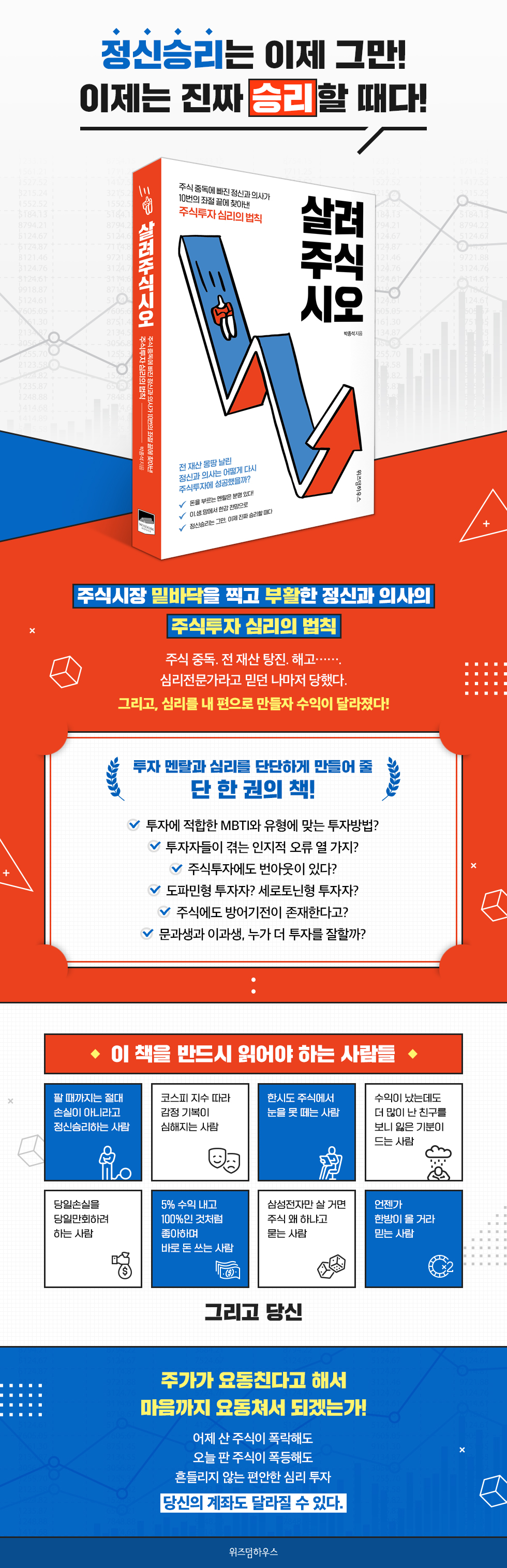
Enough with the mental victories! It's time for real victory!
People who must read this book
- A person who tries to recover the loss on the same day
- A person who trades brains as if it were nothing
- People who ask why you should buy stocks if you're only going to buy Samsung Electronics
- A person who considers losing 50,000 won in stocks as eating pig's feet
- A person who believes in a mental victory that it is never a loss until it is sold.
- A person who believes that one day a cure will come
- A person who shouts that he will have the cash if he just finds the principal.
- People who think they should have put their money in the bank and kept the principal
- People who feel like they've lost money even though they've made money and see friends who have made more money
- People whose emotions fluctuate greatly depending on the KOSPI index
- A person who can't take his eyes off the stocks even for a moment
- People who like making 5% profit as if it were 100% and spend money right away
A book that will keep beginner stock investors on their toes, turning blue when you buy.
“I doubled my money with OOO, you should do some stocks too.” I started investing in stocks late, just listening to my friend.
It's already gone up 10% in just a few minutes since the market opened! I knew I absolutely had to buy this, so I poured in my entire savings.
But how did this happen?
As soon as I bought it, it turned blue.
In 2020, no matter what stock you bought, you made money.
But now things are different.
The stock market is efficient, but the investments I make as a human are inefficient.
As Kostolany said, ‘investing is a psychological game.’
Humans repeat mistakes and only realize it after losing a lot of things.
But is it really necessary to lose so much to realize something? First, we should learn from the stories of those who have experienced loss and minimize our mistakes.
"Please Save Me" is a desperate investment record written by a psychiatrist who considered extreme measures due to failed stock investments.
After reading this book, you'll be able to reflect on the investment decisions you make every day and develop an investment mindset that's destined for success.
“Before you look at the financial statements, look inside your head!”
A painful lesson from a psychiatrist who bounced back from the stock market's bottom.
“I should have bought Tesla back then.” “I shouldn’t have sold Samsung Electronics back then.” Investors are always fixated on the outcome and reminisce about the past.
Even people with great character have a hard time keeping their composure when a stock that was cut this morning hits its upper limit by lunchtime, or a stock that was skyrocketing plummets immediately after purchase.
The most difficult moment when investing in stocks is when you blame yourself.
Self-reproach is a human instinct, so there is nothing we can do about it.
However, self-reproach makes people more anxious and makes them repeat the same mistakes despite wanting to do better.
The reason humans repeat mistakes is because they were born that way.
To become a wise investor, you must go against these human instincts.
The reason we must do this difficult task is because only then can we succeed in investing and make money.
To break free from the shackles of self-reproach, you must first recognize the mistakes you make without even realizing it.
When you become aware of something, your behavior changes, and when this becomes a routine, you will rarely make mistakes.
Just as you fall in love with a woman who looks and has a personality similar to your first love, a morning person will wake up early in the morning without difficulty throughout their life, and a person who likes tuna sashimi will never dislike tuna sashimi as they get older,
So what we have to do is clear.
Reviewing my mistakes and engraving new routines into my bones and brain.
Having navigated the river of devastating investment failure, the author now wants to help you reflect on your mistakes and properly correct your actions.
By using this book to put your mind on your side, you will be able to experience the joy of increasing profits without being swayed by the volatile stock market.
Just because the stock price fluctuates, does that mean my heart should fluctuate too?
When I put psychology on my side, my profits changed.
The author loses his job and all his money in his mid-thirties due to stock addiction.
It's not common, but it sounds familiar. He's a psychiatrist who graduated from one of the prestigious universities we commonly refer to as "SKY."
He invested in stocks in his mid-thirties, even going so far as to open an overdraft account, and as a result, he lost all his assets.
I couldn't focus on my work and just kept thinking about stocks. I finally got rid of it after I got fired from my job.
But the author doesn't end with investment failure.
Learn from past failures and find the cause.
The author, who realized that he had overestimated his status as a psychiatrist and failed to manage his investment mentality, and had invested based solely on intuition without studying investment, starts all over again to manage his investment mentality and study investment.
Currently, it is not only recovering the losses it had previously suffered, but is also recording steady profits.
And I have included in this book all the information I have shared with those who desperately ask, “What is the secret?”
This book was written for people whose hearts are also shaken by fluctuating stock prices.
The end result for investors who are swayed by emotions is a negative balance.
Most people sell stocks when they need money quickly, only to regret it when the stocks start to rise again.
After suffering losses a few times and thinking, “Stocks are not for me,” you give up, but then start investing again after hearing about how others made a few percent profit.
Investing without any knowledge of your own psychological state is bound to fail.
The best way to invest is to know yourself and develop an investment method that suits you.
The author argues that “you can only make money if you get your mind on your side.”
The author, who experienced a major failure in stock investing but is now making huge profits, confidently believed he understood human psychology, but in reality, he was unaware of investment psychology. Based on his own experiences, he reveals in detail how he achieved investment success.
In addition, he disclosed all the items he directly traded and the process.
This book provides an opportunity for even investors who have never seen a red light on their accounts to develop a sound investment mindset.
Enough with the mental victories! It's time for real victory!
People who must read this book
- A person who tries to recover the loss on the same day
- A person who trades brains as if it were nothing
- People who ask why you should buy stocks if you're only going to buy Samsung Electronics
- A person who considers losing 50,000 won in stocks as eating pig's feet
- A person who believes in a mental victory that it is never a loss until it is sold.
- A person who believes that one day a cure will come
- A person who shouts that he will have the cash if he just finds the principal.
- People who think they should have put their money in the bank and kept the principal
- People who feel like they've lost money even though they've made money and see friends who have made more money
- People whose emotions fluctuate greatly depending on the KOSPI index
- A person who can't take his eyes off the stocks even for a moment
- People who like making 5% profit as if it were 100% and spend money right away
GOODS SPECIFICS
- Publication date: May 20, 2021
- Page count, weight, size: 304 pages | 510g | 145*215*18mm
- ISBN13: 9791191583779
- ISBN10: 1191583775
You may also like
카테고리
korean


korean

![ELLE 엘르 스페셜 에디션 A형 : 12월 [2025]](http://librairie.coreenne.fr/cdn/shop/files/b8e27a3de6c9538896439686c6b0e8fb.jpg?v=1766436872&width=3840)


