

Comrade Girl, shoot the enemy
 |
Description
Book Introduction
- A word from MD
-
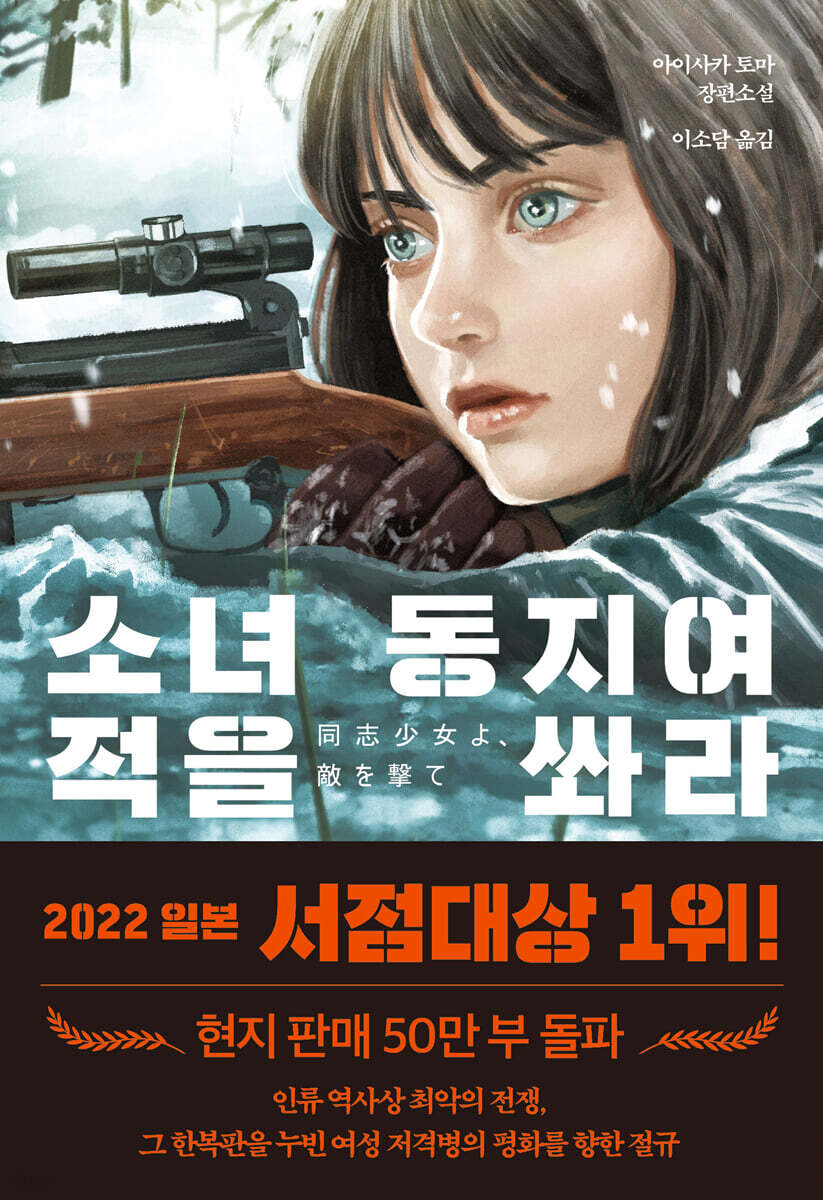
A hotly anticipated debut, it won first place at the 2022 Bookstore Awards.A full-length novel based on the true stories of female soldiers who fought in the German-Soviet War in the 1940s.
The life of the girl snipers who lost loved ones in war but still tried to keep their beliefs was written with excellent writing skills.
A novel that conveys an anti-war message by exposing the cruelty of war while also showing human dignity.
September 15, 2023. Novel/Poetry PD Kim Yu-ri
2022 Japan Bookstore Award #1!
The birth of a new monster writer who has been praised by Japan's leading writers and has 500,000 readers raving about it.
August 2021.
Toma Aisaka was an aspiring novelist and a human resources employee who managed employees' attendance and salaries at a company.
After work, I quickly had dinner at a udon restaurant, came home, took a bath, and then continued to write for two or three hours every day.
I was feeling exhausted from having continued to submit novels but not yet seeing results, when I received a reply to an email I sent to the respected director Mamoru Oshii, which gave me great strength.
November 2021.
Her submission to the Agatha Christie Award for Best Novel, "Comrade Girl, Shoot the Enemy," received perfect scores from all the judges, and she finally published her first book, debuting as a novelist.
It was the 10th year since I started writing novels while working.
April 2022.
"Comrade Girl, Shoot the Enemy" won first place in the Bookstore Award, beating out works by famous established authors such as Honobu Yonezawa.
It was the only debut work among the books ranked from 1st to 10th.
He was nominated for the 166th Naoki Prize and his debut work sold over 500,000 copies.
Five months have passed since I debuted as a novelist.
You are now witnessing the birth of a new author who will have his or her own bookshelf in the Japanese Literature Corner in the future.
The birth of a new monster writer who has been praised by Japan's leading writers and has 500,000 readers raving about it.
August 2021.
Toma Aisaka was an aspiring novelist and a human resources employee who managed employees' attendance and salaries at a company.
After work, I quickly had dinner at a udon restaurant, came home, took a bath, and then continued to write for two or three hours every day.
I was feeling exhausted from having continued to submit novels but not yet seeing results, when I received a reply to an email I sent to the respected director Mamoru Oshii, which gave me great strength.
November 2021.
Her submission to the Agatha Christie Award for Best Novel, "Comrade Girl, Shoot the Enemy," received perfect scores from all the judges, and she finally published her first book, debuting as a novelist.
It was the 10th year since I started writing novels while working.
April 2022.
"Comrade Girl, Shoot the Enemy" won first place in the Bookstore Award, beating out works by famous established authors such as Honobu Yonezawa.
It was the only debut work among the books ranked from 1st to 10th.
He was nominated for the 166th Naoki Prize and his debut work sold over 500,000 copies.
Five months have passed since I debuted as a novelist.
You are now witnessing the birth of a new author who will have his or her own bookshelf in the Japanese Literature Corner in the future.
- You can preview some of the book's contents.
Preview
index
To Korean readers
prolog
Ivanovskaya village
Witch's Lair
Operation Uranus
There is no land beyond the Volga River
Days leading up to the final battle
The Fortress City of Königsberg - About Love
Epilogue
Acknowledgements
Key References
Translator's Note
prolog
Ivanovskaya village
Witch's Lair
Operation Uranus
There is no land beyond the Volga River
Days leading up to the final battle
The Fortress City of Königsberg - About Love
Epilogue
Acknowledgements
Key References
Translator's Note
Detailed image
Into the book
“When you go out into battle and shoot the enemy, don’t think about anything.
Don't think of anything.
… … I can’t even think about not thinking about it.
“Just surrender to the technique, don’t feel anything, and shoot the enemy.”
--- p.85
“Always remember what you are shooting at your enemy for.
That would be losing sight of the fundamental goal.
“Then comes death.”
--- p.87
"Don't choose death, Irina.
“That is a betrayal of your life.”
“I have no intention of going to the battlefield to die, comrade.”
When asked to confirm her pledge, Irina looked out the window as if trying to avoid Nora's gaze.
Charlotte and Seraphima were running, panting.
“Because there is a death that suits me better.”
--- pp.115~116
“I fight to protect women.”
This was the most accurate answer Seraphima could find.
--- p.144
“Aya is dead.
Aya's record will not increase in the future.
So he can't be remembered as a great sniper and can't return home.
Aya will never meet the people she was supposed to meet, will never be able to raise a child, and will never have grandchildren.
There is nothing.
That's death.
“You mourn Aya and fight for her share.”
--- pp.200~201
'Don't forget.
Today is the only day you can cry.'
These were the words Irina spoke to herself and Charlotte, who were crying over Aya's death after the Uranus operation.
Because it was the first battle.
From now on, I will not forgive any weak displays like tears.
I assumed that was what it meant and had no doubts.
But the reality was different.
It meant that today would be the last day I would never cry again.
--- p.345
Charlotte took a deep breath and asked in a tone that sounded like a shot of arrows.
“After the war, how are snipers supposed to live?”
The atmosphere in the auditorium was tense.
A heterogeneous question.
It was a question that stimulated something common among snipers.
--- p.408
Fight or die.
He taught those who answered that they would fight how to fight, and he raised up those who wished for death like Seraphima.
To those who rejected both, he taught another path.
--- p.513
Even if the bow of the ship sinks, will there never come a day when this country, which strives to beautifully pass down the story of the Great Patriotic War, will be able to see the other side of it?
As she opened another letter, lost in thought, a single letter floated out of the water, capturing Seraphima's gaze.
“War has no woman’s face.”
--- pp.531~532
What Seraphima learned in war was not the skills to shoot enemies from over 800 meters away, nor the desperate psychology of humans on the battlefield, nor how to endure torture, nor how to engage in a power struggle with the enemy.
It was the meaning of life.
A life lost never returns.
There is no life to replace it.
If I've learned anything, it's just this honest truth.
I learned only this.
If anyone says they have gained anything else, they cannot be trusted.
Don't think of anything.
… … I can’t even think about not thinking about it.
“Just surrender to the technique, don’t feel anything, and shoot the enemy.”
--- p.85
“Always remember what you are shooting at your enemy for.
That would be losing sight of the fundamental goal.
“Then comes death.”
--- p.87
"Don't choose death, Irina.
“That is a betrayal of your life.”
“I have no intention of going to the battlefield to die, comrade.”
When asked to confirm her pledge, Irina looked out the window as if trying to avoid Nora's gaze.
Charlotte and Seraphima were running, panting.
“Because there is a death that suits me better.”
--- pp.115~116
“I fight to protect women.”
This was the most accurate answer Seraphima could find.
--- p.144
“Aya is dead.
Aya's record will not increase in the future.
So he can't be remembered as a great sniper and can't return home.
Aya will never meet the people she was supposed to meet, will never be able to raise a child, and will never have grandchildren.
There is nothing.
That's death.
“You mourn Aya and fight for her share.”
--- pp.200~201
'Don't forget.
Today is the only day you can cry.'
These were the words Irina spoke to herself and Charlotte, who were crying over Aya's death after the Uranus operation.
Because it was the first battle.
From now on, I will not forgive any weak displays like tears.
I assumed that was what it meant and had no doubts.
But the reality was different.
It meant that today would be the last day I would never cry again.
--- p.345
Charlotte took a deep breath and asked in a tone that sounded like a shot of arrows.
“After the war, how are snipers supposed to live?”
The atmosphere in the auditorium was tense.
A heterogeneous question.
It was a question that stimulated something common among snipers.
--- p.408
Fight or die.
He taught those who answered that they would fight how to fight, and he raised up those who wished for death like Seraphima.
To those who rejected both, he taught another path.
--- p.513
Even if the bow of the ship sinks, will there never come a day when this country, which strives to beautifully pass down the story of the Great Patriotic War, will be able to see the other side of it?
As she opened another letter, lost in thought, a single letter floated out of the water, capturing Seraphima's gaze.
“War has no woman’s face.”
--- pp.531~532
What Seraphima learned in war was not the skills to shoot enemies from over 800 meters away, nor the desperate psychology of humans on the battlefield, nor how to endure torture, nor how to engage in a power struggle with the enemy.
It was the meaning of life.
A life lost never returns.
There is no life to replace it.
If I've learned anything, it's just this honest truth.
I learned only this.
If anyone says they have gained anything else, they cannot be trusted.
--- pp.533~534
Publisher's Review
Amazing results achieved just five months after debuting as an author
Best-selling novels in Japan in 2022
On April 6, 2022, an unusual event occurred in the Japanese publishing world.
A unique debut work by an office worker has won first place at the Bookstore Awards, beating out strong competition from established writers.
Author Aisaka Toma was a company employee in charge of human resources and had been debuting as a novelist for five months.
The symptoms were already lurking.
"Comrade Girl, Shoot the Enemy" was the first work to receive the highest score from all judges at the Agatha Christie Award and was also awarded the grand prize. It also ranked first in "Kinobesu! 2022," a contest held by Kinokuniya, Tokyo's largest bookstore, in which the staff personally selected the best recommended books published that year.
It was also a finalist for the Naoki Prize and had already earned a spot on the bestseller list.
Nevertheless, the shock of this thick debut novel with over 500 pages and an unusual title taking first place at the bookstore awards was enormous, and it brought about an even bigger issue because it was set in the land where the novel was set, and the Russo-Ukrainian War had just broken out.
Afterwards, the book sold over 500,000 copies in Japan, widening the gap by about twice that of Keigo Higashino's new work, which came in second place with about half that number sold, and became the 'Best-Selling Novel in Japan in 2022'. It was also named the only novel that Japanese Prime Minister Fumio Kishida personally purchased from an offline bookstore and took with him on his summer vacation.
"Comrade Girl, Shoot the Enemy" is the debut work of Aisaka Toma, the hottest newcomer in the Japanese literary world right now. It is a war novel and anti-war novel based on the German-Soviet War that took place 80 years ago in Russia and Ukraine, where hell has been unfolding for over 500 days.
The author, who has declared that she hates war more than anything in the world, decided to write a novel about the misery of war after reading the testimonies of over 500 female soldiers in “The Unwomanly Face of War” by Svetlana Alexievich, winner of the 2015 Nobel Prize in Literature.
The author's aversion to violence led him not to turn a blind eye to violence, but rather to confront it.
For modern readers living in a time of violence where 240,000 people die each year from war, this book will provide the timely emotion and entertainment that only war novels can provide.
The most devastating war in history
A life-or-death crossroads for an eighteen-year-old girl
Although it is impossible to discuss the severity of the tragedy of war, there is no disagreement that the German-Soviet War was the worst war in human history.
In the Soviet Union, 27 million people, including civilians, died, accounting for half of the total deaths in World War II.
In Germany, the number of deaths, including civilians, is also estimated to be 7 million.
Behind these overwhelming figures lies the unique nature of the German-Soviet War, in which the two countries thoroughly carried out horrific massacres based on an ideology that regarded each other as enemies destined for annihilation.
"Comrade Girl, Shoot the Enemy" is a work that depicts the lives of Soviet female snipers and the horrors of war, especially the cruelty inflicted on vulnerable women, against the backdrop of the most horrific war in history.
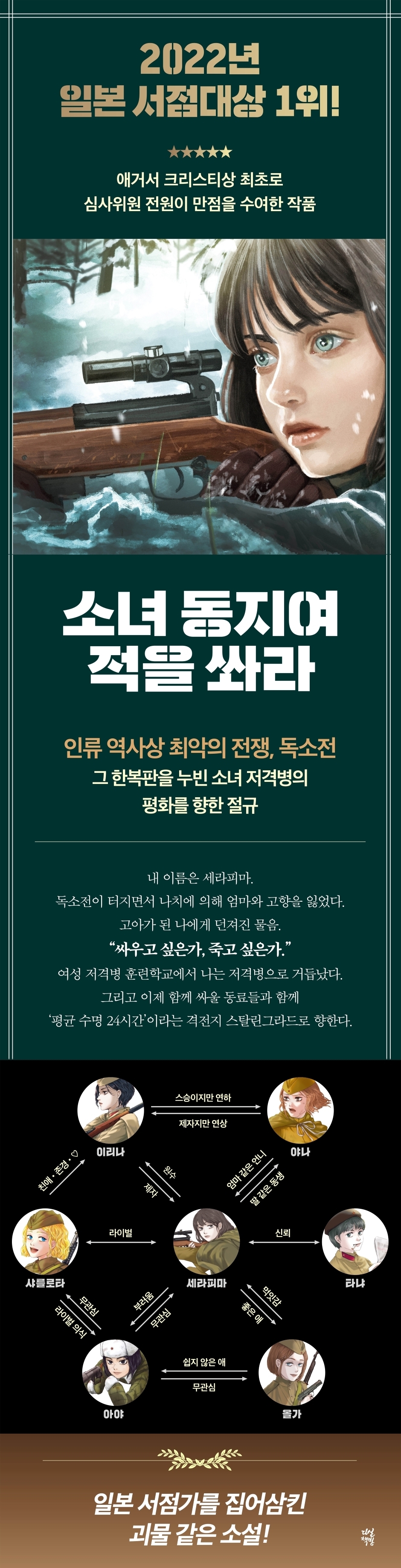
The protagonist, Seraphima, loses her mother and hometown overnight in 1942, when the German army raided her village during the height of the Nazi-Soviet War.
Just before he is about to be shot by the Nazis, he is rescued by Irina, a Red Army commander with a sniper background, but his mother's body is desecrated by Irina, who believes he is an ally.
“Fight or die?” Seraphima accepts the dichotomy presented by Irina and decides to become his disciple and a sniper.
To kill the German sniper who shot his mother, and to kill Marshal Irina who desecrated his mother's body.
At the women's sniper training school where Irina is an instructor, Seraphima meets girls in similar situations as herself.
They all lost their families and loved ones to the Germans, and when Irina presented them with the choice between fight and death, they chose to fight.
After completing training while sharing warm camaraderie, Seraphima is reborn as a proper sniper and forms a sniper platoon with her comrades.
And the sniper platoon that received the mission heads to a city for the purpose of being deployed in urban warfare, and the name of the place they arrive at is 'Stalingrad'.
It was a fiercely contested battlefield where the average survival time for a Soviet soldier was 24 hours, and a German soldier died every 7 seconds.
While war-related content written by Japanese authors can easily be dismissed as a remnant of militarism, the author also incorporated the thematic consciousness of "War Has No Woman's Face," which served as the motif for the novel, into this book.
As a member of the Red Army, the protagonist achieves a feat of killing over 100 enemy soldiers, but gradually comes to a realization as he encounters the horrors of war and the violence against women.
This war is ultimately nothing more than a grotesque massacre between dictatorships, and it is women who suffer the greatest violence under the war.
And Seraphima discovers her true motivation for fighting beyond revenge.
It is to protect women.
The reason why the spectacular war novel, "Comrade Girl, Shoot the Enemy," received such support from young women in Japan is because it went beyond simply featuring a female sniper as the protagonist and created the novel itself as a proper female narrative.
The author confesses that she very consciously brought the solidarity between female snipers to the forefront, which clarified the novel's theme and ending.
He also criticizes the way images of women carrying weapons are often misused in comics and games, saying, “Young women fighting with guns should never be the object of fetishism,” clearly indicating that this novel is at odds with such provocative popular culture.
Why I Had to Tell the Story of a Female Sniper
During World War II, Germany was also facing a shortage of troops, but they used women as auxiliary personnel.
In the US military, women were limited to serving as cheerleaders for male soldiers.
But why did the Soviet Union alone mobilize so many women to serve on the front lines as soldiers during World War II? "Comrade Girls, Shoot the Enemy" stems from this age-old question, posed by the author during her college years.
Although they clearly existed as historically very rare cases, women who participated in the war were erased as an inconvenience in the post-war fantasy that 'men fought bravely on the battlefield and women waited at home for the men's return.'
Despite having fought just like men in the face of discrimination and suffering from the psychological aftereffects of war after the war, they lost their identity.
Following Alexievich's non-fiction work, "War's Unwomanly Face," the author sought to portray in fiction the oppressed during the war and the marginalized after the war.
Talking about the unspoken.
It was precisely this will that gave birth to a war novel that had never existed before.
Another new aspect is the focus on the special nature of the sniper branch.
Advances in technology have allowed soldiers in modern warfare to carry out the process of killing people more indirectly.
But snipers are not like that.
You must see the enemy with your own eyes, confirm, aim, shoot, kill, and return.
It is also impossible to rely on the anonymity guaranteed by group nature, like in regular infantry.
The author points out that in this respect, snipers are the branch of military most directly connected to the essence of war, which is 'killing', and that it is against this backdrop that he chose a female sniper as the protagonist of his war novel.
"Comrade Girl, Shoot the Enemy" was published in Japan in November 2021 and received greater attention immediately after its publication due to the outbreak of the Russo-Ukrainian War in late February 2022.
Afterwards, Toma Aisaka clearly stated that this work was a reversal novel and expressed great regret, saying, “It achieved contemporaneity in the worst possible way.”
In an NHK interview after winning the Bookstore Award, the author said that we must think about the lives of each and every person sacrificed in war.
Reading this novel, which portrays the extreme state of war by thoroughly projecting it onto the individual human beings, will be an excellent means of realizing that the war of 80 years ago and the war currently raging thousands of kilometers away from Korea are not unrelated to us.
Best-selling novels in Japan in 2022
On April 6, 2022, an unusual event occurred in the Japanese publishing world.
A unique debut work by an office worker has won first place at the Bookstore Awards, beating out strong competition from established writers.
Author Aisaka Toma was a company employee in charge of human resources and had been debuting as a novelist for five months.
The symptoms were already lurking.
"Comrade Girl, Shoot the Enemy" was the first work to receive the highest score from all judges at the Agatha Christie Award and was also awarded the grand prize. It also ranked first in "Kinobesu! 2022," a contest held by Kinokuniya, Tokyo's largest bookstore, in which the staff personally selected the best recommended books published that year.
It was also a finalist for the Naoki Prize and had already earned a spot on the bestseller list.
Nevertheless, the shock of this thick debut novel with over 500 pages and an unusual title taking first place at the bookstore awards was enormous, and it brought about an even bigger issue because it was set in the land where the novel was set, and the Russo-Ukrainian War had just broken out.
Afterwards, the book sold over 500,000 copies in Japan, widening the gap by about twice that of Keigo Higashino's new work, which came in second place with about half that number sold, and became the 'Best-Selling Novel in Japan in 2022'. It was also named the only novel that Japanese Prime Minister Fumio Kishida personally purchased from an offline bookstore and took with him on his summer vacation.
"Comrade Girl, Shoot the Enemy" is the debut work of Aisaka Toma, the hottest newcomer in the Japanese literary world right now. It is a war novel and anti-war novel based on the German-Soviet War that took place 80 years ago in Russia and Ukraine, where hell has been unfolding for over 500 days.
The author, who has declared that she hates war more than anything in the world, decided to write a novel about the misery of war after reading the testimonies of over 500 female soldiers in “The Unwomanly Face of War” by Svetlana Alexievich, winner of the 2015 Nobel Prize in Literature.
The author's aversion to violence led him not to turn a blind eye to violence, but rather to confront it.
For modern readers living in a time of violence where 240,000 people die each year from war, this book will provide the timely emotion and entertainment that only war novels can provide.
The most devastating war in history
A life-or-death crossroads for an eighteen-year-old girl
Although it is impossible to discuss the severity of the tragedy of war, there is no disagreement that the German-Soviet War was the worst war in human history.
In the Soviet Union, 27 million people, including civilians, died, accounting for half of the total deaths in World War II.
In Germany, the number of deaths, including civilians, is also estimated to be 7 million.
Behind these overwhelming figures lies the unique nature of the German-Soviet War, in which the two countries thoroughly carried out horrific massacres based on an ideology that regarded each other as enemies destined for annihilation.
"Comrade Girl, Shoot the Enemy" is a work that depicts the lives of Soviet female snipers and the horrors of war, especially the cruelty inflicted on vulnerable women, against the backdrop of the most horrific war in history.
The protagonist, Seraphima, loses her mother and hometown overnight in 1942, when the German army raided her village during the height of the Nazi-Soviet War.
Just before he is about to be shot by the Nazis, he is rescued by Irina, a Red Army commander with a sniper background, but his mother's body is desecrated by Irina, who believes he is an ally.
“Fight or die?” Seraphima accepts the dichotomy presented by Irina and decides to become his disciple and a sniper.
To kill the German sniper who shot his mother, and to kill Marshal Irina who desecrated his mother's body.
At the women's sniper training school where Irina is an instructor, Seraphima meets girls in similar situations as herself.
They all lost their families and loved ones to the Germans, and when Irina presented them with the choice between fight and death, they chose to fight.
After completing training while sharing warm camaraderie, Seraphima is reborn as a proper sniper and forms a sniper platoon with her comrades.
And the sniper platoon that received the mission heads to a city for the purpose of being deployed in urban warfare, and the name of the place they arrive at is 'Stalingrad'.
It was a fiercely contested battlefield where the average survival time for a Soviet soldier was 24 hours, and a German soldier died every 7 seconds.
While war-related content written by Japanese authors can easily be dismissed as a remnant of militarism, the author also incorporated the thematic consciousness of "War Has No Woman's Face," which served as the motif for the novel, into this book.
As a member of the Red Army, the protagonist achieves a feat of killing over 100 enemy soldiers, but gradually comes to a realization as he encounters the horrors of war and the violence against women.
This war is ultimately nothing more than a grotesque massacre between dictatorships, and it is women who suffer the greatest violence under the war.
And Seraphima discovers her true motivation for fighting beyond revenge.
It is to protect women.
The reason why the spectacular war novel, "Comrade Girl, Shoot the Enemy," received such support from young women in Japan is because it went beyond simply featuring a female sniper as the protagonist and created the novel itself as a proper female narrative.
The author confesses that she very consciously brought the solidarity between female snipers to the forefront, which clarified the novel's theme and ending.
He also criticizes the way images of women carrying weapons are often misused in comics and games, saying, “Young women fighting with guns should never be the object of fetishism,” clearly indicating that this novel is at odds with such provocative popular culture.
Why I Had to Tell the Story of a Female Sniper
During World War II, Germany was also facing a shortage of troops, but they used women as auxiliary personnel.
In the US military, women were limited to serving as cheerleaders for male soldiers.
But why did the Soviet Union alone mobilize so many women to serve on the front lines as soldiers during World War II? "Comrade Girls, Shoot the Enemy" stems from this age-old question, posed by the author during her college years.
Although they clearly existed as historically very rare cases, women who participated in the war were erased as an inconvenience in the post-war fantasy that 'men fought bravely on the battlefield and women waited at home for the men's return.'
Despite having fought just like men in the face of discrimination and suffering from the psychological aftereffects of war after the war, they lost their identity.
Following Alexievich's non-fiction work, "War's Unwomanly Face," the author sought to portray in fiction the oppressed during the war and the marginalized after the war.
Talking about the unspoken.
It was precisely this will that gave birth to a war novel that had never existed before.
Another new aspect is the focus on the special nature of the sniper branch.
Advances in technology have allowed soldiers in modern warfare to carry out the process of killing people more indirectly.
But snipers are not like that.
You must see the enemy with your own eyes, confirm, aim, shoot, kill, and return.
It is also impossible to rely on the anonymity guaranteed by group nature, like in regular infantry.
The author points out that in this respect, snipers are the branch of military most directly connected to the essence of war, which is 'killing', and that it is against this backdrop that he chose a female sniper as the protagonist of his war novel.
"Comrade Girl, Shoot the Enemy" was published in Japan in November 2021 and received greater attention immediately after its publication due to the outbreak of the Russo-Ukrainian War in late February 2022.
Afterwards, Toma Aisaka clearly stated that this work was a reversal novel and expressed great regret, saying, “It achieved contemporaneity in the worst possible way.”
In an NHK interview after winning the Bookstore Award, the author said that we must think about the lives of each and every person sacrificed in war.
Reading this novel, which portrays the extreme state of war by thoroughly projecting it onto the individual human beings, will be an excellent means of realizing that the war of 80 years ago and the war currently raging thousands of kilometers away from Korea are not unrelated to us.
GOODS SPECIFICS
- Date of issue: August 29, 2023
- Page count, weight, size: 544 pages | 616g | 142*207*35mm
- ISBN13: 9791130645490
- ISBN10: 1130645495
You may also like
카테고리
korean


korean

![GQ KOREA Mark (Monthly): December [2025]](http://librairie.coreenne.fr/cdn/shop/files/8ef265dbbfbf186523ed75ba7319009d.jpg?v=1765340328&width=3840)


