

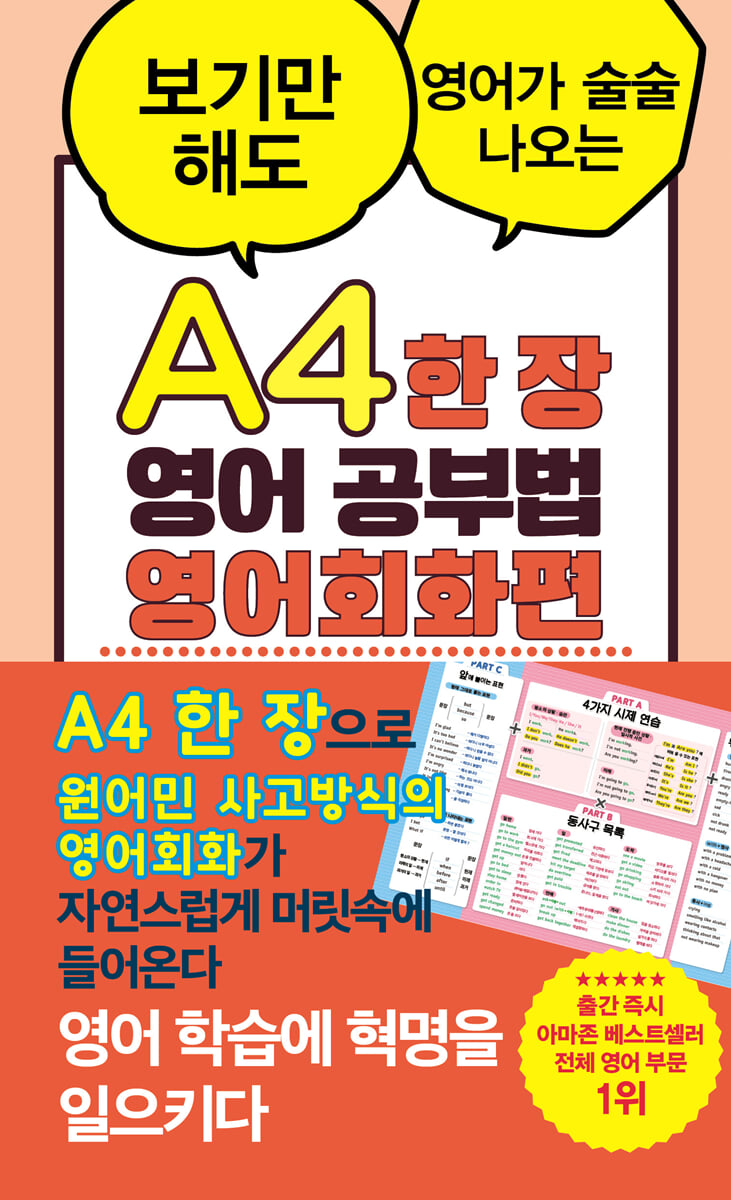
English Conversation: How to Study English on One Sheet of A4 Paper
 |
Description
Book Introduction
The Amazing Mechanism of the "One-Page English Study Method" “I can interpret it, but I can’t converse well.” Are you struggling with this? One of the main reasons English conversation is difficult is because we try to conform to a Korean template. The template mentioned here means a ‘language framework’. To have easy and natural English conversation, it is important to speak within the framework of English. If you know a certain level of vocabulary and grammar, it is possible to read and understand English sentences. However, in writing or speaking, where you have to create sentences yourself, it is difficult to convey meaning by simply listing words, no matter how much vocabulary you know. To become good at English conversation, you need a ‘framework for speaking English.’ The biggest problem many people who lack confidence in conversation face is that the knowledge in their heads is scattered and not organized into a systematic framework. What these people need is a 'magic sheet of A4 paper' that can help them learn the basics of English. By fitting words or chunks of expression into the provided framework, you can easily speak a variety of sentences without having to understand difficult grammar. |
- You can preview some of the book's contents.
Preview
index
Preface_ 3
How to Use a Magic A4 Sheet__ 6
What is the "One-Page English Study Method"?
Section 1: The Amazing Mechanism of 'One-Page English Study Method'_ 16
Section 2 Basic usage of 'A4 single sheet'_ 23
Section 3: A Study Guide to One A4 Page from a Cognitive Neuroscience Perspective_ 32
Section 4: Problems with the Habit of Translating Your Native Language into English_ 37
Chapter 1: Mastering the Basics of English: Tenses
Section 1 In English, 'tense' is the most important!_ 44
Section 2 Problems with School Curriculum_ 56
Section 3 Let's practice four tenses with subject I_ 59
Section 4 Let's practice with different subjects_ 66
Section 5: Conjugating Verbs Describing Weather_ 74
Section 6 Let's learn about tenses with various examples_ 77
Section 7: Increase your agility by repeating the exercises_ 83
Chapter 2: Develop your conversational skills by using a variety of verbs.
Section 1 Let's increase the number of verbs we can use_ 88
Section 2: Verb List Usage_ 97
Section 3: How to Use the Verb Phrase List_ 99
Chapter 3: Let's practice sentences using 'adjectives'.
Section 1 Let's make a sentence using 'adjective'_ 106
Section 2: Adjectives are OK if you just add the verb "be"!_ 115
Chapter 4: Improve Your Skills with "Expressions Attached to the Beginning of Sentences"
Let's add expressions to the section 1 sentence_ 120
Section 2 Expressions Expressing the Future in the Present Tense_ 131
Let's speak like a native speaker with Chapter 5, "Expressions that Connect Sentences."
Section 1 How to Speak Long Sentences Easily_ 142
Section 2 Expressions expressing the future in the present tense_ 146
Section 3 Let's practice combining tenses in various ways_ 156
Section 4 Differences in Tense Sense Across Languages_ 161
Chapter 6: "Miracle Applications": Easily Explaining Complex Content
Section 1: How Native Speakers Use It Everyday_ 166
Section 2 ① Adding an adjective_ 173
Section 3 ② Add “with + noun”_ 177
Section 4 ③ Adding "Verb+-ing"_ 180
Section 5: Application of the Miracle of 'Double'_ 182
Section 6 Addition Order_ 187
Section 7 Tips for Natural Conversation_ 191
How to Use a Magic A4 Sheet__ 6
What is the "One-Page English Study Method"?
Section 1: The Amazing Mechanism of 'One-Page English Study Method'_ 16
Section 2 Basic usage of 'A4 single sheet'_ 23
Section 3: A Study Guide to One A4 Page from a Cognitive Neuroscience Perspective_ 32
Section 4: Problems with the Habit of Translating Your Native Language into English_ 37
Chapter 1: Mastering the Basics of English: Tenses
Section 1 In English, 'tense' is the most important!_ 44
Section 2 Problems with School Curriculum_ 56
Section 3 Let's practice four tenses with subject I_ 59
Section 4 Let's practice with different subjects_ 66
Section 5: Conjugating Verbs Describing Weather_ 74
Section 6 Let's learn about tenses with various examples_ 77
Section 7: Increase your agility by repeating the exercises_ 83
Chapter 2: Develop your conversational skills by using a variety of verbs.
Section 1 Let's increase the number of verbs we can use_ 88
Section 2: Verb List Usage_ 97
Section 3: How to Use the Verb Phrase List_ 99
Chapter 3: Let's practice sentences using 'adjectives'.
Section 1 Let's make a sentence using 'adjective'_ 106
Section 2: Adjectives are OK if you just add the verb "be"!_ 115
Chapter 4: Improve Your Skills with "Expressions Attached to the Beginning of Sentences"
Let's add expressions to the section 1 sentence_ 120
Section 2 Expressions Expressing the Future in the Present Tense_ 131
Let's speak like a native speaker with Chapter 5, "Expressions that Connect Sentences."
Section 1 How to Speak Long Sentences Easily_ 142
Section 2 Expressions expressing the future in the present tense_ 146
Section 3 Let's practice combining tenses in various ways_ 156
Section 4 Differences in Tense Sense Across Languages_ 161
Chapter 6: "Miracle Applications": Easily Explaining Complex Content
Section 1: How Native Speakers Use It Everyday_ 166
Section 2 ① Adding an adjective_ 173
Section 3 ② Add “with + noun”_ 177
Section 4 ③ Adding "Verb+-ing"_ 180
Section 5: Application of the Miracle of 'Double'_ 182
Section 6 Addition Order_ 187
Section 7 Tips for Natural Conversation_ 191
Detailed image

Into the book
Adjectives are OK if you just attach the verb "be" to them! At this point, remember one important thing when using adjectives.
When using adjectives, just think of the verb be.
For example, “Don’t be rude,” “Don’t be rude,” and “Don’t be rude” can all be expressed as:
Don't be rude.
If we translate each sentence into English faithfully to the Korean interpretation, it can be expressed as follows:
· × Don't say rude things.(Don't say rude things.)
· × Don't do rude things. (Don't do rude things.)
· × Don't have a rude attitude.
But native speakers don't say this.
In this way, you can think of adjectives only by thinking of the verb be.
Let's look at another example. How do you say in English, "She's acting negatively," "She's saying negative things," and "She's thinking negative thoughts?" All of these can be expressed as follows:
She's being negative.
Anyone who immediately thinks of this expression is starting to get used to the English way of thinking.
Native speakers consistently say "She's being negative" in these various situations.
Someone who is overly fixated on Korean interpretation might think:
· × She's saying negative things.
(She is speaking negatively.)
· × She's thinking in a negative way.
(She is thinking negatively.)
Although these expressions are grammatically correct, they are somewhat complex and unnatural, so native speakers rarely use them in conversation.
If you want to speak like a native speaker, it's important to use adjectives with the verb be.
The expression "She's being negative" is sufficient.
This method is much simpler and more natural, so you can kill two birds with one stone.
When using adjectives, just think of the verb be.
For example, “Don’t be rude,” “Don’t be rude,” and “Don’t be rude” can all be expressed as:
Don't be rude.
If we translate each sentence into English faithfully to the Korean interpretation, it can be expressed as follows:
· × Don't say rude things.(Don't say rude things.)
· × Don't do rude things. (Don't do rude things.)
· × Don't have a rude attitude.
But native speakers don't say this.
In this way, you can think of adjectives only by thinking of the verb be.
Let's look at another example. How do you say in English, "She's acting negatively," "She's saying negative things," and "She's thinking negative thoughts?" All of these can be expressed as follows:
She's being negative.
Anyone who immediately thinks of this expression is starting to get used to the English way of thinking.
Native speakers consistently say "She's being negative" in these various situations.
Someone who is overly fixated on Korean interpretation might think:
· × She's saying negative things.
(She is speaking negatively.)
· × She's thinking in a negative way.
(She is thinking negatively.)
Although these expressions are grammatically correct, they are somewhat complex and unnatural, so native speakers rarely use them in conversation.
If you want to speak like a native speaker, it's important to use adjectives with the verb be.
The expression "She's being negative" is sufficient.
This method is much simpler and more natural, so you can kill two birds with one stone.
--- From the text
GOODS SPECIFICS
- Date of issue: February 15, 2024
- Page count, weight, size: 192 pages | 128*210*20mm
- ISBN13: 9791197618567
- ISBN10: 1197618562
You may also like
카테고리
korean


korean

![GQ KOREA Mark (Monthly): December [2025]](http://librairie.coreenne.fr/cdn/shop/files/8ef265dbbfbf186523ed75ba7319009d.jpg?v=1765340328&width=3840)


