

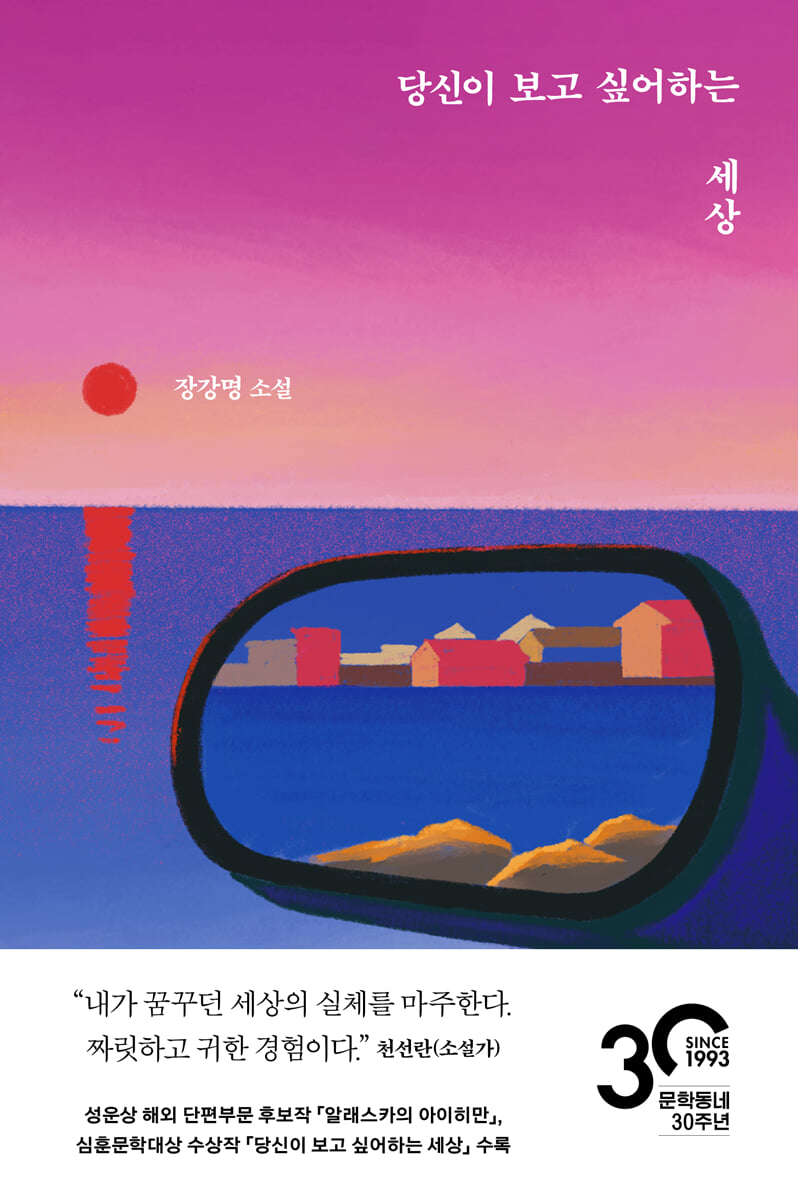
The world you want to see
 |
Description
Book Introduction
- A word from MD
-
Jang Gang-myeong's chilling vision of the near futureNovelist Jang Kang-myeong, who captures the full spectrum of social issues with a sharp eye, has returned to science fiction.
It illuminates both the light and dark sides of the near future brought about by new technologies such as augmented reality, machines that experience other people's memories, and apps that predict human relationships.
A collection of novels that captures technology, humanity, and the changes within them.
July 11, 2023. Novel/Poetry PD Kim Yu-ri
“I am confronted with the reality of the world I dreamed of.
“It is a thrilling and precious experience.”
_Cheon Seon-ran (novelist)
"Eichmann in Alaska," nominated for the Seongun Award for International Short Film,
Includes the Sim Hoon Literary Award-winning work "The World You Want to See"
Gray Utopia, or Colorful Dystopia
The invention of technology that everyone has dreamed of,
The unpredictable daily life that began from there
An exciting 'STS SF' depicting the light and dark sides of near-future technology.
The new short story collection 『The World You Want to See』 by Jang Kang-myeong, the author who has been diligently communicating with contemporary readers by publishing novels such as 『Bleach』, 『I Hate Korea』, 『The End of the Year, or How You Remember the World』, and 『Re-investigation』, as well as the reportage collection 『Election, Passing, Class』, has been published.
A total of seven stories are included, including the winner of the Sim Hoon Literary Award, “The World You Want to See,” which received a judges’ comment that it “allows you to check how to ask questions in this era, why to ask questions, and what to worry about,” and “Eichmann in Alaska,” which was nominated for the overseas short story category of the Seiun Award, a prestigious Japanese science fiction literary award.
The author, who had published science fiction short stories and columns in magazines such as 『Science Dong-A』 and 『Bestseller』 in the 1990s and founded a monthly science fiction webzine that he ran until 2001, fully displays his love and knowledge of science fiction in this collection of short stories.
In the author's note, the author describes the genre of this collection as "STS (Science, Technology, and Society) SF." STS is an academic discipline that explores the impact of science and technology on society.
The author says that science and technology are causing “an existential crisis in our society in many areas,” and that “literature must and can respond to this.”
In a conversation with Hong Seong-wook, a professor of science at Seoul National University and an authority on STS, included in the special booklet 'Commentary Book', he also described science fiction as a "thought experiment on society." The book 'The World You Want to See', which is filled with the author's thoughts, allows us to look at our rapidly changing society with a deeper perspective, thereby joining in this heated thought experiment.
『The World You Want to See』, which is a collection of four short stories included in 『Extremely Minor Superpowers』 (2019), reworked from the perspective of STS and presented along with three new works, is a topic worthy of being read anew and discussed more heatedly.
The author's trademark exciting settings, immersive plot, and vivid depictions of scenes also make it impossible to take your eyes off the story for even a moment.
“It is a thrilling and precious experience.”
_Cheon Seon-ran (novelist)
"Eichmann in Alaska," nominated for the Seongun Award for International Short Film,
Includes the Sim Hoon Literary Award-winning work "The World You Want to See"
Gray Utopia, or Colorful Dystopia
The invention of technology that everyone has dreamed of,
The unpredictable daily life that began from there
An exciting 'STS SF' depicting the light and dark sides of near-future technology.
The new short story collection 『The World You Want to See』 by Jang Kang-myeong, the author who has been diligently communicating with contemporary readers by publishing novels such as 『Bleach』, 『I Hate Korea』, 『The End of the Year, or How You Remember the World』, and 『Re-investigation』, as well as the reportage collection 『Election, Passing, Class』, has been published.
A total of seven stories are included, including the winner of the Sim Hoon Literary Award, “The World You Want to See,” which received a judges’ comment that it “allows you to check how to ask questions in this era, why to ask questions, and what to worry about,” and “Eichmann in Alaska,” which was nominated for the overseas short story category of the Seiun Award, a prestigious Japanese science fiction literary award.
The author, who had published science fiction short stories and columns in magazines such as 『Science Dong-A』 and 『Bestseller』 in the 1990s and founded a monthly science fiction webzine that he ran until 2001, fully displays his love and knowledge of science fiction in this collection of short stories.
In the author's note, the author describes the genre of this collection as "STS (Science, Technology, and Society) SF." STS is an academic discipline that explores the impact of science and technology on society.
The author says that science and technology are causing “an existential crisis in our society in many areas,” and that “literature must and can respond to this.”
In a conversation with Hong Seong-wook, a professor of science at Seoul National University and an authority on STS, included in the special booklet 'Commentary Book', he also described science fiction as a "thought experiment on society." The book 'The World You Want to See', which is filled with the author's thoughts, allows us to look at our rapidly changing society with a deeper perspective, thereby joining in this heated thought experiment.
『The World You Want to See』, which is a collection of four short stories included in 『Extremely Minor Superpowers』 (2019), reworked from the perspective of STS and presented along with three new works, is a topic worthy of being read anew and discussed more heatedly.
The author's trademark exciting settings, immersive plot, and vivid depictions of scenes also make it impossible to take your eyes off the story for even a moment.
- You can preview some of the book's contents.
Preview
index
The World You Want to See _7
You are a hot star _31
Eichmann in Alaska_99
Let's Become Trees _173
Cyborg Writing _191
Astatine _229
Love in the Data Age _361
Author's Note _395
You are a hot star _31
Eichmann in Alaska_99
Let's Become Trees _173
Cyborg Writing _191
Astatine _229
Love in the Data Age _361
Author's Note _395
Detailed image

Into the book
“Anyway, all humans live in a subjective reality.
And there are objective facts that no one wants to accept, big or small.
For us, that was the result of the last presidential election.
Some people denied the election results themselves and spread conspiracy theories, saying there was voting fraud and vote counting manipulation.
They tried to fight objective facts by holding up subjective reality.
I didn't want to do that.
“The presidential election results seemed like a joke, so I decided to just play it as a joke.”
---From "The World You Want to See"
“Even before augmented reality technology, there were many people who lived in dreams.
No, all humans are like that to some extent.
“Every moment we create our own complex world and live in it.”
---From "The World You Want to See"
“We need a subject that is lonely, joyful, desirous, and determined while staying on Venus.
“I am an actor and aspiring screenwriter who solves such concerns in a human way, according to the human clock.”
---From "You Are a Hot Star"
Imagine a situation where you are struggling for a long time without any help from those around you.
In particular, imagine a situation where the help is absolutely necessary for you but is of a very minor kind to someone else.
In the end, everyone ends up feeling like a desperately abandoned being.
And then you calculate the distance between yourself and the closest person who can help you.
---From "You Are a Hot Star"
Dr. Einstein said, “The minds of others are farther away than the moon.”
(…) What would happen if we could experience another person's joy and suffering exactly as they felt it? "Individual lives, group rules, politics and social policy, culture—even entire civilizations—would all be transformed," Einstein asserted.
---From "Eichmann in Alaska"
It was a technology I had only dreamed of for thirty-seven years.
I did not consider fasting to death like a Jain ascetic to be the best way to live.
He also saw it as an act that took my life.
Green Life surgery showed for the first time the possibility of liberating humans from the shackles of having to eat other living beings to sustain their own lives.
---From "Let's Become Trees"
“At some point, I started to want to write a novel that was closer to real life.
“There are no foreshadowing or plots in life.”
---From "Cyborg's Writing"
I raise my voice, saying that Astatine is our father, our spiritual teacher, a fable about how to realize the self, and a myth that shows us the way forward for our civilization.
The audience is moved by such nonsense.
---From "Astatine"
He wanted to believe that he was unpredictable, but those who followed every recommendation and those who did the opposite were in fact equally predictable.
---From "Love in the Data Age"
He felt that, whether the prediction was right or wrong, it was not right for someone to look so deeply into his inner self and future, which he himself could not see.
And there are objective facts that no one wants to accept, big or small.
For us, that was the result of the last presidential election.
Some people denied the election results themselves and spread conspiracy theories, saying there was voting fraud and vote counting manipulation.
They tried to fight objective facts by holding up subjective reality.
I didn't want to do that.
“The presidential election results seemed like a joke, so I decided to just play it as a joke.”
---From "The World You Want to See"
“Even before augmented reality technology, there were many people who lived in dreams.
No, all humans are like that to some extent.
“Every moment we create our own complex world and live in it.”
---From "The World You Want to See"
“We need a subject that is lonely, joyful, desirous, and determined while staying on Venus.
“I am an actor and aspiring screenwriter who solves such concerns in a human way, according to the human clock.”
---From "You Are a Hot Star"
Imagine a situation where you are struggling for a long time without any help from those around you.
In particular, imagine a situation where the help is absolutely necessary for you but is of a very minor kind to someone else.
In the end, everyone ends up feeling like a desperately abandoned being.
And then you calculate the distance between yourself and the closest person who can help you.
---From "You Are a Hot Star"
Dr. Einstein said, “The minds of others are farther away than the moon.”
(…) What would happen if we could experience another person's joy and suffering exactly as they felt it? "Individual lives, group rules, politics and social policy, culture—even entire civilizations—would all be transformed," Einstein asserted.
---From "Eichmann in Alaska"
It was a technology I had only dreamed of for thirty-seven years.
I did not consider fasting to death like a Jain ascetic to be the best way to live.
He also saw it as an act that took my life.
Green Life surgery showed for the first time the possibility of liberating humans from the shackles of having to eat other living beings to sustain their own lives.
---From "Let's Become Trees"
“At some point, I started to want to write a novel that was closer to real life.
“There are no foreshadowing or plots in life.”
---From "Cyborg's Writing"
I raise my voice, saying that Astatine is our father, our spiritual teacher, a fable about how to realize the self, and a myth that shows us the way forward for our civilization.
The audience is moved by such nonsense.
---From "Astatine"
He wanted to believe that he was unpredictable, but those who followed every recommendation and those who did the opposite were in fact equally predictable.
---From "Love in the Data Age"
He felt that, whether the prediction was right or wrong, it was not right for someone to look so deeply into his inner self and future, which he himself could not see.
---From "Love in the Data Age"
Publisher's Review
Machines that experience other people's memories, augmented reality technology, chloroplast transplant surgery,
A physical resurrection device, a relationship prediction analysis app…
A time when the landscape of life changed
The title piece, “The World You Want to See,” is a short story that can be considered a model of “STS SF.”
Set in the near future, where the augmented reality technology 'Optor', which allows users to edit and display the scenery in front of their eyes as they wish, has become commercialized, it depicts "Optor addicts" (page 9) who live on a cruise ship at sea, outside the influence of the 'Augmented Reality Regulation Act', and are content with a virtual reality controlled by the politicians they support.
This is a problematic work that makes us think about whether the society we stand on is real or a lie that seems more real than the real thing. It accurately conveys the desolate atmosphere of the near future through the bizarre sight of the scenery before our eyes being edited in an instant and the cold conversation scenes of characters who are stepping into a virtual reality.
While "The World You Want to See" deals with the psychology of those who escape into virtual reality, "You Are on a Hot Star" focuses on the body of scientist "Su-jeong" who struggles on the 400-degree Celsius planet Venus, a harsh planet for human life.
A carbonated beverage company with huge capital develops a biotechnology that separates the human body and head to efficiently manage a scientist sent to space. The head is sent to Venus while the body is kept in a cryogenic facility on Earth.
While exploring Venus, Soo-Jeong discovers the company's unethical secrets about how it treats the scientists' bodies and plans to escape.
The novel vividly conveys the resentment of a woman whose ownership of her body has been violated, while unfolding the dark side of science and technology with a black comedy that maximizes efficiency.
Meanwhile, the alternative history novel "Eichmann in Alaska," featuring Nazi war criminal Eichmann, depicts the ethical dilemma that arises with the invention of an "experience machine" that can inject memories of others.
The Jewish Committee plans to put Eichmann in an experience machine so that he can experience and reflect on the painful memories of being an Auschwitz survivor, and invites reporters to the scene.
The novel portrays the reactions of the Jewish community, the scientific community, and journalists from various countries from various angles, making us think about the flaws in the moral golden rule of "putting yourself in someone else's shoes."
Serial killers, sexual offenders, and child abusers each have their own stories.
But is it really necessary to listen to their story? And if so, for what reason? Is it simply because they resemble us? Or is it to see how far human limitations can extend in a negative direction? (...) "Other people are often hell.
And perhaps we should be thankful that hell exists beyond our understanding.” (p. 171)
While the three previous novels show the shock waves that the advancement of science and technology sends across all aspects of society, "Let's Become Trees" and "Cyborg Writing" depict the inner ripples of individuals who live their lives while willingly accepting new technologies.
"Let's Become a Tree" is a short story written in the form of a memoir by a person who underwent the 'Green Life' surgery, which transplants chloroplasts into the skin.
This is an interesting short story that questions the original sin of humans who have no choice but to kill life in order to survive, and the possibility of complete liberation from that sin, through the image of a transhuman who has gained the ability to photosynthesize like a plant that receives light and absorbs nutrients.
"Cyborg's Writing" is a story about the narrator, Jang Gang-myeong, who wears a plasma headband to overcome the depression he suffers from while going through a slump.
The plasma hairband is a special invention that maximizes concentration and allows one to become intensely immersed in even the most boring tasks. In the novel, Jang Gang-myeong gradually falls into an unexpected crisis while using this item.
It will resonate with many readers today who have dreamed of an invention like the hairband in the novel at least once.
Not the correct answer given by someone else
Accumulating the wrong answers you chose yourself
A novel that constitutes a human being called himself
"Astatine" is a grand space drama that depicts the story of Astatine, a genius scientist who created a space society in the sphere of Jupiter and Saturn.
He succeeds in developing a resurrection device that can infinitely regenerate the body, and is reborn as a super-intelligent, divine being through generations of rebirth.
He clones himself into fifteen people and devises a resurrection ritual to select one with the greatest abilities and intelligence as the final Astatine.
This survival game in the post-human era, consumed by untamable beasts of technology that threaten to fundamentally change the world's ecology, will keep readers on the edge of their seats.
The ending, which brings about a thrilling catharsis as the great conflict is finally resolved, is undoubtedly the highlight of this novel.
"Love in the Data Age," included at the end of the collection, depicts a society in which apps that predict the sustainability of human relationships based on data have become commercialized.
'Lee Yu-jin' and 'Song Yu-jin', who have completely different personalities and backgrounds, fall in love by chance, but the future predicted by the data prediction app for the two is bleak.
The two try not to give in to the prediction, but in the end, they break up just as the app predicted.
But the story after the two break up is the charm of this novel.
The novel seems to be saying that no matter how accurately we can predict the future, the randomness and uncertainty of life, metaphorized as 'love', are difficult to eliminate or control.
It can also be read as the message the author is trying to convey.
By choosing “the wrong answer you chose yourself” rather than “the right answer given by others,” you “build yourself up as a human being” (pp. 84-85).
Isn't it possible that the adventurous courage and independent perspective needed to adapt to a rapidly changing technological society are cultivated in this way?
To live more actively in the world, we need to understand the scientific advancements surrounding us and the resulting problems. I believe STS should be a core part of liberal arts education.
I hope that this collection of short stories will make it widely known.
Hong Seong-wook (Professor, Department of Science, Seoul National University)
Author's Note
STS is an academic discipline that explores how science and technology influence society.
Science and technology are now causing existential crises in many fields, and I believe literature must and can respond to them.
(…) We wanted to talk about the possibility of qualitative change at a very deep level.
In other words, we are ‘transformed’ by technology.
Capturing that transformation is the goal of STS SF.
A physical resurrection device, a relationship prediction analysis app…
A time when the landscape of life changed
The title piece, “The World You Want to See,” is a short story that can be considered a model of “STS SF.”
Set in the near future, where the augmented reality technology 'Optor', which allows users to edit and display the scenery in front of their eyes as they wish, has become commercialized, it depicts "Optor addicts" (page 9) who live on a cruise ship at sea, outside the influence of the 'Augmented Reality Regulation Act', and are content with a virtual reality controlled by the politicians they support.
This is a problematic work that makes us think about whether the society we stand on is real or a lie that seems more real than the real thing. It accurately conveys the desolate atmosphere of the near future through the bizarre sight of the scenery before our eyes being edited in an instant and the cold conversation scenes of characters who are stepping into a virtual reality.
While "The World You Want to See" deals with the psychology of those who escape into virtual reality, "You Are on a Hot Star" focuses on the body of scientist "Su-jeong" who struggles on the 400-degree Celsius planet Venus, a harsh planet for human life.
A carbonated beverage company with huge capital develops a biotechnology that separates the human body and head to efficiently manage a scientist sent to space. The head is sent to Venus while the body is kept in a cryogenic facility on Earth.
While exploring Venus, Soo-Jeong discovers the company's unethical secrets about how it treats the scientists' bodies and plans to escape.
The novel vividly conveys the resentment of a woman whose ownership of her body has been violated, while unfolding the dark side of science and technology with a black comedy that maximizes efficiency.
Meanwhile, the alternative history novel "Eichmann in Alaska," featuring Nazi war criminal Eichmann, depicts the ethical dilemma that arises with the invention of an "experience machine" that can inject memories of others.
The Jewish Committee plans to put Eichmann in an experience machine so that he can experience and reflect on the painful memories of being an Auschwitz survivor, and invites reporters to the scene.
The novel portrays the reactions of the Jewish community, the scientific community, and journalists from various countries from various angles, making us think about the flaws in the moral golden rule of "putting yourself in someone else's shoes."
Serial killers, sexual offenders, and child abusers each have their own stories.
But is it really necessary to listen to their story? And if so, for what reason? Is it simply because they resemble us? Or is it to see how far human limitations can extend in a negative direction? (...) "Other people are often hell.
And perhaps we should be thankful that hell exists beyond our understanding.” (p. 171)
While the three previous novels show the shock waves that the advancement of science and technology sends across all aspects of society, "Let's Become Trees" and "Cyborg Writing" depict the inner ripples of individuals who live their lives while willingly accepting new technologies.
"Let's Become a Tree" is a short story written in the form of a memoir by a person who underwent the 'Green Life' surgery, which transplants chloroplasts into the skin.
This is an interesting short story that questions the original sin of humans who have no choice but to kill life in order to survive, and the possibility of complete liberation from that sin, through the image of a transhuman who has gained the ability to photosynthesize like a plant that receives light and absorbs nutrients.
"Cyborg's Writing" is a story about the narrator, Jang Gang-myeong, who wears a plasma headband to overcome the depression he suffers from while going through a slump.
The plasma hairband is a special invention that maximizes concentration and allows one to become intensely immersed in even the most boring tasks. In the novel, Jang Gang-myeong gradually falls into an unexpected crisis while using this item.
It will resonate with many readers today who have dreamed of an invention like the hairband in the novel at least once.
Not the correct answer given by someone else
Accumulating the wrong answers you chose yourself
A novel that constitutes a human being called himself
"Astatine" is a grand space drama that depicts the story of Astatine, a genius scientist who created a space society in the sphere of Jupiter and Saturn.
He succeeds in developing a resurrection device that can infinitely regenerate the body, and is reborn as a super-intelligent, divine being through generations of rebirth.
He clones himself into fifteen people and devises a resurrection ritual to select one with the greatest abilities and intelligence as the final Astatine.
This survival game in the post-human era, consumed by untamable beasts of technology that threaten to fundamentally change the world's ecology, will keep readers on the edge of their seats.
The ending, which brings about a thrilling catharsis as the great conflict is finally resolved, is undoubtedly the highlight of this novel.
"Love in the Data Age," included at the end of the collection, depicts a society in which apps that predict the sustainability of human relationships based on data have become commercialized.
'Lee Yu-jin' and 'Song Yu-jin', who have completely different personalities and backgrounds, fall in love by chance, but the future predicted by the data prediction app for the two is bleak.
The two try not to give in to the prediction, but in the end, they break up just as the app predicted.
But the story after the two break up is the charm of this novel.
The novel seems to be saying that no matter how accurately we can predict the future, the randomness and uncertainty of life, metaphorized as 'love', are difficult to eliminate or control.
It can also be read as the message the author is trying to convey.
By choosing “the wrong answer you chose yourself” rather than “the right answer given by others,” you “build yourself up as a human being” (pp. 84-85).
Isn't it possible that the adventurous courage and independent perspective needed to adapt to a rapidly changing technological society are cultivated in this way?
To live more actively in the world, we need to understand the scientific advancements surrounding us and the resulting problems. I believe STS should be a core part of liberal arts education.
I hope that this collection of short stories will make it widely known.
Hong Seong-wook (Professor, Department of Science, Seoul National University)
Author's Note
STS is an academic discipline that explores how science and technology influence society.
Science and technology are now causing existential crises in many fields, and I believe literature must and can respond to them.
(…) We wanted to talk about the possibility of qualitative change at a very deep level.
In other words, we are ‘transformed’ by technology.
Capturing that transformation is the goal of STS SF.
GOODS SPECIFICS
- Date of issue: July 11, 2023
- Page count, weight, size: 404 pages | 466g | 133*200*30mm
- ISBN13: 9788954694148
- ISBN10: 8954694144
You may also like
카테고리
korean


korean

![GQ KOREA Mark (Monthly): December [2025]](http://librairie.coreenne.fr/cdn/shop/files/8ef265dbbfbf186523ed75ba7319009d.jpg?v=1765340328&width=3840)


