

Convergence 2030
 |
Description
Book Introduction
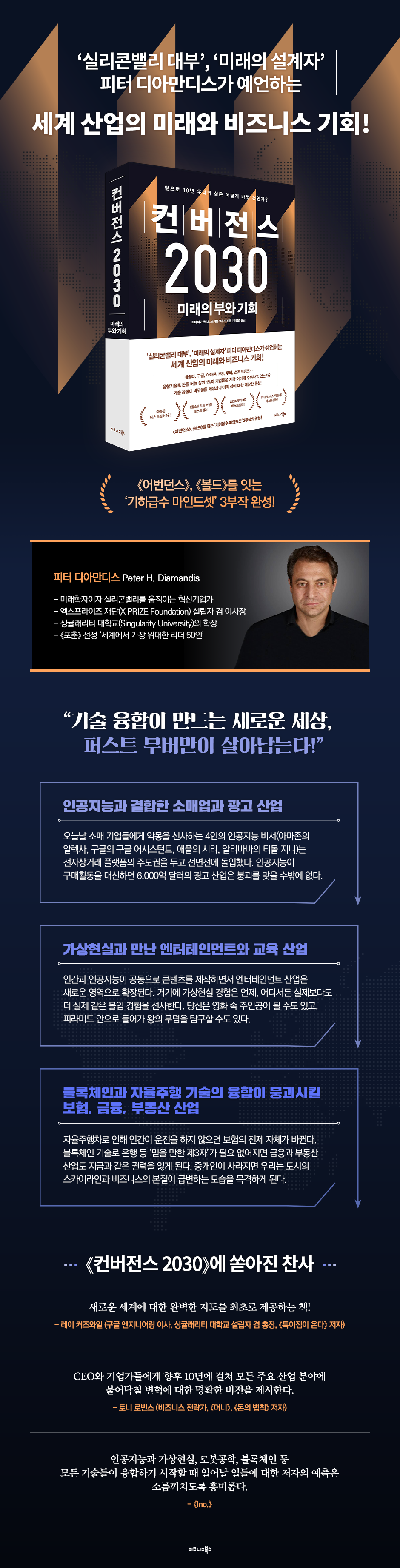
The fusion of technologies that will destroy everything has begun! A future of technological convergence, written by the designers of a new civilization! Twenty years have passed since the 21st century began. For the past 20 years, we have watched as the 'fantastic future technologies' depicted in many science fiction movies have become 'real, everyday technologies.' We can now work from anywhere with palm-sized computers, have AI assistants handle everyday tasks, build houses in a day with 3D printing technology, and enjoy movies with more immersive virtual reality technology. And as of 2021, self-driving cars and even 'flying cars', once staples of science fiction movies, are becoming a reality. Waymo, a subsidiary of Google, has already been conducting pilot tests of self-driving taxis since last year, and Uber has completed the development of a flying taxi and has begun a pilot service under the name of 'Uber Air Taxi.' Recently, Hyundai Motor Company of Korea also jumped into this huge smart mobility market by announcing plans to commercialize flying cars by 2025. Self-driving cars and flying cars, which integrate cutting-edge technologies such as artificial intelligence, networks, the Internet of Things, high-performance sensor technology, batteries, and materials science, are expected to revolutionize our lives in terms of freedom and efficiency of movement, much like the revolution brought about by trains and automobiles 200 years ago. Just 20 years ago, when technological advancements were slow, we could not have imagined a world like ours today, where 95 percent of the population uses smartphones and self-driving cars are commercially available. But now that 2021 has begun, no one can deny that the pace of technological change is faster than ever. So, what made such rapid change possible in just 20 years? How could it have happened in less than a generation? The answer is convergence—the fusion of numerous technologies we already knew. Given the rapid social changes we have experienced over the past two decades, humanity will experience the greatest innovation in history over the next decade, creating wealth far surpassing that accumulated over the past century. Moreover, the pace of change will be much faster than we expect, as numerous companies compete to seize business opportunities amidst this tsunami of change. In this book, futurist Peter Diamandis, known as the 'godfather of Silicon Valley' and 'architect of the future,' details the impact that the exponentially advancing wave of 'convergence technology' will have on our daily lives and society through an exciting and insightful roadmap for the future. What will happen when artificial intelligence, robotics, virtual reality, biotechnology, and sensors combine with 3D printers, blockchain, and gigabit networks connecting the world? How will the massive industries that dominate today's markets undergo transformation due to convergence technologies? The author also offers fascinating insights into the current state of global technology companies that are ushering in the future and the visions they offer, offering insights into what business opportunities should be seized within them. Offering a powerful and hopeful perspective on humanity's future, this book will be a necessary guide and essential reading for anyone seeking to understand the profound changes unfolding before us. |
- You can preview some of the book's contents.
Preview
index
Introduction | The Great Wave of Change Called Convergence
PART 1.
The future is faster than we think
CHAPTER 01.
The convergence of exponential technologies has begun.
Flying Cars Become a Reality | It's All Thanks to Fusion | The Mobility Revolution | Rocket: From the US to Australia in 30 Minutes | The Shockwave of Fusion Technology | Avatar: A World Without Transportation
CHAPTER 02.
Technological advancements surpass the speed of light
Quantum Computing: Moore's Law on Steroids | Artificial Intelligence: See, Hear, Read, Write | Networks: Uniting the Earth Through Data | Robotics: From Drunken Droids to Ninja Robots
CHAPTER 03.
A future with turbo boost
Virtual and Augmented Reality: Beyond Media | 3D Printing: On-Demand Manufacturing | Blockchain: Systems More Trustworthy Than Humans | Materials Science and Nanotechnology: Efficiency Innovations | Biotechnology: Technologies for Repairing Broken Cells
CHAPTER 04.
Acceleration of acceleration
Amplification through Convergence | First Driver: Saving Time | Second Driver: Availability of Capital | Third Driver: Freemization | Fourth Driver: The Birth of Genius | Fifth Driver: Rich Communication | Sixth Driver: New Business Models | Seventh Driver: Longevity
PART 2.
The Future of Wealth: Changing the Way Wealth Works with Industrial Restructuring
CHAPTER 05.
The definition of retail is changing.
The First Shopping Platform | Digital Assistants and Customer Experience | Amazon Go and Frictionless Shopping | The Robots Are Coming! | 3D Printers and the Retail Industry | The Experience Economy: The Last Hope | The End of the Shopping Mall
CHAPTER 06.
No more advertising needed
"Mad Men" took an era by storm | Advertising beyond the screen | Hyper-personalization, voice cloning, and deepfakes | AI is driving out advertising.
CHAPTER 07.
A new horizon of enjoyment opens up
Netflix's Attack | YouTubers Become High-Income Professionals | Stories Written with AI | The Rise of the Holodeck, More Realistic Than Real Life | AI Knows Even Without Speaking | Enjoyable Anywhere, Anywhere, Anywhere
CHAPTER 08.
What and how to study
A Quest for Quantity and Quality | A Billion Android Teachers | The Ultimate Field Trip: Virtual Reality | What Will Schools Look Like in 2030?
CHAPTER 09.
Human life changed by conquering disease
Rothblatt's Innovation Project | From Disease Control to Healthcare | Hey, Google.
Do I Have a Cold? | Reading, Writing, and Editing the Code of Life | The Surgeon Who Never Shakes His Hands | How to Win the Battle Against Cancer | The Future of Pharmaceuticals: Faster and Safer
CHAPTER 10.
The birth of a new species that defies death
Nine Coachmen Leading to Death | One Step Ahead of Death | The Invention of the 'Anti-Aging Drug' | Can We Turn Back Time?
CHAPTER 11.
A world without middlemen
The Perfect Future | Coffee and Risk: The Origins and Future of Insurance | The Winds of Change Blowing in the "Money Business" | Real Estate Brokerage Without Brokers
CHAPTER 12.
Programming food
Science Meets Food | How to Reduce Food Inefficiency | No More Cow Sacrifice
PART 3.
The 22nd century has already begun
CHAPTER 13.
Coming Threats and Their Solutions
Looking Ahead 100 Years | Resource Depletion: Technology to Save Half of Humanity | Climate Change: Cheap and Abundant Solar and Wind | Energy Storage: Integrated Smart Grids | Transportation: Electric Cars Accelerating | Ecosystem Destruction: The Endless Fight Against Global Warming | Economic Risks: Technological Unemployment | Existential Risks: Vision, Prevention, and Governance
CHAPTER 14.
Prepare for a massive technological migration
The Movement of Ideas and Innovation | Climate Change Drives Migration | People Heading to Cities | Living in a Virtual World | Space: Humanity's Final Frontier | Uploading Consciousness to the Cloud
In conclusion | The world becomes better without a sound
Acknowledgements
main
PART 1.
The future is faster than we think
CHAPTER 01.
The convergence of exponential technologies has begun.
Flying Cars Become a Reality | It's All Thanks to Fusion | The Mobility Revolution | Rocket: From the US to Australia in 30 Minutes | The Shockwave of Fusion Technology | Avatar: A World Without Transportation
CHAPTER 02.
Technological advancements surpass the speed of light
Quantum Computing: Moore's Law on Steroids | Artificial Intelligence: See, Hear, Read, Write | Networks: Uniting the Earth Through Data | Robotics: From Drunken Droids to Ninja Robots
CHAPTER 03.
A future with turbo boost
Virtual and Augmented Reality: Beyond Media | 3D Printing: On-Demand Manufacturing | Blockchain: Systems More Trustworthy Than Humans | Materials Science and Nanotechnology: Efficiency Innovations | Biotechnology: Technologies for Repairing Broken Cells
CHAPTER 04.
Acceleration of acceleration
Amplification through Convergence | First Driver: Saving Time | Second Driver: Availability of Capital | Third Driver: Freemization | Fourth Driver: The Birth of Genius | Fifth Driver: Rich Communication | Sixth Driver: New Business Models | Seventh Driver: Longevity
PART 2.
The Future of Wealth: Changing the Way Wealth Works with Industrial Restructuring
CHAPTER 05.
The definition of retail is changing.
The First Shopping Platform | Digital Assistants and Customer Experience | Amazon Go and Frictionless Shopping | The Robots Are Coming! | 3D Printers and the Retail Industry | The Experience Economy: The Last Hope | The End of the Shopping Mall
CHAPTER 06.
No more advertising needed
"Mad Men" took an era by storm | Advertising beyond the screen | Hyper-personalization, voice cloning, and deepfakes | AI is driving out advertising.
CHAPTER 07.
A new horizon of enjoyment opens up
Netflix's Attack | YouTubers Become High-Income Professionals | Stories Written with AI | The Rise of the Holodeck, More Realistic Than Real Life | AI Knows Even Without Speaking | Enjoyable Anywhere, Anywhere, Anywhere
CHAPTER 08.
What and how to study
A Quest for Quantity and Quality | A Billion Android Teachers | The Ultimate Field Trip: Virtual Reality | What Will Schools Look Like in 2030?
CHAPTER 09.
Human life changed by conquering disease
Rothblatt's Innovation Project | From Disease Control to Healthcare | Hey, Google.
Do I Have a Cold? | Reading, Writing, and Editing the Code of Life | The Surgeon Who Never Shakes His Hands | How to Win the Battle Against Cancer | The Future of Pharmaceuticals: Faster and Safer
CHAPTER 10.
The birth of a new species that defies death
Nine Coachmen Leading to Death | One Step Ahead of Death | The Invention of the 'Anti-Aging Drug' | Can We Turn Back Time?
CHAPTER 11.
A world without middlemen
The Perfect Future | Coffee and Risk: The Origins and Future of Insurance | The Winds of Change Blowing in the "Money Business" | Real Estate Brokerage Without Brokers
CHAPTER 12.
Programming food
Science Meets Food | How to Reduce Food Inefficiency | No More Cow Sacrifice
PART 3.
The 22nd century has already begun
CHAPTER 13.
Coming Threats and Their Solutions
Looking Ahead 100 Years | Resource Depletion: Technology to Save Half of Humanity | Climate Change: Cheap and Abundant Solar and Wind | Energy Storage: Integrated Smart Grids | Transportation: Electric Cars Accelerating | Ecosystem Destruction: The Endless Fight Against Global Warming | Economic Risks: Technological Unemployment | Existential Risks: Vision, Prevention, and Governance
CHAPTER 14.
Prepare for a massive technological migration
The Movement of Ideas and Innovation | Climate Change Drives Migration | People Heading to Cities | Living in a Virtual World | Space: Humanity's Final Frontier | Uploading Consciousness to the Cloud
In conclusion | The world becomes better without a sound
Acknowledgements
main
Detailed image
Into the book
Let's think about it from a different angle.
The industry that empowers people to own cars has been thriving for the past century.
It's only been a decade since the auto industry first faced the threat of ride-sharing services.
But it won't be more than a decade before the ride-sharing model dominates the world.
Because self-driving cars are already threatening ride-sharing services.
Self-driving cars may also be pushed out of the market by the advent of flying cars, and flying cars may also be eliminated the moment hyperloops or rockets are introduced.
And avatars will play a part in this too.
The most important thing is that all these changes will happen within the next 10 years.
We invite you to a future world that is coming much faster than we think.
--- Chapter 1_ The convergence of exponential technologies has begun
The final amplification factor we will examine is the seven additional forces that arise from the convergence of technologies.
These are secondary effects formed as technologies in the exponential development stage converge with each other, and can be said to be catalysts that further accelerate the pace of innovation.
Each force functions independently, but it is when they work in combination with other forces that they become truly effective.
So to speak, these seven forces are step-by-step solutions to the mathematical equation of humanity's future, algorithms pre-designed (and, in a way, designed by all of us) to increase the speed at which the world changes and the impact of that change.
One force is influenced by another force, while at the same time amplifying the other force.
And all these forces working together further accelerate the acceleration of technological advancement.
So we can create in just one year the changes that our ancestors experienced in their entire lives.
--- Chapter 4_ Acceleration of Acceleration
Retailers looking to stay in business now seem to have few options.
By 2024, the minimum wage in the United States is projected to reach $15 an hour, but many still believe that's too low.
As human labor costs continue to rise, robots are no longer just a new phenomenon; they are now an indispensable part of society.
Store owners will no longer feel the need to hire human employees who are prone to getting sick, being late for work, and getting injured.
Robots work 24 hours a day, 365 days a year.
I don't take vacations or stop work to go to the bathroom.
You don't need health insurance and you don't have to go on family trips.
What this means is that if this trend continues, the problem of 'unemployment due to technological advancement' will become an increasingly big problem (we will discuss this topic further in Part 3).
--- Chapter 5_ The definition of retail is changing
Additionally, your AI assistant will know your preferences for certain plots better than you do.
You only remember that you enjoyed a certain movie, but AI knows why you enjoyed it.
This system uses semantic analysis of language and biological responses to determine why specific lines in a movie evoke such strong nostalgia in you.
It also captures your heartbeat, eye blinking, pupil dilation, and other responses to determine where you focus and where you look away.
If this kind of data continues to accumulate, it is clear that in the future, when you choose the plot of a movie or game, it will be artificial intelligence, not you, that will make the decision.
AI assistants will tailor content to best meet our emotional needs by matching our past history, neurophysiological characteristics, location, social preferences, and desired level of immersion with our current emotional state.
--- Chapter 7_ A new horizon of pleasure opens up
Meanwhile, in step with the convergence of all these technologies, two major paradigm shifts are emerging.
The first is a shift from disease management to health management.
In other words, the retroactive, reactive, and uniform healthcare system is changing into a forward-looking, situation-driven, and personalized system.
The second is a change in management.
For the past century, the healthcare industry has been sustained by a precarious collaboration among big pharmaceutical companies, bloated governments, doctors, nurses, and trained medical professionals.
But now, even in this field, a strong external invasion has begun.
Several tech giants are jumping into the game, causing a huge shock to the entire industry.
Apple CEO Tim Cook recently told The Independent (the same interview in which he spoke about the potential of augmented reality):
“If at some point in the future we were asked what Apple’s greatest contribution to humanity has been, we would say it’s in healthcare.”
--- Chapter 9_ Human life changed by conquering disease
For thousands of years, mankind has searched for the fountain of youth.
But what is now clear is that what we are looking for is not a place, but 'time'.
In other words, the fountain of youth signifies a 'future point' where we will win the fight against death due to the fusion of rapidly developing technologies.
The question, “Will humans ever be able to live forever?” remains an open question, but adding at least 60 years to a 100-year lifespan (i.e., significantly increasing human lifespan) has long since shifted from a question of “if” to a question of “when.”
--- Chapter 10_ The Birth of a New Human Race That Defies Death
Convergence technologies are disrupting, democratizing, and democratizing nearly every element of the real estate industry.
The infrastructure of major real estate companies is increasingly virtualized, and the day when real estate agents disappear is not far off.
Moreover, even the two pillars of this industry—location and proximity—are expected to face the inexorable flow of free services within the next decade.
Even the most privileged real estate available today will become affordable and accessible to the majority in the future.
As these changes in real estate converge with innovations in the finance and insurance industries, we are witnessing a rapid transformation of both city skylines and the very nature of business.
What if this process were accelerated, made cheaper, and even intermediaries eliminated, allowing everyone to benefit from this progress? The three engines that have created the greatest wealth in history would enter a period of complete reinvention.
--- Chapter 11_ A World Without Brokers
And this technology has enabled the final migration we will discuss: from a world of singular consciousness based on individual brains to a cloud-based collective consciousness.
This hive mind technology reminds us that humanity's greatest journey is not a migration from Earth to the cosmos, but rather an exploration of the inner and outer world of the human psyche.
Moreover, as Elon Musk and Brian Johnson argue, the economic justification for encouraging people to migrate to a collective consciousness is sufficient.
In a world where humans are competing with artificial intelligence, solving economic problems based on this technology remains a crucial motivation for us.
The industry that empowers people to own cars has been thriving for the past century.
It's only been a decade since the auto industry first faced the threat of ride-sharing services.
But it won't be more than a decade before the ride-sharing model dominates the world.
Because self-driving cars are already threatening ride-sharing services.
Self-driving cars may also be pushed out of the market by the advent of flying cars, and flying cars may also be eliminated the moment hyperloops or rockets are introduced.
And avatars will play a part in this too.
The most important thing is that all these changes will happen within the next 10 years.
We invite you to a future world that is coming much faster than we think.
--- Chapter 1_ The convergence of exponential technologies has begun
The final amplification factor we will examine is the seven additional forces that arise from the convergence of technologies.
These are secondary effects formed as technologies in the exponential development stage converge with each other, and can be said to be catalysts that further accelerate the pace of innovation.
Each force functions independently, but it is when they work in combination with other forces that they become truly effective.
So to speak, these seven forces are step-by-step solutions to the mathematical equation of humanity's future, algorithms pre-designed (and, in a way, designed by all of us) to increase the speed at which the world changes and the impact of that change.
One force is influenced by another force, while at the same time amplifying the other force.
And all these forces working together further accelerate the acceleration of technological advancement.
So we can create in just one year the changes that our ancestors experienced in their entire lives.
--- Chapter 4_ Acceleration of Acceleration
Retailers looking to stay in business now seem to have few options.
By 2024, the minimum wage in the United States is projected to reach $15 an hour, but many still believe that's too low.
As human labor costs continue to rise, robots are no longer just a new phenomenon; they are now an indispensable part of society.
Store owners will no longer feel the need to hire human employees who are prone to getting sick, being late for work, and getting injured.
Robots work 24 hours a day, 365 days a year.
I don't take vacations or stop work to go to the bathroom.
You don't need health insurance and you don't have to go on family trips.
What this means is that if this trend continues, the problem of 'unemployment due to technological advancement' will become an increasingly big problem (we will discuss this topic further in Part 3).
--- Chapter 5_ The definition of retail is changing
Additionally, your AI assistant will know your preferences for certain plots better than you do.
You only remember that you enjoyed a certain movie, but AI knows why you enjoyed it.
This system uses semantic analysis of language and biological responses to determine why specific lines in a movie evoke such strong nostalgia in you.
It also captures your heartbeat, eye blinking, pupil dilation, and other responses to determine where you focus and where you look away.
If this kind of data continues to accumulate, it is clear that in the future, when you choose the plot of a movie or game, it will be artificial intelligence, not you, that will make the decision.
AI assistants will tailor content to best meet our emotional needs by matching our past history, neurophysiological characteristics, location, social preferences, and desired level of immersion with our current emotional state.
--- Chapter 7_ A new horizon of pleasure opens up
Meanwhile, in step with the convergence of all these technologies, two major paradigm shifts are emerging.
The first is a shift from disease management to health management.
In other words, the retroactive, reactive, and uniform healthcare system is changing into a forward-looking, situation-driven, and personalized system.
The second is a change in management.
For the past century, the healthcare industry has been sustained by a precarious collaboration among big pharmaceutical companies, bloated governments, doctors, nurses, and trained medical professionals.
But now, even in this field, a strong external invasion has begun.
Several tech giants are jumping into the game, causing a huge shock to the entire industry.
Apple CEO Tim Cook recently told The Independent (the same interview in which he spoke about the potential of augmented reality):
“If at some point in the future we were asked what Apple’s greatest contribution to humanity has been, we would say it’s in healthcare.”
--- Chapter 9_ Human life changed by conquering disease
For thousands of years, mankind has searched for the fountain of youth.
But what is now clear is that what we are looking for is not a place, but 'time'.
In other words, the fountain of youth signifies a 'future point' where we will win the fight against death due to the fusion of rapidly developing technologies.
The question, “Will humans ever be able to live forever?” remains an open question, but adding at least 60 years to a 100-year lifespan (i.e., significantly increasing human lifespan) has long since shifted from a question of “if” to a question of “when.”
--- Chapter 10_ The Birth of a New Human Race That Defies Death
Convergence technologies are disrupting, democratizing, and democratizing nearly every element of the real estate industry.
The infrastructure of major real estate companies is increasingly virtualized, and the day when real estate agents disappear is not far off.
Moreover, even the two pillars of this industry—location and proximity—are expected to face the inexorable flow of free services within the next decade.
Even the most privileged real estate available today will become affordable and accessible to the majority in the future.
As these changes in real estate converge with innovations in the finance and insurance industries, we are witnessing a rapid transformation of both city skylines and the very nature of business.
What if this process were accelerated, made cheaper, and even intermediaries eliminated, allowing everyone to benefit from this progress? The three engines that have created the greatest wealth in history would enter a period of complete reinvention.
--- Chapter 11_ A World Without Brokers
And this technology has enabled the final migration we will discuss: from a world of singular consciousness based on individual brains to a cloud-based collective consciousness.
This hive mind technology reminds us that humanity's greatest journey is not a migration from Earth to the cosmos, but rather an exploration of the inner and outer world of the human psyche.
Moreover, as Elon Musk and Brian Johnson argue, the economic justification for encouraging people to migrate to a collective consciousness is sufficient.
In a world where humans are competing with artificial intelligence, solving economic problems based on this technology remains a crucial motivation for us.
--- Chapter 14_ Prepare for the Great Technological Migration
Publisher's Review
Peter Diamandis, the "Silicon Valley Godfather," predicts the future of global industry and business opportunities!
In the next 10 years, the shock of the future begins!
Only the first movers will be able to enjoy a more prosperous future!
Last September, Neuralink, a biotechnology startup whose CEO is Tesla's Elon Musk, demonstrated its brain-computer connection technology by unveiling a pig that lived with electrodes implanted in its brain.
This technology, which could be a revolutionary treatment for dementia, Parkinson's disease, and quadriplegia, aims to eventually enable humans to read thoughts and communicate through brain waves.
In November of the same year, Waymo, a self-driving development company under Google, began pilot operations of the world's first "fully driverless" self-driving taxi without safety personnel in Arizona.
There are currently about 300 driverless taxis roaming Phoenix, Arizona.
Cruise, the autonomous driving subsidiary of General Motors, the largest automaker in the United States, also received a permit from the state to test driverless autonomous vehicles. At the 2021 Consumer Electronics Show (CES), IBM, in collaboration with the American pharmaceutical company Pfizer, unveiled an AI system that can diagnose Alzheimer's disease early.
Global fast food chain KFC recently announced that it is producing chicken nuggets made from 'lab-grown meat'.
Amazon, the world's largest e-commerce company, is deploying robots to find products in its warehouses, replacing the work of 300 people with just 25 robots.
The number of robots used in Amazon's fulfillment centers around the world currently exceeds 200,000, and the number of robots replacing "human workers" is expected to increase further due to the coronavirus pandemic.
Telepathy technology, self-driving cars, AI for health diagnosis, lab-grown meat, robots that replace humans…
As of 2021, these are the things happening around us right now.
We live in a world where technologies that seemed only possible in movies are now a reality.
The reason this has become possible is because various cutting-edge technologies that previously existed independently have begun to converge with each other, accelerating the pace of development compared to the past.
And, due to the exponential nature of these technologies, the pace of progress is only set to accelerate.
Over the next decade, a tsunami of massive change called convergence will have a devastating impact on businesses, industries, and our daily lives.
And only the "first movers" who adapt well to this massive and surprisingly rapid change and, furthermore, discover wealthy opportunities within it, will be able to enjoy the abundance of technology.
This is precisely why we must pay attention to and prepare for the disruptive potential that 'fusion' will bring.
In his previous work, Bold, author Peter Diamandis predicted the concept of exponential technologies, which double in growth over time, and the resulting market opportunities. In this book, he explores what changes will occur in our society when exponential technologies converge.
The exponential advancement of various technologies converges and disrupts not only existing products, services, and markets, but also the structures that support them.
The author sketches out a concrete blueprint for how this technology will dismantle and restructure the current industrial structure, what new businesses will emerge and which will fade into the dustbin of history, who is driving current developments, and which companies will emerge as game-changers, amassing enormous wealth in the future.
Will we be swept away by the tsunami of technological convergence?
Will you ride the wave and reach a new world?
Adapt to the speed of technology that surpasses the speed of thought!
This book is divided into three parts.
Part 1 explores nine key technology areas on the exponential growth curve, examining where each technology stands today and where it's headed.
We also anticipate the additional forces that technological advancements will create and explore how these forces will amplify the scale of the impact on humanity.
Part 2 focuses on eight key industries closely related to our lives: transportation, entertainment, education, healthcare, brokerage, energy, advertising, and retail, and forecasts the future that convergence technologies will bring.
Through various scenarios, we will explore how technology will change our daily lives over the next decade.
What changes will supermarkets and shopping malls undergo when networks, sensors, and AI technologies converge? Indeed, if 3D printing allows us to "print" customized products, won't the very definition of what we call "shopping" change? If virtual reality, avatars, and AI are introduced into education and the entertainment industry, won't hyper-personalized education and vivid experiences become possible? If Google automatically manages our health, and nanorobots smaller than cells can enter our bodies to treat tumors early and even edit our DNA, how much longer and healthier will we live? If blockchain technology eliminates the need for "middlemen," will the giant industries of insurance, finance, and real estate maintain their current power?
The final part, Part 3, takes a more macroscopic view and examines the threats our progress poses to the environment, the economy, and human existence.
It also expands its horizons to explore five major migrations humanity will face in the next century: economically motivated migration, climate-driven exodus, exploration of virtual worlds, space colonization, and the hive mind, which connects human brains to create collective intelligence.
There is no doubt that the next decade will be filled with rapid changes that will astonish the world.
With every industry on the planet facing a complete reinvention, you must be the first mover to anticipate the changes.
Only entrepreneurs, innovators, and leaders who can navigate this powerful current swiftly and courageously will be able to seize this tremendous opportunity.
For anyone struggling to determine where they and their business should be in this new world, on the brink of a technological explosion, this book will be an indispensable guide.
In the next 10 years, the shock of the future begins!
Only the first movers will be able to enjoy a more prosperous future!
Last September, Neuralink, a biotechnology startup whose CEO is Tesla's Elon Musk, demonstrated its brain-computer connection technology by unveiling a pig that lived with electrodes implanted in its brain.
This technology, which could be a revolutionary treatment for dementia, Parkinson's disease, and quadriplegia, aims to eventually enable humans to read thoughts and communicate through brain waves.
In November of the same year, Waymo, a self-driving development company under Google, began pilot operations of the world's first "fully driverless" self-driving taxi without safety personnel in Arizona.
There are currently about 300 driverless taxis roaming Phoenix, Arizona.
Cruise, the autonomous driving subsidiary of General Motors, the largest automaker in the United States, also received a permit from the state to test driverless autonomous vehicles. At the 2021 Consumer Electronics Show (CES), IBM, in collaboration with the American pharmaceutical company Pfizer, unveiled an AI system that can diagnose Alzheimer's disease early.
Global fast food chain KFC recently announced that it is producing chicken nuggets made from 'lab-grown meat'.
Amazon, the world's largest e-commerce company, is deploying robots to find products in its warehouses, replacing the work of 300 people with just 25 robots.
The number of robots used in Amazon's fulfillment centers around the world currently exceeds 200,000, and the number of robots replacing "human workers" is expected to increase further due to the coronavirus pandemic.
Telepathy technology, self-driving cars, AI for health diagnosis, lab-grown meat, robots that replace humans…
As of 2021, these are the things happening around us right now.
We live in a world where technologies that seemed only possible in movies are now a reality.
The reason this has become possible is because various cutting-edge technologies that previously existed independently have begun to converge with each other, accelerating the pace of development compared to the past.
And, due to the exponential nature of these technologies, the pace of progress is only set to accelerate.
Over the next decade, a tsunami of massive change called convergence will have a devastating impact on businesses, industries, and our daily lives.
And only the "first movers" who adapt well to this massive and surprisingly rapid change and, furthermore, discover wealthy opportunities within it, will be able to enjoy the abundance of technology.
This is precisely why we must pay attention to and prepare for the disruptive potential that 'fusion' will bring.
In his previous work, Bold, author Peter Diamandis predicted the concept of exponential technologies, which double in growth over time, and the resulting market opportunities. In this book, he explores what changes will occur in our society when exponential technologies converge.
The exponential advancement of various technologies converges and disrupts not only existing products, services, and markets, but also the structures that support them.
The author sketches out a concrete blueprint for how this technology will dismantle and restructure the current industrial structure, what new businesses will emerge and which will fade into the dustbin of history, who is driving current developments, and which companies will emerge as game-changers, amassing enormous wealth in the future.
Will we be swept away by the tsunami of technological convergence?
Will you ride the wave and reach a new world?
Adapt to the speed of technology that surpasses the speed of thought!
This book is divided into three parts.
Part 1 explores nine key technology areas on the exponential growth curve, examining where each technology stands today and where it's headed.
We also anticipate the additional forces that technological advancements will create and explore how these forces will amplify the scale of the impact on humanity.
Part 2 focuses on eight key industries closely related to our lives: transportation, entertainment, education, healthcare, brokerage, energy, advertising, and retail, and forecasts the future that convergence technologies will bring.
Through various scenarios, we will explore how technology will change our daily lives over the next decade.
What changes will supermarkets and shopping malls undergo when networks, sensors, and AI technologies converge? Indeed, if 3D printing allows us to "print" customized products, won't the very definition of what we call "shopping" change? If virtual reality, avatars, and AI are introduced into education and the entertainment industry, won't hyper-personalized education and vivid experiences become possible? If Google automatically manages our health, and nanorobots smaller than cells can enter our bodies to treat tumors early and even edit our DNA, how much longer and healthier will we live? If blockchain technology eliminates the need for "middlemen," will the giant industries of insurance, finance, and real estate maintain their current power?
The final part, Part 3, takes a more macroscopic view and examines the threats our progress poses to the environment, the economy, and human existence.
It also expands its horizons to explore five major migrations humanity will face in the next century: economically motivated migration, climate-driven exodus, exploration of virtual worlds, space colonization, and the hive mind, which connects human brains to create collective intelligence.
There is no doubt that the next decade will be filled with rapid changes that will astonish the world.
With every industry on the planet facing a complete reinvention, you must be the first mover to anticipate the changes.
Only entrepreneurs, innovators, and leaders who can navigate this powerful current swiftly and courageously will be able to seize this tremendous opportunity.
For anyone struggling to determine where they and their business should be in this new world, on the brink of a technological explosion, this book will be an indispensable guide.
GOODS SPECIFICS
- Publication date: February 8, 2021
- Page count, weight, size: 480 pages | 710g | 152*225*30mm
- ISBN13: 9791162541944
- ISBN 10: 1162541946
You may also like
카테고리
korean


korean

![GQ KOREA Mark (Monthly): December [2025]](http://librairie.coreenne.fr/cdn/shop/files/8ef265dbbfbf186523ed75ba7319009d.jpg?v=1765340328&width=3840)


