

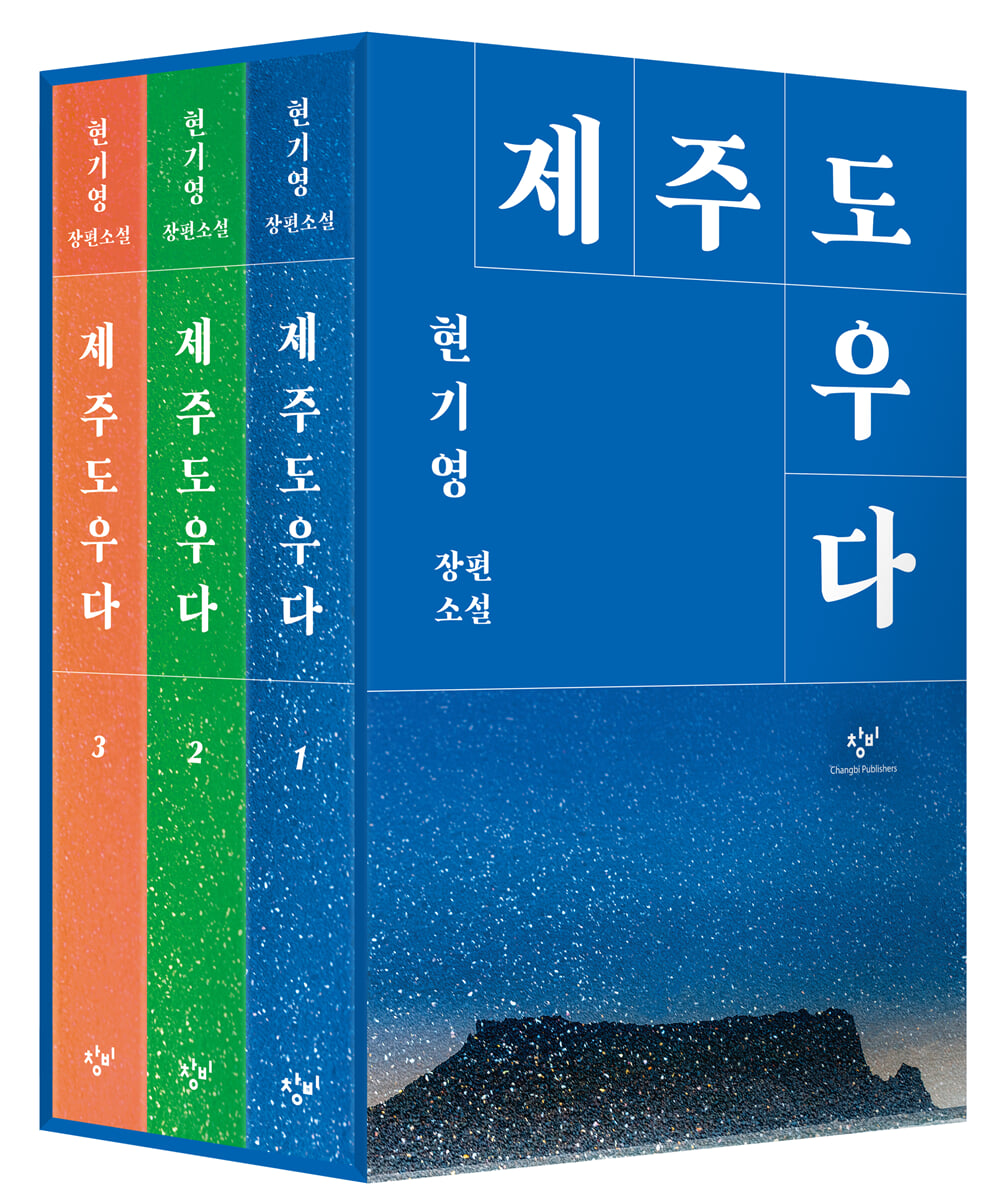
Jeju Island Uda Set
 |
Description
Book Introduction
- A word from MD
-
Uncle Sooni's Jeju April 3rd Historical Novel by Hyun Ki-youngJeju in 1948, a place that had long been kept a secret.
To reach that truth, novelist Hyun Ki-young spent four years writing a 3,500-page epic novel about Jeju's past and history.
A passionate novel that reminds us of the countless Jeju people from the Japanese colonial period to the winter of 1948.
July 7, 2023. Novel/Poetry PD Kim Yu-ri
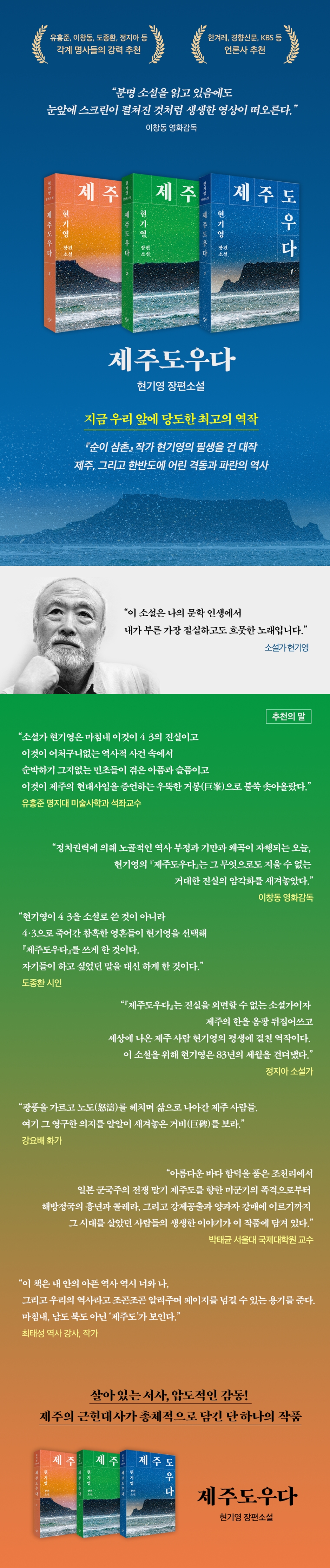
The greatest historical novel ever presented to us
The masterpiece of Hyun Ki-young, author of "Uncle Sooni," who devoted his life to it.
Recommended by Yoo Hong-jun, Lee Chang-dong, Do Jong-hwan, Jeong Ji-ah, Kang Yo-bae, Park Tae-gyun, and Choi Tae-seong!
During the military dictatorship era, when speaking about the April 3rd Incident was taboo, novelist Hyun Ki-young made the Jeju April 3rd tragedy widely known by publishing "Uncle Sooni," which contained the truth about the massacre of innocent civilians.
He presents his life's work, "Jejudouda," which contains the roots of modern history of Jeju and the Korean Peninsula.
A story told to the younger generation through the voice of Ahn Chang-se, a survivor of the April 3rd tragedy, 『Jejudouda』 is a historical novel that comprehensively covers Jeju's modern and contemporary history, from the Japanese colonial period to April 3rd, according to the flow of time, allowing us to look into the origins of the current conflict landscape in Korean society. It shows the historical tragedy with tenacious and powerful writing.
This work, which evokes overwhelming emotion through powerful narrative and vivid characters, depicts the aspirations and frustrations of a liberated space filled with the dream of building a new nation, while also paying tribute to the countless victims driven to their deaths by state violence.
The beauty of Jeju's land, sea, and people shines through the author's signature delicate and smooth prose alongside the unbelievable violence that forces us to question the very nature of humanity.
In this age of conflict and hatred, "Jejudo Uda" will be remembered as a monumental achievement in Korean literature, a historical novel of the highest order, with a serious and alarming message.
The masterpiece of Hyun Ki-young, author of "Uncle Sooni," who devoted his life to it.
Recommended by Yoo Hong-jun, Lee Chang-dong, Do Jong-hwan, Jeong Ji-ah, Kang Yo-bae, Park Tae-gyun, and Choi Tae-seong!
During the military dictatorship era, when speaking about the April 3rd Incident was taboo, novelist Hyun Ki-young made the Jeju April 3rd tragedy widely known by publishing "Uncle Sooni," which contained the truth about the massacre of innocent civilians.
He presents his life's work, "Jejudouda," which contains the roots of modern history of Jeju and the Korean Peninsula.
A story told to the younger generation through the voice of Ahn Chang-se, a survivor of the April 3rd tragedy, 『Jejudouda』 is a historical novel that comprehensively covers Jeju's modern and contemporary history, from the Japanese colonial period to April 3rd, according to the flow of time, allowing us to look into the origins of the current conflict landscape in Korean society. It shows the historical tragedy with tenacious and powerful writing.
This work, which evokes overwhelming emotion through powerful narrative and vivid characters, depicts the aspirations and frustrations of a liberated space filled with the dream of building a new nation, while also paying tribute to the countless victims driven to their deaths by state violence.
The beauty of Jeju's land, sea, and people shines through the author's signature delicate and smooth prose alongside the unbelievable violence that forces us to question the very nature of humanity.
In this age of conflict and hatred, "Jejudo Uda" will be remembered as a monumental achievement in Korean literature, a historical novel of the highest order, with a serious and alarming message.
- You can preview some of the book's contents.
Preview
index
Jeju Island 1
Prologue / Part 1 / Part 2
Jeju Island 2
Part 3 / Part 4
Jeju Island 3
Part 5 / Part 6 / Part 7 / Epilogue / Author's Note
Prologue / Part 1 / Part 2
Jeju Island 2
Part 3 / Part 4
Jeju Island 3
Part 5 / Part 6 / Part 7 / Epilogue / Author's Note
Detailed image
Into the book
Volume 1
“I wanted to be a writer, I wanted to write with this fountain pen, but alas, I wanted to write, but I ended up hitting a wall.
I couldn't write.
First, I realized that I couldn't write anything else without writing about that disaster.
Ah, Youngmi, Changgeun, this old man is alive in body, but his soul is as good as dead.
After that incident, everything seemed like a lie.
Everything is a lie, only that incident is true, and I have to write that story, but it was so scary that I couldn't even think about it... ... Okay, okay, okay, let's talk about it now! Youngmi, Changgeun, I'll give you this fountain pen, so take it.
When Mr. Jeong Du-gil gave me this fountain pen, he probably hoped that I would survive and write about the disaster.
Okay, you guys do it for me, I'll explain in detail.
Okay, let's talk about that! Let's talk about the story that has tormented my heart over the years.
“How I wanted to tell you that story!”
--- pp.24~25
Four or five barges busily came and went from the military barge that was temporarily anchored in the sea outside the port, carrying passengers and cargo.
There were old trunks, sacks, rucksacks, bundles and bedding.
The luggage of the departing young men also contained a handful of soil from their hometown, neatly wrapped in a muslin cloth.
They endured severe seasickness while smelling the earth during their voyage, and even when they were forced to work in a strange and sorrowful foreign land and suffered in prison, they did not throw away a handful of the earth, but kept it in a corner of their room like a talisman in their luggage.
For those who left, the land they must return to someday was their own, and they were a part of that land, a handful of dirt.
--- p.119
Volume 2
Sangok, you keep talking about thoughts, thoughts, but thoughts are something only cool people like you can play.
Do thoughts feed you? Grains aren't grown by thoughts.
Growing crops isn't about grand ideas, it's about the right amount of sunlight, rain, and human hands.
Jangbal is the saint, isn't he?
--- p.163
I like Jangbal's anarchism.
I like the saying, 'We are neither North Korea nor South Korea, we are Jeju Island.'
Last year, right after the 38th parallel was drawn, when Japanese refugees were coming in, MacArthur's headquarters asked them whether they wanted to go to the South or the North.
At that time, our Jeju people answered like this.
'We are neither North nor South Korea, we are Jeju Island!'
--- p.164
Volume 3
After the mass execution, there were some who survived and emerged from the mass corpses.
A young man emerged from the midst of the massacre.
Even though he was shot to confirm the kill after the first kill, he was hit by a bullet and his jaw was shattered, but he barely survived.
He continued to lie in the pile of corpses until night fell and it got dark, so he pushed the corpse lying on top of him and got up.
He was covered in blood, his whole body covered in his own blood and the blood of others.
Where should I go now? Where could I go to survive? This island was surrounded by water, so there was no escape. Even if I climbed back up the mountain, I would die someday. Even if I hid in my house, I would soon be discovered.
The only thing shining in the pitch-black darkness was the lights of the military camp.
He was so shocked that he was out of his mind and walked to the tent at the military camp.
“I survived.
Even if you kill me, I won't die, so kill me again.
“Kill me here, take me to the field and kill me, or kill me again!”
--- p.296
“Yes, when we die, this small cave will become our joint burial site.”
“Ah, yes, a joint tomb!”
“Daerim, let us think of this cave not as our grave, but as the womb of the earth.
We are in the womb of the earth.
“Warm womb! Ah, so warm and cozy!”
As he said that, Doo-gil hugged his knees and pulled them to his chest, curling his body like a fetus in the womb.
“The womb of the earth! What a wonderful word.
“As expected, poets are different.”
“We die, but we will be reborn.
Because the womb of the earth conceives new life in death.
Everything burned and everyone died, but Mother Earth embraced her dead children.
I can hear the sound of the veins in the ground pulsating in my ears now.
The earth is accepting dead children into its womb.
The earth accepts all the blood, gunshots, screams, and flesh stuck on spears and iron bars.
Ah, and finally, from that womb new life will spring forth and flourish upon the earth again.”
“I wanted to be a writer, I wanted to write with this fountain pen, but alas, I wanted to write, but I ended up hitting a wall.
I couldn't write.
First, I realized that I couldn't write anything else without writing about that disaster.
Ah, Youngmi, Changgeun, this old man is alive in body, but his soul is as good as dead.
After that incident, everything seemed like a lie.
Everything is a lie, only that incident is true, and I have to write that story, but it was so scary that I couldn't even think about it... ... Okay, okay, okay, let's talk about it now! Youngmi, Changgeun, I'll give you this fountain pen, so take it.
When Mr. Jeong Du-gil gave me this fountain pen, he probably hoped that I would survive and write about the disaster.
Okay, you guys do it for me, I'll explain in detail.
Okay, let's talk about that! Let's talk about the story that has tormented my heart over the years.
“How I wanted to tell you that story!”
--- pp.24~25
Four or five barges busily came and went from the military barge that was temporarily anchored in the sea outside the port, carrying passengers and cargo.
There were old trunks, sacks, rucksacks, bundles and bedding.
The luggage of the departing young men also contained a handful of soil from their hometown, neatly wrapped in a muslin cloth.
They endured severe seasickness while smelling the earth during their voyage, and even when they were forced to work in a strange and sorrowful foreign land and suffered in prison, they did not throw away a handful of the earth, but kept it in a corner of their room like a talisman in their luggage.
For those who left, the land they must return to someday was their own, and they were a part of that land, a handful of dirt.
--- p.119
Volume 2
Sangok, you keep talking about thoughts, thoughts, but thoughts are something only cool people like you can play.
Do thoughts feed you? Grains aren't grown by thoughts.
Growing crops isn't about grand ideas, it's about the right amount of sunlight, rain, and human hands.
Jangbal is the saint, isn't he?
--- p.163
I like Jangbal's anarchism.
I like the saying, 'We are neither North Korea nor South Korea, we are Jeju Island.'
Last year, right after the 38th parallel was drawn, when Japanese refugees were coming in, MacArthur's headquarters asked them whether they wanted to go to the South or the North.
At that time, our Jeju people answered like this.
'We are neither North nor South Korea, we are Jeju Island!'
--- p.164
Volume 3
After the mass execution, there were some who survived and emerged from the mass corpses.
A young man emerged from the midst of the massacre.
Even though he was shot to confirm the kill after the first kill, he was hit by a bullet and his jaw was shattered, but he barely survived.
He continued to lie in the pile of corpses until night fell and it got dark, so he pushed the corpse lying on top of him and got up.
He was covered in blood, his whole body covered in his own blood and the blood of others.
Where should I go now? Where could I go to survive? This island was surrounded by water, so there was no escape. Even if I climbed back up the mountain, I would die someday. Even if I hid in my house, I would soon be discovered.
The only thing shining in the pitch-black darkness was the lights of the military camp.
He was so shocked that he was out of his mind and walked to the tent at the military camp.
“I survived.
Even if you kill me, I won't die, so kill me again.
“Kill me here, take me to the field and kill me, or kill me again!”
--- p.296
“Yes, when we die, this small cave will become our joint burial site.”
“Ah, yes, a joint tomb!”
“Daerim, let us think of this cave not as our grave, but as the womb of the earth.
We are in the womb of the earth.
“Warm womb! Ah, so warm and cozy!”
As he said that, Doo-gil hugged his knees and pulled them to his chest, curling his body like a fetus in the womb.
“The womb of the earth! What a wonderful word.
“As expected, poets are different.”
“We die, but we will be reborn.
Because the womb of the earth conceives new life in death.
Everything burned and everyone died, but Mother Earth embraced her dead children.
I can hear the sound of the veins in the ground pulsating in my ears now.
The earth is accepting dead children into its womb.
The earth accepts all the blood, gunshots, screams, and flesh stuck on spears and iron bars.
Ah, and finally, from that womb new life will spring forth and flourish upon the earth again.”
--- p.351
Publisher's Review
Jeju and the Korean Peninsula's turbulent and turbulent history
『Jejudouda』 is a story that mainly covers the period from 1943, when Japanese oppression reached its peak after the outbreak of the Pacific War, to the winter of 1948, when the April 3 Incident occurred and the suppression took place. Its main setting is Jochon-ri, a coastal village in Jeju that has earned the nickname of "rebel village" for its fierce resistance to the ruling powers of the mainland throughout history.
The five years in which the eleven-year-old boy An Chang-se turned sixteen were the most turbulent period in modern Korean history. The people of Jochon-ri fought against Japanese exploitation during the Japanese colonial period, and after liberation, against the plot to establish an independent government and the tyranny of the US military government.
In the fight between individuals against the system and power, the outcome was clear.
"Jejudouda" does not just focus on the outcome, but also tells the story of those who had no choice but to act that way.
It gives the image of a writhing human being, something that cannot be captured in the clichés of brutal massacre and horrific tragedy.
Although some of the events and facts appearing in "Jejudo Uda" are well-known, the novel reaches out to the living hand of human beings beyond the familiar facts.
People who toiled diligently day after day, and in the evenings gathered with their neighborhood friends to drink and chat about trivial things; haenyeo (female divers) who endured the hardships of life and material life without losing their spirit; teuri (traditional Korean women) who herded horses in the wind-swaying meadows, humming songs… … These were also people who breathed discrimination and oppression as if it were air, suffered from forced labor, were whipped for no reason, and hid under the floors to avoid arrest and torture.
For them, resistance against Japan was as natural as their own body.
When liberation was suddenly declared one day, amidst rumors of Japan's downfall, they had no idea what kind of history they would face later.
What exactly is ‘liberation’? (…) First of all, the heavy burden that weighed down my back every time I went to school was gone.
I was so surprised and happy that the weight of the five sheets of paper had disappeared.
Pressure and liberation! The weight that had been weighing down his entire body and back was pressure, and now, with it gone, his body and mind felt light and free, as if they could fly away. Perhaps this was liberation, thought Genesis. (Volume 1, p. 233)
A burning desire and frustration for a better world
Although it is in the form of a memoir of creation by an old man, it is the youth of the liberated era who drive the events in 『Jeju Island』.
Although he has a simple understanding of various ideological tendencies, such as anarchism, communism, democracy, and right-wing nationalism, his yearning for an independent new country and a better world burns with a burning passion.
For them, the liberation period was a time when they realized that the United States, which they had welcomed as a “good country” that had defeated Japan, was “not a liberator but a troublemaker” (vol. 2, p. 162), and they accepted entering the mountain “as if it were a supreme order” (vol. 3, p. 76), unable to endure the unimaginable torture, violence, and death.
They only have fear and anger about violence, and barely have guns, only spears. Even when the 4/3 signal fire goes off and they attack the police station, they do not know how to fight.
These mountain units “underwent fierce guerrilla training to overcome their immaturity” (Volume 3, page 85), but after the establishment of the independent government, the indiscriminate arrests and torture became more brutal, and public sentiment turned against them, and support from the villages was cut off, leading to their isolation.
In the cold and hunger, they “each decides, each fights, each dies” (Volume 3, p. 120).
He chooses to stay with his friend in the cave and starve to death, or close the eyes of his friend who was killed by the punitive force's bullets and then descend.
Those who survived say:
“We didn’t think we were alive back then.
“There was no escape to heaven, and no escape to earth.” (Volume 1, page 17)
『Jejudouda』 describes their fight and lists the violence of the punitive force alongside it.
This record of violence, based on diverse testimonies and reports, is expressed in words, yet transcends human language.
This tragedy, first evoked by author Hyun Ki-young in 1978's "Uncle Sooni," is contained in dry sentences in "Jeju Island," which continues for several pages, making us ponder the powerlessness and cruelty of human beings while also making us think about the strength to endure and survive.
A rare touch of compassion, found in a scene of maddening slaughter, gives us our last hope.
Free-spirited, unconventional, sentences written by nature
On the one hand, Jeju's nature and customs are incomparably warm and beautiful amidst the endless violence.
When Chang-se, who is good at running, runs along the beach with his delivery backpack on his back, the endless sky and sea, and the scenery of plump boats on the white waves seem close enough to touch, and the meadow where his maternal uncle Yang San-do walks with a herd of horses, making the sound of “Eoreoryeo-ryeoheo Heo-reoreo” seem to be the smell of grass that is now on the tip of his nose.
The lively laughter of the female divers gathering around the fire pit to warm their bodies after finishing their work is vivid.
The descriptions of Jeju's land, sea, and people, which can be encountered throughout the novel, display a classical quality of prose that is difficult to find in recent Korean literature, and make one feel the author's deep affection for them.
To comprehensively portray nature, people, and turbulent history, 『Jejudouda』 uses all genres of writing to create a groundbreaking narrative.
The legends and tales cited here and there tell the history of Jeju and the character of the people raised by the land and sea of Jeju with the fun of old tales.
In addition, he freely utilizes poetry, plays, pansori editorials, shamans' laments, newspaper articles, proclamations, slogans, work songs, popular songs, and lyrics of protest songs to convey a sense of reality in each passage.
The sentences that flow like water, with the end of the previous sentence becoming the beginning of the next, show the power of a vivid story.
At that time and place, people worked, sang, loved, shouted and fought.
They come before us today.
Author Hyun Ki-young, who calls himself “a shaman who consoles the spirits of the Jeju April 3 Incident.”
This towering milestone he has set on his literary journey, which marks 50 years since his debut, is in itself a grand memorial service.
This work will leave a huge mark not only on the history of Korean literature but also on modern Korean history.
With this, we must now talk about the Jeju April 3 Incident more confidently.
『Jejudouda』 is a story that mainly covers the period from 1943, when Japanese oppression reached its peak after the outbreak of the Pacific War, to the winter of 1948, when the April 3 Incident occurred and the suppression took place. Its main setting is Jochon-ri, a coastal village in Jeju that has earned the nickname of "rebel village" for its fierce resistance to the ruling powers of the mainland throughout history.
The five years in which the eleven-year-old boy An Chang-se turned sixteen were the most turbulent period in modern Korean history. The people of Jochon-ri fought against Japanese exploitation during the Japanese colonial period, and after liberation, against the plot to establish an independent government and the tyranny of the US military government.
In the fight between individuals against the system and power, the outcome was clear.
"Jejudouda" does not just focus on the outcome, but also tells the story of those who had no choice but to act that way.
It gives the image of a writhing human being, something that cannot be captured in the clichés of brutal massacre and horrific tragedy.
Although some of the events and facts appearing in "Jejudo Uda" are well-known, the novel reaches out to the living hand of human beings beyond the familiar facts.
People who toiled diligently day after day, and in the evenings gathered with their neighborhood friends to drink and chat about trivial things; haenyeo (female divers) who endured the hardships of life and material life without losing their spirit; teuri (traditional Korean women) who herded horses in the wind-swaying meadows, humming songs… … These were also people who breathed discrimination and oppression as if it were air, suffered from forced labor, were whipped for no reason, and hid under the floors to avoid arrest and torture.
For them, resistance against Japan was as natural as their own body.
When liberation was suddenly declared one day, amidst rumors of Japan's downfall, they had no idea what kind of history they would face later.
What exactly is ‘liberation’? (…) First of all, the heavy burden that weighed down my back every time I went to school was gone.
I was so surprised and happy that the weight of the five sheets of paper had disappeared.
Pressure and liberation! The weight that had been weighing down his entire body and back was pressure, and now, with it gone, his body and mind felt light and free, as if they could fly away. Perhaps this was liberation, thought Genesis. (Volume 1, p. 233)
A burning desire and frustration for a better world
Although it is in the form of a memoir of creation by an old man, it is the youth of the liberated era who drive the events in 『Jeju Island』.
Although he has a simple understanding of various ideological tendencies, such as anarchism, communism, democracy, and right-wing nationalism, his yearning for an independent new country and a better world burns with a burning passion.
For them, the liberation period was a time when they realized that the United States, which they had welcomed as a “good country” that had defeated Japan, was “not a liberator but a troublemaker” (vol. 2, p. 162), and they accepted entering the mountain “as if it were a supreme order” (vol. 3, p. 76), unable to endure the unimaginable torture, violence, and death.
They only have fear and anger about violence, and barely have guns, only spears. Even when the 4/3 signal fire goes off and they attack the police station, they do not know how to fight.
These mountain units “underwent fierce guerrilla training to overcome their immaturity” (Volume 3, page 85), but after the establishment of the independent government, the indiscriminate arrests and torture became more brutal, and public sentiment turned against them, and support from the villages was cut off, leading to their isolation.
In the cold and hunger, they “each decides, each fights, each dies” (Volume 3, p. 120).
He chooses to stay with his friend in the cave and starve to death, or close the eyes of his friend who was killed by the punitive force's bullets and then descend.
Those who survived say:
“We didn’t think we were alive back then.
“There was no escape to heaven, and no escape to earth.” (Volume 1, page 17)
『Jejudouda』 describes their fight and lists the violence of the punitive force alongside it.
This record of violence, based on diverse testimonies and reports, is expressed in words, yet transcends human language.
This tragedy, first evoked by author Hyun Ki-young in 1978's "Uncle Sooni," is contained in dry sentences in "Jeju Island," which continues for several pages, making us ponder the powerlessness and cruelty of human beings while also making us think about the strength to endure and survive.
A rare touch of compassion, found in a scene of maddening slaughter, gives us our last hope.
Free-spirited, unconventional, sentences written by nature
On the one hand, Jeju's nature and customs are incomparably warm and beautiful amidst the endless violence.
When Chang-se, who is good at running, runs along the beach with his delivery backpack on his back, the endless sky and sea, and the scenery of plump boats on the white waves seem close enough to touch, and the meadow where his maternal uncle Yang San-do walks with a herd of horses, making the sound of “Eoreoryeo-ryeoheo Heo-reoreo” seem to be the smell of grass that is now on the tip of his nose.
The lively laughter of the female divers gathering around the fire pit to warm their bodies after finishing their work is vivid.
The descriptions of Jeju's land, sea, and people, which can be encountered throughout the novel, display a classical quality of prose that is difficult to find in recent Korean literature, and make one feel the author's deep affection for them.
To comprehensively portray nature, people, and turbulent history, 『Jejudouda』 uses all genres of writing to create a groundbreaking narrative.
The legends and tales cited here and there tell the history of Jeju and the character of the people raised by the land and sea of Jeju with the fun of old tales.
In addition, he freely utilizes poetry, plays, pansori editorials, shamans' laments, newspaper articles, proclamations, slogans, work songs, popular songs, and lyrics of protest songs to convey a sense of reality in each passage.
The sentences that flow like water, with the end of the previous sentence becoming the beginning of the next, show the power of a vivid story.
At that time and place, people worked, sang, loved, shouted and fought.
They come before us today.
Author Hyun Ki-young, who calls himself “a shaman who consoles the spirits of the Jeju April 3 Incident.”
This towering milestone he has set on his literary journey, which marks 50 years since his debut, is in itself a grand memorial service.
This work will leave a huge mark not only on the history of Korean literature but also on modern Korean history.
With this, we must now talk about the Jeju April 3 Incident more confidently.
GOODS SPECIFICS
- Date of issue: July 3, 2023
- Page count, weight, size: 1,104 pages | 128*188*80mm
- ISBN13: 9788936439194
- ISBN10: 8936439197
You may also like
카테고리
korean


korean

![GQ KOREA Mark (Monthly): December [2025]](http://librairie.coreenne.fr/cdn/shop/files/8ef265dbbfbf186523ed75ba7319009d.jpg?v=1765340328&width=3840)


