

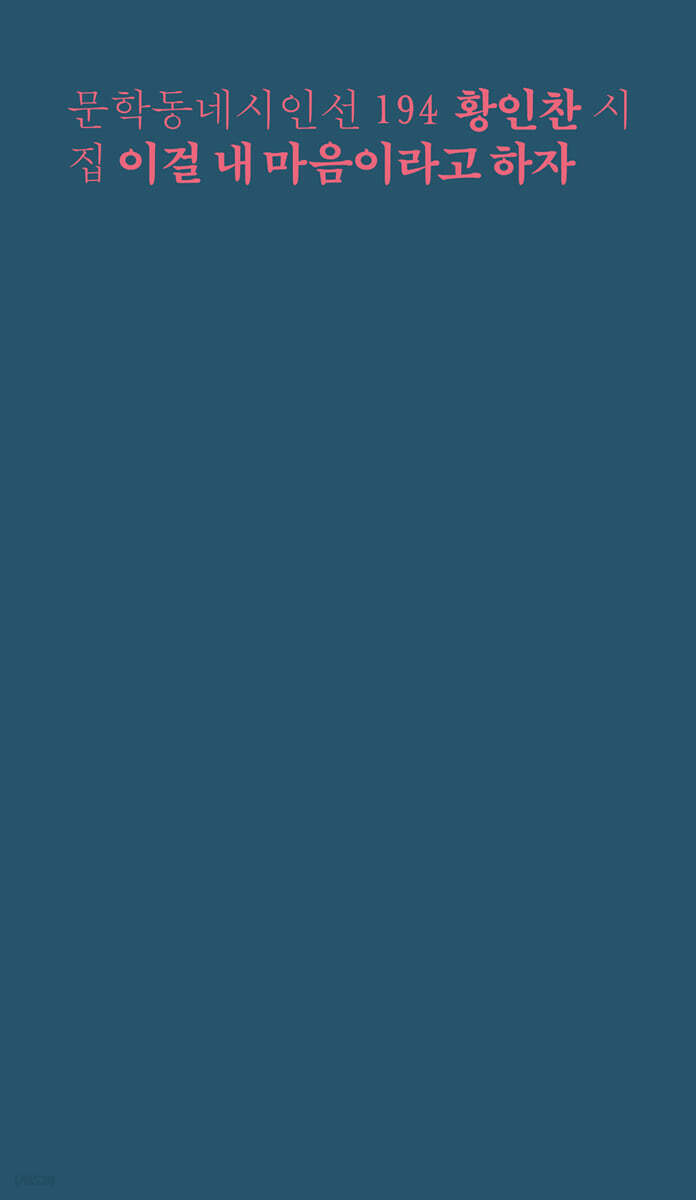
Let's call this my heart
 |
Description
Book Introduction
- A word from MD
-
“The Secret That Will Never Be Unraveled”, About LoveA new poetry collection by poet Hwang In-chan, who has received much love through works such as “Heeji’s World” and “Repetition for Love.”
The world of lyricism, shining and beautiful, that only a poet can show, is portrayed more broadly.
Through his poetry, which shines even brighter in the dark absurdity, we hope to call out to hearts that have previously gone undiscovered.
June 9, 2023. Novel/Poetry PD Kim Yu-ri
“Life and love continue so baselessly.”
Minds that come from being named
A love that persists without foundation even in an unreasonable world
A new lyric named Hwang In-chan
Includes the 66th Contemporary Literature Award winner, "Image Photograph"
Hwang In-chan, who presented a new language to the Korean poetry world with his first poetry collection, “Washing the Old Crowned Crane,” which won the Kim Su-yeong Literary Award and was praised as “a rare poet with a methodology that erases various artistic methodologies” (Kim Haeng-sook).
Afterwards, Hwang In-chan, who became a representative voice of Korean poetry with a sensibility unlike anyone else through works such as “Heeji’s World” and “Repetition for Love,” has published a new poetry collection titled “Let’s Call This My Heart” by Munhakdongne.
It contains 64 poems, including the Modern Literature Award-winning "Image Photograph," which shines with such an outstanding sensibility that it elicited the comment, "All the poems are so wonderful that it makes you think they're crazy" (Hwang In-sook).
Hwang In-chan, who transforms everyday material into poetry in his own way, writes poetry by not hastily saying that he knows the objects or events around us, nor does he make quick conclusions, but rather carefully (attempting to) name the unknown things one by one.
Instead of saying, “This is my heart,” he says, “Let’s call this my heart” (“Let’s call this my heart”).
Instead of saying, “It’s love,” he says, “I don’t think you can call it love/ But I guess it can’t be” (“None of the Evenings”).
Maybe that's why.
Hwang In-chan's poetry, filled with the language of light, is imbued with a paradoxical beauty that is not merely obvious but also beautiful.
His poetry, as critic Jeon Seung-min said, can be said to be “a ‘new lyric poetry’ in which the poet’s meta-consciousness and representation, which in fact expose the lyricism it contains, are infiltrated” (in the commentary).
We, the readers of the poem, will often be confused as we look at the world depicted by Hwang In-chan.
Just like the poet who said, “Even when I look up at the sky without thinking and am surprised by its beauty, I keep thinking, ‘What was that summer like?’” (from “Inhwa”), we too keep thinking about the beauty we feel in his poetry and what his feelings must have been like.
Minds that come from being named
A love that persists without foundation even in an unreasonable world
A new lyric named Hwang In-chan
Includes the 66th Contemporary Literature Award winner, "Image Photograph"
Hwang In-chan, who presented a new language to the Korean poetry world with his first poetry collection, “Washing the Old Crowned Crane,” which won the Kim Su-yeong Literary Award and was praised as “a rare poet with a methodology that erases various artistic methodologies” (Kim Haeng-sook).
Afterwards, Hwang In-chan, who became a representative voice of Korean poetry with a sensibility unlike anyone else through works such as “Heeji’s World” and “Repetition for Love,” has published a new poetry collection titled “Let’s Call This My Heart” by Munhakdongne.
It contains 64 poems, including the Modern Literature Award-winning "Image Photograph," which shines with such an outstanding sensibility that it elicited the comment, "All the poems are so wonderful that it makes you think they're crazy" (Hwang In-sook).
Hwang In-chan, who transforms everyday material into poetry in his own way, writes poetry by not hastily saying that he knows the objects or events around us, nor does he make quick conclusions, but rather carefully (attempting to) name the unknown things one by one.
Instead of saying, “This is my heart,” he says, “Let’s call this my heart” (“Let’s call this my heart”).
Instead of saying, “It’s love,” he says, “I don’t think you can call it love/ But I guess it can’t be” (“None of the Evenings”).
Maybe that's why.
Hwang In-chan's poetry, filled with the language of light, is imbued with a paradoxical beauty that is not merely obvious but also beautiful.
His poetry, as critic Jeon Seung-min said, can be said to be “a ‘new lyric poetry’ in which the poet’s meta-consciousness and representation, which in fact expose the lyricism it contains, are infiltrated” (in the commentary).
We, the readers of the poem, will often be confused as we look at the world depicted by Hwang In-chan.
Just like the poet who said, “Even when I look up at the sky without thinking and am surprised by its beauty, I keep thinking, ‘What was that summer like?’” (from “Inhwa”), we too keep thinking about the beauty we feel in his poetry and what his feelings must have been like.
- You can preview some of the book's contents.
Preview
index
Poet's words
Part 1 I tell you this
I'm telling you this / I didn't go to school / Left is the window, right is the door / Bright room / Image photo / Save that year / Human joy / Heart / Dictation / Everyone who knows knows / Death drop / No spirit / Empty like a white boat / Wood pigeon / The quiet customs are zero / Inhwa / Roses without snow / Confucius's winter mountain / Even if I give up singing / Borrowing the future
Part 2: The Loss of Your Soul
Legend of the Warrior of Light / The physical impossibility of death in the heart of the living / The disappearance of your soul / Invention / Control and conquest / In search of the lost spirit / Darkness / The turning point of the cosmic century / Half of spring / Gae-wan / Sedimentary coast / Hope is German, but Hope House is Korean / Who watches the watcher / Look at the birds of the air, they neither sow nor reap / Demolition scaffolding / Gold and silver / Dwarfing / History is made at night / Hatred / Ha-hae / I went to the art museum / Relay / The dream of my grandmother / Let's call this my heart
Part 3 Your darkness tilts in the opposite direction of your existence.
In search of lost time/ The man in trousers leaves wearing trousers/ The wall/ Left the park/ Winter light/ Under the cloudy white light, we are for a moment/ The nine-year-old Buddha/ The clear view index/ A movie with a public opinion/ The poetry of autonomous driving/ The coat is wool, the shoes are leather/ There is no bowl/ Everything I know/ The evening that is gone/ Restore/ Become one through faith/ In search of the lost angel/ In search of the lost bicycle/ Slow love/ Where is my friend's house?
Commentary | Let's Call This My Eternity | Jeon Seung-min (Literary Critic)
Part 1 I tell you this
I'm telling you this / I didn't go to school / Left is the window, right is the door / Bright room / Image photo / Save that year / Human joy / Heart / Dictation / Everyone who knows knows / Death drop / No spirit / Empty like a white boat / Wood pigeon / The quiet customs are zero / Inhwa / Roses without snow / Confucius's winter mountain / Even if I give up singing / Borrowing the future
Part 2: The Loss of Your Soul
Legend of the Warrior of Light / The physical impossibility of death in the heart of the living / The disappearance of your soul / Invention / Control and conquest / In search of the lost spirit / Darkness / The turning point of the cosmic century / Half of spring / Gae-wan / Sedimentary coast / Hope is German, but Hope House is Korean / Who watches the watcher / Look at the birds of the air, they neither sow nor reap / Demolition scaffolding / Gold and silver / Dwarfing / History is made at night / Hatred / Ha-hae / I went to the art museum / Relay / The dream of my grandmother / Let's call this my heart
Part 3 Your darkness tilts in the opposite direction of your existence.
In search of lost time/ The man in trousers leaves wearing trousers/ The wall/ Left the park/ Winter light/ Under the cloudy white light, we are for a moment/ The nine-year-old Buddha/ The clear view index/ A movie with a public opinion/ The poetry of autonomous driving/ The coat is wool, the shoes are leather/ There is no bowl/ Everything I know/ The evening that is gone/ Restore/ Become one through faith/ In search of the lost angel/ In search of the lost bicycle/ Slow love/ Where is my friend's house?
Commentary | Let's Call This My Eternity | Jeon Seung-min (Literary Critic)
Into the book
There is a shadow that sways alone
There are people who cry all night watching it
You can't call that love
But it's not like I can't do it
---From "The Missing Evening"
Love each other
And some people are just a little lonely and still are
There are also folk music in the non-human world.
Surprisingly, no one has changed
I felt relieved when I thought about it that way.
---From "Invention"
When I opened my eyes, I saw a familiar ceiling, when I opened my eyes, I was going to a distant house alone, when I opened my eyes, I was dreaming of someone trapped in a dream that repeated itself forever.
But I have nowhere to put my mind
I didn't have any intention to begin with
When I opened my eyes, a rabbit was scratching its head, thinking it was a rabbit.
Okay, let's call this my heart.
---From "Let's Call This My Heart"
What if I suddenly feel grateful for everything when I return home?
What should I do if a stranger comes out of my room, pats my back, and says he loves me, and I think I love him too?
---From "A man who wears pants leaves wearing pants"
From then on, our lives continued, embracing a little secret that would never be revealed.
Even at the end of endless thoughts before falling asleep
Even when I look up at the sky without thinking, I am surprised at how beautiful it is.
I keep thinking about what that summer was like
Our lives end abruptly, like fireflies flickering on and off on a summer night.
---From "Inhwa"
An ordinary weekend afternoon
In one corner of the living room, my beloved dog lay down, waiting for its food.
Mom, why is he here? Was this all a dream?
When I asked that,
There was no one in the house, only the dog lying down.
It's snowing outside.
I fed the dog and petted it for a long time.
There are people who cry all night watching it
You can't call that love
But it's not like I can't do it
---From "The Missing Evening"
Love each other
And some people are just a little lonely and still are
There are also folk music in the non-human world.
Surprisingly, no one has changed
I felt relieved when I thought about it that way.
---From "Invention"
When I opened my eyes, I saw a familiar ceiling, when I opened my eyes, I was going to a distant house alone, when I opened my eyes, I was dreaming of someone trapped in a dream that repeated itself forever.
But I have nowhere to put my mind
I didn't have any intention to begin with
When I opened my eyes, a rabbit was scratching its head, thinking it was a rabbit.
Okay, let's call this my heart.
---From "Let's Call This My Heart"
What if I suddenly feel grateful for everything when I return home?
What should I do if a stranger comes out of my room, pats my back, and says he loves me, and I think I love him too?
---From "A man who wears pants leaves wearing pants"
From then on, our lives continued, embracing a little secret that would never be revealed.
Even at the end of endless thoughts before falling asleep
Even when I look up at the sky without thinking, I am surprised at how beautiful it is.
I keep thinking about what that summer was like
Our lives end abruptly, like fireflies flickering on and off on a summer night.
---From "Inhwa"
An ordinary weekend afternoon
In one corner of the living room, my beloved dog lay down, waiting for its food.
Mom, why is he here? Was this all a dream?
When I asked that,
There was no one in the house, only the dog lying down.
It's snowing outside.
I fed the dog and petted it for a long time.
---From "Sedimentary Coast"
Publisher's Review
Hwang In-chan, who presented a new language to the Korean poetry world with his first poetry collection, “Washing the Old Crowned Crane,” which won the Kim Su-yeong Literary Award and was praised as “a rare poet with a methodology that erases various artistic methodologies” (Kim Haeng-sook).
Afterwards, Hwang In-chan, who became a representative voice of Korean poetry with a sensibility unlike anyone else through works such as “Heeji’s World” and “Repetition for Love,” has published a new poetry collection titled “Let’s Call This My Heart” by Munhakdongne.
It contains 64 poems, including the Modern Literature Award-winning "Image Photograph," which shines with such an outstanding sensibility that it elicited the comment, "All the poems are so wonderful that it makes you think they're crazy" (Hwang In-sook).
Hwang In-chan, who transforms everyday material into poetry in his own way, writes poetry by not hastily saying that he knows the objects or events around us, nor does he make quick conclusions, but rather carefully (attempting to) name the unknown things one by one.
Instead of saying, “This is my heart,” he says, “Let’s call this my heart” (“Let’s call this my heart”).
Instead of saying, “It’s love,” he says, “I don’t think you can call it love/ But I guess it can’t be” (“None of the Evenings”).
Maybe that's why.
Hwang In-chan's poetry, filled with the language of light, is imbued with a paradoxical beauty that is not merely obvious but also beautiful.
His poetry, as critic Jeon Seung-min said, can be said to be “a ‘new lyric poetry’ in which the poet’s meta-consciousness and representation, which in fact expose the lyricism it contains, are infiltrated” (in the commentary).
We, the readers of the poem, will often be confused as we look at the world depicted by Hwang In-chan.
Just like the poet who said, “Even when I look up at the sky without thinking and am surprised by its beauty, I keep thinking, ‘What was that summer like?’” (from “Inhwa”), we too keep thinking about the beauty we feel in his poetry and what his feelings must have been like.
Images that remain fixed in the photograph and repeat forever in the memory, thinking that I love you, loving you, thinking that it is too good, liking you so much
One day, when I was talking to someone about the scenery of Namdo, I thought it was really nice and very impressive.
At the moment when I speak
Beauty is created
_From "Everyone Who Knows Knows"
Perhaps, for Hwang In-chan, writing poetry is ultimately about naming things in a larger sense.
The act of observing phenomena and objects and giving them names in the language of poetry.
For him, the world is not a place to be interpreted, but a place to be recognized, a place to be named.
So he says that it is not something that “comes to mind” but something that is “created” “at the moment of speaking.”
Through such re-recognition, our experiences are recreated as entities.
Images of light and photography frequently appear in his poetry, and they also seem to be related to such a re-recognition.
In his poetry, most of the brilliant things such as light, green, summer, and joy exist in the past.
And it inevitably brings about nostalgia in us.
Let's look at the first poem that opens this collection, "I Tell You These Words."
This short poem, which begins with the line “Let’s talk about the rest tomorrow/ See you at school,” foreshadows the sentiment of the entire collection.
In his poetry, 'school' exists primarily as time, not space, so through the word 'school' he summons us to a time before 'tomorrow' in the past that we all share.
We have probably uttered the full text of this poem at least once, perhaps countless times, and so we are helplessly sucked into that time.
However, as we read the poetry collection, we realize that in Hwang In-chan's poetry, school is not just a space of nostalgia wrapped in a hazy light, but a space where both joy and pain exist.
However, instead of depicting such a space as it is, the poet re-examines the space where violence and love coexist in his own way through a series of poems set in a school.
Through the effort of transition felt in parts such as “There is no reality in your poetry/ You are not in reality// All I see outside the window is white light/ But I already know that there is nothing more than that” (“Left is the window, right is the door”), ‘violence (and) love’ is realized closer to ‘violence (and) love’.
So why do poets re-embody reality instead of portraying it as it is?
Perhaps it was not his individual will, but rather the need to be there.
This can be inferred from the fact that the subject of his re-recognition work expands from school to the world.
In Hwang In-chan's poetry, the speaker's experiences are re-recognized in various ways, and through this process, what is mainly realized are joy, love, and beauty.
His re-recognition might be called an 'active resignation' to love a world that is not kind to humans.
In that case, the speaker's words, "Let's call this my heart" or "But I guess it can't be helped" become a kind of commitment to joy, love, and beauty.
We love not because the world is beautiful, but because we cannot help but love it, or because we have decided to love it.
A commitment to actively name the world you belong to in your own way.
Perhaps that is why we read poetry, why we read Hwang In-chan's poetry.
To re-perceive and embody the world we face in our own way, not as it appears.
And to look at the world through the filter of Hwang In-chan, who finds lyricism not in beautiful things, but in the absurdity of the world.
The poet titled this collection of poems, “Let’s Call This My Heart,” thereby expressing his own feelings in the poem.
Couldn't picking up this poetry collection be considered a kind of commitment?
And through such commitments, our world is remade.
◎ Mini-interview with poet Hwang In-chan
Q1.
hello.
"Let's Call This My Heart" is a regular(?) poetry collection published four years after "Repetition for Love."
I'm curious about your thoughts on publishing this poetry collection.
Publishing a book of poetry is always a little embarrassing and awkward.
It's the same this time too.
This collection of poems feels more embarrassing and awkward than my previous ones.
Maybe it's because I've been so busy these past four years.
In the meantime, we have gone through a pandemic and experienced some sad things.
Perhaps the feeling of wanting to say "we" instead of "I" here is what I want to convey most about this question.
Q2.
This may be a bit of a strange question, but I feel like asking the poet.
How do you write poetry?
I think that writing poetry is like thinking you know how to write poetry until you start writing it, but as you start writing it, you forget everything you knew.
So, instead of talking about the process of writing poetry, I can only tell you how poetry begins.
My poetry writing begins with writing down in a notebook words that I hear without thinking or words that suddenly come to mind.
It seems like one word brings back the next sentence, then a certain scene, and then I enter a state where I can write a poem.
And when you think you can't go any further, that's when the writing ends.
Q3.
I think each reader will feel slightly different emotions while reading this collection of poems, but I felt a certain longing, a gentle anger, affection, and resignation.
This may be a question related to the title and a bit personal, but what is the most important emotion that makes up the natural person Hwang In-chan?
In fact, I can only say that I don't really know my own mind.
So, perhaps that's why I ended up publishing a poetry collection with this title? I think it's my mind that constantly oscillates between excessive doubt and excessive self-confidence.
Whatever I see, I try to be suspicious first, and at the same time, that suspicion leads to excessive confidence, and as time passes, I start to doubt it again, and this cycle continues.
I don't know if this is because I don't really know my own mind.
So at some point, I can't help but make up my mind.
Q4.
If there is a poem in this collection that you particularly cherish or would like to add to, please let us know.
I don't like my own poetry very much, but I'm less ashamed of my recent poems.
The last poems I wrote in this collection are “Dwarfing” and “A Movie with Axioms.”
5.
Finally, please give a few words of greeting to the readers of this poetry collection.
I often don't know my own mind.
So sometimes I think, let's just be happy today, and sometimes I think, let's just stay like that, not knowing.
These days, I think this idea is important.
I'm really curious to see how you all will read this collection of poems.
But no matter how you read it, it's up to you, so I hope you just read it comfortably.
■ Poet's Note
(The plum you were going to eat
You ate)
(That's how the story begins)
June 2023
Hwang In-chan
Afterwards, Hwang In-chan, who became a representative voice of Korean poetry with a sensibility unlike anyone else through works such as “Heeji’s World” and “Repetition for Love,” has published a new poetry collection titled “Let’s Call This My Heart” by Munhakdongne.
It contains 64 poems, including the Modern Literature Award-winning "Image Photograph," which shines with such an outstanding sensibility that it elicited the comment, "All the poems are so wonderful that it makes you think they're crazy" (Hwang In-sook).
Hwang In-chan, who transforms everyday material into poetry in his own way, writes poetry by not hastily saying that he knows the objects or events around us, nor does he make quick conclusions, but rather carefully (attempting to) name the unknown things one by one.
Instead of saying, “This is my heart,” he says, “Let’s call this my heart” (“Let’s call this my heart”).
Instead of saying, “It’s love,” he says, “I don’t think you can call it love/ But I guess it can’t be” (“None of the Evenings”).
Maybe that's why.
Hwang In-chan's poetry, filled with the language of light, is imbued with a paradoxical beauty that is not merely obvious but also beautiful.
His poetry, as critic Jeon Seung-min said, can be said to be “a ‘new lyric poetry’ in which the poet’s meta-consciousness and representation, which in fact expose the lyricism it contains, are infiltrated” (in the commentary).
We, the readers of the poem, will often be confused as we look at the world depicted by Hwang In-chan.
Just like the poet who said, “Even when I look up at the sky without thinking and am surprised by its beauty, I keep thinking, ‘What was that summer like?’” (from “Inhwa”), we too keep thinking about the beauty we feel in his poetry and what his feelings must have been like.
Images that remain fixed in the photograph and repeat forever in the memory, thinking that I love you, loving you, thinking that it is too good, liking you so much
One day, when I was talking to someone about the scenery of Namdo, I thought it was really nice and very impressive.
At the moment when I speak
Beauty is created
_From "Everyone Who Knows Knows"
Perhaps, for Hwang In-chan, writing poetry is ultimately about naming things in a larger sense.
The act of observing phenomena and objects and giving them names in the language of poetry.
For him, the world is not a place to be interpreted, but a place to be recognized, a place to be named.
So he says that it is not something that “comes to mind” but something that is “created” “at the moment of speaking.”
Through such re-recognition, our experiences are recreated as entities.
Images of light and photography frequently appear in his poetry, and they also seem to be related to such a re-recognition.
In his poetry, most of the brilliant things such as light, green, summer, and joy exist in the past.
And it inevitably brings about nostalgia in us.
Let's look at the first poem that opens this collection, "I Tell You These Words."
This short poem, which begins with the line “Let’s talk about the rest tomorrow/ See you at school,” foreshadows the sentiment of the entire collection.
In his poetry, 'school' exists primarily as time, not space, so through the word 'school' he summons us to a time before 'tomorrow' in the past that we all share.
We have probably uttered the full text of this poem at least once, perhaps countless times, and so we are helplessly sucked into that time.
However, as we read the poetry collection, we realize that in Hwang In-chan's poetry, school is not just a space of nostalgia wrapped in a hazy light, but a space where both joy and pain exist.
However, instead of depicting such a space as it is, the poet re-examines the space where violence and love coexist in his own way through a series of poems set in a school.
Through the effort of transition felt in parts such as “There is no reality in your poetry/ You are not in reality// All I see outside the window is white light/ But I already know that there is nothing more than that” (“Left is the window, right is the door”), ‘violence (and) love’ is realized closer to ‘violence (and) love’.
So why do poets re-embody reality instead of portraying it as it is?
Perhaps it was not his individual will, but rather the need to be there.
This can be inferred from the fact that the subject of his re-recognition work expands from school to the world.
In Hwang In-chan's poetry, the speaker's experiences are re-recognized in various ways, and through this process, what is mainly realized are joy, love, and beauty.
His re-recognition might be called an 'active resignation' to love a world that is not kind to humans.
In that case, the speaker's words, "Let's call this my heart" or "But I guess it can't be helped" become a kind of commitment to joy, love, and beauty.
We love not because the world is beautiful, but because we cannot help but love it, or because we have decided to love it.
A commitment to actively name the world you belong to in your own way.
Perhaps that is why we read poetry, why we read Hwang In-chan's poetry.
To re-perceive and embody the world we face in our own way, not as it appears.
And to look at the world through the filter of Hwang In-chan, who finds lyricism not in beautiful things, but in the absurdity of the world.
The poet titled this collection of poems, “Let’s Call This My Heart,” thereby expressing his own feelings in the poem.
Couldn't picking up this poetry collection be considered a kind of commitment?
And through such commitments, our world is remade.
◎ Mini-interview with poet Hwang In-chan
Q1.
hello.
"Let's Call This My Heart" is a regular(?) poetry collection published four years after "Repetition for Love."
I'm curious about your thoughts on publishing this poetry collection.
Publishing a book of poetry is always a little embarrassing and awkward.
It's the same this time too.
This collection of poems feels more embarrassing and awkward than my previous ones.
Maybe it's because I've been so busy these past four years.
In the meantime, we have gone through a pandemic and experienced some sad things.
Perhaps the feeling of wanting to say "we" instead of "I" here is what I want to convey most about this question.
Q2.
This may be a bit of a strange question, but I feel like asking the poet.
How do you write poetry?
I think that writing poetry is like thinking you know how to write poetry until you start writing it, but as you start writing it, you forget everything you knew.
So, instead of talking about the process of writing poetry, I can only tell you how poetry begins.
My poetry writing begins with writing down in a notebook words that I hear without thinking or words that suddenly come to mind.
It seems like one word brings back the next sentence, then a certain scene, and then I enter a state where I can write a poem.
And when you think you can't go any further, that's when the writing ends.
Q3.
I think each reader will feel slightly different emotions while reading this collection of poems, but I felt a certain longing, a gentle anger, affection, and resignation.
This may be a question related to the title and a bit personal, but what is the most important emotion that makes up the natural person Hwang In-chan?
In fact, I can only say that I don't really know my own mind.
So, perhaps that's why I ended up publishing a poetry collection with this title? I think it's my mind that constantly oscillates between excessive doubt and excessive self-confidence.
Whatever I see, I try to be suspicious first, and at the same time, that suspicion leads to excessive confidence, and as time passes, I start to doubt it again, and this cycle continues.
I don't know if this is because I don't really know my own mind.
So at some point, I can't help but make up my mind.
Q4.
If there is a poem in this collection that you particularly cherish or would like to add to, please let us know.
I don't like my own poetry very much, but I'm less ashamed of my recent poems.
The last poems I wrote in this collection are “Dwarfing” and “A Movie with Axioms.”
5.
Finally, please give a few words of greeting to the readers of this poetry collection.
I often don't know my own mind.
So sometimes I think, let's just be happy today, and sometimes I think, let's just stay like that, not knowing.
These days, I think this idea is important.
I'm really curious to see how you all will read this collection of poems.
But no matter how you read it, it's up to you, so I hope you just read it comfortably.
■ Poet's Note
(The plum you were going to eat
You ate)
(That's how the story begins)
June 2023
Hwang In-chan
GOODS SPECIFICS
- Date of issue: June 15, 2023
- Page count, weight, size: 144 pages | 180g | 130*224*20mm
- ISBN13: 9788954693370
- ISBN10: 8954693377
You may also like
카테고리
korean


korean

![GQ KOREA Mark (Monthly): December [2025]](http://librairie.coreenne.fr/cdn/shop/files/8ef265dbbfbf186523ed75ba7319009d.jpg?v=1765340328&width=3840)


