

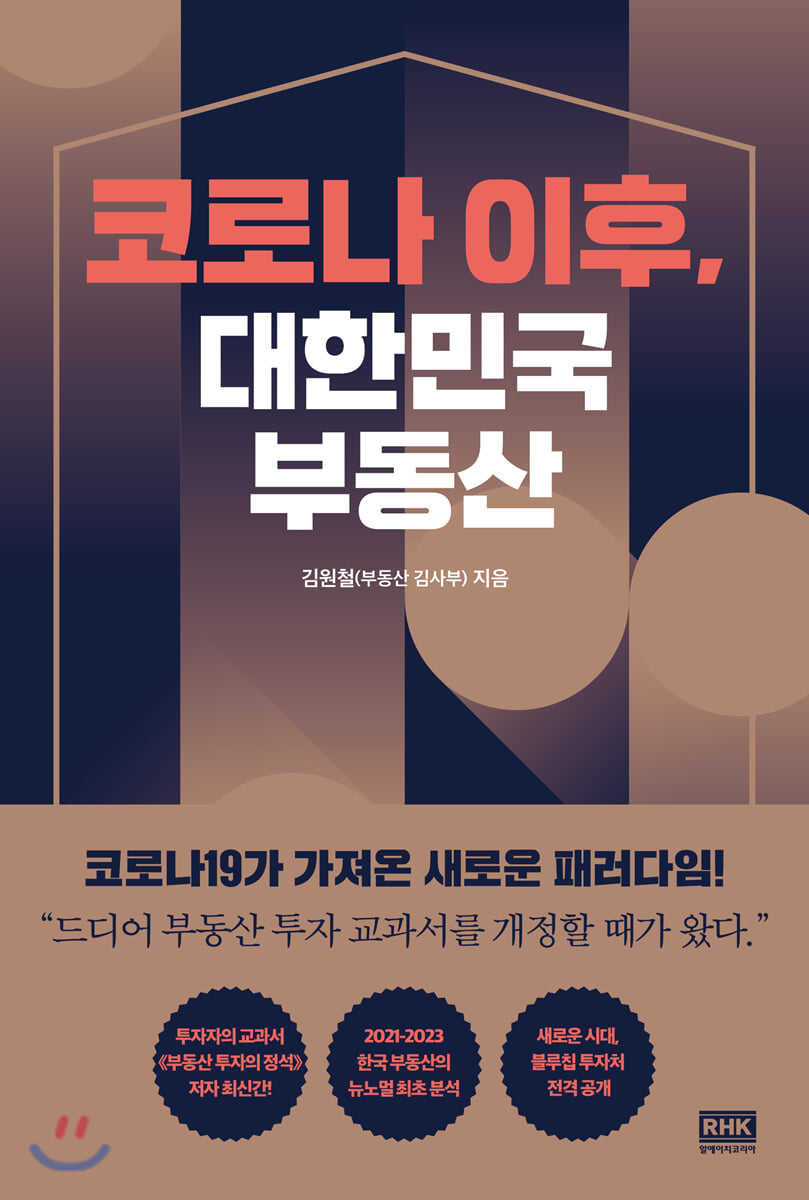
Post-COVID, South Korean real estate
 |
Description
Book Introduction
- A word from MD
-
In this new era, where are the blue chips in the real estate market?"What will happen to this chaotic real estate market?" Kim Won-cheol, a member of the Kim Sa-bu team, has taken up his pen with the intention of rewriting "The Essentials of Real Estate Investment."
As stated in the introduction, this is not a macroscopic future prediction book.
This practical investment book examines the future of profitable and valuable areas, including new construction vs. existing construction, emerging hub cities and officetels, and the second Gangnam.
December 4, 2020. Park Jeong-yoon, Economics and Management PD
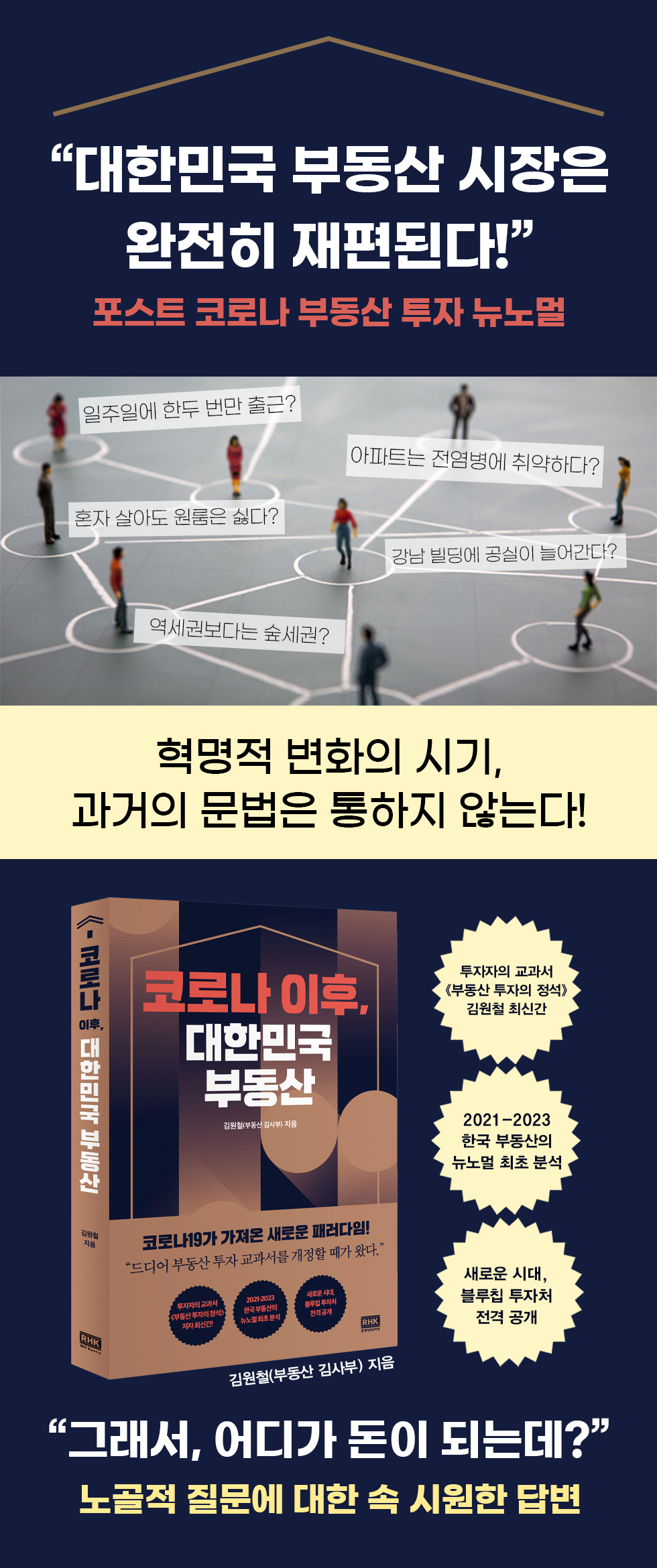
“The real estate market in South Korea is being completely reorganized!”
The seemingly endless rise in housing prices, the constant stream of new real estate policies, and the COVID-19 pandemic that has transformed our lifestyles…
Who will be the guiding light in this chaotic real estate market, where even the slightest glimpse into the future is impossible? Kim Won-cheol, author of "The Essentials of Real Estate Investment," often cited as an investor's textbook and a life guide for today's leading real estate experts, has released a new book.
What happened to the man who used to talk about the 'fundamentals of investment' that would not be shaken even when the market and policies changed?
While the fundamental principles of investing in real estate remain unchanged, this is intended to highlight opportunities worth adding in an era where human preferences are shifting due to COVID-19.
It's finally time to revise the real estate investment textbook.
"Real Estate in Korea After Corona" details notable investment destinations along with 10 themes, including emerging real estate blue chips, areas poised to become the next Gangnam, the changing status of country homes and key commercial districts, real estate in school districts, and where money with nowhere else to go will flock to in the wake of the viral pandemic.
In South Korea, where life can change with just one smart home, this is a book you absolutely must not miss if you want to seize the new opportunities that await.
The seemingly endless rise in housing prices, the constant stream of new real estate policies, and the COVID-19 pandemic that has transformed our lifestyles…
Who will be the guiding light in this chaotic real estate market, where even the slightest glimpse into the future is impossible? Kim Won-cheol, author of "The Essentials of Real Estate Investment," often cited as an investor's textbook and a life guide for today's leading real estate experts, has released a new book.
What happened to the man who used to talk about the 'fundamentals of investment' that would not be shaken even when the market and policies changed?
While the fundamental principles of investing in real estate remain unchanged, this is intended to highlight opportunities worth adding in an era where human preferences are shifting due to COVID-19.
It's finally time to revise the real estate investment textbook.
"Real Estate in Korea After Corona" details notable investment destinations along with 10 themes, including emerging real estate blue chips, areas poised to become the next Gangnam, the changing status of country homes and key commercial districts, real estate in school districts, and where money with nowhere else to go will flock to in the wake of the viral pandemic.
In South Korea, where life can change with just one smart home, this is a book you absolutely must not miss if you want to seize the new opportunities that await.
- You can preview some of the book's contents.
Preview
index
Entering
Acknowledgements
Chapter 1 - A New Era, New Blue Chips
Chapter 2 - People Want New Areas
Chapter 3 - What's the Difference Between New and Pre-Construction Apartments?
Chapter 4 - Local hub cities begin their emergency
Chapter 5 - The Rising Trend of Residential Officetels
Chapter 6 - The Future of School Districts Post-COVID
Chapter 7 - Who will be the next Gangnam?
Chapter 8 - The Changing Status of Power Houses
Chapter 9 - The Resurrection of Core Commercial Districts
Chapter 10 - Where the Money That Has Nowhere to Go Goes
Acknowledgements
Chapter 1 - A New Era, New Blue Chips
Chapter 2 - People Want New Areas
Chapter 3 - What's the Difference Between New and Pre-Construction Apartments?
Chapter 4 - Local hub cities begin their emergency
Chapter 5 - The Rising Trend of Residential Officetels
Chapter 6 - The Future of School Districts Post-COVID
Chapter 7 - Who will be the next Gangnam?
Chapter 8 - The Changing Status of Power Houses
Chapter 9 - The Resurrection of Core Commercial Districts
Chapter 10 - Where the Money That Has Nowhere to Go Goes
Detailed image
Into the book
This book is not a comprehensive forecast of the future, covering humanity's future in the face of the unprecedented crisis of COVID-19, or the changes that will come to the real estate market.
This contains answers for those who want to ask outright, “So where does the money come from?”
Although this book was written to serve a somewhat 'low-level purpose(?)', I would like to first say that this book should not be used to pursue short-term real estate price increases or short-term profits.
This is because short-term real estate price increases are influenced by the local supply, people's psychology, and, for now, policies.
--- p.5 From “Introduction”
There is another reason why we should pay attention to apartments with such a somewhat unfamiliar size.
This is because the market has yet to determine what price is appropriate for an apartment of this size, as it is still an unfamiliar size.
For this reason, the price is often set slightly lower than the actual value, and items can also be sold at very low prices, such as in a fire sale.
If you are aware of these trends, you will be able to recognize that the current market assessment and situation can be a huge opportunity.
If such areas no longer feel unfamiliar in the future, they will be recognized for their considerable value and their profitability will increase accordingly.
--- pp.53-55 From “Chapter 2: People Want New Areas”
Half of South Korea's population lives in the metropolitan area, which is one of the highest in the world.
We need to think about why this happened.
After all, it's because of jobs.
Because jobs are concentrated in Seoul and the metropolitan area, people flock there to find work.
So, what happens when jobs change? Here's the key! Until now, jobs and education were concentrated in Seoul and the metropolitan area, leading to an inevitable population influx. But after COVID-19, the situation will be dramatically different.
It's not that the workplace is moving, but rather that the workplace remains in its original location, but employees no longer need to commute to work there every day.
--- pp.97-98 From “Chapter 4 Local Hub Cities Starting an Emergency”
This is what is important in understanding the changes that will come to the real estate industry in South Korea after the coronavirus pandemic.
Some trends are simply things you need to be aware of, while others are things you can consider when making future real estate decisions.
However, some trends are ones that require immediate action once you know about them.
One of them is an officetel.
If 1.5-room officetels become the trend, what will happen to regular one-room officetels?
--- pp.122-123 From “Chapter 5: The Rising Trend of Residential Officetels”
I don't think the current real estate value created by school districts will change much, even if the education sector undergoes a major transformation after COVID-19.
Of course, there will be some changes.
Some changes are noticeable.
One of them is the emergence of new school districts.
Places that were not recognized for their value as school districts in the past are now beginning to receive recognition.
However, this change will accelerate further due to the coronavirus.
This is because the demand for ‘good homes’ has increased significantly.
As the value of a home as a living space has increased significantly compared to the past, people will be willing to spend a little more to buy a good home.
In the past, I used to think, 'I'll buy Apartment B, which I'm less satisfied with, and then save up money to buy Apartment A later,' but now I'm determined to 'I have to buy Apartment A this time, even if it means pushing myself too hard!'
--- pp. 144-145 From “Chapter 6: The Future of School Districts After Corona”
Ritz will receive even more attention post-COVID.
As everyone predicted, the coronavirus will accelerate the Fourth Industrial Revolution.
So, there can be no disagreement that when considering growth potential, investing in fields related to the 4th industrial revolution is the best option.
However, real estate somehow seems unrelated to the 4th industrial revolution.
Moreover, given our country's current situation, there seems to be no need to invest in overseas REITs.
After all, aren't apartments the most profitable?
But that may not be the case in the future! For one thing, real estate prices have risen significantly over the past five years.
In particular, apartment prices have gone up too much.
There is no need to give various reasons.
Even if we only consider this unscientific but in fact true principle that the moon wanes and the ups and downs come, we cannot expect apartment prices to continue to rise.
In addition, government regulations are becoming increasingly stricter.
Therefore, the number of people looking for alternative investment options will increase.
Even at this time, we must not forget the principles.
"Anything without growth potential is worthless." Let's remember that the reason Korea has been able to boast of its undefeated real estate market until now is not because it's safe, but because it has growth potential.
This contains answers for those who want to ask outright, “So where does the money come from?”
Although this book was written to serve a somewhat 'low-level purpose(?)', I would like to first say that this book should not be used to pursue short-term real estate price increases or short-term profits.
This is because short-term real estate price increases are influenced by the local supply, people's psychology, and, for now, policies.
--- p.5 From “Introduction”
There is another reason why we should pay attention to apartments with such a somewhat unfamiliar size.
This is because the market has yet to determine what price is appropriate for an apartment of this size, as it is still an unfamiliar size.
For this reason, the price is often set slightly lower than the actual value, and items can also be sold at very low prices, such as in a fire sale.
If you are aware of these trends, you will be able to recognize that the current market assessment and situation can be a huge opportunity.
If such areas no longer feel unfamiliar in the future, they will be recognized for their considerable value and their profitability will increase accordingly.
--- pp.53-55 From “Chapter 2: People Want New Areas”
Half of South Korea's population lives in the metropolitan area, which is one of the highest in the world.
We need to think about why this happened.
After all, it's because of jobs.
Because jobs are concentrated in Seoul and the metropolitan area, people flock there to find work.
So, what happens when jobs change? Here's the key! Until now, jobs and education were concentrated in Seoul and the metropolitan area, leading to an inevitable population influx. But after COVID-19, the situation will be dramatically different.
It's not that the workplace is moving, but rather that the workplace remains in its original location, but employees no longer need to commute to work there every day.
--- pp.97-98 From “Chapter 4 Local Hub Cities Starting an Emergency”
This is what is important in understanding the changes that will come to the real estate industry in South Korea after the coronavirus pandemic.
Some trends are simply things you need to be aware of, while others are things you can consider when making future real estate decisions.
However, some trends are ones that require immediate action once you know about them.
One of them is an officetel.
If 1.5-room officetels become the trend, what will happen to regular one-room officetels?
--- pp.122-123 From “Chapter 5: The Rising Trend of Residential Officetels”
I don't think the current real estate value created by school districts will change much, even if the education sector undergoes a major transformation after COVID-19.
Of course, there will be some changes.
Some changes are noticeable.
One of them is the emergence of new school districts.
Places that were not recognized for their value as school districts in the past are now beginning to receive recognition.
However, this change will accelerate further due to the coronavirus.
This is because the demand for ‘good homes’ has increased significantly.
As the value of a home as a living space has increased significantly compared to the past, people will be willing to spend a little more to buy a good home.
In the past, I used to think, 'I'll buy Apartment B, which I'm less satisfied with, and then save up money to buy Apartment A later,' but now I'm determined to 'I have to buy Apartment A this time, even if it means pushing myself too hard!'
--- pp. 144-145 From “Chapter 6: The Future of School Districts After Corona”
Ritz will receive even more attention post-COVID.
As everyone predicted, the coronavirus will accelerate the Fourth Industrial Revolution.
So, there can be no disagreement that when considering growth potential, investing in fields related to the 4th industrial revolution is the best option.
However, real estate somehow seems unrelated to the 4th industrial revolution.
Moreover, given our country's current situation, there seems to be no need to invest in overseas REITs.
After all, aren't apartments the most profitable?
But that may not be the case in the future! For one thing, real estate prices have risen significantly over the past five years.
In particular, apartment prices have gone up too much.
There is no need to give various reasons.
Even if we only consider this unscientific but in fact true principle that the moon wanes and the ups and downs come, we cannot expect apartment prices to continue to rise.
In addition, government regulations are becoming increasingly stricter.
Therefore, the number of people looking for alternative investment options will increase.
Even at this time, we must not forget the principles.
"Anything without growth potential is worthless." Let's remember that the reason Korea has been able to boast of its undefeated real estate market until now is not because it's safe, but because it has growth potential.
--- p.237 From “Chapter 10: Where Money with Nowhere to Go”
Publisher's Review
“It’s finally time to revise the real estate investment textbook!”
| A new paradigm brought about by COVID-19 |
In 2007, 13 years ago, the first book on investing using rental deposits as leverage was published.
At the time, it was an unfamiliar and somewhat unconventional method, so many people questioned whether it was feasible.
However, those who tried to follow along, believing they were being fooled, achieved truly astonishing results. Those who used the same methods to significantly increase their assets became investment gurus, leading to a flood of success stories! Over time, the book that became the "investor's textbook" was "The Essentials of Real Estate Investment."
Author Kim Won-cheol's (Kim Sa-bu, Real Estate) book is still a bestseller in the real estate investment field because it covers the "fundamentals of investment" that will remain unchanged even after 10 years, despite economic fluctuations, and despite policy changes.
He came out with a new book with the keyword 'Corona', which seems to be a bit timely.
What is the reason?
As of December 2020, real estate prices in South Korea are in a state of fluctuating.
With apartment prices rising by thousands of dollars a day and hundreds of millions of dollars a week, people are saying, “Real estate is crazy!” and the reality that owning a home has become more difficult is making ordinary people sigh even more deeply.
But there's one thing most people are missing: the impact of COVID-19 on South Korean real estate.
As human history proves, in times of 'revolutionary change', the grammar of the past becomes no longer applicable.
And that is precisely why new opportunities arise!
If you were expecting a book of future predictions, simply by reading the title, "Real Estate in South Korea After Corona," that comprehensively covers humanity's future in the face of the unprecedented crisis of COVID-19, life afterward, and the changes that will come to the real estate market, you can put the book down.
This book contains answers that will be welcomed by South Korean readers who want to ask the straightforward question, “So where does the money come from?”
This is because the investment book was written with the author's intention of providing readers with tangible 'money' rather than 'knowledge'.
A time of revolutionary change,
The New Normal in Real Estate in South Korea
Short-term increases in real estate prices are largely influenced by local supply, public sentiment, and, for now, real estate policies.
However, real estate investment is not just about buying common goods that are all around us.
If home appliances are something that can affect your life for 10 years based on a momentary choice, isn't real estate something that can affect your life based on a momentary choice?
The development of Gangnam, Seoul, began 50 years ago, and amidst the speculative fever, many people made huge profits in a short period of time.
But who are the true winners, those who have transformed their lives through real estate? Yes.
He is a person who has owned an apartment in Gangnam for a long time.
This book predicts changes in the real estate market with a more mid- to long-term perspective and pinpoints undervalued real estate assets with potential for future growth.
Chapter 1 introduces real estate, which will become a blue chip in the new wave brought about by COVID-19, Chapter 2 introduces new areas that will be in the spotlight, Chapter 3 explores the future of new and existing apartments, Chapter 4 explores the rise of regional hub cities, and Chapter 5 introduces the rising trend of residential officetels.
Chapter 6 looks at the future of school district real estate after COVID-19, Chapter 7 looks at where the next Gangnam will be, Chapter 8 looks at the changing status of country homes, Chapter 9 looks at the revival of key commercial districts, and Chapter 10 looks at where money with nowhere else to go will flow.
This book, which includes 10 themes and recommended areas for each, provides a broader perspective on the future of real estate in Korea and advises on where to wisely allocate our precious 'assets' right now.
A friendly and complete investment guide that teaches you not only which fish are nutritious, but also where to find them.
Books and information about the changes in human culture, society, education, and business caused by COVID-19, which has crippled and suffocated people around the world, are still pouring out.
The rise of remote work, the advancement of technology suited to a contactless society, advanced online education, and changes in people's preferences for comfortable living spaces are all things that can be easily predicted and predicted by reading just one article.
But this is what is important in the process of understanding the changes that will come to the real estate industry in South Korea after the coronavirus.
Some trends are simply things you need to be aware of, while others are things you can consider when making future real estate decisions.
But some trends are helpful only if you know about them and take action right away.
The value of this book shines even brighter precisely at this point.
Because it informs you of properties that will be in the spotlight in the future, but also of properties that will be neglected.
What should you do if the value of your real estate holdings, which account for the largest portion of your assets, is certain to decline in the future? Naturally, it's wise to liquidate them as soon as possible.
We need to keep in mind the following story by author Kim Won-cheol.
“Investing is about finding something that can generate excess returns at any time.
The target selected through comparison may produce completely different results depending on the market trend.
Investing is not just about making absolute comparisons between this and that, but also about choosing 'now this' and 'now that' according to the market flow.
“The key to investing is to comprehensively consider and compare various factors to determine the better bet.”
| A new paradigm brought about by COVID-19 |
In 2007, 13 years ago, the first book on investing using rental deposits as leverage was published.
At the time, it was an unfamiliar and somewhat unconventional method, so many people questioned whether it was feasible.
However, those who tried to follow along, believing they were being fooled, achieved truly astonishing results. Those who used the same methods to significantly increase their assets became investment gurus, leading to a flood of success stories! Over time, the book that became the "investor's textbook" was "The Essentials of Real Estate Investment."
Author Kim Won-cheol's (Kim Sa-bu, Real Estate) book is still a bestseller in the real estate investment field because it covers the "fundamentals of investment" that will remain unchanged even after 10 years, despite economic fluctuations, and despite policy changes.
He came out with a new book with the keyword 'Corona', which seems to be a bit timely.
What is the reason?
As of December 2020, real estate prices in South Korea are in a state of fluctuating.
With apartment prices rising by thousands of dollars a day and hundreds of millions of dollars a week, people are saying, “Real estate is crazy!” and the reality that owning a home has become more difficult is making ordinary people sigh even more deeply.
But there's one thing most people are missing: the impact of COVID-19 on South Korean real estate.
As human history proves, in times of 'revolutionary change', the grammar of the past becomes no longer applicable.
And that is precisely why new opportunities arise!
If you were expecting a book of future predictions, simply by reading the title, "Real Estate in South Korea After Corona," that comprehensively covers humanity's future in the face of the unprecedented crisis of COVID-19, life afterward, and the changes that will come to the real estate market, you can put the book down.
This book contains answers that will be welcomed by South Korean readers who want to ask the straightforward question, “So where does the money come from?”
This is because the investment book was written with the author's intention of providing readers with tangible 'money' rather than 'knowledge'.
A time of revolutionary change,
The New Normal in Real Estate in South Korea
Short-term increases in real estate prices are largely influenced by local supply, public sentiment, and, for now, real estate policies.
However, real estate investment is not just about buying common goods that are all around us.
If home appliances are something that can affect your life for 10 years based on a momentary choice, isn't real estate something that can affect your life based on a momentary choice?
The development of Gangnam, Seoul, began 50 years ago, and amidst the speculative fever, many people made huge profits in a short period of time.
But who are the true winners, those who have transformed their lives through real estate? Yes.
He is a person who has owned an apartment in Gangnam for a long time.
This book predicts changes in the real estate market with a more mid- to long-term perspective and pinpoints undervalued real estate assets with potential for future growth.
Chapter 1 introduces real estate, which will become a blue chip in the new wave brought about by COVID-19, Chapter 2 introduces new areas that will be in the spotlight, Chapter 3 explores the future of new and existing apartments, Chapter 4 explores the rise of regional hub cities, and Chapter 5 introduces the rising trend of residential officetels.
Chapter 6 looks at the future of school district real estate after COVID-19, Chapter 7 looks at where the next Gangnam will be, Chapter 8 looks at the changing status of country homes, Chapter 9 looks at the revival of key commercial districts, and Chapter 10 looks at where money with nowhere else to go will flow.
This book, which includes 10 themes and recommended areas for each, provides a broader perspective on the future of real estate in Korea and advises on where to wisely allocate our precious 'assets' right now.
A friendly and complete investment guide that teaches you not only which fish are nutritious, but also where to find them.
Books and information about the changes in human culture, society, education, and business caused by COVID-19, which has crippled and suffocated people around the world, are still pouring out.
The rise of remote work, the advancement of technology suited to a contactless society, advanced online education, and changes in people's preferences for comfortable living spaces are all things that can be easily predicted and predicted by reading just one article.
But this is what is important in the process of understanding the changes that will come to the real estate industry in South Korea after the coronavirus.
Some trends are simply things you need to be aware of, while others are things you can consider when making future real estate decisions.
But some trends are helpful only if you know about them and take action right away.
The value of this book shines even brighter precisely at this point.
Because it informs you of properties that will be in the spotlight in the future, but also of properties that will be neglected.
What should you do if the value of your real estate holdings, which account for the largest portion of your assets, is certain to decline in the future? Naturally, it's wise to liquidate them as soon as possible.
We need to keep in mind the following story by author Kim Won-cheol.
“Investing is about finding something that can generate excess returns at any time.
The target selected through comparison may produce completely different results depending on the market trend.
Investing is not just about making absolute comparisons between this and that, but also about choosing 'now this' and 'now that' according to the market flow.
“The key to investing is to comprehensively consider and compare various factors to determine the better bet.”
GOODS SPECIFICS
- Date of issue: December 3, 2020
- Page count, weight, size: 256 pages | 512g | 145*215*20mm
- ISBN13: 9788925589435
- ISBN10: 8925589435
You may also like
카테고리
korean


korean

![ELLE 엘르 스페셜 에디션 A형 : 12월 [2025]](http://librairie.coreenne.fr/cdn/shop/files/b8e27a3de6c9538896439686c6b0e8fb.jpg?v=1766436872&width=3840)


