

Conditions of the spectatorship
 |
Description
Book Introduction
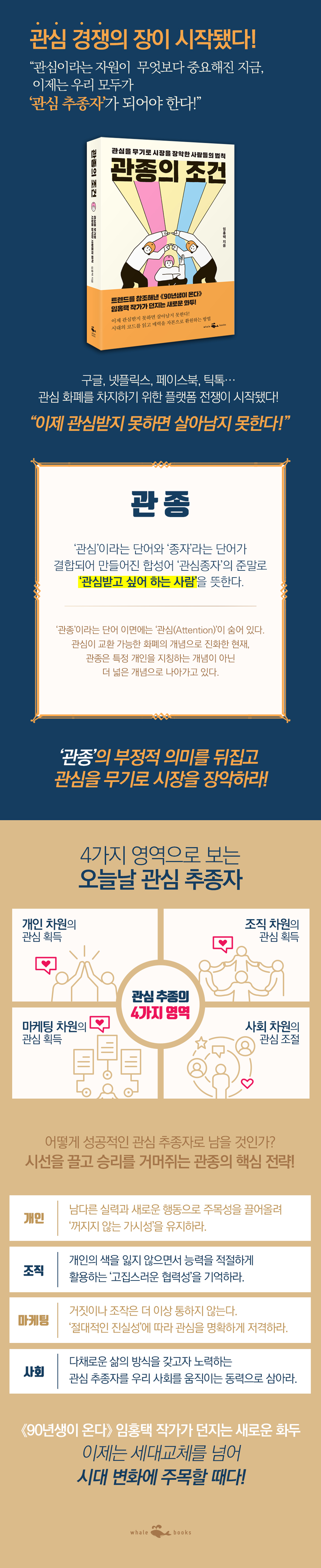
“A new topic of discussion from author Hong-taek Lim in ‘The 90s Generation is Coming!’” Now, if you don't get attention, you can't survive. The key strategy of the official to grab attention and secure victory! Turning negative connotations around and becoming mainstream The battle for attention has begun. YouTubers who fail to read the times and ruin themselves through "servile behavior," employees who believe they can advance simply by working silently, and marketers who expect sales increases through consistent exposure and "conceptual design" alone are not rewarded greatly. In this day and age, if something isn't worth posting on social media, they won't even look at it. Individuals must develop 'top star' qualities, and organizations must become 'action heroes'. Marketers will be left out of the market if they do not demonstrate the functionality and authenticity of their products. You have to be properly cared for to survive. Now we need to reverse the negative meaning of 'tolerance'. Rather than engaging in provocative behavior and interfering in others' daily lives, we should become "attention followers" who use our differences as weapons to attract attention and utilize our versatility more effectively. This book, "Conditions of Obedience," presents the correct methods and conditions for surviving as an attention follower through various examples and materials. Maintaining your own unique identity while entering people's core memories, collaborating effectively with others, and finding the right balance are the appropriate ways to utilize your interests to adapt to the changing times. Through this book, you can convert charm into capital and become a winner of the times. |
- You can preview some of the book's contents.
Preview
index
Introductory remarks - dedicated to all the servants of the world
Part 1: The Appearance of the Guanzong
1.
A different way of thinking and a new definition of tolerance
The word that's not in the dictionary, but everyone knows | People's perception of tolerance | tolerance as an extreme actor vs.
Attention Seekers as a Disposition | Distinction Between Attention Followers and Attention Seekers
* What level of indulgence do I fall into? | Interest Follower Test | Check the test results | Why I took this test
2.
Major changes in contemporary social concerns
Two Major Shifts in Attention | What Happens in an Age of Attention as Currency | The Commercialization of Everyday Life Created by New Viewing Values | Everyone's Struggle in the World of 'Internet Memes' | The Beginning of an Endless Game | Netflix Syndrome and Filter Errors | What Happens When Someone Filters Your Attention for You
3.
The birth of a servant
A new era, a new dream | Now even ordinary people can be the center of attention | People who will do anything to get attention
4.
How to remain a successful attention follower?
6 Types of Attention | The Relationship Between Attention and Core Memories | How to Enter Core Memories
Four Conditions for Part 2 of the Guide
1.
Visibility that never goes out
The Changing Meaning of Visibility | The Fear of Invisibility | The Types of Top Stars Who Have Both Attention and Skill | The Types of Top Stars Who Succeed in the World of Sports | Persevering Without Giving Up | The Power of Not Giving Up Over Long Periods | The Competition for Attention | How Can We Differentiate Ourselves in the Personal Market?
2.
stubborn cooperation
Why Humanity Chose Cooperation Over Coercion | Cooperation Between Modern Individuals and Organizations | How to Maintain Your Uniqueness While Collaborating | How to Maintain Your Uniqueness | How to Seize New Opportunities Through Cool Collaboration
3.
Absolute truthfulness
Why we talk about truth, not authenticity | The past, when the appeal to authenticity worked | The reason why successful YouTubers fell into the abyss | The endless temptation of fabrication and its conclusion | No more hard work, just show us your results | Problems that only a system that guarantees truth can solve | Why the operating room CCTV bill is gaining attention
4.
Affordable price range
Those who have been hit by crossing the line | How can we maintain the line?
Part 3: Attracting Attention at the Individual Level
1.
An individual who can attract public attention
Charm Capital: The Emergence of a New Concept of Capital | The Value Exchange of Existing Capital and Charm Capital | A World Where Personal Charm Becomes Capital: Six Types of Charm Capital | Prioritizing Charm Capital
2.
How to enhance your personal appeal in the market of interest
The emergence of a different personality: the birth of a second identity | What happens when another personality is born | How to use multiple personalities wisely | How to show unexpected charm: Unconventional usage | How to appear more competent?
3.
The world of celebrities where light and darkness coexist
What it means to be a celebrity | The irony of the world where it's hard to become moderately famous | Another challenge for internet celebrities to overcome
Part 4: Attracting Attention at the Organizational Level
1.
Their organizational life, which seeks attention
How to Leverage Personal Charm Capital at the Organizational Level | Attention-seeking Followers Who Stand Out
2.
The wise organizational life of officials
The changing relationship and interests between companies and individuals | The irony of shorter work hours and working from home: The idler is visible | The dawn of 21st-century scientific management and the individual within it | What kind of person should an individual be within an organization? | People who don't know what they're doing | Fake action actors 'Action Mask' vs.
A true action pioneer, 'Action Hero'
3.
How a Powerful Person Becomes an Action Hero
How to Become an Action Hero | The Strategic Humility of Action Heroes | How Action Heroes Collaborate | How to Show "Wise Respect" Instead of Flattery
4.
How can organizations capture the attention of individuals?
The challenges of an organization that must unify the interests of all its stakeholders | An organizational culture that serves everyone, not just one | What happens when geeks and shrinks work together | Are you just going to blame Lupin for your paycheck? How to stop freeloaders?
5.
Strategies of individuals who long to escape the organization
The Fate of a Company Employee: The One Thing They Must Leave | Organizational and Independent People: Quick Decisions and Quick Giving Up | Real-World Applications of the Barbell Strategy
Part 5: Attraction and Marketing: The Secrets of Those Who Captured the Attention of the Times
1.
Interest, Marketing, and Market Changes
A PR technique that wasn't initially welcomed | The Age of Marketing: What Matters is Consumer Perception, Not Truth | The Advent of a New World, a Perceptual Shift in the Marketing Environment
2.
How to get your customers' genuine interest
Identifying the best benefits customers truly desire | Breaking away from a transaction-based economy | The best benefits change with the times and circumstances | Making me stand out, providing a unique experience | A brand that satisfies the four conditions of a customer.
3.
4 Beliefs to Avoid in the New Era
The belief that repeated exposure will garner attention | The belief that word-of-mouth marketing can be done covertly | The belief that being kind will get you selected | The belief that a "good concept" will solve all your problems
Part 6: The Future of Society and the Influence of Species
1.
How to wisely manage social attention
Two Ways Governments Can Control Public Attention | What We Learned from Past Pandemics and Another Thing We Should Learn | It's Time to Change the Phrase "Bad Cold"
2.
Between truth and lies
Fake quotes attributed to celebrities | A chronicle of human truth and lies for attention | Why are we deceived? | When the balance between truth and lies collapses | A world overflowing with nonsense creates social polarization | How can we find the balance of truth?
3.
How can the problem of interest be solved?
Countermeasures Against Those Who Will Do Anything for Attention | How to Avoid Being Swept Away by Attention Manipulation and Seduction: Creating Your Own Attention Filter | Moving Beyond a Vertical, Uniform World to a World of Diversity
Conclusion: A society that accepts everyone as they are without discrimination.
Americas
reference book
Part 1: The Appearance of the Guanzong
1.
A different way of thinking and a new definition of tolerance
The word that's not in the dictionary, but everyone knows | People's perception of tolerance | tolerance as an extreme actor vs.
Attention Seekers as a Disposition | Distinction Between Attention Followers and Attention Seekers
* What level of indulgence do I fall into? | Interest Follower Test | Check the test results | Why I took this test
2.
Major changes in contemporary social concerns
Two Major Shifts in Attention | What Happens in an Age of Attention as Currency | The Commercialization of Everyday Life Created by New Viewing Values | Everyone's Struggle in the World of 'Internet Memes' | The Beginning of an Endless Game | Netflix Syndrome and Filter Errors | What Happens When Someone Filters Your Attention for You
3.
The birth of a servant
A new era, a new dream | Now even ordinary people can be the center of attention | People who will do anything to get attention
4.
How to remain a successful attention follower?
6 Types of Attention | The Relationship Between Attention and Core Memories | How to Enter Core Memories
Four Conditions for Part 2 of the Guide
1.
Visibility that never goes out
The Changing Meaning of Visibility | The Fear of Invisibility | The Types of Top Stars Who Have Both Attention and Skill | The Types of Top Stars Who Succeed in the World of Sports | Persevering Without Giving Up | The Power of Not Giving Up Over Long Periods | The Competition for Attention | How Can We Differentiate Ourselves in the Personal Market?
2.
stubborn cooperation
Why Humanity Chose Cooperation Over Coercion | Cooperation Between Modern Individuals and Organizations | How to Maintain Your Uniqueness While Collaborating | How to Maintain Your Uniqueness | How to Seize New Opportunities Through Cool Collaboration
3.
Absolute truthfulness
Why we talk about truth, not authenticity | The past, when the appeal to authenticity worked | The reason why successful YouTubers fell into the abyss | The endless temptation of fabrication and its conclusion | No more hard work, just show us your results | Problems that only a system that guarantees truth can solve | Why the operating room CCTV bill is gaining attention
4.
Affordable price range
Those who have been hit by crossing the line | How can we maintain the line?
Part 3: Attracting Attention at the Individual Level
1.
An individual who can attract public attention
Charm Capital: The Emergence of a New Concept of Capital | The Value Exchange of Existing Capital and Charm Capital | A World Where Personal Charm Becomes Capital: Six Types of Charm Capital | Prioritizing Charm Capital
2.
How to enhance your personal appeal in the market of interest
The emergence of a different personality: the birth of a second identity | What happens when another personality is born | How to use multiple personalities wisely | How to show unexpected charm: Unconventional usage | How to appear more competent?
3.
The world of celebrities where light and darkness coexist
What it means to be a celebrity | The irony of the world where it's hard to become moderately famous | Another challenge for internet celebrities to overcome
Part 4: Attracting Attention at the Organizational Level
1.
Their organizational life, which seeks attention
How to Leverage Personal Charm Capital at the Organizational Level | Attention-seeking Followers Who Stand Out
2.
The wise organizational life of officials
The changing relationship and interests between companies and individuals | The irony of shorter work hours and working from home: The idler is visible | The dawn of 21st-century scientific management and the individual within it | What kind of person should an individual be within an organization? | People who don't know what they're doing | Fake action actors 'Action Mask' vs.
A true action pioneer, 'Action Hero'
3.
How a Powerful Person Becomes an Action Hero
How to Become an Action Hero | The Strategic Humility of Action Heroes | How Action Heroes Collaborate | How to Show "Wise Respect" Instead of Flattery
4.
How can organizations capture the attention of individuals?
The challenges of an organization that must unify the interests of all its stakeholders | An organizational culture that serves everyone, not just one | What happens when geeks and shrinks work together | Are you just going to blame Lupin for your paycheck? How to stop freeloaders?
5.
Strategies of individuals who long to escape the organization
The Fate of a Company Employee: The One Thing They Must Leave | Organizational and Independent People: Quick Decisions and Quick Giving Up | Real-World Applications of the Barbell Strategy
Part 5: Attraction and Marketing: The Secrets of Those Who Captured the Attention of the Times
1.
Interest, Marketing, and Market Changes
A PR technique that wasn't initially welcomed | The Age of Marketing: What Matters is Consumer Perception, Not Truth | The Advent of a New World, a Perceptual Shift in the Marketing Environment
2.
How to get your customers' genuine interest
Identifying the best benefits customers truly desire | Breaking away from a transaction-based economy | The best benefits change with the times and circumstances | Making me stand out, providing a unique experience | A brand that satisfies the four conditions of a customer.
3.
4 Beliefs to Avoid in the New Era
The belief that repeated exposure will garner attention | The belief that word-of-mouth marketing can be done covertly | The belief that being kind will get you selected | The belief that a "good concept" will solve all your problems
Part 6: The Future of Society and the Influence of Species
1.
How to wisely manage social attention
Two Ways Governments Can Control Public Attention | What We Learned from Past Pandemics and Another Thing We Should Learn | It's Time to Change the Phrase "Bad Cold"
2.
Between truth and lies
Fake quotes attributed to celebrities | A chronicle of human truth and lies for attention | Why are we deceived? | When the balance between truth and lies collapses | A world overflowing with nonsense creates social polarization | How can we find the balance of truth?
3.
How can the problem of interest be solved?
Countermeasures Against Those Who Will Do Anything for Attention | How to Avoid Being Swept Away by Attention Manipulation and Seduction: Creating Your Own Attention Filter | Moving Beyond a Vertical, Uniform World to a World of Diversity
Conclusion: A society that accepts everyone as they are without discrimination.
Americas
reference book
Detailed image
Into the book
This book first focuses on how to define the word "guanjong" and at what level it should be accepted.
The most important thing I considered during this process was to analyze the ‘being who wants attention’ from a neutral perspective, rather than simply affirming or denying it.
This is why most of the terms in this book are used in a neutral sense, meaning 'attention seeker'.
But more important than the definition of attention is the word 'attention' hidden behind it.
In an age of unpredictable, rapid change, interest has evolved into the concept of exchangeable currency.
Approaching it in that sense, the concept of spectatorship seeking attention is moving beyond a concept that refers to a specific individual to a broader concept.
--- From "Introductory Remarks - Dedicated to all the servants of the world"
The reason people have different perceptions of tolerance is not because of differences in personal inclinations, but because the word tolerance is currently being used with two different meanings depending on the situation.
The two meanings that are being confused here are 'tolerance as an actor who causes extreme acts' and 'tolerance as a tendency to seek attention.'
The term "actor" refers to people who engage in unnatural behavior that is not typical of ordinary people, such as going to extreme lengths to get attention from others.
They are often called attention seekers by others, but it is important to note that this name is not given to them because of their nature, but because of their extreme behavior in order to get attention from others.
Some people who engage in such acts of indulgence suffer from mental illnesses such as delusions, but others do not.
They act intentionally for the perverse pleasure of attention or for the specific benefits they can gain from receiving attention.
This is why most of others' evaluations of them are bound to be negative.
--- From "Different Thoughts and New Definitions of Indulgence"
From some point on, we began to see the eccentric and bizarre behavior of people seeking attention through news and portal sites.
It ranges from drunk driving broadcasts to body-lighting antics.
It is not surprising that ordinary people feel aversion to the very word "tolerance" and use it as a language of criticism.
The problem was actually money from beginning to end.
The fact that anyone can be the center of attention and turn that attention into money through internet broadcasts and other means has encouraged some people with a knack for outrageous, bizarre, and bizarre behavior to gamble on attention, and they have seized this once-in-a-lifetime opportunity without missing a beat.
As a result, an environment has been created where selection and cruelty run rampant within the easy accessibility and freedom of new media.
As some BJs engage in provocative and bizarre acts to gain support from viewers, they end up producing so-called 'monsters born from capitalism.'
--- From "The Birth of a Servant"
There was a time in organizations when people who were so-called eloquent or quick-witted were recognized.
Although they may not have outstanding skills in the organization, they were able to respond quickly with their unique ability to improvise, and sometimes even achieved high positions beyond those with more ability.
There are many reasons why these people were able to thrive in existing organizations, but one of them is that in the past business environment, it was difficult to measure in detail the actual contributions that individuals made to the company's performance.
In an environment where both skills and abilities cannot be expressed in numbers, the ability to "package oneself with words" provided an opportunity to be evaluated more highly than one's actual abilities.
But now the business environment for many companies has changed.
Detailed management indicators have evolved beyond immediate sales and operating profit, and cutting-edge IT technology has enabled real-time tracking of which websites employees are accessing and what actions they are taking.
Furthermore, as business competition intensifies and the 52-hour workweek is implemented, there is no longer any room to wait for employees' passion based on overtime.
--- From "Absolute Truth"
What is most effective at an organizational level, along with human appeal, is professional expertise.
Professional skills in organizational life can be special talents or knowledge, as at the individual level, but more than that, they refer to specialized work abilities within the company.
This is considered a basic ability that an individual working in an organization must possess, along with the ability to cooperate with others.
If you have only one of these two, you are doomed to have a hard time surviving in an organized society.
For example, even if you are a person who is better at collaborating with others than anyone else, if your work skills are lacking, it can become a problem.
Conversely, no matter how talented a person is, if he or she always has trouble cooperating with others, he or she will face the same problem.
George Howard, a world-renowned management consultant and professor at the Wharton School of the University of Pennsylvania, said that there are only two ways for a person to thrive in an organization.
One is 'influencing someone', and the other is 'getting along well with others'.
The influence he is talking about is the individual's ability to successfully carry out company tasks.
Also, relationships with others mean the ability to cooperate.
--- From "Their Organizational Life: Seeking Attention"
But unfortunately, not all of these exceptionally skilled individuals become action heroes within their organizations.
It's true that all action heroes are skilled, but not all skilled people are action heroes.
In other words, skills alone are not enough to become an action hero.
So what is missing?
He has the skills, but he lacks the ability to get attention.
Many high-performing people who think they can just quietly get their work done at work are missing out on opportunities to make a significant impact.
This can be applied to a model that receives continuous attention, as examined in Part 2, 'Unquenchable Visibility'.
To be a true action hero, you need to have both skills and know how to get attention and use it to your advantage.
If you don't properly utilize the power of attention, you could end up like Manager Oh Sang-sik from the webtoon "Misaeng," who was outstanding in his abilities but not recognized by the organization.
--- From "How a Powerful Person Becomes an Action Hero"
In the new era, subtly manipulating customers' psychology or forcing false perceptions on them to get their attention no longer works.
To get real attention from your customers, you have to do something 'real' for them, not just put on a fake show.
The first thing to do is to know exactly what customers in my industry want.
Bill Bishop, author of "Pink Penguin," describes what customers truly want as "peak benefit."
This ultimate benefit is the intrinsic benefit hidden within the apparent 'surface benefit'.
For example, the superficial benefit that a customer receiving financial services hopes for is making money, but the ultimate benefit that they truly desire is to realize the life of their dreams.
And while the superficial benefit for customers receiving haircut services at beauty salons is getting their hair cut, the ultimate benefit they truly desire is a great hairstyle.
Many business owners still assume that the superficial benefits that customers want are what they actually want.
If you try to differentiate yourself with that kind of mindset, you will end up being the same as everyone else, and in the end, you will not be able to achieve outstanding results.
Bill Bishop explains that pinpointing the best benefits customers want is the escape hatch from a pack of penguins who all seem similar.
--- From "How to Get Your Customers' Genuine Interest"
The phrase “everything can be solved with one concept” is increasingly being revealed to be nothing more than a myth rather than truth.
Consumers no longer prefer products that simply boast a sharp concept, without being based on innovative technology or offering the best possible benefits.
In particular, in the case of 'creative concepts' that give a new concept to an already created product during the advertising production stage, rather than the 'original product concept' that is applied from the product planning stage, the ripple effect will be weaker in the future.
With so many products failing and disappearing from the market, it's likely only the advertising planners who still believe that the product concept and related advertising were successful.
The product has already been erased from our memories.
It just remains in the portfolios of advertising planners.
Instead of embracing the powerful power of concepts, we need to escape the trap of thinking that concepts can solve everything.
Before creating a good concept, you should first consider "true technological innovation" and the "best benefit" you can give to your customers. If that's not possible, you should first think about a concept that will make your customers stand out.
--- From "4 Beliefs to Avoid in the New Era"
If we approach the gathering of individual interest economically, we can see that it opens up opportunities to make money.
But from a social perspective, individual interest can also be a source of power that can sway public opinion and drive the social agenda.
In the early to mid-20th century, those in power in politics successfully manipulated public attention and guided actions in a way that served their purposes by using mass media to fan public sentiment.
The Allied methods of inciting the public by establishing the Federal Information Committee during World War I were later passed on to and developed by Goebbels and the Nazi regime in Germany, which started World War II.
However, the way the state manipulates public opinion in one direction has become largely ineffective in modern democratic societies.
While ideological conflict has lost its power in modern society, a bigger reason is that society as a whole has become more diverse and complex, creating a highly volatile environment.
In a society like this, it is virtually impossible to gather and lead the public's attention to a single point.
Now, in order for the country and society to move within a normal flow, it is necessary to gain the attention of the people.
This is because the public's interest is essential for the country to inform and implement major policies that move society as planned.
--- From "How to Control Social Interest"
Ultimately, the way to stop fake news is to change the current business model of generating advertising revenue through content exposure, that is, to change digital platform companies.
We need to regulate and limit the massive data collection and recommendation algorithms that enable business strategies where content that attracts the most attention, regardless of its truthfulness, generates more advertising revenue.
We cannot criticize platform companies for pursuing profit as a single entity.
In particular, they did not intentionally create fake news or design their business model with the hope of spreading lies and nonsense in society.
We just wanted to open up information and connect everyone so that everyone could easily access it, and maybe the only way to make money within the business model was through a collaborative business model.
However, within these structural conditions, where more provocative fake news brings greater profits and social polarization deepens due to algorithmic recommendations, harmful fake news and addictive content are bound to increase.
In this situation, external regulation is absolutely necessary because change cannot be achieved through the platform's own self-regulation efforts alone.
Among the representative methods being discussed, the most effective solution seems to be to prevent large platform companies from arbitrarily collecting massive amounts of user data.
The way fake news and recommended content tailored to user preferences is fundamentally based on the collection and analysis of user data.
This is where regulations come into play.
The most important thing I considered during this process was to analyze the ‘being who wants attention’ from a neutral perspective, rather than simply affirming or denying it.
This is why most of the terms in this book are used in a neutral sense, meaning 'attention seeker'.
But more important than the definition of attention is the word 'attention' hidden behind it.
In an age of unpredictable, rapid change, interest has evolved into the concept of exchangeable currency.
Approaching it in that sense, the concept of spectatorship seeking attention is moving beyond a concept that refers to a specific individual to a broader concept.
--- From "Introductory Remarks - Dedicated to all the servants of the world"
The reason people have different perceptions of tolerance is not because of differences in personal inclinations, but because the word tolerance is currently being used with two different meanings depending on the situation.
The two meanings that are being confused here are 'tolerance as an actor who causes extreme acts' and 'tolerance as a tendency to seek attention.'
The term "actor" refers to people who engage in unnatural behavior that is not typical of ordinary people, such as going to extreme lengths to get attention from others.
They are often called attention seekers by others, but it is important to note that this name is not given to them because of their nature, but because of their extreme behavior in order to get attention from others.
Some people who engage in such acts of indulgence suffer from mental illnesses such as delusions, but others do not.
They act intentionally for the perverse pleasure of attention or for the specific benefits they can gain from receiving attention.
This is why most of others' evaluations of them are bound to be negative.
--- From "Different Thoughts and New Definitions of Indulgence"
From some point on, we began to see the eccentric and bizarre behavior of people seeking attention through news and portal sites.
It ranges from drunk driving broadcasts to body-lighting antics.
It is not surprising that ordinary people feel aversion to the very word "tolerance" and use it as a language of criticism.
The problem was actually money from beginning to end.
The fact that anyone can be the center of attention and turn that attention into money through internet broadcasts and other means has encouraged some people with a knack for outrageous, bizarre, and bizarre behavior to gamble on attention, and they have seized this once-in-a-lifetime opportunity without missing a beat.
As a result, an environment has been created where selection and cruelty run rampant within the easy accessibility and freedom of new media.
As some BJs engage in provocative and bizarre acts to gain support from viewers, they end up producing so-called 'monsters born from capitalism.'
--- From "The Birth of a Servant"
There was a time in organizations when people who were so-called eloquent or quick-witted were recognized.
Although they may not have outstanding skills in the organization, they were able to respond quickly with their unique ability to improvise, and sometimes even achieved high positions beyond those with more ability.
There are many reasons why these people were able to thrive in existing organizations, but one of them is that in the past business environment, it was difficult to measure in detail the actual contributions that individuals made to the company's performance.
In an environment where both skills and abilities cannot be expressed in numbers, the ability to "package oneself with words" provided an opportunity to be evaluated more highly than one's actual abilities.
But now the business environment for many companies has changed.
Detailed management indicators have evolved beyond immediate sales and operating profit, and cutting-edge IT technology has enabled real-time tracking of which websites employees are accessing and what actions they are taking.
Furthermore, as business competition intensifies and the 52-hour workweek is implemented, there is no longer any room to wait for employees' passion based on overtime.
--- From "Absolute Truth"
What is most effective at an organizational level, along with human appeal, is professional expertise.
Professional skills in organizational life can be special talents or knowledge, as at the individual level, but more than that, they refer to specialized work abilities within the company.
This is considered a basic ability that an individual working in an organization must possess, along with the ability to cooperate with others.
If you have only one of these two, you are doomed to have a hard time surviving in an organized society.
For example, even if you are a person who is better at collaborating with others than anyone else, if your work skills are lacking, it can become a problem.
Conversely, no matter how talented a person is, if he or she always has trouble cooperating with others, he or she will face the same problem.
George Howard, a world-renowned management consultant and professor at the Wharton School of the University of Pennsylvania, said that there are only two ways for a person to thrive in an organization.
One is 'influencing someone', and the other is 'getting along well with others'.
The influence he is talking about is the individual's ability to successfully carry out company tasks.
Also, relationships with others mean the ability to cooperate.
--- From "Their Organizational Life: Seeking Attention"
But unfortunately, not all of these exceptionally skilled individuals become action heroes within their organizations.
It's true that all action heroes are skilled, but not all skilled people are action heroes.
In other words, skills alone are not enough to become an action hero.
So what is missing?
He has the skills, but he lacks the ability to get attention.
Many high-performing people who think they can just quietly get their work done at work are missing out on opportunities to make a significant impact.
This can be applied to a model that receives continuous attention, as examined in Part 2, 'Unquenchable Visibility'.
To be a true action hero, you need to have both skills and know how to get attention and use it to your advantage.
If you don't properly utilize the power of attention, you could end up like Manager Oh Sang-sik from the webtoon "Misaeng," who was outstanding in his abilities but not recognized by the organization.
--- From "How a Powerful Person Becomes an Action Hero"
In the new era, subtly manipulating customers' psychology or forcing false perceptions on them to get their attention no longer works.
To get real attention from your customers, you have to do something 'real' for them, not just put on a fake show.
The first thing to do is to know exactly what customers in my industry want.
Bill Bishop, author of "Pink Penguin," describes what customers truly want as "peak benefit."
This ultimate benefit is the intrinsic benefit hidden within the apparent 'surface benefit'.
For example, the superficial benefit that a customer receiving financial services hopes for is making money, but the ultimate benefit that they truly desire is to realize the life of their dreams.
And while the superficial benefit for customers receiving haircut services at beauty salons is getting their hair cut, the ultimate benefit they truly desire is a great hairstyle.
Many business owners still assume that the superficial benefits that customers want are what they actually want.
If you try to differentiate yourself with that kind of mindset, you will end up being the same as everyone else, and in the end, you will not be able to achieve outstanding results.
Bill Bishop explains that pinpointing the best benefits customers want is the escape hatch from a pack of penguins who all seem similar.
--- From "How to Get Your Customers' Genuine Interest"
The phrase “everything can be solved with one concept” is increasingly being revealed to be nothing more than a myth rather than truth.
Consumers no longer prefer products that simply boast a sharp concept, without being based on innovative technology or offering the best possible benefits.
In particular, in the case of 'creative concepts' that give a new concept to an already created product during the advertising production stage, rather than the 'original product concept' that is applied from the product planning stage, the ripple effect will be weaker in the future.
With so many products failing and disappearing from the market, it's likely only the advertising planners who still believe that the product concept and related advertising were successful.
The product has already been erased from our memories.
It just remains in the portfolios of advertising planners.
Instead of embracing the powerful power of concepts, we need to escape the trap of thinking that concepts can solve everything.
Before creating a good concept, you should first consider "true technological innovation" and the "best benefit" you can give to your customers. If that's not possible, you should first think about a concept that will make your customers stand out.
--- From "4 Beliefs to Avoid in the New Era"
If we approach the gathering of individual interest economically, we can see that it opens up opportunities to make money.
But from a social perspective, individual interest can also be a source of power that can sway public opinion and drive the social agenda.
In the early to mid-20th century, those in power in politics successfully manipulated public attention and guided actions in a way that served their purposes by using mass media to fan public sentiment.
The Allied methods of inciting the public by establishing the Federal Information Committee during World War I were later passed on to and developed by Goebbels and the Nazi regime in Germany, which started World War II.
However, the way the state manipulates public opinion in one direction has become largely ineffective in modern democratic societies.
While ideological conflict has lost its power in modern society, a bigger reason is that society as a whole has become more diverse and complex, creating a highly volatile environment.
In a society like this, it is virtually impossible to gather and lead the public's attention to a single point.
Now, in order for the country and society to move within a normal flow, it is necessary to gain the attention of the people.
This is because the public's interest is essential for the country to inform and implement major policies that move society as planned.
--- From "How to Control Social Interest"
Ultimately, the way to stop fake news is to change the current business model of generating advertising revenue through content exposure, that is, to change digital platform companies.
We need to regulate and limit the massive data collection and recommendation algorithms that enable business strategies where content that attracts the most attention, regardless of its truthfulness, generates more advertising revenue.
We cannot criticize platform companies for pursuing profit as a single entity.
In particular, they did not intentionally create fake news or design their business model with the hope of spreading lies and nonsense in society.
We just wanted to open up information and connect everyone so that everyone could easily access it, and maybe the only way to make money within the business model was through a collaborative business model.
However, within these structural conditions, where more provocative fake news brings greater profits and social polarization deepens due to algorithmic recommendations, harmful fake news and addictive content are bound to increase.
In this situation, external regulation is absolutely necessary because change cannot be achieved through the platform's own self-regulation efforts alone.
Among the representative methods being discussed, the most effective solution seems to be to prevent large platform companies from arbitrarily collecting massive amounts of user data.
The way fake news and recommended content tailored to user preferences is fundamentally based on the collection and analysis of user data.
This is where regulations come into play.
--- From "Between Truth and Lies"
Publisher's Review
The Right Way to Become an 'Attention Follower'
Focus on "unwavering visibility" and "a manageable level of affordability."
In 2019, Forbes magazine in the United States named Mayweather as the highest-paid athlete among global sports stars in the 2010s.
The reason boxers, considered a fading popular sport, were able to capitalize on their strengths and turn their popularity into currency lies in their "unwavering visibility," which this book presents as one of the conditions for spectatorship.
He is a 'top star type' who has both the ability to attract attention and the skills to do so. He does not stop at attracting attention based on his skills, but also calls himself 'The Money', thereby drawing attention.
This attention isn't limited to sports stars.
Those who survive in the one-person media market don't just do the same "mukbang" or "workout" YouTube videos as everyone else, but rather reveal themselves with new backgrounds and actions, gaining popularity that doesn't easily fade.
Just as the general merchandise market is changing, the personal interest market is also having to fill its niche within more detailed and segmented categories to differentiate itself from others.
As new media proliferated and the barriers to entry for participation lowered, individuals began to create content and generate monetary value from that content.
The scope of individual activities is no longer tied to the huge broadcasting market.
Rather, in today's world, where YouTubers who know exactly what their subscribers want have become the 'content that's popular with the big media, individuals have become more focused on 'getting attention.'
However, there are cases where people make the mistake of focusing only on attracting attention.
They pretend to be sick, appear on air in skimpy clothes, and talk about sexual topics carelessly during live broadcasts.
But the public's gaze is different than before.
While expecting newness and one's own tastes from them, one judges the appropriateness and rightness of their actions.
This is why 'a manageable level' has become as important as visibility.
It quickly becomes apparent that individuals who are solely focused on attention and the exchange value of that attention, and who focus on stimulated behaviors for greater attention, are often ostracized by the public in the personal attention market.
This book explains the trends of the times that can interest anyone, using case studies and statistical data from various figures.
It also presents the right way to become an 'attention follower' who uses that attention as a weapon and dominates the market.
A strategy of interest needed not only by businesses but also by society!
Gain attention with "stubborn cooperation" and "absolute truthfulness."
Why are Silicon Valley's work methods constantly cited as essential for domestic organizations? Netflix, as detailed in its "Culture Deck," which outlines its culture and personnel principles, has chosen to retain only "A-level" employees who demonstrate exceptional abilities.
Google also had two genius founders who were almost geeks, and they achieved innovation in the field of professional programming.
But the success factors of these organizations do not stop at personnel and skills.
The most important factor is connected to 'stubborn cooperation', which is presented as one of the conditions of generosity in this book.
Stubborn cooperation is the ability to attract the attention of others without losing your own color.
Netflix boldly excluded employees, no matter how high-performing, if they hindered teamwork, and Google also placed more emphasis on the importance of collaboration in organizational development by appointing Eric Schmidt, who is close to Shrink, as CEO to foster collaboration between non-engineers and engineers.
The author emphasizes that creating an equal organizational principle and culture is a priority for persistent cooperation.
Collaboration in organizations is different than it used to be.
The unconditional sacrifice of an individual has disappeared.
Organizations now place emphasis on appropriately utilizing individual capabilities.
The author also speaks of the importance of 'absolute truthfulness' among the values needed by businesses and society.
A society that seeks to group together businesses and individuals who unconditionally seek to stand out and push them in one direction can no longer be within the public's sphere of interest.
Companies must clearly target the interests of the times.
In a world where no concept of 'good consumption' that benefits consumers or products that are not of good quality will work,
The reason people feel even more betrayed by fake news and why legislation mandating CCTV in operating rooms and daycare centers is receiving active support is also in the same vein.
The author raised a new topic called 'interest follower' by focusing on interest rather than tolerance.
And within it, it talks about the direction in which individuals and society can move forward in step with each other.
When we clearly face the direction of that flow and go beyond the vertical and uniform world, interest can become a driving force that moves us and society.
Focus on "unwavering visibility" and "a manageable level of affordability."
In 2019, Forbes magazine in the United States named Mayweather as the highest-paid athlete among global sports stars in the 2010s.
The reason boxers, considered a fading popular sport, were able to capitalize on their strengths and turn their popularity into currency lies in their "unwavering visibility," which this book presents as one of the conditions for spectatorship.
He is a 'top star type' who has both the ability to attract attention and the skills to do so. He does not stop at attracting attention based on his skills, but also calls himself 'The Money', thereby drawing attention.
This attention isn't limited to sports stars.
Those who survive in the one-person media market don't just do the same "mukbang" or "workout" YouTube videos as everyone else, but rather reveal themselves with new backgrounds and actions, gaining popularity that doesn't easily fade.
Just as the general merchandise market is changing, the personal interest market is also having to fill its niche within more detailed and segmented categories to differentiate itself from others.
As new media proliferated and the barriers to entry for participation lowered, individuals began to create content and generate monetary value from that content.
The scope of individual activities is no longer tied to the huge broadcasting market.
Rather, in today's world, where YouTubers who know exactly what their subscribers want have become the 'content that's popular with the big media, individuals have become more focused on 'getting attention.'
However, there are cases where people make the mistake of focusing only on attracting attention.
They pretend to be sick, appear on air in skimpy clothes, and talk about sexual topics carelessly during live broadcasts.
But the public's gaze is different than before.
While expecting newness and one's own tastes from them, one judges the appropriateness and rightness of their actions.
This is why 'a manageable level' has become as important as visibility.
It quickly becomes apparent that individuals who are solely focused on attention and the exchange value of that attention, and who focus on stimulated behaviors for greater attention, are often ostracized by the public in the personal attention market.
This book explains the trends of the times that can interest anyone, using case studies and statistical data from various figures.
It also presents the right way to become an 'attention follower' who uses that attention as a weapon and dominates the market.
A strategy of interest needed not only by businesses but also by society!
Gain attention with "stubborn cooperation" and "absolute truthfulness."
Why are Silicon Valley's work methods constantly cited as essential for domestic organizations? Netflix, as detailed in its "Culture Deck," which outlines its culture and personnel principles, has chosen to retain only "A-level" employees who demonstrate exceptional abilities.
Google also had two genius founders who were almost geeks, and they achieved innovation in the field of professional programming.
But the success factors of these organizations do not stop at personnel and skills.
The most important factor is connected to 'stubborn cooperation', which is presented as one of the conditions of generosity in this book.
Stubborn cooperation is the ability to attract the attention of others without losing your own color.
Netflix boldly excluded employees, no matter how high-performing, if they hindered teamwork, and Google also placed more emphasis on the importance of collaboration in organizational development by appointing Eric Schmidt, who is close to Shrink, as CEO to foster collaboration between non-engineers and engineers.
The author emphasizes that creating an equal organizational principle and culture is a priority for persistent cooperation.
Collaboration in organizations is different than it used to be.
The unconditional sacrifice of an individual has disappeared.
Organizations now place emphasis on appropriately utilizing individual capabilities.
The author also speaks of the importance of 'absolute truthfulness' among the values needed by businesses and society.
A society that seeks to group together businesses and individuals who unconditionally seek to stand out and push them in one direction can no longer be within the public's sphere of interest.
Companies must clearly target the interests of the times.
In a world where no concept of 'good consumption' that benefits consumers or products that are not of good quality will work,
The reason people feel even more betrayed by fake news and why legislation mandating CCTV in operating rooms and daycare centers is receiving active support is also in the same vein.
The author raised a new topic called 'interest follower' by focusing on interest rather than tolerance.
And within it, it talks about the direction in which individuals and society can move forward in step with each other.
When we clearly face the direction of that flow and go beyond the vertical and uniform world, interest can become a driving force that moves us and society.
GOODS SPECIFICS
- Publication date: December 10, 2020
- Page count, weight, size: 440 pages | 600g | 145*210*30mm
- ISBN13: 9791190313605
- ISBN10: 119031360X
You may also like
카테고리
korean


korean

![ELLE 엘르 스페셜 에디션 A형 : 12월 [2025]](http://librairie.coreenne.fr/cdn/shop/files/b8e27a3de6c9538896439686c6b0e8fb.jpg?v=1766436872&width=3840)


