

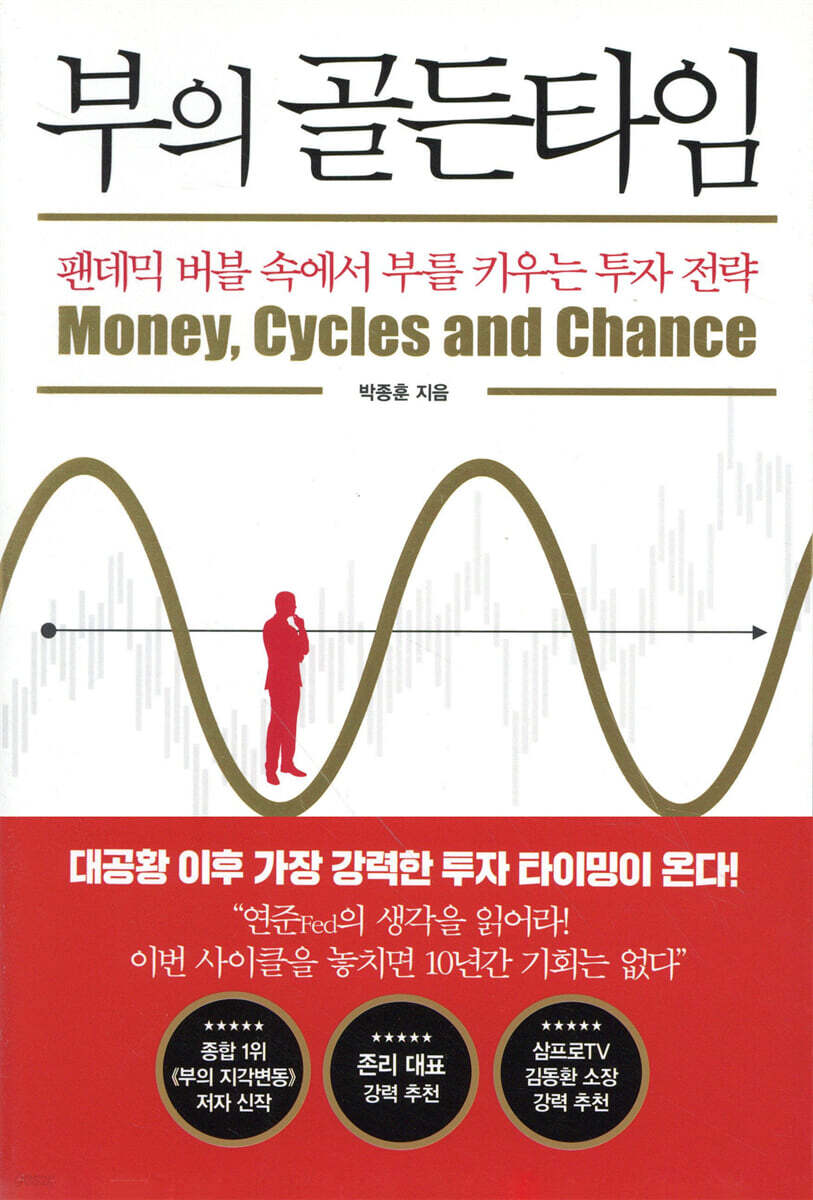
Golden Time of Wealth
 |
Description
Book Introduction
- A word from MD
-
It all starts with the Federal Reserve.At the center of all this unlimited money printing and the unprecedented stock market boom was the Federal Reserve.
What's the Federal Reserve, which drives the global economy through its benchmark interest rate and policies, thinking now? Economics reporter Park Jong-hoon explores the Fed's history, trends, and debt cycles to identify unmissable investment opportunities even amidst bubble fears.
October 27, 2020. Park Jeong-yoon, Economics and Management PD
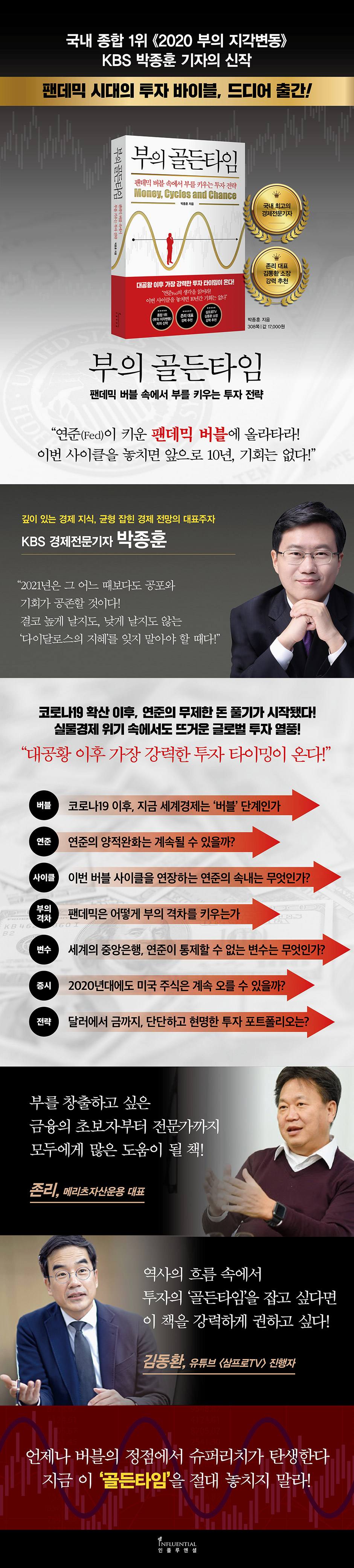
The new work by KBS reporter Park Jong-hoon, the No. 1 comprehensive Korean writer, "2020 Wealth Perception Shift."
CEO John Lee strongly recommends Sampro TV CEO Kim Dong-hwan.
The Fed's unlimited quantitative easing, the stock market hitting record highs, and the post-pandemic real shock!
The Economics of Smart Investment: The Debt Cycle and the 100-Year History of the Federal Reserve
“Read the Fed’s mind!
“If you miss this cycle, you won’t have another chance for 10 years!”
It is difficult to predict the direction of the global economy after COVID-19.
But the signals of crisis have been amplified for years.
Amidst the prolonged economic boom and massive liquidity surge that has lasted for nearly a decade, many economists have already warned of a crisis on numerous occasions.
The root of the crisis is the debt cycle, the beginning and end of the bubble.
In particular, what is extending this cycle is the US Federal Reserve's (Fed) unlimited monetary policy to cushion the impact of the pandemic.
Key indicators, which are hitting record highs every day, are leading the world, and will the Federal Reserve's corresponding policies be able to prevent a bubble burst?
The global economy in the post-COVID era is difficult to predict even an inch ahead! KBS economics reporter Park Jong-hoon offers strategies for growing your wealth amidst the ever-increasing global economic bubble, covering stocks, the dollar, gold, and bond investments.
CEO John Lee strongly recommends Sampro TV CEO Kim Dong-hwan.
The Fed's unlimited quantitative easing, the stock market hitting record highs, and the post-pandemic real shock!
The Economics of Smart Investment: The Debt Cycle and the 100-Year History of the Federal Reserve
“Read the Fed’s mind!
“If you miss this cycle, you won’t have another chance for 10 years!”
It is difficult to predict the direction of the global economy after COVID-19.
But the signals of crisis have been amplified for years.
Amidst the prolonged economic boom and massive liquidity surge that has lasted for nearly a decade, many economists have already warned of a crisis on numerous occasions.
The root of the crisis is the debt cycle, the beginning and end of the bubble.
In particular, what is extending this cycle is the US Federal Reserve's (Fed) unlimited monetary policy to cushion the impact of the pandemic.
Key indicators, which are hitting record highs every day, are leading the world, and will the Federal Reserve's corresponding policies be able to prevent a bubble burst?
The global economy in the post-COVID era is difficult to predict even an inch ahead! KBS economics reporter Park Jong-hoon offers strategies for growing your wealth amidst the ever-increasing global economic bubble, covering stocks, the dollar, gold, and bond investments.
- You can preview some of the book's contents.
Preview
index
Prologue ┃ Post-COVID: Fear and Opportunity Coexist: Pay Attention to the Fed and the Debt Cycle
Part 1: Understanding the Debt Cycle That's Ruining the Global Economy
1.
What causes economic fluctuations
Will a shrinking sunspot cause an economic crisis? ┃ Debt ultimately fuels booms and busts, cyclical fluctuations.
2.
The Four-Stage Debt Cycle: Bubbles Feed Bubbles
Stage 1: Goldilocks ┃ Stage 2: Bubble and Self-Reinforcement ┃ Stage 3: Bubble Burst ┃ Stage 4: Recession and Deleveraging
3.
Warning signals that the bubble is peaking
The most important signal: the inversion of the short-term and long-term interest rate spreads. Another sign: a sharp currency devaluation.
4.
What Determines the Pattern of Stock Price Recovery After a Bubble Burst
Rebound or Dead Cat Bounce? ┃ Three Factors That Determine Recovery and Crash
5.
The swamp of deleveraging and prolonged recession
Part 2: The Birth, Growth, and Crisis of the Federal Reserve, the Atlas that Supports the Global Economy
1.
Launched amidst secret meetings of banking capitalists
Scene 1: A Historic Duck Hunt That Made a Mark in Global Financial History
2.
Paul Volcker Restores the Fed's Failed Presence
Scene 2: Inflation fighters forced to bring bodyguards amidst death threats
3.
The Fed's Glory and Shame: A History Created by Greenspan
Scene 3: The Master's Bag Thickness Shakes Up the Market
4.
"Helicopter Van"? The Myth and the Truth
Scene 4: Ben Bernanke gets rejected for a home mortgage.
5.
This time is different: quantitative easing after COVID-19.
Scene 5: Powell's TV interview breaks convention, declaring the real "helicopter money."
6.
Bubble Extension: Is the Fed's Strategy Working?
Checkpoint 1: Can the Fed Continue to Support Asset Prices?
Checkpoint 2: Will quantitative easing be possible again until the real economy recovers?
Checkpoint 3 ┃ If unlimited quantitative easing doesn't work, is there a third card left?
Part 3: The Post-COVID World Economy: Variables Beyond the Fed's Control
1.
Balance between liquidity and real assets
How the gap between the real economy and stock prices arises: The stock market's growing dependence on the Federal Reserve.
2.
Wealth Gap: The Fatal Side Effect of Quantitative Easing
Since the Great Depression, severe wealth inequality has emerged. Why is free money concentrated among the wealthy?
3.
The pandemic and the deepening dominance of big tech companies
Big Tech Pills Predating Old Industries: How the Pandemic Destroyed Path Dependency in Consumption
4.
Is the inflation the Fed is hoping for a blessing?
Pay attention to the inflation and deflation thresholds ┃ If regulations on Big Tech begin after COVID-19
5.
The low-oil cycle's counterattack: the oil war
The History of the Oil Wars That Shook the World ┃ The Cycle of Production Cuts and High Oil Prices Could Return at Any Time
6.
Can quantitative easing save emerging economies?
7.
China's economic bubble takes a breather
8.
The Euro's Resurgence After COVID-19
Part 4: Smart Investment Strategies in the COVID-19 Era: How to Invest in an Uncertain Future
1.
Safe Investment: Delaying It Can Be Risky: Treasury Bonds and the Dollar
Is it okay to buy US Treasury bonds, a classic safe asset, now? ┃ Are foreign currency deposits still valid for dollar investment?
2.
Gold Hits All-Time Highs: Should You Buy It Now?
Gold Investment: A Long History Intertwined with the Dollar's Hegemony ┃ Gold Price Forecasting: Keep an Eye on Supply as Much as Demand
3.
Will the US stock market's dominance continue into the 2020s?
Over the past 100 years, stocks have been the most profitable investment. ┃ Six factors driving the rise of U.S. stock prices.
4.
When and How to Invest in US Stocks
Unpredictable Complexity: Establishing Safety Nets ┃ Post-COVID Investment Strategies that Capture Both the Risks and Returns of a Bubble
5.
The Korean stock market is aiming to break out of its trading range. Spot the leading stocks.
Why We're Different from the US Market: Signals of Leading Stock Fever and Decline
6.
There are investments you absolutely must avoid.
Investing in China: Opportunity or Trap? ┃ Avoid Emerging Markets Left Behind in the Digital Economy
7.
South Korea's real estate investment at a crossroads
Supply shortages pose a risk for the next two years. ┃ What has recent real estate policy overlooked? ┃ There's no such thing as invincible; don't overlook bubbles and external variables.
8.
Never fall into debt at the peak of a bubble.
Epilogue│Recall the Wisdom of Daedalus at the End of the Long-Term Boom
main
References
Part 1: Understanding the Debt Cycle That's Ruining the Global Economy
1.
What causes economic fluctuations
Will a shrinking sunspot cause an economic crisis? ┃ Debt ultimately fuels booms and busts, cyclical fluctuations.
2.
The Four-Stage Debt Cycle: Bubbles Feed Bubbles
Stage 1: Goldilocks ┃ Stage 2: Bubble and Self-Reinforcement ┃ Stage 3: Bubble Burst ┃ Stage 4: Recession and Deleveraging
3.
Warning signals that the bubble is peaking
The most important signal: the inversion of the short-term and long-term interest rate spreads. Another sign: a sharp currency devaluation.
4.
What Determines the Pattern of Stock Price Recovery After a Bubble Burst
Rebound or Dead Cat Bounce? ┃ Three Factors That Determine Recovery and Crash
5.
The swamp of deleveraging and prolonged recession
Part 2: The Birth, Growth, and Crisis of the Federal Reserve, the Atlas that Supports the Global Economy
1.
Launched amidst secret meetings of banking capitalists
Scene 1: A Historic Duck Hunt That Made a Mark in Global Financial History
2.
Paul Volcker Restores the Fed's Failed Presence
Scene 2: Inflation fighters forced to bring bodyguards amidst death threats
3.
The Fed's Glory and Shame: A History Created by Greenspan
Scene 3: The Master's Bag Thickness Shakes Up the Market
4.
"Helicopter Van"? The Myth and the Truth
Scene 4: Ben Bernanke gets rejected for a home mortgage.
5.
This time is different: quantitative easing after COVID-19.
Scene 5: Powell's TV interview breaks convention, declaring the real "helicopter money."
6.
Bubble Extension: Is the Fed's Strategy Working?
Checkpoint 1: Can the Fed Continue to Support Asset Prices?
Checkpoint 2: Will quantitative easing be possible again until the real economy recovers?
Checkpoint 3 ┃ If unlimited quantitative easing doesn't work, is there a third card left?
Part 3: The Post-COVID World Economy: Variables Beyond the Fed's Control
1.
Balance between liquidity and real assets
How the gap between the real economy and stock prices arises: The stock market's growing dependence on the Federal Reserve.
2.
Wealth Gap: The Fatal Side Effect of Quantitative Easing
Since the Great Depression, severe wealth inequality has emerged. Why is free money concentrated among the wealthy?
3.
The pandemic and the deepening dominance of big tech companies
Big Tech Pills Predating Old Industries: How the Pandemic Destroyed Path Dependency in Consumption
4.
Is the inflation the Fed is hoping for a blessing?
Pay attention to the inflation and deflation thresholds ┃ If regulations on Big Tech begin after COVID-19
5.
The low-oil cycle's counterattack: the oil war
The History of the Oil Wars That Shook the World ┃ The Cycle of Production Cuts and High Oil Prices Could Return at Any Time
6.
Can quantitative easing save emerging economies?
7.
China's economic bubble takes a breather
8.
The Euro's Resurgence After COVID-19
Part 4: Smart Investment Strategies in the COVID-19 Era: How to Invest in an Uncertain Future
1.
Safe Investment: Delaying It Can Be Risky: Treasury Bonds and the Dollar
Is it okay to buy US Treasury bonds, a classic safe asset, now? ┃ Are foreign currency deposits still valid for dollar investment?
2.
Gold Hits All-Time Highs: Should You Buy It Now?
Gold Investment: A Long History Intertwined with the Dollar's Hegemony ┃ Gold Price Forecasting: Keep an Eye on Supply as Much as Demand
3.
Will the US stock market's dominance continue into the 2020s?
Over the past 100 years, stocks have been the most profitable investment. ┃ Six factors driving the rise of U.S. stock prices.
4.
When and How to Invest in US Stocks
Unpredictable Complexity: Establishing Safety Nets ┃ Post-COVID Investment Strategies that Capture Both the Risks and Returns of a Bubble
5.
The Korean stock market is aiming to break out of its trading range. Spot the leading stocks.
Why We're Different from the US Market: Signals of Leading Stock Fever and Decline
6.
There are investments you absolutely must avoid.
Investing in China: Opportunity or Trap? ┃ Avoid Emerging Markets Left Behind in the Digital Economy
7.
South Korea's real estate investment at a crossroads
Supply shortages pose a risk for the next two years. ┃ What has recent real estate policy overlooked? ┃ There's no such thing as invincible; don't overlook bubbles and external variables.
8.
Never fall into debt at the peak of a bubble.
Epilogue│Recall the Wisdom of Daedalus at the End of the Long-Term Boom
main
References
Detailed image
Into the book
2021, a year marked by a perilous period of both fear and opportunity, will be a year unlike any other. We must navigate the vast chasm between the "pandemic bubble" fueled by the Federal Reserve's monetary power and the real economy being dragged down by COVID-19.
Furthermore, depending on how we respond to the massive "wealth shift" that will unfold amidst this disharmony, 2021 could either be the year of the worst crisis or a golden opportunity for a major turnaround.
--- Prologue
The most significant characteristic of the second stage of the debt cycle, the bubble stage, is that it exhibits strong self-reinforcing characteristics that drive up asset prices.
As asset prices begin to rise in the bubble phase, everyone rushes to invest in assets, further increasing the returns on asset investments.
However, as asset prices rise, the value of collateral increases, allowing more money to be borrowed, which in turn leads to a 'self-reinforcing phenomenon' in which more money is invested.
If everyone borrows money and invests in various ways, asset prices will rise even more.
This creates a 'net worth effect' that makes people feel wealthier and leads them to spend more money.
--- p.34
Given the overall strength of the bubble, it is clear that the US economic bubble in 2020 is in a somewhat precarious state.
Moreover, unlike the 2000 dot-com bubble, where bubble signals appeared only in the stock market, or the 2008 global financial crisis, where bubble signals appeared only in the real estate market, this time bubble signals are appearing simultaneously in both the stock and real estate markets, so we must be more careful. --- pp.58-59
Looking at the situation in 2020, the Fed appears more adept at handling crises than ever before.
In particular, we are responding proactively and boldly based on the lessons learned from the 2008 global financial crisis.
Another strength of the Federal Reserve is its ability to respond with a variety of policy tools whenever a crisis emerges, such as during the COVID-19 pandemic in 2020.
However, the problem is that Chairman Jerome Powell's leadership and authority are somewhat weaker than those of former chairmen Paul Volcker and Alan Greenspan, who led the Fed to its heyday.
Indeed, the Fed, led by Chairman Powell, has been at the mercy of market demands since 2019, raising concerns that it could lose control of the market if the crisis worsens.
--- pp.68-69
In 2014, when former Federal Reserve Chairman Ben Bernanke, who reigned as the "economic president" after Greenspan, left office, he applied to commercial banks to convert home mortgage loans to low-interest rates.
But commercial banks refused to approve the low-interest convertible loans, citing Bernanke's lack of stable employment after he left the Fed chairmanship.
Bernanke received a salary of $200,000 (240 million won) while serving as Federal Reserve Chairman.
However, after stepping down as Federal Reserve Chairman, he was denied a loan on grounds that his job was unstable because he had been working as a part-time researcher at the Brookings Institution.
(Omitted) The fact that the loan was rejected shows how strict bank lending has become since the global financial crisis.
--- pp.104-105
The problem is that this phenomenon has become even more severe since the Federal Reserve once again embarked on unlimited quantitative easing following the COVID-19 outbreak.
Because the learning effect that quantitative easing alone would lead to a sharp rise in stock prices had already been established during the global financial crisis, U.S. stock prices rebounded sharply in March 2020, immediately following the Federal Reserve's announcement of unlimited quantitative easing.
The money released through quantitative easing is not reaching the middle class, but rather lingers in financial institutions, driving up the prices of assets such as stocks and real estate held by a select few.
If the current situation, where the benefits of quantitative easing do not reach the middle class, continues, the gap between financial markets and the real economy will inevitably widen.
--- pp.160-161
However, as the COVID-19 pandemic led to the resumption of zero interest rates and large-scale quantitative easing, gold prices broke through their all-time highs and surpassed $2,000 in August 2020.
So what will happen to the price of gold in the future? On the demand side, gold has a variety of uses, including as a store of value, jewelry, and electronics. On the supply side, supply comes from traditional gold mines as well as "urban mines."
Because both supply and demand are affected by various factors, it is impossible to predict the price of gold with 100% certainty.
However, if we carefully examine the past history of gold and the long-term trends in terms of supply and demand, we can get some hints about the direction of gold prices.
--- p.232
While the long-term prospects for Big Tech, another driving force behind the rise in U.S. stocks, remain bright, we must also consider the potential backlash against their rapid growth, which has pushed out traditional industries.
As traditional industries are being pushed out by big tech companies, and the countless jobs they created disappear, the U.S. government is likely to strengthen laws and regulations to protect these industries.
While the COVID-19 pandemic continues, there will likely be caution in tightening regulations, but as the worst of the situation fades, calls for restraint on Big Tech companies will likely grow louder.
If various regulations, such as the dissolution of monopolies or restrictions on business operations, are introduced, even the biggest tech companies will face restrictions on their growth for a while.
Furthermore, depending on how we respond to the massive "wealth shift" that will unfold amidst this disharmony, 2021 could either be the year of the worst crisis or a golden opportunity for a major turnaround.
--- Prologue
The most significant characteristic of the second stage of the debt cycle, the bubble stage, is that it exhibits strong self-reinforcing characteristics that drive up asset prices.
As asset prices begin to rise in the bubble phase, everyone rushes to invest in assets, further increasing the returns on asset investments.
However, as asset prices rise, the value of collateral increases, allowing more money to be borrowed, which in turn leads to a 'self-reinforcing phenomenon' in which more money is invested.
If everyone borrows money and invests in various ways, asset prices will rise even more.
This creates a 'net worth effect' that makes people feel wealthier and leads them to spend more money.
--- p.34
Given the overall strength of the bubble, it is clear that the US economic bubble in 2020 is in a somewhat precarious state.
Moreover, unlike the 2000 dot-com bubble, where bubble signals appeared only in the stock market, or the 2008 global financial crisis, where bubble signals appeared only in the real estate market, this time bubble signals are appearing simultaneously in both the stock and real estate markets, so we must be more careful. --- pp.58-59
Looking at the situation in 2020, the Fed appears more adept at handling crises than ever before.
In particular, we are responding proactively and boldly based on the lessons learned from the 2008 global financial crisis.
Another strength of the Federal Reserve is its ability to respond with a variety of policy tools whenever a crisis emerges, such as during the COVID-19 pandemic in 2020.
However, the problem is that Chairman Jerome Powell's leadership and authority are somewhat weaker than those of former chairmen Paul Volcker and Alan Greenspan, who led the Fed to its heyday.
Indeed, the Fed, led by Chairman Powell, has been at the mercy of market demands since 2019, raising concerns that it could lose control of the market if the crisis worsens.
--- pp.68-69
In 2014, when former Federal Reserve Chairman Ben Bernanke, who reigned as the "economic president" after Greenspan, left office, he applied to commercial banks to convert home mortgage loans to low-interest rates.
But commercial banks refused to approve the low-interest convertible loans, citing Bernanke's lack of stable employment after he left the Fed chairmanship.
Bernanke received a salary of $200,000 (240 million won) while serving as Federal Reserve Chairman.
However, after stepping down as Federal Reserve Chairman, he was denied a loan on grounds that his job was unstable because he had been working as a part-time researcher at the Brookings Institution.
(Omitted) The fact that the loan was rejected shows how strict bank lending has become since the global financial crisis.
--- pp.104-105
The problem is that this phenomenon has become even more severe since the Federal Reserve once again embarked on unlimited quantitative easing following the COVID-19 outbreak.
Because the learning effect that quantitative easing alone would lead to a sharp rise in stock prices had already been established during the global financial crisis, U.S. stock prices rebounded sharply in March 2020, immediately following the Federal Reserve's announcement of unlimited quantitative easing.
The money released through quantitative easing is not reaching the middle class, but rather lingers in financial institutions, driving up the prices of assets such as stocks and real estate held by a select few.
If the current situation, where the benefits of quantitative easing do not reach the middle class, continues, the gap between financial markets and the real economy will inevitably widen.
--- pp.160-161
However, as the COVID-19 pandemic led to the resumption of zero interest rates and large-scale quantitative easing, gold prices broke through their all-time highs and surpassed $2,000 in August 2020.
So what will happen to the price of gold in the future? On the demand side, gold has a variety of uses, including as a store of value, jewelry, and electronics. On the supply side, supply comes from traditional gold mines as well as "urban mines."
Because both supply and demand are affected by various factors, it is impossible to predict the price of gold with 100% certainty.
However, if we carefully examine the past history of gold and the long-term trends in terms of supply and demand, we can get some hints about the direction of gold prices.
--- p.232
While the long-term prospects for Big Tech, another driving force behind the rise in U.S. stocks, remain bright, we must also consider the potential backlash against their rapid growth, which has pushed out traditional industries.
As traditional industries are being pushed out by big tech companies, and the countless jobs they created disappear, the U.S. government is likely to strengthen laws and regulations to protect these industries.
While the COVID-19 pandemic continues, there will likely be caution in tightening regulations, but as the worst of the situation fades, calls for restraint on Big Tech companies will likely grow louder.
If various regulations, such as the dissolution of monopolies or restrictions on business operations, are introduced, even the biggest tech companies will face restrictions on their growth for a while.
--- p.242
Publisher's Review
"The longest boom in financial history is over, and the Fed's 'pandemic bubble' extension has begun!"
― The global stock market boom and investment boom fueled by unlimited quantitative easing following the COVID-19 pandemic.
The global economy was thrown into panic in 2020 due to the unexpected COVID-19 pandemic.
The one that moved faster than anyone else was the US Federal Reserve (Fed).
The Federal Reserve, which has been the central bank of not only the U.S. economy but also virtually the entire world, has demonstrated strong leadership since the pandemic and is unleashing unprecedented economic stimulus measures in the form of "unlimited quantitative easing."
Federal Reserve Chairman Jerome Powell has repeatedly warned that the global economy is in irreversible "uncertainty" following the pandemic, and has emphasized that only immediate and massive fiscal support can prevent a larger economic crisis.
However, the problem is that the Fed's 'unlimited money injection' to save the global economy is causing stock prices in major countries, including the United States, to rise without stopping, and the global market is entering a 'bubble extension war.'
Since March 2020, the Fed has gone beyond the level of support for employment and households and has implemented unprecedented policies to indirectly purchase not only high-credit corporate bonds but also bonds from companies whose credit ratings have fallen to speculative grade.
As a result, major U.S. stock markets have hit record highs, and in Korea, the long-term boom that lasted over 10 years is now in full swing, with the "Seohak Ant Fever" spreading beyond the "Donghak Ant Movement," making the investment boom seem meaningless.
But as we all know, the real economy is not recovering at all, and asset prices are rising, widening the gap.
Park Jong-hoon, an economics reporter at KBS and author of 『2020 Wealth Shift』, which ranked first in the overall bestseller list in 2019, defines the current situation as a 'pandemic bubble' and analyzes the chaotic global economy focusing on the 'principle of the debt cycle' and 'the birth and policies of the Federal Reserve', and visits readers with his new book 『Golden Time of Wealth』, which presents a wise investment strategy for the pandemic era.
■ “The bubble is bound to burst someday! But we haven’t reached the ‘peak of the bubble’ yet!”
― The 'Timing of Wealth' Discovered in the Principle of the Four-Stage Global Economic Cycle
The medium that creates and amplifies a business cycle is debt.
For this reason, the author calls the business cycle a debt cycle.
Until now, the global economy has grown through debt cycles that generally last from 8 to 12 years.
A cycle consists of the first stage, Goldilocks, where the real economy recovers from a recession; the second stage, a bubble, where debt increases and the boom reaches its peak; the third stage, a bubble burst, where asset prices plummet and an economic crisis occur; and the fourth stage, a recession and deleveraging, where debt is painfully resolved through bankruptcies and debt restructuring.
Between stages 2 and 3, that is, between the bubble and the bubble burst, a real 'wealth shift' occurs.
Inflection points in the debt cycle represent critical crossroads for individual asset portfolios as well as financial authorities.
Since the dot-com bubble burst in 2000, the Federal Reserve has responded with ad hoc measures that have only fueled the bubble, rather than proactively stabilizing financial markets.
It is consistent with the so-called 'Not In My TErm' policy, which means 'it only has to stay on during my term of office.'
The author believes that this cycle, which has been ongoing since 2009, entered a prolonged rally due to the pandemic and the Federal Reserve's artificial and comprehensive stimulus measures.
However, no matter how big the bubble is, it will eventually burst.
What we need to pay attention to at this time is the ‘peak of the bubble.’
The peak of a bubble is both a crisis and an opportunity.
There are signals such as an inversion of the long-term and short-term interest rate spreads and a sharp decline in currency value, but above all, asset prices soar sharply as they approach their peak.
Coincidentally, this period is also the 'wealth timing' that can widen the wealth gap.
This is why the author emphasizes that we must keep a close eye on which stage of the debt cycle the global economy is currently in.
■ "Unlimited Money Printing! Is the Fed's Strategy Effective? What Are the Uncontrollable Variables?"
From the birth of the Federal Reserve, which began with the "duck hunt" of bank capitalists, to Powell's "helicopter money"
The author says, “In effect, the Fed is propping up the U.S. economy, and indeed the global economy, with quantitative easing.
He scolds them, saying, “It’s like the situation of Atlas, who is punished to hold up the sky alone.”
How on earth did the Federal Reserve come into being and reach its current status?
Above all, can the Fed's capabilities and response measures save the global economy from the current crisis?
This is why the author closely examines the birth of the Federal Reserve and its policy capabilities in his new book, "The Golden Time of Wealth."
In 1910, at a luxury resort on Jekyll Island in Georgia, seven executives from the then-dominant financial markets, including JP Morgan and National City Bank, and powerful figures from Wall Street gathered to plan the creation of the Federal Reserve, the central bank of the United States.
As a result, the Fed remains under the powerful influence of bank capital.
During the Great Depression of 1929, the Federal Reserve should have lowered interest rates to overcome deflation, but instead raised them, a miscalculation that has been a target of ongoing criticism.
It was Chairman Paul Volcker, who is considered the "greatest central banker of the 20th century," who restored the status of the collapsed Federal Reserve.
This position was solidified by Alan Greenspan, who was nicknamed the 'President of the World Economy'.
The author traces the Fed's historical moments, from these chairmen and Ben Bernanke to Jerome Powell, who left significant marks, to the Great Depression, the 2008 global financial crisis, and the pandemic crisis.
In particular, it analyzes how effective the Fed's stimulus measures have been since the quantitative easing policy of 2008, which gave rise to the nickname "Helicopter Ben," and the effects and limitations of Chairman Powell's "helicopter money" amid the current pandemic crisis.
We also examine the side effects of quantitative easing, focusing on the "discrepancy between real and liquid" brought about by near-unlimited support measures, the "widening wealth gap," and external variables such as emerging markets.
■ "Will the US stock market continue to rise? Stocks, the dollar, bonds, gold... How should I invest?"
― A Smart Investment Portfolio Strategy for the Post-2020 Global Economy: A Year of Fear and Opportunity
With a vaccine still a long way to go, the pandemic economy is prolonging its bubble, supported only by the Federal Reserve's quantitative easing.
In a time of unprecedented uncertainty, there is a fear that even a small shock could shake the entire global economy, as well as the expectation of a massive asset surge brought about by the "bubble peak."
It is at times like these that we emphasize the need for a restrained and balanced investment portfolio.
Over the past 100 years, in the United States, the asset that has produced the highest returns among stocks, Treasury bonds, corporate bonds, real estate, and gold has been stocks.
It is true that the U.S. stock market has performed remarkably well compared to other countries' stock markets.
So, can this trend continue in the future?
The author identifies six driving forces behind U.S. stocks, emphasizing that while their growth momentum may be weakening, they remain a viable investment compared to other options.
Rather, government bonds and the dollar, which have been recommended as safe assets, are seen as having lost much of their merit as a means of hedging risk in stock investment, as government bond interest rates are close to 0%. Gold, which has hit an all-time high, is still mentioned as an attractive investment.
He points out that central banks around the world are rapidly expanding their gold holdings in contrast to the Federal Reserve's unlimited dollar printing, and that it is difficult to increase mining output on both the demand side and the supply side.
In particular, the principle the author emphasizes most is to make balanced, diversified investments rather than aggressive investments in the current pandemic situation, and especially to 'split investment over time.'
■ “Remember the wings of Icarus who crashed while flying toward the hot sun!”
― The pandemic investment war: Turning the bubble into an opportunity requires the wisdom of Daedalus.
Daedalus was a skilled craftsman.
He built a labyrinth from which there was no escape at the order of King Minos.
However, when the hero Theseus escaped the labyrinth, the angry king imprisoned Daedalus and his son Icarus in the labyrinth.
Daedalus made wings out of wax to help his son Icarus escape the labyrinth and gave them to him, but he gave him a strict warning: 'Do not fly too close to the sun, lest your wings melt, and do not fly too close to the sea, lest your wings get wet.'
As many of you may know, the ending of this myth is a tragedy in which Icarus, intoxicated by the joy of flying, soars close to the sun, only to fall to the ground with his wings melting.
Author Park Jong-hoon emphasizes that the "wisdom of Daedalus" is necessary for anyone seeking to grow wealth in today's volatile economic climate.
In 2020, the global economy is facing a situation where unemployment is worsening, the gap between rich and poor is widening, and overall market demand is decreasing, making it difficult to make bold investments.
However, it is also unwise to hold on to cash, which loses value day by day, worrying about an economic crisis that could strike at any moment.
It is a time when we desperately need the wisdom to control our greed and build a smart portfolio.
Through the new book, "The Golden Time of Wealth," I hope that, like Daedalus, you can seize the "golden time" of a great turnaround in the repetitive cycle with balanced insight and sensibility.
― The global stock market boom and investment boom fueled by unlimited quantitative easing following the COVID-19 pandemic.
The global economy was thrown into panic in 2020 due to the unexpected COVID-19 pandemic.
The one that moved faster than anyone else was the US Federal Reserve (Fed).
The Federal Reserve, which has been the central bank of not only the U.S. economy but also virtually the entire world, has demonstrated strong leadership since the pandemic and is unleashing unprecedented economic stimulus measures in the form of "unlimited quantitative easing."
Federal Reserve Chairman Jerome Powell has repeatedly warned that the global economy is in irreversible "uncertainty" following the pandemic, and has emphasized that only immediate and massive fiscal support can prevent a larger economic crisis.
However, the problem is that the Fed's 'unlimited money injection' to save the global economy is causing stock prices in major countries, including the United States, to rise without stopping, and the global market is entering a 'bubble extension war.'
Since March 2020, the Fed has gone beyond the level of support for employment and households and has implemented unprecedented policies to indirectly purchase not only high-credit corporate bonds but also bonds from companies whose credit ratings have fallen to speculative grade.
As a result, major U.S. stock markets have hit record highs, and in Korea, the long-term boom that lasted over 10 years is now in full swing, with the "Seohak Ant Fever" spreading beyond the "Donghak Ant Movement," making the investment boom seem meaningless.
But as we all know, the real economy is not recovering at all, and asset prices are rising, widening the gap.
Park Jong-hoon, an economics reporter at KBS and author of 『2020 Wealth Shift』, which ranked first in the overall bestseller list in 2019, defines the current situation as a 'pandemic bubble' and analyzes the chaotic global economy focusing on the 'principle of the debt cycle' and 'the birth and policies of the Federal Reserve', and visits readers with his new book 『Golden Time of Wealth』, which presents a wise investment strategy for the pandemic era.
■ “The bubble is bound to burst someday! But we haven’t reached the ‘peak of the bubble’ yet!”
― The 'Timing of Wealth' Discovered in the Principle of the Four-Stage Global Economic Cycle
The medium that creates and amplifies a business cycle is debt.
For this reason, the author calls the business cycle a debt cycle.
Until now, the global economy has grown through debt cycles that generally last from 8 to 12 years.
A cycle consists of the first stage, Goldilocks, where the real economy recovers from a recession; the second stage, a bubble, where debt increases and the boom reaches its peak; the third stage, a bubble burst, where asset prices plummet and an economic crisis occur; and the fourth stage, a recession and deleveraging, where debt is painfully resolved through bankruptcies and debt restructuring.
Between stages 2 and 3, that is, between the bubble and the bubble burst, a real 'wealth shift' occurs.
Inflection points in the debt cycle represent critical crossroads for individual asset portfolios as well as financial authorities.
Since the dot-com bubble burst in 2000, the Federal Reserve has responded with ad hoc measures that have only fueled the bubble, rather than proactively stabilizing financial markets.
It is consistent with the so-called 'Not In My TErm' policy, which means 'it only has to stay on during my term of office.'
The author believes that this cycle, which has been ongoing since 2009, entered a prolonged rally due to the pandemic and the Federal Reserve's artificial and comprehensive stimulus measures.
However, no matter how big the bubble is, it will eventually burst.
What we need to pay attention to at this time is the ‘peak of the bubble.’
The peak of a bubble is both a crisis and an opportunity.
There are signals such as an inversion of the long-term and short-term interest rate spreads and a sharp decline in currency value, but above all, asset prices soar sharply as they approach their peak.
Coincidentally, this period is also the 'wealth timing' that can widen the wealth gap.
This is why the author emphasizes that we must keep a close eye on which stage of the debt cycle the global economy is currently in.
■ "Unlimited Money Printing! Is the Fed's Strategy Effective? What Are the Uncontrollable Variables?"
From the birth of the Federal Reserve, which began with the "duck hunt" of bank capitalists, to Powell's "helicopter money"
The author says, “In effect, the Fed is propping up the U.S. economy, and indeed the global economy, with quantitative easing.
He scolds them, saying, “It’s like the situation of Atlas, who is punished to hold up the sky alone.”
How on earth did the Federal Reserve come into being and reach its current status?
Above all, can the Fed's capabilities and response measures save the global economy from the current crisis?
This is why the author closely examines the birth of the Federal Reserve and its policy capabilities in his new book, "The Golden Time of Wealth."
In 1910, at a luxury resort on Jekyll Island in Georgia, seven executives from the then-dominant financial markets, including JP Morgan and National City Bank, and powerful figures from Wall Street gathered to plan the creation of the Federal Reserve, the central bank of the United States.
As a result, the Fed remains under the powerful influence of bank capital.
During the Great Depression of 1929, the Federal Reserve should have lowered interest rates to overcome deflation, but instead raised them, a miscalculation that has been a target of ongoing criticism.
It was Chairman Paul Volcker, who is considered the "greatest central banker of the 20th century," who restored the status of the collapsed Federal Reserve.
This position was solidified by Alan Greenspan, who was nicknamed the 'President of the World Economy'.
The author traces the Fed's historical moments, from these chairmen and Ben Bernanke to Jerome Powell, who left significant marks, to the Great Depression, the 2008 global financial crisis, and the pandemic crisis.
In particular, it analyzes how effective the Fed's stimulus measures have been since the quantitative easing policy of 2008, which gave rise to the nickname "Helicopter Ben," and the effects and limitations of Chairman Powell's "helicopter money" amid the current pandemic crisis.
We also examine the side effects of quantitative easing, focusing on the "discrepancy between real and liquid" brought about by near-unlimited support measures, the "widening wealth gap," and external variables such as emerging markets.
■ "Will the US stock market continue to rise? Stocks, the dollar, bonds, gold... How should I invest?"
― A Smart Investment Portfolio Strategy for the Post-2020 Global Economy: A Year of Fear and Opportunity
With a vaccine still a long way to go, the pandemic economy is prolonging its bubble, supported only by the Federal Reserve's quantitative easing.
In a time of unprecedented uncertainty, there is a fear that even a small shock could shake the entire global economy, as well as the expectation of a massive asset surge brought about by the "bubble peak."
It is at times like these that we emphasize the need for a restrained and balanced investment portfolio.
Over the past 100 years, in the United States, the asset that has produced the highest returns among stocks, Treasury bonds, corporate bonds, real estate, and gold has been stocks.
It is true that the U.S. stock market has performed remarkably well compared to other countries' stock markets.
So, can this trend continue in the future?
The author identifies six driving forces behind U.S. stocks, emphasizing that while their growth momentum may be weakening, they remain a viable investment compared to other options.
Rather, government bonds and the dollar, which have been recommended as safe assets, are seen as having lost much of their merit as a means of hedging risk in stock investment, as government bond interest rates are close to 0%. Gold, which has hit an all-time high, is still mentioned as an attractive investment.
He points out that central banks around the world are rapidly expanding their gold holdings in contrast to the Federal Reserve's unlimited dollar printing, and that it is difficult to increase mining output on both the demand side and the supply side.
In particular, the principle the author emphasizes most is to make balanced, diversified investments rather than aggressive investments in the current pandemic situation, and especially to 'split investment over time.'
■ “Remember the wings of Icarus who crashed while flying toward the hot sun!”
― The pandemic investment war: Turning the bubble into an opportunity requires the wisdom of Daedalus.
Daedalus was a skilled craftsman.
He built a labyrinth from which there was no escape at the order of King Minos.
However, when the hero Theseus escaped the labyrinth, the angry king imprisoned Daedalus and his son Icarus in the labyrinth.
Daedalus made wings out of wax to help his son Icarus escape the labyrinth and gave them to him, but he gave him a strict warning: 'Do not fly too close to the sun, lest your wings melt, and do not fly too close to the sea, lest your wings get wet.'
As many of you may know, the ending of this myth is a tragedy in which Icarus, intoxicated by the joy of flying, soars close to the sun, only to fall to the ground with his wings melting.
Author Park Jong-hoon emphasizes that the "wisdom of Daedalus" is necessary for anyone seeking to grow wealth in today's volatile economic climate.
In 2020, the global economy is facing a situation where unemployment is worsening, the gap between rich and poor is widening, and overall market demand is decreasing, making it difficult to make bold investments.
However, it is also unwise to hold on to cash, which loses value day by day, worrying about an economic crisis that could strike at any moment.
It is a time when we desperately need the wisdom to control our greed and build a smart portfolio.
Through the new book, "The Golden Time of Wealth," I hope that, like Daedalus, you can seize the "golden time" of a great turnaround in the repetitive cycle with balanced insight and sensibility.
GOODS SPECIFICS
- Publication date: October 26, 2020
- Page count, weight, size: 307 pages | 526g | 150*220*30mm
- ISBN13: 9791191056174
- ISBN10: 1191056171
You may also like
카테고리
korean


korean

![ELLE 엘르 스페셜 에디션 A형 : 12월 [2025]](http://librairie.coreenne.fr/cdn/shop/files/b8e27a3de6c9538896439686c6b0e8fb.jpg?v=1766436872&width=3840)


