

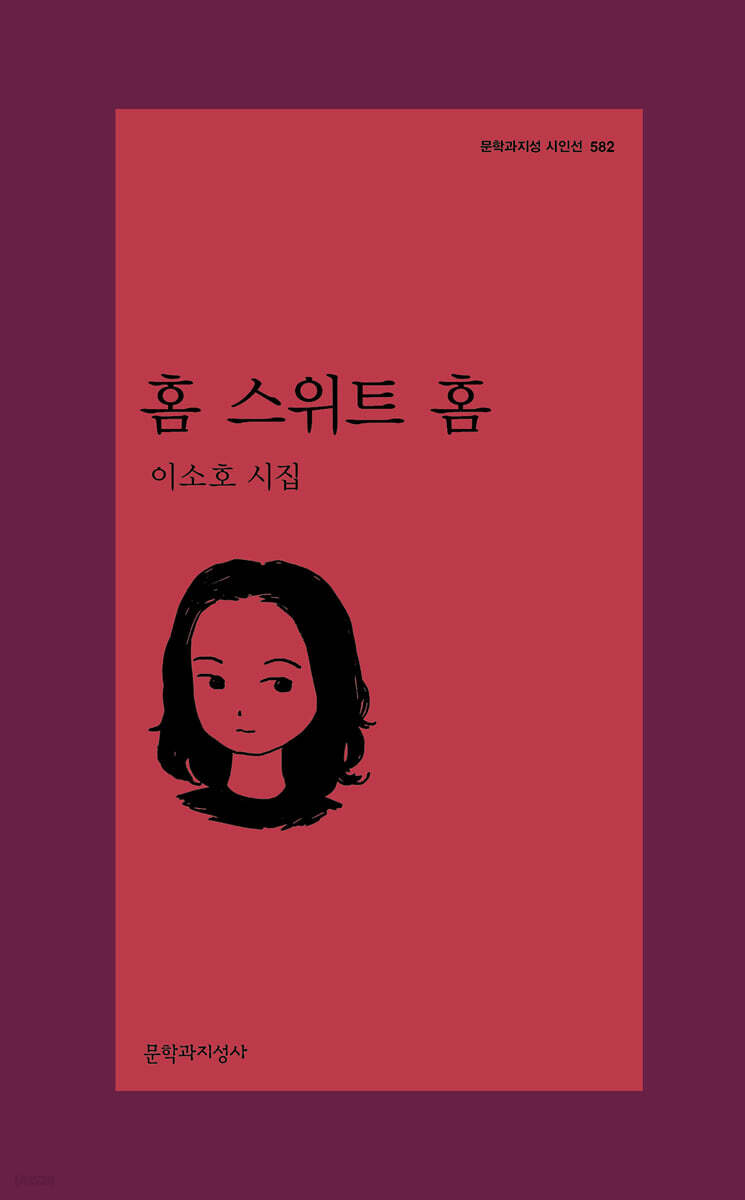
Home Sweet Home
 |
Description
Book Introduction
“It was so far away that I felt like I could never escape.
So I thought it had to be now.”
The house that takes me in and the family that confines me
A history of violence surrounding spaces designed with love
The courage to bring liberation beyond closed doors: Lee So-ho's third poetry collection published.
Poet Lee So-ho, who began his career in 2014 with 『Modern Poetry』 and presented avant-garde and combative works that shattered the everyday, winning the 37th Kim Su-young Literary Award, has published his third poetry collection, 『Home Sweet Home』, with Munhak-kwa-Jiseongsa.
It has been two years since the previous poetry collection, 『Unsettling and Imperfect Letter』 (Hyundae Literature, 2021).
A total of 48 poems were collected.
Lee So-ho's poetry, which traces the historical suffering of women and seeks an escape from reality, boldly exposes the dark remnants of patriarchal society, such as sexism and hatred for the weak, and appeals for the restoration of contemporary ethics.
The groundbreaking voice of her debut poetry collection, 『Catcalling』, which “boldly erases the position of a third party as a witness and bystander in a place of violence” (Jang Eun-jeong), goes through the textualization and aesthetic exploration of an exhibition space that maximizes immersion (『Unsettling and Incomplete Letters』), and in this poetry collection, through the poetic self with enhanced density and the title “Home Sweet Home,” sharply dissects the irony of the primal group.
The illustrations in the text, created by visual artist Yeon Yeo-in, renowned for her delicate handling of unconscious expressions, further enrich the reader's synesthesia.
“By choosing the method of ‘exhibition’ that clearly, directly, and shockingly shows, isn’t it possible that Lee So-ho’s poetry is instead focusing on remembering, on making us remember, that there are still many things that cannot be heard clearly?” (Hong Seong-hee) Lee So-ho’s poetry persistently digs into the depths of the collective consciousness that has been unconsciously embodied in individuals and searches for the future.
Going beyond the personal history filled with confusion and pain, aiming straight at the direction and leap point that the history of the self should take.
Lee So-ho's poetry may be trying to give back, at least for a moment, the empty space where some stories can escape being buried in the logic of people's comfortable fables.
I hope that emptiness can approach my affectionate neighbors as much as it can me, not as a sweetness that is simply covered, but as a loneliness, and that someday we can all hear that in the silence that is five or six times deeper than the blank space that separates a line, there is a person, not a rat.
-Hong Seong-hee, commentary from "A Place Without a Rice Cooker"
So I thought it had to be now.”
The house that takes me in and the family that confines me
A history of violence surrounding spaces designed with love
The courage to bring liberation beyond closed doors: Lee So-ho's third poetry collection published.
Poet Lee So-ho, who began his career in 2014 with 『Modern Poetry』 and presented avant-garde and combative works that shattered the everyday, winning the 37th Kim Su-young Literary Award, has published his third poetry collection, 『Home Sweet Home』, with Munhak-kwa-Jiseongsa.
It has been two years since the previous poetry collection, 『Unsettling and Imperfect Letter』 (Hyundae Literature, 2021).
A total of 48 poems were collected.
Lee So-ho's poetry, which traces the historical suffering of women and seeks an escape from reality, boldly exposes the dark remnants of patriarchal society, such as sexism and hatred for the weak, and appeals for the restoration of contemporary ethics.
The groundbreaking voice of her debut poetry collection, 『Catcalling』, which “boldly erases the position of a third party as a witness and bystander in a place of violence” (Jang Eun-jeong), goes through the textualization and aesthetic exploration of an exhibition space that maximizes immersion (『Unsettling and Incomplete Letters』), and in this poetry collection, through the poetic self with enhanced density and the title “Home Sweet Home,” sharply dissects the irony of the primal group.
The illustrations in the text, created by visual artist Yeon Yeo-in, renowned for her delicate handling of unconscious expressions, further enrich the reader's synesthesia.
“By choosing the method of ‘exhibition’ that clearly, directly, and shockingly shows, isn’t it possible that Lee So-ho’s poetry is instead focusing on remembering, on making us remember, that there are still many things that cannot be heard clearly?” (Hong Seong-hee) Lee So-ho’s poetry persistently digs into the depths of the collective consciousness that has been unconsciously embodied in individuals and searches for the future.
Going beyond the personal history filled with confusion and pain, aiming straight at the direction and leap point that the history of the self should take.
Lee So-ho's poetry may be trying to give back, at least for a moment, the empty space where some stories can escape being buried in the logic of people's comfortable fables.
I hope that emptiness can approach my affectionate neighbors as much as it can me, not as a sweetness that is simply covered, but as a loneliness, and that someday we can all hear that in the silence that is five or six times deeper than the blank space that separates a line, there is a person, not a rat.
-Hong Seong-hee, commentary from "A Place Without a Rice Cooker"
- You can preview some of the book's contents.
Preview
index
Poet's words
plastic house
Members
fanatic
I live alone in an apartment
It's our home and not our home at the same time
From the bottom
Home Sweet Home
Home at Home
Handless Day
Father comes into the bag
Special Documentary
A voice buried between friendly neighbors and noise between floors
minimalist
The life story of a lonely gateball player
refugees
unpopular house
bundle
Good Morning America
All the possibilities that newspapers cannot contain
Inuit eating birds
Tundra
Off-White
He is American and I am Korean
Growing pains
playground
school, paper, ding
Bingo is my name
dice game
Shapes, Shadows, and Illusions
The place where the string stayed
This paper is too small to hold all your feelings.
Road, rain, and each other's room
Taxi Mania
City Health Guide
Mimosa
Instant Poem
Rest in peace in New York
The Bronx over the Brooklyn Bridge
vacation spot
Non-neighbors
The exhibition "Lee So-ho: A Thick Forest" is currently being held on the B4 floor of the New Museum in New York.
Nude Croquis at Midday
Letter from Melbourne
Immigration News in Brief
For Whom the Bell Tolls
Comeback Home
8th day
Maybe there's something better out there for us
commentary
A place without a rice cooker · Hong Seong-hee
plastic house
Members
fanatic
I live alone in an apartment
It's our home and not our home at the same time
From the bottom
Home Sweet Home
Home at Home
Handless Day
Father comes into the bag
Special Documentary
A voice buried between friendly neighbors and noise between floors
minimalist
The life story of a lonely gateball player
refugees
unpopular house
bundle
Good Morning America
All the possibilities that newspapers cannot contain
Inuit eating birds
Tundra
Off-White
He is American and I am Korean
Growing pains
playground
school, paper, ding
Bingo is my name
dice game
Shapes, Shadows, and Illusions
The place where the string stayed
This paper is too small to hold all your feelings.
Road, rain, and each other's room
Taxi Mania
City Health Guide
Mimosa
Instant Poem
Rest in peace in New York
The Bronx over the Brooklyn Bridge
vacation spot
Non-neighbors
The exhibition "Lee So-ho: A Thick Forest" is currently being held on the B4 floor of the New Museum in New York.
Nude Croquis at Midday
Letter from Melbourne
Immigration News in Brief
For Whom the Bell Tolls
Comeback Home
8th day
Maybe there's something better out there for us
commentary
A place without a rice cooker · Hong Seong-hee
Into the book
Claws are sharp, stealthy, and dirty. That's why claws were useful in many ways. With the same hand that dug into the gazelle's insides, I scratched the inside of my pants. Every time there was a thumping sound, I only knew how to gasp for breath. My husband, who was in the electric blanket, said in Africa, "Hey, you ignorant woman, didn't you see it on TV? Don't brag about doing the same petty housework that everyone else does. A detective doesn't hunt, if you don't even know."
---From "Special Documentary"
My dear youngest daughter, this place is full of grass that lies flat on the ground. After the long winter, we go to each other's house on the damp, pathless road that has become hollow. My father always lives in a light that may go out at any time. When I look at the horizon, I think it is as long as the palm of my hand. I wonder if I have ever been so close to death for so long.
The white sunset swallows the red sun, and I draw Korea in the rain. Every handful of wet dirt has the weight of a single letter, and every wet piece of paper reminds me of a tree planted far away. Daughter, it's hard to believe this place, but it's a night where mornings continue. It's a morning where light continues. That's why it's a difficult night where I have to live through the day without stopping.
---From "Tundra"
I wish my house was all red
I take out a red pen and write my name on it.
Lee Kyung-jin, Lee So-ri, Lee So-ho
Who should I kill first to be happy?
The pen killed me first
---From "Taxi Mania"
Mom, do you know that?
My brother is different from other people.
Just touching it occasionally
Except for that one thing, really
great
I'm so lucky
---From "Mimosa"
Therefore, we each say what we want to believe.
I chose and believed
You are right
I am out of sync
That very world
“Who do you think died?”
---From "For Whom the Bell Tolls"
We lie down and dream dreams that don't exist, like the first humans and their children, connecting the dots to make lines and filling them with all the things we like, creating stories of stories.
Maybe they did too? Eventually, they'll forget everything and only look for the North Star and the Big Dipper like we do. Because that's the most striking. And they'll pretend to know everything else, even though they only know names. And the people who fall asleep listening to those stories like lullabies, the sheep that those named people raised quietly at night, and the dogs that herd those sheep all had names. Perhaps they shear the sheep in winter and slaughter them in summer, and for a brief moment, they'll pray for their souls and ease their guilt, just like us.
---From "Special Documentary"
My dear youngest daughter, this place is full of grass that lies flat on the ground. After the long winter, we go to each other's house on the damp, pathless road that has become hollow. My father always lives in a light that may go out at any time. When I look at the horizon, I think it is as long as the palm of my hand. I wonder if I have ever been so close to death for so long.
The white sunset swallows the red sun, and I draw Korea in the rain. Every handful of wet dirt has the weight of a single letter, and every wet piece of paper reminds me of a tree planted far away. Daughter, it's hard to believe this place, but it's a night where mornings continue. It's a morning where light continues. That's why it's a difficult night where I have to live through the day without stopping.
---From "Tundra"
I wish my house was all red
I take out a red pen and write my name on it.
Lee Kyung-jin, Lee So-ri, Lee So-ho
Who should I kill first to be happy?
The pen killed me first
---From "Taxi Mania"
Mom, do you know that?
My brother is different from other people.
Just touching it occasionally
Except for that one thing, really
great
I'm so lucky
---From "Mimosa"
Therefore, we each say what we want to believe.
I chose and believed
You are right
I am out of sync
That very world
“Who do you think died?”
---From "For Whom the Bell Tolls"
We lie down and dream dreams that don't exist, like the first humans and their children, connecting the dots to make lines and filling them with all the things we like, creating stories of stories.
Maybe they did too? Eventually, they'll forget everything and only look for the North Star and the Big Dipper like we do. Because that's the most striking. And they'll pretend to know everything else, even though they only know names. And the people who fall asleep listening to those stories like lullabies, the sheep that those named people raised quietly at night, and the dogs that herd those sheep all had names. Perhaps they shear the sheep in winter and slaughter them in summer, and for a brief moment, they'll pray for their souls and ease their guilt, just like us.
---From "The Eighth Day"
Publisher's Review
Lee So-ho's fable that pushes away tragedy
At the pinnacle of understanding, the 'I' stuffed into a story
I am the father between my father and the television
I crossed the bridge
You're a bitch without any sense
Adults don't cross the line
got angry
Death abounds on television
Hope is only in the weather
─Excerpt from "Handless Day"
In Lee So-ho's poetry, the home does not function as a safe fence.
Family members, who should be the foundation of emotional stability, sporadically shout at the poetic speaker, "I," in voices close to noise, expressing their contempt through oppression and control.
This act of the other within the primary group, which denies the value of existence before the judgment of 'me', not only hinders the growth of the subject, but also foreshadows the birth of a member of the secondary group, ruined by strong bondage and pathological adhesion.
The unconfirmed “laughter of another family on TV” (“Plastic House”) is too distant, and the family custom of “the one with the loudest voice wins” is too close.
For me, who is not protected by my family, society is another fear, a wall blocking a landscape that can only be imagined.
Having learned the art of survival by “swearing at my mother and my mother’s mother to silence her” and “learning from the corner of my eye what my mother did to me” (“Constituent”), “I” question the world, “How can trials become a testimony?” and shout, “Faith is only possible when you show a miracle” (“Fanatic”).
“People far away working all night/I take it as part of the scenery” (“I Live Alone in an Apartment”). ‘I’ define my social status as a “non-regular poet” who “has no home” and “has no property” and tries to run away to find a new family, but the man who “searched for my name” overtakes ‘I’ and runs away from ‘I’.
After the failed escape, the sentence that was “quietly filled on the empty floor” in a small size that the family could not notice was none other than “Please save me” (from “Home Sweet Home”).
The reader repeatedly witnesses this desperate and desperate scream growing deeper inside, becoming a 'prayer' in small, dense layers ("At the Bottom").
Shall we forget today's rare misfortune?
I put my hand in front of the typewriter
Dad, who had been staring blankly, shouted
The daughter is sitting proudly and writing.
Are you saying I have to pay all that money?
You too give up hope
─「Home Sweet Home」 section
The inherent flaws of the primal group allow 'I' to perceive and perceive, almost a priori, the isolation and fractures of the self.
According to my father, 'I' am a split self that possesses both 'no concept' and 'nobility'.
The former refers to the absence of a concept that fits the system and discipline enforced in the home, while the latter is a mockery of the speaker's own autonomous act of choice (writing).
Neither side can be safe from the cries of “abandon hope.”
As we live, we come to realize that we/didn't know each other very well" ("Maybe there's something better for us"), the unhappiness of family brings about extreme frustration and helplessness that is different from any other social group we experience in life, not only because of the consideration of 'compatibility' with 'me', but also because there is no choice.
Indiscriminate personal attacks and frequent 'sentences' have a direct impact on life, and as emotional detachment becomes difficult, they create a chronic 'my fault' or guilt.
“I don’t know what my fault is,” he says, but he continues to endlessly yearn for something to fill the void, knowing “no other way than to lie flat on the ground” (“Come Back Home”).
Looking at “the empty moon and the streetlights beyond the window collapsing,” and wishing “my house would all turn red” (“Taxi Mania”), self-destructive desires and hostility boil over in the heart of “me.”
However, the speaker stops running away from the tragedy and picks up his pen to slowly relive the dead time.
The back of a dream that hasn't been there for a very long time
A sad immigrant story
I, who throws away whatever I can get my hands on, even if it's just for a handshake, and even though I know that I won't be able to change anything, I keep picking up stones, one after another, until the scenery turns white, stones that were once stones, worn down and worn down.
Throw
So that means I like you
─「Instant Poem」 section
The text illustrations by visual artist Yeon Yeo-in, which flow without a trace, are a landmark for those exploring 『Home Sweet Home』.
A girl with a backpack watches intently at a grotesque house with people's limbs poking out of the wall (p.
52) “There is no eternal leader” and we walk into the history of maternal grandmother Lee Soon-jung and maternal grandfather Chae Hyeon-muk through an alley where ‘leak light’ can be seen (in “The Unpopular House”).
The lives of an American immigrant father who “always lives in a light that may go out at any moment” (“Tundra”) and his Korean wife who “has to raise three children alone in a single-parent household” (“He is American, I am Korean”) are as distant as the physical gap that has widened, and they do not receive each other’s attention, but they continue a new conversation through the poet’s pen.
The intersection of multiple voices found in Lee So-ho's poetry thus stems from a constant attempt to grasp the tragedy of existence in a broader sense.
Even if it is not true, with the upright attitude of “learning to see throughout one’s life” (“Off-White”), he delves into the details of each existence’s time and weaves together multiple perspectives.
Lee So-ho creates a new family narrative by combining unconvincing language with an unconvincing heart.
Off-white, close to pure white but not pure white, the poetry of eyes mixed with confession and forgiveness fills the deep-seated furrows of the heart with white.
The speaker, who mutters, “How sad is the world that looks only to the left, in a mess” (“A Voice Lost Between a Kind Neighbor and the Noise Between Floors”), chooses to “imagine the sadness of a stranger” (“Instant Poem”) as a way to escape the loneliness of being completely alone.
It traces and records the sorrow of a stranger who has set foot on the land of 'my' by tracing the history of family members.
Everyone's story starts with me.
The poet's writing continues like that.
Running away and expanding infinitely
Light discovered in the world of 'writing'
The fingers rise calmly over the keyboard
A hymn that is difficult for everyone to sing because it is stuck in a strange octave
It's strange, no matter how much I call it, it's a return sign
Go back
But someone put emphasis on the ending
“Ah—amen”
It will only end when you shout it out
It has not yet been revealed who that someone is.
I wanted to keep singing
I was the most desperate person that day.
― From the poet's prose on the back cover
The poetic speakers Soho and Sijin, descendants of first-generation immigrants who left in search of the American dream, also seek to escape home through immigration or study abroad.
However, he endures time under the compulsion to “survive here” (“Letters from Melbourne”), suffering from the pain of “feeling like I have no home anywhere now” and “wanting to go home even though I am at home.”
The stories of Chae Hyun-mook, who lived a life where he had to “dig a new hole every day he went outside” (“The Bird-Eating Inuit”) in the midst of chaos, and Si-jin (“A Brief Immigration News”), who breathlessly introduced himself in English to obtain a visa, seem to be common gestures of being trapped in a terrible return point where they can never leave home or be saved, but the “Soho Fable” is completed without presenting a single clear lesson from it.
As Hong Seong-hee, who commented on the poetry collection, said, “Perhaps the work of ‘Home Sweet Home’ is asking each of us where ‘home sweet home’ is, only in the way we dream of moving while not completing the move, and in the way we believe that moving should not be completed, at least not yet.”
Lee So-ho's poetry says, "We cannot help but hesitate before the great period."
Lee So-ho's world of poetry is about returning the subject to a state of yearning for possibility, not death, and enlightenment, and thus, it describes a long journey to sincerely send a letter that "writes about our future and our lofty hopes," a letter that "may never arrive" (from "Maybe There's Something Greater for Us").
The house that the short-haired girl, the main character of the main illustration, leaves behind gradually shrinks in size and disappears at the end.
Sitting on a one-person sofa on the rough waves, he looks at a map under the light, his expression quite serious and comfortable, like a 'person at home'.
Thus, today, Lee So-ho's world of poetry invites us to a literary home constructed in the most free and three-dimensional way, crossing over personal grief and despair.
■ Back cover text (poet's prose)
I briefly visited hell while God was dozing off. I wore a white veil and a rosary ring, but it was so horrible that I opened my eyes in a flash during the service. My mother, who was sitting next to me confessing a sin I hadn't committed, stopped making the sign of the cross and quickly placed her index finger on my noisy lips.
again
The fingers rise calmly over the keyboard
A hymn that is difficult for everyone to sing because it is stuck in a strange octave
It's strange, no matter how much I call it, it's a return sign
Go back
But someone put emphasis on the ending
“Ah—amen”
It will only end when you shout it out
It has not yet been revealed who that someone is.
I wanted to keep singing
I was the most desperate person that day.
■ Poet's Note
I decided not to go home.
That place is not sunny
Even if it is a place where light shines.
Spring 2023
Lee So-ho
At the pinnacle of understanding, the 'I' stuffed into a story
I am the father between my father and the television
I crossed the bridge
You're a bitch without any sense
Adults don't cross the line
got angry
Death abounds on television
Hope is only in the weather
─Excerpt from "Handless Day"
In Lee So-ho's poetry, the home does not function as a safe fence.
Family members, who should be the foundation of emotional stability, sporadically shout at the poetic speaker, "I," in voices close to noise, expressing their contempt through oppression and control.
This act of the other within the primary group, which denies the value of existence before the judgment of 'me', not only hinders the growth of the subject, but also foreshadows the birth of a member of the secondary group, ruined by strong bondage and pathological adhesion.
The unconfirmed “laughter of another family on TV” (“Plastic House”) is too distant, and the family custom of “the one with the loudest voice wins” is too close.
For me, who is not protected by my family, society is another fear, a wall blocking a landscape that can only be imagined.
Having learned the art of survival by “swearing at my mother and my mother’s mother to silence her” and “learning from the corner of my eye what my mother did to me” (“Constituent”), “I” question the world, “How can trials become a testimony?” and shout, “Faith is only possible when you show a miracle” (“Fanatic”).
“People far away working all night/I take it as part of the scenery” (“I Live Alone in an Apartment”). ‘I’ define my social status as a “non-regular poet” who “has no home” and “has no property” and tries to run away to find a new family, but the man who “searched for my name” overtakes ‘I’ and runs away from ‘I’.
After the failed escape, the sentence that was “quietly filled on the empty floor” in a small size that the family could not notice was none other than “Please save me” (from “Home Sweet Home”).
The reader repeatedly witnesses this desperate and desperate scream growing deeper inside, becoming a 'prayer' in small, dense layers ("At the Bottom").
Shall we forget today's rare misfortune?
I put my hand in front of the typewriter
Dad, who had been staring blankly, shouted
The daughter is sitting proudly and writing.
Are you saying I have to pay all that money?
You too give up hope
─「Home Sweet Home」 section
The inherent flaws of the primal group allow 'I' to perceive and perceive, almost a priori, the isolation and fractures of the self.
According to my father, 'I' am a split self that possesses both 'no concept' and 'nobility'.
The former refers to the absence of a concept that fits the system and discipline enforced in the home, while the latter is a mockery of the speaker's own autonomous act of choice (writing).
Neither side can be safe from the cries of “abandon hope.”
As we live, we come to realize that we/didn't know each other very well" ("Maybe there's something better for us"), the unhappiness of family brings about extreme frustration and helplessness that is different from any other social group we experience in life, not only because of the consideration of 'compatibility' with 'me', but also because there is no choice.
Indiscriminate personal attacks and frequent 'sentences' have a direct impact on life, and as emotional detachment becomes difficult, they create a chronic 'my fault' or guilt.
“I don’t know what my fault is,” he says, but he continues to endlessly yearn for something to fill the void, knowing “no other way than to lie flat on the ground” (“Come Back Home”).
Looking at “the empty moon and the streetlights beyond the window collapsing,” and wishing “my house would all turn red” (“Taxi Mania”), self-destructive desires and hostility boil over in the heart of “me.”
However, the speaker stops running away from the tragedy and picks up his pen to slowly relive the dead time.
The back of a dream that hasn't been there for a very long time
A sad immigrant story
I, who throws away whatever I can get my hands on, even if it's just for a handshake, and even though I know that I won't be able to change anything, I keep picking up stones, one after another, until the scenery turns white, stones that were once stones, worn down and worn down.
Throw
So that means I like you
─「Instant Poem」 section
The text illustrations by visual artist Yeon Yeo-in, which flow without a trace, are a landmark for those exploring 『Home Sweet Home』.
A girl with a backpack watches intently at a grotesque house with people's limbs poking out of the wall (p.
52) “There is no eternal leader” and we walk into the history of maternal grandmother Lee Soon-jung and maternal grandfather Chae Hyeon-muk through an alley where ‘leak light’ can be seen (in “The Unpopular House”).
The lives of an American immigrant father who “always lives in a light that may go out at any moment” (“Tundra”) and his Korean wife who “has to raise three children alone in a single-parent household” (“He is American, I am Korean”) are as distant as the physical gap that has widened, and they do not receive each other’s attention, but they continue a new conversation through the poet’s pen.
The intersection of multiple voices found in Lee So-ho's poetry thus stems from a constant attempt to grasp the tragedy of existence in a broader sense.
Even if it is not true, with the upright attitude of “learning to see throughout one’s life” (“Off-White”), he delves into the details of each existence’s time and weaves together multiple perspectives.
Lee So-ho creates a new family narrative by combining unconvincing language with an unconvincing heart.
Off-white, close to pure white but not pure white, the poetry of eyes mixed with confession and forgiveness fills the deep-seated furrows of the heart with white.
The speaker, who mutters, “How sad is the world that looks only to the left, in a mess” (“A Voice Lost Between a Kind Neighbor and the Noise Between Floors”), chooses to “imagine the sadness of a stranger” (“Instant Poem”) as a way to escape the loneliness of being completely alone.
It traces and records the sorrow of a stranger who has set foot on the land of 'my' by tracing the history of family members.
Everyone's story starts with me.
The poet's writing continues like that.
Running away and expanding infinitely
Light discovered in the world of 'writing'
The fingers rise calmly over the keyboard
A hymn that is difficult for everyone to sing because it is stuck in a strange octave
It's strange, no matter how much I call it, it's a return sign
Go back
But someone put emphasis on the ending
“Ah—amen”
It will only end when you shout it out
It has not yet been revealed who that someone is.
I wanted to keep singing
I was the most desperate person that day.
― From the poet's prose on the back cover
The poetic speakers Soho and Sijin, descendants of first-generation immigrants who left in search of the American dream, also seek to escape home through immigration or study abroad.
However, he endures time under the compulsion to “survive here” (“Letters from Melbourne”), suffering from the pain of “feeling like I have no home anywhere now” and “wanting to go home even though I am at home.”
The stories of Chae Hyun-mook, who lived a life where he had to “dig a new hole every day he went outside” (“The Bird-Eating Inuit”) in the midst of chaos, and Si-jin (“A Brief Immigration News”), who breathlessly introduced himself in English to obtain a visa, seem to be common gestures of being trapped in a terrible return point where they can never leave home or be saved, but the “Soho Fable” is completed without presenting a single clear lesson from it.
As Hong Seong-hee, who commented on the poetry collection, said, “Perhaps the work of ‘Home Sweet Home’ is asking each of us where ‘home sweet home’ is, only in the way we dream of moving while not completing the move, and in the way we believe that moving should not be completed, at least not yet.”
Lee So-ho's poetry says, "We cannot help but hesitate before the great period."
Lee So-ho's world of poetry is about returning the subject to a state of yearning for possibility, not death, and enlightenment, and thus, it describes a long journey to sincerely send a letter that "writes about our future and our lofty hopes," a letter that "may never arrive" (from "Maybe There's Something Greater for Us").
The house that the short-haired girl, the main character of the main illustration, leaves behind gradually shrinks in size and disappears at the end.
Sitting on a one-person sofa on the rough waves, he looks at a map under the light, his expression quite serious and comfortable, like a 'person at home'.
Thus, today, Lee So-ho's world of poetry invites us to a literary home constructed in the most free and three-dimensional way, crossing over personal grief and despair.
■ Back cover text (poet's prose)
I briefly visited hell while God was dozing off. I wore a white veil and a rosary ring, but it was so horrible that I opened my eyes in a flash during the service. My mother, who was sitting next to me confessing a sin I hadn't committed, stopped making the sign of the cross and quickly placed her index finger on my noisy lips.
again
The fingers rise calmly over the keyboard
A hymn that is difficult for everyone to sing because it is stuck in a strange octave
It's strange, no matter how much I call it, it's a return sign
Go back
But someone put emphasis on the ending
“Ah—amen”
It will only end when you shout it out
It has not yet been revealed who that someone is.
I wanted to keep singing
I was the most desperate person that day.
■ Poet's Note
I decided not to go home.
That place is not sunny
Even if it is a place where light shines.
Spring 2023
Lee So-ho
GOODS SPECIFICS
- Date of issue: April 1, 2023
- Page count, weight, size: 188 pages | 266g | 128*205*20mm
- ISBN13: 9788932041346
- ISBN10: 8932041342
You may also like
카테고리
korean


korean

![ELLE 엘르 스페셜 에디션 A형 : 12월 [2025]](http://librairie.coreenne.fr/cdn/shop/files/b8e27a3de6c9538896439686c6b0e8fb.jpg?v=1766436872&width=3840)


