

The Beginning of a Post-Peak Massive Reversal
 |
Description
Book Introduction
- A word from MD
-
Should we use more nuclear power and genetically modified crops?"Technological advancements and capitalism will create an environmentally friendly future." I don't readily agree.
But if you read this book, you'll realize that maybe that's not entirely wrong.
Is there any hope for us as we approach the peak of our planetary exploitation? To move forward in a better direction, we sometimes need to listen to voices that differ from our own.
October 30, 2020. Park Jeong-yoon, Economics and Management PD
“Technological advancement and capitalism create
A more prosperous and environmentally friendly future is coming!”
Praised by the global media, including The Economist, Publisher's Weekly, and The Wall Street Journal!
Highly recommended by Steven Pinker, Christine Lagarde, Eric Schmidt… leaders from around the world!
∨ Are existing species really endangered?
∨ Is global inequality continuing to increase?
∨ Is there no way to grow without damaging the Earth?
∨ How will we survive in the face of climate change?
We have now passed the peak of Earth's exploitation.
Is sustainable growth possible amidst new technological advancements? Professor Andrew McAfee of the MIT Center for Digital Business, who has previously posited a rosy outlook on the future of technological advancement in his books "The Second Machine Age" and "Machine Platform Crowd," presents a new book, "Post-Peak: The Beginning of the Great Reversal," using various charts and indices to illustrate the changes that will occur as we reduce our use of the Earth's resources.
Moreover, it clearly presents how this change will transform industry, the economy, and the world, and the magical future that will unfold before our eyes through it.
A more prosperous and environmentally friendly future is coming!”
Praised by the global media, including The Economist, Publisher's Weekly, and The Wall Street Journal!
Highly recommended by Steven Pinker, Christine Lagarde, Eric Schmidt… leaders from around the world!
∨ Are existing species really endangered?
∨ Is global inequality continuing to increase?
∨ Is there no way to grow without damaging the Earth?
∨ How will we survive in the face of climate change?
We have now passed the peak of Earth's exploitation.
Is sustainable growth possible amidst new technological advancements? Professor Andrew McAfee of the MIT Center for Digital Business, who has previously posited a rosy outlook on the future of technological advancement in his books "The Second Machine Age" and "Machine Platform Crowd," presents a new book, "Post-Peak: The Beginning of the Great Reversal," using various charts and indices to illustrate the changes that will occur as we reduce our use of the Earth's resources.
Moreover, it clearly presents how this change will transform industry, the economy, and the world, and the magical future that will unfold before our eyes through it.
- You can preview some of the book's contents.
Preview
index
Introduction: A User's Manual for a New Earth
┃Chapter 1┃Malthus's Era: Humanity Covering the Earth
Bad Vibrations | The Limits to Growth | Us vs. the World
Chapter 2: The Industrial Age, When Humanity Conquered the Earth
The World's Most Powerful Concept: From Steam to Earth: Rising Income, Vanishing Germs, Better Food: The Second Century of Electricity and Combustion: Feeding the World: Masters of Our Field
Chapter 3: Errors Created by the Industrial Age
Humans as Property ┃ Children Suffering from Labor ┃ A Desperate Desire for Land ┃ All We Gained Was Gray Sky ┃ An Unhappy Hunting Ground ┃ Jevons and Marshall, the Depressed Brothers ┃ The Battle for More and More
┃Chapter 4┃ On Earth Day and the Controversy
Is pollution the problem? ┃Bad breeding┃Depleted reserves┃Energy depletion┃Emergency statement┃CRIB or grave┃Is it really that bad?┃Betting on the planet┃The forecast remains bleak.
Chapter 5: The Amazing Achievement of Dematerialization
Without realizing that it was getting lighter┃A great reversal
┃Chapter 6┃CRIB Supplementary Explanation
Everyone Consumes┃Recycling Unrelated to Dematerialization┃Returning to Farming is Bad for the Land┃Laws That Impose Restrictions
Chapter 7: Causes of Dematerialization: Capitalism and Technological Development
Fertile Farms┃ Thin Cans┃ Disappearing Devices┃ From Peak to Peak Again in Oil Production┃ Examining Railroad Cars┃ Why the Rare Earth Threat Failed┃ What's Happening?┃ Technology, the Interface Between Humans and Materials┃ Capitalism as a Means of Production┃ Overcoming Limitations┃ The Beginning of the Second Enlightenment
Chapter 8: What We Didn't Know About Capitalism
Critics of capitalism are only half right. Somewhere along the spectrum, socialist experiments are no longer needed. The problem is that capitalism isn't being fully embraced.
Chapter 9: Why Public Awareness and Government Policy Are Necessary
The Negative Sides of Capitalism | Markets for Pollution | Of and for People | Globalization of Pollution | Animal Welfare Obligations and the Beast | Confronting Animal Drives | When Cooperation Fails | The Four Horsemen of Optimism | Institutionalized Progress | Horsemen and the Automobile | Fewer Horsemen? Fewer Whales
Chapter 10: The Four Horsemen's World Ride
For Everyone | Mass Market Entry | Global Good Government Movement | Embracing Compassion
┃Chapter 11┃Getting Much Better
The Power of Negative Thinking ┃The State of Nature┃The Human Condition
┃Chapter 12┃The Power of Concentration
Where the action is: Doing more with less | Giants of industry | Winner-take-all in technology | Three economic stories from the world's richest people
┃Chapter 13┃The Disconnection Brought About by the Weakening of Bonds
Capital Under Attack ┃Critical Decline ┃Shattered ┃What Your Riders Left Behind ┃Perceived Injustice Disconnection, Authoritarianism, Polarization ┃Believe in What's Not True
Chapter 14: Predicting the Future
A Growth Mindset ┃A Prosperity Machine ┃A Brighter, Lighter Future ┃Healing a Heated World ┃The Second Round: A Gamble on the Fate of the Earth
┃Chapter 15┃How can we change it?
National Policy┃Good Business┃Non-profit Organizations┃Enlightened Citizens
Conclusion Our next planet
After moving
annotation
┃Chapter 1┃Malthus's Era: Humanity Covering the Earth
Bad Vibrations | The Limits to Growth | Us vs. the World
Chapter 2: The Industrial Age, When Humanity Conquered the Earth
The World's Most Powerful Concept: From Steam to Earth: Rising Income, Vanishing Germs, Better Food: The Second Century of Electricity and Combustion: Feeding the World: Masters of Our Field
Chapter 3: Errors Created by the Industrial Age
Humans as Property ┃ Children Suffering from Labor ┃ A Desperate Desire for Land ┃ All We Gained Was Gray Sky ┃ An Unhappy Hunting Ground ┃ Jevons and Marshall, the Depressed Brothers ┃ The Battle for More and More
┃Chapter 4┃ On Earth Day and the Controversy
Is pollution the problem? ┃Bad breeding┃Depleted reserves┃Energy depletion┃Emergency statement┃CRIB or grave┃Is it really that bad?┃Betting on the planet┃The forecast remains bleak.
Chapter 5: The Amazing Achievement of Dematerialization
Without realizing that it was getting lighter┃A great reversal
┃Chapter 6┃CRIB Supplementary Explanation
Everyone Consumes┃Recycling Unrelated to Dematerialization┃Returning to Farming is Bad for the Land┃Laws That Impose Restrictions
Chapter 7: Causes of Dematerialization: Capitalism and Technological Development
Fertile Farms┃ Thin Cans┃ Disappearing Devices┃ From Peak to Peak Again in Oil Production┃ Examining Railroad Cars┃ Why the Rare Earth Threat Failed┃ What's Happening?┃ Technology, the Interface Between Humans and Materials┃ Capitalism as a Means of Production┃ Overcoming Limitations┃ The Beginning of the Second Enlightenment
Chapter 8: What We Didn't Know About Capitalism
Critics of capitalism are only half right. Somewhere along the spectrum, socialist experiments are no longer needed. The problem is that capitalism isn't being fully embraced.
Chapter 9: Why Public Awareness and Government Policy Are Necessary
The Negative Sides of Capitalism | Markets for Pollution | Of and for People | Globalization of Pollution | Animal Welfare Obligations and the Beast | Confronting Animal Drives | When Cooperation Fails | The Four Horsemen of Optimism | Institutionalized Progress | Horsemen and the Automobile | Fewer Horsemen? Fewer Whales
Chapter 10: The Four Horsemen's World Ride
For Everyone | Mass Market Entry | Global Good Government Movement | Embracing Compassion
┃Chapter 11┃Getting Much Better
The Power of Negative Thinking ┃The State of Nature┃The Human Condition
┃Chapter 12┃The Power of Concentration
Where the action is: Doing more with less | Giants of industry | Winner-take-all in technology | Three economic stories from the world's richest people
┃Chapter 13┃The Disconnection Brought About by the Weakening of Bonds
Capital Under Attack ┃Critical Decline ┃Shattered ┃What Your Riders Left Behind ┃Perceived Injustice Disconnection, Authoritarianism, Polarization ┃Believe in What's Not True
Chapter 14: Predicting the Future
A Growth Mindset ┃A Prosperity Machine ┃A Brighter, Lighter Future ┃Healing a Heated World ┃The Second Round: A Gamble on the Fate of the Earth
┃Chapter 15┃How can we change it?
National Policy┃Good Business┃Non-profit Organizations┃Enlightened Citizens
Conclusion Our next planet
After moving
annotation
Detailed image
Into the book
This book shows that we are beginning to get more by spending less, and explains how we reached this important milestone.
The most bizarre aspect of this story is that we haven't radically changed course to eliminate the trade-off between human prosperity and planetary health.
We just got better at what we were already doing.
--- p.8 "Introduction_User's Manual for a New Earth"
I was surprised to learn that total energy use in the United States in 2017 was down nearly 2 percent from its peak in 2008.
This is especially true considering that our economy grew by more than 15 percent during that period.
I had an unproven assumption that a growing economy would inevitably use more energy over the years.
But it's becoming clear that this is no longer the case, and that's a profound change.
As we saw in the previous chapter, energy use increased in line with economic growth in the United States over the 170 years from 1800 to 1970.
After that, the rate of increase in energy use slowed and eventually turned into a downward trend.
This is true even though the economy continues to grow.
Over the past decade, we have been producing more and more economically while using less energy.
--- pp. 114-115 "The Amazing Achievement of Dematerialization"
Smartphones have replaced several previously separate devices. They also function as GPS devices, significantly reducing the need for printed maps and contributing to the current trend toward less paper usage.
If we look back through the generations of computer paper, from the punch cards of the 1960s to the dot-column printer paper of the 1980s, it's easy to conclude that the second machine age has led to more and more trees being cut down.
However, paper consumption in the United States peaked in 1990.
As our devices become increasingly capable, interconnected, and always-on, we are rapidly moving away from paper.
The peak of global paper consumption was probably in 2013. 35)
--- p.150 "Causes of Dematerialization: Capitalism and Technological Development"
If pollution costs money, companies will invest time and effort and make the necessary technological innovations to reduce it.
Just as we make all sorts of clever attempts to reduce material and resources.
If pollution costs money, not free, then companies will strive to depollute just as they strive to dematerialize.
--- pp. 186-187 "Chapter 9: Why Public Perception and Government Policy Are Necessary"
So it's no surprise that many middle-class people in the wealthy world feel they have been treated unfairly.
And as we move deeper into the second machine age and the twin horsemen of capitalism and technological progress continue to gallop across the globe, this feeling seems likely to intensify.
Disconnection is growing in part because the structural and pervasive forces of capitalism and technological advancement breed resentment and alienation instead of trust, reciprocity, and what Mattis calls “a sense of belonging to something bigger.”
Capitalism and technological advancement directly and indirectly contribute to the phenomenon of 'disconnection'.
What about the other two riders of optimism? Responsive government and public perception? How do they relate to the decline in social capital we're experiencing?
--- p.290 "The Disconnection Brought About by the Weakening of Bonds"
In the Second Machine Age, the world's digital tools are growing at an unprecedented rate.
There are countless ways for profit-seeking companies to combine raw materials in ways that use fewer resources.
In economically developed countries like the United States, the cumulative impact of this combination of capitalism and technological advancement is significant.
It has achieved absolute dematerialization of economy and society and the consequent reduction of our footprint on the Earth.
The most bizarre aspect of this story is that we haven't radically changed course to eliminate the trade-off between human prosperity and planetary health.
We just got better at what we were already doing.
--- p.8 "Introduction_User's Manual for a New Earth"
I was surprised to learn that total energy use in the United States in 2017 was down nearly 2 percent from its peak in 2008.
This is especially true considering that our economy grew by more than 15 percent during that period.
I had an unproven assumption that a growing economy would inevitably use more energy over the years.
But it's becoming clear that this is no longer the case, and that's a profound change.
As we saw in the previous chapter, energy use increased in line with economic growth in the United States over the 170 years from 1800 to 1970.
After that, the rate of increase in energy use slowed and eventually turned into a downward trend.
This is true even though the economy continues to grow.
Over the past decade, we have been producing more and more economically while using less energy.
--- pp. 114-115 "The Amazing Achievement of Dematerialization"
Smartphones have replaced several previously separate devices. They also function as GPS devices, significantly reducing the need for printed maps and contributing to the current trend toward less paper usage.
If we look back through the generations of computer paper, from the punch cards of the 1960s to the dot-column printer paper of the 1980s, it's easy to conclude that the second machine age has led to more and more trees being cut down.
However, paper consumption in the United States peaked in 1990.
As our devices become increasingly capable, interconnected, and always-on, we are rapidly moving away from paper.
The peak of global paper consumption was probably in 2013. 35)
--- p.150 "Causes of Dematerialization: Capitalism and Technological Development"
If pollution costs money, companies will invest time and effort and make the necessary technological innovations to reduce it.
Just as we make all sorts of clever attempts to reduce material and resources.
If pollution costs money, not free, then companies will strive to depollute just as they strive to dematerialize.
--- pp. 186-187 "Chapter 9: Why Public Perception and Government Policy Are Necessary"
So it's no surprise that many middle-class people in the wealthy world feel they have been treated unfairly.
And as we move deeper into the second machine age and the twin horsemen of capitalism and technological progress continue to gallop across the globe, this feeling seems likely to intensify.
Disconnection is growing in part because the structural and pervasive forces of capitalism and technological advancement breed resentment and alienation instead of trust, reciprocity, and what Mattis calls “a sense of belonging to something bigger.”
Capitalism and technological advancement directly and indirectly contribute to the phenomenon of 'disconnection'.
What about the other two riders of optimism? Responsive government and public perception? How do they relate to the decline in social capital we're experiencing?
--- p.290 "The Disconnection Brought About by the Weakening of Bonds"
In the Second Machine Age, the world's digital tools are growing at an unprecedented rate.
There are countless ways for profit-seeking companies to combine raw materials in ways that use fewer resources.
In economically developed countries like the United States, the cumulative impact of this combination of capitalism and technological advancement is significant.
It has achieved absolute dematerialization of economy and society and the consequent reduction of our footprint on the Earth.
--- p.303 "Predicting the Future"
Publisher's Review
“In the end, we will save the Earth!”
If you're curious about the magical growth brought about by technological evolution, this is a must-read!
Throughout human history, destroying the Earth has been the only way we have grown.
We grew by cutting down forests, polluting air and water, and endlessly mining resources.
The industrial age is a representative example of economic growth based on such sacrifices of the Earth.
Capitalism and technological advancement seemed to be dragging our future into darkness.
Since the first Earth Day, the argument that we must fundamentally change this development path to protect the planet has become mainstream.
We must reduce consumption, tighten our belts, learn to share and recycle, and curb growth.
Is this claim actually correct?
Never.
In this book, MIT professor Andrew McAfee argues that we don't need to make any new changes when it comes to protecting the planet.
Our direction was not wrong.
It just needs to be accelerated a little more.
In other words, his argument is that we need to develop a market economy based on advanced technology around the world.
How could he dare make such a claim? The proof is right here in this book.
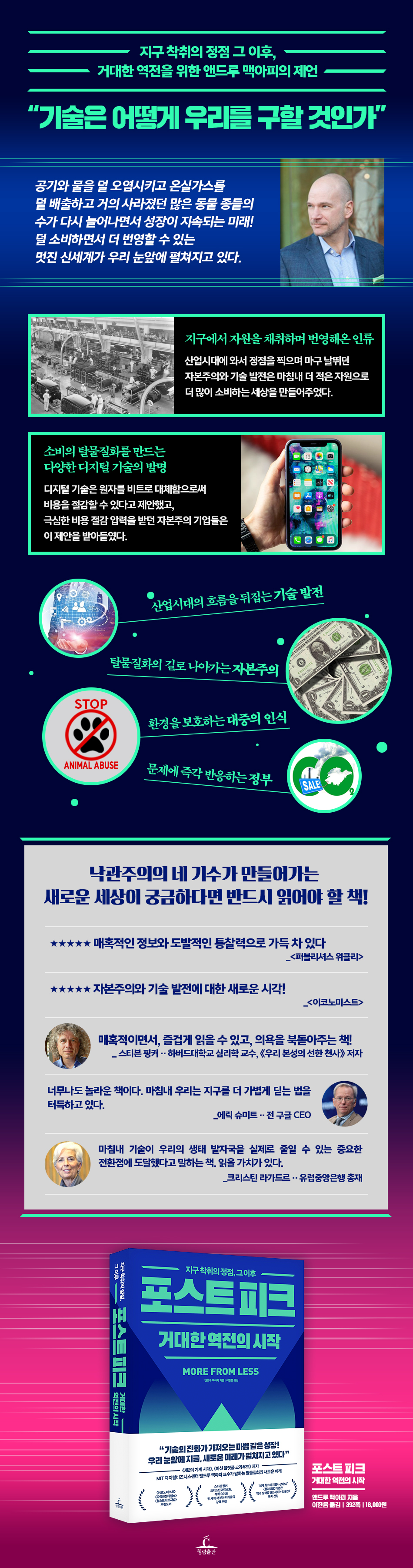
Technological advancements that reverse the flow of the industrial age, capitalism moving toward dematerialization,
Public awareness of environmental protection and government response to problems
A new world created by the four horsemen of optimism
The United States—a high-tech nation that accounts for about 25 percent of the global economy—is now using fewer resources overall year after year.
Yet, America's economy and population continue to grow.
Moreover, the United States pollutes less air and water, emits fewer greenhouse gases, and increases the population of endangered species.
And as the author shows, it's not just America.
This fundamental shift is also happening in other countries around the world.
What made this massive transformation possible? The primary cause was the collaboration between technology and capitalism.
Public awareness of environmental protection and government response to this by creating good policies also played an important role.
The author delves deeper into the future, discussing unresolved issues such as global warming, the indiscriminate hunting of endangered species, and the communities left behind by the rush of capitalism and technological advancement.
The author, who argues that we will actually take better care of the Earth and create a better world, calls technological advancement, capitalism, responsive government, and public awareness the Four Horsemen of Optimism, and says that if these knights do their job, a future brighter than we can imagine will come.
After the Peak of Earth Exploitation, Andrew McAfee's Suggestion for a Massive Reversal
The rampant capitalism and technological advancements of the industrial age have enabled us to consume more while taking less of the Earth.
We have invented many digital technologies, including computers and the Internet, that will dematerialize consumption.
Digital technology suggested that costs could be reduced by replacing atoms with bits, and capitalist companies, under intense pressure to cut costs, embraced this proposal.
Consider a smartphone.
How many cameras, camcorders, answering machines, and fax machines are being produced today? All of these tools can now be replaced by small, handheld communication devices.
We have grown and developed more, but we are using less of the Earth's resources.
“I think smartphones have actually helped ease the burden we place on the planet,” the author says in the book.
That doesn't mean we can be complacent about our technology-driven reality.
Without regulation, capitalism reveals its greedy nature.
If left alone, they will eat sea otters, tigers, rhinoceroses, and blue whales.
Ultimately, governments must protect endangered species and make polluting technologies more expensive than clean technologies.
Additionally, companies should pay citizens a carbon tax (or better yet, a dividend) based on the amount of carbon dioxide they emit.
Properly structured and limited, capitalism will not eat the planet.
Fundamentally, this book revels in the story of how we have inadvertently moved toward greater balance with nature through technological advancement and capitalism, explaining it through the lens of a paradigm shift.
This book asserts that a more prosperous and environmentally friendly future is unfolding before our eyes.
If you're curious about the magical growth brought about by technological evolution, this is a must-read!
Throughout human history, destroying the Earth has been the only way we have grown.
We grew by cutting down forests, polluting air and water, and endlessly mining resources.
The industrial age is a representative example of economic growth based on such sacrifices of the Earth.
Capitalism and technological advancement seemed to be dragging our future into darkness.
Since the first Earth Day, the argument that we must fundamentally change this development path to protect the planet has become mainstream.
We must reduce consumption, tighten our belts, learn to share and recycle, and curb growth.
Is this claim actually correct?
Never.
In this book, MIT professor Andrew McAfee argues that we don't need to make any new changes when it comes to protecting the planet.
Our direction was not wrong.
It just needs to be accelerated a little more.
In other words, his argument is that we need to develop a market economy based on advanced technology around the world.
How could he dare make such a claim? The proof is right here in this book.
Technological advancements that reverse the flow of the industrial age, capitalism moving toward dematerialization,
Public awareness of environmental protection and government response to problems
A new world created by the four horsemen of optimism
The United States—a high-tech nation that accounts for about 25 percent of the global economy—is now using fewer resources overall year after year.
Yet, America's economy and population continue to grow.
Moreover, the United States pollutes less air and water, emits fewer greenhouse gases, and increases the population of endangered species.
And as the author shows, it's not just America.
This fundamental shift is also happening in other countries around the world.
What made this massive transformation possible? The primary cause was the collaboration between technology and capitalism.
Public awareness of environmental protection and government response to this by creating good policies also played an important role.
The author delves deeper into the future, discussing unresolved issues such as global warming, the indiscriminate hunting of endangered species, and the communities left behind by the rush of capitalism and technological advancement.
The author, who argues that we will actually take better care of the Earth and create a better world, calls technological advancement, capitalism, responsive government, and public awareness the Four Horsemen of Optimism, and says that if these knights do their job, a future brighter than we can imagine will come.
After the Peak of Earth Exploitation, Andrew McAfee's Suggestion for a Massive Reversal
The rampant capitalism and technological advancements of the industrial age have enabled us to consume more while taking less of the Earth.
We have invented many digital technologies, including computers and the Internet, that will dematerialize consumption.
Digital technology suggested that costs could be reduced by replacing atoms with bits, and capitalist companies, under intense pressure to cut costs, embraced this proposal.
Consider a smartphone.
How many cameras, camcorders, answering machines, and fax machines are being produced today? All of these tools can now be replaced by small, handheld communication devices.
We have grown and developed more, but we are using less of the Earth's resources.
“I think smartphones have actually helped ease the burden we place on the planet,” the author says in the book.
That doesn't mean we can be complacent about our technology-driven reality.
Without regulation, capitalism reveals its greedy nature.
If left alone, they will eat sea otters, tigers, rhinoceroses, and blue whales.
Ultimately, governments must protect endangered species and make polluting technologies more expensive than clean technologies.
Additionally, companies should pay citizens a carbon tax (or better yet, a dividend) based on the amount of carbon dioxide they emit.
Properly structured and limited, capitalism will not eat the planet.
Fundamentally, this book revels in the story of how we have inadvertently moved toward greater balance with nature through technological advancement and capitalism, explaining it through the lens of a paradigm shift.
This book asserts that a more prosperous and environmentally friendly future is unfolding before our eyes.
GOODS SPECIFICS
- Publication date: October 28, 2020
- Page count, weight, size: 392 pages | 708g | 152*224*30mm
- ISBN13: 9788935213290
- ISBN10: 8935213292
You may also like
카테고리
korean


korean

![GQ KOREA Mark (Monthly): December [2025]](http://librairie.coreenne.fr/cdn/shop/files/8ef265dbbfbf186523ed75ba7319009d.jpg?v=1765340328&width=3840)


