

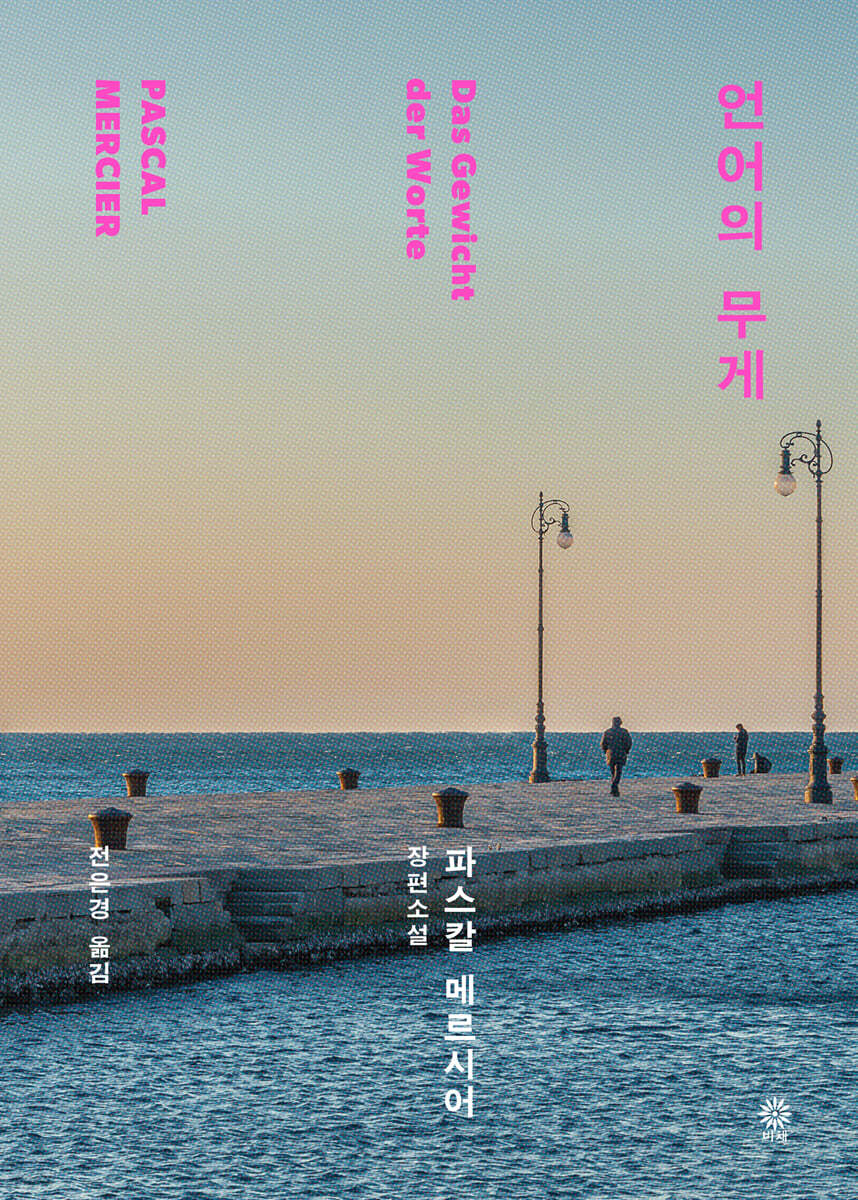
The weight of language
 |
Description
Book Introduction
- A word from MD
- [Pascal Mercier's new novel after 16 years] 'Night Train to Lisbon' Pascal Mercier's new work.
The protagonist, Leyland, stands at the end of his life and unfolds his life as a translator and his pure passion for literature in a grand panorama.
Another pure love story dedicated to literature, the “excellent and great world” that remains unchanged even in a world that changes constantly.
- Novel/Poetry PD Kim Yu-ri
Pascal Mercier, the writer who revives forgotten romance
A new novel, his first in 16 years since "Night Train to Lisbon."
Pascal Mercier, who captivated the world with "Night Train to Lisbon," meets readers with his new novel, "The Weight of Language," after 16 years.
This work colorfully illuminates the lives of several literary figures against the backdrop of Italy and England.
Leyland, who ran a long-established publishing company, stands at the end of his life and reflects on his life.
The years I have lived as a translator, the relationships that have flowed by, countless writers, translators, and publishers… … .
Looking back at all these people who have made literature their guide in life, Leyland confronts head-on the desire for creation that he had previously neglected.
Delicate yet profound thoughts, dramatic episodes of characters living in literature, and romantic European landscapes.
"The Weight of Language" has received rave reviews, claiming that it "contains all the strengths that made Pascal Mercier a world-renowned author," and has become a Der Spiegel annual bestseller, proving its worth as another of the author's masterpieces.
A new novel, his first in 16 years since "Night Train to Lisbon."
Pascal Mercier, who captivated the world with "Night Train to Lisbon," meets readers with his new novel, "The Weight of Language," after 16 years.
This work colorfully illuminates the lives of several literary figures against the backdrop of Italy and England.
Leyland, who ran a long-established publishing company, stands at the end of his life and reflects on his life.
The years I have lived as a translator, the relationships that have flowed by, countless writers, translators, and publishers… … .
Looking back at all these people who have made literature their guide in life, Leyland confronts head-on the desire for creation that he had previously neglected.
Delicate yet profound thoughts, dramatic episodes of characters living in literature, and romantic European landscapes.
"The Weight of Language" has received rave reviews, claiming that it "contains all the strengths that made Pascal Mercier a world-renowned author," and has become a Der Spiegel annual bestseller, proving its worth as another of the author's masterpieces.
- You can preview some of the book's contents.
Preview
Detailed image

Into the book
As always, when he liked a sentence, Leyland read it aloud, listening to its rhythm, the rhythm of tone and the rhythm of meaning, and the way the two rhythms blended together.
After a while he realized that he was doing something other than enjoying the sound of the words.
He was reading the sentence to Libya.
After 11 years have passed.
The way his wife listened intently to his words captivated and engulfed him.
It was the same even after 20 years.
At their Trieste home, the two would sit on the top step of the stairs and talk about words and their meanings, and how to translate them into German, English, Italian, French, and sometimes even Trieste dialect.
--- p.23
During the three years he spent sitting at the reception desk night after night, Leyland saw and heard firsthand things he had previously only read about.
Guests who returned drunk could not remember their room numbers.
I lost my documents and couldn't pay my accommodation fees.
There was even a customer who had to call a doctor because his stomach pain was so bad.
One woman's labor pains started earlier than expected, so an ambulance was called.
There were also instances where the police showed up and took someone away.
Some crazy musician played the trumpet at 3 in the morning.
There were some couples who were so in a hurry that they couldn't even get to bed.
Some film crews were trying to shoot in the middle of the night.
There were also people who came to an unfamiliar city and urgently needed a lawyer.
People who just wanted to talk were happy to see Leyland, who spoke their native language.
These were fragmented stories of disappointment, anxiety, and loneliness.
--- p.60
“I was a pharmacist.
I took over my father's pharmacy.
It was in Hackney, in the East End.
There are many workers, poor people, and undocumented foreigners living there.
There are few doctors and you have to wait a long time.
People who cannot afford medicine have come.
It was an obvious disease, obvious symptoms.
From what I've found out, the doctor would have judged it the same way.
In my first year, I said what a pharmacist should say.
You can't sell medicine without a prescription.
Then the difficult winter came.
There were many epidemics, pneumonia, and dangerous diseases.
A coughing mother and her sick children.
'We can't go to the doctor,' they said. 'What can we do?'
So I started giving prescription medications without a prescription.
People who received help from the medicine came to express their gratitude.
As word spread, more and more people came.
I manipulated the accounting books.
The employee looked at it and was silent for a while before speaking.
'It's too dangerous,' I replied.
'I know too.
But this is the right thing to do.
It's illegal, but it's right.'
--- p.131
So I started translating.
It took over two years, which was longer than expected.
Because I wrote a different version for almost every sentence.
It was important to find a consistent Russian tone that would harmonize with the Basque sentences.
It wasn't until I started that I realized how difficult it was, but I was grateful for the difficulty that kept the dead time alive even a little.
As the end neared, I started to panic.
Because there were still six years left on his sentence.
Then, an idea that would save me came to me: to rewrite this story.
Let's try another possibility to free Antoine from his destructive intimacy.
It was an interesting plan in a double sense.
Because I can find out my own feelings by writing my own story with my own sentences and scenes, and letting Antoine experience those feelings.
--- p.360
The repetition that happens in life... I thought this could be one of the themes of a novel.
What is good about repetition, which gives us a sense of order and security, and how does it relate to the boredom of life?
Leyland sat up.
A feeling that has long been secretly accompanies someone, only to become clear enough to find the right words for it. Is it the very expression of that feeling that creates the theme of a novel? A story about a retired old man, a man weary of everything, and above all, a man weary of the inevitable repetition of things, seemed like a good fit.
It seemed important to deal with the process of gradually acknowledging one's own feelings.
Suddenly, the man's image appeared before my eyes.
A thin man with tangled gray hair visible under his beret, carrying a smoking pipe, a cane, and a dog.
After a while he realized that he was doing something other than enjoying the sound of the words.
He was reading the sentence to Libya.
After 11 years have passed.
The way his wife listened intently to his words captivated and engulfed him.
It was the same even after 20 years.
At their Trieste home, the two would sit on the top step of the stairs and talk about words and their meanings, and how to translate them into German, English, Italian, French, and sometimes even Trieste dialect.
--- p.23
During the three years he spent sitting at the reception desk night after night, Leyland saw and heard firsthand things he had previously only read about.
Guests who returned drunk could not remember their room numbers.
I lost my documents and couldn't pay my accommodation fees.
There was even a customer who had to call a doctor because his stomach pain was so bad.
One woman's labor pains started earlier than expected, so an ambulance was called.
There were also instances where the police showed up and took someone away.
Some crazy musician played the trumpet at 3 in the morning.
There were some couples who were so in a hurry that they couldn't even get to bed.
Some film crews were trying to shoot in the middle of the night.
There were also people who came to an unfamiliar city and urgently needed a lawyer.
People who just wanted to talk were happy to see Leyland, who spoke their native language.
These were fragmented stories of disappointment, anxiety, and loneliness.
--- p.60
“I was a pharmacist.
I took over my father's pharmacy.
It was in Hackney, in the East End.
There are many workers, poor people, and undocumented foreigners living there.
There are few doctors and you have to wait a long time.
People who cannot afford medicine have come.
It was an obvious disease, obvious symptoms.
From what I've found out, the doctor would have judged it the same way.
In my first year, I said what a pharmacist should say.
You can't sell medicine without a prescription.
Then the difficult winter came.
There were many epidemics, pneumonia, and dangerous diseases.
A coughing mother and her sick children.
'We can't go to the doctor,' they said. 'What can we do?'
So I started giving prescription medications without a prescription.
People who received help from the medicine came to express their gratitude.
As word spread, more and more people came.
I manipulated the accounting books.
The employee looked at it and was silent for a while before speaking.
'It's too dangerous,' I replied.
'I know too.
But this is the right thing to do.
It's illegal, but it's right.'
--- p.131
So I started translating.
It took over two years, which was longer than expected.
Because I wrote a different version for almost every sentence.
It was important to find a consistent Russian tone that would harmonize with the Basque sentences.
It wasn't until I started that I realized how difficult it was, but I was grateful for the difficulty that kept the dead time alive even a little.
As the end neared, I started to panic.
Because there were still six years left on his sentence.
Then, an idea that would save me came to me: to rewrite this story.
Let's try another possibility to free Antoine from his destructive intimacy.
It was an interesting plan in a double sense.
Because I can find out my own feelings by writing my own story with my own sentences and scenes, and letting Antoine experience those feelings.
--- p.360
The repetition that happens in life... I thought this could be one of the themes of a novel.
What is good about repetition, which gives us a sense of order and security, and how does it relate to the boredom of life?
Leyland sat up.
A feeling that has long been secretly accompanies someone, only to become clear enough to find the right words for it. Is it the very expression of that feeling that creates the theme of a novel? A story about a retired old man, a man weary of everything, and above all, a man weary of the inevitable repetition of things, seemed like a good fit.
It seemed important to deal with the process of gradually acknowledging one's own feelings.
Suddenly, the man's image appeared before my eyes.
A thin man with tangled gray hair visible under his beret, carrying a smoking pipe, a cane, and a dog.
--- p.561
Publisher's Review
“The only thing that stopped our time was a beautiful sentence.”
On a quiet life based on literature
The story begins in a mansion in London.
Leyland, who was frustrated by the terminal diagnosis, finds out that it was a misdiagnosis and wants to start a new life in the mansion that his uncle left him.
We spend each day wasting time without even trying to create meaningful memories.
The only thing he does regularly is write letters to his dead wife.
Leyland sits at his desk and reflects on the past year.
As a child, I dreamed of becoming a translator, admiring my uncle, who was an oriental scholar.
He ran away from home because he hated his overbearing father and school, and worked as a night security guard at an old hotel.
The countless nights spent teaching myself translation and the joy of finally debuting as a translator.
The moment I first saw my wife on the train.
I met many writers at the publishing company my wife runs.
Days surrounded by books.
A time when I could only love literature.
But the precious people leave this world first, and the world becomes increasingly noisy.
"The Weight of Language" progresses gradually, crossing Leyland's past and present, and traversing Italy and England.
In Trieste, where his wife's publishing company was located, and in London, where his uncle's mansion is located, Leyland meets new people and discovers unexpected sides of his acquaintances.
Andrei, a Russian translator, is imprisoned for killing his lover. He reads and rereads a novel, eventually writing down the various endings he desires.
Kenneth Burke, a neighbor and friend, is a pharmacist who was brought to court for dispensing medication to illegal immigrants without a prescription, while novelist Francesca Marchese writes a novel that no one will ever see.
Mary Ann, a successful writer at a young age, suddenly announces she will stop writing, and her publishing executive mother and son, Christie, struggle to adapt to the new world.
Living their lives directly and indirectly, Leyland finally begins to write his own novel.
“Because what I write is me, and I am this writing.”
A story about self-esteem that confronts the world with a sound mind.
The characters in “The Weight of Language” live their lives with language and literature as their guides.
Because literature is presented not as a simple object of affection but as a tool for navigating life, "The Weight of Language" has a variety of meanings.
Leyland, who believes that 'everything only really exists after it has been named and spoken of' and 'you can only experience it properly if you understand it through language', obsessively checks his sanity by repeating several words in his head when he is at a crossroads between life and death.
He also writes letters to his dead wife without stopping to reflect on how he is living his new life.
Even in days of anxiety and suffering that seem to have no end, not falling into material pleasure, desire, or emptiness.
Rather, the way we cultivate our spirit through language and literature seems to suggest the most sublime attitude toward facing the world.
This same appearance can be seen in other characters as well.
After his release, Andrei translates the works of Russian exile writers.
The novelists in the work, including Marchese and Paolo, write desperately, regardless of public opinion, as if their very existence depended on it.
"The Weight of Language" reads like a case study of people who sustain their lives through literature, effectively expressing the process of life being sublimated into literature by presenting the writings they read and write in a framed manner.
The story of a character in a novel and another story that the character reads and writes… … .
Even within the novel, the boundaries between fiction and reality become increasingly blurred, and various characters and events from the European literary world unfold in a fantastical way.
This is why "The Weight of Language" is a truly authorial work, yet at the same time reads like a gift to all readers who love literature even in this hectic world.
“An elegant meditation on what language can do.”
Another masterpiece from Pascal Mercier
Pascal Mercier is considered a problematic writer in German literary criticism.
He is a philosopher who has published philosophical books such as 『The Life Style』 and 『Self-Determination』 under his real name, Peter Bieri, and is also a novelist who has written five full-length novels.
As if fully displaying his talent as a philosopher, Pascal Mercier goes beyond the typical character- and event-centered novel format and employs a unique style filled with philosophical reflections and proverbial sentences.
While some critics find the narrative and characters to be contemplative and esoteric, the general readership has responded enthusiastically to Pascal Mercier's work.
His previous work, "Night Train to Lisbon," was loved by 2 million readers in German-speaking countries alone and translated into over 30 languages, and "The Weight of Language" also received widespread support, making it to the Der Spiegel annual bestseller list.
As the Süddeutsche Zeitung evaluated it, saying that it contains “all the strengths that made Pascal Mercier a world-renowned writer” by “expressing the sharp author’s consciousness in a unique confessional style and realizing novelistic fun,” many characters, including Leyland, do not hide their emotions and express them directly.
And that feeling is a love of language and literature, a will to understand the world with clarity of mind through them.
"The Weight of Language," a work that elaborates the critical awareness of a writer and philosopher into a sophisticated novel, depicts those who strive to fully live their lives through literature in an era when the power of literature has weakened, and will deliver a powerful impression to readers who have been waiting for a deep and profound novel.
On a quiet life based on literature
The story begins in a mansion in London.
Leyland, who was frustrated by the terminal diagnosis, finds out that it was a misdiagnosis and wants to start a new life in the mansion that his uncle left him.
We spend each day wasting time without even trying to create meaningful memories.
The only thing he does regularly is write letters to his dead wife.
Leyland sits at his desk and reflects on the past year.
As a child, I dreamed of becoming a translator, admiring my uncle, who was an oriental scholar.
He ran away from home because he hated his overbearing father and school, and worked as a night security guard at an old hotel.
The countless nights spent teaching myself translation and the joy of finally debuting as a translator.
The moment I first saw my wife on the train.
I met many writers at the publishing company my wife runs.
Days surrounded by books.
A time when I could only love literature.
But the precious people leave this world first, and the world becomes increasingly noisy.
"The Weight of Language" progresses gradually, crossing Leyland's past and present, and traversing Italy and England.
In Trieste, where his wife's publishing company was located, and in London, where his uncle's mansion is located, Leyland meets new people and discovers unexpected sides of his acquaintances.
Andrei, a Russian translator, is imprisoned for killing his lover. He reads and rereads a novel, eventually writing down the various endings he desires.
Kenneth Burke, a neighbor and friend, is a pharmacist who was brought to court for dispensing medication to illegal immigrants without a prescription, while novelist Francesca Marchese writes a novel that no one will ever see.
Mary Ann, a successful writer at a young age, suddenly announces she will stop writing, and her publishing executive mother and son, Christie, struggle to adapt to the new world.
Living their lives directly and indirectly, Leyland finally begins to write his own novel.
“Because what I write is me, and I am this writing.”
A story about self-esteem that confronts the world with a sound mind.
The characters in “The Weight of Language” live their lives with language and literature as their guides.
Because literature is presented not as a simple object of affection but as a tool for navigating life, "The Weight of Language" has a variety of meanings.
Leyland, who believes that 'everything only really exists after it has been named and spoken of' and 'you can only experience it properly if you understand it through language', obsessively checks his sanity by repeating several words in his head when he is at a crossroads between life and death.
He also writes letters to his dead wife without stopping to reflect on how he is living his new life.
Even in days of anxiety and suffering that seem to have no end, not falling into material pleasure, desire, or emptiness.
Rather, the way we cultivate our spirit through language and literature seems to suggest the most sublime attitude toward facing the world.
This same appearance can be seen in other characters as well.
After his release, Andrei translates the works of Russian exile writers.
The novelists in the work, including Marchese and Paolo, write desperately, regardless of public opinion, as if their very existence depended on it.
"The Weight of Language" reads like a case study of people who sustain their lives through literature, effectively expressing the process of life being sublimated into literature by presenting the writings they read and write in a framed manner.
The story of a character in a novel and another story that the character reads and writes… … .
Even within the novel, the boundaries between fiction and reality become increasingly blurred, and various characters and events from the European literary world unfold in a fantastical way.
This is why "The Weight of Language" is a truly authorial work, yet at the same time reads like a gift to all readers who love literature even in this hectic world.
“An elegant meditation on what language can do.”
Another masterpiece from Pascal Mercier
Pascal Mercier is considered a problematic writer in German literary criticism.
He is a philosopher who has published philosophical books such as 『The Life Style』 and 『Self-Determination』 under his real name, Peter Bieri, and is also a novelist who has written five full-length novels.
As if fully displaying his talent as a philosopher, Pascal Mercier goes beyond the typical character- and event-centered novel format and employs a unique style filled with philosophical reflections and proverbial sentences.
While some critics find the narrative and characters to be contemplative and esoteric, the general readership has responded enthusiastically to Pascal Mercier's work.
His previous work, "Night Train to Lisbon," was loved by 2 million readers in German-speaking countries alone and translated into over 30 languages, and "The Weight of Language" also received widespread support, making it to the Der Spiegel annual bestseller list.
As the Süddeutsche Zeitung evaluated it, saying that it contains “all the strengths that made Pascal Mercier a world-renowned writer” by “expressing the sharp author’s consciousness in a unique confessional style and realizing novelistic fun,” many characters, including Leyland, do not hide their emotions and express them directly.
And that feeling is a love of language and literature, a will to understand the world with clarity of mind through them.
"The Weight of Language," a work that elaborates the critical awareness of a writer and philosopher into a sophisticated novel, depicts those who strive to fully live their lives through literature in an era when the power of literature has weakened, and will deliver a powerful impression to readers who have been waiting for a deep and profound novel.
GOODS SPECIFICS
- Date of issue: April 3, 2023
- Format: Hardcover book binding method guide
- Page count, weight, size: 632 pages | 780g | 133*191*35mm
- ISBN13: 9788934981190
- ISBN10: 8934981199
You may also like
카테고리
korean


korean

![GQ KOREA Mark (Monthly): December [2025]](http://librairie.coreenne.fr/cdn/shop/files/8ef265dbbfbf186523ed75ba7319009d.jpg?v=1765340328&width=3840)


