

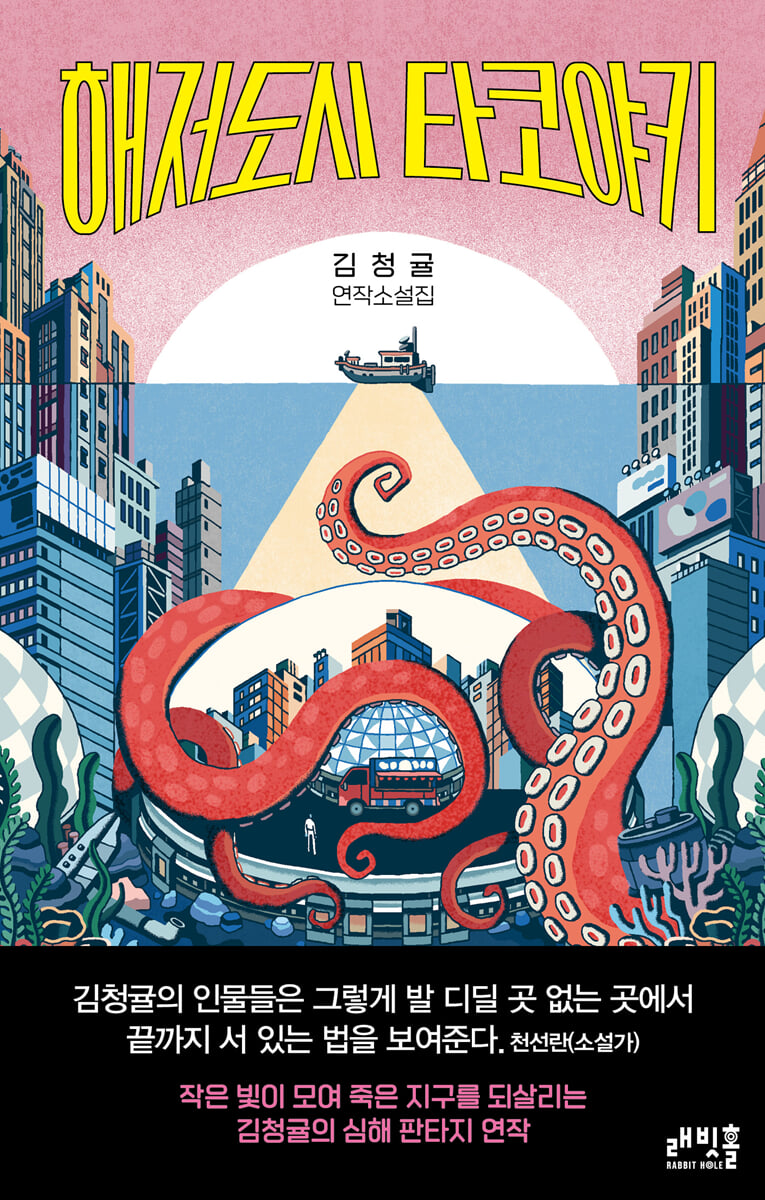
Takoyaki in the Underwater City
 |
Description
Book Introduction
- A word from MD
-
Even if the Earth is destroyed, we still have love.Kim Cheong-gyul, author of "Ashes and Bubbles," has returned with a climate novel (Cli-fi).
The Earth in the novel is a dystopia in itself, with glaciers melting and covered by ocean due to climate change.
It clearly portrays characters who remain united even on the brink of the apocalypse.
This series of novels by Kim Cheong-gyul will bring us sacrifice, love, and courage.
March 28, 2023. Novel/Poetry PD Kim Yu-ri
A deep-sea fantasy series where small lights come together to revive a dead Earth.
Ashes and Bubbles, Kim Cheong-gyul's new short story collection
Kim Cheong-gyul's characters show how to stand until the end in a place where there is no place to stand.
- Cheon Seon-ran (novelist)
Kim Cheong-gyul, who brought a fresh shock to the Korean fantasy novel scene with "Ashes and Bubbles" two years ago, has now compiled a series of six stories about humanity going underwater to survive on a planet where all land is covered by sea due to climate change.
Here is your chance to imagine a better tomorrow for Earth as you experience the rainbow-colored love shared by characters across the ocean.
Starting with “Starfish,” which tells the story of a family and lovers struggling to protect their loved ones from an infectious disease spreading from a glacier, it moves on to the conflict between humans who live and drift on ships and the new humans who have adapted to the water (“Dance with the Sea,” “Paradise”), the period when they settle in an underwater city and seek survival (“The Delivery Man,” “Takoyaki in the Underwater City”), and the period when the new humans in the water try to restore the Earth (“Coral Tree”).
Ashes and Bubbles, Kim Cheong-gyul's new short story collection
Kim Cheong-gyul's characters show how to stand until the end in a place where there is no place to stand.
- Cheon Seon-ran (novelist)
Kim Cheong-gyul, who brought a fresh shock to the Korean fantasy novel scene with "Ashes and Bubbles" two years ago, has now compiled a series of six stories about humanity going underwater to survive on a planet where all land is covered by sea due to climate change.
Here is your chance to imagine a better tomorrow for Earth as you experience the rainbow-colored love shared by characters across the ocean.
Starting with “Starfish,” which tells the story of a family and lovers struggling to protect their loved ones from an infectious disease spreading from a glacier, it moves on to the conflict between humans who live and drift on ships and the new humans who have adapted to the water (“Dance with the Sea,” “Paradise”), the period when they settle in an underwater city and seek survival (“The Delivery Man,” “Takoyaki in the Underwater City”), and the period when the new humans in the water try to restore the Earth (“Coral Tree”).
- You can preview some of the book's contents.
Preview
index
starfish
Dance with the sea
Paradise
Underwater City Deliveryman
Takoyaki in the Underwater City
coral tree
Commentary | Catastrophe and Fantasy Coloring the Future by Sim Wan-seon
Author's Note
Recommendation
Dance with the sea
Paradise
Underwater City Deliveryman
Takoyaki in the Underwater City
coral tree
Commentary | Catastrophe and Fantasy Coloring the Future by Sim Wan-seon
Author's Note
Recommendation
Detailed image
.jpg)
Into the book
Why was I born? Why was I born? A whale's cry was heard from somewhere.
Unlike my mother's crying, I had no idea what it meant.
It was just mysterious, wonderful, and comforting.
It seemed like it would be okay to go into the sea.
Yeah, can't I go in Mom's place? If I were a whale... or an octopus... .
If you inherited your mother's genes and mutated into something related to the sea...
---From "Bulgasari"
You can't be greedy at sea.
As I recalled those words, I dropped the loose ring from my finger to the floor and wrapped the two necklaces around my wrists.
As I looked down at the things falling down, I turned my gaze and saw the dolphins with disappointed eyes, so I quickly comforted them.
“Thank you all.
But I can't take them all, that's why.
“But I still took two!”
Then, the dolphins started poking and tickling my feet as if to say, "Do you have ankles?" and I burst out laughing.
---From "Dancing with the Sea"
My mother said that humans can't breathe underwater, so if they fall into the water, they'll all die.
Then just let me breathe.
He kissed the child's lips and breathed deeply into his mouth.
His pale face turned red and he seemed to be feeling much better.
Something long and thin swept towards me, approaching me at high speed.
I grabbed the child's arm and swam quickly.
Fortunately, the eddy was small and the current was slow, so I was able to escape easily.
---From "Paradise"
When my sisters returned to the dome after finishing their deliveries, they taught me how to deliver.
The most basic skills, such as how to navigate and learn the terrain, how to find a water current that is easy to swim in, how to create oxygen bubbles that are essential for delivering humans, how to greet dolphins, and how to identify edible seaweed.
My sisters also fed me a little bit of seaweed that was mildly poisonous.
It would be best if such a situation did not exist, but it is possible to survive when there is nothing to eat but poisonous plants, or when a predator appears and you have to hide among the poisonous plants for a long time.
---From "The Underwater City Deliveryman"
I found myself humming along to the sound of the bells without realizing it.
Lalala.
There were no lyrics, but it was a song.
He spun around, waved his hands up and down, and jumped around.
It was a garment with only holes for the head and arms to stick out of the sack, so my movements were limited, but it couldn't stop me.
I danced to the beat and the song.
The boss stopped grilling the takoyaki and was shaking the bell to match my movements.
The takoyaki was charred black and smoking, and it felt like a special effect for me, so I burst out laughing.
---From "Takoyaki in the Underwater City"
As I was wandering around, I came across a place where a huge metal doll was mixed in with the rocks and covered in shining moss.
And the star model that was buried in between.
Even the stars, too big to hold in one's arms, twinkled yellow thanks to the moss.
I've never actually seen a star, but if I had, wouldn't it look like this? This star was definitely going to be at the top of this Christmas tree.
Unlike my mother's crying, I had no idea what it meant.
It was just mysterious, wonderful, and comforting.
It seemed like it would be okay to go into the sea.
Yeah, can't I go in Mom's place? If I were a whale... or an octopus... .
If you inherited your mother's genes and mutated into something related to the sea...
---From "Bulgasari"
You can't be greedy at sea.
As I recalled those words, I dropped the loose ring from my finger to the floor and wrapped the two necklaces around my wrists.
As I looked down at the things falling down, I turned my gaze and saw the dolphins with disappointed eyes, so I quickly comforted them.
“Thank you all.
But I can't take them all, that's why.
“But I still took two!”
Then, the dolphins started poking and tickling my feet as if to say, "Do you have ankles?" and I burst out laughing.
---From "Dancing with the Sea"
My mother said that humans can't breathe underwater, so if they fall into the water, they'll all die.
Then just let me breathe.
He kissed the child's lips and breathed deeply into his mouth.
His pale face turned red and he seemed to be feeling much better.
Something long and thin swept towards me, approaching me at high speed.
I grabbed the child's arm and swam quickly.
Fortunately, the eddy was small and the current was slow, so I was able to escape easily.
---From "Paradise"
When my sisters returned to the dome after finishing their deliveries, they taught me how to deliver.
The most basic skills, such as how to navigate and learn the terrain, how to find a water current that is easy to swim in, how to create oxygen bubbles that are essential for delivering humans, how to greet dolphins, and how to identify edible seaweed.
My sisters also fed me a little bit of seaweed that was mildly poisonous.
It would be best if such a situation did not exist, but it is possible to survive when there is nothing to eat but poisonous plants, or when a predator appears and you have to hide among the poisonous plants for a long time.
---From "The Underwater City Deliveryman"
I found myself humming along to the sound of the bells without realizing it.
Lalala.
There were no lyrics, but it was a song.
He spun around, waved his hands up and down, and jumped around.
It was a garment with only holes for the head and arms to stick out of the sack, so my movements were limited, but it couldn't stop me.
I danced to the beat and the song.
The boss stopped grilling the takoyaki and was shaking the bell to match my movements.
The takoyaki was charred black and smoking, and it felt like a special effect for me, so I burst out laughing.
---From "Takoyaki in the Underwater City"
As I was wandering around, I came across a place where a huge metal doll was mixed in with the rocks and covered in shining moss.
And the star model that was buried in between.
Even the stars, too big to hold in one's arms, twinkled yellow thanks to the moss.
I've never actually seen a star, but if I had, wouldn't it look like this? This star was definitely going to be at the top of this Christmas tree.
---From "Coral Tree"
Publisher's Review
“We were running towards destruction and death,
But I still believed there would be more days of laughter.”
A happy ending for dancing and loving beings on a flooded Earth.
Novelist Kim Cheong-gyul, who received much love from readers for injecting a fresh shock into the Korean fantasy novel scene with her 2021 novel 『Ashes and Bubbles』, presents the short story collection 『Underwater City Takoyaki』 as the first book from the influential literature brand 'Rabbit Hole'.
This series of six short stories tells the story of humanity going into the ocean to survive on a planet where glaciers are melting and land is disappearing due to climate change.
This series is set in a future where glaciers have melted, the land has been covered by sea, and even food has become scarce.
It shows people loving and showing camaraderie even among people who are tense and in a state of epidemic.
The short stories are arranged in chronological order. If the first one, “Bulgasari,” presents a time of food shortages and epidemics, the next stage is when humans living on boats and drifting and a new species adapted to the water appear (“Dance with the Sea” and “Paradise”), after which a form of fragmented survival by building an underwater city becomes established (“Underwater City Delivery Man” and “Underwater City Takoyaki”), and finally, it continues to a time when only the new species in the water remain and hope for the world’s recovery (“Coral Tree”).
“We are stealing tomorrow now.”
A story about exploring the fantastic ocean and thinking about the future of the Earth.
Adults were afraid of the sea.
As the Earth gets hotter, large icebergs called glaciers melt in an instant, flooding most of the land without any preparation.
It was said that even the remaining land was eroded away by the tsunami, and the land itself disappeared.
(〈Dance with the Sea〉, p.
65)
Greta Thunberg, the environmental activist who was nominated for the Nobel Peace Prize, said this.
“You say you love your children, but you’re actually stealing their future right now.” For us living in the 21st century, where factories are run for immediate profit and efficiency is the sole pursuit, “environmental issues” and “climate crisis” seem to have become unrealistic words, like a broken alarm.
In "The Underwater City Deliveryman," Bo-reum looks at an abandoned snowball and says this.
“There are so many useless things in the world that all the land must be underwater.” (p.
124)
In Kim Cheong-gyul's novel, humans act like masters of the Earth, editing the genes of animals and building underwater cities.
Even if they have to become desperate for survival, “both the animals exploited by humans and the Earth will ultimately be wronged” (p.
22) the author points out.
Meanwhile, water people appear as a contrast to the selfishness of humans.
They are adapted to marine life, can even breathe underwater, and live in harmony with the ecosystem.
Climate fiction (Cli-fi) is receiving a lot of attention with novels by authors such as Kim Cho-yeop, Cheon Seon-ran, and Dan Yo.
Kim Cheong-gyul's latest novel is expected to be another icon leading the Cli-fi movement of the 2020s, reflecting the desperate concerns about the climate crisis and rising sea levels in Korean fantasy novels.
Beings who sing and dance even in a ruined world
A loving community that gathers the light of the past and moves toward recovery.
I found myself humming along to the sound of the bells without realizing it.
Lalala.
There were no lyrics, but it was a song.
He spun around, waved his hands up and down, and jumped around.
It was a garment with only holes for the head and arms to stick out of the sack, so my movements were limited, but it couldn't stop me.
I danced to the beat and the song.
The boss stopped grilling the takoyaki and was shaking the bell to match my movements.
The takoyaki was charred black and smoking, and it felt like a special effect for me, so I burst out laughing.
(〈Underwater City Takoyaki〉, p.
198)
Kim Cheong-gyul is a writer who has focused on beautiful people who, despite being in a socially vulnerable position, are able to confidently express themselves and live life to the fullest.
Following the previous work, this collection of short stories is filled with the earnest love of those who live in this day and age on the brink of destruction and seek to protect one another, painting the stories in a warm rainbow of colors.
These six novels all break through the rigid world of normalcy and portray colorful relationships.
It shows the deep love exchanged in relationships that are difficult to define in familiar terms, such as two mothers who are willing to sacrifice themselves to give birth to their daughter and help her recover from her illness (〈Bulgasari〉), delivery girls who truly care for Boreum unlike their blood family who only try to use them (〈Deliveryman to the Underwater City〉), and girls who choose to become bubbles to save each other while enduring brutal violence (〈Paradise〉).
So, even if the ending of each novel is superficially the disappearance or death of the characters, the impression left in our hearts as we close the book will definitely be that of a 'happy ending.'
The author neither stops at critically depicting the disasters brought about by material abundance nor falls into hopeless optimism.
Even in a world where all hope has vanished, it is said that a faint glimmer of hope can be fostered through characters who sing, dance, ponder a worthwhile day, and find the courage to love.
They appear fragile, but possess a strength and will stronger than anyone else's, and they ultimately open up a restored Earth and new possibilities, and paint the entire world in a bright “yellow” (p.
250) is.
"Underwater City Takoyaki" is a collection of short stories that conveys the belief that even though today seems to be rushing toward destruction as if it has lost its brakes, we will gain the courage to imagine a slightly better tomorrow for you, the one I love most.
But I still believed there would be more days of laughter.”
A happy ending for dancing and loving beings on a flooded Earth.
Novelist Kim Cheong-gyul, who received much love from readers for injecting a fresh shock into the Korean fantasy novel scene with her 2021 novel 『Ashes and Bubbles』, presents the short story collection 『Underwater City Takoyaki』 as the first book from the influential literature brand 'Rabbit Hole'.
This series of six short stories tells the story of humanity going into the ocean to survive on a planet where glaciers are melting and land is disappearing due to climate change.
This series is set in a future where glaciers have melted, the land has been covered by sea, and even food has become scarce.
It shows people loving and showing camaraderie even among people who are tense and in a state of epidemic.
The short stories are arranged in chronological order. If the first one, “Bulgasari,” presents a time of food shortages and epidemics, the next stage is when humans living on boats and drifting and a new species adapted to the water appear (“Dance with the Sea” and “Paradise”), after which a form of fragmented survival by building an underwater city becomes established (“Underwater City Delivery Man” and “Underwater City Takoyaki”), and finally, it continues to a time when only the new species in the water remain and hope for the world’s recovery (“Coral Tree”).
“We are stealing tomorrow now.”
A story about exploring the fantastic ocean and thinking about the future of the Earth.
Adults were afraid of the sea.
As the Earth gets hotter, large icebergs called glaciers melt in an instant, flooding most of the land without any preparation.
It was said that even the remaining land was eroded away by the tsunami, and the land itself disappeared.
(〈Dance with the Sea〉, p.
65)
Greta Thunberg, the environmental activist who was nominated for the Nobel Peace Prize, said this.
“You say you love your children, but you’re actually stealing their future right now.” For us living in the 21st century, where factories are run for immediate profit and efficiency is the sole pursuit, “environmental issues” and “climate crisis” seem to have become unrealistic words, like a broken alarm.
In "The Underwater City Deliveryman," Bo-reum looks at an abandoned snowball and says this.
“There are so many useless things in the world that all the land must be underwater.” (p.
124)
In Kim Cheong-gyul's novel, humans act like masters of the Earth, editing the genes of animals and building underwater cities.
Even if they have to become desperate for survival, “both the animals exploited by humans and the Earth will ultimately be wronged” (p.
22) the author points out.
Meanwhile, water people appear as a contrast to the selfishness of humans.
They are adapted to marine life, can even breathe underwater, and live in harmony with the ecosystem.
Climate fiction (Cli-fi) is receiving a lot of attention with novels by authors such as Kim Cho-yeop, Cheon Seon-ran, and Dan Yo.
Kim Cheong-gyul's latest novel is expected to be another icon leading the Cli-fi movement of the 2020s, reflecting the desperate concerns about the climate crisis and rising sea levels in Korean fantasy novels.
Beings who sing and dance even in a ruined world
A loving community that gathers the light of the past and moves toward recovery.
I found myself humming along to the sound of the bells without realizing it.
Lalala.
There were no lyrics, but it was a song.
He spun around, waved his hands up and down, and jumped around.
It was a garment with only holes for the head and arms to stick out of the sack, so my movements were limited, but it couldn't stop me.
I danced to the beat and the song.
The boss stopped grilling the takoyaki and was shaking the bell to match my movements.
The takoyaki was charred black and smoking, and it felt like a special effect for me, so I burst out laughing.
(〈Underwater City Takoyaki〉, p.
198)
Kim Cheong-gyul is a writer who has focused on beautiful people who, despite being in a socially vulnerable position, are able to confidently express themselves and live life to the fullest.
Following the previous work, this collection of short stories is filled with the earnest love of those who live in this day and age on the brink of destruction and seek to protect one another, painting the stories in a warm rainbow of colors.
These six novels all break through the rigid world of normalcy and portray colorful relationships.
It shows the deep love exchanged in relationships that are difficult to define in familiar terms, such as two mothers who are willing to sacrifice themselves to give birth to their daughter and help her recover from her illness (〈Bulgasari〉), delivery girls who truly care for Boreum unlike their blood family who only try to use them (〈Deliveryman to the Underwater City〉), and girls who choose to become bubbles to save each other while enduring brutal violence (〈Paradise〉).
So, even if the ending of each novel is superficially the disappearance or death of the characters, the impression left in our hearts as we close the book will definitely be that of a 'happy ending.'
The author neither stops at critically depicting the disasters brought about by material abundance nor falls into hopeless optimism.
Even in a world where all hope has vanished, it is said that a faint glimmer of hope can be fostered through characters who sing, dance, ponder a worthwhile day, and find the courage to love.
They appear fragile, but possess a strength and will stronger than anyone else's, and they ultimately open up a restored Earth and new possibilities, and paint the entire world in a bright “yellow” (p.
250) is.
"Underwater City Takoyaki" is a collection of short stories that conveys the belief that even though today seems to be rushing toward destruction as if it has lost its brakes, we will gain the courage to imagine a slightly better tomorrow for you, the one I love most.
GOODS SPECIFICS
- Date of issue: March 27, 2023
- Page count, weight, size: 272 pages | 278g | 120*188*20mm
- ISBN13: 9791168340930
- ISBN10: 1168340934
You may also like
카테고리
korean


korean

![GQ KOREA Mark (Monthly): December [2025]](http://librairie.coreenne.fr/cdn/shop/files/8ef265dbbfbf186523ed75ba7319009d.jpg?v=1765340328&width=3840)


